• 検索結果がありません。

東北医科薬科大学 審査学位論文(博士)

N/A
N/A
Protected

Academic year: 2021

シェア "東北医科薬科大学 審査学位論文(博士)"

Copied!
42
0
0

読み込み中.... (全文を見る)

全文

(1)

東北医科薬科大学 審査学位論文(博士)

氏名(本籍)

陸 需(中国)

学位の種類 博士(薬科学)

学位記番号 博薬科第

19

学位授与の日付 平成

31

3

8

学位授与の要件 学位規則第4条1項該当

学位論文題名

Functional analysis of core fucosylation in neuroinflammation

論文審査委員

主査 授 東 副査 授 丹 野 孝 副査 授 顧

(2)

Functional analysis of core fucosylation in neuroinflammation

東北医科薬科大学大学院薬学研究科

陸 需

平成 31 年 3 月

(3)

Functional analysis of core fucosylation in

neuroinflammation

(4)

CONTENTS

INTRODUCTION... 1

MATERIALS AND METHODS ... 4

RESULTS ... 10

DISCUSSION ... 23

REFERENCES ... 28

ABBREVIATIONS ... 37

ACKNOWLEDGMENTS ... 38

(5)

1

1. Introduction

α1,6-Fucosyltransferase (Fut8) transfers a fucose residue from GDP-fucose to the innermost N-acetylglucosamine (GlcNAc) residue

via α1,6-linkage to form α1,6-fucosylation (1), which is referred to as core fucosylation in mammals (2, 3) (Fig.1). In fact, N-glycans with core fucosylation are widely distributed in a variety of glycoproteins, and then regulate functions in different manners. Accumulating data suggests that Fut8 and its products play important roles in various physiological and pathological processes, such as tumor formation (4, 5), inflammation and immune response (6-9), and central nervous system (CNS) diseases (10, 11).

Fut8-deficient (Fut8 -/- ) mice exhibit a schizophrenia-like phenotype with a decrease in working memory (10) and long-term potentiation (12). Very recently, a complete loss of core fucosylation in patients was reported (13). Those patients showed growth retardation, severe developmental and growth delays and also including neurological impairment, which was quite similar to that seen in the phenotypes of Fut8 -/- mice (10, 14). These data suggested core fucosylation plays important roles in the CNS. To explore the underlying mechanisms, we generated a Fut8 conditional knockout mouse using tamoxifen-inducible synapsin promoter-driven Cre recombinase. Surprisingly, the neuron-specific Fut8 conditional knockout mice did not show these phenotypes (unpublished data), suggesting there may be other cell types in the CNS that contribute to the schizophrenia-like behavior induced by the lack of core fucosylation.

The pathophysiology of schizophrenia has not yet been fully elucidated. Studies

involving in vivo imaging suggest that neuroinflammation may contribute to the

Fig. 1 Biosynthesis of core fucose

(6)

2

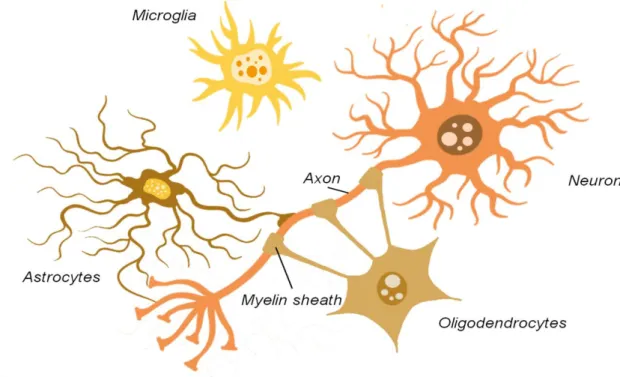
pathogenesis of schizophrenia, which could be due to a dysfunction in glial cells (15, 16). In the CNS, glial cells are made up mostly of microglia, astrocytes, and oligodendrocytes (Fig. 2). For several decades, many researchers believed that glial cells outnumbered neurons at a ratio of 10:1 (17), but recently researchers used isotropic fractionators to demonstrate that the ratio of glial cells to neurons is actually about 1:1 (18). Anyway, glial cells are known to play crucial roles in neuronal functions (19, 20).

As the only resident macrophage-like cells in the CNS, microglia are the pre-eminent form of active immune defense (21), even though they only account for 10-15% of all glial cells (22). In addition to their surveillance role, microglia participates in maintaining synapses and homeostasis in the CNS (23, 24). Astrocytes are the most abundant glial type, and make up ~20-40% (25). They provide trophic support for neurons (26), and also participate in the maintenance of synapses and in the process of neuroinflammation (27, 28). Oligodendrocytes coat axons in the CNS and produce the myelin sheath, which provides insulation to the axon that allows electrical signals to propagate more efficiently (29).

Fig. 2 Main composition of glial cells in CNS

(7)

3

Microglial cells play a key role in neuroinflammation. After activation, microglia quickly release several pro-inflammatory mediators such as interleukin-1β (IL-1β), interleukin-6 (IL-6), and interferon gamma (IFN-γ), and induce reactive astrocytes, which leads to the further injury of neurons (28). In fact, postmortem studies have discovered a higher level of activation and increased microglia density in schizophrenia (30). Gene-set analyses have also shown that genetic alterations of astrocytes could increase the risk for schizophrenia (31). These results suggest the potential role of microglia and astrocytes in this disorder.

Recently, several studies have also demonstrated that N-glycosylation might play important roles in schizophrenia. Postmortem examinations of the cortex of schizophrenia patients have shown alterations in the N-glycosylation of α-amino-3-hydroxy-5-methyl-4-isoxazolepropionate receptor (AMPAR), N-methyl-D-aspartate receptor (NMDAR) and γ-aminobutyric acid type A (GABA A ) receptors (32-34). Furthermore, in the superior temporal gyrus of elderly patients with schizophrenia, the expression levels of Fut8 were decreased (35).

The present study was focused on glial cells to explore the underlying mechanisms of

the disorders found in the brains of Fut8 -/- mice. We found that the initial status of

microglia and astrocytes activation and the neuroinflammation model induced by

lipopolysaccharide (LPS) both were significantly enhanced in Fut8 -/- mice, compared

with wild-type (Fut8 +/+ ) mice. In accordance with the in vivo data, the sensitivities to

inflammatory stimulators such as IFN-γ or IL-6 were greatly increased in glial cell lines

lacking Fut8 (Fut8 KO cells) or primary astrocyte cells treated with 2-fluoro-L-fucose

(2FF) (36-38), a fluorinated analog of fucose, which could dramatically inhibit

fucosylation in cells, compared with those in wild-type (WT) cells. Along with previous

results (10-12), these data clearly demonstrate the importance of Fut8 in microglia and

astrocytes, and the disorders of Fut8 -/- mice are caused not only by neurons but also by

glial cell dysfunction.

(8)

4

2. Materials and methods

2.1. Materials

The experiments were performed using the following antibodies: mouse mAb against inducible nitric oxide synthase (iNOS) (ab49999) and goat pAb against ionized calcium binding adaptor molecule 1 (Iba-1) (ab5076) were purchased from Abcam; rabbit pAb against Iba-1 (019-19741) was from Wako, Japan; mouse mAb against glial fibrillary acidic protein (GFAP) (MAB360) was from Millipore Corporation; mouse mAb against signal transducer and activator of transcription 3 (STAT3) (9139S), rabbit mAb against p-STAT3 Tyr705 (9145S), mouse mAb against Smad2 (3103S), rabbit mAb against p-Smad2 Ser465/467 (3108S), rabbit mAb against signal transducer and activator of transcription 1 (STAT1) (14994S), and rabbit mAb against p-STAT1 Tyr701 (9167S) were purchased from Cell Signaling Technology; mouse mAb against gp130 (MAB5029) was from R&D Systems; mouse mAb against α-tubulin (T6199) was from Sigma and rabbit pAb against glyceraldehyde-3-phosphate dehydrogenase (GAPDH) (sc-25778) was from Santa Cruz.

Biotinylated Aleuria Aurantia Lectin (AAL), concanavalin A (ConA), sambucus nigra lectin (SNA) and maackia amurensis lectin (MAA) were obtained from J-oil Mills (Tokyo, Japan). Biotinylated Pholiota Squarrosa Lectin (PhoSL) was a generous gift from Dr. Yuka Kobayashi (J-oil Mills, Tokyo, Japan).

The peroxidase-conjugated goat against mouse and rabbit IgG antibodies, and donkey against sheep/goat IgG antibody were obtained from Promega, Cell Signaling Technology and Millipore Corporation, respectively. Goat anti-mouse IgG Alexa Fluor 568, goat anti-rabbit IgG Alexa Fluor 488, streptavidin-conjugate Alexa Fluor 647 were purchased from Invitrogen. 4',6-Diamidino-2-phenylindole Dihydrochloride n-Hydrate (DAPI) was obtained from Wako, Japan.

LPS purified from Escherichia coli 0111:B4 was the product of Sigma, recombinant

mouse IFN-γ was purchased from Prospec Bio, recombinant rat IL-6 was purchased

(9)

5

from PEPROTECH, and 2FF was purchased from Synchem, Inc., IL, USA.

2.2. Animals

The generation of Fut8 -/- mice by a gene-targeting technique has been described previously (10). ICR genetic background F1 heterozygous mice were mated with JF1/Ms (Japanese fancy mouse 1, M. m. molossinus–derived inbred strains) (39) mice to produce F2 generation mice, and the F2 generation mice were paired with other F2 generation mice to generate the Fut8 -/- mice. All experiments were conducted with male and female mice 5~6 weeks old. Mice were housed in groups in each cage under conditions of constant temperature (22 ± 2°C) and humidity (55 ± 5%) on a 12-h light-dark cycle (lights on: 07:00 - 19:00) with free access to food and water. All animal experiments were performed in accordance with protocols approved by the Animal Care and Use Committee of the Graduate School of Pharmaceutical Sciences, Tohoku Medical and Pharmaceutical University.

2.3. Cell culture

Mouse microglia cell line BV-2 was kindly provided by Professor Elisabetta Blasi (University of Modena and Reggio Emilia, Modena, Italy). Rat glioma cell line C6 was purchased from American Type Culture Collection (Rockville, MD, USA). Cells were cultured in Dulbecco’s modified Eagle Medium (DMEM) containing 10% fetal bovine serum (FBS) and incubated at 37 °C in a humidified atmosphere with 5% CO 2 . The medium was replaced every 3 days.

Mouse primary cells from brain tissues were prepared as previously reported with some

modifications (40). Briefly, newborn (day 0-1) ICR Fut8 +/+ mice were euthanized by

decapitation using scissors, the cortex was removed, and cut into pieces on ice, and then

digested with 0.125% trypsin for 20 min at 37 °C. A 100 μm Nylon (Falcon) cell

strainer was used to filter the undigested tissue. This procedure was followed by

centrifugation at 300 g for 5 min, and then the cells were re-suspended and plated on

(10)

6

poly-D-lysine (PDL, 50 μg/mL)-coated culture flasks. Single-cell suspensions were cultured in DMEM/F12 supplemented with 10% FBS and 1% penicillin-streptomycin (100 U/mL). The medium was replaced with fresh medium after 24 h and changed every 3 days. In order to isolate the primary microglia, after 14 days, the mixed cells were shaken gently at 180 rpm for 2 h at 37 °C, and then the supernatants containing microglia were collected and plated on the new PDL-coated culture dishes. The remaining cells were washed with phosphate buffered saline (PBS), and then detached with 0.25% trypsin to obtain the primary astrocytes. After centrifuge, the primary astrocytes were also cultured in PDL-coated culture dishes. All cells were maintained in a 37 °C incubator containing 95% air and 5% CO 2 . Immunofluorescent staining with Iba-1 and GFAP antibodies was used to differentiate the microglia and astrocytes. The purity of both the microglia and astrocytes was more than 90%.

2.4. Immunofluorescence

After intraperitoneal injection with LPS (1 mg/kg) for 24 h, animals were deeply anesthetized with sodium pentobarbital and intracardially perfused with 50 ml of PBS, followed by 50 ml of 4% paraformaldehyde (PFA; Sigma-Aldrich) in 0.1 M PBS.

Brains were post-fixed in 4% PFA-0.1 M PBS at 4 °C overnight, followed by

immersion in 20% sucrose-0.1 M PBS for 48 h. The brains were cut into 40 μm sections

that included the dorsal dentate gyrus from bregma -1.60 mm to -2.60 mm using a

cryostat (MICROM HM560, Microm International GmbH, Walldorf, Germany). Frozen

sections were mounted on glass slides (Matsunami Glass, Japan). The sections were

incubated with PBS containing 1% normal goat serum and 0.3% Triton X-100 (PBSGT)

at room temperature for 2 h. The sections were incubated overnight at 4 °C with rabbit

anti-Iba1 (1:200) and mouse anti-GFAP (1:200) antibodies. Sections were washed 3

times with PBS every 10 min, then incubated with goat anti-mouse IgG Alexa Fluor 568

(1:500) and goat anti-rabbit IgG Alexa Fluor 488 (1:500) in PBSGT for 2 h at room

temperature. Finally, sections were washed 3 times with PBS every 10 min and

(11)

7

coverslipped with fluorescent mounting medium (Dako, Carpinteria, CA, USA).

Immunofluorescent images were analyzed using a confocal laser-scanning microscope (A1Rsi: Nikon, Tokyo, Japan). The number of Iba-1 positive cells in the images (0.04 cm 2 ) and the length of each soma radius were measured using NIS-Elements AR Analysis (Nikon, Tokyo, Japan), the area of superficial somas was then calculated by following the equation (4πR 2 ).

2.5. Generation of CRISPR/Cas9-based Fut8- KO Cells

The CRISPR/Cas9-based Fut8-KO cells were established, as described previously (41).

Briefly, the sgRNA-specifying oligo sequences (sequences one:

5’-CACCGCAGAATTGGCGCTATGCTAC-3’ and

5’-AAACGTAGCATAGCGCCAATTCTGC-3’; sequences two:

5’-CACCGATTCGTCCACAACCTTGGC-3’ and

5’-AAACGCCAAGGTTGTGGACGAATC-3’) spanning Mus musculus

fucosyltransferase 8 (NM_001252614) and the sgRNA-specifying oligo sequences

(sequences one: 5’-CACCGGAGATAAGTTATTCTCCGC-3’ and

5’-AAACGCGGAGAATAACTTATCTCC-3’; sequences two:

5’-CACCGATTTGATTCGTCCACAACCT-3’ and

5’-AAACAGGTTGTGGACGAATCAAATC-3’) spanning rattus norvegicus fucosyltransferase 8 (NM_001002289.1) were cloned into the pSpCas9 (BB)-2A-GFP (Addgene plasmid ID: 48138) vector (41), which was a kind gift from Dr. Feng Zhang.

The plasmid was electroincorporated into the BV-2 and C6 cells according to the manufacturer’s instructions (Amaxa® cell line Nucleofector R kit V). After 72 h of transfection, GFP-positive cells were sorted using the FACS Aria II (BD Bioscience).

Cells that were Fut8 positive and GFP negative were sorted approximately three times

using PhoSL during the following 3-week culture. The Fut8-KO cells were confirmed

by flow cytometric and lectin blotting analyses, as described in the following section.

(12)

8

2.6. Flow cytometric analysis

Cells were grown to ~80% confluency, then detached from culture dishes, washed with ice-cold PBS, and subsequently stained with biotinylated PhoSL for 1 h on ice, followed by incubation with streptavidin-conjugate Alexa Fluor 647 for 1 h on ice in the dark. A negative control was prepared only with streptavidin-conjugate Alexa Fluor 647. During incubation, the cells were gently mixed every 10 min by flicking. Finally, cells were washed 3 times with ice-cold PBS and analyzed via FACSCalibur flow cytometer (BD Biosciences).

2.7. Western blot and lectin blot analyses

The mice were euthanized by decapitation after 24 h of LPS (1 mg/kg) administration.

Brain hippocampi were rapidly removed, placed on ice, and then homogenized in 4 volumes of TBS (20 mM Tris-HCl, pH 7.4, 150 mM NaCl, 1% protease) with φ2.0 Zirconia Beads by Micro Smash MS-100 (Digital Biology), according to the manufacturer’s instructions. After centrifugation at 8,000 rpm for 15 min, the supernatants were collected and used for analysis.

Cells cultured under different conditions were washed with PBS and lysed with lysis buffer that contained 20 mM Tris-HCl (pH 7.4), 150 mM NaCl, 1% Triton-X100, and 1%

protease and phosphatase inhibitor cocktail (Nacalai Tesque, Japan). Protein concentrations were measured using a bicinchoninic acid protein assay kit (Thermo Fisher Scientific, Wilmington, DE, USA).

Equal amounts of proteins were separated by sodium dodecyl sulfate–polyacrylamide gel electrophoresis (SDS-PAGE) and then transferred to PVDF (Millipore, Billerica, MA, USA) membranes for future detection. For Western blot, after blocking with 5%

skim milk or 3% bovine serum albumin (BSA) for 2 h at room temperature, the

membranes were incubated with specific primary antibodies at 4 °C overnight, followed

by incubation with appropriate horseradish peroxidase (HRP)-conjugated secondary

antibody. For lectin blot, the membranes were blocked in 3% BSA overnight at 4 °C,

(13)

9

followed by incubation with biotinylated AAL, ConA, SNA or MAA lectin for 2 h at room temperature, and then the immunoreactive bands were probed with a Vectastain ABC kit (Vector Laboratories, Burlingame, CA, USA). Finally, specific proteins were visualized using an ECL select TM reagent (Amersham, Piscataway, NJ, USA).

2.8. Video microscope

BV-2 Cells were plated at a density of 1×10 4 in a glass-bottom dish (Asahi Glass, Shizuoka, Japan). After the cells attached over night, the culture media were replaced with fresh media without phenol red but with IFN-γ (20 ng/ml), and then cell motility was monitored for 12 h using Axio Vision (Carl Zeiss, Jena, Germany). Images were acquired using an inverted microscope (AxioObserver.D1; Carl Zeiss) every 10 min with 5% CO 2 at 37 °C in a heated chamber equipped with temperature and CO 2

controllers (Onpu-4 and CO 2 ; AR Brown, Tokyo, Japan) during time-lapse imaging.

Cell migration was evaluated using an AxioVision Tracking module (Carl Zeiss).

2.9. Immunoprecipitation

After being washed with PBS, cells were treated with lysis buffer, as previously described. Anti-gp130 antibody and Ab-Capcher Protein A-R28 agarose (Protenova, Tokushima, Japan) were first mixed together for 1 h on ice, and then gently mixed again every 10 min. The cell lysates were then immunoprecipitated with the antibody-agarose solution for 1 h at 4 °C with rotation. The immunoprecipitates were then washed twice with TBS and subjected to SDS-PAGE.

2.10. Statistical analysis

Results are reported as the means ± S.E.M. Statistical analyses were performed using an

unpaired Student’s t test with Welch’s correction or a one-way analysis of variance

(ANOVA) with Tukey’s post hoc test by GraphPad Prism version 5. Statistical

significance was defined as p < 0.05.

(14)

10

3. Results

3.1. The basal status of microglia activation was increased in Fut8 -/- mice

First, we checked the basal status of glial cell activation by detecting Iba-1 and GFAP, which are markers for microglia and astrocytes, respectively, in the hippocampus regions in vivo. The immunochemical staining with anti-Iba-1 antibody clearly showed that the Iba-1-positive cells were significantly increased in Fut8 -/- mice under normal conditions without treatment, compared with that of the Fut8 +/+ mice (Fig. 3A and C).

Interestingly, the number of Iba-1-positive cells in the Fut8 +/- mice fell between those of

both the Fut8 +/+ and Fut8 -/- mice, which may have been due to the lower enzyme activity

of Fut8. Furthermore, the sizes of the microglia, evaluated by the superficial area of the

central soma, in Fut8 -/- mice were larger than those in the Fut8 +/+ mice, while the sizes

in the Fut8 +/- mice fell between those of both the Fut8 +/+ and Fut8 -/- mice (Fig. 3A and

D). These results suggest that the deficiency of Fut8 could have spontaneously

increased the basal level of microglia activation in vivo.

(15)

11

Figure 3. Effects of core fucosylation on the activation of glial cells in mice brain tissues. Brain sections of mice were prepared and analyzed, as described in

“Experimental procedures”. (A) The representative microscopy images immunostained with anti-Iba1 (green) antibodies, anti-GFAP (red) antibodies, and DAPI (blue) in the hippocampus of brain tissues of mice under normal conditions; (B) The representative microscopy images after the administration of LPS by intraperitoneal injection (i.p. 1 mg/kg, 24 h). (C) Quantification of Iba-1 positive cells using representative tissue sections stained with anti-Iba1 antibody. Data represent the mean ± S.E.M.; p values were calculated using one-way ANOVA with Tukey’s multiple comparison test. *p <

0.05 vs. Fut8 +/+ mice (n=3, n: number of slices; N=3, N: number of the mice per group).

(D) Quantification of microglia soma size using representative tissue sections stained with anti-Iba1 antibody. Data represent the mean ± S.E.M.; p values were calculated using one-way ANOVA with Tukey’s multiple comparison test. **p < 0.01 vs. Fut8 +/+

mice (n=96, n: number of recordings; N=3, N: number of the mice per group).

(16)

12

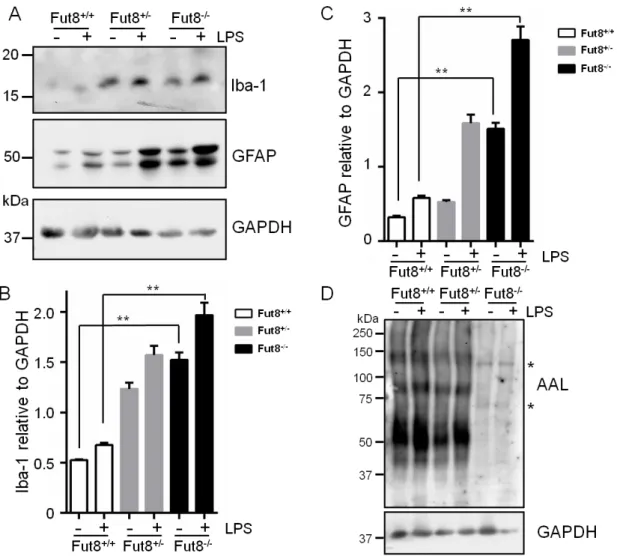
3.2. Microglia and astrocytes of Fut8 -/- showed a greater level of sensitivity to LPS It is well known that neuroinflammation is a common pathological change in many disorders of the CNS such as Alzheimer's disease (42) and Parkinson's disease (43), and that it also could participate in the pathology of schizophrenia (44). Here, we established a systemic inflammatory model induced by a low dose of LPS at 1 mg/kg via intraperitoneal injection, as described in “Experimental procedures”. The immunochemical staining of brain tissues with anti-Iba-1 antibody showed greater increase in microglia activation, which included both numbers and sizes in Fut8 -/- mice, compared with those in Fut8 +/- and Fut8 +/+ mice (Fig. 3B, C and D). Consistent with the immunohistochemical analysis, Western blot analysis has shown that without LPS treatment the basal expression levels of Iba-1 are increased in both Fut8 -/- and Fut8 +/- mice, compared with that in Fut8 +/+ mice (Fig. 4A, B), and the injection of LPS greatly increased the expression levels of Iba-1 in the Fut8 -/- and Fut8 +/- mice, but only modestly increased the levels in Fut8 +/+ mice (Fig. 4A, B). Western blot analysis also showed a significantly increased expression of GFAP in both untreated and LPS-treated Fut8 -/- and Fut8 +/- mice, compared with Fut8 +/+ mice (Fig. 4A, C). These results indicated that Fut8 may negatively regulate microglia and astrocytes responses to extrinsic stimuli during the process of neuroinflammation.

It is worth mentioning that the inflammation induced by LPS increased the expression

of fucosylation. The lectin blotting with AAL, which preferentially recognizes core

fucose (45), showed an increase in both Fut8 +/- and Fut8 +/+ mice brain tissues for 24 h

following an injection of LPS. It is reasonable to speculate that specific reactive bands

simply could not be detected in the Fut8 -/- mice (Fig. 4D).

(17)

13

Figure 4. Effects of LPS on fucosylation, and expression of Iba-1 and GFAP in mice brain tissues. Tissue lysates from mice hippocampi were prepared as described in

“Experimental procedures”. (A) The expression levels of Iba-1 and GFAP were examined by Western blotting with anti-Iba-1 and anti-GFAP antibodies. GAPDH was used as a loading control. (B) Quantitative analysis of Iba-1 protein expression in normal and LPS-stimulated Fut8 +/+ and Fut8 -/- mice. Data represent the mean ± S.E.M;

p values were calculated using unpaired t test with Welch’s correction. **p < 0.01 vs.

Fut8 +/+ mice (n=3). (C) Quantitative analysis of GFAP protein expression in normal and LPS-stimulated Fut8 +/+ and Fut8 -/- mice. Data represent the mean ± S.E.M; p values were calculated using unpaired t test with Welch’s correction. **p < 0.01 vs. Fut8 +/+

mice (n=3). (D) The expression levels of fucosylation were detected by AAL lectin blot.

(18)

14

Asterisks indicate nonspecific bands.

3.3. Neuroinflammation upregulated fucosylation expression in microglia

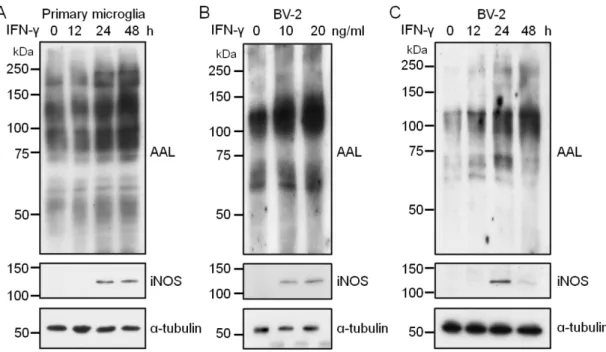
We isolated primary microglial cells from Fut8 +/+ mice brain tissues and stimulated them with a commonly used stimuli for inflammation, IFN-γ (46), which also shows an increased expression in schizophrenia patients (47). The IFN-γ stimulation consistently increased the expression of fucosylation detected by lectin blotting with AAL (Fig. 5A), and induced the expression of iNOS, which is an enzyme responsible for the inflammation-induced production of nitric oxide (NO) (48). To further confirm the effects of neuroinflammation on fucosylation expression in microglia, we used BV-2, a microglial cell line, as a cell model. The reactivity with AAL was also enhanced in a dose- (Fig. 5B) and time-dependent manner (Fig. 5C). The expression of iNOS induced by IFN-γ was observed at a final concentration at 10 ng/ml, and remarkably appeared at 20 ng/ml (Fig. 5B). In addition, iNOS expression reached a peak at 24 h, after which it diminished (Fig. 5C). These data showed that neuroinflammation might upregulate the expression of fucosylation in microglia.

Figure 5. Changes in fucosylation and iNOS expression in primary microglia cells

(19)

15

and in BV-2 cells treated with IFN-γ. (A) Primary microglia cells were prepared as described in “Experimental procedures”, and were then treated with IFN-γ (20 ng/ml) at the indicated times. Equal amounts of cell lysates were detected via AAL lectin blot (upper panel) and anti-iNOS antibody (middle panel). (B) BV-2 cells were treated with IFN-γ for 24 h at the indicated concentrations, and then harvested. The cell lysates were detected via AAL lectin blot (upper panel) and anti-iNOS antibody (middle panel). (C) BV-2 cells were treated with IFN-γ (20 ng/ml) at the indicated times, and then harvested for AAL lectin blot (upper panel) and anti-iNOS antibody (middle panel) testing.

α-tubulin was used as a loading control.

3.4. Established a core fucosylation-deficient BV-2 cell line

To explore the roles of core fucosylation in microglia-mediated neuroinflammation, we

established a core fucosylation-deficient BV-2 cell line using the CRISPR/Cas9 system

described in “Experimental procedures”. The efficiency of Fut8 KO was confirmed by

AAL blot analysis (Fig. 6A) and flow cytometric analysis stained with PhoSL, which

specifically recognizes core fucosylated N-glycans (49) (Fig. 6E). These results clearly

showed that core fucosylation was completely abolished in Fut8 KO cells. The results of

ConA, SNA and MAA lectin blotting showed no significant differences between WT

and KO cells (Fig. 6B, C and D), which suggested that only core fucosylation was

specifically blocked. Here, we chose KO2 cells for the following experiments.

(20)

16

Figure 6. Established the Fut8 KO BV-2 cell line. The Fut8-deficient BV-2 cells were established using the CRISPR/Cas9 system, as described in “Experimental procedures”.

(A) Equal amounts of cell lysates were detected by AAL lectin blot with α-tubulin used as the loading control. Asterisks indicate nonspecific bands. Equal amounts of cell lysates were detected by ConA lectin blot (B), SNA lectin blot (C), and MAA lectin blot (D). (E) The expression level of core fucosylation on the cell surface recognized by PhoSL, was analyzed via flow cytometry.

3.5. Effects of Fut8 on IFN-γ stimulated neuroinflammation in BV-2 cells

To explore the roles of core fucosylation in IFN-γ stimulated neuroinflammation, we detected the IFN-γ-stimulated signaling pathways in BV-2 WT and KO cells. Western blot assay revealed that IFN-γ induced iNOS expression with a dose-dependent manner in both the WT and KO cells. However, the induction of iNOS expression by IFN-γ at doses of both 10 ng/ml and 20 ng/ml was much higher in the KO cells, compared with that in WT cells (Fig. 7A, B). The time-course effects of IFN-γ at 20 ng/ml also clearly showed that the iNOS expression levels were higher in the KO cells, compared with those in WT cells (Fig. 7C, D). In addition, we used time-lapse microscopy to detect cell motility, which is known to indicate the activation of microglia after inflammatory stimulation. We found that those cells did not move under normal culture condition, while after IFN-γ stimulation, the cell motility was significantly increased in the KO cells (Fig. 7E).

Consistently, the IFN-γ-induced phosphorylation levels of STAT1 in the KO cells were

slightly higher than those in the WT cells (Fig. 7F, G). While examining the

involvement of crosstalk between IFN-γ- and transforming growth factor β

(TGF-β)-mediated signaling, a common anti-inflammatory cytokine (50, 51), we

detected phosphorylation levels of Smad2, which is a specific TGF-β downstream

signaling molecule. As shown in Fig. 7H and I, the expression of p-Smad2 was detected

under stimulation with IFN-γ at 12 and 24 h in the WT cells, while it was undetectable

(21)

17

in the KO cells. These data indicated that a deficiency in Fut8 could increase the sensitivity of microglia to inflammatory stimulators and increase the inflammatory reaction while decrease the anti-inflammatory reaction.

Figure 7. Effects of core fucosylation on cellular signaling and cell motility in BV-2

cells treated with IFN-γ. (A) After cells were stimulated with IFN-γ at the indicated

doses for 24 h, the expression levels of iNOS in both WT and KO cells were examined

by Western blotting with anti-iNOS antibody. (B) Quantitative analysis of iNOS protein

expression in IFN-γ-stimulated WT and KO cells. Data represent the mean ± S.E.M; p

values were calculated using unpaired t test with Welch’s correction. *p < 0.05 vs. WT

cells (n=3). (C) After cells were stimulated with IFN-γ at 20 ng/ml for the indicated

time, the expression levels of iNOS in both WT and KO cells were examined by

Western blotting with anti-iNOS antibody. (D) Quantitative analysis of iNOS protein

expression in IFN-γ-stimulated WT and KO cells. Data represent the mean ± S.E.M; p

(22)

18

values were calculated using unpaired t test with Welch’s correction. *p < 0.05 vs. WT cells (n=3). (E) Cell motility of BV-2 cells was examined via video microscope, as described in “Experimental procedures”. The cell moving distances of both WT and KO cells were recorded during the stimulation with IFN-γ (20 ng/ml) for 12 h. Data represent the mean ± S.E.M; p values were calculated using unpaired t test with Welch’s correction. **p < 0.01 vs. WT cells (n=33, n: numbers of recording). (F) After cells were stimulated with IFN-γ (20 ng/ml) at the indicated times, the expression levels of phosphorylation for STAT1, a downstream signaling of IFN-γ, in both WT and KO cells were examined by Western blotting with anti-phospho-STAT1 antibody. Total STAT1 was used as a loading control. (G) Quantitative analysis of p-STAT1 protein expression in IFN-γ-stimulated WT and KO cells. Data represent the mean ± S.E.M; p values were calculated using unpaired t test with Welch’s correction. *p < 0.05 vs. WT cells (n=3).

(H) After cells were stimulated with IFN-γ (20 ng/ml) at indicated times, the expression levels of the phosphorylation of Smad2, a specific signaling of TGF-β, were examined by Western blotting in both WT and KO cells with anti-phospho-Smad2 antibody. Total Smad2 was used as a loading control. (I) Quantitative analysis of p-Smad2 protein expression in IFN-γ-stimulated WT and KO cells. Data represent the mean ± S.E.M; p values were calculated using unpaired t test with Welch’s correction. **p < 0.01 vs. WT cells (n=3).

3.6. Effects of Fut8 expression on cellular signaling in primary astrocytes

It is well known that astrocytes also participate in neuroinflammation (52). Thus, we isolated the primary astrocytes from the Fut8 +/+ mice brain tissues, and treated them with or without 2FF. After treatment for 3 days, the inhibitory effects of 2FF were observed at a final concentration at 30 μM, and remarkably appeared at 100 μM (Fig.

8A). IL-6 is an important inflammatory cytokine in schizophrenia (47), and the

responses which it stimulates were compared between the cells. As shown in Fig. 8B

and C, IL-6-mediated phosphorylation levels of STAT3 were higher in the

(23)

19

2FF-pretreated cells, compared with those in the control cells.

Figure 8. Effects of 2FF on fucosylation and cellular signaling in primary astrocytes. (A) Primary astrocytes were prepared as described in “Experimental procedures”, and were cultured with 2FF, an inhibitor of fucosylation, for 3 days at the indicated concentrations. Equal amounts of cell lysates were detected by AAL lectin blot. α-Tubulin was used as a loading control. Asterisks indicate the nonspecific bands.

(B) The primary astrocytes were pretreated with or without 2FF at 30 μM for 3 days, and then were further stimulated with or without IL-6 (10 ng/ml) at the indicated times.

The expression levels of phosphorylated STAT3 in those cells were examined by

Western blotting with anti-phospho-STAT3 antibody. Total STAT3 was used as a

loading control. (C) Quantitative analysis of the effects of 2FF on p-STAT3 protein

expression in IL-6-stimulated primary cells. Data represent the mean ± S.E.M; p values

were calculated using unpaired t test with Welch’s correction. **p < 0.01 vs. control

cells (n=3).

(24)

20

3.7. Effects of Fut8 expression on cellular signaling in C6 cell line

To further explore the effect of Fut8 in astrocytes during neuroinflammation, we used glioma C6 cells as an astrocyte cell model. We established the Fut8-KO cells via the CRISPR/Cas9 system, which was confirmed by AAL lectin blotting (Fig. 9A) and flow cytometric analysis (Fig. 9B). We chose the KO2 cells for further experiments.

Consistent with data obtained from primary astrocytes (Fig. 8), the responses stimulated by IL-6 in KO cells were sharper and stronger than those in the WT (Fig. 9C, D). When considering the core fucosylation influence on the functions of glycoproteins expressed on the cell surface, we attempted to detect whether these receptors were modified by core fucosylation. We found that glycoprotein 130 (gp130), one subunit of IL-6 receptor, contained core fucosylation as detected by AAL lectin in the WT cells, and the reactivity with AAL was abolished in the KO cells (Fig. 9E).

Figure 9: Effects of core fucosylation on cellular signaling in C6 cells. Establishment of the Fut8 KO C6 cells was performed via a CRISPR/Cas9 system, as described in

“Experimental procedures”. (A) Equal amounts of cell lysates were detected by AAL

lectin blot. (B) The expression level of core fucosylation recognized by PhoSL on the

(25)

21

cell surfaces was subjected to flow cytometric analysis. (C) The expression levels of phosphorylated STAT3 in both WT and KO cells treated with or without IL-6 (10 ng/ml) stimulation at indicated times, were examined by Western blotting with anti-phospho-STAT3 antibody. Total STAT3 was used as a loading control. (D) Quantitative analysis of p-STAT3 protein expression in IL-6-stimulated C6 WT and KO cells. Data represent the mean ± S.E.M; p values were calculated using unpaired t test with Welch’s correction. *p < 0.05 vs. WT cells (n=3). (E) Equal amounts of cell lysates were immunoprecipitated (IP) with anti-gp130 antibody, which was followed by AAL lectin blot (upper panel). Whole cell lysates were directly blotted with anti-gp130 (as an input, middle panel) and α-tubulin (as a loading control, lower panel) antibodies.

3.8. Effects of Fut8 on IL-6 stimulated BV-2 cells and IFN-γ stimulated C6 cells To further confirm the effect of core fucosylation on microglia and astrocytes, we examine the signaling pathways of IL-6 induced STAT3 signaling pathway in BV-2 cells and IFN-γ induced STAT1 signaling pathway in C6 cells. Consistent with data obtained from C6 cells, the IL-6-induced phosphorylation levels of STAT3 in the BV-2 KO cells were sharper and stronger than those in the WT (Fig. 10A, B). The responses of IFN-γ stimulated in C6 cells were also similar to those in BV-2 cells: the phosphorylation levels of STAT1 in C6 cells were slightly higher than those in WT cells (Fig. 10C, D).

Depends on these data, we believe that glial cells, at least microglia and astrocytes, may

share similar responses to IFN-γ and IL-6.

(26)

22

Figure 10: Effects of core fucosylation on IL-6-STAT3 signaling pathway in BV-2 cells and IFN-γ-STAT1 signaling pathway in C6 cells. (A) After cells were stimulated with IL-6 (10 ng/ml) at the indicated times, the expression levels of phosphorylation for STAT3 in both WT and KO BV-2 cells were examined by Western blotting with anti-phospho-STAT3 antibody. Total STAT3 was used as a loading control. (B) Quantitative analysis of p-STAT3 protein expression in IL-6-stimulated WT and KO BV-2 cells. Data represent the mean ± S.E.M; p values were calculated using unpaired t test with Welch’s correction. *p < 0.05 vs. WT cells (n=3). (C) After cells were stimulated with IFN-γ (20 ng/ml) at the indicated times, the expression levels of phosphorylation for STAT1 in both WT and KO C6 cells were examined by Western blotting with anti-phospho-STAT1 antibody. Total STAT1 was used as a loading control.

(D) Quantitative analysis of p-STAT1 protein expression in IFN-γ-stimulated WT and

KO C6 cells. Data represent the mean ± S.E.M; p values were calculated using unpaired

t test with Welch’s correction. *p < 0.05 vs. WT cells (n=3).

(27)

23

4. Discussion

In the present study, we investigated the potential roles of core fucosylation involved in neuroinflammation, and found that a higher activation of microglia and astrocytes was observed in Fut8 -/- mice, compared with that in Fut8 +/+ mice. The experiments using primary cells and cell models of microglia and astrocytes suggested that suppression of core fucosylation resulted in an increase in sensitivity for pro-inflammatory cytokines such as IFN-γ and IL-6. Furthermore, the results of mouse inflammatory models induced by LPS also showed that the response for LPS was greatly increased in the Fut8 -/- mice, compared with that in Fut8 +/+ mice, although the responses were different from results obtained from mouse embryonic fibroblasts (53), which may be due to different cell types and the existence of blood-brain barrier. It is also worth noting that those responses in the Fut8 +/- mice always occurred on a level that fell between that of Fut8 -/- and Fut8 +/+ mice. These results clearly suggest that core fucosylation negatively regulates the functions of microglia and astrocytes in neuroinflammation.

Neuroinflammation could protect the CNS from harmful stimuli arising from both endogenous and exogenous substances in physiological conditions. However, uncontrolled or persistent neuroinflammation is potentially harmful and can result in cellular damage, which is particularly relevant to neurodegenerative diseases (54).

Microglia cells are the first responders to infection or tissue injury, and often initiate the

inflammatory response. Our data clearly showed that the microglia cells in Fut8 -/- mice

exist in a spontaneously activated state, while those in Fut8 +/+ mice are in a resting state

under normal conditions (Fig. 3), which suggests the occurrence of persistent

neuroinflammation in the Fut8 -/- mice. Further in vitro experiments have shown that a

lack of core fucosylation could increase the response of the microglia cell line BV-2 to

IFN-γ (Fig. 7). Astrocytes, together with microglia, also contribute to immune and

inflammatory reactions in the CNS. In response to pro-inflammatory molecules

including NO and reactive oxygen species released by microglial cells, astrocytes

(28)

24

become activated and secrete great amounts of cytokines (55). Our data also showed that the IL-6-mediated cellular signaling was greatly promoted by primary astrocytes treated with 2FF, an inhibitor of fucosylation, which was also confirmed by the deletion of Fut8 in glioma C6 cells (Fig. 8, 9). All these data indicated that deficiency of core fucosylation might increase the sensitivity of microglia and astrocytes to stimuli. It is also worth mentioning that both in vivo and in vitro experiments showed the increased expression of AAL after long-time inflammatory stimulation. This interesting phenotype may be due to a negative feedback of inflammation.

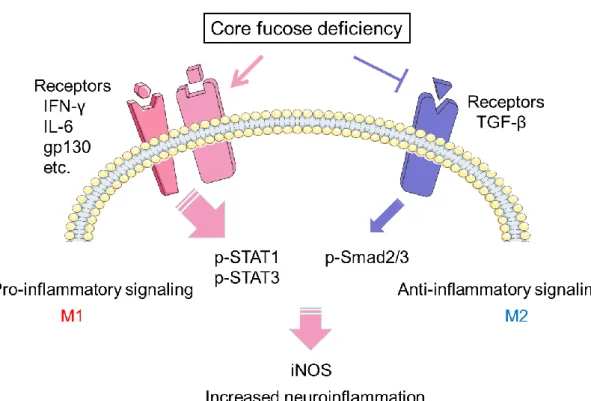
We wondered why the sensitivity of microglia and astrocytes increases with a lack of core fucosylation. Although the underlying molecular mechanism remains unclear, the following scenario is plausible. First, a lack of core fucosylation on these cytokine receptors might enhance the interaction between a receptor and its ligand, and could promote several pro-inflammatory signaling (Fig. 11). Previous studies by our group and by those of other groups have indicated that many receptors expressed on the cell surface contain core fucose: TGF-β1 receptors (14, 56), epidermal growth factor (EGF) receptors (57, 58), T cell receptors (TCR) (6, 9), and integrin α3β1 (59). The present study found that gp130, an important transmembrane protein of IL-6 signaling complexes, also contain core fucose (Fig. 9). Loss of core fucose on activin receptors (11) and AMPARs, one type of ionotropic glutamate receptor, enhanced the formation of receptor complexes (12), which constitutively activated intracellular signaling.

Interestingly, the results obtained from two independent analyses of the crystal

structures of glycosylated Fc receptor FcγRIIIa and both the core fucosylated and

unfucosylated Fc regions of immunoglobulin G (IgG) (60, 61) also supported these

observations. Core fucose depletion can increase the incidence of the active

conformation of the Tyr-296 of Fc, thereby accelerating the high-affinity

heteromerization with its receptor. Those two independent studies clearly revealed why

a lack of core fucosylation on IgG1 can dramatically enhance antibody-dependent

cellular cytotoxicity activity (62, 63). The results of the present study showed an

(29)

25

enhancement of the IL-6-induced p-STAT3 signal pathway in Fut8 KO C6 cells (Fig. 9) as well as in the Fut8 KO BV-2 cells (Fig. 10), and the IFN-γ-induced p-STAT1 signaling in Fut8 KO BV-2 cells (Fig. 7) as well as in the Fut8 KO C6 cells (Fig. 10), all of which could share similar mechanisms. The detailed molecular mechanisms require further studies.

Second, core fucosylation deficiency could down-regulate anti-inflammatory signaling (Fig. 11). It is known that microglia can exist in two different states: one is an activated state (M1), which is typified by the expression of inflammatory cytokines and reactive oxygen species such as NO produced by iNOS; the other is a state of alternative activation (M2), which exhibits the properties of an anti-inflammatory phenotype involved in the production of interleukin 4 (IL-4), interleukin 10 (IL-10), and TGF-β etc., that are implicated in inhibiting inflammation and restoring homeostasis in the CNS (64). As described above, the TGF-β-induced Smad2/3 signaling pathway is also one of the important anti-inflammatory signaling pathways. Core fucosylation differentially regulates the biological functions of receptors. Our previous study showed that a lack of core fucose led to a marked reduction in the ligand-binding ability and the downstream signaling of several receptors (8, 14, 56). A lack of core fucose in TGF-β receptors suppressed its binding with TGF-β and subsequently inhibited its downstream signaling such as in the phosphorylation of Smad2/3, which resulted in the development of an emphysema-like phenotype in Fut8 -/- mice (14, 56). Furthermore, in a cigarette smoke-induced emphysema model, the Fut8 +/- mice showed a higher inflammatory response than that of Fut8 +/+ mice (8). In this study, coincidentally, we observed a modest expression of phosphorylated Smad2 following stimulation with IFN-γ in WT BV-2 cells, but this expression was below the detection level in the KO cells (Fig. 7).

These data suggested that the anti-inflammatory signaling pathways, at least TGF-β signaling pathway, could be downregulated in Fut8 deficient cells.

Third, a lack of core fucose in IgG might also contribute to increased

neuroinflammation in Fut8 -/- mice, because IgG plays an important role in the human

(30)

26

immune system, and N-glycans act as a switch between pro- and anti-inflammatory IgG functions. As described above, core fucose deficiency in the N-glycans of Fc receptor FcγRIIIa expressed on microphages and in the Fc region of IgG dramatically increases Fc and Fc receptor binding, which may also partially explain why Fut8 -/- mice demonstrate a higher state of inflammation.

Figure 11: A simplified model for core fucosylation on a neuroinflammation model.

Based on our observations in the present study, loss of core fucosylation could cause differences in the regulation of the sensitivities of microglia and astrocytes to stimuli.

Core fucose deficiency seemed to enhance the pro-inflammatory signaling, such as

IFN-γ/p-STAT1 and IL-6/p-STAT3 signaling pathways, while decrease the

anti-inflammatory signaling, such as in the TGF-β/p-Smad2 signaling pathway, which

has been also observed in lung tissues as well as in fibroblast cells (14). It should be

noted that only modest changes could be detected in the pro-inflammatory and

anti-inflammatory signaling levels between WT and Fut8 KO glial cells. Considering

most cytokine receptors, such as TGF-β receptor and gp130, could be core fucosylated,

we believe that the concerted responses of these small effects could result in a

(31)

27

significant impact in vivo, as observed in Fut8 KO mice as well as in Fut8-deficient patients (10, 12, 13).

These studies provide direct evidence for the mechanistic roles of Fut8 in different biological processes, where the attachment of core fucose leads to an alteration in the glycoprotein conformation, which determines its protein dynamics coupled with the selection of protein-protein interactions and complex formation, and consequently affects the intracellular signaling pathways.

In summary, results from the present study clearly showed that core fucosylation exerts

dual effects in microglia and astrocytes. Deficiency of Fut8 enhanced the

pro-inflammatory signaling pathways, while inhibited the anti-inflammatory signaling

pathways (Fig. 11). It should be noted that only modest changes in the pro-inflammatory

and anti-inflammatory signaling could be detected between WT and Fut8 KO cells in

this study, but in concerted responses these small effects may result in a big impact in

vivo, as shown in Fig. 3. Considering the important roles of microglia during brain

development (65) and the participation of glial cells in schizophrenia (16), and the

schizophrenia-like phenotype (10) as well as the high rate of mortality (14) found in

Fut8 -/- mice, we concluded that the disorders in CNS with deficient core fucosylation

may be caused by not only neurons but also by glial cells.

(32)

28

References

1. Kotzler, M. P., Blank, S., Bantleon, F. I., Spillner, E., and Meyer, B. (2012) Donor substrate binding and enzymatic mechanism of human core alpha1,6-fucosyltransferase (FUT8). Biochim. Biophys. Acta 1820, 1915-1925 2. Wilson, J. R., Williams, D., and Schachter, H. (1976) The control of

glycoprotein synthesis: N-acetylglucosamine linkage to a mannose residue as a signal for the attachment of L-fucose to the asparagine-linked N-acetylglucosamine residue of glycopeptide from alpha1-acid glycoprotein.

Biochem. Biophys. Res. Commun. 72, 909-916

3. Schneider, M., Al-Shareffi, E., and Haltiwanger, R. S. (2017) Biological functions of fucose in mammals. Glycobiology 27, 601-618

4. Zhou, Y., Fukuda, T., Hang, Q., Hou, S., Isaji, T., Kameyama, A., and Gu, J.

(2017) Inhibition of fucosylation by 2-fluorofucose suppresses human liver cancer HepG2 cell proliferation and migration as well as tumor formation. Sci Rep 7, 11563

5. Wang, Y., Fukuda, T., Isaji, T., Lu, J., Im, S., Hang, Q., Gu, W., Hou, S., Ohtsubo, K., and Gu, J. (2015) Loss of alpha1,6-fucosyltransferase inhibits chemical-induced hepatocellular carcinoma and tumorigenesis by down-regulating several cell signaling pathways. FASEB J. 29, 3217-3227 6. Fujii, H., Shinzaki, S., Iijima, H., Wakamatsu, K., Iwamoto, C., Sobajima, T.,

Kuwahara, R., Hiyama, S., Hayashi, Y., Takamatsu, S., Uozumi, N., Kamada, Y., Tsujii, M., Taniguchi, N., Takehara, T., and Miyoshi, E. (2016) Core Fucosylation on T Cells, Required for Activation of T-Cell Receptor Signaling and Induction of Colitis in Mice, Is Increased in Patients With Inflammatory Bowel Disease. Gastroenterology 150, 1620-1632

7. Li, W., Yu, R., Ma, B., Yang, Y., Jiao, X., Liu, Y., Cao, H., Dong, W., Liu, L., Ma,

K., Fukuda, T., Liu, Q., Ma, T., Wang, Z., Gu, J., Zhang, J., and Taniguchi, N.

(33)

29

(2015) Core fucosylation of IgG B cell receptor is required for antigen recognition and antibody production. J. Immunol. 194, 2596-2606

8. Gao, C., Maeno, T., Ota, F., Ueno, M., Korekane, H., Takamatsu, S., Shirato, K., Matsumoto, A., Kobayashi, S., Yoshida, K., Kitazume, S., Ohtsubo, K., Betsuyaku, T., and Taniguchi, N. (2012) Sensitivity of heterozygous alpha1,6-fucosyltransferase knock-out mice to cigarette smoke-induced emphysema: implication of aberrant transforming growth factor-beta signaling and matrix metalloproteinase gene expression. J. Biol. Chem. 287, 16699-16708 9. Liang, W., Mao, S., Sun, S., Li, M., Li, Z., Yu, R., Ma, T., Gu, J., Zhang, J.,

Taniguchi, N., and Li, W. (2018) Core Fucosylation of the T Cell Receptor Is Required for T Cell Activation. Front Immunol 9, 78

10. Fukuda, T., Hashimoto, H., Okayasu, N., Kameyama, A., Onogi, H., Nakagawasai, O., Nakazawa, T., Kurosawa, T., Hao, Y., Isaji, T., Tadano, T., Narimatsu, H., Taniguchi, N., and Gu, J. (2011) Alpha1,6-fucosyltransferase-deficient mice exhibit multiple behavioral abnormalities associated with a schizophrenia-like phenotype: importance of the balance between the dopamine and serotonin systems. J. Biol. Chem. 286, 18434-18443

11. Gu, W., Fukuda, T., Isaji, T., Hashimoto, H., Wang, Y., and Gu, J. (2013) alpha1,6-Fucosylation regulates neurite formation via the activin/phospho-Smad2 pathway in PC12 cells: the implicated dual effects of Fut8 for TGF-beta/activin-mediated signaling. FASEB J. 27, 3947-3958

12. Gu, W., Fukuda, T., Isaji, T., Hang, Q., Lee, H. H., Sakai, S., Morise, J., Mitoma, J., Higashi, H., Taniguchi, N., Yawo, H., Oka, S., and Gu, J. (2015) Loss of alpha1,6-Fucosyltransferase Decreases Hippocampal Long Term Potentiation:

IMPLICATIONS FOR CORE FUCOSYLATION IN THE REGULATION OF AMPA RECEPTOR HETEROMERIZATION AND CELLULAR SIGNALING.

J. Biol. Chem. 290, 17566-17575

(34)

30

13. Ng, B. G., Xu, G., Chandy, N., Steyermark, J., Shinde, D. N., Radtke, K., Raymond, K., Lebrilla, C. B., AlAsmari, A., Suchy, S. F., Powis, Z., Faqeih, E.

A., Berry, S. A., Kronn, D. F., and Freeze, H. H. (2018) Biallelic Mutations in FUT8 Cause a Congenital Disorder of Glycosylation with Defective Fucosylation. Am. J. Hum. Genet. 102, 188-195

14. Wang, X., Inoue, S., Gu, J., Miyoshi, E., Noda, K., Li, W., Mizuno-Horikawa, Y., Nakano, M., Asahi, M., Takahashi, M., Uozumi, N., Ihara, S., Lee, S. H., Ikeda, Y., Yamaguchi, Y., Aze, Y., Tomiyama, Y., Fujii, J., Suzuki, K., Kondo, A., Shapiro, S. D., Lopez-Otin, C., Kuwaki, T., Okabe, M., Honke, K., and Taniguchi, N. (2005) Dysregulation of TGF-beta1 receptor activation leads to abnormal lung development and emphysema-like phenotype in core fucose-deficient mice. Proc Natl Acad Sci U S A 102, 15791-15796

15. Howes, O. D., and McCutcheon, R. (2017) Inflammation and the neural diathesis-stress hypothesis of schizophrenia: a reconceptualization. Transl Psychiatry 7, e1024

16. Pasternak, O., Kubicki, M., and Shenton, M. E. (2016) In vivo imaging of neuroinflammation in schizophrenia. Schizophrenia research 173, 200-212 17. Haydon, P. G. (2001) GLIA: listening and talking to the synapse. Nat. Rev.

Neurosci. 2, 185-193

18. Gundersen, V., Storm-Mathisen, J., and Bergersen, L. H. (2015) Neuroglial Transmission. Physiol. Rev. 95, 695-726

19. Eroglu, C., and Barres, B. A. (2010) Regulation of synaptic connectivity by glia.

Nature 468, 223-231

20. Nave, K. A. (2010) Myelination and support of axonal integrity by glia. Nature 468, 244-252

21. Glass, C. K., Saijo, K., Winner, B., Marchetto, M. C., and Gage, F. H. (2010)

Mechanisms underlying inflammation in neurodegeneration. Cell 140, 918-934

22. Lawson, L. J., Perry, V. H., and Gordon, S. (1992) Turnover of resident

(35)

31

microglia in the normal adult mouse brain. Neuroscience 48, 405-415

23. Schafer, D. P., Lehrman, E. K., Kautzman, A. G., Koyama, R., Mardinly, A. R., Yamasaki, R., Ransohoff, R. M., Greenberg, M. E., Barres, B. A., and Stevens, B.

(2012) Microglia sculpt postnatal neural circuits in an activity and complement-dependent manner. Neuron 74, 691-705

24. Paolicelli, R. C., Bolasco, G., Pagani, F., Maggi, L., Scianni, M., Panzanelli, P., Giustetto, M., Ferreira, T. A., Guiducci, E., Dumas, L., Ragozzino, D., and Gross, C. T. (2011) Synaptic pruning by microglia is necessary for normal brain development. Science 333, 1456-1458

25. Herculano-Houzel, S. (2014) The glia/neuron ratio: how it varies uniformly across brain structures and species and what that means for brain physiology and evolution. Glia 62, 1377-1391

26. Clarke, L. E., and Barres, B. A. (2013) Emerging roles of astrocytes in neural circuit development. Nat. Rev. Neurosci. 14, 311-321

27. Chung, W. S., Clarke, L. E., Wang, G. X., Stafford, B. K., Sher, A., Chakraborty, C., Joung, J., Foo, L. C., Thompson, A., Chen, C., Smith, S. J., and Barres, B. A.

(2013) Astrocytes mediate synapse elimination through MEGF10 and MERTK pathways. Nature 504, 394-400

28. Liddelow, S. A., Guttenplan, K. A., Clarke, L. E., Bennett, F. C., Bohlen, C. J., Schirmer, L., Bennett, M. L., Munch, A. E., Chung, W. S., Peterson, T. C., Wilton, D. K., Frouin, A., Napier, B. A., Panicker, N., Kumar, M., Buckwalter, M. S., Rowitch, D. H., Dawson, V. L., Dawson, T. M., Stevens, B., and Barres, B.

A. (2017) Neurotoxic reactive astrocytes are induced by activated microglia.

Nature 541, 481-487

29. Baumann, N., and Pham-Dinh, D. (2001) Biology of oligodendrocyte and myelin in the mammalian central nervous system. Physiol. Rev. 81, 871-927 30. Bayer, T. A., Buslei, R., Havas, L., and Falkai, P. (1999) Evidence for activation

of microglia in patients with psychiatric illnesses. Neurosci. Lett. 271, 126-128

(36)

32

31. Goudriaan, A., de Leeuw, C., Ripke, S., Hultman, C. M., Sklar, P., Sullivan, P. F., Smit, A. B., Posthuma, D., and Verheijen, M. H. (2014) Specific glial functions contribute to schizophrenia susceptibility. Schizophr Bull 40, 925-935

32. Kippe, J. M., Mueller, T. M., Haroutunian, V., and Meador-Woodruff, J. H.

(2015) Abnormal N-acetylglucosaminyltransferase expression in prefrontal cortex in schizophrenia. Schizophrenia research 166, 219-224

33. Tucholski, J., Simmons, M. S., Pinner, A. L., Haroutunian, V., McCullumsmith, R. E., and Meador-Woodruff, J. H. (2013) Abnormal N-linked glycosylation of cortical AMPA receptor subunits in schizophrenia. Schizophrenia research 146, 177-183

34. Mueller, T. M., Haroutunian, V., and Meador-Woodruff, J. H. (2014) N-Glycosylation of GABAA receptor subunits is altered in Schizophrenia.

Neuropsychopharmacology 39, 528-537

35. Mueller, T. M., Yates, S. D., Haroutunian, V., and Meador-Woodruff, J. H. (2017) Altered fucosyltransferase expression in the superior temporal gyrus of elderly patients with schizophrenia. Schizophrenia research 182, 66-73

36. Rillahan, C. D., Antonopoulos, A., Lefort, C. T., Sonon, R., Azadi, P., Ley, K., Dell, A., Haslam, S. M., and Paulson, J. C. (2012) Global metabolic inhibitors of sialyl- and fucosyltransferases remodel the glycome. Nat. Chem. Biol. 8, 661-668

37. Okeley, N. M., Alley, S. C., Anderson, M. E., Boursalian, T. E., Burke, P. J., Emmerton, K. M., Jeffrey, S. C., Klussman, K., Law, C. L., Sussman, D., Toki, B. E., Westendorf, L., Zeng, W., Zhang, X., Benjamin, D. R., and Senter, P. D.

(2013) Development of orally active inhibitors of protein and cellular fucosylation. Proc Natl Acad Sci U S A 110, 5404-5409

38. Dumont, M., Lehner, A., Bardor, M., Burel, C., Vauzeilles, B., Lerouxel, O.,

Anderson, C. T., Mollet, J. C., and Lerouge, P. (2015) Inhibition of fucosylation

of cell wall components by 2-fluoro 2-deoxy-L-fucose induces defects in root

(37)

33

cell elongation. Plant J. 84, 1137-1151

39. Takada, T., Ebata, T., Noguchi, H., Keane, T. M., Adams, D. J., Narita, T., Shin, I.

T., Fujisawa, H., Toyoda, A., Abe, K., Obata, Y., Sakaki, Y., Moriwaki, K., Fujiyama, A., Kohara, Y., and Shiroishi, T. (2013) The ancestor of extant Japanese fancy mice contributed to the mosaic genomes of classical inbred strains. Genome Res. 23, 1329-1338

40. Huang, C., Hu, Z. L., Wu, W. N., Yu, D. F., Xiong, Q. J., Song, J. R., Shu, Q., Fu, H., Wang, F., and Chen, J. G. (2010) Existence and distinction of acid-evoked currents in rat astrocytes. Glia 58, 1415-1424

41. Ran, F. A., Hsu, P. D., Wright, J., Agarwala, V., Scott, D. A., and Zhang, F. (2013) Genome engineering using the CRISPR-Cas9 system. Nat Protoc 8, 2281-2308 42. Latta, C. H., Brothers, H. M., and Wilcock, D. M. (2015) Neuroinflammation in

Alzheimer's disease; A source of heterogeneity and target for personalized therapy. Neuroscience 302, 103-111

43. Cebrian, C., Loike, J. D., and Sulzer, D. (2015) Neuroinflammation in Parkinson's disease animal models: a cell stress response or a step in neurodegeneration? Curr Top Behav Neurosci 22, 237-270

44. Na, K. S., Jung, H. Y., and Kim, Y. K. (2014) The role of pro-inflammatory cytokines in the neuroinflammation and neurogenesis of schizophrenia. Prog Neuropsychopharmacol Biol Psychiatry 48, 277-286

45. Matsumura, K., Higashida, K., Ishida, H., Hata, Y., Yamamoto, K., Shigeta, M., Mizuno-Horikawa, Y., Wang, X., Miyoshi, E., Gu, J., and Taniguchi, N. (2007) Carbohydrate binding specificity of a fucose-specific lectin from Aspergillus oryzae: a novel probe for core fucose. J. Biol. Chem. 282, 15700-15708

46. Martinez, F. O., and Gordon, S. (2014) The M1 and M2 paradigm of macrophage activation: time for reassessment. F1000Prime Rep 6, 13

47. Miller, B. J., Buckley, P., Seabolt, W., Mellor, A., and Kirkpatrick, B. (2011)

Meta-analysis of cytokine alterations in schizophrenia: clinical status and

(38)

34

antipsychotic effects. Biol Psychiatry 70, 663-671

48. Tse, J. K. Y. (2017) Gut Microbiota, Nitric Oxide, and Microglia as Prerequisites for Neurodegenerative Disorders. ACS Chem Neurosci 8, 1438-1447

49. Kobayashi, Y., Tateno, H., Dohra, H., Moriwaki, K., Miyoshi, E., Hirabayashi, J., and Kawagishi, H. (2012) A novel core fucose-specific lectin from the mushroom Pholiota squarrosa. J. Biol. Chem. 287, 33973-33982

50. Ishida, Y., Kondo, T., Takayasu, T., Iwakura, Y., and Mukaida, N. (2004) The essential involvement of cross-talk between IFN-gamma and TGF-beta in the skin wound-healing process. J. Immunol. 172, 1848-1855

51. Strober, W., Kelsall, B., Fuss, I., Marth, T., Ludviksson, B., Ehrhardt, R., and Neurath, M. (1997) Reciprocal IFN-gamma and TGF-beta responses regulate the occurrence of mucosal inflammation. Immunol. Today 18, 61-64

52. Sofroniew, M. V., and Vinters, H. V. (2010) Astrocytes: biology and pathology.

Acta Neuropathol 119, 7-35

53. Iijima, J., Kobayashi, S., Kitazume, S., Kizuka, Y., Fujinawa, R., Korekane, H., Shibata, T., Saitoh, S. I., Akashi-Takamura, S., Miyake, K., Miyoshi, E., and Taniguchi, N. (2017) Core fucose is critical for CD14-dependent Toll-like receptor 4 signaling. Glycobiology 27, 1006-1015

54. Frank-Cannon, T. C., Alto, L. T., McAlpine, F. E., and Tansey, M. G. (2009) Does neuroinflammation fan the flame in neurodegenerative diseases? Mol Neurodegener 4, 47

55. Devinsky, O., Vezzani, A., Najjar, S., De Lanerolle, N. C., and Rogawski, M. A.

(2013) Glia and epilepsy: excitability and inflammation. Trends Neurosci. 36, 174-184

56. Wang, X., Gu, J., Miyoshi, E., Honke, K., and Taniguchi, N. (2006) Phenotype changes of Fut8 knockout mouse: core fucosylation is crucial for the function of growth factor receptor(s). Methods Enzymol. 417, 11-22

57. Wang, X., Gu, J., Ihara, H., Miyoshi, E., Honke, K., and Taniguchi, N. (2006)

(39)

35

Core fucosylation regulates epidermal growth factor receptor-mediated intracellular signaling. J. Biol. Chem. 281, 2572-2577

58. Matsumoto, K., Yokote, H., Arao, T., Maegawa, M., Tanaka, K., Fujita, Y., Shimizu, C., Hanafusa, T., Fujiwara, Y., and Nishio, K. (2008) N-Glycan fucosylation of epidermal growth factor receptor modulates receptor activity and sensitivity to epidermal growth factor receptor tyrosine kinase inhibitor. Cancer Sci. 99, 1611-1617

59. Zhao, Y., Itoh, S., Wang, X., Isaji, T., Miyoshi, E., Kariya, Y., Miyazaki, K., Kawasaki, N., Taniguchi, N., and Gu, J. (2006) Deletion of core fucosylation on alpha3beta1 integrin down-regulates its functions. J. Biol. Chem. 281, 38343-38350

60. Ferrara, C., Grau, S., Jager, C., Sondermann, P., Brunker, P., Waldhauer, I., Hennig, M., Ruf, A., Rufer, A. C., Stihle, M., Umana, P., and Benz, J. (2011) Unique carbohydrate-carbohydrate interactions are required for high affinity binding between FcgammaRIII and antibodies lacking core fucose. Proceedings of the National Academy of Sciences of the United States of America 108, 12669-12674

61. Mizushima, T., Yagi, H., Takemoto, E., Shibata-Koyama, M., Isoda, Y., Iida, S., Masuda, K., Satoh, M., and Kato, K. (2011) Structural basis for improved efficacy of therapeutic antibodies on defucosylation of their Fc glycans. Genes Cells 16, 1071-1080

62. Shields, R. L., Lai, J., Keck, R., O'Connell, L. Y., Hong, K., Meng, Y. G., Weikert, S. H., and Presta, L. G. (2002) Lack of fucose on human IgG1 N-linked oligosaccharide improves binding to human Fcgamma RIII and antibody-dependent cellular toxicity. J Biol Chem 277, 26733-26740

63. Shinkawa, T., Nakamura, K., Yamane, N., Shoji-Hosaka, E., Kanda, Y.,

Sakurada, M., Uchida, K., Anazawa, H., Satoh, M., Yamasaki, M., Hanai, N.,

and Shitara, K. (2003) The absence of fucose but not the presence of galactose

(40)

36

or bisecting N-acetylglucosamine of human IgG1 complex-type oligosaccharides shows the critical role of enhancing antibody-dependent cellular cytotoxicity. J Biol Chem 278, 3466-3473

64. Cherry, J. D., Olschowka, J. A., and O'Banion, M. K. (2014) Neuroinflammation and M2 microglia: the good, the bad, and the inflamed. J Neuroinflammation 11, 98

65. Matcovitch-Natan, O., Winter, D. R., Giladi, A., Vargas Aguilar, S., Spinrad, A.,

Sarrazin, S., Ben-Yehuda, H., David, E., Zelada Gonzalez, F., Perrin, P.,

Keren-Shaul, H., Gury, M., Lara-Astaiso, D., Thaiss, C. A., Cohen, M., Bahar

Halpern, K., Baruch, K., Deczkowska, A., Lorenzo-Vivas, E., Itzkovitz, S.,

Elinav, E., Sieweke, M. H., Schwartz, M., and Amit, I. (2016) Microglia

development follows a stepwise program to regulate brain homeostasis. Science

353, aad8670

(41)

37

Abbreviations

Fut8: α1,6-Fucosyltransferase CNS: central nervous system IL-6: interleukin-6

IFN-γ: interferon gamma LPS: lipopolysaccharide 2FF: 2-fluoro-L-fucose

Iba-1: ionized calcium binding adaptor molecule 1 GFAP: glial fibrillary acidic protein

AAL: Aleuria Aurantia Lectin PhoSL: Pholiota Squarrosa Lectin ConA: concanavalin A

SNA: sambucus nigra lectin MAA: maackia amurensis lectin iNOS: inducible nitric oxide synthase NO: nitric oxide

TGF-β: transforming growth factor β

GAPDH: glyceraldehyde-3-phosphate dehydrogenase

DAPI: 4',6-Diamidino-2-phenylindole Dihydrochloride n-Hydrate STAT1: signal transducer and activator of transcription 1

STAT3: signal transducer and activator of transcription 3

gp130: glycoprotein 130

Fig. 2 Main composition of glial cells in CNS
Figure  3.  Effects  of  core  fucosylation  on  the  activation  of  glial  cells  in  mice  brain  tissues
Figure 4. Effects of LPS on fucosylation, and expression of Iba-1 and GFAP in mice  brain  tissues
Figure 5. Changes in fucosylation and iNOS expression in primary microglia cells
+6

参照

関連したドキュメント

1 Introduction and overview 1.1 Introduction 1.2 Model of the public goods game 2 Expectation of non-strategic sanctioning 2.1 Introduction 2.2 The game and experimental design

Jinxing Liang, Takahiro Matsuo, Fusao Kohsaka, Xuefeng Li, Ken Kunitomo and Toshitsugu Ueda, “Fabrication of Two-Axis Quartz MEMS-Based Capacitive Tilt Sensor”, IEEJ Transactions

第3節 チューリッヒの政治、経済、文化的背景 第4節 ウルリッヒ・ツウィングリ 第5節 ツウィングリの政治性 第6節

話教育実践を分析、検証している。このような二つの会話教育実践では、学習者の支援の

(Approximately 4,000 characters in Japanese, or 1,500 words in English. The Doctoral Thesis title, however, must be written in both Japanese and English.).. 博士論文審査委員会

クター(SMB)およびバリューファクター(HML)および投資ファクター(AGR)の動的特性を得るために、特

Cioffi, “Pilot tone selection for channel estimation in a mobile OFDM systems,” IEEE Trans.. Sunaga, “Rayleigh fading compensation for QAM in land mobile ra- dio communications,”

ている。本論文では、彼らの実践内容と方法を検討することで、これまでの生活指導を重視し