51-56,March 2011
INTRODUCTION
Cereals are a very important food and energy source throughout the world. About 30 kinds of cereals are cultivated in the world, and the most highly produced cereals are corn, rice and wheat. Some cereals have become a subject of scientific interest because of their dietary functions. We previously reported that buckwheat hot-water extract significantly decreased the plasma very-low-density lipoprotein plus low-density lipoprotein (VLDL+LDL)-cholesterol concentration in a basal diet, and significantly suppressed the liver triglyceride content and weakened the fatty liver in a cholesterol-loaded diet in rats.
1)Dietary purple rice significantly enhanced the plasma high-density lipoprotein (HDL)- cholesterol concentration and suppressed the plasma thio- barbituric acid-reactive substance value in rats.
2)Dietary proso millet protein concentrate significantly increased the plasma HDL-cholesterol concentration in mice.
3,4)Amaranth, Amaranthus hypochondriacus, is an annual herbaceous plant that is native to Mexico. The seed of the amaranth is 1.0-1.5 mm in diameter, and most kinds of amaranth are of the glutinous type. Amaranth is eaten as a whole grain with the hull, and it is rich in protein, lipid, calcium, lysine and dietary fiber as compared to rice.
The present study examined the effects of the ingestion of dietary amaranth on serum and liver lipid levels in rats. One group of rats was fed the amaranth in amounts based on the human ingestion of energy from rice as a fraction of all food intake. Amaranth is usually cooked with rice; thus, another group of rats was fed an amaranth-supplemented rice diet.
MATERIALS AND METHODS
Animals and diets. This animal experiment was conducted with the approval of the Ethics Committee of Animal Study of Morioka Junior College, Iwate Prefectural University.
Male Wistar rats (3 wk old, Charles River Japan Inc., Kanagawa, Japan) were individually housed in stainless steel cages with wire bottoms in an air-conditioned room at a temperature of 22 ± 2
℃, a relative humidity of 60 ± 5 %, anda 12-h light cycle (0800-2000). They were fed a stock pellet diet (MF; Oriental Yeast Co., Tokyo, Japan) followed by a basal diet for 4 d. Subsequently, the rats were divided into three groups (n=5) with similar body weights and were fed the basal
5)(Control group) or experimental diets containing amaranth. In the present study, rats were fed amaranth in amounts based on the human ingestion of energy from rice as a fraction of all food intake. In humans, about 356.0 g of rice
学術論文Effects of Dietary Amaranth, Amaranthus hypochondriacus, on Serum and Liver Lipid Levels in Rats
*1ラットの血清および肝臓脂質レベルに対する食餌アマランサスの作用
Masashi KAWASAKI,
*2,3Yuka OKAMURA,
*2Misa KIKUCHI,
*2Miwa NITTA
*2and Mana YAMAZAKI
*2川崎雅志,岡村有華,菊池美沙,新田未和,山崎真奈
The effects of dietary amaranth, Amaranthus hypochondriacus, ingestion on serum and liver lipid levels were studied in rats. Rats were fed the amaranth in amounts based on the human ingestion of energy from rice as a fraction of all food intake. Serum total cholesterol and high-density lipoprotein-cholesterol concentrations in the groups fed amaranth and amaranth-supplemented rice diets tended to increase. Liver triglyceride content was significantly reduced by the amaranth diet. These results suggest that the dietary amaranth may exert a fatty liver prevention effect along with a decrease in the liver triglyceride content. This finding suggests that the ingestion of amaranth has a beneficial effect on the lipid metabolism.
Key words: amaranth, liver lipid, serum lipid
アマランサス,肝臓脂質,血清脂質
*1 This study was conducted as a part of the Special Training of Food and Nutrition Major, Science of Living Department.
*2 Food and Nutrition Major, Science of Living Department.
*3 Corresponding author.
Abbreviations: HDL, high-density lipoprotein; LDL, low-density lipoprotein; NEFA, nonesterified fatty acid; VLDL, very-low-density lipoprotein.
(cooked paddy rice) (= about 161.8 g of rice (paddy rice grain)) is ingested daily in Japan, and this weight is equal to 576 kcal.
On the other hand, about 1,920 kcal of energy are obtained from all foods combined; thus about 30 % of the total energy is obtained from rice. The energy of the basal diet is 416 kcal/100 g in the present study, so the caloric intake from rice is equal to 124.8 kcal/100 g. The energy contents of amaranth and rice are 358 and 356 kcal/100 g edible portion, respectively.
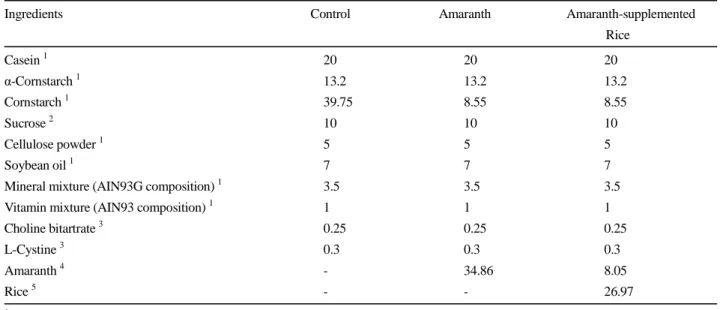
6)Therefore, the amounts of amaranth (whole grain, raw) and rice (well-milled, raw) in the diet were 34.9 g and 35.1 g, respectively. The experimental diet of one group was supplemented with 34.9 g of amaranth (whole grain, raw) per 100 g diet (Amaranth group). Amaranth is usually cooked with white rice, with the amount of amaranth added about 30 % of the amount of white rice. Therefore, the experimental diet of the other group was supplemented with 8.1 g of amaranth and 27.0 g of rice per 100 g diet (Amaranth-supplemented rice group). The compositions of the basal and experimental diets are shown in Table 1. The rats were kept for 28 d further. The diet and water were available at all times. Animals were deprived of their diet at 0900 on the 28th day but allowed free access to water until killing, which was performed 4 h later.
Blood was collected from the heart and left to clot at room temperature so that serum could be obtained. The liver was quickly removed, washed with cold 0.9 % NaCl, blotted on filter paper, and weighed. The serum and liver were stored at
-80
℃until being analyzed. Aliquots of the liver were also preserved in methanol and stored at 4
℃until lipid content analyses were performed.
Lipid analyses. Serum total cholesterol, HDL-cholesterol, triglyceride, phospholipid, and nonesterified fatty acid (NEFA) concentrations were determined by an enzymatic method using a Cholesterol E-test Wako, HDL-Cholesterol E-test Wako, Triglyceride E-test Wako, Phospholipid C-test Wako, and NEFA-C test Wako, respectively. All test kits were obtained from Wako Pure Chemical Industries, Osaka, Japan. The difference between total cholesterol concentration and HDL-cholesterol concentration was regarded as (VLDL+
LDL)-cholesterol concentration. The ratio of (VLDL+LDL)- cholesterol concentration to HDL-cholesterol concentration was designated as the atherogenic index. The ratio of HDL- cholesterol concentration to total cholesterol concentration was estimated as the HDL-cholesterol ratio.
Total lipids from the liver were extracted according to the procedure described by Folch et al.
7)After portions of the chloroform phase had been dried under nitrogen, cholesterol,
8)triglyceride,
9)and phospholipid
10)contents were determined.
Statistical analyses. Results were expressed as means ± standard errors. Statistical analysis was carried out by one-way analysis of variance followed by Fisher’s protected least significant difference (PLSD) test. A significance level of p <
0.05 was used for all the comparisons.
Table 1. Composition of experimental diets (g / 416 kcal).
Ingredients Control Amaranth Amaranth-supplemented Rice
Casein 1 20 20 20 α-Cornstarch 1 13.2 13.2 13.2 Cornstarch 1 39.75 8.55 8.55 Sucrose 2 10 10 10 Cellulose powder 1 5 5 5 Soybean oil 1 7 7 7 Mineral mixture (AIN93G composition) 1 3.5 3.5 3.5 Vitamin mixture (AIN93 composition) 1 1 1 1 Choline bitartrate 3 0.25 0.25 0.25 L-Cystine 3 0.3 0.3 0.3 Amaranth 4 - 34.86 8.05 Rice 5 - - 26.97
1 Oriental Yeast Co., Tokyo, Japan.
2 Nissin Sugar Manufacturing Co., Tokyo, Japan.
3 Wako Pure Chemical Industries, Osaka, Japan.
4 Kuji Health Farm, Iwate, Japan.
5 Junjomai Iwate, Co., Iwate, Japan.
RESULTS
Table 2 shows the initial body weight, food intake and body weight gain for a duration of 28 d of experimental feeding, and the relative liver weight at the end of experimental feeding.
Food intake, body weight gain and liver weight were not significantly different among the three groups.
Serum cholesterol concentrations are shown in Fig. 1.
Serum total cholesterol concentration was not significantly different among the three groups, although ingestion of the amaranth and amaranth-supplemented rice diets tended to
increase the total cholesterol concentration. Regarding lipoprotein cholesterol concentration, there were no significant differences in the HDL-cholesterol and (VLDL+LDL)- cholesterol concentrations among the three groups. However, the HDL-concentration in the groups fed amaranth and amaranth-supplemented rice diets tended to increase. The atherogenic index and HDL-cholesterol ratio were not significantly different among the three groups.
Fig. 2 shows the serum triglyceride, phospholipid and NEFA concentrations. Both the amaranth and
Table 2. Initial body weight, food intake, body weight gain and liver weight in rats and rats fed on amaranth or amaranth-supplemented rice diet.Measurement Control Amaranth Amaranth-supplemented Rice
Initial body weight (g) 71.8 ± 1.6 76.2 ± 2.4 77.7 ± 3.4 Food intake (g/28d) 555.4 ± 14.0 558.2 ± 22.4 598.1 ± 8.1 Body weight gain (g/28d) 203.4 ± 8.5 210.3 ± 11.0 230.1 ± 4.0 Liver weight (g/100g body weight) 4.58 ± 0.21 4.70 ± 0.15 4.43 ± 0.08 Each value represents the mean ± standard error for five rats.
0 2 4
C A AR
(mmol/L)
Total cholesterol (A)
0 1 2 3
C A AR
(mmol/L)
HDL-cholesterol(B)
0 0.5 1
C A AR
(mmol/L)
(VLDL+LDL)-cholesterol (C=A-B)
0 50 100
C A AR
(%)
HDL-cholesterol ratio (B/A×100)
0 0.5 1
C A AR
Atherogenic index (C/B)
Fig. 1. Effects of dietary amaranth on serum cholesterol concentration, atherogenic index and high-density lipoprotein (HDL)-cholesterol ratio in rats.
Measurement of the serum cholesterol concentration was carried out as described in the MATERIALS AND METHODS section. Each value and vertical bar represents the mean and standard error for five rats. C, basal diet (Control) group; A, amaranth diet group; AR, amaranth-supplemented rice diet group.
amaranth-supplemented rice diets did not affect the serum triglyceride concentration, although the amaranth and amaranth-supplemented diets tended to cause the serum triglyceride concentration to decrease. Serum phospholipid and NEFA concentrations were not affected by the amaranth or amaranth-supplemented rice diet.
Liver lipid contents are shown in Fig. 3. Both the amaranth and amaranth-supplemented rice diets did not change the liver
cholesterol content. The amaranth diet caused the liver triglyceride content to significantly decrease. The amaranth- supplemented rice diet tended to reduce the liver triglyceride content. Liver phospholipid content was not affected by the amaranth or amaranth-supplemented rice diet.
DISCUSSION
The present study was performed to evaluate the effects of
0 5 10
C A AR
(μmol/g of liver)
Cholesterol
0 10 20
C A AR
(μmol/g of liver)
Triglyceride
0 25 50
C A AR
(μmol/g of liver)
Phospholipid
a
ab b
0 1 2
C A AR
(mmol/L)
Triglyceride
0 1 2
C A AR
(mmol/L)
Phospholipid
0 0.1 0.2 0.3 0.4 0.5
C A AR
(mEq/L)
NEFA
Fig. 2. Effects of dietary amaranth on serum triglyceride, phospholipid and nonesterified fatty acid (NEFA) concentrations in rats. Measurements of the serum triglyceride, phospholipid and NEFA concentrations were carried out as described in the MATERIALS AND METHODS section. Each value and vertical bar represents the mean and standard error for five rats. C, basal diet (Control) group; A, amaranth diet group; AR, amaranth-supplemented rice diet group.
Fig. 3. Effects of dietary amaranth on liver lipid contents in rats. Measurements of the liver lipid contents were carried out as described in the MATERIALS AND METHODS section. Each value and vertical bar represents the mean and standard error for five rats. Values not sharing a common letter are significantly different at p < 0.05 by one-way analysis of variance followed by Fisher’s protected least significant difference (PLSD) test. C, basal diet (Control) group; A, amaranth diet group; AR, amaranth-supplemented rice diet group.
dietary amaranth ingestion on serum and liver lipid levels in rats. The amaranth ingestion tended to increase the serum total cholesterol and HDL-cholesterol concentrations; however, no significant increase was seen. It has been reported that dietary cereals increased the HDL-cholesterol concentration in the blood. For example, dietary proso millet protein concentrate increased the plasma HDL-cholesterol concentration in comparison to the casein diet in mice.
3,4)Our previous study also reported that dietary purple rice increased the plasma HDL-cholesterol concentration as compared with the casein diet.
2)There is a possibility that amaranth, which is a cereal, might also contribute to the serum HDL-cholesterol-lifting action; however, the HDL-cholesterol lifting action by dietary amaranth might be weaker than that by these cereals.
The amaranth-supplemented rice diet also did not affect the serum HDL-cholesterol concentration; however, the serum HDL-cholesterol concentration in the amaranth-supplemented rice diet group tended to be high in comparison to that of the casein diet group as well as that of the amaranth diet group. The amaranth-supplemented rice diet was the same in terms of calories as the amaranth diet, and rice makes up more than half of the cereals in the diet. Thus, it is considered that it may be a common trait among cereals to induce HDL-cholesterol-lifting action in the blood.
Dietary amaranth ingestion significantly decreased the liver triglyceride content. Liver triglyceride metabolism is regulated by the synthesis and breakdown pathway in the liver or the secretion pathway from the liver to the blood. Yang et al.
reported that the ingestion of rice protein reduced the liver triglyceride content, and this reduction of the liver triglyceride content by rice protein might be considered to signify decreased triglyceride synthesis and increased triglyceride breakdown in the liver in addition to lower triglyceride flux in the circulation.
11)Because amaranth and rice are both cereals, it is considered that dietary amaranth may have the same action as dietary rice protein; thus, the liver triglyceride content was significantly decreased.
In conclusion, dietary amaranth may exert a fatty liver prevention effect along with the decrease in the liver triglyceride content. This finding suggests that the ingestion of amaranth brings beneficial effects to the lipid metabolism. In addition, the serum HDL-cholesterol concentration tended to increase with the ingestion of amaranth and amaranth- supplemented rice diets. The liver triglyceride content-lowering effect or the significant serum HDL-cholesterol concentration- lifting effect by dietary amaranth may be elucidated by an investigation of the most effective combination ratio of
amaranth and rice, of the most effective addition ratio of amaranth to the diet, or of the comparison with the rice diet.
Further studies are required to clarify this issue.
REFERENCES
1) Kawasaki, M., Sakamoto, H., Takahashi, R., Nishita, Y., Kano, M., Kon, Y., and Sugawara, C., Effects of buckwheat (Fagopyrum esculentum) hot-water extracts on plasma and liver lipid levels in rats, Bulletin of Morioka Junior College, Iwate Prefectural University, 8, 7-12 (2006).
2) Kawasaki, M., Sato, Y., Chida, M., and Hatakeyama, C., Effects of dietary purple rice on plasma and liver lipid levels in rats, Bulletin of Morioka Junior College, Iwate Prefectural University, 9, 63-68 (2007).
3) Nishizawa, N., Oikawa, M., and Hareyama, S., Effect of dietary protein from proso millet on the plasma cholesterol metabolism in rats, Agric. Biol. Chem., 54, 229-230 (1990).
4) Nishizawa, N., and Fudamoto, Y., The elevation of plasma concentration of high-density lipoprotein cholesterol in
mice fed with protein from proso millet, Biosci. Biothchnol.
Biochem., 59, 333-335 (1995).
5) Reeves, P. G., Nielsen, F. H., and Fahey, G. C. Jr., AIN-93 purified diets for laboratory rodents: Final report of the American Institute of Nutrition ad hoc writing committee on the reformulation of the AIN-76A rodent diet, J. Nutr.,
123, 1939-1951 (1993).6) Standard tables of food composition in Japan, Fifth revised and enlarged edition, Ministry of Education, Culture, Sports, Science and Technology, Japan (2005).
7) Folch, J., Lees, M., and Sloane-Stanley, G. H., A simple method for the isolation and purification of total lipides from animal tissues, J. Biol. Chem., 226, 497-509 (1957).
8) Zak, B., Simple rapid microtechnic for serum total cholesterol, Am. J. Clin. Path., 27, 583-588 (1957).
9) van Handel, E., Suggested modifications of the micro determination of triglycerides, Clin. Chem.,
7, 249-251(1961).
10) Chen, P. S., Toribara, T. Y., and Warner, H., Microdetermination of phosphorus, Anal. Chem., 28, 1756-1758 (1956).
11) Yang, L., Kumagai, T., Kawamura, H., Watanabe, T., Kubota, M., Fujimura, S., Watanabe, R., and Kadowaki, M.,
Effects of rice proteins from two cultivars, Koshihikari and Shunyo, on cholesterol and triglyceride metabolism in
growing and adult rats, Biosci. Biothchnol. Biochem.,
71,694-703 (2007).
和文要旨 ラットにおける血清および肝臓脂質レベルに対する食餌アマランサス摂取の作用を検討した。ラット にはアマランサスをヒトのコメエネルギー摂取量に基づいて与えた。アマランサスならびにアマランサスを添加した コメの摂取により,血清総コレステロールならびに高密度リポタンパク質コレステロール濃度の上昇傾向がみられた。
肝臓トリグリセリド含量がアマランサスの摂取により有意に減少した。これらの結果より,アマランサスは肝臓トリ グリセリド含量を減少させることにより脂肪肝抑制的に作用し,脂質代謝に対して有用な作用をもたらす可能性が示 唆された。