77
Effects of Intravenously Injected Eritadenine on
Serum Lipids in Ovariectomized (OVX) Rats
Norihiko ASADA
*1and Akifumi ONO
*2(Accepted January 17, 2019)
Key words: eritadenine, intravenous injection, serum lipids, ovariectmy (OVX)
Abstract
This research investigated and reported on whether or not intravenous administration of eritadenine to ovariectomized (OVX) rats affects serum lipid parameters like those found in the results of studies on its oral administration. Serum triglyceride, phospholipid, and total cholesterol levels were significantly lower in the OVX and Sham groups intravenously administered eritadenine than in the control OVX and Sham groups. The present results suggest that the administration of eritadenine in saline at a rate of 0.5 mg/mL and amount of 1 mL per kg of body weight via the tail vein for 10 days decreased serum lipid levels to a similar extent as when it was orally administered.
*1 Department of Food and Nutrition, Faculty of Food Science and Nutrition, Beppu University Beppu, 874-8501, Japan
E-Mail: [email protected]
*2 Department of Clinical Nutrition, Faculty of Health Science and Technology, Kawasaki University of Medical Welfare
1. Introduction
A number of mushrooms have recently been studied for their physiological effects, such as decreasing serum lipid concentrations1-4), anti-tumor activity5), the suppression of blood pressure elevations6,7), and the inhibition of increases in blood glucose8). The enhancing effects of mushrooms on lipid metabolism have been examined in detail. The cholesterol-lowering effects of eritadenine in shiitake mushrooms may be due to the strong inhibitory activity of S-adenosyl-L-homocysteine hydrolase (SAHH)9-13). However, these studies involved the oral administration of eritadenine and shiitake mushrooms.
Takashima et al. showed that a single dose of 50 mg / kg eritadenine intravenously has no effect on serum cholesterol14). However, as Takashima et al. stated, it can be considered that the maintenance of an effective concentration of eritadenine in the target organs for a certain period of time may be necessary for the effect to be seen. Therefore, it was thought that if it was administered multiple times rather than in a single dose, there is a possibility that the effect may be obtained. Specifically, a 0.5 mg / ml concentration of erythadenine was administered 10 times at a rate of 1 ml / kg BW.
On the other hand, since the reports of serum lipids lowering the action of eritadenine in OVX rats was not found, ovariectomized (OVX) rats, which are a model of obesity15-17), were selected for this study.
We intravenously administered eritadenine for the purpose of confirming its ability to decrease serum lipid levels. Since the titer of orally administered eritadenine is considered to be 5 mg/kg BW based on previous findings11-13), eritadenine was administered at a dose of at 0.5 mg/kg BW at ten different times in the present study.
2. Materials and Methods
2.1 Animals and diets
This study was conducted in accordance with the ethical guidelines of the Beppu University Animal Experimentation Committee and in complete compliance with the National Institutes of Health Guidelines for the Care and Use of Laboratory Animals, and was also approved by this committee18).
Twenty eight female 4 week-old Sprague-Dawley rats (Japan Clare Co., Japan) were fed a commercial diet (MF, Oriental Yeast Co., Tokyo) for one week. After acclimation for one week, rats were randomly divided into four groups consisting of seven animals. Two groups underwent OVX surgery and the other two groups were subjected to sham surgery. All rats were allowed free access to food and tap water. Rats were individually housed in plastic cages kept in a room at a controlled temperature (25 ± 2 ℃) and humidity (55 ± 5%). Lights were maintained on a 12-h light-dark cycle (lights on from 7:00 to 19:00). Body weight was measured every day. Food intake was recorded every 5 weeks after surgery.
2.2 OVX
After acclimation for one week, OVX and sham surgery were performed at 5 weeks of age. General anesthesia was performed with pentobarbital (somnopentyl, Kyoritsu Pharmaceutical) administered intraperitoneally (5.0 mg/100 g body weight), and the area of the back at the peripheral portion of the lumbar vertebra was shaved and disinfected with 70% ethanol. The skin was surgically opened at a single site to incise the muscles surrounding the kidneys at the left and right sites, and in order to remove the ovaries of fat. After uterine ligation with silk thread, the uterus was replaced to the original site. The incised muscle layer and skin were disinfected again with 70% ethanol after suturing. In the Sham group, the skin was incised and suturing was performed without OVX.
2.3 Administration of eritadenine
Eritadenine manufactured by Santa Cruz Biotechnology was used in the present study, a solution prepared by mixing eritadenine with 0.5 mg/mL saline. One group among the OVX rats was intravenously administered the eritadenine solution at a rate of 1mL/kg body weight on the 20th week after surgery, while the other group was administered physiological saline. Similarly, one group among the sham-operated rats was intravenously administered the eritadenine solution at a rate of 1mL/kg body weight on the 20th week after surgery, while the other group was administered physiological saline. The administration period was for 10 days in each case.
In this study, the dose concentration of eritadenine was set at 0.5 mg/mL. In the experiment on the influence of eritadenine on serum lipids by oral ingestion, 50 mg of eritadenine was administered per kg of diet, and the intake amount for 14 days was 200 g19). Therefore, a total of 10 mg eritadenine was administered in 14 days. In addition, prior to this study, eritadenine was administered at a concentration of 0.2 mg/mL for 5 days, but there was absolutely no effect on serum lipids. When the administration concentration of eritadenine was 0.5 mg/mL and the administration days were 10 days, serum total cholesterol levels were decreased. Based on these results it is concluded that the administration concentration of eritadenine was set at 0.5 mg/mL and the administration days were set at 10 days in this study.
2.4 Sampling procedures and measurement of serum parameters
Blood collection (pre-administration: pre) was started on the 20th week after OVX and sham surgery. After fasting for 8 hours from 8:00-16:00 (light term), blood was collected from the tail vein (pre-administration: pre) under isoflurane anesthesia (Pfizer), and the first administration of eritadenine and physiological saline (control groups) was performed. On the next day, after fasting for 8 hours from 8:00-16:00 (light term), eritadenine and physiological saline were administered again (10 times in total) under isoflurane anesthesia. On the day after the 10th administration of eritadenine and physiological saline, blood was collected under
isoflurane anesthesia after fasting for 8 hours from 8:00-16:00 (light term). Rats were euthanized under isoflurane anesthesia.
Blood was centrifuged at 3000 rpm for 10 min. Serum was frozen immediately and stored at -80℃ until assayed. Serum triglyceride20), phospholipid21), and total cholesterol22) levels were measured using a previously described enzymatic method. Lecithin cholesterol acyl transferase (L-CAT) activity levels were assayed using the dipalmitoyl lecithin substrate method23).
2.5 Statistical analysis
Results were expressed as means ± standard deviation (SD). The significance of differences in body weights and food intake between the OVX group and Sham group were analyzed by the Student’s t-test for independent samples. The significance of differences in serum parameters between pre and the 10 day administration of eritadenine or saline were analyzed by the Student’s paired t-test. A p value of 0.05 or less was considered to be significant. Statistical analyses were performed using SPSS Ver16.0 software (SPSS, Tokyo, Japan).
3. Results
3.1 Body weight and food intake
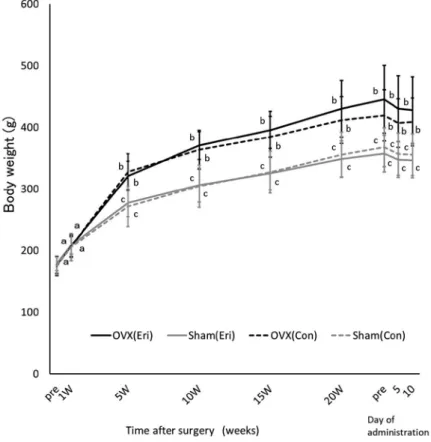
The initial body weights for each group were as follows: OVX (Eritadenine) 176.5 ± 13.6g, OVX (Control) 174.9 ± 15.2g, Sham (Eritadenine) 178.7 ± 11.3g, and Sham (Control) 175.3 ± 14.0g. Immediately after surgery, body weights were higher in the OVX groups than in the Sham groups (Figure 1). After starting the administration of the eritadenine or saline, the body weight tended to decrease in all groups. There
Figure 1 Effects of eritadenine intravenous injections on body weight in ovariectomized (OVX) rats Eri: intravenous injection of eritadenine, Con: intravenous injection of saline. Values are means ± SD. Different letters indicate significant differences between the OVX group and the Sham group
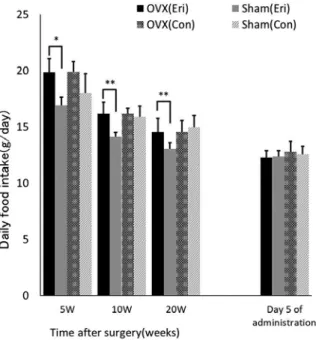
was no significant difference between the eritadenine administration group and control group. In the 5th, 10th, and 20th weeks after surgery, food intake was significantly higher in the eritadenine-administered OVX groups than in the eritadenine-administered Sham groups (Figure 2). However, food intake in all groups decreased with time, and no significant differences were observed between the 4 groups on day 5 of administration.
3.2 Serum lipid and L-CAT activity levels
Serum triglyceride levels were significantly lower in the OVX and Sham groups receiving eritadenine for 10 days (Figure 3a). Serum phospholipid levels were significantly lower in all groups by administration for 10 days (Figure 3b). The difference was particularly large in the group receiving eritadenine. Serum total cholesterol levels were significantly lower in the OVX and Sham groups receiving eritadenine for 10 days (Figure 3c). L-CAT activity levels were significantly lower in the OVX group receiving eritadenine for 10 days (Figure 3d).
4. Discussion
This research investigated whether or not intravenously administered eritadenine affects serum lipid parameters to a similar extent as in its oral administration. In our study, intravenous administration of eritadenine showed lowering lipid effects.
Body weight was slightly higher in the OVX group than in the Sham group. Food intake by mice and rats has been shown to increase following OVX24). Although no significant differences were observed in the present study, food intake slightly increased in the OVX group, which may account for the weight gain observed. It was speculated that weight loss on day 5 of administration was due to a decreased food intake caused by isoflurane anesthesia or puncture of the tail vein during intravenous administration.
Serum triglyceride, phospholipid, and total cholesterol levels were significantly lower in the OVX and Sham groups treated with eritadenine for 10 days. Serum triglyceride levels were significantly higher in
Figure 2 Effects of eritadenine intravenous injections on daily food intake in ovariectomized (OVX) rats Eri: intravenous injection of eritadenine, Con: intravenous injection of saline. Values are means ± SD.
*p<0.05, **p<0.01 indicate significant differences between the OVX group and the Sham group tested
Figure 3 Effects of eritadenine intravenous injections on serum lipid profiles and lecithin-cholesterol acyltransferase (L-CAT) activities in ovariectomized (OVX) rats
Eri: intravenous injection of eritadenine, Con: intravenous injection of saline. Values are means ± SD. *p<0.05,
**p<0.01, ***p<0.001 indicate significant differences between pre and the administration of eritadenine or saline
the Sham groups than in the OVX groups before the administration of eritadenine and saline. However, the reason for this remains unclear. L-CAT activity levels were significantly decreased in the eritadenine-administered OVX group, but were only slightly reduced in the three other groups. Serum triglyceride levels and total cholesterol levels were significantly lower in groups treated with eritadenine than in the control group. There was no significant difference in total cholesterol elevation due to the OVX operation, but total cholesterol was significantly decreased by eritadenine. In the 20 weeks after OVX surgery food intake increased, but no significant increase in serum triglyceride or cholesterol was observed, so it seems that it is necessary to review the postoperative period and the others as well. For example, it is considered that serum total cholesterol increased effectively by adding cholesterol to the diets.
These results suggest that the administration of eritadenine at a dose of 0.5 mg/kg body weight via the tail vein at ten times the previous amount decreased serum lipid levels. The titer of intravenously administered eritadenine may be 5 mg/kg BW, which is similar to that of its oral administration in rats11-13,19). As we hypothesised, our results showed the lowering lipid effects of eritadenine by intravenous administration contrary to Takashima’s report. We think this is because eritadenine was administered repeatedly, which might have sustained its serum concentration even at the target organ and showed its effect. Intravenous administration is considered to be effective because it is not affected by absorption and a scientific term. The repeated administration of eritadenine may have been effective for lowering serum total cholesterol levels in the present study.
References
1. Sato M, Tokuji Y, Yoneyama S, Fujii-Akiyama K, Kinoshita M, Chiji H and Ohnishi M : Effect of dietary maitake (Grifola frondosa) mushrooms on plasma cholesterol and hepatic gene expression in cholesterol-fed mice. Journal of Oleo Science, 62(12), 1049-1058, 2013.
2. Hiwatashi K, Kosaka Y, Suzuki N, Hata K, Mukaiyama T, Sakamoto K, Shirakawa H and Komai M : Yamabushitake mushroom (Hericium erinaceus) improved lipid metabolism in mice fed a high-fat diet.
Bioscience, Biotechnology, and Biochemistry, 74(7), 1447-1451, 2010.
3. Inoue N, Inafuku M, Shirouchi B, Nagao K and Yanagita T : Effect of Mukitake mushroom (Panellus
serotinus) on the pathogenesis of lipid abnormalities in obese, diabetic ob/ob mice. Lipids in Health and Disease, 14, 12-18, 2013.
4. Asada N, Kairiku R, Tobo M and Ono A : Effects of shiitake intake on serum lipids in rats fed different high-oil or high-fat diets. Journal of Dietary Supplements, 2018 (in press).
5. Zhang M, Cui SW, Cheung PCK and Wang Q : Antitumor polysaccharides from mushrooms: A review on their isolation process, structural characteristics and antitumor activity. Trends in Food Science &
Technology, 18(1), 4-19, 2007.
6. Midoh N, Miyazawa N and Eguchi F : Effects of a hot-water extract of porcini (Boletus aestivalis) mushrooms on the blood pressure and heart rate of spontaneously hypertensive rats. Bioscience, Biotechnology, and
Biochemistry, 77(8), 1769-1772, 2013.
7. Miyazawa N, Okazaki M and Ohga S : Antihypertensive effect of pleurotus nebrodensis in spontaneously hypertensive rats. Journal of Oleo Science, 57(12), 675-681, 2008.
8. Zhang HN and Lin ZB : Hypoglycemic effect of Ganoderma lucidum polysaccharides. Acta Pharmacologica
Sinica, 25(2), 191-195, 2004.
9. Sugiyama K, Yamakawa A and Saeki S : Correlation of suppressed linoleic acid metabolism with the hypocholesterolemic action of eritadenine in rats. Lipids, 32(8), 859-866, 1997.
10. Shimada Y, Morita T and Sugiyama K : Effect of Lentinus edodes on fatty acid and molecular species profiles of phosphatidylcholine in rats fed different levels of corn oil. Bioscience, Biotechnology, and
Biochemistry, 66(8), 1759-1763, 2002.
11. Shimada Y, Morita T and Sugiyama K : Dietary eritadenine and ethanolamine depress fatty acid desaturase activities by increasing liver microsomal phosphatidylethanolamine in rats. The Journal of
Nutrition, 133(3), 758-765, 2003.
12. Shimada Y, Morita T and Sugiyama K : Effects of dietary eritadenine on the liver microsomal Δ6- desaturase activity and its mRNA in rats. Bioscience, Biotechnology, and Biochemistry, 67(6), 1258-1266, 2003. 13. Fukada S, Setoue M, Morita T and Sugiyama K : Dietary eritadenine suppresses guanidinoacetic
acid-induced hyperhomocysteinemia in rats. The Journal of Nutrition, 136(11), 2797-2802, 2006.
14. Takashima K, Izumi K, Iwai H and Takeyama S : The hypocholesterolemic action of eritadenine in the rat. Atherosclerosis, 17, 491-502, 1973.
15. Mitamura R, Hara H, Aoyama Y, Takahashi T and Furuta H : Ingestion of water-soluble soybean fiber prevents osteopenia and hypercholesterolemia induced by ovariectomy in rats. Journal of Agricultural and
Food Chemistry, 51(4), 1085-1089, 2003.
16. Bhattarai K, Adhikari S, Fujitani M and Kishida T : Dietary daidzein, but not genistein, has a hypocholesterolemic effect in non-ovariectomized and ovariectomized female Sprague-Dawley rats on a cholesterol-free diet. Bioscience, Biotechnology, and Biochemistry, 81(9), 1805-1813, 2017.
17. Jin B, Wang W, Bai W, Zhang J, Wang K and Qin L : The effects of estradiol valerate and remifemin on liver lipid metabolism. Acta Histochemica, 119(6), 610-619, 2017.
18. National Institutes of Health, National Research Council : Guide for the care and use of laboratory animals. National Academy Press, Washington DC, 1996.
19. Shimada Y, Morita T and Sugiyama K : Eritadenine-induced alterations of plasma lipoprotein lipid concentrations and phosphatidylcholine molecular species profile in rats fed cholesterol-free and cholesterol-enriched diets. Bioscience, Biotechnology, and Biochemistry, 67(5), 996-1006, 2003.
20. Tamaoku K, Ueno K, Akiura K and Ohkura Y : New water-soluble hydrogen donors for the enzymatic photometric determination of hydrogen peroxide : Ⅱ. N-Ethyl-N-(2-hydroxy-3-sulfopropyl) aniline derivatives. Chemical and Pharmaceutical Bulletin, 30(7), 2492-2497, 1982.
21. Takayama M, Itoh S, Nagasaki T and Tanimizu I : A new enzymatic method for determination of serum choline-containing phospholipids. Clinica Chimica Acta, 79(1), 93-98, 1977.
22. Richmond W : Preparation and properties of a cholesterol oxidase from Nocardia sp. and its application to the enzymatic assay of total cholesterol in serum. Clinical Chemistry, 19(12), 1350-1356, 1973.
23. Nagasaki T and Akanuma Y : A new colorimetric method for the determination of plasma lecithin-cholesterol acyltransferase activity. Clinica Chimica Acta, 75(3), 371-375, 1977.
24. Asarian L and Geary N : Cyclic estradiol treatment normalizes body weight and restores physiological patterns of spontaneous feeding and sexual receptivity in ovariectomized rats. Hormones and Behavior,