INTRODUCTION
In traditional Japanese cuisine, rice is a staple food, and the main protein source is fish. However, the Japanese diet has been Westernized since the end of World WarⅡ. The dietary preferences among the Japanese population have changed as the meal contents have changed, and a demand for simple and easily cooked meals has arisen. New food processing techniques have also been developed, including the development of instant noodles. Instant noodles are dried or precooked noodles that are usually sold with seasoning. Dried noodles are usually ingested after being cooked or soaked in boiling water, while precooked noodles are ingested directly or after being reheated.
Some kinds of instant noodles are packed in containers of polystyrene foam, plastic, or paper, and are known as instant cup noodles. In Japan, the first instant cup noodle products were sold by Nissin Food Products in 1971. The demand for instant cup noodles has grown dramatically because they are easy to make and eat.
On the other hand, instant noodles are often criticized as a nutritionally unbalanced and unhealthy food. Instant noodles contain high amounts of lipids and salt, whereas they contains low amounts of fiber, vitamins and minerals. It is thought that ingesting high amounts of instant cup noodles may induce a surplus intake of salt, disrupt the body’s nutritional balance, and cause obesity.
The present study examined the effects of consuming instant cup noodles on serum and liver lipid levels in rats. The rats were fed an experimental diet containing instant cup noodles. People usually ingest instant cup noodles as one of three daily meals; therefore, the rats were fed experimental instant cup noodles to make up one-third of their total calorie intake. The seasonings of meals vary by region; therefore, the rats were fed instant cup noodles that included different seasonings that are made available on a limited basis in eastern or western Japan under the same product names in addition to examine the effect of the feeding of instant cup noodles.
学術論文
Effects of the Feeding of Instant Cup Noodles on Serum and Liver Lipid Levels in Rats:
Comparison between Identical Products Using Different Types of Seasoning
*1ラットの血清および肝臓脂質レベルに対するインスタントカップ麺摂取の影響㻌
-異なる種類の調味料を用いた同一製品間の比較-㻌
Sayuri CHIBA,*2,3 Shiori SETTAI,*2,3 Chika SHINOGI,*2,3 Hiroko KOHAMA,*2,3 Natsumi KANAZAWA,*2,3 Wakana IZUMIYAMA*2,3 and Masashi KAWASAKI*2,4
千葉さゆり,摂待詩織,篠木千佳,小濱広子,金澤奈津美,泉山若菜,川崎雅志
The effects of the feeding of instant cup noodles on serum and liver lipid levels were studied in rats. Rats were fed an experimental diet containing instant cup noodles with different types of seasoning which are usually sold and consumed in eastern and western Japan. Instant cup noodles are usually ingested as one of three daily meals; therefore, the rats were fed experimental instant cup noodles to make up one-third of their total calorie intake. The absolute epididymal adipose tissue weight in the eastern Japan diet group was significantly higher than that in the basal diet group, and that in the western Japan diet group was higher but without a significant difference as compared to the basal diet group. The relative epididymal adipose tissue weight in the eastern and western Japan diet groups was significantly higher than that in the basal diet group. The liver triglyceride content in the eastern Japan diet group was significantly higher than that in the basal diet group, and that in the western Japan diet group was higher but without a significant difference as compared to the basal diet group. Furthermore, the water intake and urinary excretion in the western diet group were significantly higher than that in the basal diet group, and those in the eastern Japan diet group were higher but without a significant difference as compared to the basal diet group. The instant cup noodle ingestion increased the epididymal adipose tissue weight and liver triglyceride content, resulting in triglyceride accumulation, which accompanies the surplus intake of oils and fats. Furthermore, the ingestion of instant cup noodles resulted in an enhanced water intake, which is known to accompany the surplus intake of salt, resulting in an increase in urinary excretion. These results suggest that the feeding of instant cup noodles might create a risk of developing dyslipidemia and obesity due to the surplus intake of oils and fats, and may induce hypertension due to the surplus intake of salt. Therefore, it is important to limit the ingestion of instant cup noodles as much as possible to prevent the development of such lifestyle-related diseases, and to ensure the intake of a well-balanced diet.
Keywords: instant cup noodles, liver lipid, serum lipid インスタントカップ麺,肝臓脂質,血清脂質
*1 This study was conducted as a part of the Special Training of Food and Nutrition Major, Science of Living Department.
*2 Food and Nutrition Major, Science of Living Department.
*3 Co-first authors. These authors contributed equally to this work.
*4 Corresponding author.
Abbreviations: HDL, high-density lipoprotein; LDL, low-density lipoprotein; NEFA, nonesterified fatty acid; TBARS, thiobarbituric acid-reactive substance; VLDL, very-low-density lipoprotein.
5) van Handel, E., Suggested modifications of the micro determination of triglycerides, Clin. Chem., 7, 249-251 (1961).
6) Chen, P. S., Toribara, T. Y., and Warner, H., Microdetermination of phosphorus, Anal. Chem., 28, 1756-1758 (1956).
7) Yagi, K., A simple fluorometric assay for lipoperoxide in blood plasma, Biochem Med., 15, 212-216 (1976).
8) Mihara, M., and Uchiyama, M., Determination of malonaldehyde precursor in tissues by thiobarbituric acid test, Anal. Biochem., 86, 271-278 (1978).
9) Pedersen, A., Baumstark, M. W., Marckmann, P., Gylling, H., Sandström, B., An olive oil-rich diet results in higher concentrations of LDL cholesterol and a higher number of LDL subfraction particles than rapeseed oil and sunflower oil diets, J. Lipid Res., 41, 1901-1911 (2000).
10) Kawasaki, M., Oikawa, T., Kudo, C., Fujisawa, A., and Mizuno, S.,
Effects of the feeding of oil and fat derived from different kinds of foods on serum and liver lipid levels in rats, Bulletin of Morioka Junior College, Iwate Prefectural University, 15, 21-27 (2013).
11) Du, C., Sato, A., Watanabe, S., Wu, C. Z., Ikemoto, A., Ando, K., Kikugawa, K., Fujii, Y., and Okuyama, H., Cholesterol synthesis in mice is suppressed but lipofuscin formation is not affected by long-term feeding of n-3 fatty acid-enriched oils compared with lard and n-6 fatty acid-enriched oils, Biol. Pharm. Bull., 26, 766-70 (2003).
12) Yoshida, H., Ikeda, I., Tomooka, M., Mawatari, M., Imaizumi, K., Seto, A., and Tsuji, H., Effect of dietary seal and fish oils on lipid metabolism in hamsters, J. Nutr. Sci. Vitaminol., 47, 242-247 (2001).
13) Ribeiro, A., Mangeney, M., Cardot, P., Loriette, C., Rayssiguier, Y., Chambaz, J., and Bereziat, G., Effect of dietary fish oil and corn oil on lipid metabolism and apolipoprotein gene expression by rat liver, Eur.
J. Biochem., 196, 499-507 (1991).
和文要旨 異なる種類の食餌摂取の血清および肝臓脂質レベルに対する影響をラットにおいて検討した。ラットには,実験 食として日本料理,西洋料理,中華料理を,ヒトが一般に摂取している食事を組み合わせてメニューとし,カロリーを等価として 与えた。副睾丸脂肪組織の絶対重量は,3食の間で有意な違いはみられなかったが,相対重量が,日本食摂取に比べて洋食摂取に よって有意に増加し,中華食摂取によって増加の傾向を示した。血清トリグリセリド濃度ならびに肝臓トリグリセリド含量が,洋 食摂取によって日本食摂取に比べて有意に増加し,中華食摂取に比べて増加の傾向を示した。肝臓コレステロール含量が,洋食な らびに中華食摂取によって日本食摂取に比べて有意に増加した。日本料理,西洋料理,中華料理から調製した異なる種類の食餌摂 取により血清および肝臓脂質レベルに対して異なる作用がみられ,こうした異なる作用は,少なくとも一部としてそれぞれの食餌 の成分組成の違いによるものであることが示唆された。食品の作用は様々な成分の栄養的多様性により現れることが考えられ,バ ランスのとれた食事を摂ることが重要である。
MATERIALS AND METHODS
Animals and diets. This animal experiment was conducted with the approval of the Iwate Prefectural University Research Ethics Committee.
Male Wistar rats (3-wk-old, Charles River Laboratories Japan, Inc., Kanagawa, Japan) were individually housed in stainless steel cages with wire bottoms in an air-conditioned room at a temperature of 22±2 ℃, relative humidity of 60±5 %, and a 12-h light cycle (0800-2000). Rats were fed a stock pellet diet (MF; Oriental Yeast Co., Ltd., Tokyo, Japan) followed by a basal diet1) for 6 days. Subsequently, the rats were divided into three groups (n=5) with similar body weights, and were fed the experimental diets; two groups were fed a diet containing instant cup noodles, and the other group was fed a basal diet.
The experimental instant cup noodles used in the present study included different types of seasoning and are usually only available on a limited basis in either eastern or western Japan. These two different types of instant cup noodles were both produced using udon and soba
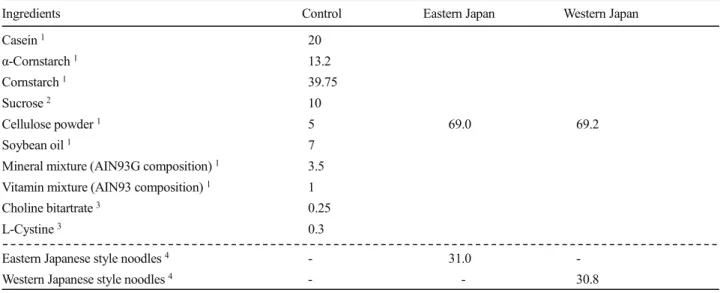
noodles; therefore, the experimental instant cup noodles were prepared by mixing these two products equally with the seasoning. The noodles were ground. Instant cup noodles are usually ingested as one of three daily meals; therefore, the rats were fed experimental instant cup noodles to make up one-third of their total calorie intake. The compositions of the experimental diets supplied to the animals are shown in Table 1. The food compositions of the experimental diets are shown in Table 2. The rats were kept for 28 days in total. The experimental diet and water were available at all times. Urine was collected, and its volume was measured for the experimental period.
Animals were deprived of their diets at 0900 on the 28th day but allowed free access to water until they were sacrificed, which was performed 4 h later. Blood was collected from the heart and left to clot at room temperature so that serum could be obtained. The liver and epididymal adipose tissue were quickly removed, washed with cold 0.9 % NaCl, blotted on filter paper, and weighed. The serum and liver were stored at -30 ℃ until lipid concentration analyses were Table 1. Composition of experimental diets. (g/100g)
Ingredients Control Eastern Japan Western Japan Casein 1 20
α-Cornstarch 1 13.2 Cornstarch 1 39.75 Sucrose 2 10
Cellulose powder 1 5 69.0 69.2 Soybean oil 1 7
Mineral mixture (AIN93G composition) 1 3.5 Vitamin mixture (AIN93 composition) 1 1 Choline bitartrate 3 0.25 L-Cystine 3 0.3
Eastern Japanese style noodles 4 - 31.0 - Western Japanese style noodles 4 - - 30.8
1 Oriental Yeast Co., Ltd., Tokyo, Japan.
2 Nissin Sugar Manufacturing Co., Ltd., Tokyo, Japan.
3 Wako Pure Chemical Industries, Ltd., Osaka, Japan.
4 Nissin Food Products Co., Ltd., Tokyo, Japan.
Table 2. Food composition of experimental diets. (per 100g)
Control Eastern Japan Western Japan Energy (kcal) 416 426 427 Protein (g) 20.3 (20)1 17.3 (16) 17.3 (16) Lipid (g) 7.0 (15) 10.5 (22) 10.7 (23) Carbohydrate (g) 68.0 (65) 65.6 (62) 65.4 (61) Sodium (mg) 102 844 812 Salt equivalents (g) 0.26 2.14 2.06
1 PFC (protein, fat, and carbohydrate) balance (%).
performed. Aliquots of the liver were also preserved in methanol and stored at 4 ℃ until analyses of the lipid content were performed.
Lipid analyses. Serum total cholesterol, HDL-cholesterol, triglyceride, phospholipid, and NEFA concentrations were determined by an enzymatic method using a Cholesterol E-test Wako, HDL-Cholesterol E-test Wako, Triglyceride E-test Wako, Phospholipid C-test Wako, and NEFA-C test Wako, respectively. All test kits were obtained from Wako Pure Chemical Industries, Ltd., Osaka, Japan. The difference between the total cholesterol concentration and the HDL-cholesterol concentration was regarded as the (VLDL+LDL)-cholesterol concentration. The ratio of the (VLDL+LDL)-cholesterol concentration to the HDL-cholesterol concentration is designated as the atherogenic index. The ratio of the HDL-cholesterol concentration to the total cholesterol concentration is designated as the HDL-cholesterol ratio.
Total lipids from the liver were extracted according to the procedure described by Folch et al.2) After portions of the chloroform phase had been dried under nitrogen, cholesterol,3) triglyceride,4) and phospholipid5) contents were determined.
The serum and liver thiobarbituric acid-reactive substance (TBARS) values were measured according to the method described by Yagi6) and Mihara et al.,7) respectively.
Statistical analyses. Results were expressed as mean ± standard error. Statistical analysis was carried out by one-way analysis of variance followed by Fisher’s protected least significant difference (PLSD) test using the SPSS Statistics, version 22 (IBM Japan, Ltd., Tokyo, Japan). A significance level of p < 0.05 was used for all the comparisons.
RESULTS
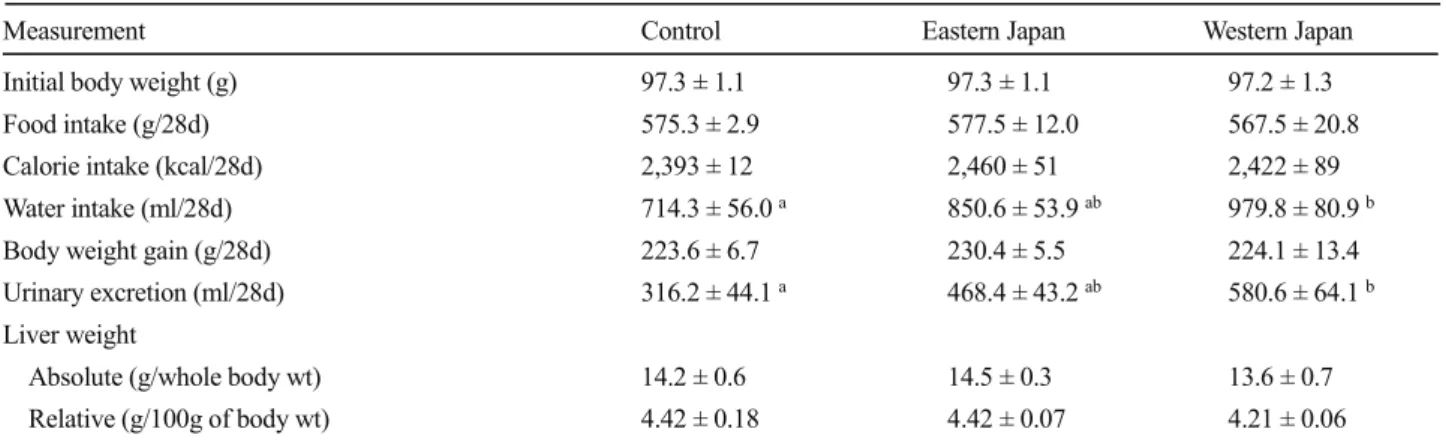
Table 3 shows the initial body weight, food, calorie and water intakes, body weight gain, and urinary excretion for the duration of the
28 days of experimental feeding, and the weight of the liver at the end of the experimental feeding period. The food and calorie intakes, and body weight gain were not significantly different among the three experimental diet groups. On the other hand, the water intake and urinary excretion in the western Japan diet group were significantly higher than those in the basal diet group, and those in the eastern Japan diet group were higher but without a significant difference as compared to the basal diet group. The liver weight was not significantly different among the three experimental diet groups in terms of both absolute and relative values.
Figure 1 shows the weight of the epididymal adipose tissue at the end of the experimental feeding period. The absolute weight in the eastern Japan diet group was significantly higher than that in the basal diet group, and that in the western Japan diet group was higher but without a significant difference as compared to the basal diet group.
The relative weight in the eastern Japan and western Japan diet groups was significantly higher than that in the basal diet group.
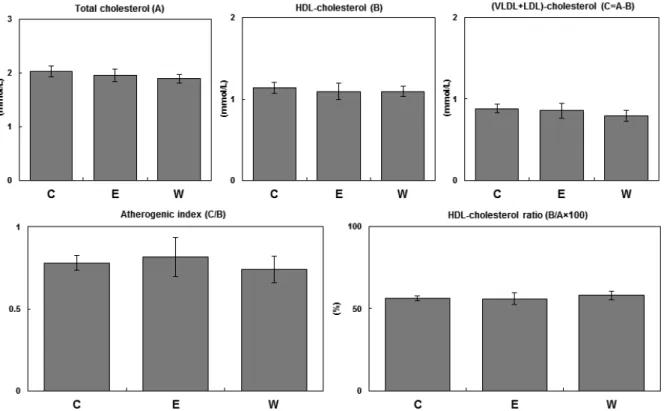
Serum cholesterol concentrations are shown in Figure 2. The serum total cholesterol concentration was not significantly different among the three experimental diet groups. As for the lipoprotein cholesterol concentrations, neither the HDL-cholesterol nor (VLDL+LDL)-cholesterol concentrations were significantly different among the three experimental diet groups. Therefore, there were no significant differences in the atherogenic index or HDL-cholesterol ratio among the three experimental diet groups.
Figure 3 shows the serum triglyceride, phospholipid, and NEFA concentrations. The serum triglyceride, phospholipid, and NEFA concentrations were not significantly different among the three experimental diet groups.
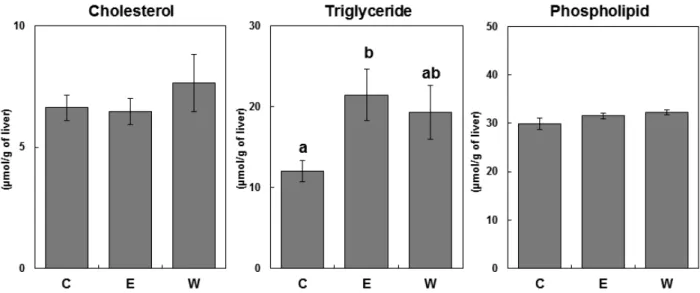
Liver lipid contents are shown in Figure 4. The liver cholesterol content was not significantly different among the three experimental diet groups. The liver triglyceride content in the eastern Japan diet Table 3. Initial body weight, food, calorie and water intakes, body weight gain, urinary excretion, and liver weight in rats fed different types of instant cup noodles.
Measurement Control Eastern Japan Western Japan Initial body weight (g) 97.3 ± 1.1 97.3 ± 1.1 97.2 ± 1.3 Food intake (g/28d) 575.3 ± 2.9 577.5 ± 12.0 567.5 ± 20.8 Calorie intake (kcal/28d) 2,393 ± 12 2,460 ± 51 2,422 ± 89 Water intake (ml/28d) 714.3 ± 56.0 a 850.6 ± 53.9 ab 979.8 ± 80.9 b Body weight gain (g/28d) 223.6 ± 6.7 230.4 ± 5.5 224.1 ± 13.4 Urinary excretion (ml/28d) 316.2 ± 44.1 a 468.4 ± 43.2 ab 580.6 ± 64.1 b Liver weight
Absolute (g/whole body wt) 14.2 ± 0.6 14.5 ± 0.3 13.6 ± 0.7 Relative (g/100g of body wt) 4.42 ± 0.18 4.42 ± 0.07 4.21 ± 0.06 Values represent the means ± standard errors for five rats. Values not sharing a common letter are significantly different at p < 0.05 by one-way analysis of variance followed by Fisher’s protected least significant difference (PLSD) test.
MATERIALS AND METHODS
Animals and diets. This animal experiment was conducted with the approval of the Iwate Prefectural University Research Ethics Committee.
Male Wistar rats (3-wk-old, Charles River Laboratories Japan, Inc., Kanagawa, Japan) were individually housed in stainless steel cages with wire bottoms in an air-conditioned room at a temperature of 22±2 ℃, relative humidity of 60±5 %, and a 12-h light cycle (0800-2000). Rats were fed a stock pellet diet (MF; Oriental Yeast Co., Ltd., Tokyo, Japan) followed by a basal diet1) for 6 days. Subsequently, the rats were divided into three groups (n=5) with similar body weights, and were fed the experimental diets; two groups were fed a diet containing instant cup noodles, and the other group was fed a basal diet.
The experimental instant cup noodles used in the present study included different types of seasoning and are usually only available on a limited basis in either eastern or western Japan. These two different types of instant cup noodles were both produced using udon and soba
noodles; therefore, the experimental instant cup noodles were prepared by mixing these two products equally with the seasoning. The noodles were ground. Instant cup noodles are usually ingested as one of three daily meals; therefore, the rats were fed experimental instant cup noodles to make up one-third of their total calorie intake. The compositions of the experimental diets supplied to the animals are shown in Table 1. The food compositions of the experimental diets are shown in Table 2. The rats were kept for 28 days in total. The experimental diet and water were available at all times. Urine was collected, and its volume was measured for the experimental period.
Animals were deprived of their diets at 0900 on the 28th day but allowed free access to water until they were sacrificed, which was performed 4 h later. Blood was collected from the heart and left to clot at room temperature so that serum could be obtained. The liver and epididymal adipose tissue were quickly removed, washed with cold 0.9 % NaCl, blotted on filter paper, and weighed. The serum and liver were stored at -30 ℃ until lipid concentration analyses were Table 1. Composition of experimental diets. (g/100g)
Ingredients Control Eastern Japan Western Japan Casein 1 20
α-Cornstarch 1 13.2 Cornstarch 1 39.75 Sucrose 2 10
Cellulose powder 1 5 69.0 69.2 Soybean oil 1 7
Mineral mixture (AIN93G composition) 1 3.5 Vitamin mixture (AIN93 composition) 1 1 Choline bitartrate 3 0.25 L-Cystine 3 0.3
Eastern Japanese style noodles 4 - 31.0 - Western Japanese style noodles 4 - - 30.8
1 Oriental Yeast Co., Ltd., Tokyo, Japan.
2 Nissin Sugar Manufacturing Co., Ltd., Tokyo, Japan.
3 Wako Pure Chemical Industries, Ltd., Osaka, Japan.
4 Nissin Food Products Co., Ltd., Tokyo, Japan.
Table 2. Food composition of experimental diets. (per 100g)
Control Eastern Japan Western Japan Energy (kcal) 416 426 427 Protein (g) 20.3 (20)1 17.3 (16) 17.3 (16) Lipid (g) 7.0 (15) 10.5 (22) 10.7 (23) Carbohydrate (g) 68.0 (65) 65.6 (62) 65.4 (61) Sodium (mg) 102 844 812 Salt equivalents (g) 0.26 2.14 2.06
1 PFC (protein, fat, and carbohydrate) balance (%).
group was significantly higher than that in the basal diet group, and that in the western Japan diet group was higher but without a significant difference as compared to the basal diet group. The liver phospholipid content was not significantly different among the three experimental diet groups.
Serum and liver TBARS values are shown in Figure 5. Neither the serum nor liver TBARS values were significantly different among the three experimental diet groups.
DISCUSSION
The feeding of the instant cup noodle affected the lipid profiles in rats. The absolute epididymal adipose tissue weight in the eastern Japan diet group was significantly higher than that in the basal diet group, and that in the western Japan diet group was higher but without a significant difference as compared to the basal diet group. The relative epididymal adipose tissue weight in the eastern and western Japan diet groups was significantly higher than that in the basal diet group without any difference in food intake. Furthermore, the liver triglyceride content in the eastern Japan diet group was significantly higher than that in the basal diet group, and that in the western Japan diet group was higher but without a significant difference as compared to the basal diet group.
It is known that a surplus intake of oils and fats causes triglyceride to accumulate in the body. In the present study, the lipid content in the experimental instant-cup-noodle-containing diet (eastern Japan (10.5 g) and western Japan (10.5 g)) was higher than that in the basal diet (7.0 g); therefore, the triglyceride intake and accumulation might have been increased, resulting in the increase in the epididymal adipose tissue weight and the liver triglyceride content in the instant-cup-noodle-containing diet groups as compared to the basal diet
group.
On the other hand, the ingestion of the instant cup noodles did not affect the serum and liver TBARS values. The TBARS value is an index of lipid peroxidation in the blood or tissues. Lipid peroxidizes at double bonds between carbon atoms. A previous study reported that there were no significant differences in the serum and liver TBARS values between beef fat and soybean oil diets.8) Beef fat includes high percentages of saturated fatty acids (mainly palmitic acid and stearic acid9)) and monounsaturated fatty acids (mainly oleic acid9)), and soybean oil includes high percentages of monounsaturated fatty acids (mainly oleic acid9)) and unsaturated fatty acids (mainly linoleic acid,17) which contains only two double bonds). In the present study, the basal diet included soybean oil, whereas the instant cup noodles included plant oils, both of which include many double-bond-poor unsaturated fatty acids. Thus, the degree of fatty acid peroxidation in the body induced by ingestion of the instant cup noodle diet is likely to be almost the same in comparison to the basal diet; therefore, the serum and liver TBARS values might not be significantly different between the basal and instant-cup-noodle-containing diet groups.
The serum total, HDL-, and (VLDL+LDL)-cholesterol concentrations were not significantly affected by the ingestion of the instant cup noodles. The serum cholesterol concentration is known to be changed by fatty acids. For example, animal fats, including many saturated fatty acids, elevate the serum cholesterol concentration, whereas plant oils, including many unsaturated fatty acids, reduce it. In the present study, the basal diet included soybean oil, whereas the instant cup noodles included plant oils. The fatty acid composition of the plant oils is unknown, though the fatty acid composition of the instant cup noodle diet is likely to be almost the same as that of soybean Fig. 1. Effects of the feeding of different types of instant noodles on absolute and relative epididymal adipose tissue weight in rats. Values represent the means for five rats. Vertical bars indicate standard errors. Values not sharing a common letter are significantly different at p < 0.05 by one-way analysis of variance followed by Fisher’s protected least significant difference (PLSD) test. C, basal diet (control) group; E, eastern Japan style instant noodle diet group; W, western Japan style instant noodle diet group..
oil because these two oils are both plant oils. Therefore, this may be why the serum total, HDL-, and (VLDL+LDL)-cholesterol concentrations were not significantly different between the basal and instant-cup-noodle-containing diet groups.
In the present study, the urinary excretion in the western Japan diet group was significantly higher than that in the basal diet group, and that in the eastern Japan diet group was higher but without a significant
difference as compared to the basal diet group without any difference in food intake. The salt equivalents per 100 g of the basal, eastern Japan, and western Japan diets were 0.26 g, 2.18 g, and 2.08 g, respectively.
The increase in the urinary excretion is considered to be a result of an increase in the water intake caused by an increase in the salt intake. A surplus intake of salt enhances the osmotic pressure in the blood and the water intake is increased in order to reduce the osmotic pressure, Fig. 2. Effects of the feeding of different types of instant cup noodles on serum cholesterol concentration, atherogenic index, and high-density lipoprotein (HDL)-cholesterol ratio in rats. Values represent the means for five rats. Vertical bars indicate standard errors. C, basal diet (control) group; E, eastern Japan style instant noodle diet group; W, western Japan style instant noodle diet group.
Fig. 3. Effects of the feeding of different types of instant cup noodles on serum triglyceride, phospholipid, and nonesterified fatty acid (NEFA) concentrations in rats. Values represent the means for five rats. Vertical bars indicate standard errors. C, basal diet (control) group; E, eastern Japan style instant noodle diet group; W, western Japan style instant noodle diet group.
group was significantly higher than that in the basal diet group, and that in the western Japan diet group was higher but without a significant difference as compared to the basal diet group. The liver phospholipid content was not significantly different among the three experimental diet groups.
Serum and liver TBARS values are shown in Figure 5. Neither the serum nor liver TBARS values were significantly different among the three experimental diet groups.
DISCUSSION
The feeding of the instant cup noodle affected the lipid profiles in rats. The absolute epididymal adipose tissue weight in the eastern Japan diet group was significantly higher than that in the basal diet group, and that in the western Japan diet group was higher but without a significant difference as compared to the basal diet group. The relative epididymal adipose tissue weight in the eastern and western Japan diet groups was significantly higher than that in the basal diet group without any difference in food intake. Furthermore, the liver triglyceride content in the eastern Japan diet group was significantly higher than that in the basal diet group, and that in the western Japan diet group was higher but without a significant difference as compared to the basal diet group.
It is known that a surplus intake of oils and fats causes triglyceride to accumulate in the body. In the present study, the lipid content in the experimental instant-cup-noodle-containing diet (eastern Japan (10.5 g) and western Japan (10.5 g)) was higher than that in the basal diet (7.0 g); therefore, the triglyceride intake and accumulation might have been increased, resulting in the increase in the epididymal adipose tissue weight and the liver triglyceride content in the instant-cup-noodle-containing diet groups as compared to the basal diet
group.
On the other hand, the ingestion of the instant cup noodles did not affect the serum and liver TBARS values. The TBARS value is an index of lipid peroxidation in the blood or tissues. Lipid peroxidizes at double bonds between carbon atoms. A previous study reported that there were no significant differences in the serum and liver TBARS values between beef fat and soybean oil diets.8) Beef fat includes high percentages of saturated fatty acids (mainly palmitic acid and stearic acid9)) and monounsaturated fatty acids (mainly oleic acid9)), and soybean oil includes high percentages of monounsaturated fatty acids (mainly oleic acid9)) and unsaturated fatty acids (mainly linoleic acid,17) which contains only two double bonds). In the present study, the basal diet included soybean oil, whereas the instant cup noodles included plant oils, both of which include many double-bond-poor unsaturated fatty acids. Thus, the degree of fatty acid peroxidation in the body induced by ingestion of the instant cup noodle diet is likely to be almost the same in comparison to the basal diet; therefore, the serum and liver TBARS values might not be significantly different between the basal and instant-cup-noodle-containing diet groups.
The serum total, HDL-, and (VLDL+LDL)-cholesterol concentrations were not significantly affected by the ingestion of the instant cup noodles. The serum cholesterol concentration is known to be changed by fatty acids. For example, animal fats, including many saturated fatty acids, elevate the serum cholesterol concentration, whereas plant oils, including many unsaturated fatty acids, reduce it. In the present study, the basal diet included soybean oil, whereas the instant cup noodles included plant oils. The fatty acid composition of the plant oils is unknown, though the fatty acid composition of the instant cup noodle diet is likely to be almost the same as that of soybean Fig. 1. Effects of the feeding of different types of instant noodles on absolute and relative epididymal adipose tissue weight in rats. Values represent the means for five rats. Vertical bars indicate standard errors. Values not sharing a common letter are significantly different at p < 0.05 by one-way analysis of variance followed by Fisher’s protected least significant difference (PLSD) test. C, basal diet (control) group; E, eastern Japan style instant noodle diet group; W, western Japan style instant noodle diet group..
resulting in maintenance of the electrolyte concentrations. In the present study, the water intake in the western Japan diet group was significantly higher than that in the basal diet group, and that in the eastern Japan diet group was higher but without a significant difference as compared to the basal diet group; therefore, this may be why the urinary excretion in the western Japan diet group was significantly higher than that in the basal diet group, and that in the eastern Japan diet group was higher but without a significant difference as compared to the basal diet group.
The effects of feeding of different types of seasoning in products that were otherwise the same of the instant cup noodles were examined
in addition to the effect of instant cup noodle ingestion, and there were no significant differences in all parameters measured in the present study. The food composition of the two types of experimental instant cup noodles were almost the same (Table 2); therefore, this may be why there were no significant differences between the instant-cup-noodle-containing eastern Japan and western Japan diet groups.
In conclusion, the feeding of instant cup noodles affected the lipid profiles in rats. Instant cup noodle ingestion increased the epididymal adipose tissue weight and liver triglyceride content, resulting in Fig. 4. Effects of the feeding of different types of instant cup noodles on liver lipid contents in rats. Values represent the means for five rats. Vertical bars indicate standard errors. Values not sharing a common letter are significantly different at p < 0.05 by one-way analysis of variance followed by Fisher’s protected least significant difference (PLSD) test. C, basal diet (control) group; E, eastern Japan style instant noodle diet group; W, western Japan style instant noodle diet group.
Fig. 5. Effects of the feeding of different types of instant cup noodles on serum and liver thiobarbituric acid-reactive substance (TBARS) values in rats. Values represent the means for five rats. Vertical bars indicate standard errors. C, basal diet (control) group; E, eastern Japan style instant noodle diet group; W, western Japan style instant noodle diet group.
triglyceride accumulation in the body, which often accompanies the surplus intake of oils and fats. Furthermore, the instant cup noodle ingestion enhanced the water intake, likely due to a surplus intake of salt, resulting in an increase in urinary excretion. The surplus intake of oils and fats might lead to a risk of developing dyslipidemia and obesity.10) The surplus intake of salt is often considered to induce hypertension.11) Therefore, it is important to limit the ingestion of instant cup noodles as much as possible to prevent the development of such lifestyle-related diseases, and to ensure the intake of a well-balanced diet.
REFERENCES
1) Reeves, P. G., Nielsen, F. H., and Fahey, G. C. Jr., AIN-93 purified diets for laboratory rodents: Final report of the American Institute of Nutrition ad hoc writing committee on the reformulation of the AIN-76A rodent diet, J. Nutr., 123, 1939-1951 (1993).
2) Folch, J., Lees, M., and Sloane-Stanley, G. H., A simple method for the isolation and purification of total lipides from animal tissues, J.
Biol. Chem., 226, 497-509 (1957).
3) Zak, B., Simple rapid microtechnic for serum total cholesterol, Am. J.
Clin. Path., 27, 583-588 (1957).
4) van Handel, E., Suggested modifications of the micro determination of triglycerides, Clin. Chem., 7, 249-251 (1961).
5) Chen, P. S., Toribara, T. Y., and Warner, H., Microdetermination of phosphorus, Anal. Chem., 28, 1756-1758 (1956).
6) Yagi, K., A simple fluorometric assay for lipoperoxide in blood plasma, Biochem Med., 15, 212-216 (1976).
7) Mihara, M., and Uchiyama, M., Determination of malonaldehyde precursor in tissues by thiobarbituric acid test, Anal. Biochem., 86, 271-278 (1978).
8) Kawasaki, M., Oikawa, T., Kudo, C., Fujisawa, A., and Mizuno, S., Effects of the feeding of oil and fat derived from different kinds of foods on serum and liver lipid levels in rats, Bulletin of Morioka Junior College, Iwate Prefectural University, 15, 21-27 (2013).
9) Standard tables of food composition in Japan, Fifth revised and enlarged edition, Fatty acids section, Council for Science and Technology, Ministry of Education, Culture, Sports, Science and Technology, Japan (2005).
10) Tsuduki, T., Kitano, Y., Honma, T., Kijima, R., and Ikeda, I., High dietary fat intake during lactation promotes development of diet-induced obesity in male offspring of mice, J. Nutr. Sci. Vitaminol., 59, 384-392 (2013).
11) He, F. J., Li, J., and Macgregor, G. A., Effect of longer-term modest salt reduction on blood pressure, Cochrane Database Syst. Rev., CD004937 (2013).
和文要旨 インスタントカップ麺摂取の血清および肝臓脂質レベルに対する影響をラットにおいて検討した。ラットには一 般に東日本と西日本で異なる種類の調味料で販売され摂取されているインスタントカップ麺を与えた。インスタントカップ麺は一 般に,毎日の食事の3食のうちの1食として摂取することから,総エネルギー摂取量の3分の1をインスタントカップ麺としてラ ットに与えた。副睾丸脂肪組織の絶対重量が,基本食摂取に比べて東日本食摂取によって有意に増加し,西日本食摂取によって増 加の傾向を示した。相対重量は,東日本食,西日本食両摂取によって基本食摂取に比べて有意に増加した。肝臓トリグリセリド含 量が,基本食摂取に比べて東日本食摂取によって有意に増加し,西日本食摂取によって増加の傾向を示した。さらに,飲水量と尿 排泄量が,基本食摂取に比べて西日本食摂取によって有意に増加し,東日本食摂取によって増加の傾向を示した。インスタントカ ップ麺の摂取によって,過剰な油脂の摂取による副睾丸脂肪組織と肝臓トリグリセリド含量の増加によるトリグリセリドの蓄積を もたらし,さらに,塩分の過剰摂取によることが知られている飲水量の増加によって尿排泄量の増加をもたらした。インスタント カップ麺の摂取は,油脂の過剰摂取による脂質異常症および肥満や,塩分の過剰摂取による高血圧症を発症させる危険性が高くな る恐れがあるため,そのような生活習慣病発症を防ぎ,また,バランスのとれた食事を確保するために,摂取をできる限り控える ことが望ましい。
resulting in maintenance of the electrolyte concentrations. In the present study, the water intake in the western Japan diet group was significantly higher than that in the basal diet group, and that in the eastern Japan diet group was higher but without a significant difference as compared to the basal diet group; therefore, this may be why the urinary excretion in the western Japan diet group was significantly higher than that in the basal diet group, and that in the eastern Japan diet group was higher but without a significant difference as compared to the basal diet group.
The effects of feeding of different types of seasoning in products that were otherwise the same of the instant cup noodles were examined
in addition to the effect of instant cup noodle ingestion, and there were no significant differences in all parameters measured in the present study. The food composition of the two types of experimental instant cup noodles were almost the same (Table 2); therefore, this may be why there were no significant differences between the instant-cup-noodle-containing eastern Japan and western Japan diet groups.
In conclusion, the feeding of instant cup noodles affected the lipid profiles in rats. Instant cup noodle ingestion increased the epididymal adipose tissue weight and liver triglyceride content, resulting in Fig. 4. Effects of the feeding of different types of instant cup noodles on liver lipid contents in rats. Values represent the means for five rats. Vertical bars indicate standard errors. Values not sharing a common letter are significantly different at p < 0.05 by one-way analysis of variance followed by Fisher’s protected least significant difference (PLSD) test. C, basal diet (control) group; E, eastern Japan style instant noodle diet group; W, western Japan style instant noodle diet group.
Fig. 5. Effects of the feeding of different types of instant cup noodles on serum and liver thiobarbituric acid-reactive substance (TBARS) values in rats. Values represent the means for five rats. Vertical bars indicate standard errors. C, basal diet (control) group; E, eastern Japan style instant noodle diet group; W, western Japan style instant noodle diet group.