Effects of Korean Red Pepper on Lipid Metabolism in the Rats
Sho Nakamura, Hiroki Hamada* and Akiyoshi Moriwaki
Effects of Korean red pepper on lipid metabolism were investigated using the rats. The red pepper was orally administrated as a part of diet. Daily intake of the red pepper decreased plasma triglyceride and deposit fat. The red pepper taken as a diet influences lipid metabolism and may have preventive effects on lifestyle-related disease.
Key Words : Pepper, Lipid Metabolism, Diet, Rat
Introduction
Pepper ( ) is a native plant in Central or South America, the fruit and seeds of which are used for food and spices. Pepper tastes hot due to the functional molecules such as capsaicin and dihydrocapsaicin that they contain. They are members of the capsaicinoids and have physiological functions in humans such as activation of fat metabolism, promotion of appetite, heat generation, and perspiration. These physiological functions of capsaicinoids are intermediated by increased secretion of catecholamines [1, 2]. The pepper has a potential to prevent lifestyle related disease by affecting fat metabolism as a functional food.
However, it is difficult to intake a large quantity of pepper because of its pungency. Korean red pepper contains less capsaicin and dihydrocapsaicin, and much more capsaicin glycoside and capsiate than Japanese the red Takanotsume pepper. So, Korean red pepper is less pungent, and it is possible to ingest larger quantities as a vegetable. In this study we
investigated the effect of Korean red pepper on fat metabolism through oral intake as a part of diet.
Materials and Methods
Male Wistar rats 4 weeks old (Charles River Laboratories Japan, Inc. ) were used. They were housed individually in cages on a standard 12 h light/12h dark cycle at 24±2℃, humidity 60±5オ, with food and water available ad libitum. All animal use procedures were in strict accordance with the Act on Welfare and Management of Animals in Japan.
When the rats grew up to 250 g, they were divided into four groups: a control group receiving a standard diet (Oriental Yeast CO., LTD, MF), group R receiving a standard diet and 10オ red pepper, group SR receiving a standard diet, 30オ white sugar and 10オ red pepper and group S receiving 30オ white sugar. All groups were fed ad libitum for 7 to 8 weeks. Constituent parts of the diets are shown in Table 1. Dried Red pepper was produced in Korea and purchased from the National Agricultural Cooperative Federation, Imsil County, Korea. The red pepper is the Shinjokwang species, which contains 0.1 to 0.5オ capsaicin glycoside and approximately 1.3オ capsaicin. Compared with the Japanese pepper species Takanotsume, which
* ン ン
Copyright© 2014 by Chugokugakuen
http://www.cjc.ac.jp/
Corresponding author.
Akiyoshi Moriwaki
Department of Human Nutrition, Faculty of Contemporary Life Science, Chugokugakuen University, 83, Niwase, Kitaku, Okayama 701ン0197, Japan Tel ; + 81 86 293 0247 Fax ; + 81 86 293 2798
contains approximately 4オ capsaicin, the Korean red pepper is less piquant and pungent. The red pepper added to the diets was ground into powder and filtrated through a 500μm mesh. The body weight, weight of food intake and weight of stool were measured. Some stool was used to detect excreted cholesterol. Blood was collected from the tail vain under ether anesthesia between 14:00 and 15:00, and the plasma was separated. Eight weeks after the feed, the rats were killed under deep anesthesia.
The visceral adipose tissue around the testicles and posterior abdominal wall was removed and the weight was measured, and the small and large intestines were removed and weighed. The liver was also removed and weighed, and a sample removed for histological analysis.
The plasma was analyzed by Dry‑Chem (FUJIFILM Medical Co., Ltd. ). Triglyceride, triglyceride associated lipoproteins namely total cholesterol (TC) and HDL‑cholesterol were measured. Arteriosclerotic index (AI) was calculated.
Non HDL‑cholesterol was calculated by subtraction of the HDL‑cholesterol value from the TC value.
The cholesterol in the stool was measured using the Zak‑Henly method, after extraction by mixing it with chloroform-methanol (v/v 2:1).
The results are expressed as the mean±S.E.
Statistical significance was evaluated by analysis of variance, followed by Studentʼs t‑test. Values of p<0.05 were regarded as statistically significant.
Results
Growth rate was assessed by the increase in body weight in each group. Growth rate did not change and the rats showed a similar growth rate regardless of the diets (Fig. 1). Statistical significant differences were not observed in the daily intake of the diet among the groups, but group SR and group R showed an
increased tendency in diet uptake (Fig. 2).
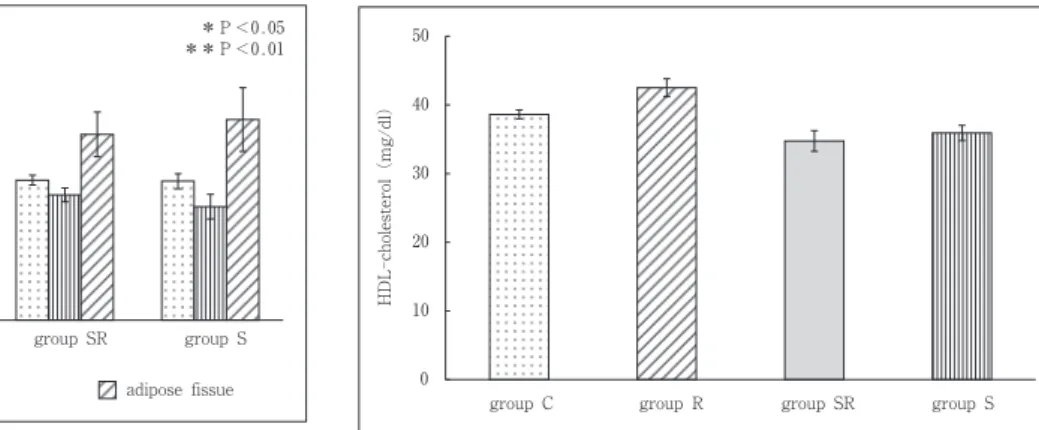
Concerning the weight of the visceral adipose tissue, group R showed significantly decreased weight compared to the control (Fig. 3). In addition, group R showed significantly decreased weight of the intestines compared to the control group.
No difference was observed in plasma concentration of triglyceride among the groups (Fig. 4). The concentration of total cholesterol
0 50 100 150 200 250 300 350 400 450
3 10 17 24 31 38 45 52 59 66
Days
group C group R group SR group S
Body weight (g)
Fig. 1 Increase in the body weight of the rats by group
0 5 10 15 20 25 30 35
3 10 17 24 31 38 45 52 59
Day group C group R
Diet intake (g/day)
group S group SR
Fig. 2 Daily diet intake of the rats by group Table 1 Constituents of the diets/100g
Energy (kcal) Water (g) Protein (g) Fat (g) Carbohydrate (g) Ash (g) Dietary fiber (g)
Control 66.6 1.4 4.4 1 10.1 10.1 0.5
10% red pepper 67.7 1.3 4.2 1.1 10.3 10.3 0.5
30% sugar 67.9 1 3.1 0.7 12.6 12.6 0.4
10% red pepper and 30% sugar 69.0 0.9 2.9 0.8 12.8 12.8 0.3
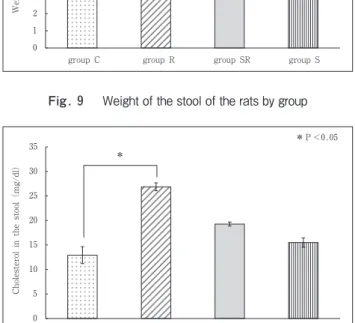
was significantly lower in the groups R and SR compared to the control group (Fig. 5). However, the concentration of HDL‑cholesterol did not significantly change among the groups (Fig. 6). Furthermore, AI did not change among the groups (Fig. 7). The non
HDL‑cholesterol value was significantly lower in group R compared to the control group (Fig. 8).
Group R showed significantly increased weight of the stool compared to the control group, and group SR also showed significantly increased weight of
0 5 10 15 20 25 30 35
Weight (g)
group C group R group SR group S
*P<0.05
**P<0.01
*
**
liver intestime adipose fissue
Fig. 3 Tissue weight of the rats by group
Tryglyceride (mg/dl)
0 50 100 150 200 250
group C group R group SR group S
Fig. 4 Plasma triglyceride concentration of the rats by group
Total cholesterol (mg/dl)
0 10 20 30 40 50 60 70 80
group C group R group SR group S
**P<0.01
**
**
Fig. 5 Total plasma cholesterol concentration of the rats by group
0 10 20 30 40 50
HDL‑cholesterol (mg/dl)
group C group R group SR group S
Fig. 6 Plasma HDL‑cholesterol of the rats by group
Arteriosclerotic index
0.0 0.1 0.2 0.3 0.4 0.5 0.6 0.7
group C group R group SR group S
Fig. 7 Arteriosclerotic index of the rats by group
0 5 10 15 20 25 30
Non HDL‑cholesterol (mg/dl)
group C group R group SR group S
Fig. 8 Non HDL‑cholesterol value of the rats by group
the stool compared to group S (Fig. 9). Excreted cholesterol in the stool increased in group R compared to the control group (Fig. 10).
Discussion
The results of this study clearly show that orally taken red pepper reduced plasma TC and deposit fat, but has no influence on plasma triglyceride.
Red pepper therefore influences fat metabolism, especially lipoprotein and adiposity. Few studies have investigated the effects of orally administered red pepper on fat metabolism. It is the pungent components or ingredients of the red pepper that probably influence fat metabolism. One of the molecules is capsaicin, and the effects of capsaicin on triglyceride or cholesterol have been investigated.
Capsaicin has been shown to lower plasma triglycerides and triglycerides associated lipoproteins
[3, 4]. In agreement with these previous research, the results of this study showed a similar influence on fat metabolism. The red pepper administered in this study contains less capsaicin but much more capsaicin glycoside and capsiate, so it is conceivable that capsaicin glycoside and capsiate exert the same effect on fat metabolism as capsaicin. The red pepper contains several kinds of capsaicinoids, so it is possible that a synergistic effect has been observed in this experiment. A recent study has revealed that capciate and capsaicin bind to the same receptor but capcitate did not induce nociception [5]. The other capsaicinoides contained in the red pepper may bind to the receptor and exert effects. Further analysis of the capsaicinoides and verification of the effect are necessary to clarify the nutrient function of the red pepper.
The two groups of rats fed red pepper (group R and group SR) showed an increased tendency for food intake. This result supports the notion that red pepper has an appetite promotion effect [6].
Group R tended to take in much more food but the body weight did not increase by much, and showed decreased visceral adipose weight. This is probably a result of enhanced energy expenditure due to the red pepper and consequent inhibition to reserve fat.
Capsaicin induced reduction of adipose tissue has been reported, and different doses of capsaicin affect the volume of food intake and energy expenditure [7].
Group SR tended to increase body weight, appetite promotion effect and additional calorie intake through sugar, resulting in increased deposits of energy in adipose tissue. In the SR group the energy intake was enhanced much more than energy expenditure due to the red pepper.
The effects of red pepper on physiological function have been investigated previously. Capsaicin activates the sympathetic nervous system and increases catecholamine secretion from the adrenal gland. The secreted catecholamines bind with the β‑adrenergic receptors and exert the effects [8].
So, the effect or influence of red pepper must be intermediated by hormones and the autonomic nervous system. Another recent study has also revealed that capsaicin, capsiate and an analogue of capsaicin bind to capsaicin-binding transient potential vanilloid 1 (TRPV1) receptors. However, their physiological effects are different [5]. TRPV1 receptors are found
0 1 2 3 4 5 6 7 8 9 10
Weight of the stool (g)
*P<0.05
*
*
group C group R group SR group S
Fig. 9 Weight of the stool of the rats by group
0 5 10 15 20 25 30 35
Cholesterol in the stool (mg/dl)
*P<0.05
*
group C group R group SR group S
Fig. 10 Excreted cholesterol in the stool of the rats by group
mainly in the nociceptive neurons of the peripheral nervous system, but they have also been described in many other tissues, including the central nervous system [9, 10]. Capsaicin-like substances also gate TRPV1 receptors [11]. TRPV1 receptors in the hypothalamus probably influence appetite generation, and the capsaicinoids in the red pepper presumably exerts appetite promotion through the receptors.
Capsaicin-induced reduction of plasma triglyceride and cholesterol have also been reported [2, 3, 8].
Capsaicin activates lipase and decreases plasma cholesterol [12]. However, the results of this study did not show decreased plasma triglyceride due to red pepper ingestion. A much higher intake of red pepper may result in agreement with the results of previous reports. Capsaicin lowered the activity of HMG‑CoA reductase, and enhanced the activity of cholesterol 7α‑hydroxylase[13]. In addition, capsaiciniods inhibit cholesterol absorption, reduce resorption of bile acid and effectively lower plasma cholesterol level [14]. The results of this study showed increased cholesterol excretion in the rats fed red peppers, indicating the decreased absorption of cholesterol or resorption of bile acids by red pepper.
Recent reports have revealed that capsaicin affects adipokine levels and glucose metabolism through insulin sensitivity [15, 16]. These results suggest that capcinoids have similar effects on metabolism as capsaicin. A new method has been developed to convert capsaicin to capciate [17]. Less pungent capsaicinoids including capciate can be taken in much larger quantities in humans with the potential to improve fat and glucose metabolism. Korean red pepper, taken in larger quantities as a vegetable, may reduce or prevent lifestyle-related disease.
References
1. Iwai K and Watanebe T: Red Peppers Science of Pungency (2008) Saiwai Shobo (in Japanese).
2. Kawata T, Hagihara K and Iwai K: Effects of capsaicin on lipid metabolism in rats fed a high fat diet. J Nutrition (1986) 116, 1272‑ 1278.
3. Monsereenusorn Y: Subchronic toxicity studies of capsaicin and capsicum in rats. Res Commun Chem Pathol Pharmacol (1983) 41,
95‑110.
4. Negulesco JA, Young RM and Ki P: Capsaicin lowers plasma cholesterol and triglycerides of lagomorphs. Artery (1985) 12, 301‑ 311.
5. Tsurugizawa T, Nogusa Y, Ando Y and Uneyama H: Different TRPV1‑mediated brain responses to intragastric infusion of capsaicin and capsiate. Eur J Neurosci (2013) 38, 3628‑3635.
6. Yoshioka M, St‑Pierre S, Drapeau V, Dionne I, Doucet E, Suzuki M and Tremblay A: Effects of red pepper on appetite and energy intake. Br J Nutr (1999) 82, 115‑123.
7. Ludy MJ, Moore GE and Mattes RD: The effects of capsaicin and capsiate on energy balance: critical review and meta-analyses of studies in humans. Chem Senses (2012) 37, 103‑102.
8. Watanabe T, Kawada T, Yamamoto M and Iwai K: Capsaicin, a pungent principle of hot red pepper, evokes catecholamine secretion from the adrenal medulla of anesthetized rats. Biochem Biophys Res Commun (1987) 142, 259‑264.
9. Srinivasan MR and Satyanarayana MN: Effect of capsaicin on skeletal muscle lipoprotein lipase in rats fed high fat diet, Indian J Exp Biol (1989) 10, 910‑912.
10. Cui M, Honore P, Zhong C, Gauvin D, Mikusa J, Hernandez G, Chandran P, Gomtsyan A, Brown B, Bayburt EK, Marsh K, Bianchi B, McDonald H, Niforatos W, Neelands TR, Moreland RB, Decker MW, Lee CH, Sullivan JP and Faltynek CR: TRPV1 receptors in the CNS play a key role in broad-spectrum analgesia of TRPV1 antagonists. J Neurosci (2006) 26, 9385‑9393.
11. Huang SM1, Bisogno T, Trevisani M, Al‑Hayani A, De Petrocellis L, Fezza F, Tognetto M, Petros TJ, Krey JF, Chu CJ, Miller JD, Davies SN, Geppetti P, Walker JM and Di Marzo V: An endogenous capsaicin-like substance with high potency at recombinant and native vanilloid VR1 receptors. Proc Natl Acad Sci USA. (2002) 99, 8400‑8405.
12. Srinivasan MR and Chandrasekhara N: Comparative influence of vanillin & capsaicin on liver & blood lipids in the rat. Ind J Med Res (1992) 96, 133‑135.
13. Srinivasan K and Sambaiah K: The effect of spices on cholesterol 7 alpha-hydroxylase activity and on serum and hepatic cholesterol levels in the rat. Int J Vitam Nutr Res (1991) 61, 364‑369.
14. Zhang L, Zhou M, Fang G, Tang Y, Chen Z and Liu X : Hypocholesterolemic effect of capsaiciniods by increased bile acids excretion in ovariectomized rats. Mol Nutr Food Res (2013) 57, 1080‑1088.
15. Lee GR, Shin MK, Yoon DJ, Kim AR, Yu R, Park NH and Han IS: Topical application of capsaicin reduces visceral adipose fat by affecting adipokine levels in high-fat diet-induced obese mice.
Obesity (Silver Spring). (2013) 21, 115‑122.
16. Kwon DY, Kim YS, Ryu SY, Cha MR, Yon GH, Yang HJ, Kim MJ, Kang S and Park S: Capsiate improves glucose metabolism by improving insulin sensitivity better than capsaicin in diabetic rats. J Nutr Biochem (2013) 24, 1078‑1085.
17. Ishihara K, Kwon SI, Masuoka N, Nakajima N and Hamada H: One-procedure synthesis of capsiate from capsaicin by lipase- catalyzed dynamic transacylation. World J Microbiol Biotechnol (2010) 26, 1337‑1340.
Accepted March 31, 2014.