INVITED PAPER
Special Section on Medical Information Communication Technology for Disaster Recovery and Human Health Care SupportApplication of a Telemedical Tool in an Isolated Island and a Disaster Area of the Great East Japan Earthquake
Makoto YOSHIZAWA†a), Tomoyuki YAMBE††, Norihiro SUGITA†††, Satoshi KONNO††, Makoto ABE†††, Noriyasu HOMMA†, Futoshi TAKEI††††, Katsuhiko YOKOTA†††††, Yoshifumi SAIJO††††††, andShin-ichi NITTA∗,Nonmembers
SUMMARY The present paper has reported a case study of the “Elec- tronic Doctor’s Bag” which is a telemedical tool for home-visit medical services using the mobile communications environment in an isolated is- land and a disaster area hit by the tsunami. Clinical trials performed for 20 patients around a clinic in Miyako Island indicated that the communi- cation functions of the proposed system were highly evaluated by patients as well as medical staffs. However, the system still has room for further improvement in operability, portability and mobile communication envi- ronment. The experience at the shelter in Kesennuma City suggested that mobile healthcare tools such as the proposed system will be strongly re- quired when there are no or only paramedical staffs after leaving of emer- gency medical staffs.
key words: the Great East Japan Earthquake, telemedicine, isolated is- land, disaster area, mobile communication
1. Introduction
On March 11, the giant tsunami in the Great East Japan Earthquake hit the coastal areas of Tohoku district and fully destroyed their environment of life. For several months after the tsunami, the disaster victims who lost their houses were forced to live in shelters such as school gymnasiums with a horrible environment. Currently almost all the victims have moved to temporary houses whose healthcare environment is not always good.
However, the healthcare environment in Tohoku region has already been in a critical state because the uneven distri- bution of medical doctors has been widened due to an aging and declining population. It can be easily predicted that the disaster will accelerate the deterioration of this serious prob- lem.
On the contrary, this case will become a touchstone for solution of the same problem as all other rural areas in Japan
Manuscript received January 31, 2012.
Manuscript revised March 21, 2012.
†The authors are with Cyberscience Center, Tohoku University, Sendai-shi, 980-8578 Japan.
††The authors are with Institute of Development, Aging and Cancer, Tohoku University, Sendai-shi, 980-8574 Japan.
†††The authors are with the Graduate School of Engineering, Tohoku University, Sendai-shi, 980-8579 Japan.
††††The author is with Umyaasu N Clinic, Miyakojima-shi, 906- 0013 Japan.
†††††The author is with Tokyo Denki University, Tokyo, 101-8457 Japan.
††††††The author is with the Graduate School of Biomedical Engi- neering, Tohoku University, Sendai-shi, 980-8579 Japan.
∗The author is an emeritus professor of Tohoku University.
a) E-mail: [email protected] DOI: 10.1587/transcom.E95.B.3067
as well as Tohoku region are facing. The use of information and communication technology (ICT) may be a possible so- lution for such issues.
To prevent crisis in the nation’s deficit-ridden health in- surance system, the Japanese government is promoting the policy of home medical care. The healthcare insurance re- form in 2006 newly established the home care support clinic system which intends to spread the clinics operating house visit services on 24-hour schedules [1].
However, in the case of a small clinic, a doctor may be forced to work in sleepless and hard working environ- ment and the doctor’s transportation time to patients’ homes reduces the efficiency of medical care. Moreover, the remu- neration for medical services decided by the system is not enough to spread the home care support clinics.
In this situation, Tohoku University established a con- sortium “The Consortium for Medical Information Commu- nications System in the Mobile Environment” on March 4, 2009. The main purpose of this consortium is to provide the ubiquitous communications system not only for home- visit medical services but also for mass health examination, emergency care, and disaster areas. In collaboration with the Sendai Area Knowledge Cluster Initiative supported by the Ministry of Education, Science, Culture and Sports in Japan, the consortium developed a prototype of communi- cations system, named “Electronic Doctor’s Bag” in 2009.
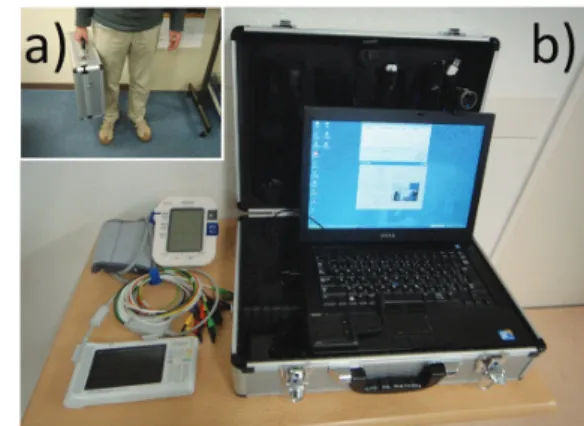
After evaluation of its function at a few clinics [2], a new version has newly developed in 2010 as shown in Fig. 1.
The purpose of this system is that instead of a doc- tor, a nurse carries the Electronic Doctor’s Bag and visits
Fig. 1 Electronic Doctor’s Bag. a) Carrying mode. b) Operation mode.
Copyright c2012 The Institute of Electronics, Information and Communication Engineers
a patient’s home but an equivalent face-to-face communica- tion between the doctor in his or her clinic and the patient at home can be realized by sending biological information with multiple high-definition images.
This paper will report the results of field tests of the proposed telemedical tool applied in an isolated island and a disaster area of the Great East Japan Earthquake.
2. Methods
2.1 Basic Function of Electronic Doctor’s Bag
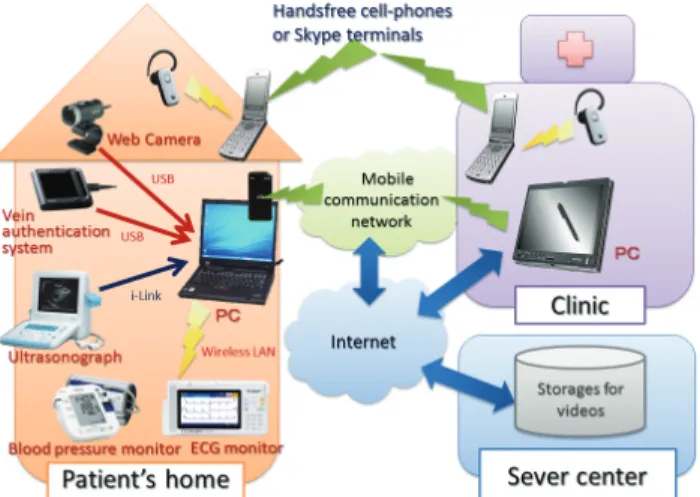
Figure 2 shows the framework of the Electronic Doctor’s Bag. First, personal verification of the patient is done with a vein authentication to avoid mixing-up among patients.
Secondly, to verify the patient’s state such as complexion, movement and gait, his high resolution video picture is taken, highly compressed and coded for preserving individ- ual security in a real time fashion. This signal is sent to the medical doctor staying in his own clinical office via a mobile communications system of cellular phones and the Internet.
The main targets of the proposed system are general chronic diseases such as circulatory disease, diabetes and the respiratory organ disease. Not only patient’s high- definition video image to doctors to provide just like face- to-face examination but also various kinds of biological data are measured with an electrocardiographic (ECG) monitor, a blood-pressure meter, a blood sugar level meter and an ultra- sonic diagnostic system. These data are connected directly with the main body of the Bag via USB interface or wireless communication line and also compressed, coded and sent to the doctor as automatically as the nurse does not need any cumbersome procedure. The ubiquitous system can be used in places without the Internet access, including ordi- nary households or moving vehicles such as ambulance cars.
2.2 New Features of Electronic Doctor’s Bag
The system has following new features in comparison with
Fig. 2 Framework of the Electronic Doctor’s Bag.
the previous version [3].
1) The PC for transmission
A high performance laptop computer was used. For mobile Internet access, E-mobile 3G (D31HD; Up- stream: 5.8 Mbps, Downstream: 21 Mbps) and Will- com CORE 3G (HX006ZT; Upstream: 5.7 Mbps, Downstream: 7.2 Mbps) were used However, it is as- sumed that any clinic can have sufficiently high Inter- net access such as an ADSL or a fiber-optic network.
The whole system measures 475×355×185 mm and weighs 8 kg.
2) 12-lead electrocardiographic monitor (Fukuda Den- shi; ESP-300DX/SP)
A wireless LAN was used for sending data to the PC after monitoring to enhance operability.
3) Ultrasonographic monitor
A High resolution-type portable ultrasonographic unit (Honda Electronics; HS-2100) was used and its video output signal was acquired with the video capture box to be sent to the PC. Moreover, an ultra-compact ultra- sonographic unit (GE; Vscan) was used in an offline fashion.
4) Web camera
A digital video camera (1080 p) used in the previ- ous version had high performance such as a function to avoid blurring of images due to hand movement.
However, the camera was heavy and not easy to han- dle. A Web camera (Microsoft; LifeCam Cinema;
720 p) with lower weight and cost has been adopted to improve operability.
5) Conversation tool
Not only at the clinic but also at patients’ homes, video terminals for Skype (ASUS; AiGuru SV1T) were used to hold a conversation among the patient, his or her family, the nurse and the doctor with a low-definition video image (monochrome, 640×480 pixels) as well as a high-definition image (color, 1080 p) provided by the Bag.
6) Personal authentication
A vein authentication tool (Sony; FVA-U1) was used to identify patients, nurses and doctors. Such a bio- metric tool is useful for avoiding mixing-up among patients and preventing unauthorized persons from ac- cessing patients’ individual information.
g) Data server
A data server is placed in Tokyo and working to pre- serve the data sent from the PC in patients’ homes.
This has enabled the plural doctors to refer and share the patients’ present data as well as the past one. The size of the server is 430 GB and ensures records of over 3,000 hours with the present resolution of the video signal captured by the system. It is easy to ex- tend the size of the server.
7) Data access of the PC as a receiver
In the previous version, a gateway named “Digital Gate” made by Sony Co. was needed to receive the
encrypted data. In the current version, any PC that can access the Internet has been able to receive the data if the PC is installed with the certification software to certify the right of access to the information. This process has enabled the plural doctors to receive the data of the same patient simultaneously in anywhere all over the world by accessing the server in the In- ternet without loss of security. This function will be able to promote establishment of a cooperation net- work among doctors.
8) Display function of the PC as a receiver
Both of the video image of the ultrasonographic mon- itor and the video image of the Web camera can be displayed simultaneously on the PC for receiving the data. This function has enabled the doctor to watch the echo image, ascertaining the position and the posture of the probe operated by the nurse.
2.3 Application in an Isolated Island
In general, the healthcare environment of isolated islands is not good due to geographical conditions. In an isolated is- land, it is likely that residents have a bad access to hospitals and that a doctor and an insufficient number of healthcare professionals are forced to perform a heavy medical prac- tice, coping with a sense of isolation under less up-to-date medical information.
The Electronic Doctor’s Bag is suitable for improve- ment of the healthcare environment of isolated islands. This system will be able to save the cost and time for transporta- tion if the nurse visits patients’ home with the Bag instead of the doctor.
To ascertain the above thought, the experiment was performed at total 20 patients’ homes around “Umyaasu N Clinic” (Director: Dr. Futoshi Takei) in Miyako island, Okinawa Prefecture for 20 days from October 20th, 2010 to November 10, 2010.
The following items were preliminarily evaluated for a nurse with a simulated patient before carrying out the main experiments using actual patients.
1) To check the mobile communication environment of the patients’ home.
2) To understand how to carry and deal with the equip- ment.
3) To learn the procedure of preparation, operation, data transmission and communication with the doctor.
4) To understand the purpose of the operational protocols related to ordinary healthcare treatments.
5) To learn how to get an informed consent from the pa- tients and their family.
6) To learn remote indication and instruction from the doctor.
7) To check the adequacy of conversation among the pa- tient, the nurse and the doctor through remote commu- nication devices.
8) To check the adequacy of healthcare treatments ac-
cording to kinds of diseases under remote instruction from the doctor.
9) To learn how to record the procedure of the experi- ment.
After the preliminary evaluation, patients satisfying the following conditions were used to apply the proposed sys- tem.
• The patients who have been receiving the home visit medical services or who do not easily go to the clinic.
• The patients who have indication for ECG, blood pres- sure or ultrasonographic examination.
• The patients who can be diagnosed with the transmitted video or still images.
• The patients who have chronic diseases such as cardio- vascular diseases, diabetics or cerebral stroke, etc.
In the experiment with actual patients, the following items were evaluated.
10) For the doctor
a) To check if the doctor can clearly read ECG, blood pressure and ultrasonographic data, comparing with the original data measured at the patient’s home.
b) To check the followings on the basis of the transmitted video image.
• The state of attaching the electrodes of the ECG monitor.
• The state of attaching the cuffof the blood pressure monitor.
• The position and attitude of the probe of the ultra- sonographic monitor.
• The effect of motion of the camera operated by the nurse on visibility of the video image.
c) To check the followings on the basis of the transmitted sounds.
• Quality and delay of sounds.
• Ability of conversation among attendants.
• Ability of instruction from the doctor to the nurse.
11) For the nurse and the patient
In addition to the above items for the doctor, the fol- lowings were evaluated.
• To check if the camera can be set at an appropriate position to take the state of the patient as soon as possible.
• To check if the camera can be successfully moved according to the instruction from the doctor.
• To check if the nurse can operate the PC of the Bag even at the patient’s home.
• To check if the patient and his or her family feel un- easy due to unfamiliar equipment and strange op- eration.
The above all items were evaluated with questionnaires asked to the doctor, the nurse and patients.
2.4 Application in a Disaster Area
Moreover, the proposed system was also applied in a disas- ter area hit by the tsunami of the Great East Japan Earth- quake. On June 18, 2011 at the shelter of the gymnasium of Hashikami Junior High School in Kesennuma City, Miyagi prefecture, Japan, the Bag was used for health consultation of 17 people of the victims. The place was a temporary healthcare room that had been a preparation room for sport- ing equipment. The doctor, Dr. Tomoyuki Yambe, was at the laboratory of the Department of Medical Engineering and Cardiology, Institute of development, Aging and Can- cer, Tohoku University, Sendai City, Japan.
3. Results
3.1 Application in an Isolated Island Mobile communication quality
Around “Umyaasu N Clinic”, Willcom Core 3G was not stable and about 60 kbp upstream at most. On the other hand, E-mobile 3G was sufficient for communication be- cause it attained about 250 kbps upstream and 3.8 Mbps downstream. The most severe problem was that almost all patients’ houses were built of concrete against typhoons, and thus it was difficult for radio waves to penetrate through the wall into the room where the Bag worked.
Evaluation of the adequacy of the proposed system
Figure 3 shows a scene of measuring blood pressure at the clinic using a simulated patient. It was ascertained that the almost all preliminary items 1)–9) shown in 2.3 were suc- cessfully evaluated by the nurse.
In the actual clinical trials, the nurse visited total 20 pa- tients with cerebral infarction, cerebral hemorrhage, chronic endocranium, Alzheimer’s dementia, aphasia, Parkinson’s disease, depression, cardiac noise, expansion type car- diomyopathy, hypertension, hyperlipidemia, hypercholes- terol, metabolic syndrome, diabetes, glucose tolerance ob- stacle, SAS, bloody bowel discharge tumor, hyperuricemia,
Fig. 3 Measurement of blood pressure with the Electronic Doctor’s Bag at “Umyaasu N Clinic” using a simulated patient.
bone fracture, arthropathy, gonarthrosis, congenital scolio- sis, back pain, uneasy walk, pigmentary degeneration of the retina, etc. Most of them were accompanied by complica- tions. It was also confirmed that the almost all items 10) and 11) for the experiment using the actual patients were successfully evaluated except some parts shown below.
The function of almost automatic transmission of bi- ological data, i.e., ECG and blood pressure, was highly evaluated by the nurses. However, they assessed that the procedure of setting of the video camera and connection among the main body, the peripheral devices and the elec- trical power units should be improved to be done in a much simpler way. In particular, it could be found that setting and operation of the video camera may prevent the nurse from taking care of the patient and performing other usual medi- cal tasks.
It could be verified that the transmitted high-definition video image from the Bag was very useful for the patient’s state from the view point of the doctors. On the other hand, the doctor and the nurse indicated that the Skype terminals were also useful for conversation in a similar face-to-face fashion due to bidirectional communication but not suitable for diagnosis and precise instruction from the doctor to the nurse.
Moreover, the patients and their family told comments, which were described in questionnaires, as follows:
• I really impressed by the fact that I can face and talk with the doctor using the TV phone.
• I think this system will be very good unless the Skype works intermittently.
• I am happy to take the health check while sitting in my own home.
3.2 Application in a Disaster Area
Figure 4 shows the photos taken at the temporary health- care room of the shelter of the gymnasium of Hashikami Junior High School in Kesennuma. At that time, about three months had passed from the Earthquake but the shelter was full of victims as shown in Fig. 4(a). Figure 4(b) represents a scene of the tele-consultation of a patient with the doctor in Sendai about 100 km far from Kesennuma. As shown in Fig. 4(c), another patient holds a conversation with the doc- tor through the Skype terminals. In this case, the communi- cation line was not the mobile communication but the tem- porary Internet cable provided by a communication com- pany without any charge. Figure 4(d) shows a scene of the ultrasonographic diagnosis using the Vscan.
This ultrasonographic machine is so compact that the measurement was very easy even if the patient was lying on a mat spread out on the straw bed, which is a Japanese traditional type of room floor. Their surfaces were almost the same level. Unfortunately, the Vscan does not have an electrical outlet port of the video signal, and then the nurse was forced to take the display screen of the Vscan with the camera of the Bag to send to the doctor. Of course, the res-
Fig. 4 Application of the proposed system at the shelter using a gymna- sium in Kesennuma. a) Whole view of the shelter, b) Remote consultation assisted by a nurse, c) Conversation between a patient and a doctor far from there with Skype terminals, d) Use of an ultra-compact ultrasonographic unit.
olution of transmitted video image was reduced due to indi- rect shooting and the stability of the video frame was poor because the nurse took the video with the camera supported by only her hand without any tripod stand.
On the other hand, it could be verified that the high res- olution color video transmission to the doctor was valid for consultation with a male patient complaining about pain at his hand because the doctor could judge his condition cor- rectly.
4. Discussion
4.1 Application in an Isolated Island
It was not until we went to Miyako Island and actually per- formed the experiment that we found average private houses so bad in mobile communication environment. Miyako Is- land is an isolated island but a popular sightseeing place, and then we had considered that its mobile communication envi- ronment was better rather than rural and remote areas in the mainland. However, the ability of radio wave reception will be improved if a radio repeater is set around a window. On the other hand, in the case of extremely rural and remote ar- eas such as mountain villages where mobile phones are out of service, the proposed system is, of course, invalid. The similar problem will happen if the proposed system is used in an ambulance car that may go to a poor reception area of radio wave.
In the literature [3], the authors pointed out the supe- riority of the proposed system to the other types of tele- healthcare systems [4]–[9]. That is to say, the proposed portable high-definition video transmission system based on mobile communication is unique in comparison with other similar systems [7]–[9].
The results obtained from the clinical trials performed
in Miyako Island indicates that only a low-definition TV meeting system or a TV phone like Skype terminals is not sufficient for precise medical diagnosis while the proposed system is useful due to both functions of high-resolution video image transmission and bidirectional audio and vi- sual communication with cheap cost. However, it should be noted that the communication based on Skype has often been criticized for its weak security because of usage of P2P technology [10].
As shown in the patients’ and their family’s comments described in the questionnaire, they did not feel uneasy. This may be because the nurse was always with the patient and his or her family and she explained the procedure of the remote diagnosis. This fact suggests that home visit-type telemedical services will be easily accepted to at least pa- tients.
4.2 Application in a Disaster Area
The results mentioned here were obtained from a temporary and transient situation such as the shelter about three months after the disaster. However, the situation changed rapidly than one might imagine in spite of the same disaster area.
In the first several weeks, the healthcare situation was most sever and many doctors and paramedical staffs were strongly needed as well as emergency materials such as drags, foods, fuels, electricity and communication tools.
In this meaning, the proposed system will become use- ful a few or several months later when emergency medi- cal teams had already gone but the healthcare environment around shelters or temporary houses remains poor. As al- ready described above, the shelter we visited had a suffi- ciently fast fixed Internet access line at that time, and thus the mobile communication cards were not necessary. How- ever, it is not realistic that all temporary houses in the disas- ter areas have the fixed line because the communication fee must be paid by oneself. In this case, similar healthcare units should be equipped at a house built as a community center in the temporary houses, or some healthcare cars equipped with clinical instruments and mobile communication lines should visit there with paramedical staffs instead of a doc- tor.
Currently, smartphones and tablet PCs have spread drastically into many people. In addition, the speed of mo- bile communications lines is getting higher, for example, the next generation WiMAX (IEEE802.16 m) will be 350 Mbps in the best effort. This stream enables us to guess that in the future, patients as well as doctors will think of mobile healthcare as a matter of course. The key to the promotion of the mobile healthcare may be to develop various kinds of light, compact and portable medical devices linked wire- lessly to smartphones or tablet PCs, and more simple, pre- cise and cheap personal authentication units are required. It is also important to develop groupware to collaborate among doctors and paramedical staffs with a high security level af- ter some related legal deregulation.
Judging from this tendency, the system developed here
can be regarded as a transitional prototype of a mobile healthcare tool in order to predict its idealized model in the near future.
5. Conclusions
The present paper has reported a case study of the “Elec- tronic Doctor’s Bag” which is a telemedical tool for home- visit medical services using the mobile communications en- vironment in an isolated island, Miyako Island, and a disas- ter area, Kesennuma City hit by the tsunami.
Clinical trials of the proposed system were performed for total 20 patients around a clinic in Miyako Island. As a result, it was shown that both functions of high-resolution video image transmission and bidirectional audio and vi- sual communication equipped in the proposed system were highly evaluated by patients as well as medical staffs. How- ever, the system still has room for further improvement in operability and portability. In addition, we should cope with the poor radio wave environment inside private houses built of concrete.
At the shelter in Kesennuma, the proposed system was used for healthcare consultation for the victims with the doc- tor in Sendai. The experience suggested that mobile health- care tools such as the proposed system will be strongly re- quired when there are no or only paramedical staffs after leaving of emergency medical staffs.
Acknowledgments
The authors pray for an extraordinarily large number of vic- tims of the Great East Japan Earthquake and Mr. Hiroshi Kawata who had dedicated himself to the progress of the present study but passed away immediately after the dis- aster. The authors thank staffs of Sony Business Solutions Co., Three Links Co., Fukuda Denshi Co., Honda Electron- ics Co., Willcom Co., Netone Co., Omron Healthcare Co. as members of The Consortium for Medical Information Com- munications System in the Mobile Environment, ICR Co., Sendai City and Miyagi Prefecture collaborating with the Sendai Area Knowledge Cluster Initiative.
References
[1] http://www.geocities.jp/onlinemedsante/zaitaku.html (in Japanese).
[2] M. Yoshizawa, T. Yambe, S. Konno, Y. Saijo, N. Sugita, T.K. Sugai, M. Abe, T. Sonobe, Y. Katahira, and S. Nitta, “A mobile communi- cation system for home-visit medical services: The Electronic Doc- tor’s Bag,” Proc. 32nd Annu. Int. Conf. of IEEE EMBS, pp.5496–
5499, Buenos Aires, Argentina, Sept. 2010.
[3] N. Sugita, M. Yoshizawa, T. Yambe, Y. Saijo, S. Konno, and S. Nitta,
“Progress and evaluation of the Electronic Doctor’s Bag,” J. Jap.
Telemed. and Telecare Assoc., vol.6, no.2, pp.207–210, 2010 (in Japanese).
[4] H. Hoenig, J.A. Sanford, T. Butterfield, P.C. Griffiths, P. Richardson, and K. Hargraves, “Development of a teletechnology protocol for in-home rehabilitation,” J. Rehabil. Res. Dev., vol.43, no.2, pp.287–
298, 2006.
[5] C.M. Cusack, E. Pan, J.M. Hook, A. Vincent, D.C. Kaelbe, and B.
Middleton, “The value proposition in the widespread use of tele- health,” J. Telemed. Telecare, vol.14, no.4, pp.167–168, 2008.
[6] M.A. Hebert, M.J. Paquin, L. Whitten, and P. Cai, “Analysis of the suitability of ‘video-visits’ for palliative home care: Implications for practice,” J. Telemed. Telecare, vol.13, no.2, pp.74–78, 2007.
[7] J.C. Rosser, Jr, R.L. Prosst, E.B. Rodas, L.E. Rosser, M. Murayama, and H. Brem, “Evaluation of the effectiveness of portable low- bandwidth telemedical applications for postoperative followup: ini- tial results,” J. Am. Coll. Surg, vol.191, no.2, pp.196–203, 2000.
[8] K. Ogasawara, K. Ito, G. Jiang, A. Endoh, T. Sakurai, H. Sato, Y.
Okuhara, T. Adachi, and K. Hori, “Preliminary clinical evaluation of a video transmission system for home visits,” J. Telemed. Telecare, vol.9, no.5, pp.292–295, 2003.
[9] C. Yu, J.J. Yang, J.C. Chen, C.S. Liu, C.C. Chen, M.L. Lin, O.L.
Liu, G. Yao, and C.W. Lin, “The development and evaluation of the Citizen Telehealth Care service System: Case study in Taipei,” Proc.
IEEE Eng. Med. Biol. Soc., pp.6095–6098, 2009.
[10] P. Wibmann, “Security review of the Skype network,” Seminar at the Chair for Network and Data Security, Ruhr-University of Bochum, pp.1–13, Bochum, Germany, Jan. 2008.
Makoto Yoshizawa received the B.S., M.S.
and Ph.D. degrees in Electrical and Communi- cation Engineering from Tohoku University in 1978, 1980 and 1983, respectively. He was a Research Associate from 1983 to 1991 in the same department. Since 1991 to 1994, he was an Associate Professor in Toyohashi University of Technology, Toyohashi, Japan. In 1994, he re- turned to Tohoku University. He became a Vis- iting Scientist, Research Institute of Medicine, Johns Hopkins University, Baltimore and Bay- lor College of Medicine, Houston, U.S.A. in 1999. Since 2001, he has been a Professor in the Research Division on Advanced Information Technology, Information Synergy Center (currently, Cyberscience Center), Tohoku Uni- versity. He engages in application of virtual reality to medicine, intelligent control of artificial hearts, assessment of effects of visual stimulation on hu- mans and tele-healthcare. From 2005 to 2007, he was a Director of Finance of the Society of Instrument and Control Engineers. He was a member of AdCom of IEEE EMBS From 2009 to 2011. He has been a member of Editorial Committee and a councilor of Journal of the Japanese Society for Medical and Biological Engineering.
Tomoyuki Yambe received the M.D. and Ph.D. degrees in Medical Science from Tohoku University, Sendai, Japan, in 1986 and 1989, re- spectively. He was a Research Associate from 1992 at the Division of Medical engineering and Clinical investigation and Department of Medi- cal Engineering and Cardiology, Institute of De- velopment, Aging and Cancer, Tohoku Univer- sity. He has been a Professor in the some de- partment from 2004. He engages in artificial heart, autonomic nervous system analysis and telemedicine. He is a member of Japanese Society for Artificial Organs, the Japanese Society for Medical and Biological Engineering, and Japanese Society of Neurovegetative Research.
Norihiro Sugita received the B.S., M.S. and Ph.D. degrees in engineering from Tohoku Uni- versity, Sendai, Japan, in 1998, 2001 and 2004, respectively. He was a COE Research Fellow from 2004 to 2006 and an Assistant Professor from 2006 to 2010 in the Department of Electri- cal and Communication Engineering, Graduate School of Engineering, Tohoku University. He is currently an Associate Professor in the De- partment of Management Science and Technol- ogy, Graduate School of Engineering, Tohoku University. His research interests include application of virtual reality to medicine, assessment of effects of visual stimulation on humans and tele- healthcare. He is a member of Japanese Telemedicine and Telecare Asso- ciation and the Society of Instrument and Control Engineers of Japan.
Satoshi Konno received the M.D. and Ph.D.
degrees in internal medicine from Tohoku Uni- versity in 1999 and 2003, respectively. He was a Research Associate from 2003 to 2011 at the Division of Medical engineering and Clinical in- vestigation and Department of Medical Engi- neering and Cardiology, Institute of Develop- ment, Aging and Cancer, Tohoku University.
Since 2011, he has been a Lecturer at the same department.
Makoto Abe received the B.S., M.S. and Ph.D. degrees in Electrical and Communication Engineering from Tohoku University in 2004, 2006 and 2009, respectively. He was a Postdoc- toral Fellow from 2009 to 2010 in Cyberscience Center, Tohoku University. Since 2011, he has been an Assistant Professor in Graduate School of Engineering, Tohoku University. He engages in evaluation of effects of visual stimulation on humans and development of a detection algo- rithm of fatal arrhythmias for the implantable cardioverter-defibrillator. He has been a member of the society of IEEE and the Institute of Electrical Engineers of Japan.
Noriyasu Homma received the B.S., M.S.
and Ph.D. degrees in electrical and communi- cation engineering from Tohoku University in 1990, 1992 and 1995, respectively. From 1995 to 1998, he was a lecturer at the Tohoku Uni- versity, Japan. He is currently an associate pro- fessor of the Cyberscience Center at the Tohoku University. From 2000 to 2001, he was a vis- iting professor at the Intelligent Systems Re- search Laboratory, University of Saskatchewan, Canada. His current research interests include neural networks, complex and chaotic systems, soft-computing, cognitive sciences, medical systems and brain sciences. He has been an associate editor of Journal of Intelligent & Fuzzy Systems since 2006 and a member of NNTC of IEEE Computational Intelligence Society since 2007.
Futoshi Takei was a Research Associate, a Lecturer of School of Medicine, Tokai Uni- versity from 1989 to 1991 and from 1993 to 1997, respectively. He was with Miyakojima Tokushukai Hospital from 2001 to 2005. He has been a Director of Umyaasu-N Clinic from 2006.
Katsuhiko Yokota is a Fellow of Engineer- ing, Department of Information Systems and Multimedia Design, School of Science Tech- nology for Future Life Tokyo Denki Univer- sity, an Expert Member of Technical Commit- tee on Medical Communication & Information Technology, and a Member of Technology Com- mittee of Japanese Telemedicine and Telecare Association. He had joined Image Technolog- ical Society Company Graphics Communica- tions Technologies (GCT) in ASCII Co. (1992–
2000). He left ASCII and has joined the Center for Collaborative Research (CCR), University of Tokyo (2003–2008). His study area is applied in- formation technology and telemedical information network. He has been involved in works on video coding, tele-presence, B-ISDN network and services, the Internet and computer communication applications.
Yoshifumi Saijo obtained his M.D. at Tohoku University in 1988 and trained in car- diology at Sendai Kosei Hospital and Tohoku Kosei-Nenkin Hospital. He received his Ph.D.
in Medical Science from Tohoku University in 1993. He joined the Department of Medical En- gineering and Cardiology at the Institute of De- velopment, Aging and Cancer at Tohoku Uni- versity in 1997. He is currently a Professor of Biomedical Imaging Laboratory in the Graduate School of Biomedical Engineering at Tohoku University. His current research interests include biomedical imaging based on high frequency ultrasound and optics.
Shin-ichi Nitta graduated from Tohoku Uni- versity School of Medicine in 1966. He was a Researcher at the Texas Heart Institute, Hous- ton, USA in 1974. He was an Assistant profes- sor of Tohoku University at Institute of Develop- ment, Aging and Cancer in 1981. He was Pro- fessor of Tohoku University at Institute of De- velopment, Aging and Cancer in 1996. In 1996 he was a Concurrent professor at Tokyo Insti- tute of Technology. In 2003 he was a Professor of Tohoku University of Division of Medical en- gineering and Clinical investigation at Institute of Development, Aging and Cancer. He is an emeritus professor of Tohoku University from 2010.