• 検索結果がありません。

Conservation and Restoration of Tangible Cultural Properties : Rescue Operations Related to the Great East Japan Earthquake

N/A
N/A
Protected

Academic year: 2021

シェア "Conservation and Restoration of Tangible Cultural Properties : Rescue Operations Related to the Great East Japan Earthquake"

Copied!
11
0
0

読み込み中.... (全文を見る)

全文

(1)

Conservation and Restoration of Tangible Cultural Properties : Rescue Operations Related to the Great East Japan Earthquake

著者(英) Shingo Hidaka

journal or

publication title

Senri Ethnological Reports

volume 125

page range 69‑78

year 2015‑02‑26

URL http://doi.org/10.15021/00000837

(2)

Conservation and Restoration of Tangible Cultural Properties: Rescue Operations Related to the Great East Japan Earthquake

Shingo Hidaka

National Museum of Ethnology, Japan

1 Introduction

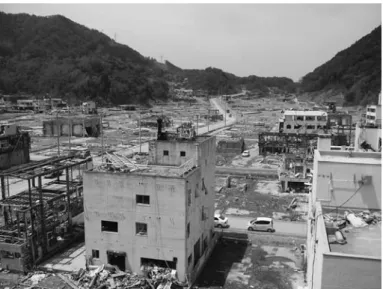
The earthquake which occurred off the Pacifi c coast of Tōhoku (fi gure 1) at 14:46 on March 11, 2011 became the Great East Japan Earthquake which caused unprecedented damage (fi gure 2). A great many folk objects, which are tangible cultural properties, were damaged in this catastrophe. Here, by folk objects I refer to those historic objects consisting of tools and instruments of daily life, livelihood, and religious rites, nurtured and utilized within the local culture.

To conserve these pieces of cultural heritage, the Cultural Agency issued a call for a nationwide support system, and the “Committee for Salvaging Cultural Properties Affected by the 2011 Earthquake off the Pacifi c Coast of Tohoku and Related Disasters” was formed. The actual activities consist of rescue, temporary storage, and emergency treatment of cultural properties affected by the tsunami.

Here I will report on my involvement in the rescue operations and conservation activities of folk objects.

Figure 1 Map of Japan showing the region attacked by a tsunami.

Naoko Sonoda, Katsumi Tamura, Nu Mra Zan (eds.) Asian Museums and Museology 2013

Senri Ethnological Reports 125: 69 78 (2015)

(3)

2 Rescue system for tangible cultural Properties

Rescue operations for tangible cultural properties damaged by the Great East Japan Earthquake had to be on a nationwide scale, as the extent of damage was great. To organize a systematic approach, the Cultural Agency issued a call to national research institutions associated with cultural properties, and on March 30 the

“Committee for Salvaging Cultural Properties Affected by the 2011 Earthquake off the Pacifi c Coast of Tohoku and Related Disasters” (“Rescue Committee”) (fi gure 3) was established, with the rescue system headquartered in National Research Institute for Cultural Properties, Tokyo. The following is a list of institutions which participated in the Rescue Committee.

-    Museums and art galleries, etc.: National Institutes for Cultural Heritage;

National Museum of Art; National Museum of Nature and Science, Tokyo;

Japanese Council of Science Museums; National Diet Library; Japanese Association of Museums; The Japanese Council of Art Museums

-    Universities, etc.: National Institutes for the Humanities (of which the National Museum of Ethnology, Japan is a member); National Council for University Museology Programs

-    Academic societies, etc.: Japan Society for the Conservation of Cultural Property; Japan Society for Scientifi c Studies on Cultural Properties; Japan Society of Archives Institutions; Cultural Properties Rescue Network

The activities of the Rescue Committee and the types of objects eligible for rescue are specifi ed in the prospectus. Briefl y, the activities consist of providing support for rescue, temporary storage, and emergency treatment of cultural

Figure 2 Appearance of the town affected by the disaster (20.06.2011).

(4)

Hidaka Conservation and Restoration of Tangible Cultural Properties

properties. Objects eligible for rescue are described as paintings, sculptures, craftwork, calligraphy, books, ancient documents, archaeological objects, historic objects, tangible folk objects, and other movable properties and works of art, without regard to designation as cultural properties etc. at the national or local level.

Here, national or locally designed cultural properties refer to those pieces identifi ed and designated as being of particular importance and requiring preservation under the national Law for Protection of Cultural Properties or local bylaws for cultural property protection. Incidentally, there is great signifi cance in the defi nition of eligibility for rescue under the Rescue Committee operations. Under normal circumstances, the only cultural properties considered eligible for conservation by the Cultural Agency or local Boards of Education are those which have obtained designation status. However, eligibility for Rescue Committee operations is without regard for whether or not the article is designated. In other words, both the Cultural Agency and the municipal Boards of Education had greatly expanded their scope of operations to deal with the terrible tragedy of the Great East Japan Earthquake. Note that the last time such a system was organized with this kind of intent was in 1995, in the wake of the Great Hanshin-Awaji Earthquake [Relief Committee for Cultural Properties Damaged by the Great Hanshin-Awaji Earthquake Secretariat 1999].

3 Rescue operations for tangible cultural Properties

As outlined above, the activities for rescuing disaster-damaged cultural properties consist of supporting three actions: Rescue, temporary storage, and emergency

Figure 3 Organization chart of the Committee for salvaging cultural properties.

Agency for Cultural Affairs

National Institutes for Cultural Heritage Headquarter

Organizations Related to Cultural Property and Art

Each Prefectural Board of Education of the Disaster-stricken Area

Each Prefectural Board of education

The Foundation for Cultural Heritage and Art Research

Committee for Salvaging Cultural Properties 䠄secretariat䠖National Research Institute for Cultural Properties,

Tokyo䠅

The Local Headquarter

Rescue Teams

Museums, etc.

Contributions and Donations

Local cities, towns and villages䠄 Depending on the situation, the local Prefectural Board of Education and the local headquarter cooperates.䠅

Owners, etc.

Cooperate

䞉General Incorporated Association The Japan Society for the Conservation of Cultural Property 䞉Japan Society for Scientific Studies on Cultural Properties

䞉Independent Administrative Institution National Museum of Art 䞉Independent Administrative Institution National Museum of Nature and Science 䞉Japanese Council of Science Museum

䞉Inter-University Research Institute Corporation National Institutes for the Humanities 䞉National Diet Library

䞉Japanese Association of Museum / The Japanese Council of Art Museum 䞉The Japan Society of Archives Institutions

䞉Japanese Association of Museological Course of University 䞉Network for the rescue of Cultural Property

Aomori䠋Iwate䠋Miyagi䠋Fukushima䠋Ibaraki䠋others Main Operation Chart

Dispatch staff

Request for cooperation Dispatch staff, etc.

Temporary Storage Dispatch temporary workers Supply rescue materials

Appeal Committee for Salvaging Cultural Properties Affected by the 2011 Earthquake off the Pacific Coast of Tohoku and Related Disasters 䠖the Operation for the rescue of Cultural Property

Request for cooperation

Request for support

Request for cooperation Staff Request for

cooperation

Request for cooperation

Request for rescue

In the presence of owners Subsidize

(5)

treatment. Out of these, rescue and temporary storage must be performed on site, under considerably poor conditions.

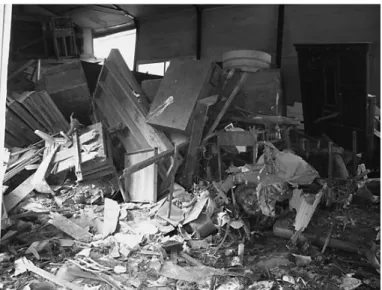
The actual rescue operations involve battling the swirling dust from the rubble- clearing work going on nearby, as well as enduring the stench of sludge and oppressively high temperatures. In addition, as the days went by in the wake of the disaster and things began to rot, we had to address the risk of tetanus. Furthermore, the disaster-damaged museum facilities had no electricity and we had to work in total darkness. The fl oor was littered with debris and we had to be careful of uncertain footing as well as of things falling from the ceiling. We therefore had to wear a protective mask, helmet, protective clothing with long sleeves and pants, thick working gloves, safety shoes, and headlight (fi gure 4). This was the kind of environment in which we had to search for cultural properties buried under the broken glass and tsunami-borne sludge covering the fl oor (fi gure 5). Our goggles steamed up very fast and we were dripping with sweat as we worked. It was an exhausting experience.

For temporary storage, the cultural properties had to be transported all at once to the place of safekeeping, within the limited time available to have the curator of the disaster-stricken museum standing. The reason for this was that, given the extent of damage in the Tohoku region, even museum curators could not devote themselves solely to museum matters, as restoration and rebuilding of the entire living situation had to take priority over the rescue of cultural properties. In order to load as many articles on the transportation truck, we had no time to wrap every salvaged piece properly, aside from fragile objects. Therefore, we decided to load the truck with strong, durable pieces on the bottom with lightweight pieces placed on top of them.

Compared to the chaotic rescue and temporary storage operations, the

Figure 4 Equipment for the rescue activities.

(6)

Hidaka Conservation and Restoration of Tangible Cultural Properties

emergency treatment was carried out under relatively stable conditions. The main source of contamination of the folk objects damaged by the earthquake and tsunami was the sand carried in by the tsunami. We also had to consider the saline content of the seawater which was another source of deterioration. Therefore, for emergency treatment, we considered the removal of surface sand and salt content.

To remove the surface sand, it is obvious that the visible contamination must be removed. We could not leave the sand-covered pieces standing within the temporary storage facility, which is a clean environment. In addition, the surface sand contains salt, which attracts moisture and promotes mold growth. Furthermore, the contamination made the objects diffi cult to handle, which posed the risk of signifi cantly hampering the sorting and organizing activities being carried out in the temporary storage facility. Decontamination, therefore, was an immediate necessity.

To deal with salt, the other major cause of deterioration, we considered desalination [Hidaka 2010]. However, due to the need for water tanks and drainage facilities, we decided that this procedure was not feasible within the fi scal year 2011.

For the above reasons, we determined it was impractical to include desalination in the emergency treatment, and decided on a two-step treatment method.

-    The fi rst step consisted of removing the sand and sludge contaminating the surface of the objects and making them diffi cult to handle. Initially, we thought the use of water was an absolute must for this kind of operation, as in my past experiences with fl ood-damaged folk objects, the normal procedure was to fi rst soak the article in water to soften and loosen the surface sand and sludge, then using a soft brush to remove the foreign matter (fi gure 6). This method was highly successful in the rescue of folk objects housed in a museum which had

Figure 5 Folk objects inside a storage after the disaster.

(7)

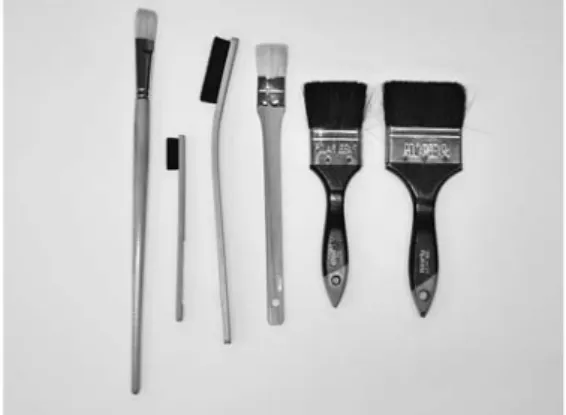
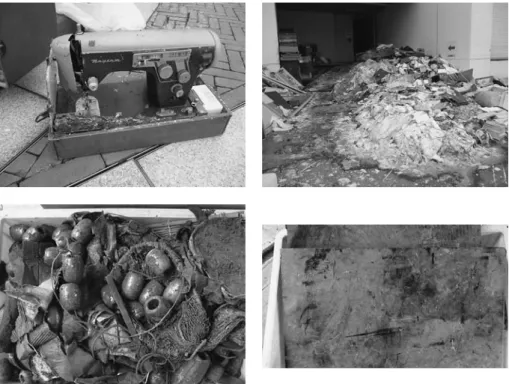
been fl ooded with the raw material from an adjacent paper-making factory (fi gure 7). However, in the process of performing emergency treatment on folk objects at other disaster sites, it occurred to us that the situation was slightly different. That is, the matter contaminating the surface of the Tohoku tsunami- damaged articles was sea sand, and when dry, it could be removed satisfactorily simply by brushing off, without the need to use water. In addition, we were entering the rainy season as emergency treatment progressed, and the use of water posed the risk of mold while the pieces were left to dry. We therefore decided to use a cleansing kit consisting of soft brushes instead of water to treat many of the folk objects. Needless to say, those pieces which we judged to require washing with water were subjected to such washing, with ample consideration for thorough drying after the washing procedure. In the emergency treatment process, we were able to perform fi rst-stage cleansing of as many as 4,000 or so pieces of folk objects, thanks to the extremely clear-cut criterion of removing only the sand that could be removed by the cleansing kit.

-    The second stage of treatment consists of desalination, a task which we have been performing since fi scal 2012. Specifi cally, this entails a status assessment of the rescued folk objects, followed by an investigation of the effect of the salt content on the pieces, followed by a deliberation of whether to perform desalination treatment. As a result of these procedures, we came to the conclusion that objects mostly made of wood required desalination to prevent salt-related deterioration (fi gure 8). We also concluded that desalination should be performed as soon as possible, as the salt in salt-containing articles attracted moisture and led to mold, posing the risk of contaminating the entire temporary storage facility. At present, we are collaborating with disaster area museums and universities to put together a full-fl edged system for desalination, and considering the application for a budget to perform desalination as a full

Figure 6 Cleansing kit.

(8)

Hidaka Conservation and Restoration of Tangible Cultural Properties

Figure 7 Objects contaminated with sand, sludge and pulp.

Figure 8 Salt deposits on the wood surface.

(9)

program of conservation on the massive amounts of folk objects.

4 Activities leading to the restoration of disaster-stricken tangible cultural Properties

I have already given an overview of rescue, temporary storage, and emergency treatment operations performed on cultural properties affected by the recent disaster.

I also mentioned the desalination treatment to be performed as the second stage of emergency treatment. These activities are not suffi cient to restore the value of these folk objects that are local cultural properties. In order to restore their value, I believe the following 8 steps are needed [Hidaka 2011].

1. Disaster damage: The untreated state of the objects, damaged by the disaster with no treatment having been performed.

2. Rescue and temporary storage: Transporting the objects from the disaster site to a safe place for temporary storage.

3. Emergency treatment: First-aid treatment performed for the purpose of preventing the worsening of the objects, broken or contaminated by dust or mud.

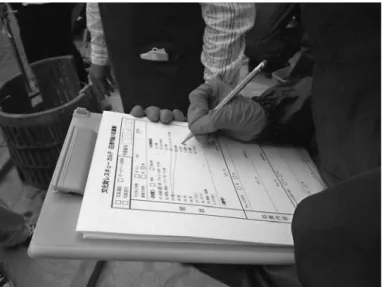
4. Sorting, organizing, and recording: Counting the number of rescued objects and formulating a list to grasp the overall picture.

5. Conservation and repair: Work performed by conservation specialists on those pieces judged to require full-fl edged conservation.

6. Permanent storage: Returning the restored objects to the owner’s storage facility, or putting them in the care of a museum or similar facility for safekeeping.

Figure 9 Making a list of articles.

(10)

Hidaka Conservation and Restoration of Tangible Cultural Properties

7. Research and utilization: Compiling the information on the specialized research covering the activities performed to date, and adding the information inherent within the damage-stricken objects. Also, making the results of studies to date available to the general public.

8. Disaster prevention: Preparing for future disasters by utilizing the lessons learned throughout the disaster support process.

Out of these 8 activities, those performed by the Rescue Committee were rescue, temporary storage, and emergency treatment. And currently, we are working in coordination with the disaster-stricken regions to organize and record the rescued objects to formulate a list of articles, and to perform a part of the conservation and restoration work (fi gure 9). In the upcoming period, we must attempt to include research and utilization in order to impart the rescued pieces with the historic information required for them to be properly valued as cultural properties. In the disaster-affected regions, efforts must be made toward the permanent storage of rescued objects, to return them to their proper places.

5 Future activities

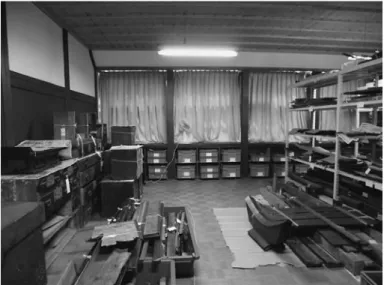
Currently, the disaster-stricken regions are steadily rebuilding. However, the people have not yet returned to their normal daily lives and restoration plans for museum facilities are far from satisfactory. These factors are leading to prolonged use of temporary storage facilities initially intended for provisional use (fi gure 10). To address this situation, the National Institutes for the Humanities, of which the National Museum of Ethnology, Japan is a member, has created a budget for research activities to support the disaster areas. I myself am the senior researcher

Figure 10 Temporary storage using an abandoned school.

(11)

for“Museums and the Revitalization of Cultural Heritage: Towards the Practical Involvement of Inter-University Research Institutes in the Reconstruction process after the Great East Japan Earthquake.” In the upcoming period, we will focus mainly on research, while also working with Professor Sonoda on the followings:

1. Formulating a system for the storage of tangible cultural properties stored in temporary storage facilities;

2. Building a system for museums to coordinate with one another in times of disaster.

Bibliography

HIDAKA Shingo

“Higashi Nihon Daishinsai ni okeru Hisai Bunkazai no Kyuuen no Genba kara:

Yuukei Minzoku Bunkazai no Shien wo Chuushin ni (From the Front Lines of Rescue of Cultural Properties Damaged in the Great East Japan Earthquake: With a Focus on Tangible Folk Cultural Properties)” Minpaku Tsushin Vol.135, pp.2-7, 2011

HIDAKA Shingo (ISHII Rika, KAWAMOTO Kozo, and 3 others)

“Minzoku Shiryou no Rekka to Sono Taishohou ni Kansuru Kenkyuu (1) Mokubu e no Enbun Shintou Jikken to Kinzoku Bousei Shorihou no Kenshou Jikken (Study on the Deterioration of Folk Objects and Methods of Treatment (1) Chloride Permeability Test on Wood Components and Verifi cation of Rustproofi ng of Metal)”

27 th Convention of the Japanese Society for Scientifi c Studies on Cultural Property, pp.310-311, 2010

Relief Committee for Cultural Properties Damaged by the Great Hanshin-Awaji Earthquake Secretariat

“Hanshin-Awaji Daishinsai Hisai Bunkazai nado Kyuen Iinkai Katsudou Kiroku

(Activities Report of the Relief Committee for Cultural Properties Damaged by the

Great Hanshin-Awaji Earthquake)” 1999

Figure 1 Map of Japan showing the region attacked by a tsunami.
Figure 2 Appearance of the town affected by the disaster (20.06.2011).
Figure 3 Organization chart of the Committee for salvaging cultural properties.
Figure 4 Equipment for the rescue activities.
+6

参照

関連したドキュメント

The mathematical and cultural work of the Romanian geometer Gheorghe Tzitzeica is a great one, because of its importance, its originality but also due to its dimensions: more than

Indeed, if we use the indicated decoration for this knot, it is straightforward if tedious to verify that there is a unique essential state in dimension 0, and it has filtration

In Section 3, we show that the clique- width is unbounded in any superfactorial class of graphs, and in Section 4, we prove that the clique-width is bounded in any hereditary

In this paper, under some conditions, we show that the so- lution of a semidiscrete form of a nonlocal parabolic problem quenches in a finite time and estimate its semidiscrete

n , 1) maps the space of all homogeneous elements of degree n of an arbitrary free associative algebra onto its subspace of homogeneous Lie elements of degree n. A second

This concept of generalized sign is then used to characterize the entropy condition for discontinuous solutions of scalar conservation laws.. Keywords: Colombeau algebra,

It is worth noting that the above proof shows also that the only non-simple Seifert bred manifolds with non-unique Seifert bration are those with trivial W{decomposition mentioned

Keywords Vertex covers of graphs · Cover ideal · Edge ideal · Fiber cone · Koszul · Straightening laws · Krull dimension · Arithmetical rank · Cohen–Macaulay