Beyond Objectivity : Local Newspaper and the Great East Japan Earthquake
著者(英) Shoji AZUMA
journal or
publication title
NINJAL Research Papers
number 17
page range 1‑13
year 2019‑07
URL http://doi.org/10.15084/00002221
Beyond Objectivity:
Local Newspaper and the Great East Japan Earthquake
Shoji AZUMA
University of Utah / Visiting Researcher, NINJAL [–2014.08]
Abstract
For six days following the Great East Japan Earthquake and accompanying tsunami (March 11, 2011) the printing facilities of the Ishinomaki Hibi Shinbun, an evening newspaper in Ishi- nomaki, Japan, could not be used. Working with flashlights and marker pens, dedicated editors produced handwritten “newspapers” and posted them at local evacuation centers for survivors to read.
The present study is a content analysis of the six issues of the handwritten newspaper as well as interviews with the editors and local readers in Ishinomaki. The analysis concludes that the editors effectively constructed a framework of solidarity in the community by shifting from the traditional fact and figures reporting style to a more rapport-building style. This shift can be characterized as a shift from the editors’ uni-directional monologue to a “dialogue” or “a joint production” between the editors and readers.
The change to the rapport-building style assisted in simplifying reality for the readers by focusing on a subset of disaster-related content (e.g., volunteers and relief goods), which, in turn, constructed an emerging framework of solidarity that had the ability to alter the attitude and emotional well-being of the readers. The rapport-building style of the reporting made readers feel connected, involved, and not abandoned. The editors, in effect, sent a meta-message of cama- raderie among the paper’s readers and the readers embraced it.*
Key words: earthquake, fact, objectivity, solidarity
1. Introduction
On March 11, 2011, Japan was hit by a 9.0 magnitude earthquake commonly known as “the Great East Japan Earthquake.” It was the most powerful earthquake to have hit Japan in 140 years and one of the four most powerful earthquakes in the world since 1900 (when record keeping began). The earthquake and the powerful tsunami waves it triggered claimed more than 19,000 lives, with thousands still missing. In addition, the earthquake caused meltdowns in three reactors at the Fukushima Daiichi Nuclear Power Plant (Kingstone 2012). Six years later, nearly 120,000 people still remain displaced from their homes, including residents from Fukushima prefecture due to radioactive contamination in the region (Fukkō chō 2017).
How do people overcome such dire consequences? How do they deal with the panic, fear,
sorrow, hopelessness, depression, dismay, and emotional breakdown? What happens when many* I am grateful to Mr. Akihiro Mioka of Mainichi Shinbun, Mr. Hiroyuki Takeuchi of Ishinomaki Hibi Shin- bun, Mr. Eiichi Hiratsuka of the Onagawa city government and the people in the disaster-stricken area for allowing me to interview them. Part of this research was conducted from October 2013 to August 2014 as a visiting researcher and recipient of the 8th Hakuho Foundation Japanese Research Fellowship at the Na- tional Institute for Japanese Language and Linguistics.
are frightened, desperate, and bitterly disappointed in their government’s inadequate response to their destitute circumstances? For purposes of this inquiry, what can journalists do for the survi- vors, residents, and the community in overcoming the crisis? What is the role of journalism in a time of disaster? The victims obviously need food, water, and other basic materials, but they also need positive emotional support to help them get through the hardship.
Scholars have helped us to theorize about positive emotions. According to Lazarus (1991), positive emotions are discrete emotions that are positively valenced or emotions that result from benefits rather than harms. Positive emotions also include the sentiment of elevation, leading people to act, and may include hope as well as others (e.g., joy, contentment, pride, and love). For example, Haidt (2003) describes elevation as an emotional response to witnessing an act of vir- tue, and it may encourage people to affiliate with and help others (Algoe and Haidt 2009). Hope occurs when individuals believe something positive, which does not currently exist in their lives, can materialize (Lazarus 1999). Fredrickson (2001) suggests that positive emotions can increase individual and societal well-being. Hence, based on these assumptions, we may postulate that positive emotions displayed in public language, such as a newspaper, may have the potential for exerting great influence on the psychological well-being of persons involved in a natural disaster.
Nevertheless, the role of positive emotions and compassion may conflict with the traditional principle of objectivity in journalism. Objectivity is the ideal, in which journalists are unbiased, keeping their values and beliefs out of their work. This definition, therefore, leaves no room for compassion. Acknowledging emotions and allowing emotions into a news story is not compat- ible with the principle of objectivity. However, in today’s changing media environment, the prin- ciple of objectivity has been questioned. While some might say that emotions are at odds with journalism, there are many who agree that having empathy, compassion and solidarity toward the people is considered an integral part of the journalists’ mission. For example, constructive jour- nalism, which draws on insights from positive psychology, argues for the positive role of compas- sion in journalism (Gyldensted 2015, McIntyre 2015). Hayashi (2011), a Japanese researcher on journalism, argues for what she calls “journalism of care” which emphasizes the connection between journalists and the people being covered by the news (see also Terashima 2005, Fujita 2012, Niwa 2013).
In this article, we study positive emotions and compassion in the context of journalism in local newspapers during the post-disaster period. In particular, a rather unusual case of journal- ism will be examined in an attempt to illustrate the benefits of emotional content in newspapers and other printed materials. The case concerns six issues of a handwritten newspaper called Ishinomaki Hibi Shinbun in the city of Ishinomaki during the first week after the quake and tsunami. People in the city of Ishinomaki and its vicinities were hit hard by the quake and tsu- nami, and suffered great loss as a result of the disaster. Owing to perhaps language barriers and difficulties in obtaining access to the research materials, no prior research focusing on a linguistic analysis of the public language in the disaster-stricken area has been conducted. Thus, the present study is the first attempt to examine how positive emotions were expressed in public language in the area and how effective they were in empowering the people during the post-disaster period.
2. Method
Through site visits to the northeastern region of Japan (Ishinomaki, Onagawa, Higashi Matsushima and Sendai), relevant data about the handwritten newspaper were collected in July
2011, August 2013, and February 2015. Digital photos of the actual issues of the paper were taken for later analysis. In addition, interviews with newspaper editors and reporters at the head- quarters of Ishinomaki Hibi Shinbun (Ishinomaki) were conducted to gather information about their editorial stance, disaster reporting and future perspectives as journalists.
Furthermore, local residents were also interviewed regarding their general responses to the newspapers. The interviews were conducted by the author in an informal, open-ended format so that the interviewees’ frank and honest responses could be solicited. In particular, it was noted that disaster victims are generally reluctant to express their personal feelings and experiences to outsiders (e.g., Curtis 2012). Commonly, if approached by a complete stranger, potential interviewees reply that they do not have any comment and turn away. Even if they do engage in conversation, their replies tend to be short and guarded. Thus, extra cautions were taken to ensure that the interviewees felt comfortable enough to speak freely with the author. Through multiple visits to the sites and establishing a quasi-membership rapport in the community, unwanted ten- sion and reluctance from the interviewees were reduced. This approach was also helpful in mini- mizing any response bias of expressing favorable attitudes toward their local newspapers, given that the interviewer was not a complete outsider to them.
Interviews were conducted either individually or in small groups of 3–5 people. In the group interviews, it was emphasized that various viewpoints from all are welcome: consensus was unnecessary. Altogether, 20 people volunteered to be interviewed at locations including tempo- rary shopping centers, community centers and temporary shelter meeting rooms. These included 12 females and 8 males, ranging from 30’s to 70’s in age. Their occupations included fishermen, drivers, former school teachers, retirees, housewives, employees at local hotels, organization staff, and construction workers. Twelve of the interviewees were recruited on the spot as the author engaged them in natural unfolding conversation. The other eight were recruited through the author’s personal network. Questions about the newspapers were embedded in the casual and informal conversation. The questions included the following: Where were you when you read the newspapers? Were the newspapers helpful? If so, in what way? Each interview lasted about 15–20 minutes.
Simplified content analyses of the articles/sentences in the handwritten newspapers were performed, focusing on their positive versus negative content on a scale of −1 to +1 where −1 is negative, +1 is positive and 0 is neutral. In order to obtain reliability in the analysis, two other native Japanese research assistants also conducted their own analysis of the materials. Initially, we were in agreement with each other on about 93% of the analysis, and after further discussion, we reached 100% consensus on the findings. The following contains the result of such analysis.
3. Ishinomaki Hibi Shinbun
The city of Ishinomaki, with a population of about 160,000, was one of the hardest hit by the disaster, with approximately 80 percent of the homes destroyed, about 1,300 people killed and more than 2,700 still missing. The Ishinomaki Hibi Shinbun is a local evening newspaper with a circulation of about 18,000. Its major coverage areas include the cities of Ishinomaki, Onagawa, and Higashi Matsushima. Sadly, the massive quake and accompanying tsunami crippled the printing facilities at the newspaper headquarters. Working with flashlights and markers, dedi- cated editors produced handwritten “newspapers” and pinned them up for survivors to read at local evacuation centers in the critical first six days immediately following the quake. The
Washington Post (March 21, 2011) reported the effort of the local newspaper to the world as follows:
Nobody tweeted or blogged or e-mailed. They didn’t telephone either. Bereft of electricity, gasoline and gas, this tsunami-traumatized town did things the really-old-fashioned way—
with pen and paper. Unable to operate its 20th-century printing press—never mind its com- puters, Web site or 3G mobile phones—the town’s only newspaper, the Ishinomaki Hibi Shinbun, wrote its articles by hand with black felt-tip pens on big sheets of white paper. But unlike modern media, the method worked.
The article in the Washington Post brought global recognition of the handwritten newspaper.
For example, the International Press Institute awarded a special citation in recognition of its unflinching dedication to the profession of journalism at their World Congress 2011. Newseum in Washington D. C., a museum dedicated to journalistic artifacts, acquired the original copies of the handwritten newspaper as a permanent display of “an important artifact that demonstrates the essential need for journalists to convey the news, especially in times of crisis.” Domestically, the Japan National Press Club presented a special award to the newspaper stating that “the journalist spirit displays to the world determination and capability and we are very proud of the Ishinomaki Hibi Shinbun. The handwritten newspaper is to be remembered in the history of Japanese journalism and it is highly praised as exhibiting the mission of newspaper.” The newspa- per has also received the prestigious 59th Kikuchi Kan Prize, which honors all aspects of Japanese literary culture. In addition, foreign dignitaries have visited the headquarters of the Ishinomaki Hibi Shinbun in the city of Ishinomaki, including Prince William of England on March 1, 2015.
Figure 1 Mr. Takeuchi and the display of actual copies of the handwritten newspaper
The resilience and ingenuity of the reporters and staff to continue to “publish” the newspa- per, even in the form of an old-fashioned handwritten newspaper, clearly deserves high praise, particularly when we consider the fact that the reporters were victims of the disaster themselves.
For example, one of the reporters was missing for the first three days as a victim of the tsunami.
Luckily, he survived and joined his colleagues immediately after his rescue. Mr. Takeuchi, the chief of reporters of the newspaper, slept in the office for the first ten days before going back home, and the first few days he was not even certain about his own family’s safety. Fortunately, he learned later that his family had survived and was safe (Ishinomaki Hibi Shinbun-sha 2011).
Although the newspaper has been globally commended, the actual content of the paper has not yet been studied in depth. What did the six issues report? In what follows, an examination of the paper is presented.
4. Day-by-day analysis
First of all, it is evident that, under an extremely difficult situation, the newspaper was able to provide information-starved residents with vital news about the catastrophe, including which roads and bridges had been cleared of rubble, the location and size of shelters, when rescue teams would arrive with much needed food, water, and blankets, and what damage occurred along with its overall magnitude. Observe the following examples which appeared in the March 12 issue, immediately after the March 11 quake and tsunami.
(1) 11 nichi gogo 2 ji 46 fun goro, sanrikuoki o shingen to suru jishin ga hassei. Jishin no kibo wa magunichūdo 8.8 saidai shindo “7.” Meiji jidai ni jishin kansoku shite irai mottomo kyodai na jishin. Ishinomaki chihō de wa “6 kyō” o kiroku.
‘Approximately 2:46 pm on the 11th, an earthquake occurred centered in Sanrikuoki (the deep water in the Sanriku Ocean). The scale of the earthquake is an 8.8 magnitude (on the Richter Scale), and the maximum seismic intensity of “7” (on the Japanese scale). Since the Meiji era, when record keeping started, (it is) the largest earthquake. In the Ishinomaki area, an “upper 6” was recorded.’
(2) 11 nichi gogo 4:00 ishinomaki shiyakusho 7 kai ga hōraku. Ayukawahama zen’iki ga kaimetsu jōtai.
‘At 4:00 pm on the 11th, the 7th floor of Ishinomaki City Hall collapsed. The entire Ayu- kawahama area sustained severe damage.’
(3) Dō 5:50 Kado shō ga zenshō. Kitamura shō wa tōkai no osore ari.
‘At 5:50 pm on the same day, Kado Elementary School burned down. Kitamura Elemen- tary School is in danger of collapse.’
(4) Dō 7:20 Kōkū jieitai Matsushima kichi wa kassōro ga shinsui no tame ugokezu.
‘At 7:20 pm on the same day, the Matsushima Air Base of the JSDF (the local airport) was flooded, and it is not operational.’
(5) Dō 8:10 Tennōbashi ga rakka.
‘At 8:10 pm on the same day, the Tennōbashi bridge collapsed.’
The sequential narrative of events was extremely informative to the residents who had lost power and with it most forms of communication, including television, radio, telephone, and the internet. The only media form available to the residents was the newspaper. Each person endured his or her own version of the disaster in their specific surroundings, but it was the newspaper that
framed the individual experience as part of a much larger collective event occurring beyond their immediate vicinity, in their city, and the extended Tohoku area (a district in the north-eastern part of Japan). The survivors began to realize the extent of the damage when provided with con- crete information such as the destruction of city hall, bridges, schools, and the airport. The March 12th issue of the newspaper was successful in informing the residents of key infrastructure dam- age even though the information was extremely limited in its amount and scope.
On the following day, March 13th, the issue provided further details regarding the disaster’s damage. Observe the following examples.
(6) Minamihama chō Kadowaki chō kaimetsu, Toba engan chiku to dōyō ka. Onagawa chō Oga chiku Okachi kaimetsu jōtai no moyō.
‘The town of Minamihama and the town of Kadowaki are wiped out. Toba seaside may be the same. The Okachi area in the Oga district of Onagawa appears to be wiped out.’
(7) Akai chiku made nami ga tōtatsu, yuka ue shinsui tasū. 13 nichi asa no jiten de mizu ga koshi no takasa made tasshite iru. Jūmin no hanashi ni yoru to Ōmagari chiku kaimetsu.
‘The flooding extends as far as the Akai district. Many houses are flooded above the first floor. As of the morning hours on the 13th, the height of the water is waist deep. According to the residents, the Ōmagari district has been wiped out.’
The details of various towns were relevant to the local people who had local knowledge about the area. They may have had family members, friends, or acquaintances in the affected area.
This information helped people understand the extent of the disaster, in both property and in life.
However, interestingly enough, over the coming days the focus of the news coverage gradu- ally shifted to more positive aspects of the conditions, even though there was not a corresponding reduction in the extent of catastrophic damage. Observe the following example from the March 15th issue of the newspaper.
(8) Ishinomaki shinai no ōgataten kara shokuryō, mizu, mōfu nado teikyō o ukete iru hoka, zenkoku no jichitai kara shien busshi ga kongo todokerareru. Ishinomaki shi wa sōgō undō kōen ni sorera o mazu shūseki. Sono go, kaku hinanjo e haifu suru. Mata zenkoku suidō kyōkai ya taken kara kyūsuisha ya inryōsui ga Ishinomaki shi ni todokerarete iru.
‘Major stores in Ishinomaki contributed goods such as food, water and blankets. In addi- tion, from now on, rescue goods are planned to be delivered by local governments across the country. The city of Ishinomaki plans to store them at the general ground park. From there, the goods will be distributed to shelters. Furthermore, water wagons and drinking water from the national water supply association and other prefectures are on their way to Ishinomaki.’
News about the arrival of rescue items such as food, water and blankets is welcomed by resi- dents who have been evacuated to shelters where none of these items are available. The people are hungry, living in cold weather conditions without any heat, and are desperately in need of basic provisions to survive. In reality, the news does not guarantee that the items will be delivered soon, but the news gave people hope that the provisions will eventually become available. In essence, the news provides an assurance to the people that they have not been forgotten.
As the days go by, the seriousness of the catastrophe becomes even more evident. However, the newspaper selectively focuses on the positive side of the events. In the March 17th issue, the
newspaper reported the restoration of electric power. Observe the following example.
(9) Higashi Matsushima shi no ichibu chiiki de wa denki no fukkyū mo hajimatta. Saigai taisaku honbu ga okarete iru shiyakusho ya hinanjo nado no kōkyō shisetsu ga chūshin to naru ga tsūden han’i wa jojo ni hirogaru to mirareru.
‘Electric power has been restored to part of the Higashi Matsushima district. At this time, the restoration is limited to the city hall, where the rescue headquarters is located, and other public places, such as evacuation centers, but it is expected that the restoration area will gradually be expanded.’
(10) Ichiritsu Yamoto Daiichi Chūgakkō ni hinan shite iru josē (59) wa “akari ga tomotta shunkan ni wa minna de hakushu o shite yorokonda. Kore de kibō ga miete kita kanji ga suru” to fukkyū to sono saki ni aru fukkō ni kitai o yosete ita. (emphasis added)
‘A woman (59) at the Municipal Yamoto 1st Middle School shelter said, “We all applauded at the moment when the lights turned on. I feel that hope is in sight,” and she was expect- ing restoration, and reconstruction to follow.’
At first, the restoration of power was severely limited to several strategically important pub- lic buildings. However, the fact that power was slowly coming back was encouraging and positive news for the residents and survivors. The newspaper quotes the direct words of one survivor say- ing ‘hope is in sight.’ The voice originates from the survivor, but it is also the voice of the report- ers who had lost access to the electric power as well. In this sense, the news is jointly constructed by the survivor and the journalists. The voice becomes shared among the survivor, journalists, and readers of the newspaper.
At this point, the tone of the newspaper has shifted from negative-news reporting to more positive-news reporting. The news shares hope among the survivors, readers, and journalists who are all victims of the disaster and striving to survive in their own capacity. This shift is clearly reflected in the text of the main headline of the newspaper over the course of seven days, from March 11th through March 17th. Observe the following transition of newspaper headlines each passing day.
(11) Nihon saidaikyū no jishin ōtsunami (March 11th) ‘The largest earthquake and tsunami in Japan.’
(12) Higai jōkyō ga jojo ni akiraka ni (March 12th) ‘The extent of the damage is gradually unraveled.’
(13) Zenkoku kara busshi kyōkyū (March 13th) ‘Rescue goods from all over Japan’
(14) Borantea sentā setchi (March 14th) ‘Volunteer centers established’
(15) Sasaeai de norikitte (March 15th) ‘Please support each other.’
(16) Machi ni akari hirogaru (March 16th) ‘The light of the town spreads.’
The headlines shifted from the “largest” earthquake and tsunami (11) to the arrival of res- cue groups and materials (13), asking for volunteers (14), a plea to help each other (15), and the hope of light (16). The newspaper quickly gravitated toward the positive aspects of the disaster,
even though information about the devastation was plentiful (e.g., death tolls, and destruction of houses, ports, and infrastructure).
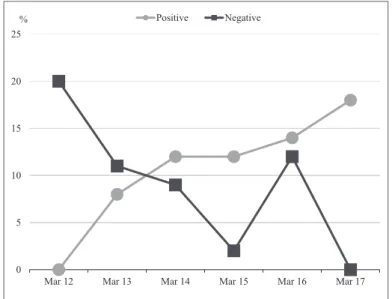
The following figure shows the result of coding each sentence in all six issues of the newspa- per with either a positive or negative indicator. For example, the sentence Naikaibashi ga kanraku (The Naikai bridge has collapsed) was coded negative because it carries the negative information of the destruction of the bridge, and the sentence mizōu no saigai o norikitte hoshii to messēji ga zenkoku kara todoiteiru (Messages encouraging survivors to overcome the unprecedented disaster have arrived from all over Japan) was coded positive because it conveys an encouraging message.
Neutral sentences such as seikaku na jōhō de kōdō o (Please act based on correct information) were excluded from the tabulation.
Figure 2 Positive/negative sentences by each issue
We can see a clear shift from a negative tone to a more positive tone starting with the March 14th and March 15th issues. In particular, the March 12th issue and the March 17th issues are in sharp contrast. Initially all information pouring into the newsroom was negative indicat- ing the vast and extensive damage of the disaster, and the newspaper reported this information to the public. However, when the negative information continued pouring into the newsroom day by day, the editorial board made a conscious decision to look for positive, encouraging, and heartwarming news, and to report positive stories as much as possible. In an interview with Mr. Takeuchi, the editor-in-chief of the newspaper, he confirmed that the editorial decision to include any positive sign of survival and restoration was made around March 15th. According to him, the decision was made because the amount of negative information was simply overwhelm- ing and too depressing. For example, his staff gathered stories about elderly people who managed to survive the tsunami only to die in evacuation centers from hypothermia because of delays in getting blankets and dry clothing to them. His staff also gathered information about more than one hundred dead bodies found along the shore of the local beach. None of these stories appeared in the newspaper. Instead of endlessly and exhaustively reporting the devastation of
disaster, the editorial staff felt that the mission of the local newspaper was to report the disaster in a more engaging and empowering way for the local people who were desperately in need of any sign of hope and encouragement.
It is true that there is always some “time delay” between a disaster and the arrival of goods or aid, and as such, a lack of positive news on the March 12th issue (immediately after the disas- ter) is expected. However, as time progressed, the editorial staff ’s decision to focus on positive news is significant, especially considering that negative news as well as positive news was pour- ing into the newsroom. This editorial stance becomes more evident when compared with other newspapers published at the same time. For example, the Mainichi Shinbun, a major national newspaper, included some positive news in their reporting, but not to the same extent as the Ishinomaki Hibi Shinbun. The Mainichi Shinbun reported positive news such as a new born baby at a hospital where there is no electricity (March 15th issue) and a 75 year old survivor who was rescued after four days (March 16th issue). However, such positive news was still limited, and the majority of the news focused on the devastation of the disaster. Some sample headlines from the Mainichi Shinbun are the following:
(17) Kemuri ni kasumu sora, kiesatta machi, shūraku “zenmetsu da”, kogoeru hisaisha (March 12th) ‘The sky blurred in smoke, towns disappeared, villages have been “completely destroyed,”
victims freezing.’
(18) Engan ittai muzan, nomikomareta machi, subete nagasareta (March 13th) ‘The miserable coastal zone, swallowed towns, everything swept away.’
(19) Jūichi ken sanjū yonman nin hinan (March 14th)
‘11 prefectures, three hundred forty thousand evacuated.’
Figure 3 The handwritten newspaper at one of the evacuation centers (photo taken at the Ishinomaki Nyūze)
(20) Shisha sanzen nin chō, gojū yonman nin hinan (March 15th)
‘More than three thousand dead, five hundred forty thousand evacuated.’
(21) Kōreisha taichō shinpai (March 16th) ‘Elderly worry about physical condition.’
(22) Nenryō o denki o, shisha yonsen nin kosu (March 17th)
‘(We need) fuel and electricity, the number of dead exceeds four thousand.’
As the headlines suggest, the reporting focused on the devastating and distressing aspects of the disaster. This negative reporting tone contrasts sharply with the positive tone of the Ishinomaki Hibi Shinbun which attempts to lift the spirits of the victims. Compare these headlines with the headlines shown in (11)–(16) above.
In the case of the Ishinomaki Hibi Shinbun, we learn that journalistic objectivity was difficult
to achieve when journalists were faced with the catastrophic damage of a natural disaster such as the great earthquake. Asking journalists to disregard their own experience, feelings, and emotions under circumstances was a demanding task. But out of these conditions, we are able to observe a remarkable finding. Compassionate reporting helped journalists to understand and connect with the people on a human level. Compassion actually helped the journalists to perform their job as public servants. In interviews with local residents, many stated that they were extremely grateful for the newspaper, not only because it was a source of information about the disaster, but because it was a source of hope. Some of the statements provided by local residents are shown below.(23) Jibun mo mae o muite aruite ikō to iu kimochi ni narimashita
‘(The newspaper) made me feel that I should walk facing forward, too.’
(24) Katsuji de miru to shinrai ga waki tasuke wa kuru to omoimashita
‘Because the news was written on paper, they became trustworthy and made me feel that help was coming.’
(25) Shinbunsha no hito tachi mo hisai shite iru no ni, ore tachi mo ganbaranakya to yūki zukerare- mashita.
‘Even though the newspaper reporters themselves were victims, (but they were producing the newspapers) and I felt we were encouraged to do our best.’
(26) Kuroi ame ga furu to ka keisatsukan ga korosareta to ka iu dema ga takusan atta kedo, shinbun o mite ochitsukimashita. Shinbun no borantea no tasuke ga kuru to iu nyūsu ni hagemasaremashita.
‘Although there were numerous false rumors such as black rain would fall and a policeman was killed, I felt calm when I read the newspaper. The news that the help of volunteers would come cheered me up.’
The newspaper made people feel connected, involved, and not abandoned. It created a link with the people and the people embraced it. In the brief six-day period following the disaster, com- passionate reporting accomplished more than what traditional reporting could do. By filtering, focusing, and shaping a positive reality in the midst of many other negative realities, the news- paper succeeded in empowering a community during its critical post-disaster recovery. It is this positive role of empathy in journalism—showing compassion, not objectivity—that can achieve credibility with and acceptance by an audience.
5. Discussion and concluding remarks
The mission of journalism is to inform and reflect, as accurately as possible, the community that it serves (Harland 2008). Accuracy and truth-telling are paramount, and the principle of “objec- tivity” has long been the ideal for journalism. However, this principle of objectivity often leads to a hyper-focus on negative and conflict-based information. When we read newspapers or watch TV news channels, we typically find news such as crime, violence, and war. A common assump- tion may be that journalists gravitate toward drama, deviance, and scandal reporting. According to a national survey in Patterson (2000), 84% of respondents perceived the news to be depressing and only 16% of them reported that the news was spiritually uplifting (cited in McIntyre 2015).
A stereotypical image we may also paint of journalists may include belligerent, stubborn, and disrespectful personality traits, but certainly not the attribute of being compassionate (Harland 2008).
Nevertheless, as this study has shown, compassion may actually be an attribute that helps journalists understand and connect with people they serve. The notion of civic journalism (e.g., Rosen 1999, Perry 2003) becomes very revealing when journalists are forced to deal with the aftermath of a catastrophic disaster such as the Japanese earthquake and tsunami. The compas- sion exhibited by the journalists of Ishinomaki Hibi Shinbun exhibited in the case of the hand- written newspapers, exemplifies an emerging role of journalism. This role is defined as being more attentive to the needs of the audience and in striving to build a trusting relationship with readers. After all, in the case of the earthquake and tsunami, reporters themselves were as much victims of the disaster as members of the audience. The reporters, in that case, were able to pro- vide the most needed information—not just the information about the magnitude of the disaster, but the kind of information that positively affects the audience’s state of mind. The news was encouraging and emotionally uplifting, bringing hope to the audience when they most desper- ately needed it. The press often does more than report the real story; it also filters and shapes it.
In the case of the handwritten newspaper, focusing on the positive facts resulted in empowering a community during its critical post-disaster recovery period.
Rosen (1999: 54) has described the following general characteristics of journalists:
“Journalists tend to see themselves as observers; their job is to tell the truth, not to bring new truths into being. Almost all the key tenets in their ethical code emphasize detachment rather than participation.” Thus, an interesting question is how much involvement and participation can be allowed for journalists who want to maintain some journalistic objectivity in news report- ing? What is the ideal relationship between detachment and participation? Surely, it is difficult to draw a clear line. It may be one of those uncomfortable grey areas where multiple factors are intertwined in the dichotomy.
However, the present study suggests that exercising journalistic compassion during the recovery period of a natural disaster can be an effective and valued contribution by local news- papers. Doing so is a productive way of connecting and reconnecting with the resident survivors and identifying, addressing, and supporting their needs. To this end, the newspapers’ decisions to focus on positive emotions resulted in reducing the burden of sorrow and despair and provid- ing hope for the people. As local newspapers serving the disaster-stricken area, compassion as participants—not objectivity as observers—has earned them trust from the local people and the community, then, now, and into the future.
References
Algoe, Sara, and Jonathan Haidt (2009) Witnessing excellence in action: The “other-praising” emotions of elevation, gratitude, and admiration. The Journal of Positive Psychology 4(2): 105–127.
Curtis, Gerald (2012) Tōhoku diary: Reportage on the Tōhoku disaster. In: Jeff Kingston (ed.) Natural disaster and nuclear crisis in Japan: Response and recovery after Japan’s 3/11, 15–32. New York: Routledge.
Fredrickson, Barbara L. (2001) The role of positive emotions in positive psychology: The broaden-and-build theory of positive emotions. American Psychologist 56(3): 218–226.
Fujita, Masafumi (2012) Higashi nihon daishinsai hōdō no kenshō. Mass Communication Kenkyū 81: 17–19.
Fukkō chō (2017) Hinanshasū no suii.
http://www.reconstruction.go.jp/topics/main-cat2/sub-cat2-1/20170328_hinansha_suii.pdf (Accessed on June 1, 2017).
Gyldensted, Cathrine (2015) From mirrors to movers: Five elements of positive psychology in constructive jour- nalism. GGroup Publishing.
Haidt, Jonathan (2003) Elevation and the positive psychology of morality. In: Corey L. M. Keyes and Jonathan Haidt (eds.) Flourishing: Positive psychology and the life well-lived, 275–289. Washington, DC:
American Psychological Association.
Harland, Kyle (2008) Practicing compassion in an unbiased journalism.
http://ethics.journalism.wisc.edu/2008/06/16/practicing-compassion-in-an-unbiased-journalism/
(Accessed on June 1, 2017).
Hayashi, Kaori (2011) Onna kodomo no jānarizumu. Tokyo: Iwanami Shoten.
Ishinomaki Hibi Shinbun-sha (2011) Rokumai no kabe shinbun. Tokyo: Kadokawa Shoten.
Kingstone, Jeff (2012) Natural disaster and nuclear crisis in Japan: Response and recovery after Japan’s 3/11.
New York: Routledge.
Lazarus, Richard S. (1991) Progress on a cognitive-motivational-relative theory of emotion. American Psy- chologist 46(8): 819–834.
Lazarus, Richard S. (1999) Hope: An emotion and a vital coping resource against despair. Social Research 66(2): 655–678.
McIntyre, Karen E. (2015) Constructive journalism: The effects of positive emotions and solution informa- tion in news stories. Ph.D. diss., University of North Carolina at Chapel Hill.
Niwa, Yoshiyuki (2013) Higashi nihon daishinsai o kioku suru. In: Yoshiyuki Niwa and Masafumi Fujita (eds.) Media ga furueta: Terebi, rajio to higashi nihon daishinsai, 359–400. Tokyo: Tokyo Daigaku Shup- pankai.
Patterson, Thomas E. (2000) Doing well and doing good: How soft news and critical journalism are shrinking the news audience and weakening democracy – and what news outlets can do about it. MA: Joan Shorenstein Center on the Press, Politics and Public Policy, Harvard University.
Perry, David K. (2003) The roots of civic journalism: Darwin, dewey, and mead. New York: University Press of America.
Rosen, Jay (1999) What are journalists for? New Haven: Yale University Press.
Terashima, Hideya (2005) Shibikku jānarizumu no chōsen. Tokyo: Nihon Hyōronsha.
Washington Post (2011) In Ishinomaki, news comes old-fashioned way: Via paper.
https://www.washingtonpost.com/world/in-ishinomaki-news-comes-old-fashioned-way-via- paper/2011/03/21/ABPp8X9_story.html?utm_term=.9f901eb77ba5 (Accessed on June 1, 2017).
客観報道を超えて
――地方紙と東日本大震災――
東 照二
ユタ大学/国立国語研究所 外来研究員[–2014.08]
要旨
津波をともなった東日本大震災(2011年3月11日)発生直後からの6日間,石巻市に本社を おく石巻日日新聞の印刷機器は,震災により,完全に停止してしまった。そのため,新聞の編集 者たちは懐中電灯やマーカーペンなどを使って,独自の「壁新聞」を作成し,避難者が集まる場 所に掲示するという苦肉の策をとった。
本研究は,この6枚の壁新聞の分析,さらに記者,そして読者たちへのインタビューにもとづ くものである。分析の結果,記者たちは伝統的な事実確認の記事スタイルから,コミュニティー の「連帯」を作り出す記事スタイルへと,効果的に変化させていることが確認された。これは,
記者からの一方通行的なスタイルから,読者との「対話」,「共同生産」を生み出すスタイルへの 変化と捉えることができる。
現実の単なる実態の描写を超えて,悲劇を取りまく周りの状況(ボランティアや救援物資など)
に焦点を当てることによって,読み手との共感を作り上げていくスタイルは,読者の態度や心理 的状況に大きく寄与する「連帯」の精神を作り上げることに成功したと言えるだろう。この共感,
連帯を作り上げるスタイルは,読み手がお互いに繋がっている,連動している,見捨てられてい ない,といった気持ちを醸し出すことにつながっている。別な言い方をすると,記者は読者に「仲 間意識」のメタメッセージを送ったことになり,読者はそのメタメッセージを積極的に受け入れ たと言うことができる。
キーワード:地震,事実,客観性,仲間意識