E24
Impacts of the Great East Japan Earthquake and Tsunami on Industrial Parks: Analysis based on a
questionnaire survey"
Junlei YU, 〇Ana Maria CRUZ, Eric PIATYSZEK, Michel LESBATS, Alicja TARDY, Akihiko HOKUGO and Hirokazu TATANO1. INTRODUCTION Many industrial facilities were affected by the Great East Japan earthquake and/or tsunami (GEJET) in 2011. Damages and and hazardous materials (hazmats) releases were reported by former studies. This paper provides further details concerning the impact of GEJET based on data collected from a series of field visits, interviews and mail surveys. In this study, we report the facility damage and economic losses, the performance of safety and mitigation measures, the emergency preparedness and response, and changes to preparedness practices at the facilities after experiencing the GEJET.
2. BACKGROUND The Great East Japan Earthquake and tsunami (GEJET) on March 11, 2011 affected industrial facilities in coastal areas in Tohoku. Earthquake damages extended beyond the coastal areas inland, and even to coastal facilities located on the Japan Sea. Zama et al. (2012) reported damage at 3,324 oil storage and hazmat facilities in the affected areas. 1,404 of these were damaged by the strong ground motion, 1,807 by the tsunami and the rest, 113, remain unknown. According to their report, fires occurred in 42 facilities, and oil leakage occurred in 122 facilities, representing about a 4.9% of the damaged industries.
Krausmann and Cruz (2013) investigated hazmats releases at industrial facilities impacted by the GEJET based on a review of open sources such as company websites and newspaper articles, and interviews with fire department officials in Sendai and Chiba. At the
Sendai refinery, the authors reported several fires, and at least two large oil spills (of 4400m3 and 3900 m3).
This paper provides further details regarding the impact of the Tohoku disaster on industrial installations at the Sendai, Kashima, and Chiba industrial parks in an effort to better understand the impact of the earthquake and tsunami in these areas. Although the sample is relatively small, the analysis complements the previous works by providing more details into the damage and losses, the performance of safety and mitigation measures, as well as the emergency management systems that were in place. Finally, the paper puts the Tohoku earthquake and tsunami impact on industry into perspective when compared to previous studies in the literature.
3. METHODOLOGY We conducted several field visits and person to person interviews at several industrial plants, and two mail surveys of industrial facilities located in selected industrial areas affected by the GEJET in Aomori, Iwate, Miyagi, Fukushima, Ibaraki and Chiba prefectures. A total of 351 questionnaires were mailed out to all industrial facilities in Kashima and Chiba industrial parks, and selected facilities in other areas that were heavily affected by the GEJET with the held of the Industrial and Medical Gases Association who was able to maintain contact even with companies that were closed down.
4. RESULTS AND ANALYSIS In total, 48 completed questionnaires were returned and included
in this analysis, for a response rate of 13.3%. Past surveys reported response rates of 23-26% (Cruz and Steinberg 2005; Lindell and Perry 1998, Webb et al. 2000). Given the general difficulty to access information from industrial installations, we believe the results presented here provide important insights.
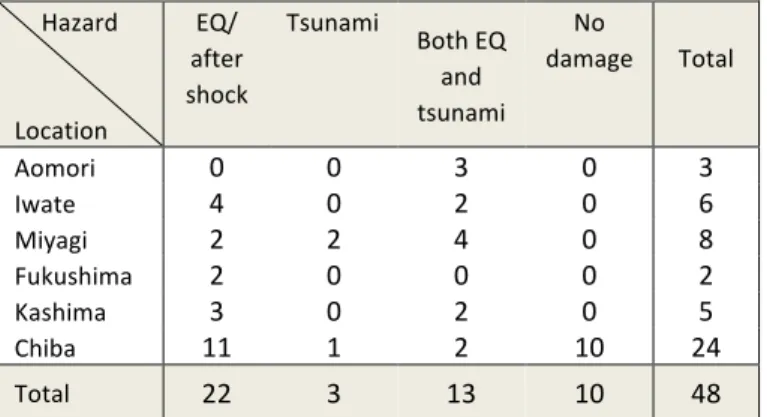
Most companies self-identified as small size (63%), and 70% were chemical, petrochemical and oil refineries. Only half indicated the date of construction of their plants: 6–built before 1970, 10-built between 1970-1980, and 9-built after 1980. 22 (46%) plants were damaged by the earthquake and/or the aftershocks, and 13 (27%) were affected by both the earthquake and the tsunami. See figure 1.
Figure 1. Number of facilities damaged by hazard.
Direct and indirect damage resulted in total shutdown in 23 plants, and partial and total shutdown in parts of the plants in 12 others. Average shut down periods were 61-63 days. The main causes for plant shutdown were direct and indirect damage (58%), loss of electricity (52%), blocked transportation routes (17%), and supply chain impacts (16%). Over 50% of responding facilities reported economic losses, and 56% of them indicated their losses were not covered by insurance. Six (of 26 that handle hazmats) facilities reported releases. Three of these releases resulted in fires and/ or explosions. No injuries or deaths of residents were reported due to the Natech. Three facilities reported slight environmental pollution of air, water and soil. Residents near two of the affected facilities were forced to evacuate.
We were interested in the performance of safety
and mitigation systems. Loss of electricity was reported as a problem affecting operations at 17 storage tanks and vessels, and pipeline systems. Onsite power generation plants or back up power generators if available (only 4% indicated they had them) were most likely flooded, and those that were not, may have been available only for lighting purposes, not to operate process equipment. Our results show that facilities were less likely to take tsunami protection countermeasures.
Even though over 50% of respondents reported that they had response plans considering the hazmat releases during earthquake and/or tsunami, 21% of them indicated that the plans were not well designed. An important issue revealed by this study is that 65% of the facilities surveyed had no programs or activities to communicate with the public regarding preparedness for hazmat accidents.
5. CONCLUSIONS This study shows that the surveyed industrial facilities suffered substantial direct and indirect damages and economic losses during the GEJET. Respondents feel that they need to be better prepared for any future event. Comprehensive loss estimation caused by potential natural hazard impacts should be conducted for the existing industrial facilities in areas subject to high earthquake and tsunami hazards such as in Osaka Bay in Japan. Particular attention should be given to facilities or equipment that are more vulnerable housing hazmats to prevent cascading effects. Finally, effective emergency plans to deal with the conjoint impact by natural events and chemical accident should be discussed and improved.
REFERENCES
Krausmann, E., and Cruz A. M. (2013). Impact of the 11 March 2011, Great East Japan earthquake and tsunami on the chemical industry. Nat Hazards, 67: 811-828. Zama et al. (2012). On damage of oil storage tanks due
to the 2011 off the Pacific Coast of Tohoku Earthquake (Mw9.0), Japan. Proc. 15th World Conf. on Earthq. Eng. (WCEE), Tokyo.
Hazard Location EQ/ after shock Tsunami Both EQ and tsunami No damage Total Aomori 0 0 3 0 3 Iwate 4 0 2 0 6 Miyagi 2 2 4 0 8 Fukushima 2 0 0 0 2 Kashima 3 0 2 0 5 Chiba 11 1 2 10 24 Total 22 3 13 10 48