15
Methodology of Education for Tsunami Disaster Prevention
Sharing the Experiences of Great East Japan Earthquake
NOMOTO Hiroyuki*
Introduction
On March 11th, 2011, the northeast coast of Japan was seriously hit by huge Tsunami that resulted in about 20,000 deaths. The size of the earthquake and Tsunami was much greater than the level expected by most scientists and the government. It is inevitable to have some casualties, because our scientific knowledge is limited and the emergency contingency plans for natural disaster can not be perfect. However, according to the reports' written by the survivors and community members, we noticed that in some areas and communities there were fewer victims in spite of serious damage by the Tsunami.
In Kamaishi City, Iwate Prefecture, there were no victims among the students who were studying in the elementary and middle schools when the Tsunami hit them. In those schools, the students had been well trained with quality educational programs for Tsunami disaster prevention. In Akasaki Town also, Ofunato City, Iwate Prefecture, there were few victims although its seaside area was completely destroyed by the Tsunami. In that town, the community members had participated in periodical drills for Tsunami disaster prevention.
This article aims to analyze these two successful cases mentioned above and show
* Tokyo Metropolitan University e-mail: [email protected]
16 1 AZ,711.1 No.512-5 (2016 )
how the people survived the Tsunami disaster. By reading this article, people at risk in the world, including students, their parents and community members, related to Education for Tsunami Disaster Prevention, can share their experiences.
1. The Importance of Education for Tsunami Disaster Prevention
(1) Lessons from the Experiences of the East Japan Great Earthquake.
In these five years, not only local governments, but also community leaders and the survivors themselves have been trying to collect information and testimonies about the Tsunami to publish them. The main objective is to learn from their experiences and to prepare for a future Tsunami. The most important thing is to know how they could or could not survive the Tsunami and what they should do for the future in order to have no more casualties in the schools, families and communities.
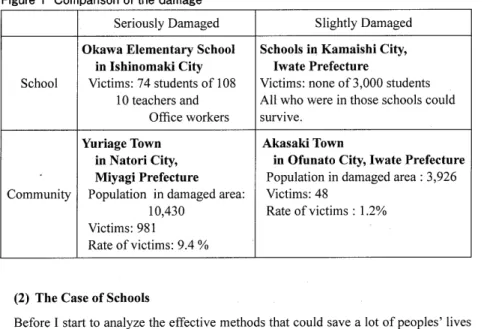
Analyzing those reports, we can see clearly that in some areas and communities, there were a lot of victims, but in others, there were few. For example, Akasaki Town located inside of the Ofunato Bay, was seriously damaged by Tsunami and 45 residents died. But compared to the cases of other areas, the percentage of the victims is about 1% and much lower than that in other areas. According to the report2 written by the people in Akasaki Town, almost all of the victims were persons who did not escape soon because of negligence. (See Fig. 1)
Another important fact those reports show is how important the periodical exercises are. It is very clear that there were fewer victims in the schools and communities where they had been trained well in case of Tsunami. The schools in Kamaishi City, Iwate Prefecture, is the most recognized example of successful Tsunami disaster prevention.
All the students, about 3.000, studying at the schools escaped from the Tsunami, because they had prepared well for a Tsunami disaster since 2004 under the instruction of Dr. Toshitaka Katada3, a specialist of Tsunami disaster prevention. He helped the schools to create quality educational programs.
Methodology of Education for Tsunami Disaster Prevention 17
Figure 1 Comparison of the damage
Seriously Damaged Slightly Damaged
School
Okawa Elementary School in Ishinomaki City Victims: 74 students of 108
10 teachers and Office workers
Schools in Kamaishi City, Iwate Prefecture
Victims: none of 3,000 students All who were in those schools could survive.
Community
Yuriage Town in Natori City, Miyagi Prefecture
Population in damaged area:
10,430 Victims: 981
Rate of victims: 9.4 %
Akasaki Town
in Ofunato City, Iwate Prefecture Population in damaged area : 3,926 Victims: 48
Rate of victims : 1.2%
(2) The Case of Schools
Before I start to analyze the effective methods that could save a lot of peoples' lives from a Tsunami disaster, I will analyze the cases of tragedy in which many people did not survive.
At the moment of Tsunami in 2011, there were many students studying or participating in club activities in the schools located near the seashore. However, almost all of them survived because of the periodical exercises for Tsunami disaster prevention in those schools and adequate decision making by the teachers and students themselves.
But we know of some schools and educational institutions in which many children died. In Ogawa Elementary School in Ishinomaki City, Miyagi Prefecture, 74 students of 108 and 10 teachers and office workers died in the Tsunami. The school did not have proper guideline or instructions to prepare for a Tsunami even though the Board of Education of Ishinomaki City had asked before the Tsunami for all of the local schools to make them. However, in Ogawa Elementary School , because of poor preparedness for Tsunami disasters, all of the students and teachers were waiting for a decision by teachers on where they should go, staying in the playground of the school for more
18 1A311J No.512-5 (2016)
than fifty minutes. Finally, the 10 meter high Tsunami reached them and took the lives of 74 students, 10 school staff and many community members who were accompanying the students.
When we visit the place where the buildings damaged and destroyed by Tsunami are still remaining as they were, we can see hills at the back of the school buildings. Many people questioned why the students and teachers didn't go up those hills to escape the Tsunami. In fact, it would not be so difficult for the students, even the lower grade students, to go up. But they didn't do that. After fifty minutes' waiting on the grounds of the school, they began to move to a bridge located on relatively higher ground. On the way to that bridge, the Tsunami hit them and washed away many of them.
By analyzing the testimony and information, it became clear that one of the main factors that caused the tragedy was the unpreparedness of the school for the Tsunami. If the school had prepared well for.a Tsunami disaster and had practices evacuation from a Tsunami, they would not have lost so many student lives.
(3) The Case of Community
Yuriage Town in Natori City, Miyagi Prefecture, was known as a town developed at the seaside of the old port for Sendai City which was the capital of a local government in the Tokugawa Era. This town was also hit by the Tsunami's more than 10 meter high waves and was seriously damaged. Among 10,430 residents in this area, 981 persons, equivalent to 9.4% of its populations, died. This proportion is one of the highest among those of Great East Japan Earthquake disaster. It is not easy to identify the reasons why so many people died, because community leaders who might have had important information for investigation were also swept away by the Tsunami. But, some research and reports suggests the reasons.
One research' shows that 82.2% of the young survivors never participated in the drills for Tsunami disaster prevention that had been held periodically before Tsunami.
Another report' made by NHK(Nihon Hoso Kyokai : Japan Broadcast Association ) TV crew found that the Yuriage Community Learning Center which was designated
Methodology of Education for Tsunami Disaster Prevention 19
officially as a local shelter by the City didn't work effectively to protect to the community members. It didn't have any apparatus like a radio telephone system for collecting information and only one megaphone to control the movements of the evacuees and to guide associations and groups for disaster prevention. That's why many residents who went first to the Center and , following the alert by the fireman, began to move to the Yuriage Elementary School 3-story building, died while driving cars on the way to the school.
It is very important to note that in Yuriage Nursery School located very close to seashore, all of the 54 children aged 1 to 6 years old, escaped from the Tsunami.
Because of its dangerous location, the school staff had a strong sense of the impending crisis and acted decisively when the Tsunami was coming. Soon after the earthquake, the director ordered the school staff to put all the children in cars and to rush them to the Yuriage Elementary School building which was designated as their shelter. This action also led the parents to the shelter to save the lives of many parents of the children.
Rikuzen-Takada City, Iwate Prefecture, was also known as the city where there were a lot of victims from the Tsunami. 1771 residents among its population of 24,246, died in the Tsunami disaster. The mistake of Rikuzen-Takada City was to underestimate the height of the Tsunami with which the governmental plan for Tsunami disaster prevention had developed. A Tsunami of more than 10 meters hit the downtown of the city. They had only prepared for a 0.5 —1.0 meter high Tsunami at the front of the City Hall. According to this assumption, Rikuzen-Takada City designated the City Gymnasium and the Civic Hall as shelters, although those buildings were located only a little higher than sea level. That's why 80-100 refugees died in the City Gymnasium, and 130-170 died in the Civic Hall. At the same time, 111 officers working in the public institutions serving the evacuees also died.
20 rAsc*tu No.512-5 (2016 )
2. School Education for Tsunami Disaster Prevention
(1) "The Miracle of Kamaishi"
"The Miracle of Kamaishi"8 has been used to describe the successful evacuation of the students studying in the elementary and middle schools in Kamaishi City at the moment when the Tsunami hit. There were about 3,000 students in those schools. In spite of the serious destruction by the Tsunami, none of them died. That's why the journalists began to call it "The Miracle of Kamaishi".
Some people in Kamaishi City and researchers don't like using this expression, because outside the schools, 1040 residents in Kamaishi City died. The students in those schools also don't like being called "Miracle". Because they know the successful evacuation was not coincident, but a natural result of their daily and hard preparations for a Tsunami disaster.
Although I know these facts, I want to use this expression here to emphasize the meaning of what happened to the students in Kamaishi City. It was not easy for them to escape from the Tsunami, because the height of the Tsunami that hit those schools was over 10 meters.
Here I can tell one story on how the students struggled to escape from the Tsunami.
The Kamaishi Higashi Middle School and the Unosumai Elementary School were located in Unosumai Town. According to the hazard map made by the City, the schools were outside the area where a Tsunami might reach. But, after the strong quakes, the students of the middle school began to rush toward the designated safe place. The elementary school students and teachers at first went up to the roof of the school building, but when they saw the middle school students running up to higher ground, they began to move together with the middle school students. At the designated place, the students suggested the teachers to move up even a higher grounds to escape from the Tsunami. On the way, some middle school students guided the elementary school students and elderly people of the community, others carried the nursery school children on their backs or helped to push baby carriages of the nursery school. Their
Methodology of Education for Tsunami Disaster Prevention 21 '
struggles to escape from the Tsunami saved not only their lives but also the lives of many community residents, including elderly people. After that, it was found that the elementary school buildings were totally engulfed by the Tsunami. If the elementary school students had remained staying on the roof, none of them would have survived.
(2) Quality Programs for Tsunami Disaster Prevention
It is very important to note that every school in Kamaishi City had quality programs for Tsunami disaster prevention, elaborated with the advice from Dr. Toshitaka Katada.
First of all, in the school curriculum, the Education for Tsunami Disaster Prevention has been placed as a core. In each subject, the contents based on Tsunami disaster prevention were taught. (See Fig. 2)
For example, they learned the mechanisms of a Tsunami in science class. It is very interesting to note that they got academic proficiency through content related to a Tsunami. They learn distance, height or speed, relating them to Tsunamis.
In addition to the academic contents related to Tsunami, the students have periodical drills to practice escaping from a Tsunami with other local schools' students and community members. Besides the exercises, they learn various skills like fire extinction, first aid care, stretcher usage or first aid cooking.
It is needless to say that each school had their own guidelines and instructions to protect themselves from a Tsunami disaster, even though the schools were not officially recognized to be located in a dangerous area. The guidelines and instructions had been often discussed and revised by the school staff
(3) 3 Basic Principles for Evacuation and "Tsunami Tendenko" as a Core of Program'°.
The particular principles of Education for Tsunami Disaster Prevention in Kamaishi City have been elaborated on with Dr. Takatoshi Katada. Following his suggestions, the students are taught 3 basic principles related to Tsunami disaster prevention.
Firstly, Dr. Katada proposes the students not to trust completely the assumptions
22 FASCIA] No.512-5 (2016• )
Figure 2 Educational Curriculum for Tsunami Disaster Prevention in Kamaishi City
Educational Content Elementary
1st , 2nd
Elementary 3rd, 4th
Elementary 5th, 6th
Middle 1st 2nd, 3"
_ Know about the earthquake and Tsunami
A Mechanism of earthquake, tsunami (5) HA: lh (4) HA: lh (2)-1 S:lh
B Characteristics of Tsunami (2) FE,HA:lh (3) M:15-20m
(6) HA: lh
C Need to evacuate (1) HA: 1 h
D Various characteristics of Tsunami (1) HA: lh
(5) HA: lb
E Characteristics of quakes (2)-2 S:Ih
11 Know how to act against Tsunami
A Protect from earthquake (1) HA: lb
B Method to escape from Tsunami (2)-1 HA:lh (6) HA: lh
C Location of shelters near school and house
(4)-1 LES: lh (4)-2 LES: lb
(2)-2 SS: 2h (2) IS:Shrs
D Various ways to escape (2)-3 SS:lh
(2)-4 SS:3hrs
E After evacuation (3) HA: 2hrs
(4) HA:l h
F Human mind of those who don't escape
(6) LES or HA: lh
III Think about the damage in the community by the Tsunami
A Know the past Tsunami damage (3)-1 HA:lb (7) IS:1-3hrs
B Know policies to protect the community from Tsunami
(3)-2 HA: lh (3) IS: lh (5) IS:lh
(5) SS:lh _V Learn from the experiences of ancestors
A Listen to the survivors (4) HA: lb
B "Tsunami Tendenko" (6)HA: l h
C Responsibility to transmit stories (7) ME: lh
HA: Homeroom Activities / M: Mathematics / S: Science / SS: Social Study / IS: Integrated Study / ME: Moral Education / FE: Physical Education / LES: Life Environmental Studies
*(1) of the middle school is the revision of all the content of the elementary school
Font:Board of Education in Kamaishi City, Manual of Tsunami Disaster Education.9 Translated by the auther.
made by the official institutions, in other words, not to believe in the hazard map. The assumption is just an assumption and may be different from what happens in reality. It means that we have to prepare for what might really happen, even though we consider
Methodology of Education for Tsunami Disaster Prevention 23
those assumptions with respect to their scientific value. The word "safe " should not be used at 100% face value in Tsunami disaster prevention.
Secondly, he asks the students to do the best they can, saying they will not survive if the natural power is stronger than human power. It is very important to know human limitation facing natural power on one hand, and on the other hand, to do the best under such limitations.
Thirdly, he advises the students to be the first person to try to escape from Tsunami disaster. He considers that the mode of evacuation is an action to break normalcy bias and lead a lot of people nearby to active evacuation. In fact, in the schools of Kamaishi, many students soon took the action of evacuation independently of others and led the active evacuation of many residents in the community to save their lives.
In addition to these 3 principles of evacuation, "Tsunami Tendenko" has been placed at the core of the program. The word "Tsunami Tendenko" has been used generally in Tohoku area, northeast Japan, to express the traditional mode of evacuation to save the lives of family and community members. It means that each individual should save first his/ her own life instead of being worried about saving other people. It comes from traditional and local knowledge to avoid death in action rather than to save other people with the possibility of total annihilation of the community. It should not be considered egoistic action.
What Dr. Katada added to these words has innovative meaning. He suggests that the students to escape first to save their own lives, believing strongly in their parents, brothers and sisters also escaping with a strong belief in them struggling to save their own lives instead of rushing to go back to the houses to save other family members.
3. Community Education for Tsunami Disaster Prevention"
(1) Damage of Akasaki Town
Akasaki Town became well known for its community-based successful evacuation.
It is a small town located inside the Ofunato Bay which was seriously damaged by the Tsunami with waves reaching about 10 meters high. Although many houses were
24 PA *1.1 No.512-5 (2016 V-)
totally destroyed by the Tsunami, there were few victims. Especially, in Oikata Community, 113 houses of 114 were totally destroyed, but it had only 9 victims.
The main shelter of Akasaki Town was located on the top of the hill near the seashore. Soon after the earthquake, 336 evacuees came to the shelter, including the students of the Akasaki Elementary School, the nursery school children, local residents and the workers in the factories. When the Tsunami reached the height of the shelter, they tried to put the children on the roof of the Center in order not to be swept away by the Tsunami. Fortunately, the Tsunami didn't breach.
Akasaki Town has also been known for their effective management of the shelters and first aid activities. Soon after the evacuation action, on that day, the local community leaders established a headquarters for the management of shelters and local first aid activities , based on the exercises held by the resident association and local voluntary group for disaster prevention. The Akasaki Community Learning Center became one of the shelters which received first aid supply from the US Navy Helicopters and also one of those which accepted many young voluntary workers to help with its reconstruction.
(2) Characteristics of Periodical Drill
For the majority of the residents in Akasaki Town, this damage by the Tsunami was not for the first time. In 1960, this area was hit by a Tsunami which came from Chile in South America. It caused serious damage although there were no casualties. Mr. Tadao Yoshida, the director at the time of 2011, remembered his house being swept away by the Tsunami.
That's why this town had been emphasizing the importance of periodical drills. In Akasaki Town, the rate of participation was not so high. However, after Hanshin-Awaji Great Earthquake in 1995, the community leaders had been trying to increase participation. At the moment when the City announced the alert for the Tsunami on February 9th, 2011, one month before Great East Japan Earthquake, the rate of evacuation reached 100% in Oikata Community although the rates in other towns of
Methodology of Education for Tsunami Disaster Prevention 25
Ofunato City were less than 10%.
In addition to the high rate of participation in the periodical drills, Akasaki Town had unique activities like map making or "call out" exercise for the families with special care needs, checking the items in the emergency kit and bucket relay. According to Mr.
Tadao Yoshida, in fact, at the moment of the Tsunami in 2011, the map which was developed to save the people with special needs and the procedures to guide them to the shelter functioned very well. As a result, all of the people with special needs
escaped from the Tsunami disaster with help of the community members except for one person whose presence was not registered by the Center.
The strong partnership between the schools and community was remarkable. They had face-to-face meetings between the students and voluntary community workers who would help those students when the Tsunami would hit them on the way to go to and back from the schools. The meeting helped the students to identify those community workers. In May, they had a disaster prevention drill together on the assumption that the earthquake would happen out of schools. In this drill, the students had been taught by the community workers and leaders where to go to escape from the Tsunami. In addition to those drills. The students were invited to the Community Learning Center to listen to the story telling about the past Tsunami disaster in the region.
(3) Management of the Shelter
The quality preparedness for the Tsunami disaster in Akasaki Town helped the management of their shelters which had been operated until the end of June. At the main shelter operated in Akasaki Community Learning Center, after the rapid establishment of the headquarters, they had a morning assembly every day at 7 o'clock and the staff meeting at 6 o'clock in the evening. In the everyday morning assembly, the Chief of the headquarters, Mr. Tadao Yoshida gave a short lecture on how to live together in a difficult situation and after that the important information, including on food distribution or announcement by the City, had been transmitted to the evacuees. In the evening staff meeting, they shared the information on what happened on that day
26 QAt ti No.512-5 (2016 - -)
and prepared for the morning assembly of the next day. In these meetings, the representatives of other 9 shelters in the region of Akasaki, also participated to share the information and act together. These meetings had been held every day until the closing of the shelters.
What surprised us was the fact they realized the disaster prevention drill in that shelter with the participation of all the evacuees to go up to the higher grounds on the assumption that the greater Tsunami would reach. In that drill, they thought out proper way to go across the road so that the act of crossing road would not disturb the other evacuees driving cars.
The reason the US Navy helicopters flew many times to supply first aid materials to the Akasaki Shelters was that they had secured the space for helicopters landing on the ground beside the Center on the assumption that the shelter would be isolated because of the destruction of infrastructure by the Tsunami.
It is important to notice that many of these effective actions were based on the quality leadership of the executive members of the local institutions and associations.
According to Mr. Yoshida, they had a strong mission to save all of the residents without any victims even though the Tsunami would sweep away their houses.
4. Needs to Share Experiences to Survive (1) The Importance of Sharing Experiences.
In 1995, Japan had a great earthquake called the Hanshin-Awaji Great Earthquake that happened in Kobe City and caused about 6,000 casualties. With that experience, the educators and researchers learned a lot and developed education for disaster prevention. But, as time goes on, among the researchers, there has been less interest in education for disaster prevention.
Even when the Sumatra Earthquake caused a giant Tsunami and claimed 280,000 victims, we didn't notice the importance of preparation for future Tsunami disasters in Japan. We just looked on that tragedy with indifference. Missing these opportunities for development of Education for a Tsunami Disaster Prevention in Japan, the events of
Methodology of Education for Tsunami Disaster Prevention 27
March 11th , 2011, happened.
The experiences of this Tsunami disaster should be seen differently from past ones and recognized as a unique one, because at first it happened in Japan where historically we have had Tsunami disasters and the word "Tsunami" was actually born. Comparing to other countries in which they had Tsunami disaster experiences, Japan had accumulated more historical and scientific knowledge on Tsunami. For example, in Japan we can read the description of a Tsunami disaster which happened AD 869, called `Jyogan Earthquake and Tsunami'. The Maori people would not inhabit Aotearoa/New Zealand for another 800 years after that. The Japanese have a long history of Tsunami documentation.
Secondly, we collected important data and information not only of natural science, but also of human activities related to earthquakes and Tsunami. Particularly, we had a lot of information and testimonies about how to prevent from Tsunami damage. As I mentioned above, during these five years after the Tsunami disaster in Japan, many local governments, communities and survivors themselves have made reports on their experiences. It is the first time in human history we are able to collect so much worthy information on a Tsunami disaster and the evacuation from it.
Thirdly, this Tsunami disaster happened in Japan where new technologies like cell phones and Social Networking Service (SNS), are commonplace. Although we know how to use this technology to disasters, the basic skills to escape from the Tsunami were not digital but analogue, like daily communication in our neighborhoods or simple participation in the prevention drills.
(2) Normalcy Bias and Sense of Crisis.
Even though we have found the importance of sharing experiences, generally the people in crisis will not have strong sense of crisis because of "normalcy bias".
"Normalcy bias" indicates the phenomenon that people prefer not to think about the worst situation at hand, but to prefer to imagine a safer situation instead of facing the difficult situation or crisis.
28 1 A.SC .! No.512-5 (2016 )
It is said that normalcy bias influences the sense of crisis of the people in two ways.
Even though the people were living in the area with risk of tsunamis, they underestimated that risk because of the normalcy bias. At the moment the Tsunami warning was issued, there were some people who supposed that the Tsunami would not reach them.
In addition to the normalcy bias, there are other factors to keep the sense of crisis weak in spite of the strong possibility to be affected by the Tsunami disaster. One of them is commercial interest, especially related to development of houses or land. The developer and its stakeholders don't want to decrease the value of the land and houses because of the risk of potential Tsunami. They don't want the people to have a sense of danger.
The same thing happens in tourist resorts. For example, in the area of Pucket which is famous as an international resort, but was once damaged by a giant Tsunami in 2004, few measures for Tsunami disaster prevention have been developed rather than the expected opposite, because the business concerned with tourism don't want the tourists to fear a tsunami and avoid visiting.
(3) The Importance of Exchange Activities
In order to promote the activities for Tsunami disaster prevention, it is very important to share experiences. In Japan, after the East Japan Great Earthquake, the voluntary activities to help the reconstruction of the cities and the lives of the evacuees have continued. At the same time, educational activities have been developed so that the people living in other areas than east Japan can learn from the experiences of the disaster. Especially, in the Tokyo metropolitan area and southwest area of Japan where the great earthquake and tsunami might happen in the near future, the people are learning from the experiences to apply the lessons to their own communities In the Tokyo metropolitan area, it has been assumed a strong local earthquake will happen and tens of thousands people may die. In Nankai Trough Earthquake, they are expecting a strong earthquake to happen in the near future. In case of Kuroshio Town ,
Methodology of Education for Tsunami Disaster Prevention 29 it is estimated a Tsunami with a maximum height of 34 meters would hit in 10 minutes.
Kuroshio Town invited Dr. Katada as an advisor for Tsunami disaster to apply the same method as he used in the schools of Kamaishi City.
In the Tokyo metropolitan area, there are many activities to remember the victims still struggling to reconstruct their lives and to learn from the experiences to prevent another disaster. In Sagamihara City, Sagamihara Civil Voluntary Group to Support Ofunato People'2 has taken study tours to Ofunato City every year in August to exchange activities with the local people, listen to the voices of the survivors and learn from their experiences.
This kind of study should not be limited to Japan. It is very important to share the experiences with people in the world, living in the coastal areas which are in danger of being affected by a Tsunami disaster.
For example, the Bay of Plenty in north island of Aotearoa/New Zealand is known as a place which will be affected by a potential Tsunami. Tauranga City in the Bay of Plenty has been developing policies to protect the local residents from a Tsunami disaster. However, comparing with the measures against Tsunami, taken by the government and community in Japan, those of Tauranga City don't seem to be enough.
The exchange activities crossing the borders will be very important for the development of Tsunami disaster prevention. For example, the local leaders, stakeholders or the students can visit the cities damaged in Japan to observe the measures and listen to the voices of the survivors. The local government and community have been trying to preserve the buildings damaged by the Tsunami as monument to study and pray at. New Zealanders can invite the people from Japan to exchange opinions.
Conclusion
During the last 10 years, mankind has experienced two giant Tsunami disasters with countless casualties. In struggling to reconstruct the cities and peoples' lives and to learn from lessons, it has become clear that in facing a Tsunami, we don't have to give
30 1A ti No.512-5 (2016 )
up and can survive if we prepare well in schools and communities. That's what the Katada method and Akasaki method have proved. These methods are not perfect and should be developed more. However, for the moment, we can spread these experiences and the methods as widely as possible in the world.
Notes 1.
2.
3.
4.
5.
6.
7.
8.
9.
10.
11.
Nomoto, Hiroyuki(2015)."Shakaikyouiku ni okeru Bousaikyouiku no Tenkai Higashinihon Dishinsai Kisokushi no Bunseki o Tyushin ni–" (" The Development of Education for Disaster Prevention in Adult and Community Education"), Shuto Daigaku Tokyo(ed) (School of Social Sciences and Humanities of Tokyo Metropolitan University(ed)), Jinbun Gakuhou(The Jornal of Social Sciences and Humanities ), No.501.
Akasakichiku Jisyubousai Soshiki Rengoukai (Federation of Voluntary Associations for Disaster Prevention in Akasaki)ed.(2013).Akasakichiku-3.11 no Kioku — Higashi Nihon Daishinsai kara Manabu (Akasaki Town—Memory of 3.11 — Learn from Great East Japan Earthquake).
See http://dsel.ce.gunma-u.ac.jp/index.html retrieved February, 2016.
Ikegami, Masaki and Katou, Jyunko(2012). Anotoki, Okawa Shogakkou de Naniga Okitanoka(At that time,what happened to Okawa Elementary School), Seishisha.
NHK Special Shuzaihan(NHK Special Program Crew)ed.(2012).Kyodai Tsunami Sonotoki Hitowa Dou Ugoitaka(At that time, how the people moved), NHK.
Uchida, Tatsushi(2013). "Tsunami Hisaichi Shuhen Chiiki no Jyumin no Keiken Miyagi-ken Natori-shi Jyumin heno Shitumonshi Tyousa kara—"("The Experiences of the Residents near the area damaged by the Tsunami—Research based on the questionnaire to the residents of Natori City, Miyagi Prefecture —"). p.52.
See The Report by Rikzen Takada City
http://www.city.rikuzentakata. iwate. jp/kategorie/bousai-syoubou/shinsai/kshoukokusyo.pdf#
search='%E9%99%B8%E5%89%8D%E9%AB%98%E7%94%B0+%E6%A4%9C%E8%A 8%BC%E5%A0%B1%E5%91%8A%E6%9B%B8' retrieved February, 2016.
Katada, Toshitaka(2012). Hito ga Shinanai Bousai (Disaster Prevention in which nobody die).Shueisha.
See Board of Education in Kamaishi City.
http://dsel.ce.gunma-u.ac.jp/kamaishi_tool/ retrieved February, 2016.
Katada, Toshitaka, ibid, pp.60-75.
See Nomoto, Hiroyuki(2012). "Ofunatoshi Akasaki chiku Kominkan no Hinan • Fukkyu no
Methodology of Education for Tsunami Disaster Prevention 31
Keiken ni Manabu" ("Learn from the experiences of evacuation and reconstruction by Akasaki Community Learning Center in Ofunato City"), Ishiiyama, Ryuhei(ed),Higashi Nihon Daishinsai to Shakai Kyouku 3 • 11 go no Sekai ni Mukiau Shakai Kyouiku (The
Great East Japan Earthquake and Adult and Community Education —Adult and Community Education facing the world post 3 • 11—) . Kokudosha, pp53-59.
12. It was organized in June, 2011, by the participants in the seminor on the damage of Ofunato city, to send the first aid materials and donation .
* This 26285172.
work was supported by JSPS KAKENHI Grant Number 15H01985,