Metabolism of Amino Acids in Aquatic Animals
II : The effect of an amino acid supplemented
casein diet on the growth rate of carp
著者
TANAKA Yoshito, HOKAZONO Shigeo, KATAYAMA
Teruhisa, SIMPSON K.L., CHICHESTER C.O.
journal or
publication title
鹿児島大学水産学部紀要=Memoirs of Faculty of
Fisheries Kagoshima University
volume
26
page range
45-48
別言語のタイトル
水産動物のアミノ酸代謝に関する研究 II : コイの
アミノ酸添加カゼイン餌料における成長率
Vol. 26 pp. 45-48 (1977)
Metabolism of Amino Acids in Aquatic Animals—II
The effect of an amino acid supplemented casein diet onthe growth rate of carp
Yoshito Tanaka, Shigeo Hokazono, Teruhisa Katayama*,
K. L. Simpson and CO. Chichester**
Abstract
By feeding the casein diet supplemented with pure amino acid, it was confirmed that the nutritive values are different for different amino acid being supplemented to casein diet.
In the case of L-alanine, L-valine, L-tryptophane, L-methionine and L-proline, the growth rate became higher than the pure casein, but the addition of L-phenylalanine and serine to the casein diet did not improve its nutritive value in comparison with pure casein diet.
Aoe et al. 1) reported that a diet of casein hydrolyzates with trypsin, pepsin or
pro-nase was unable to maintain the normal growth of young carp, whereas casein as well as hydrolyzates sustained the growth of young rainbow trout. Hashimoto et al.
2) reported that carp require ten amino acids for optimum growth which are: ar-ginine, histidine, isoleucine, leucine, lysine, methionine, phenylalanine, threonine, tryptophan and valine. It is not known why amino acid test diets can not sustain the growth of carp. Experiments using a protein diet supplemented with amino acids to improve the nutritive value have not been reported.
The present study was undertaken to determine the growth rate of carp and the relationship of growth rate to the retention time of the diet in their intestine using a
casein diet supplenented with amino acids.
Materials and Methods
1. Experimental fish and feeding methods: Healthy carp (about 5 cm
length) were purchased from a local fish hatchery.
Twenty carp were placed in each tank and acclimated for a week. The fish in
each tank were fed four times a day as follows: Tank 1 — casein diet, its composition
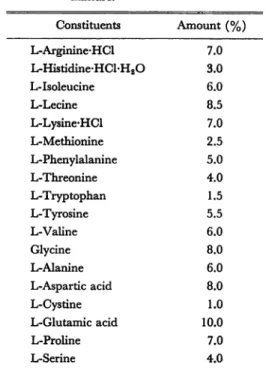
is shown in Table 1: Tank 2 — amino acid test diet, its constituents are shown in
Table 2: Tank 3 — casein diet supplemented with amino acid. The vitamin and mineral mixture was prepared according to Halver et al. (3).
* Laboratory of Marine Biochemistry, Faculty of Fisheries, University of Kagoshima.
** Department of Food Science and Technology, University of Rhode Island, Kingston, Rhode Island, U. S. A.
46 Mem. Fac. Fish., Kagoshima Univ. Vol. 26 (1977)
Table 2. Composition of amino acid
Table 1. Composition of test: diet for carp. mixture.
Composition Content (gm) Constituents Amount (%)
Casein 50 L-Arginine-HCl 7.0
Soybean oil 5 L-Histidine-HCl-H20 3.0
Cod liver oil 2 L-Isoleucine 6.0
Dextrin 19 L-Lecine 8.5
Cellulose powder-fVitamin 10 L-Lysine-HCl 7.0
Mineral mixture 4 L-Methionine 2.5
Carboxy methyl cellulose 10 L-Phenylalanine 5.0
Water 100 L-Threonine L-Tryptophan 4.0 1.5 L-Tyrosine 5.5 L-Valine 6.0 Glycine 8.0 L-Alanine 6.0 L-Aspartic acid 8.0 L-Cystine 1.0 L-Glutamic acid 10.0 L-Proline 7.0 L-Serine 4.0
The amount of amino acid added to the casein test diet was twice that contained
in the amino acid test diet, i.e.: per 100 g in dry matters, L-alanine, 6.0 g; L-valine,
6.0 g; L-tryptophane, 1.5 g; L-glutamic acid, 10.0 g; L-methionine, 2.5 g; L-proline,
7.0 g; L-serine, 4.0 g; L-phenylalanine, 5.0 g.
2. Feeding methods: An aquarium, 30X30X 100 cm was prepared as follows: a filter aid was used, and during feeding the water was circulated, aerated a 400 ml per minute and kept at room temperature. The feeding experiment was carried out for four weeks, the fish were fed the experimental diet four times a day and were weighed once a week. The amount of experimental diet fed each day was about 10% of the subjects' weight.
3. Measurement of intestine retention time: Each test diet was mixed
with sudan black as reported in the earlier experiments. (4). The amount used was 500 mg in 25 g of the diet (wet materials). The average retention time was calcu lated from the start of feeding to excretion of the digested matter.
Results and Discussion
The results of the feeding experiment are shown in Table 3. From these results
it is evident that nutritive values differ between the amino acid diet and the amino
Table 3. Weight and Growth Rates.
Diets
Average Body Weight (gm) at start at end Gain (gm) Increment (%) Rate of Growth Casein 1.80±0.49 3.41 ±0.71 1.61 ±0.22 93.41 ±9.86 100
Amino acid mixture 1.67 ±0.44 1.64±0.49 -0.03 ±0.05 -2.78±3.73 -2.47± 3.66 Casein+L-Alanine 1.97±0.37 3.93 ±0.88 2.14±0.51 118.74±3.95 130.86±22.68 Casein + L-Valine 1.50±0.40 3.03 ±0.89 1.53 ±0.49 100.44±5.89 111.08±21.97 Casein H-L-Tryptophan 1.68±0.40 3.32 ±0.88 1.64±0.48 96.28±5.65 106.48 ±21.07 Casein -f L-Glutamic acid 1.95 ±0.56 3.39±0.91 1.44±0.35 74.87 ±3.56 81.57± 7.67 Casein 4- L-Methionine 1.84±0.50 3.77±1.01 1.93±0.51 105.12 ±0.85 115.18±15.31 Casein + L-Phenylalanine 3.49±0.59 6.15±1.32 2.66±0.73 74.82±8.27 83.35±20.63 Casein -f L-Proline 1.72±0.32 3.56±0.81 1.78±0.49 101.71±9.57 113.04± 26.21 Casein+L-Serine 1.62 ±0.33 2.86±0.58 1.24±0.25 76.58±0.17 83.97 ± 11.65
22.68, higher than that with the pure casein diet where the growth is 100. When L-valine, L-tryptophane, L-methionine, and L-proline were used the growth rate was
111.08±21.98, 106.48±21.07, 117.18±15.31 and 113.04±6.21 respectively, the use
of these also resulting in a more rapid growth rate when the pure casein diet was used. Thus it is confirmed that the addition of these amino acids to the casein diet
therefore resulted in a marked improvement of the diet.
However, the addition of L-phenylalanine and serine to the casein diet did not
improve the diets nutritive value to the same degree, the rates of growth being: 81.57 ±7.67, 83.35±20.63 and 83.97± 11.65 respectively, compared to that of the pure casein diet which was 100.
Table 4. Comparison: Intestional Retention Period and Growth Rate.
Test diets Average Retention Time (minutes) Rate of Growth Casein 255±10 100
Amino acid mixture 105 -2.47±3.66
Casein ± L-Alanine 300 130.86±22.68 Casein+L-Valine 275 lll.86zb21.97 Casein+L-Tryptophan 130 106.48 ±21.07 Casein+L-Glutamic acid 342 81.57± 7.67 Casein ± L-Methionine 270 115.18±15.31 Casein+L-Phenylalanine 155 83.35 ±20.63 Casein+L-Proline 105 113.04±26.21 Casein -f-L-Serine 110 83.97 ± 11.65
48 Mem. Fac. Fish., Kagoshima Univ. Vol. 26 (1977)
From these results it can be concluded that the addition of some amino acids to
the casein diet, can enhance the diets nutritive value, whereas the addition of other amino acids to the diet produce a negative growth rate.
In addition, it was found that there was no difference in intestional tract retention
time using the casein diet or the amino acid supplemented casein diet (Table 4).
References
1) H. Aoe, K. Ikeda and T. Saito: Bull. Jap. Soc. Sci. Fish., 40, 375-379, 1974.
2) T. Nose, S. Arai, D. L. Lee and Y. Hashimoto: ibid., 40, 903-908, 1974. 3) J. E. Halver: /. Nutrition, 62, 225-243, 1957.
4) Y. Tanaka, S. Hokazono, T. Katayama, K. L. Simpson and C. O. Chichester: This Bull,