Detection of Locomotive Behavior in Aquatic
Animals by the Use of Infra-red Light
著者
YONEMORI Tooru
journal or
publication title
南方海域調査研究報告=Occasional Papers
volume
13
page range
20-23
URL
http://hdl.handle.net/10232/16223
Detection of Locomotive Behavior in Aquatic Animals
by the Use of Infra-red Light
Tooru YONEMORI
Abstract
To promote catching efficiency of shrimp pots, infra-red light was applied to the de
tection of animal movements. A sensing unit was composed of a LED (light emitting diode) and a photo-transister. At two sections in the entrance funnel of the pot, one each unit was fixed as a check point. By reading the time lag between transit signals from each gate, the direction of animal locomotion was recognized, furthermore, the number of individuals both entering and escaping animal was counted.
Introduction
It has been believed that the fishing techniques must be established on the basis of fish behavioral studies. Among the various techniques, the trap fishing is especially con nected with animal behavior. The typical shrimp pot has one or two conical entrance. In a preliminary test using the typical one, it was found that about half the number of shrimps escaped through the entrance. In order to prevent such an easy escapement, size effect of the funnel is considered most important. To get an optimum design of the
funnel by trial-and-error method, a device to record the animal locomotion became
necessary. In the observation of underwater animals, the image sensing techniques (e. g. camera or TV work) is ordinarily used, however, these needs lighting and it disturbs animal behavior. Sound or supersonic wave were also excluded because of their excessive instrumental size, then, infra-red light was choozen for this study.
Recently, the use of infra-red light became popular in our life, and by such a small
device it can reach about 5 meters or more. Pointing out the only disadvantage, the light
is heavily declined by a propagation through water. Due to the weak point, it has never been applied to the underwater technique of long distance. The only attempt was done by DALLEY (1981) to record behavior in prawns and shrimps. He installed all equipments
Detection of Locomotive Behavior in Aquatic Animals by the Use of Infra-red Light 21
in the atmosphere on both side of a small glazed tank, and the light penetrated water
from outside of the tank.
Apparatus and Method
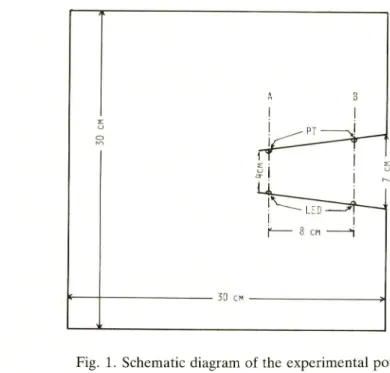
A pot demensioned 30 X 30 X 30 cm was made of stainless steel wire net. A conic
al funnel 7 - 4 cm dia., 12 cm length was fixed to a side as an entrance. Two sections in
the funnel were determined as check gates, and the distance between the gates was 8
cm. On the circumference of each gate, a LED and a photo-transister was alligned to
face each other. As the gate was curtained with infra-red light, an existence on the sec
tion intercepted the ray of the light. The signal occured by an animal locomotor was am
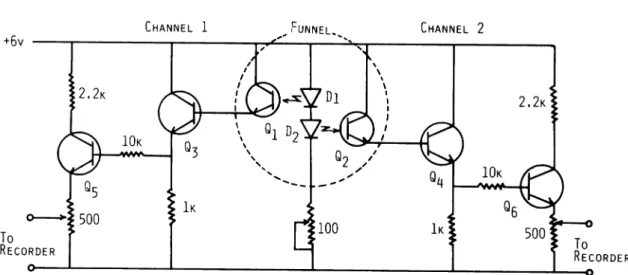
plified and then indicated with a pen recorder. As shown in Fig. 2, the circuit for ampli
fication was designed simply and a 2-pen recorder (YOKOGAWA 3057-22) was used
for a duplex channel indication. Both LED and photo transister were wide range type
and the peak wave length of LED was 940 n. m.. An adapter for pocket computer or
1.5 V X 4 dry batteries supplied electric power to the sensor unit. As the experimental
animals, small shrimp Palaemon paucidens, prawn Penaeus japonicus, crab Eriocheir
japonicus, pond snail Cipangopaludlna chinensis nalleata and guppy Poecilia reticulata
were used.
To Recorder
Channel 1 ^ TUNNEL^ Channel 2
Q2/
^J
Dj , D2
: GL 513 ( LED )
Qj , Q2
: PT 500 ( Photo-transister )
Q3 , Q^ , Q5 , Q6
: 2SC 945
Fig. 2. Circuit diagram of the whole electrical equipment.
Result and Discussion
2.2k
To Recorder
It was known from an underwater test that the unit reduced its sensitivity to 1 / 20
of an atmospheric test, however, it had enough ability to cover such a short distance
across the funnel. For driving the diode, 50 mA current was enough to cover 5 cm dis tance through the water. In addition, two LED for both gates were connected together in series, consequently the batteries stood continuous use more than 2 days. In a con tinuous recording through the night, no disturbance due to visual lights was indicated. It is shown in Fig. 3 that a small and transparent body like P. paucidence gave a faint rise, while large and opaque one like a fish registered a clear impulse. A fast swimming fish indicated a brief response and a slowgoing snail showed a wide indication. Shrimps were often observed stopping upon the diode projected from the funnel. Judging from this observation, animals did not avoid the ray of infra-red light, consequently their behavior
was not disturbed with it. If a signal from gate B precede gate A, the direction of animal locomotion is decided "entry". So, the number of individuals entered or escaped are countable. The diurnal periodicity in animal behavior is known from the continuous re cord, and a time scheduled fishing operation can be also carried out. As an extended
study, the mean locomotive speed and the body length are relatively computable. According to the following merits, infra-red light technique is considered suitable for a deep sea local sensing. (1) The technique needs no lighting, while it is essential for the
Detection of Locomotive Behavior in Aquatic Animals by the Use of infra-red Light 23
image sensing technique. (2) Parts to be underwater (LED and photo-transisters) are
compact molding and have perfect waterproofness.
—t—— i — - - - .;__!.--. , . ) . . , , j... '• ! i I . 1 i !- 1 - 1- 1 L -— LL i -4—— i —— ~ Q -L±J "-. " i i LU LU 1— "»I-z u. < CO LU -_-±-_:- „; :i... :- -Z i ^ -t .v!..: -j— -•_._-;__. — J- -zfrr . 1.. .;. j ~ - •• - ! _.J"JlJ7 : > -—• 2 d— > - _J _ _ — —! _._ "-: -i 1 a . - " 1C£ — i a_ ._". ' "T • z:-j< -—•! — iC/~ r n 7~-~-~_ ::-^:i_ . . . - e n | . , —
t
-T—-•;#
—fc /\[-
1—H— —!—*Signal from" 1 -4+- • ~ - ' _,gate B _ —j-.—I— — i „- ._71 7 ~ :"— —|-.—..:"."""" -. _ _ . . . _ ' 1 ' . — t — I ! :::.t" _~ : - : — «9 —1— ":;..: - j ^ r : ~— '_—. —I—1= • — — 1 ~ L— ... .,._..-]-
= : ~ .7="„_l— - - : ™V •
i • j — — -~ ..".._; -___r_. - - . i | : 4 : -i—!— '—h rv. . _ . . — " 1- . - -;•{; -"".7 -•:.".— -4-t • : | —1 1
H—|
— — ' - = : •—re>— r h Li . - ."• —|— 4-, *j —-— c S I -— — \ Z ~— — --4fc -. : : -. — t — •Y ! cb CM ' CM : 5IGNAL FROM GATE A -1c f—t — -.:.: [— :--•— ~b
- -~ .-... . 1 OFig. 3. An example of the recording paper showing animal locomotion.
Referencees
l) Dalley R. and Bailey H. (1981) : A new apparatus used to record the locomotor rhythms of