Amino Acids in Prawn Penaeus japonicus as
Osmo-Regulation Factors
著者
SAMESHIMA Muneo, SHIMAMURA Fujio
journal or
publication title
鹿児島大学水産学部紀要=Memoirs of Faculty of
Fisheries Kagoshima University
volume
29
page range
293-299
別言語のタイトル
浸透圧調節因子としてのクルマエビのアミノ酸
Vol.29 pp. 293-299 (1980)
Amino Acids in Prawn Penaeus japonicus
as Osmo-Regulation Factors
Muneo Sameshima* and Fujio Shimamura*
Abstract
When culturalsea water isdiluted, prawnmust be accommodated their bodyfluid to different salinity of the water by being regulated by the osmotic pressure.
Concentration of free amino acids in body fluid of prawn Penaeus japonicus is decreased to adapt itself to theenvironment according as salinity ofcultural sea water isgradually decreased. This phenomenon is explained by the function of osmo-regulation.
The prawn changes composition of free amino acids in the body fluid with salinity of the cultural sea water. Main amino acids, which change their concentration and act as osmo regulation factor, are glycine, proline, arginine and alanine.
When the cultural sea water is diluted drastically, the prawn is obliged to be confuged the free amino acid composition in its body fluid for a few days.
Crustacea change the pattern of free amino acid composition in their body fluid
according to the circumstances or their physiological conditions.1-^
In case of fishes, these osmo-regulation works according to changes of concentration
of sodium, potassium, calsium and the other inorganic ions in their body fluid9>.
But in case of Crustacea, the osmo-regulation is controled by the concentration of lowmolecular organic compounds such as amino acids likewise as the inorganic materials4).
The authors examined and discussed on the changes of species and composition of
free amino acids in the body fluid of prawn, which were cultured into low level of
salinity of sea water.
Methods to decrease the salinity of cultural sea water were
adapted following two ways. One of them was gradual or stepwise dilution and the
other was direct or rapid dilution.Materials and Methods
The prawns used as the samples were purchased at a local prawn-farm in Kago
shima prefecture. Average body length was about 10 cm and body weight was about
7 g. The prawns were cultured in 500 / cultivation tanks with sand-bed, filter and
water circulation apparatus. The cultural temperature was 21-24°C.Authentic amino acids and reagents were purchased from Wako Pure Chemical
Co. Ltd.
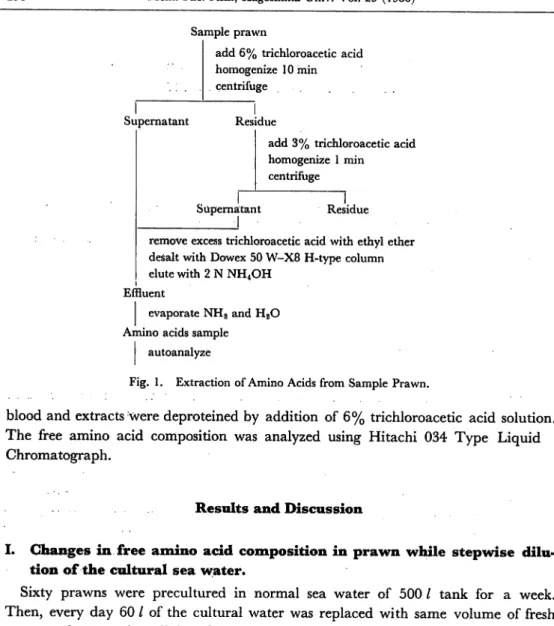
The body fluid from the muscle or hepatopancreas were collected as explained in
Fig. 1. The blood was collected from the ventral artery by cutting the tail.
These
294 Mem. Fac. Fish., Kagoshima Univ. Vol. 29 (1980)
Sample prawn
add 6% trichloroacetic acid homogenize 10 min centrifuge
Supernatant Residuei
add 3% trichloroacetic acid homogenize 1 min
centrifuge
Supernatant Residuei
remove excess trichloroacetic acid with ethyl ether desalt with Dowex 50 W-X8 H-type column
elutewith2NNH4OH Effluent
evaporate NH8 and H20
Amino acids sample
autoanalyze
Fig. 1. Extraction of Amino Acids from Sample Prawn.
blood and extracts were deproteined by addition of 6% trichloroacetic acid solution.
The free amino acid composition was analyzed using Hitachi 034 Type Liquid
Chromatograph.
Results and Discussion
I. Changes in free amino acid composition in prawn while stepwise dilu
tion of the cultural sea water.
Sixty prawns were precultured in normal sea water of 500 / tank for a week. Then, every day 60 / of the cultural water was replaced with same volume of fresh water to decrease the salinity of the cultural water moderately. Free amino acids in
0) 4-> 1.030 <0 i . 3 *3 O 1.020 ® o= Sampling points <*-o
—J®
*> a> u 1.010 i nnn —1 1 1 t ,—1 1—,©
1 1 1 1 & 0 2 4 6 8 10 11 Dayswhole body of the prawns were analyzed at each points of circles marked in Fig. 2.
Specific gravity and sea water contents in percent of each points were as follows;
©: 1.024(100%), ®: 1.021 (88%), ®: 1.019(77%), ®: 1.014(60%), ®: 1.010
(46%), ®: 1.006 (36%), ®: 1.004 (32%) and ©: 1.003 (28%).
While cultural sea
water was gradually diluted, free amino acids contents of the prawns were shown in
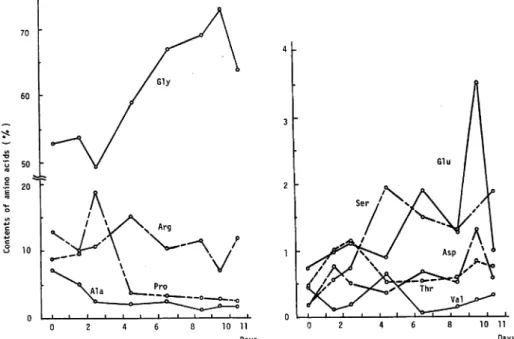
Fig. 3. Contents of amino acid in Fig. 3 shows percent value to total free amino
Fig. 3. Changes in Free Amino Acid Contents ofthe Prawn whilethe Cultural Water was Gradually
Diluted.
acids in weight. Main components of free amino acid in whole body of the prawn
were glycine, proline, arginine and alanine, and they were accounted for 90% of
total free amino acids quantitatively. These amino acids were remarkably decreased in this experiment. Variation of main amino acids are summerized in Fig. 4. Spe cific gravity of cultural water was 1.024 (100%) at first day, and it had been de creased stepwise to 1.003 (28%) at 11 days after. The results in Fig. 4 show a decreasing tendency of total amount of the free amino acids in proportion to decrease of the specific gravity of the cultural sea water. Gilles3> reported that 37-48% of free amino acids in stenohaline crab Libina emarginata was lost when the crab had been adapted to 40% concentration sea water. They also reported decreasing rate of glycine, arginine, alanine and proline were especially remarkable. In this ex
periment, the prawns were adapted to 28% sea water in the final step, and 64% of
free amino acids in the body fluid were decreased compared with the control samples. These reports on the crab and the prawn have resemble tendency.
296 Mem. Fac. Fish., Kagoshima Univ. Vol. 29 (1980)
0 2 4
Specific gravity: 1.024
Fig. 4. Changes in Free Amino Acid Contents of the Prawn while Salinity
of the Cultural Water was Gradually Reduced.
Fig. 5 shows relative efficiencies to the osmo-regulation by free amino acids in body fluid of the prawn. Relative efficiency value is expressed as percentage value of
decreased each amino acid , ^ , , r . .
decreased total amino acids ; but' decreased amounts of total or each ammo acids
TJthers
& -25
Days
Fig. 5. Relative Efficiencies of Main Amino Acids ofthe Prawn on the Osmo-Regulation. (Gradual Dilution)
are compared with just before step of the experiment, for example, ® is compared with ®. Higher value in the relative efficiency shows remarkable decrease of con cerned amino acid, and also indicates higher efficiency to the osmo-regulation. At first half steps until ®, it seems that the prawns were obliged to be confused physio logically by the environmental change. After ® step, variation of each amino acids became gradually quiet. Main amino acids contributed to the osmo-regulation at the final step ® are glycine (relative contribution rate is 40%), arginine (28%), proline (20%) and alanine (14%). The other amino acids were little contributed to the osmo-regulation of the prawn.
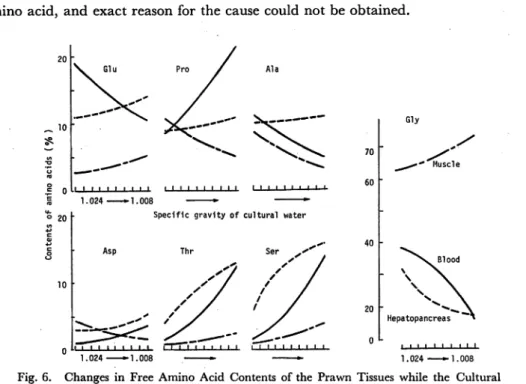
Changes in free amino acids contents of blood, hepatopancreas and muscle of the prawns were shown in Fig. 6. Contents of amino acids (%) in the Fig. 6 is percent
value to total free amino acid in weight. Cultural conditions of the prawns were same to the above mentioned. There are much deviations on concentration of the amino acid, and exact reason for the cause could not be obtained.
20
~ 10
.= o • • • i I II I I I I I I I 1 t I i I i i i i '
1.024- •1.008
Specific gravity of cultural water
-1.008 70 Gly Hepatopancreas i i ii I I i i l I 1.024 •-1.008 Fig. 6. Changes in Free Amino Acid Contents of the Prawn Tissues while the Cultural
Water was Gradually Diluted.
II. Changes in free amino acid composition in prawn while rapid dilution
of the cultural sea water.
Prawns, which were precultured in normal sea water, were directly transferred into diluted sea water. Specific gravity and sea water contents in percent of each points were as follows; ®: 1.024 (100%), ®: 1.016 (67%), ®: 1.008 (41%), ®:
•o b •
(0o>
Muscle
iii,.,. .
Blood Total body
No. of cultural tanks
Fig. 7. Changes in Free Amino Acid Contents of the Prawn while Salinity of Cultural Water was Rapidly Diluted.
Specific gravity of each tank; ®: 1.024 (100% sea water), ®: 1.016,
Mem. Fac. Fish., Kagoshima Univ. Vol. 29 (1980)
1.004 (32%) and ®: 1.000 (0%, fresh water). After 8 hours, free amino acids in muscle, blood and whole body of prawn were analyzed. On the samples cultured in fresh water, the amino acids were analyzed at 4 hours from start of the examination, because of 75% of the sample prawns were weaken by low osmotic pressure at that time. The results are shown in Fig. 7. In general, total amounts of free amino acids in each tissues seem to have an increasing tendency. But, the tendency is in a state of confusion. In the experiment with gradual dilution, there were the same confused state in their first half, steps, too. Through the confused state, the prawn have surely got a stable adapted state to osmotic pressure. These confused state on free amino acid contents have also reported about a stenohaline crab Eriochir sinensis5'6\
Summary
When the salinity of cultural sea water is reduced, main free amino acids in the prawn, which make a remarkable changes in concentration, are glycine, arginine, proline and alanine. And serine, glutamic acid, aspartic acid are followed to main amino acids. These amino acids except arginine are dispensable for the prawn10). Essential amino acids are indispensable to metabolism for the prawn, therefore, they are probably reserved in tissues of the prawn. A reason for arginine as osmo-regu lation factor is unexplained. At the first half steps of moderate dilution or at the drastic dilution of the cultural sea water, it seems that the prawns are obliged to be confused their free amino acid composition. But, at the latter half steps of moderate dilution, these confusion is solved gradually. It is interesting mention that there is some relationship between osmo-regulation and free amino acids in prawn. It is also interesting to consider the concentration of the other low-molecular nitrogen con taining compounds beside free amino acids or inorganic compounds as the osmo-regulators for prawn.
Acknowledgement
The authors express their thanks to Professor T. Katayama, Faculty of Fisheries, Kagoshima University, for his critical reading the manuscript. The authors are grateful to The Fisheries Experimental Station of Kagoshima Prefecture and Mr. O. Deshimaru for their kind permission to use a liquid chromatograph, and also to Mr. N. Kanda, Hayato Fish-Farm of MBC Kaihatsu Co. for supplying the sample shrimps.
References
1) Florkin, M. (1960): T. H. Waterman ed. "The Physiology of Crustacea" Vol. 1, 395-405,
Academic Press, New York.
3) Gilles, R. (1970): Arch. Intern. Physiol. Biochim., 78, 91-99.
4) Kamemoto, F. I. (1973): S. Uchida ed. "Kaiyodobutsuseiri", 143-152, Tokyo Univ. Press,
Tokyo (in Japanese).
5) Bricteux-Gregoire, S., Gh. DuchAteau-Bosson, Ch. Jeuniaux and M. Florkin (1962): Arch. Intern. Physiol. Biochim., 70, 272-286.
6) Florkin, M., Gh. DuchAteau-Bosson, Ch. Jeuniaux and E. Schoffeniels (1964): Arch. Intern. Physiol. Biochim., 72, 892-906.
7) DuchAteau, Gh. and M. Florkin (1955): Arch. Intern. Physiol. Biochim., 63, 249-251. 8) DuchAteau-Bosson and M. Florkin (1962): Arch. Intern. Physiol. Biochim., 70, 345-355. 9) Uchida, S. (1973): S. Uchida ed. "Kaiyodobutsuseiri", 125-142, Tokyo Univ. Press, Tokyo
(in Japanese).