Sterols and Fatty Acids of the Lab-lab and
Snail from the Milkfish-Pond
著者
TESHIMA Shin-ichi, KANAZAWA Akio, TAGO Akio
journal or
publication title
鹿児島大学水産学部紀要=Memoirs of Faculty of
Fisheries Kagoshima University
volume
30
page range
317-323
別言語のタイトル
ラブ・ラブおよび巻貝のステロールおよび脂肪酸組
成
Vol.30 pp. 317-323 (1981)
Sterols and Fatty Acids of the Lab-lab and Snail
from the Milkfish-Pond
Shin-ichi Teshima, Akio Kanazawa and Akio Tago*1
Abstract
The sterol and fatty acid compositions of the lab-lab and snail (family Ceritheidae) were
analyzed in the interests of bio-ecological transport of dietary sterols and fish nutrition in the
extensive fishpond.
The floating lab-lab contained cholesterol (40.2% of total sterols), 24-methycholesterol (14.0%), 24-methylcholesta-5, 22-dienol (17.3%), 24-ethylcholesterol (7.2%), and 24-ethylcholesta-5, 22-dienol (9.7%) as the major sterols. In the adhering lab-lab,
24-E-ethylidenecholesterol (13.3%) was the prominent sterol in addition to the above-mentioned
five sterols. The snail contained cholesterol (54.9%), cholest-7-enol (5.9%), 24-methylcho-lesterol (12.6%), 24-ethylcho24-methylcho-lesterol (3.9%), cholesta-5, 22-dienol (6.7%), 24-methylcholesta-5, 22-dienol (9.4%), cholesta-5, 24-dienol (6.0%), and small amount of 24-norcholesta-5, 22-dienol
(0.5%).
The fatty acid composition of floating lab-lab resembled that of adhering lab-lab. The two types of lab-lab contained palmitic (16:0) and palmitoleic (16:1) acids as the major fatty acids and substancial amounts of linoleic (18:2a>6, 3.6% and 6.1%) and linolenic (18:3o>3, 4.5%) acids. But, the lab-lab involved very low levels of eicosapentaenoic (20:3<o3) and
docosa-hexaenoic (22:6Vw3) acids.
In Philippines, fish-farmers have been rearing the milkfish, Chanos chanos, a
marine fish subsisting on filamentous green algae, in extensive pond operations.
The fishponds are generally set up on tidal flats near tidal streams, so they incidentally
produce the crops such as the jumbo shrimp, Penaeus monodon, swamp crab, Scylla
serrata, other species of fish etc1). A lab-lab is the so-called mixture of some algae
and plankton which propagate thick in the fishponds.
The adhering lab-lab is the
conglomerate of alive organisms attached to the fish-net etc., whereas the floating
lab-lab is regarded to be dead.
Undoubtedly, the lab-lab is recognized to be an
important food stuff to support the growth of milkfish and other animals in extensive
fishponds.In relation to the bio-ecological transport ofdietary sterols, we intend to investigate
the sterol composition of the lab-lab and snail (family Ceritheidae) which were
collected from the fishpond in Philippines. Also, our interest was focussed on thefatty acid composition of the lab-lab, because recent investigations on fish nutrition
have pointed out the unique aspects of essential fatty acid (EFA) requirements in
*l Laboratory of Fisheries Chemistry, Faculty ofFisheries, University of Kagoshima, 4-50-20318 Mem. Fac. Fish., Kagoshima Univ. Vol. 30 (1981)
aquatic animals2"5): that is, in most fish they have been shown to require <y3-series
of fatty acids such as linolenic (18: 3<o3), eicosapentaenoic (20: 5<o3), and
docosahexaenoic (22: 6<y3) acidsrather than <w6 series of acidssuch as linoleic (18: 2<w6)
and arachidonic (20: 4<y6) acids.The present paper deals with these results and discussion.
Materials and Methods
Samples analyzed The specimens of the lab-lab and snail (family Ceritheidae)
were collected in Iloilo, Philippines, during August, 1978.
The lab-lab was mainly
composed of blue-green algae (about 50%) and other organisms such as some green
algae, copepods, rotifers, diatoms, and Euglena sp.Isolation of fatty acids and sterols
The lab-lab and snail were directly sap
onified with ethanolic potassium hydroxide6) at 80°C for 24 hr, and then separated
into the unsaponifiable matter and fatty acid fractions by extraction with ether.
The fatty acid fraction was subjected to determination of fatty acid composition.
Sterols were isolated from the unsaponifiable matters by alumina column chroma
tography with hexane-benzene7).Determination of fatty acid composition The composition of fatty acids was
determined by gas-liquid chromatography (GLC) on 10%DEGS (column 3 m x 3 mm
i.d., column temperature 190°C) as described previously8).
Identification of sterol components
The sterol components were preliminarily
identified by comparison of relative retention times (RRT) to standards in GLC on
1.5% OV-17 (column 3mx3mm i.d., column temperature 245°C)9).
Then, the
acetate derivative of sterols were separated into the several fractions by thin-layer
chromatography on 10% (w/w) AgN03-Kieselgel G with ethanol-free chloroform10),
and the fractions so obtained were subjected to GLC-Mass spectrometry to confirm
the identity of sterol components.
GLC-Mass spectrometry11) was conducted with a
column (2 mx2 mm i.d.) of 3.0% OV-1 at 270°C by using a Japan Electron Optics
JEOL-JMS-300 mass spectrometer.Results and Discussion
Sterols of the lab-lab
Table 1 shows the yields of sterols from the floating and
adhering lab-lab.
Most oflab-lab sterols was present as desmethylsterols. Although
the lab-lab contained small amounts of methylsterols which were less polar in TLC
on Kieselgel G with chloroform-methanol (49: 1) than common desmethylsterols,
further characterization of the components was not carried out in this study.
The
steryl acetates of desmethylsterols from the floating lab-lab gave nine peaks in GLC
on 1.5% OV-17 and also separated into six bands of Rf 0.88, 0.78, 0.68, 0.50, 0.38,
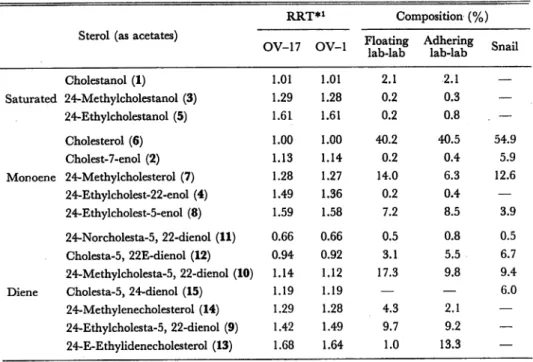
and 0.13 in AgN03-TLC. Table 2 indicates the sterol composition of the floating
and adhering lab-lab. All sterols given in Table 2 showed the identical behaviour
Table 1. Yields of the unsaponifiable matters and sterols from the lab-lab and snail.
Fraction
Weight (mg)
Floating Adhering
lab-lab lab-lab Snail
Unsaponifiable matters 53.4 48.6 13.0
Total sterols 6.3 4.2 1.2
Desmethylsterols 5.6 3.7 1.2
Methylsterols 0.7 0.4 0
on TLC and GLC, and the same mass spectra as authentic sterols or steryl acetates.
The most less polar band in AgN03-TLC was composed of five components which
were elucidated by GLC-Mass spectrometry to be cholestanyl (1, RRT 1.01) in GLC
on 3.0% OV-1), cholest-7-enyl (2, RRT 1.14), 24-methylcholestanyl (3, RRT 1.28),
24-ethylcholest-22-enyl (4, RRT 1.36), and 24-ethylcholestanyl (5, RRT 1.58) acetates.
1: m/e 430 (M+), 415, 370, 355, 316, 290, 276, 275, 257, 230, and 215.
3: m/e 444
(M+), 429, 384, 330, 290, 276, 275, 257, 230, and 215.
5: m/e 458 (M+), 443, 398
383, 344, 290, 276, 257, 230, and 215.
The presence of the molecular ions at m/e
430, 444, and 458, together with the ions at m/e 257 (M+-R-AcOH, R=side chain)12)
and the ions (M+-C-1 to C-4) at m/e 316, 330, and 344, supported the structures of
1, 3, and 5. 2: m/e 428 (M+), 413, 368, 315, 288, 255, 229, and 213. The intensemolecular ion peak at m/e 428 (100%, relative intensity) and the ion at m/e 255
(M+-R-AcOH, 40%) were indicative of C27-J7 steryl acetate12).
4: m/e 456 (M+),
413, 353, 344, 329, 315, 284, 269, 257, 255, and 215. Together with the molecular
ion at m/e 456, the intense ions at m/e 257 R-AcOH, 100%) and 215
(M+-R-42-AcOH) showed that 4 had a saturated ring and C10 side chain involving one
double. The position of side chain was determined to be located at C-22 by the
ions13) at m/e 315 (M+-R-2H), 413 (M+-43), 353 (M+-43-AcOH), 284 (M+-C-22
to C-29-lH-AcOH), and 269 (m/e 284-CH3). Thus, 4 was identified as 24-ethylcholest-22-enyl acetate14).The secondary less polar band in AgN03-TLC (Rf 0.78) was composed of three
components, cholesteryl (6, RRT 1.00 in GLC on 3.0% OV-1), 24-methylcholesteryl
(7, RRT 1.27), and 24-ethylcholesteryl (8, RRT 1.58) acetates. 6: m/e 368
(M+-AcOH), 353, 275, 260, 255, 247, 228, and 213.
7: m/e 382 (M+-AcOH), 274, 261,
255, 228, and 213. 8: m/e 396 (M+-AcOH), 288, 275, 255, 228, and 213. The
band (Rf 0.68) contained 24-ethylcholesta-5, 22-dienyl acetate (9, RRT 1.49). 9:
m/e 394 (M+-AcOH), 379, 351, 282, 267, 255, 228, and 213.
The band (Rf 0.50)
contained 24-methylcholesta-5, 22-dienyl acetate (10, RRT 1.12).
10: m/e 380
(M+-AcOH), 351, 282, 267, 255, 188, and 213. The unresolved bands with Rf 0.38were found to contain 24-norcholesta-5, dienyl (11, RRT 0.66), cholesta-5,
22-dienyl (12, RRT 0.92), and 24-E-ethylidenecholesteryl (13, RRT 1.68) acetates.
11:
m/e 352 AcOH), 337, 282, 267, 255, 253, 228, and 213. 12: m/e 366
(M+-320 Mem. Fac. Fish., Kagoshima Univ. Vol. 30 (1981)
AcOH), 351, 282, 255, 253, 228, and 213. 13: m/e 394 (M+-AcOH), 379, 351, 281, 267, 255, 253, 228, and 213. The absence of molecular ion12) and the ions13) at m/e 282 due to the cleavage at C(20)-C(22) with one hydrogen transfer and the loss of acetic acid indicated that 11 and 12 were C26-i5,22 and C27-d5'22 steryl acetates, re spectively. In conjunction with the RRT in GLC, 13 was characterized as 24-E-ethylidenecholesteryl acetate by the ions at m/e 296 (M+-C-23 to C-29-lH-AcOH) and 281 (m/e 296-CH3) characteristic of C-24 ethylidene steryl acetates. The most
polar band (Rf 0.13) was identified as 24-methylenecholesteryl acetate (14, RRT 1.28).
14: m/e 380 (M+-AcOH), 296 (M+-C-23 to C-28-lH-AcOH, 40%), 281 (m/e 296-CH3), 255, 253, 228, and 213.
Table 2. Sterol composition of the floating lab-lab, adhering lab-lab, and snail.
Sterol (as acetates)
RRT*1 Composition (%)
OV-17 OV-1 Floating lab-lab Adhering lab-lab Snail Cholestanol (1) 1.01 1.01 2.1 2.1 — Saturated 24-Methylcholestanol (3) 1.29 1.28 0.2 0.3 — 24-Ethylcholestanol (5) 1.61 1.61 0.2 0.8 . — Cholesterol (6) 1.00 1.00 40.2 40.5 54.9 Cholest-7-enol (2) 1.13 1.14 0.2 0.4 5.9 Monoene 24-Methylcholesterol (7) 1.28 1.27 14.0 6.3 12.6 24-Ethylcholest-22-enol (4) 1.49 1.36 0.2 0.4 — 24-Ethylcholest-5-enol (8) 1.59 1.58 7.2 8.5 3.9 24-Norcholesta-5, 22-dienol (11) 0.66 0.66 0.5 0.8 0.5 Cholesta-5, 22E-dienol (12) 0.94 0.92 3.1 5.5 6.7 24-Methylcholesta-5, 22-dienol (10) 1.14 1.12 17.3 9.8 9.4
Diene Cholesta-5, 24-dienol (15) 1.19 1.19 — — 6.0
24-Methylenecholesterol (14) 1.29 1.28 4.3 2.1 —
24-Ethylcholesta-5, 22-dienol (9) 1.42 1.49 9.7 9.2 —
24-E-Ethylidenecholesterol (13) 1.68 1.64 1.0 13.3 —
*l Relative retention times of steryl acetates to cholesteryl acetate
The similar analyses of sterols from the adhering lab-lab also showed the occurrence
of the same sterol components as those from the floating lab-lab (Table 2). As shown
in Table 2, the sterol composition (%) of two types of lab-lab resembled each other,
except for the occurrence of relatively large amounts of 24-E-ethylidenecholesterol
in the adhering lab-lab.
The present study showed that the floating and adhering
lab-lab composed of mainly (50%) blue-green algae contained cholesterol (40.2 and
40.5% of total sterols), 24-methylcholesterol (14 and 6.3%), 24-ethylcholesterol
(7.2 and 8.5%), 24-methylcholesta-5, 22-dienol (17.3 and 0.8%), and
Blue-green algae have been recognized to lack sterols in their tissues up to the last decade15). Later, the occurrence of sterols has been reported in all species examined. Cholesterol and 24-ethylcholesterol were detected in Phormidium luridum16\ Anacyctis nidulans17\ Fremyella diplosiphon17^, Calothriv sp18)., Nostoc commune18\ and Cyanidium caldarium1BK In the case of the blue-green alga, Anabena cylindrical, 24-methylcholesta-5, 22-dienol was found to be the exclusively major sterol (90%). Since the blue-green
Table 3. Fatty acid composition (%) of the floating lab-lab and
adhering lab-lab. Composition (%) Fatty acid Floating lab-lab Adhering lab-lab 12:0 1.0 4.0 14:0 2.6 3.5 14: 1 4.5 3.5 15:0 0.2 1.8 15: 1 . 0.8 T** 16:0 44.0 36.0 16: 1 20.5 14.0 17:0 2.0 2.4 17: 1 2.4 2.2 18:0 2.0 2.1 18: lw9 4.6 3.1 18:2o>6 3.6 6.1 18:3o>6 1.5 2.1 18:3<w3 4.5 4.5 20: 1q>9 0.9 3.0 20: 2g>3 0.9 0.5 20: 2a>6 0.5 0.6 20: 3o>3 0.3 1.8 20:4o>6 0.6 0 20:4<w3 0.5 1.6 22: \o)9 T 0.1 20:5<w3 0.5 T 22:4<y6 0.3 T 22:4a>3 0.8 T 22:5o>6 0.6 3.1 22:6ft>3 0.5 0.3 Saturates 51.8 49.8 Monoenes 33.7 29.4 2(o6 7.1 11.9 Za>3 8.0 8.7 ** Less than 0.1%
322 Mem. Fac. Fish., Kagoshima Univ. Vol. 30 (1981)
algae contain in general cholesterol as the minor sterols, cholesterol occurring in the lab-lab was deduced to come from the zooplankton in the lab-lab. Whereas, 24-methyl- and 24-ethylsterols and their ^-derivatives detected in the lab-lab were suspected to be mainly derived from the blue-green algae and other phytoplankton. Sterols of the snail The snail contained cholesterol (54.9%), cholest-7-enol (5.7%), 24-methylcholesterol (12.6%), 24-ethylcholesterol (3.9%), cholesta-5, 22-dienol (6.7%), 24-methylcholesta-5, 22-22-dienol (9.4%), cholesta-5, 24-22-dienol (6.0%), and traces of 24-norcholesta-5, 22-dienol. Cholesta-5, 24-dienyl acetate (15): m/e 366 (M+-AcOH), 351 (M+-AcOH-CH3), 342 (M+-C-22 to C-27-1H), 255, 253, 228, 213, and 69. As compared with most gastropods reported in other studies19'20), this snail was unique in the respect that it contained lesser amounts of cholesterol and considerably high amounts of other C^-sterols such as cholest-7-enol and C28- and C2g-sterols. Although it is difficult to withdraw definite reasons why the snail showed the unique sterol composition, we imagine that some sterols such as 24-methyl cholesterol, 24-ethylcholesterol, and 24-methylcholesta-5, 22-dienol were partly
derived from the lab-lab.
Fatty acids of the lab-lab Table 3 indicates the composition (%) of fatty acids of the floating and adhering lab-lab. In both two types of the lab-lab, palmitic (16: 0) and palmitoleic (16: 1) acids were the major fatty acids. In addition, the two types of the lab-lab contained substancial amounts of 18: 2<w6 and 18: 3o>3 but extremely low levels of 20: 5o>3 and 22: 6<y3. The sum of <y3-series of fatty acids amounted to 8.0 and 8.7% of total acids in the floating and adhering lab-lab, respec tively. Except for Tilapia zillii21\ most fish has been shown to require o>3 fatty acids such as 18: 3o>3, 20: 5<»3, and 22: 6<y3 rather than w6fatty acids such as 18: 2o>6 and 20: 4<y62""4). Especially, marine fish such as the red sea bream etc4), were demon strated to require 20: 5a>3 but not 18: 3o>3. Therefore, the question araises whether the milkfish requires strictly 20: 5<y3 as essential fatty acids as well as other marine fish and possesses the ability for conversion of dietary 18: 3<y3 to 20: 5o>3 and 22: 6o>3, because the lab-lab, their primary food, contained very small amounts of 20: 5g>3 and 22: 6a>3. This point should be investigated in detail by the feeding trials and also by the tracer experiments in future.
References
1) Drews R. A.: in "Fish as Food" (ed. by Borgstrom G.), Vol. 1, Academic Press, New York and London, 1961, pp. 121-143.
2) Cowey C. B. and J. R. Sargent: Comp. Biochem. Physiol., 57B, 269-273 (1977).
3) TakeuchiT.: in "Yogyo to Shiryo-Shishitsu" (ed. by Japan. Soc. Sci. Fish.), Suisangaku Ser. No. 22, Koseisha Koseikaku, Tokyo, 1978, pp. 23-42.
4) Yone Y.: in "Yogyo to Shiryo-Shishitsu" (ed. by Japan. Soc. Sci. Fish.), Suisangaku Ser. No. 22, Koseisha Koseikaku, Tokyo, 1978, pp. 43-59.
5) Teshima S.: in "Yogyo to Shiryo-Shishitsu" (ed. by Japan. Soc. Sci. Fish.), Suisangaku Ser.
6) Teshima S. and A. Kanazawa: Bull. Japan. Soc. Sci. Fish., 38, 1197-1202 (1972).
7) Teshima S. and A. Kanazawa: Bull. Japan. Soc. Sci. Fish., 37, 63-67 (1971).
8) Teshima S., A. Kanazawa and H. Okamoto: Mem. Fac. Fish. Kagoshima Univ., 25, 41-46 (1976).
9) Teshima S., A. Kanazawa and T. Ando: Mem. Fac. Fish. Kagoshima Univ., 20, 131-139 (1971).
10) Rubinstein I. and L.J. Goad: Phytochemistry, 13, 481-484 (1974).
11) Teshima S., A. Kanazawa, S. Hyodo and T. Ando: Comp. Biochem. Physiol., 64B, 225-228 (1979).
12) Knights B. A.: /. Gas-chromatog., 5, 273-282 (1967).
13) Wyllie S. G. and C. Djerassi: /. Org. Chem., 33, 305-313 (1968). 14) Erdman T. R. and R. H. Thomson: Tetrahedron, 28, 5163-5173 (1972).
15) Austin J.: in "Advances in Steroid Biochemistry and Pharmacology" (ed. by Briggs M. H.), Vol. 1, Academic Press, London, 1970, pp. 73-96.
16) De Souza N.J. and W. R. Nes: Science, 162, 363 (1968).
17) Reitz R. C. and J. G. Hamilton: Comp. Biochem. Physiol., 25, 401-416 (1968).
18) Paoletti C, B. Pushparaj, G. Florenzano, P. Capella and G. Lercker: Lipids, 11, 266-(1976).
19) Idler D. R. and P. Wiseman: Int. J. Biochem., 2, 516-528 (1971).
20) Goad L. J.: in "Marine Natural Products, Chemical and Biological Perspectives" (ed. by Scheuer P. J.), Vol.11, Academic Press, New York, San Francisco, and London, 1978, pp. 75-172.
21) Kanazawa A., S. Teshima, M. Sakamoto and Md. A. Awal: Bull. Japan. Soc. Sci. Fish., 46, in press (1980).