Chemoreceptive Property in Feeding of the
Prawn Penaeus japonicus
著者
NAKAMURA Kaworu
journal or
publication title
鹿児島大学水産学部紀要=Memoirs of Faculty of
Fisheries Kagoshima University
volume
36
number
1
page range
201-205
別言語のタイトル
クルマエビ摂餌時の化学的受容の特性
Chemoreceptive Property in Feeding of the Prawn
Penaeus japonicus
Kaworu Nakamura*
Abstract
Chemoreception of the prawn P. japonicus was investigated using the eyestalk-ablated individuals in two experiments. For the examination of chemical stimulants involved in the searching behaviour, each solution of the amino acids, proteins and saccharides wasdropwise
added to water in a tank holding an individual. To identify the substance that stimulates the
prawn during the process of ingestion, each of the amino acids, proteins and saccharides was mixed individuallywith curdlanto make pellets of uni-composition. As a result, the chemical property of the receptors associated with the searching showed a more selectivity to amino
acids, especially arginine and glycine, than to saccharides. Reversely, for ingestive response,
some protein such as casein and gelatine as well as saccharides, glucose and starch, were more
stimulative than amino acids.
Feeding response at the first process of the feeding behaviour includes chemical
recognitions such as the olfactory and taste receptions1'. These functions are performed by
the appendages of the cephalo-thorax, especially by the sensory setae present in the
mouth-parts2).
Properties of the chemoreceptors related to feeding have been studied ethologically in
Natantia species, Palaemonetes pugio3) and Penaeus japonicus ], and in Reptantia species,
Homarus gammarus\ Callinectes sapidus], Petrolisthes cinctipes7) and Plagusia dentipesi]'. Many
of these studies deal with the chemical sensitivity of the materials to amino acids, saccharides and raw extract which exist commonly in food.To understand the chemoreceptive property of the prawn P. japonicus, its chemical
responses in feeding have been studied.* Eyestalk-ablated individuals were used because their feeding behaviour appeared at the day-time after the operation. This phenomenon has been already reported in the spiny lobster Panulirus argus during the evaluation of the
threshold for the 1st antenna after eyestalk-ablation912). Therefore, it is necessary to take
into account the effect of the eyestalk-ablation on the threshold in the discussion of results.
Laboratory of Propagation Physiology, Faculty of Fisheries, Kagoshima University, 50-20 Shimoarata 4, Kagoshima, 890 Japan.
202 Mem. Fac. Fish., Kagoshima Univ. Vol.36, No.l (1987)
Material and Methods
The prawn Penaeus japonicus weighing about 10 g were used in the present experiments.
After eyestalk-ablation by compression with hot tweezers, the individuals were
separately placed in a cubic container, 5 / in volume, and subjected to the following
experiments.
The 1st experiment was done to clarify a chemical property of the prawn's receptor involved in the searching behaviour. Occurrence of the searching reaction for solutions, which were dropwise added, of five different concentrations of amino acids, proteins and saccharides, was investigated. Final concentrations of each substance in the container were
2X10"4, 2X10"5, 2X10"6, 2X10~8and2X10"10mol//. The minimum concentration of
each substance that gave a positive response was determined as the threshold value. For each concentration, six trials were undertaken. For each trial, a new individual was usually
used. However, for same concentrations of the substances, the solutions were sometimes
added successively after short intervals using the same prawn, until it exhibited a positive
response. As for proteins and polysaccharides, 0. 5% solutions were only prepared as original solutions because of their unidentified molecular weight. The solvent was sea
water, and the solution was non-adjusted for pH.
The 2nd experiment was carried out for the ingestion reaction following the searching
behaviour. Each of the amino acids, proteins and saccharides was prepared with /?
-l,3-glucan13), curdlan (WakoP. C. I., code No. 032-09902), forthe pellet of
uni-composi-tion. Then, after about 0. 2 mmol of each substance was mixed with 0.1 g curdlan and 2 m/of sea water, the mixture was coagulated in hot water. The substance of unidentified molecular
weight was mixed to obtain the pellet containing 2.5% of the matter. Blank test was treated with the pellet containing curdlan only. The number of trials was different for each substance, ranging from six to fifteen times. For each trial of the substances, the same prawn was used until it reacted positively. The repeated trials were undertaken using
different individuals.
During the experiments, water temperature was 19. 5—22. 3°C.
Results and Discussion The 1st Experiment
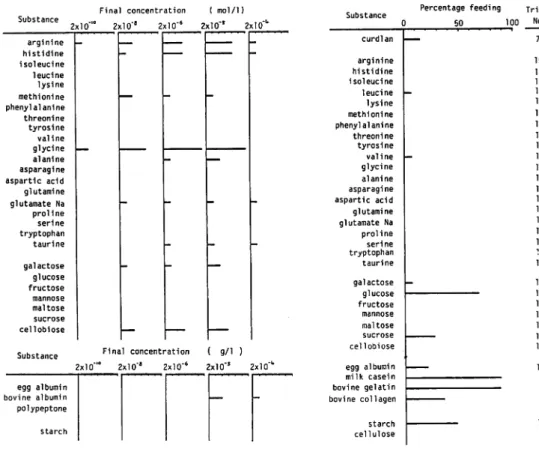
The substances examined were presented with their results in Fig. 1. Two amino acids, arginine and glycine, gave an extremely strong stimulus to the prawn. It seems that their
ethological threshold may be 2X10⁻¹⁰ mol//or lower thanthis value, and correspond nearly
to that value for taurine or glutamic acid resulted previously from the response ratio of
individuals among a population in crabs14). It is on electrophysiological record that glutamic
acid, glutamine and taurine have been strong stimulants for the 1st antenna or dactylopodite
of pereiopod in crabs and lobsters15"18'. Glycine has beenreported to be less stimulative than other amino acids or to be non-stimulant in lobster19'. For the prawn P. japonicus, the
feeding rate increased after addition of glycine to the diet20'. It is considered that the
chemical sensitivity to amino acids is different among decapod species, and each species
has the proper receptor for specific amino acids. Furthermore, eyestalk-ablation does not
seem to affect distinctly the chemical sensitivity of the prawn P. japonicus, unlike in species
previously reported9"1 .
For proteins, the positive response is achieved only by bovine albumin (Fig. 1). It has
been reported that peptides and albumin are very weak stimuli for the porcelain crab .
For sugars, cellobiose and galactose showed to be a high stimulant (Fig. 1). Their
ethological thresholds were determined to be 2X10"8 or 2X10⁻⁹ mol/Z. These values
indicate, at least, 10 times lower sensitivity, comparing with amino acids such as arginine
and glycine. In the hermit crab, trehalose and glucose have a comparatively high
stimulating effect and their ethological threshold has been recognized as higher than amino
Final concentration ( mol/1) c . . _
ci,,».,„,.„ Substance
bubstance ..„ - • * - « . -l. n
?Yin'° ?vin8 ?xin"6 7xio • 2x10 b mJ
Percentage feeding Trial
50 100 No. arginine curdlan 7 histidine isoleucine arginine 15 leucine histidine 15 lysine isoleucine 15 methionine leucine lysine _ 15 15 phenylalanine threonine methionine 14 tyrosine phenylalanine 15 valine threonine 15 glycine alanine tyrosine 15 valine - 15 asparagine glycine 15
aspartic acid alanine 14
glutamine asparagine 15
glutamate Na - aspartic acid 15
15 proline glutamine serine glutamate Na 15 tryptophan proline 14 taurine — serine tryptophan 15 15 galactose taurine 14 glucose fructose galactose glucose fructose 15 mannose maltose 15 mannose 15 sucrose cellobiose — — maltose 15 1 sucrose — — — 15
Substance Finalconcentration ( g/l )
cellobiose 15 z>xl0"'° 2x10*8 2x10"6 i>x!0"s 2x10"^ egg albumin 14 egg albumin bovinealbumin milk casein bovine gelatin ~* bovine collagen starch cellulose g polypeptone 15 starch 6
Fig. 1. Searching response of the eyestalk-ablated prawn to each solution dropwise added. The
horizontal lines corresponding to each substance indicate the number of positive reactions to six trials at respective concentrations.
Fig. 2. Ingesting response of the eyestalk-ablated prawn to each pellet of
uni-composition of the substance.
The percentage feeding means the
percentage of the positive reaction to
204 Mem. Fac. Fish., Kagoshima Univ. Vol.36, No.l (1987)
acids by 100-1000 times7'. But galactose was a weak stimulant. Cellobiose was not referred
to in that report. In the prawn P. japonicus, differing from the hermit crab, sugars showed to
be generally a weaker stimuli than amino acids.
As a result, the chemical property of the receptorseems to be specialized for the detection
of amino acids such as arginine and glycine during the searching procedure of the prawn
P. japonicus. The 2nd Experiment
Amino acids were either extremely weak or non-stimulant for ingestion (Fig. 2). For proteins, a very high value of the percentage feeding wasrecognized at 87. 5%, especially in
both milk casein and bovine gelatin. The percentage feeding means the number of positive
responses to 100 trials.
For saccharides, glucose and starch showed high percentage feedings at 66.7% and 46.7%, respectively. The value for sucrose was lower than the two.
Considering these results, the prawn seems to prefer proteins and saccharides to amino
acids during the process of ingestion. Among saccharides, glucose indicates to be a strong
stimulusfor the intake reaction of food. As for this tendency of chemoreception, it has been affirmatively reported previously in the crab Uca pugilator21) that saccharides become more
effective stimulants than amino acids at its ingestion.
Based on the above mentioned results, it is proposed that in the feeding behaviour of the prawn P japonicus a chemical stimulus from specific amino acids such as arginine and glycine elevates the searching behaviour. Then, in successive process of ingestion, the
detection of proteins and saccharides preferred by the prawn brings about an active intake of
food. However, it needs another experiments with non-eyestalk-ablated prawns to prove
this proposition.
References
1) SCHONE, H. (1961) : Complex behavior. "The Physiology of Crustacea" (ed. by
T.H. Waterman), vol.2, 465-593, Academic Press, New York.
2 ) ACHE, B. W. (1982) : Chemoreception and thermoreception. "The Biology of Crustacea" (ed.
by D.E. Bliss), vol.3, 369-398, Academic Press, New York.
3 ) Carr, W. E.S. (1978) '. Chemoreception in the shrimp, Palaemonetes pugio : The role of amino
acids and betaine in elicitation of a feeding response by extracts. Comp. Biochem. Physiol., 61 A, 127-131.
4 ) Takei, M. (1969) ! Studies on fishes favorite foods. 4. Feeding and reaction tests of eel and
prawn (kuruma). Bull. Tokai Reg. Fish.Res. Lab., 57, 71-79.
5 ) MACKIE, A.M. (1973) '. The chemical basis of food detection in the lobster Homarus gammarus.
Marine Biol, 21, 103-108.
6 ) PEARSON, W. H. and B.L. Olla (1977) : Chemoreception in the blue crab, Callinectes sapidus.
7 ) HARTMAN, H. B. and M. S. HARTMAN (1977) '. The stimulation of filter feeding in the porcelaine
crab Petrolisthes cinctipes Randall by amino acids and sugars. Comp. Biochem. Physiol, 56 A, 19-22.
8) Al, N. and M. TAKEI (1973) '. Chemoreception in the antennual organ of the marine crab.
ZoolMag., 82, 59-63 (in Japanese).
9 ) MAYNARD, D. M. and H. DlNGLE (1963) ! An effect of eyestalk ablation on antennular function in
the spiny lobster, Panulirus argus. Z. vergl. Physiol, 46, 515-540.
10) MAYNARD, D. M. and J. G. YAGER (1968) : Function of an eyestalk ganglion, the medulla
terminalis, in olfactory integration in the lobster, Panulirus argus. Z. vergl. Physiol, 59, 241-249.
11) MAYNARD, D. M. and A. SALLEE (1970) '. Disturbance of feeding behavior in the spiny lobster,
Panulirus argus, following bilateral ablation of the medulla terminalis. Z. vergl Physiol, 66, 123-140.
12) HAZLETT, B. A. (1971) '. Non-visual functions of crustacean eyestalk ganglia. Z. vergl Physiol,
71, 1-13.
13) HARADA, T., A. MlSAKI and H. SAITO (1968) : Curdlan i a bacterial gel-forming /?-1, 3-glucan. Arch. Biochem. Biophys., 124, 292-298.
14) FUZESSERY, Z. M. and J. J. CHILDRESS (1975) ' Comparative chemosensitivity to amino acids and their role in the feeding activity of bathypelagic and littoral crustaceans. Biol Bull, 149,
522-538.
15) Case, J. and G. F. GwiLLIAM (1961) * Amino acid sensitivity of the dactyl chemoreceptors of Carcinides maenas. Biol. Bull, 121, 449-455.
16) LAVERACK, M. (1963) ! Aspects of chemoreception in Crustacea. Comp. Biochem. Physiol, 8,
141-151.
17) CASE, J. (1964) I Properties of the dactyl chemoreceptors of Cancer antennarius ST IMP SON and C. productus RANDALL. Biol Bull, 127, 428-446.
18) JOHNSON, B. and B. ACHE (1978) ! Antennular chemosensitivity in the spiny lobster, Panulirus
argus : Amino acids as feeding stimuli. Mar. Behav. Physiol., 5, 145-157.
19) LEVANDOWSKY, M. and E. S. HODGSON (1965) '. Amino acid and amine receptors of lobsters. Comp. Biochem.Physiol., 16, 159-161.
20) DESHIMARU, 0. and Y. YONE (1978) i Effect of dietary supplements on the feeding behavior of prawn. Nippon Suisan Gakkaishi, 44, 903-905.
21) ROBERTSON, J. (1980) '. Feeding stimulants of the sand fiddler crab, Uca pugilator. Amer. Zool, 20, 924.