Study on Use of Commercial Proteolytic Enzymes
in Production of Fish Sauce
著者
OOSHIRO Zentaro, TAING Ok, UNE Hiroshi,
HAYASHI Seiichi, ITAKURA Takao
journal or
publication title
鹿児島大学水産学部紀要=Memoirs of Faculty of
Fisheries Kagoshima University
volume
30
page range
383-394
別言語のタイトル
魚醤油の製造における蛋白分解酵素の利用
Mem. Fac. Fish., Kagoshima Univ. Vol.30 pp. 383-394(1981)
Study on Use of Commercial Proteolytic Enzymes
in Production of Fish Sauce
Zentaro Ooshiro, Taing Ok, Hiroshi Une, Seiichi Hayashi and Takao Itakura*
Abstract
Sardine, mackerel, and ami were used for fish sauce making by adding commercial enzymes of papain, bromelain and trypsin. Fermentation temperature was varied as room temperature, 37°C or 50°C. Initial pH was adjusted to 4.5, 6.5 or unadjusted (5.2). Addition of salt was
carried out either by adding total amount of salt (25% based on fish weight) or by adding part
of salt (5% or 15%) on first day and adding the remaining after 24 h keeping at 37°C or 50°C. Minced samples were prepared by using hand-mincer. • Weight of papain was varied as 0.2, 0.3 or 0.5% based on fish weight. Fermentation was proceeded to 340-350 days.
Total soluble nitrogen, amino-type nitrogen, volatile base nitrogen, total volatile acid and individual volatile organic acids were determined at occasions during fermentation period. Papain was satisfactory for proteolysis of unminced sardines under the processing conditions of fermentation temperature of 37°C, natural initial pH, 25% salt based on fish weight, added in once together with enzyme, and enzyme weight of 0.3% based on fish weight. The taste and colour of papain-added sample was satisfactory. The aroma did not appear in both control samples without added enzyme and enzyme-added samples. Aroma was detected in matured control sample while it was not detected in matured enzyme-added sample.
Fish sauces are fermented condiments traditionally produced and extensively consumed by over 250 million people in South-east Asia and some other parts of the Far East1). Traditionally fish sauces are prepared by mixing small, uneviscerated
tropical fish with salt in the ratio of one part of salt to 1.5-3 parts by weight offish.
The mixture is placed in a concrete vat where it is allowed to ferment for about 6-9 months at temperatures between 30°C and 40°C during which time, the fish disinte grates to have a brown liquid. The liquid is run off and allowed to mature for about
3-6 months before shipping to the market. Production of fish sauce takes usually
one year or more than one year.
It has been generally considered that, it would be advantageous if the production
period of fish sauce could be shortened so that the production rate will be increased
and consequently the capital costs will be reduced. Different ways of increasing the
fermentation rate have been investigated, among which addition of commercial proteolytic enzymes got favoured by many researchers since proteolysis is the funda
mental reaction that takes place during fermentation of fish sauce. Use of bioprase,
pronase, molsin, protease AJ, papain, bromelain and ficin was investigated by some * Laboratory of Food Chemistry, Faculty of Fisheries, Kagoshima University
researchers2'3'4*5). However, the results varied widely and most workers did not specifically mention about the organoleptic properties of the product, which are important qualities of fish sauce. This report describes the effect of addition of some commercial proteolytic enzymes, papain, bromelain, and trypsin, on the rate of fermentation of fish sauce at various operating conditions and on the organoleptic properties of the fish sauce products.
Materials and Methods
Fish
Sardines, mackerel, caughtin May, and frozen ami, were bou ght from the market. Enzyme
Papain, bromelain (both were food additives of Nagase Co.) and trypsin (La boratory chemicals, Wako Co. product) were used.
Salt
Kitchen salt was bought from the market. Fish sauce production
Schematic presentation of fish sauce processing is shown in Table 1. For each sample, 400 g of fish was processed. Sardines were divided into four without evis ceration. Mackerel was beheaded and cut into pieces approximately equal to the size of sardine pieces, without evisceration. For ami, frozen block was cut into smaller blocks.
In Table 1, where there is no specific description, the general processing conditions would be regarded as follows: — fish used was sardines, unminced; amount of salt added was 25%, based on fish weight, and all amount of salt was added in one time together with enzyme; enzyme used was papain, and the amount was 0.3% based on fish weight, fermentation temperature was 37°C; initial pH was not adjusted. Cysteine (HOmg) was also added to the samples with added papain or bromelain. Fish, salt and additives were well mixed and the mixture was put into 500 ml-glass
jar, capped with screw-type plastic cover and placed under the prescribed temperature.
Fermentation was carried out for 340-350 days when the samples were filtered through Toyo No. 2 filter paper.
Chemical analysis of fish sauce
At appropriate occasions, fish sauce samples were filtered through Toyo No. 2 filter paper and chemical analyses were carried out in duplicates.
Total soluble nitrogen (T. S. N) was determined by slightly modified Kjeldahl method. For 0.5 ml of fish sauce, 3 ml of cone. H2SO4 was used in decomposition
Ooshiro-Taing Ok-Une-Hayashi-Itakura: Use of Proteases in Fish Sauce Production 385
Table 1. Scheme for the fish sauce processing.
Samples without commercial enzymes No Description 1 Control, Sardine 2 Mackerel 3 Ami
4 Initial pH adjusted to 4.5 with 2N citric acid 5 Initial pH adjusted to 6.5 with 2N NaHCOa 6 Fermentation at room temperature
7 Fermentation at 50°C 8 Minced with hand mincer
9 5% salt added on first day, placed at 376C for 24h followed by addition of remaining salt
10 The same as No 9 except that 15% salt was added on first day 11 The same as No 9 except that the sample was placed at 50°C for
24 h
12 The same as No 10 except that the sample was placed at 50°C for
24 h 13 Counterpart of No 1 14 / / No 2 15 / / No 3 16 / / No 4 17 / / No 5 18 / / No 6 Samples with 19 / / No 7 added enzyme 20 / / No 8 21 / / No 9 22 / / No 10 23 / / No 11 24 / / No 12
25 0.3%bromelain was added 26 0.3% trypsinwas added 27 0.2% papainwas added 28 0.5% papainwas added
step and 15 ml of alkali solution (40% NaOH, 5% Na2S203) was used in evapora tion step. Amino acid type nitrogen (A. N) was determined by Ninhydrin method. Volatile basic nitrogen (V. B. N) was determined by Conway's microdiffusion
method6) and pH was measured by Horiba pH meter. Volatile organic acids (V. O. A)
V. O. A was analysed by slightly modified Dougan's method7). Five ml of fish sauce was acidified to pH 2.5 with cone, phosphoric acid and was steam distilled in Kjeldahl still. One hundred ml of distillate was collected and titrated with 0.1 N
NaOH solution using phenolphthalein as indicator. Titration volume was noted as total volatile acid (T. V. A). Then 1.5 ml of alkali was added in excess. The solution was evaporated to small volume and was transferred to an oven at 40°C where it was left overnight to evaporate to dryness. Next day, the dry residue was dissolved with 1 ml of 0.1 N phosphoric acid solution containing 0.5 ml n-valeric acid/100 ml solution; the latter served as internal standard.
Portions (2-8 pi) of this solution were injected into gas chromatograph (Shimadzu, GC-3BF), pyrex glass column of 3 mm dia X2.6 m, packed with Chromosorb 101 (80-100 mesh) under the conditions of oven temperature, 210°C; ignition tempera ture, 5.5; carrier gas pressure, 1.0 kg/cm2; H2 gas pressure, 0.5 kg/cm2; air pressure, 1.0 kg/cm2. Peak areas were determined by triangulation. A series of standard synthetic solutions were prepared by using standard organic acids. Five ml each of standard solutions were steam distilled without adjusting pH and the same pro cedure as in the case of fish sauce was followed. Portions of the same standard solu tions, after adding n-valeric acid as internal standard, were directly injected into gas chromatograph. From the peak areas of chromatograms of steam-distilled and non-distilled standard solutions, the recovery of acetic acid was calculated as 86% and the other acids as almost 100%. These values of recovery were used in the calculation of the volatile organic acid concentrations of fish sauce to correct for the losses.
Results and Discussion
Type of enzymes used
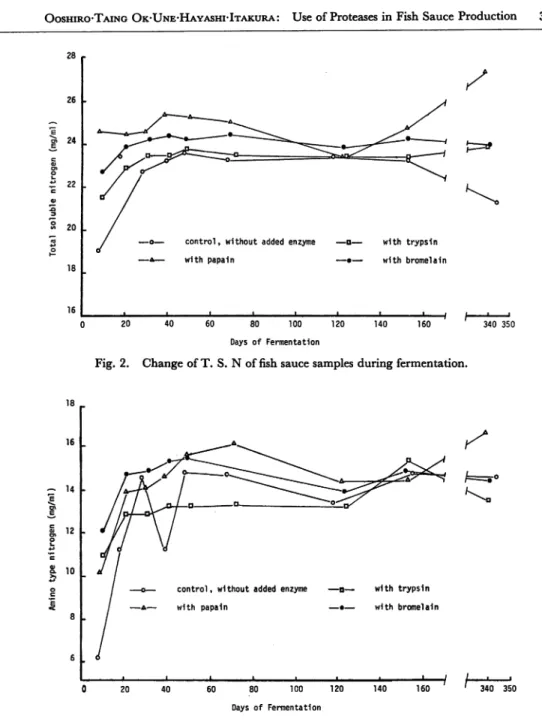
Fig. 1 to 4 shows the change in some properties of fish sauce during fermentation according to the type of enzymes used. Both for control and enzyme-added samples, pH did not markedly change. The values of T. S. N, and A. N for all enzyme-added samples were higher than the corresponding values for control through out the
fer-^-o control, without added enzyme — Q— with trypsin
with papain —•— with bromelain
6.0
5.0
4.0
20 40 60 80 100 120 140 160 340 350
Days of Fermentation
Ooshiro-Taing OkUneHayashi Itakura: Use of Proteases in Fish Sauce Production 387 28 24 £ 22 18 _ ~ 14 S
I "
o J-4-> c 2. io o c I 8control, without added enzyme with papain
a— With trypsin
••— with bromelain
20 40 60 80 100 120 140 160
Days of Fermentation
Fig. 2. Change of T. S. N offish sauce samples during fermentation.
H h
340 350
20
control, without added enzyme with papain
40 60 80 100 120
Days of Fermentation
Fig. 3. Change of A. N offish sauce samples during fermentation.
mentation period. The same was true in the case of V. B. N except for trypsin-added sample. For fish sauce, V. B. N is considered as one of the notes offish sauce aroma7). Of the enzymes used, papain resulted in higher values of properties, although the difference in the values were not so great. It is needed to point out that the effect of added-enzyme was seen sharply only for the early few days of fermantation period, after which the enzyme activity became weak due to the high salt concentration.
with trypsin
with bromelain
S
*v.1.8 1.6 J! 1.4 e S> o u ? 1.2 u w JO 0) ~ i.o +J I 0.8 0.6 20
control, without added enzyme —a— with trypsin with papain —•— with bromelain
40 60 80 100
Days of Fermentation
Fig. 4. Change of V. B. N of fish sauce samples during fermentation.
On the other hand, the control, although the values were low for first few days, followed the enzyme-added samples later because of the endogeneous enzymes of fish.
Type of fish used
The properties of fish sauce samples from different fish are shown in Table 2, together with those of commercial fish sauce from Burma and China for comparison. As can be seen from the table, T. S. N, A. N and V. B. N were somewhat increased for sardine while these properties were unaffected or decreased for mackerel and ami. It would be deduced that the effect of added papain was more pronounced for sardine than for mackerel and ami.
120 140 160
V
340 350
Table 2. Some properties of fish sauce from three kinds of raw materials.
Fish pH T.S.N (mg/m/) A.N (mg/m/) V.B.N (mg/m/) s a u c e
sample withoutadded with added without added with added without added with added without added with added
enzyme enzyme enzyme enzyme enzyme enzyme enzyme enzyme
Sardine 5.6 4.9 21.29 27.34 14.57 16.69 1.36 1.73 Mackerel 5.6 4.9 25.54 25.61 17.80 13.20 1.51 1.35 Ami 6.5 7.0 12.23 18.42 6.34 6.16 1.67 1.81 Burma 6.9 — 19.41 — 15.61 — 2.92 — China 5.6 — 17.97 — 12.66 — 2.66 — Effect of initial pH
Ooshiro'Taing Ok-Une-Hayashi-Itakura: Use of Proteases in Fish Sauce Production 389
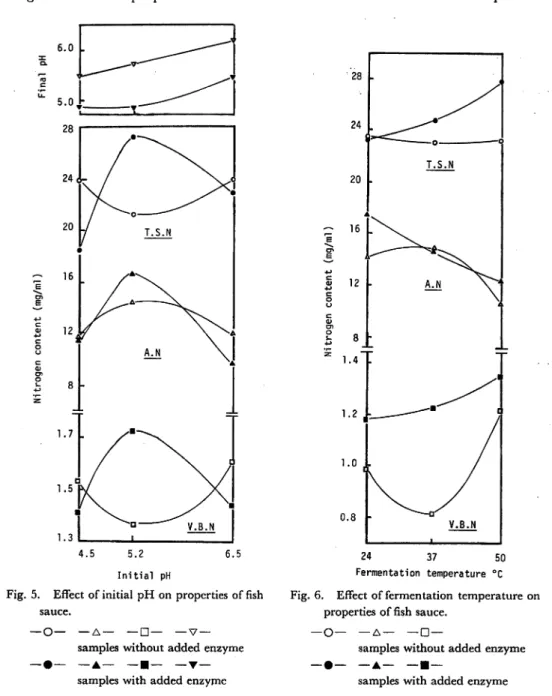
pH at the time of filtration are plotted with initial pH in Fig. 5. It is noted that the sample without adjustment of initial pH (initial pH 5.2) would be regarded as the best for enzyme-added samples since it resulted in highest values of properties. The results were random for samples with no added enzymes.
Effect of fermentation temperature
Fig. 6 shows the properties of fish sauces at different fermentation temperatures
— 16
5.2 6.5
Initial pH
Fig. 5. Effect of initial pH on properties of fish
s a u c e .
—O— —A— —•— —V—
samples without added enzyme
— # — —A— —•— —T—
samples with added enzyme
"28 24 j 20 — 16 e CT> | 12 c o u c 0) OI S 3 * 1.4" 1-2. 1.0 t 0.8 T.S.N A " / V.B.N 24 37 50 Fermentation temperature °C
Fig. 6. Effect of fermentation temperature on properties of fish sauce.
—O— —A— —•—
samples without added enzyme
—•— —A— —•—
on their 153th day since fermentation started. Although room temperature varied greatly throughout the prolonged processing period, the data of sample at room temperature are arbitrarily plotted on the ordinate of 24°C for convenience. The data on the final day of filtration were not available since the samples at 50°C lost all of their moisture content at that time. Even on 153th day, loss of moisture due to evaporation would be great enough so that all of the various nitrogen contents were concentrated. Even on this assumption, it is quite notable that lowest A. N content was observed for samples at 50°C either with or without added enzyme. The temperature of 50°C is high enough to depress the activity of either endogeneous or added enzyme.
On the other hand, the difference between room temperature and 37°C was not clearly observed. The processing of fish sauce samples started in May when the average room temperature was far less than 37°C. During this early period, the concentrations of various nitrogen in fish sauce at room temperature were far less than the corresponding values offish sauce at 37°C (data not shown). However the values of properties increased and approached to those of sample at 37°C, as room temperature increased in mid summer. Beyond this period, the values of both samples (room temperature and 37°C) fluctuated.
Effect of delayed addition of salt
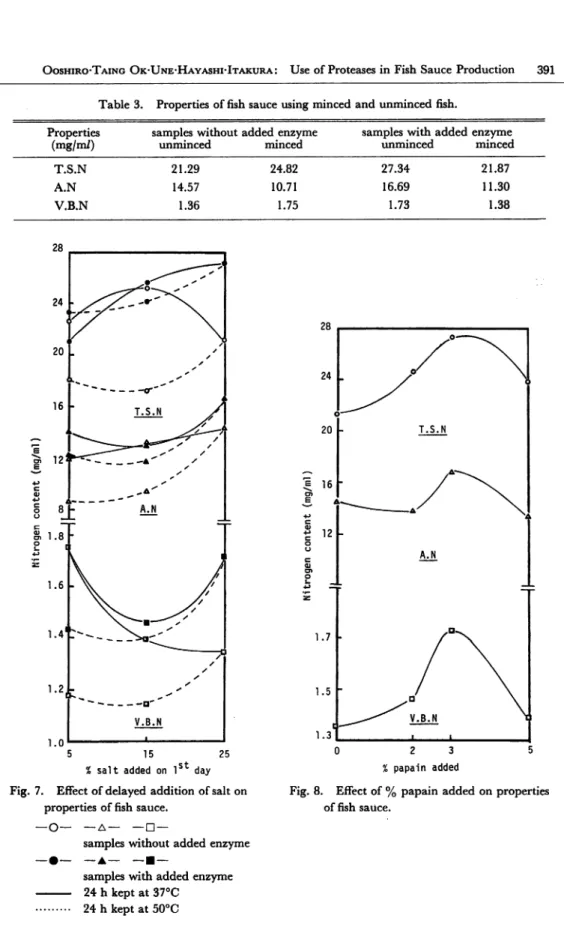
It was clear that, from Fig. 7, delayed addition of salt did not promote the pro teolysis of fish sauce and even worsened both for control and enzyme-added counter parts. Delayed addition of salt plus 24 h keeping at 50°C further made decrease in various N concentrations in fish sauce.
Effect of mincing
As can be seen from Table 3, mincing made increase in T. S. N and V. B. N but decrease in A. N for samples without added enzyme. However, it is quite interesting that mincing resulted in inferior results for enzyme-added sample. One notable advantage of mincing was that the highest yield in volume offish sauce were obtained (data not shown).
Effect of amount of enzyme used
From Fig. 8, it can be seen clearly that, all of the properties were highest for the sample with 0.3% papain. Sample with 0.5% papain showed better results than that with 0.2% enzyme. It is notable that sample with 0.2% enzyme had lower content of A. N even than control with 0% enzyme.
Organoleptic properties
At the early days of fermentation, the colour offish sauce samples was amber yellow but it gradually darkened as the time proceeded, and became dark-red at the time of final filtration. There was no remarkable difference between the colour of samples
Ooshiro-Taing Ok-Une-Hayashi-Itakura: Use of Proteases in Fish Sauce Production 391
Table 3. Properties of fish sauce using minced and unminced fish. Properties
(mg/m/)
samples without added enzyme
unminced minced
samples with added enzyme
unminced minced T.S.N 21.29 24.82 27.34 21.87 A.N 14.57 10.71 16.69 11.30 V.B.N 1.36 1.75 1.73 1.38 28 1.0 5 15 25
%salt added on 1st day Fig. 7. Effect of delayed addition of salt on
properties of fish sauce.
—O— —A— —•—
samples without added enzyme
— • — —A— —•—
samples with added enzyme 24 h kept at 37°C
24 h kept at 50°C
2 3
% papain added
Fig. 8. Effect of % papain added on properties
with no added enzyme and that of enzyme-added counterparts. Mackerel sauce were more reddish and ami sauce were darker than sardine sauce. As expected, the degree of darkness was in direct relationship with fermentation temperature —
the highest temperature resulted in the darkest product. The colour of Burmese
fish sauce was dark-brown and that of Chinese fish sauce was yellowish brown.
The taste of all sardine samples were stronger than that of commercial fish sauce products of Burma and China, and all were acceptable. However, the taste of enzyme-added product (eg. No. 13) was slightly sour, which might be the consequence
of low pH (final pH of No. 13 was 4.90 in contrast.to 5.55 of No. 1). No bitter
taste was detected in all enzyme-added products. The taste of ami sauce was un satisfactory.
Only very faint aroma appeared in all samples until the day of final filtration
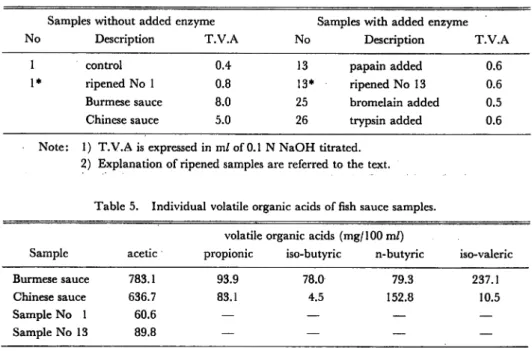
(340-350 days since fermentation started). Rancid smell was detected in mackerel sauce especially in the sample with added enzyme. This fact is in agreement with the result of some investigators3). The typical aroma offish sauce is generally considered as comprised by three notes, namely, meaty aroma due to amino acids and amines, ammoniacal aroma due to volatile basic compounds, and cheese aroma due to volatile organic acids7). Total volatile acid content of samples were determined on their 153th day of fermentation (part of the results shown in Table 4) and found out that the values were far less than those of commercial products. When the individual volatile acids were analysed by gas chromatography, it was observed that only small amount of acetic acid appeared in the samples (Table 5). That the samples had very
Table 4. Total volatile acid content of some fish sauce samples. Samples without addedenzyme Samples with added enzyme
No Description T.V.A No Description T.V.A
1 control 0.4 13 papain added 0.6
1* ripened No 1 0.8 13* ripened No 13 0.6
Burmese sauce 8.0 25 bromelain added 0.5
Chinese sauce 5.0 26 trypsin added 0.6
Note: 1) T.V.A is expressed in ml of 0.1 N NaOH titrated. 2) Explanation of ripened samples are referred to the text.
Table 5. Individual volatile organic acids of fish sauce samples. volatile organic acids (mg/100 ml)
Sample acetic propionic iso-butyric n-butyric iso-valeric
Burmese sauce 783.1 93.9 78.0 79.3 237.1
Chinese sauce 636.7 83.1 4.5 152.8 10.5
Sample No 1 60.6 — — — —
Ooshiro-Taing Ok-Une-Hayashi Itakura: Use of Proteases in Fish Sauce Production 393
low V. B. N values was also partly attributable to their faint aroma. V. B. N increased considerably as the fermentation proceeded, but the values were still less than those of commercial fish sauce products (Table 2).
The synthetic aroma .solutions (volatile organic acids) were prepared based on the results of commercial fish sauce products and added to the fish sauce samples in various ratios. It was found out that if sufficient amount of volatile organic acids solution was added to the fish sauce sample, either with or without added enzyme, the typical fish sauce aroma appeared distinctly. Hence, it is sure that volatile organic acids are important components for the development of fish sauce aroma. One interesting point was that part of the fish sauce sample, without added enzyme, (No. 1), which was filtered in its 7th month of fermentation, and ripened at room temperature, was found that fish sauce aroma appeared when total processing time reached 344 days. Total volatile acid content of this ripened sample, (No. 1* in Table 4) became doubled than that of unripened sample, (No. 1), although it was still far less than that of commercial fish sauce products. The detection of individual volatile acids by gas chromatography was not carried out because of the insufficient amount of this ripened sample. From this result, it would be considered that the ripening or maturing period is essential for the development of fish sauce aroma.
Most investigators on fish sauce did not mention the significance of ripening stage
which, in fact, is practically established in production offish sauce in Bruma. There may be colloidal compounds in the sludge of fish sauce mass which interferes with the development of aroma compounds.
On the other hand, when part of the sample with added papain, (No. 13), was
filtered in its 7th month of fermentation and ripened till the total processing time
reached 339 days, the aroma did not appear. This result was supported by the fact
that total volatile acid content of this ripened sample was the same as that of unripened
sample (No. 13* and No. 13 in Table 4). This fact was in alignment with what revealed by some researchers that the quality of fish sauce with added enzyme was poor85.
Conclusions and Recommendations
1. Of the three types of enzymes tested, papain was the most effective in view point
of proteolysis for the production of fish sauce from sardines. Mackerel resulted in rancid smell and the taste of ami was unsatisfactory.
2. Fermentation with 0.3% papain at 37°C without adjusting initial pH was the best condition for maximum proteolysis. Delayed-addition of salt and mincing before fermentation did not promote proteolysis and, even worsened for
enzyme-added samples.
3. The taste and colour of papain-added samples were acceptable, and were not
different from those of control sample without added enzyme.
the fermentation time proceeded to more than 340 days. Ripening or maturing period was found to be essential for development of aroma compounds.
5. Aroma did not appear in sample with added enzyme even though matured. Determination of free amino acids content and ripening of samples at different ripening conditions are being carried out. It would be recommended that evolution of aroma compounds from fish sauce during its ripening period should be further investigated so that the significance of ripening period is well established.
References
1) Saisithi, P., Kasemsarn, B., Liston, J., and Dollar, A. M. (1966): Microbiology and chemistry of fermented fish. J. FoodSci. 31, 105-110.
2) Beddows, C. G., and Ardeshir, A. G. (1979): The production of soluble fish protein solution for use in fish sauce manufacture. I. The use of added enzymes. Food Technol. 14, 603-612.
3) Miyazawa, K., Van Lee, C, Ito, K., and Matsumoto, F. (1979): Studies on fish sauce. J. Fac. App. Biol. Sci. Hiroshima Univ. 18, 55-63.
4) Murayama, S., Calvez, D. L., and Nitayachin, P. (1962): Study on the production offish sauce. I. Effect of commercial proteolytic enzymes on the production of fish sauce. Bull. Tokai Reg. Fish. Res. Lab. No. 32, 155-162.
5) Ohono, E., and Asano, N. (1968): Studies on the special foods in Akita prefecture. II. Factors Affecting the quick ripening of shottsuru (fish sauce). Akita Daigaku Kyoiku Gakkubu Kiyo (Shizen Khagaku). No. 19, 85-99.
6) Pearson, D. (1973): in "Laboratory Techniques in Food Analysis", Butterworths, London, pp. 169-172.
7) Dougan, J., and Howard, G. E. (1975): Some flavouring constitutents of fermented fish sauce.
J. Sci. Fd. Agri. 26, 887-894.
8) Jones, N. R. (1974): in "Artisanal processing and utilization of tropical fish products". Proc. IV Int. Congress Food Sci. and Technol. Vol. V, pp. 246.