Fukushima Medical University
福島県立医科大学 学術機関リポジトリ
This document is downloaded at: 2021-11-08T00:04:28Z
Title Long-term survival after resection of metastases in the lungs and larynx originating from sigmoid colon cancer: report of a case
Author(s) Terashima, Shinya; Watanabe, Satoshi; Shoji, Mitsuo
Citation Fukushima Journal of Medical Science. 60(1): 82-85
Issue Date 2014-08-08
URL http://ir.fmu.ac.jp/dspace/handle/123456789/407
Rights © 2014 The Fukushima Society of Medical Science
DOI 10.5387/fms.2013-14
Text Version publisher
82 Vol. 60, No. 1, 2014
Corresponding author : Shinya Terashima E
-mail : [email protected] https://www.jstage.jst.go.jp/browse/fms http://www.fmu.ac.jp/home/lib/F
-igaku/
[Case Report]
LONG
-TERM SURVIVAL AFTER RESECTION OF METASTASES IN THE LUNGS AND LARYNX ORIGINATING
FROM SIGMOID COLON CANCER : REPORT OF A CASE
SHINYA TERASHIMA, SATOSHI WATANABE and MITSUO SHOJI
Department of Surgery, Fujita General Hospital, 14
-1 Sanbongi Tsukanome, Kunimi
-machi, Date
-gun, Fukushima 969
-1751, Japan
(Received August 28, 2013, accepted November 8, 2013)
Abstract : Metastatic neoplasms in the larynx from remote primary tumors are uncommon, and laryngeal metastasis originating from the colorectum is extremely rare. We herein report a case of metastatic laryngeal carcinoma originating from sigmoid colon cancer in a 54
-year
-old female.
Curative partial laryngectomy was performed, and the patient remains alive with a good quality of life and no signs of recurrence seven years and eight months after sigmoidectomy and four years and eight months after partial laryngectomy.
Key words : Colorectal cancer, Larynx, Metastasis
INTRODUCTION
Secondary laryngeal cancers are very rare tumors, with an incidence ranging from 0.09% to 0.4% of all laryngeal neoplasms. Among these lesions, skin melanoma and renal cell carcinoma are the most frequent sites of origin
1). However, colorectal carcinoma (CRC) metastases to the larynx are extremely rare ; there are only 12 cases of sec- ondary laryngeal tumors originating from CRC.
We herein report a case of sigmoid colon cancer metastasis to the lungs and larynx that was success- fully resected and discuss the characteristics of met- astatic laryngeal tumors. To our knowledge, this case is the only reported case of long
-term survival in a patient with this disease.
CASE REPORT
In November 2005, a 54
-year
-old Japanese female underwent sigmoidectomy with lymph node dissection under a diagnosis of sigmoid colon cancer.
The postoperative TNM classification was Stage IIIB disease (T3N1M0) and histopathological find- ings were moderately differentiated adenocarcinoma (Fig. 1a). Postoperative adjuvant FOLFOX4 (oxali-
platin plus an infusion of 5
-fluorouracil /levofolinate) therapy was administered for 11 cycles. In May 2008, a computed tomography (CT) scan of the tho- rax showed a 2 cm nodular mass in the right middle lung. Consistent with the CT findings, positron emission tomography (PET) demonstrated high uptake of FDG in the right middle lung. There were no abnormal areas of uptake in either the anas- tomotic lesion or regional lymph nodes. Therefore, middle lobectomy of the right lung was performed under a diagnosis of lung metastasis. The histo- pathological findings were well differentiated adeno- carcinoma, consistent with a diagnosis of metachro- nous lung metastasis of sigmoid colon carcinoma (Fig. 1b).
In November 2008, the patient was admitted to our clinic with a 2
-week history of hoarseness. On admission, she looked well. Her body temperature, arterial blood pressure and respirations were nor- mal. A physical examination showed no abnormal findings. Laboratory tests were normal, and the carcinoembryonic antigen level was 2.9 μg/L (normal range : <5.0 μg/L).
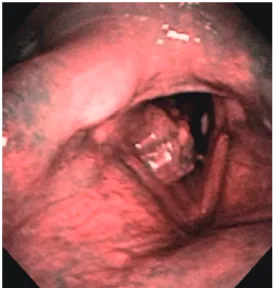
Laryngoscopy revealed a nodular mass in the
right subglottic lesion (Fig. 2). A histological
examina tion of laryngoscopic biopsy specimens
83 LONG
-TERM SURVIVAL AFTER RESECTION OF METASTASES
revealed suspected metastasis from sigmoidal ade- nocarcinoma. A further workup did not reveal any other sites of metastatic spread. Therefore, the patient underwent partial laryngectomy at another institution. The pathological specimen exhibited moderately differentiated adenocarcinoma, consis- tent with a diagnosis of metastasis from sigmoidal adenocarcinoma (Fig. 1c). Additional chemotherapy
with S1 was administered at 100 mg/day over six months. The patient remains alive with a good quality of life at seven years and six months after the initial surgery, and four years and six months after partial laryngectomy, respectively. Moreover, posttreatment annual CT scan showed no recurrent disease.
DISCUSSION
Colorectal cancer is a major cause of death worldwide, and its incidence has been increasing over the past 25 years
2-4).
With the increasing use of new radiologic modalities, such as CT, magnetic resonance imaging (MRI) and PET, together with the increasing sur- vival rates of patients with primary colorectal cancer, metastasis is more likely to be diagnosed.
Common metastatic sites for adenocarcinoma of the colon and rectum include the liver and the lungs, whereas metastasis to the larynx is very rare.
Metastatic neoplasms in the larynx are unusual, accounting for 0.09% to 0.4% of all laryngeal tumors
1). On the other hand, Friedmann and Osborn
5)reported that 23.9% of patients with metastasis to the head and neck have laryngeal and/or tracheal diseases at autopsy. The difference in the frequency of this disease in clinical and autopsy cases suggests the possibility that the actual clinical prevalence of laryngeal metastasis has been underestimated.
To the best of our knowledge, only 12 cases, including our case, of metastasis of CRC have been reported in the English language literature (Table 1)
6-15).
Based on the cases with available information, laryngeal metastases have the following characteris- a
b
c
Fig. 1. Microscopic findings of the reseted speci- mens. a. sigmoid colon, b. lungs, c. laryngeal tumor (H&E, a
-c ×10).
Fig. 2.
tics. The mean age of the patients with laryngeal metastasis originating from CRC was 64.7 years (range : 51
-81). The 12 reported cases involved 8 females and 4 males. The signs and symptoms of secondary laryngeal neoplasms are similar to those of other malignant laryngeal lesions. The primary site of CRC was the sigmoid colon in 4 cases, rectum in 4 cases, transverse colon in 1 case and unspeci- fied colonic locations in 3 cases. Data for the grad- ing of primary CRC are available for 10 patients : G2 in 8 cases and G1 in 2 cases. Data for other sites of distant metastasis are available for 10 patients : 9 patients had other sites of distant metastasis and 1 patient had isolated laryngeal metastasis. Of the 9 patients with other distant sites of metastasis, meta- chronous lung metastasis was present in 8 cases and liver metastasis was present in 3 cases before laryn- geal metastasis. Although the metastatic mecha- nism to the larynx is still unknown, metastatic spread can occur via hematogenous and lymphatic route. The route for hematogenous spread via the systemic circulation is the inferior vena cava, right heart, lungs, left heart, aorta, external carotid artery, upper thyroid artery, and upper laryngeal artery
16). The vertebral venous plexus has also been impli- cated in retrograde metastatic spread of colorectal cancer
17). The high incidence of lung metastasis in the patients with laryngeal metastasis strongly sug-
gests a metastatic route from the lungs to the lar- ynx.
Since no general rules can be established on how to treat secondary laryngeal tumors due to their rare nature, the treatment approach must be tailored to the individual patient based on the biologic behav- ior of the primary tumor, the characteristics of the laryngeal lesion, the general condition of the patient and the results of the metastatic workup, which must include CT, PET and bone scintigraphy as long as possible.
A general recommendation, however, can be made that symptomatic and palliative treatment should be administered in patients with multiple metastases, including those in the larynx. Options for intervention include bronchoscopy, direct laryn- goscopy with laser excision, and debulking of the laryngeal tumor. Tracheostomy can be performed in patients with significant respiratory distress due to airway obstruction. A reasonable chance for curative treatment can be expected only in patients with solitary laryngeal metastases. Therefore, adjuvant therapy was done only in our present case.
The prognosis of patients with laryngeal metastasis is poor because laryngeal involvement is generally observed in terminal patients with other multiple metastases. The longest survival after treatment for laryngeal metastases originating from CRC was Table 1. Reported cases of laryngeal metastasis originating from colorectal cancer.
First author
Ref)Age (years)/
Sex Initial
presentation Primary
site
aTNM G
grade Other distant
metastasis Treatment for
laryngeal metastasis Results Whicker
6)75/M Hoarseness,
Stridor S 2 Unknown Radiation 6 months alive
Abemayor
7)69/F Hoarseness,
Stridor T 2 Liver Tracheostomy,
Radiation Unknown
Cavicchi
8)59/F Dyspnea Unknown 1 Lung Radiation Unknown
Nicolai
9)53/F Dyspnea R 1 Lung Laser resection In a year dead
Nicolai
9)58/F Dyspnea S 2 Lung Laser resection,
Photocoagulation 20 months alive Puxeddu
10)65/M Respiratory
distress Unknown 2 Liver Tracheostomy,
Radiation 3 months dead
Hilger
11)73/F Stridor R Unknown Unknown Extended
laryngectomy 15 months dead
Sano
12)81/F Hoaseness,
Dyspnea Unknown 2 Lung, Sacrum Tracheostomy,
Radiation 16 months alive Ramanathan
13)51/M Hoarseness,
Swelling R 2 Liver, Sacrum Unknown Unknown
Marioni
14)78/F Peristomal
swelling S Unknown Lung, Thyroid Total thyroidectomy,
Laryngectomy 4 months alive with metastasis
Ta
15)60/M Dyspnea R 2 Lung Tracheostomy,
Debulking Unknown
Present case 54/F Hoarseness S 2 Lung Partial laryngectomy 54 months alive
a