• 検索結果がありません。

福島県立医科大学 学術機関リポジトリ

N/A
N/A
Protected

Academic year: 2021

シェア "福島県立医科大学 学術機関リポジトリ"

Copied!
11
0
0

読み込み中.... (全文を見る)

全文

(1)

Fukushima Medical University

This document is downloaded at: 2021-11-08T00:12:12Z

Title Outcome of clival chordomas after skull base surgeries with mean follow-up of 10 years

Author(s) Tamura, Takamitsu; Sato, Taku; Kishida, Yugo; Ichikawa, Masahiro; Oda, Keiko; Ito, Eiji; Watanabe, Tadashi; Sakuma, Jun; Saito, Kiyoshi

Citation Fukushima Journal of Medical Science. 61(2): 131-140

Issue Date 2015

URL http://ir.fmu.ac.jp/dspace/handle/123456789/491

Rights © 2015 The Fukushima Society of Medical Science

DOI 10.5387/fms.2015-12

Text Version publisher

(2)

131 LONG

-

TERM OUTCOME OF CLIVAL CHORDOMAS

Fukushima J. Med. Sci., Vol. 61, No. 2, 2015

[Original Article]

OUTCOME OF CLIVAL CHORDOMAS AFTER SKULL BASE SURGERIES WITH MEAN FOLLOW

-

UP OF 10 YEARS

TAKAMITSU TAMURA

1,2)

, TAKU SATO

1)

, YUGO KISHIDA

1)

, MASAHIRO ICHIKAWA

1)

, KEIKO ODA

1)

, EIJI ITO

3)

, TADASHI WATANABE

4)

, JUN SAKUMA

1)

and KIYOSHI SAITO

1)

1)

Department of Neurosurgery, Fukushima Medical University, Fukushima, Japan,

2)

Department of Neu- rosurgery Graduate School of Medicine, University of the Ryukyus, Nishihara, Japan,

3)

Department of Neurosurgery, Gifu Prefectural Tajimi Hospital, Tajimi, Japan,

4)

Department of Neurosurgery, Nagoya Daini Red Cross Hospital, Nagoya, Japan

(Received April 9, 2015, accepted July 24, 2015)

Abstract : Background and Objective : Skull base chordomas are clinically malignant because of the difficulty of total removal, high recurrence rate, and occasional drop metastasis. Although ag- gressive surgical resection and postoperative radiation have been recommended, the long

-

term out- come remains unsatisfactory.

Methods : From 1992 to 2011, we treated 24 patients with skull base chordoma using aggressive surgical removal as a principal strategy. Skull base approaches were selected according to tumor extension to remove the tumor and surrounding bone as completely as possible. After surgery, all patients were closely observed with MRI to find small and localized recurrent tumors, which were treated with gamma

-

knife radiosurgery or surgical resection. The mean postoperative follow

-

up duration was 10.2 years (range, 1

-

17.2 years).

Results : The 5

-

, 10

-

, and 15

-

year overall survival rates were 86%, 72%, and 72%, respectively.

The 5

-

and 10

-

year progression

-

free survival rates were 47% and 35%, respectively. Tumor exten- sion to the brainstem and partial tumor removal were the factors related to poor survival.

Conclusions : Our results suggest that aggressive surgical removal improves the long

-

term out- come of patients with skull base chordoma. We would like to emphasize that skull base chordomas should be aggressively removed using various skull base approaches.

Key words : clival chordoma, skull base surgery, long

-

term outcome

INTRODUCTION

Chordoma is a rare tumor, presumably originat- ing from remnants of the primitive notochord. The incidence of chordomas ranges from 0.8 to 5 cases per million individuals per year. Approximately 50% of chordomas develop in the sacrococcygeal re- gion, 35% in the spheno

-

occipital region, and 15% in the vertebrae. Skull base chordomas arise in and around the upper and middle clivus as well as the spheno

-

occipital synchondrosis. Although they are considered to be slowly growing low

-

grade malig- nancies, their behavior is more aggressive because of infiltration to local bone, extension to adjacent

soft tissue, high recurrence rate, and occasional me- tastasis

1)

.

Clival chordomas are difficult to treat because of their deep location and the invasive nature of the tumor. An aggressive surgical approach to attempt radical resection and subsequent postoperative radi- ation therapy is recommended as the current thera- peutic algorithm

1-3)

. The degree of tumor resection has proved to be an independent factor for tumor re- currence and the strongest determinant of survival

1)

. Long

-

term follow

-

up reports have shown that lon- ger survival rates were correlated with more exten- sive tumor removal

2-6)

.

In our previous study, we demonstrated long

-

Corresponding author : Kiyoshi Saito E

-

mail : [email protected]

https://www.jstage.jst.go.jp/browse/fms http://www.fmu.ac.jp/home/lib/F

-

igaku/

(3)

term control of clival chordoma with initial aggres- sive surgical resection, and gamma knife stereotactic radiosurgery (SRS) for recurrence

7)

. The mean fol- low

-

up after surgical resection at that time was 7.3 years. In the present study, we show further long

-

term outcome with the mean follow

-

up of 10.2 years and evaluate clinical factors for poor outcome.

PATIENTS AND METHODS

From 1992 to 2011, we treated 24 consecutive patients with clival chordoma in Nagoya University Hospital, Fukushima Medical University Hospital, and their affiliated hospitals : 15 men and 9 women, age ranging from 7 to 75 years old (mean, 46) (Table 1). Two patients had recurrent tumor after surgery or multiple surgeries and radiation. Our principal strategy is aggressive surgical resection. We tried total removal of the tumors using various skull base

approaches. The surrounding bone was removed or drilled out as completely as possible, and the clival dura was thoroughly cleaned up.

The location and extension of the tumors with surgical approaches are shown in Table 1. Selected approaches were a transsphenoidal approach : micro scopic (2 patients) before 1998 and endoscopic (6 patients) thereafter, an anterior craniofacial ap- proach with preserving olfaction (7 patients)

8)

, staged lateral suboccipital and anterior craniofacial approaches (1 patient), an orbitozygomatic or zygo- matic approach (2 patients), an anterior or combined petrosal approach (3 patients), 3

-

staged surgery : right and left transcondylar approaches and anterior approach, either transoral or mandibular swing ap- proach (2 patients), and a combined zygomatic and extended endonasal endoscopic approach (1 patient).

If a dural defect had been made by the tumor itself or was made by surgical procedures, it was patched

Table 1. Clinical factors, tumor location and extension, and selected approach of 24 patients with clival chordomas

Age 7

-

75 (mean, 46)

Gender

Male 15

Female 9

Primary/recurrent

Primary 22

Recurrent 2

Tumor location (approach)

Mainly clivus 6 (transsphenoidal)

with intradural extension 2 (transsphenoidal)  Anterior extension to

  Sphenoid sinus 4 (anterior craniofacial)

  with intradural extension 1 (lateral suboccipital/anterior craniofacial)   Anterior cranial base 2 (anterior craniofacial)

  Lateral extension to

  Petrous apex 1 (anterior craniofacial)   Cavernous sinus, petrous apex 2 (orbitozygomatic, zygomatic)   Cavernous sinus, retropharynx 1 (zygomatic+endonasal endoscopic)  Inferior extension to

  Axis, retropharynx 2 (3

-

staged)  Posterior extension

  with intradural extension 2 (combined petrosal)   Pure intradural 1 (anterior petrosal) Dural defect

Negative 16

Positive 8

Intradural tumor extension 6

Extension to the brainstem

Adhesion to the brainstem 1

Invasion in the brainstem 3

(4)

133 LONG

-

TERM OUTCOME OF CLIVAL CHORDOMAS

using fascial graft and covered with either a naso- septal flap or a temporoparietal galeal flap

9,10)

.

After surgery, all patients were closely ob- served with magnetic resonance imaging (MRI) ev- ery 4

-

6 months. Our secondary strategy is to find recurrent tumors as early as possible, and treat them by surgical resection or SRS. Since the re- current tumors were usually small and localized af- ter aggressive resection, they could be treated with high

-

dose radiation (marginal dose ≥ 16 Gy, when- ever possible) using SRS. Some tumors that ad- hered to the brainstem or recurred in the spine were treated with fractionated stereotactic radiotherapy (SRT, Novalis). The mean duration of postopera- tive follow

-

up was 10.2 years (range, 1

-

17.2 years).

Statistical analysis of data was performed using SPSS. Overall survival and progression

-

free sur- vival (PFS) were calculated using Kaplan

-

Meier analysis. To detect clinical factors affecting surviv- al, a log

-

rank test as well as uni

-

and multivariate analyses using the Cox proportional hazards model were performed. Values of p<0.05 were consid- ered statistically significant.

RESULTS

Surgical results

Total removal was achieved in 16 patients (67%) and subtotal in 6 (25%). In the remaining 2 pa- tients (8%), the tumor was partially removed be- cause of extension to the cavernous sinus and inva- sion to the brainstem. Postoperative complications occurred in 11 patients, which were temporary in 5

and permanent in 6 (Table 2). The most frequent complication was abducens nerve palsy, which oc- curred in 8 patients, temporarily in 4 and perma- nently in 4. CFS leak in 2 patients was successfully treated with lumbar drainage. Postoperative Kar- nofsky performance scales for all 24 patients were between 80 and 100.

Three patients received conventional radiation since before 1996 we selected postoperative radia- tion for remnant tumor immediately after subtotal removal. One patient after partial removal received additional surgery using an anterior craniofacial ap- proach to remove remnant tumor in the cavernous sinus. The other patient who had undergone par- tial removal received SRT (3 Gy, 14 fractions) for remnant tumor on the brainstem immediately after the initial operation.

Recurrence

During follow

-

up, tumors recurred in 13 pa- tients, between 6 and 74 months (mean, 28) after initial surgery. Three tumors, 1 recurrence at the atlas and 2 drop metastases in the anterior cranial base and on the cerebellum, were surgically re- moved. The other 10 first recurrent tumors were treated with SRS. Five

-

and 10

-

year PFS were 47% and 35%, respectively (Fig. 1a).

Among the 13 patients with tumor recurrence, 9 were alive at the end of the study. Of these, 5 pa- tients including Case 2 had a single recurrent tumor (treated by SRS in 4 and surgery in 1) and 4 had multiple recurrences. One of these 4 patients (Case 3) had 7 recurrent tumors in different loca- tions of the clivus and paranasal sinuses, all treated by SRS. Taken together, a total of 22 recurrent tu- mors in 9 alive patients were treated by SRS.

Three tumors recurred and the other 19 tumors were controlled during follow

-

up of 3 to 169 months (mean, 69 months).

Survival

Among the 11 patients without tumor recur- rence, 2 patients died : 1 died of gastric cancer 10 months after surgery and the other died of surgical complication, infection and carotid artery rupture, 4 months after surgery. Among the 13 patients with tumor recurrence, 4 patients died. One patient died 104 months after initial surgery with dissemi- nation along the tentorium. Another patient died 118 months after initial surgery, with tumor invasion around the carotid artery. Another patient died 45 months after initial surgery with tumor invasion to the brainstem and dissemination. The final patient Table 2. Surgical complications in 11 patients

Temporary 5

Cranial nerve palsy

Oculomotor 1

Trigeminal 1

Abducens 4

Hypopituitarism 1

Diabetes insipidus 1

CSF leak 2

Permanent 6

Cranial nerve palsy

Trochlear 1

Trigeminal 2

Abducens 4

Hypoglossal 1

Dysphagia 1

Temporal contusion 1

(5)

died 40 months after initial surgery with tumors in the brainstem and drop metastases. The 5

-

, 10

-

, and 15

-

year overall survival rates were 86%, 72%, and 72%, respectively (Fig. 1b).

Clinical factors affecting survival

The relationships between the overall survival and clinical factors such as gender, age at the initial treatment, with or without dural defect, with or without intradural extension, with or without exten- sion to the brainstem (adhesion to or invasion in the brainstem), degree of tumor resection, and MIB

-

1 labeling index were analyzed. Kaplan

-

Meier log

-

rank analysis indicated that overall survival was sig- nificantly longer in patients who were ≤ 55 years old than those who were >55 at the initial treatment (p=0.034), in those without intradural tumor exten- sion than those with (p=0.044), in those without tu- mor extension into the brainstem than those with (p=0.001, Fig. 2a), and in those with total or subtotal removal than those with partial removal (p=0.016, Fig. 2b). Univariate analysis revealed correlations between tumor extension to the brainstem or the degree of tumor resection and the overall survival (Table 3). In multivariate analysis, significant rela- tion with the overall survival was found in the tumor extension to the brainstem (p=0.021) but not in the degree of tumor resection (p=0.160).

The relationships between the PFS and clinical a

b

Fig. 1. Kaplan

-

Meier curves for progression

-

free survival (a) and overall survival (b) of 24 patients with clival chordoma.

Table 3. Correlation between the clinical factors and overall survival based on the univariate analysis of Cox proportional hazards modeling.

Clinical factors Hazard ratio

(95% CI) p

Gender

Male vs. female 2.549

(0.284

-

22.831) 0.403

Age at initial treatment

> 55 year old vs. ≤ 55 year old 7.630

(0.842

-

69.111) 0.071

Without vs. with dural defect 4.343

(0.713

-

26.441) 0.111

Without vs. with intradural tumor extension 5.223

(0.868

-

31.418) 0.071

Without vs. with tumor extension to brainstem 11.837

(1.932

-

72.520) 0.008

Degree of tumor resection

Total or subtotal vs. partial 6.669

(1.111

-

40.048) 0.038

Without vs. with tumor recurrence 2.195

(0.242

-

19.903) 0.485

MIB

-

1 labeling index

< 3.44% vs. > 3.44% 3.255

(0.336

-

31.578) 0.309

(6)

135 LONG

-

TERM OUTCOME OF CLIVAL CHORDOMAS

factors were analyzed. Kaplan

-

Meier log

-

rank analysis indicated that PFS was significantly longer in patients without tumor extension into the brain- stem than those with (p=0.019, Fig. 3a), in those with total or subtotal removal than those with partial removal (p=0.015, Fig. 3b), and in those with MIB

-

1 index of the tumor < 3.44% than those with

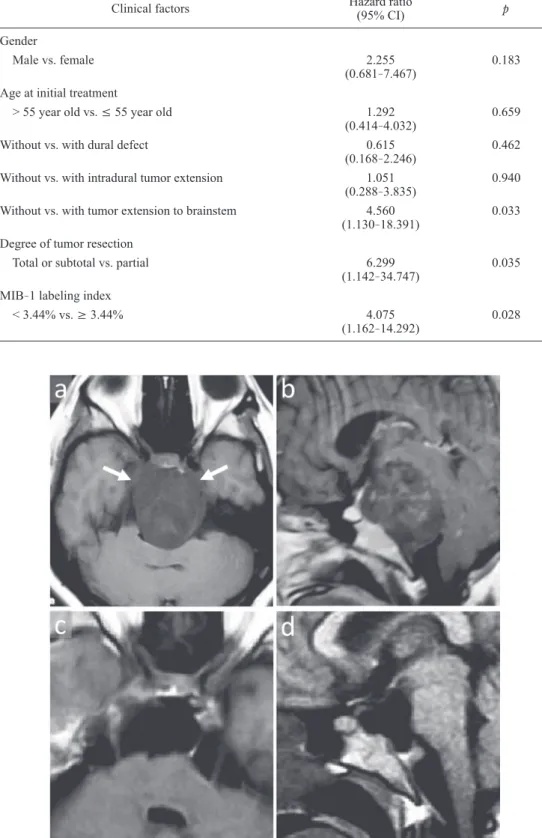
≥ 3.44% (p=0.019). Univariate analysis revealed correlations between tumor extension to the brain- stem, the degree of tumor resection, or MIB

-

1 index and the PFS (Table 4). In multivariate analysis, however, correlations between these factors and the PFS were not significant.

ILLUSTRATIVE CASES

Case 1

An 18

-

year

-

old woman was referred to us with diplopia due to left abducens nerve palsy. MRI re- vealed a clival tumor extended posteriorly with se- vere compression of the brainstem (Fig. 4a, b). We selected a right combined petrosal approach.

Through a dural defect, the tumor extended into the intradural space without adhesion to or invasion into the brainstem. The tumor was totally removed (Fig. 4c, d). After surgery, the patient suffered from bilateral abducens nerve and left oculomotor nerve palsy. During a follow

-

up period of 10 years and 10 months, these symptoms were resolved and a

b

Fig. 2. Kaplan

-

Meier curves for overall survival of 24 patients with clival chordoma. a : Survival of pa- tients without tumor extension to the brainstem (n=20) was significantly better than that of pa- tients with such extension (n=4) by log

-

rank test (p=0.001). b : Survival of patients with total or subtotal tumor removal (n=22) was significantly better than that of patients with partial tumor re- moval (n=2) by log

-

rank test (p=0.016).

Fig. 3. Kaplan

-

Meier curves for progression

-

free survival of 24 patients with clival chor- doma. a : Progression

-

free survival of pa- tients without tumor extension to the brainstem (n=20) was significantly better than that of patients with such extension ( n =4) by log

-

rank test (p =0.019).

b : Progression

-

free survival of patients with total or subtotal tumor removal (n=22) was significantly better than that of patients with partial tumor removal (n=2) by log

-

rank test (p=0.015).

a

b

(7)

Table 4. Correlation between the clinical factors and progression

-

free survival based on the univariate analysis of Cox proportional hazards modeling.

Clinical factors Hazard ratio

(95% CI) p

Gender

Male vs. female 2.255

(0.681

-

7.467) 0.183

Age at initial treatment

> 55 year old vs. ≤ 55 year old 1.292

(0.414

-

4.032) 0.659

Without vs. with dural defect 0.615

(0.168

-

2.246) 0.462

Without vs. with intradural tumor extension 1.051

(0.288

-

3.835) 0.940

Without vs. with tumor extension to brainstem 4.560

(1.130

-

18.391) 0.033 Degree of tumor resection

Total or subtotal vs. partial 6.299

(1.142

-

34.747) 0.035 MIB

-

1 labeling index

< 3.44% vs. ≥ 3.44% 4.075

(1.162

-

14.292) 0.028

Fig. 4. Case 1. a, b : Preoperative axial T1

-

weighted (a) and sagittal enhanced (b) MRI showing a clival tumor ex-

tended posteriorly and severely compressing the brainstem. The tumor occupied the right and left Meckel’s

caves (arrows). c, d : Postoperative enhanced axial (c) and sagittal (d) MRI showing total removal of the tumor.

(8)

137 LONG

-

TERM OUTCOME OF CLIVAL CHORDOMAS

no recurrence was observed.

Case 2

A 25

-

year

-

old woman was referred to us with symptoms of left facial dysesthesia and spasm.

MRI revealed a clival tumor extended laterally into the cavernous sinus and the petrous bone (Fig. 5 a, b). We selected an orbitozygomatic approach.

The tumor was totally removed. The petrous bone was removed to expose the entire petrous carotid artery, eustachian tube and part of the cochlea. The clivus was thoroughly drilled until to reach the nor- mal bone at the remnant lower clivus (Fig. 5c). The skull base defect was reconstructed using a tempo- roparietal galeal flap. After surgery, the patient temporarily suffered from facial numbness and abdu- cens nerve palsy. Twenty

-

nine months after sur- gery, MRI revealed a recurrent tumor in the right side of the posterior clinoid process (Fig. 5d, e), which was treated by SRS. For 10 years and 11 months after the initial surgery, the recurrent tumor was kept under control and no other recurrence was found.

Case 3

A 55

-

year

-

old man was referred to us with dip- lopia due to left abducens nerve palsy. MRI re-

vealed a clival tumor extended to the sphenoid sinus (Fig. 6a, b). We selected an anterior craniofacial approach. The tumor was totally removed (Fig.

6c). After surgery, the diplopia improved. Thir- teen months after surgery, a recurrence was found in the left cavernous sinus and treated by SRS.

Then, almost every year, a new recurrence was found in the ethmoid sinus, cavernous sinus, medial part of the orbit, or cranial base (Fig. 6d). In total, 7 recurrent tumors were treated by SRS and con- trolled for 7 years and 5 months after the initial sur- gery (Fig. 6e).

DISCUSSION

Prognosis of chordoma patients remains unsat- isfactory with 5

-

year overall survival rates of around 60

-

80%

11-16)

. In the USA, the analysis of 400 pa- tients from 1973 to1995 revealed 5

-

and 10

-

year rel- ative survival rates of 67.5% and 39.9%, respective- ly

13)

. In the UK, registry data showed that the 5

-

year survival rate of patients who were diagnosed between 1998 and 2002 was 56%

15)

. A systematic review of 560 non

-

duplicated patients demonstrated 5

-

and 10

-

year survival rates of 63% and 16%, re- spectively

12)

. Radical surgical resection has been shown to be a key factor for longer survival

2,3,6)

. Fig. 5. Case 2. a, b : Preoperative enhanced axial MRI showing a clival tumor extending to the left cavernous sinus

and petrous bone. c : Postoperative CT showing resected clival and petrous bone. d, e : T2

-

weighted (d) and

enhanced (e) axial MRI 29 months after surgery showing a recurrent tumor at the right posterior clinoid process

(arrows).

(9)

Previously, we reported the follow

-

up results of 19 patients

7)

: all were alive at the end of the study with mean follow

-

up of 7.3 years. Since some pa- tients died after the publication of that paper, we re- viewed the follow

-

up data again with newly treated patients and longer follow

-

up outcome. Our mean postoperative follow

-

up of 10.2 years was signifi- cantly long in order to evaluate the long

-

term out- come. The 5

-

and 10

-

year overall survival rates of our patients, 86% and 72%, respectively, proved that aggressive removal of chordomas improves long

-

term outcome of chordoma.

We selected various skull base approaches and showed that aggressive removal is a fundamental factor for better outcome. Recently, an extended endonasal endoscopic approach has been devel- oped

17-19)

. Koutourousiou M, et al. reported results of the endoscopic endonasal approach on 60 patients with a mean follow

-

up of 17.8 months

18)

. The limi- tations for gross total resection, achieved in two thirds of their patients, were tumor volume greater than 20 ml, tumor location in the lower clivus with lateral extension, and previously treated disease.

The complications included CSF leak (20%) result- ing in meningitis (3.3%), and carotid injuries oc- curred in 2 patients. Even in endoscopic surgeries,

total tumor resection with removal or drilling of the surrounding bone should be performed. Longer follow

-

up results are necessary to confirm the real benefits of the extended endonasal endoscopic ap- proach.

Besides incomplete surgical resection, clinical factors such as old age, female sex, large tumor size, prior surgery and prior radiotherapy have been as- sociated with poor prognosis

20-23)

. Wu Z, et al. ana- lyzed 79 of 106 consecutive patients with an average follow

-

up of 63.9 months

16)

. The history of radio- therapy or surgery, dedifferentiated pathology, and insufficient tumor resection were risk factors for long

-

term survival and recurrence. In our previous paper, we demonstrated that higher MIB

-

1 labeling index was associated with shorter progression

-

free survival

7)

. In the data of this paper, tumor adhesion or invasion to the brainstem was a factor of poor long

-

term outcome.

High dose radiation is another important factor for better control of the chordoma

1,3)

. Proton

-

beam therapy has been used to deliver high dose radiation to clival chordomas

24,25)

. Data have shown an in- crease in local control and survival with the use of proton therapy

26)

. Recently, carbon ion radiation therapy has been available

27,28)

. Uhl M, et al. treat- Fig. 6. Case 3. a, b : Preoperative enhanced coronal (a) and axial (b) MRI showing a clival tumor extending to the

sphenoid sinus. c : Postoperative sagittal T1

-

weighted MRI showing total removal of the tumor. d : T2

-

weighted axial MRI 53 months after surgery showing a recurrent tumor (arrows), which was treated by the fourth

gamma knife radiosurgery. e : T2

-

weighted MRI 89 months after surgery showing controlled recurrent tumors

(arrows).

(10)

139 LONG

-

TERM OUTCOME OF CLIVAL CHORDOMAS

ed 155 patients with 5

-

year and 10

-

year local control rates of 72% and 54%, respectively, and 5

-

year and 10

-

year overall survival rates of 85% and 75%, re- spectively

29)

. Fractionated stereotactic radiation therapy is another method for high dose radiation.

Jiang B, et al. reported the outcome of 20 chordoma patients with a mean marginal dose of 32.5 Gy (18

-

50 Gy). The overall survival at 5 years was 52.5%

30)

. Bugoci DM, et al. reported 12 patients who under- went surgical resection followed by high

-

dose frac- tionated stereotactic radiotherapy. The overall 5

-

year survival rate in that study was 76.4%

31)

.

We selected SRS for recurrent tumors

32,33)

and treated them with high dose radiation since they had been localized and small after total or subtotal re- moval by initial aggressive surgery. Koga T, et al.

showed that sufficient marginal doses of SRS at least 16 Gy appeared crucial

34)

. Kano H, et al. reported results of SRS from the North American Gamma Knife Consortium

35)

. In their paper, the 5

-

year overall survival rate was 80% for the entire group and 93% for the no prior fractionated radiation group. Marginal dose of ≥ 15 Gy and smaller tu- mor volume were significantly associated with bet- ter tumor control

32,35)

. They concluded that SRS was a potent treatment option for small chordomas, especially in younger patients and as part of multi- pronged attack that includes surgical resection.

CONCLUSION

We report long

-

term outcome (mean follow

-

up of 10.2 years) of 24 patients with skull base chordo- ma treated using aggressive surgical removal as a principal strategy. Skull base approaches were se- lected according to tumor extension to remove the tumor and surrounding bone as completely as possi- ble. The 5

-

, 10

-

, and 15

-

year overall survival rates were 86%, 72%, and 72%, respectively. The 5

-

and 10

-

year progression

-

free survival rates were 47%

and 35%, respectively. Our results clearly suggest that aggressive surgical removal improves the long

-

term outcome of patients with skull base chordoma.

CONFLICT OF INTEREST

We have no relationship with companies that may have a financial interest.

REFERENCES

1. Koutourousiou M, Snyderman CH, Fernandez

-

Mi- randa J, Gardner PA. Skull base chordomas.

Otolaryngol Clin N Am, 44 : 1155

-

1171, 2011.

2. Colli BO, Al

-

Mefty O. Chordomas of the cranio- cervical junction : follow

-

up review and prognostic factors. J Neurosurg, 95 : 933

-

943, 2001.

3. Gay E, Sekhar LN, Rubinstein E, et al. Chordo- mas and chondrosarcomas of the cranial base : results and follow

-

up of 60 patients. Neurosur- gery, 36 : 887

-

897, 1995.

4. Diaz RJ, Cusimano MD. The biological basis for modern treatment of chordoma. J Neurooncol, 104 : 411

-

422, 2011.

5. Eid AS, Chang U

-

K, Lee S

-

Y, Jeon D

-

G. The treatment outcome depending on the extent of re- section in skull base and spinal chordomas. Acta Neurochir, 153 : 509

-

516, 2011.

6. Sen C, Triana AI, Berglind N, Godbold J, Shrivas- tava RK. Clival chordomas : clinical manage- ment, results, and complications in 71 patients. J Neurosurg, 113 : 1059

-

1071, 2010.

7. Ito E, Saito K, Okada T, Nagatani T, Nagasaka T.

Long

-

term control of clival chordoma with initial aggressive surgical resection and gamma knife ra- diosurgery for recurrence. Acta Neurochir, 152 : 57

-

67, 2010.

8. Spetzler RF, Herman JM, Beals S, Joganic E, Milli- gan J. Preservation of olfaction in anterior cranio- facial approaches. J Neurosurg, 79 : 48

-

52, 1993 9. Fukuta K, Saito K, Takahashi M, Torii S. Surgical

approach to midline skull base tumors with olfacto- ry preservation. Plast Reconstr Surg, 100 : 318

-

325, 1997.

10. Ito E, Watanabe T, Sato T, et al. Skull base recon- struction using various types of galeal flap. Acta Neurochir, 154 : 179

-

185, 2012.

11. Hug EB, Loredo LN, Slater JD, et al. Proton radi- ation therapy for chordomas and chondrosarcomas of the skull base. J Neurosurg, 91 : 432

-

439, 1999.

12. Jian BJ, Bloch OG, Yang I, Han SJ, Aranda D, Parsa AT. A comprehensive analysis of intracranial chordoma and survival : a systematic review. Br J Neurosurg, 25 : 446

-

453, 2011.

13. McMaster ML, Goldstein AM, Bromley CM, Ishibe N, Parry DM. Chordoma : incidence and survival patterns in the United States, 1973

-

1995. Cancer Causes Control, 12 : 1

-

11, 2001.

14. Samii A, Gerganov VM, Herold C, et al. Chordo- mas of the skull base : surgical management and outcome. J Neurosurg, 107 : 319

-

324, 2007.

15. Whelan J, McTiernan A, Cooper N, et al. Inci- dence and survival of malignant bone sarcomas in England 1979

-

2007. Int J Cancer, 131 : E508

-

517, 2012.

16. Wu Z, Zhang J, Zhang L, et al. Prognostic factors

for long

-

term outcome of patients with surgical re-

section of skull base chordomas – 106 cases review

(11)

in one institution. Neurosurg Rev, 33 : 451

-

456, 2010.

17. Fraser JF, Nyquist GG, Moore N, Anand VK, Schwartz TH. Endoscopic endonasal transclival resection of chordomas : operative technique, clin- ical outcome, and review of the literature. J Neu- rosurg, 112 : 1061

-

1069, 2010.

18. Koutourousiou M, Gardner PA, Tormenti MJ, et al.

Endoscopic endonasal approach for resection of cranial base chordomas : outcomes and learning curve. Neurosurgery, 71 : 614

-

625, 2012.

19. Saito K, Toda M, Tomita T, Ogawa K, Yoshida K.

Surgical results of an endoscopic endonasal ap- proach for clival chordomas. Acta Neurochir, 154 : 879

-

886, 2012.

20. Austin JP, Urie MM, Cardenosa G, Munzenrider JE. Probable causes of recurrence in patients with chordoma and chondrosarcoma of the base of skull and cervical spine. Int J Radiat Oncol Biol Phys, 25 : 439

-

444, 1993.

21. Forsyth PA, Cascino TL, Shaw EG, et al. Intracra- nial chordomas : a clinicopathological and prognos- tic study of 51 cases. J Neurosurg, 78 : 741

-

747, 1993.

22. Halperin EC. Why is female sex an independent predictor of shortened overall survival after pro- ton/photon radiation therapy for skull base chordo- mas? Int J Radiat Oncol Biol Phys, 38 : 225

-

230, 1997.

23. O’Connell JX, Renard LG, Liebsch NJ, Efird JT, Munzenrider JE, Rosenberg AE. Base of skull chordoma : a correlative study of histological and clinical features of 62 cases. Cancer, 74 : 2261

-

2267, 1994.

24. Hug EB, Slater JD. Proton radiation therapy for chordomas and chondrosarcomas of the skull base. Neurosurg Clin N Am, 11 : 627

-

638, 2000.

25. Terahara A, Niemierko A, Goitein M, et al. Analy- sis of the relationship between tumor dose inho- mogeneity and local control in patients with skull base chordoma. Int J Radiat Oncol Biol Phys, 45 : 351

-

358, 1999.

26. Alonso

-

Basanta M, Lustig RA, Kennedy DW. Pro-

ton beam therapy in skull base pathology. Otolar- yngol Clin N Am, 44 : 1173

-

1183, 2011.

27. Takahashi S, Kawase T, Yoshida K, Hasegawa A, Mizoe J. Skull base chordomas : efficacy of sur- gery followed by carbon ion radiotherapy. Acta Neurochir, 151 : 759

-

769, 2009.

28. Nikoghosyan AV, Karapanagiotou

-

Schenkel I, Munter MW, Jensen AD, Combs SE, Debus J.

Randomized trial of proton vs. carbon ion radiation therapy in patients with chordoma of the skull base, clinical phase III study HIT

-

1

-

Study. BMC Cancer, 10 : 607, 2010.

29. Uhl M, Mattke M, Welzel T, et al. Highly effective treatment of skull base chordoma with carbon ion irradiation using a raster scan technique in 155 patients : first long

-

term results. Cancer, 120 : 3410

-

3417, 2014.

30. Jiang B, Veeravagu A, Lee M, et al. Management of intracranial and extracranial chordomas with Cy- berknife stereotactic radiosurgery. J Clin Neuro- sci, 19 : 1101

-

1106, 2012.

31. Bugoci DM, Girvigian MR, Chen JST, Miller MM, Rahimian J. Photon

-

based fractionated stereotac- tic radiotherapy for postoperative treatment of skull base chordomas. Am J Clin Oncol, 36 : 404

-

410, 2013.

32. Hasegawa T, Ishii D, Kida Y, Yoshimoto M, Koike J, Iizuka H. Gamma knife surgery for skull base chordomas and chondrosarcomas. J Neurosurg, 107 : 752

-

757, 2007.

33. Martin JJ, Niranjan A, Kondziolka D, Flickinger JC, Lozanne KA, Lunsford LD. Radiosurgery for chordomas and chondrosarcomas of the skull base. J Neurosurg, 107 : 758

-

764, 2007.

34. Koga T, Shin M, Saito N. Treatment with high marginal dose is mandatory to achieve long

-

term control of skull base chordomas and chondrosarco- mas by means of stereotactic radiosurgery. J Neurooncol, 98 : 233

-

238, 2010.

35. Kano H, Iqbal FO, Sheehan J, et al. Stereotactic

radiosurgery for chordoma : a report from the

North American Gamma Knife Consortium. Neu-

rosurgery, 68 : 379

-

389, 2011.

Table 1.  Clinical factors, tumor location and extension, and selected approach of 24 patients  with clival chordomas
Table 3.  Correlation between the clinical factors and overall survival based on the univariate  analysis of Cox proportional hazards modeling.
Fig. 2.  Kaplan - Meier curves for overall survival of 24  patients with clival chordoma
Table 4.  Correlation between the clinical factors and progression - free survival based on the  univariate analysis of Cox proportional hazards modeling.

参照

関連したドキュメント

Example (No separating edges or vertices) Restricting our attention to those CLTTF Artin groups G = G(∆) where ∆ has no separating edge or vertex, we see that two such groups

清水 悦郎 国立大学法人東京海洋大学 学術研究院海洋電子機械工学部門 教授 鶴指 眞志 長崎県立大学 地域創造学部実践経済学科 講師 クロサカタツヤ 株式会社企 代表取締役.

静岡大学 静岡キャンパス 静岡大学 浜松キャンパス 静岡県立大学 静岡県立大学短期大学部 東海大学 清水キャンパス

Amount of Remuneration, etc. The Company does not pay to Directors who concurrently serve as Executive Officer the remuneration paid to Directors. Therefore, “Number of Persons”

静岡大学 静岡キャンパス 静岡大学 浜松キャンパス 静岡県立大学 静岡県立大学短期大学部 東海大学 清水キャンパス

[r]