Fukushima Medical University
福島県立医科大学 学術機関リポジトリ
This document is downloaded at: 2021-11-07T23:16:01Z
Title Attempting to define sentinel node micrometastasis in oral squamous cell carcinoma
Author(s)
Matsuzuka, Takashi; Uemura, Hirokazu; Yoshimoto, Seiichi;
Miura, Kouki; Shiotani, Akihiro; Sugasawa, Masashi; Homma, Akihiro; Yokoyama, Junkichi; Tsukahara, Kiyoaki; Yoshizaki, Tomokazu; Yatabe, Yasushi; Kobari, Takehiro; Kosuda, Shigeru; Murono, Shigeyuki; Hasegawa, Yasuhisa Citation Fukushima Journal of Medical Science. 66(3): 143-147
Issue Date 2020
URL http://ir.fmu.ac.jp/dspace/handle/123456789/1357
Rights © 2020 The Fukushima Society of Medical Science. This article is licensed under a Creative Commons [Attribution- NonCommercial-ShareAlike 4.0 International] license.
DOI 10.5387/fms.2020-17
Text Version publisher
patients ; however, it often causes severe complica- tions. To avoid any unnecessary END, sentinel node (SN) biopsy (SNB) for OSCC, which has been clinically used in Western countries, will soon be ad-
Introduction
Elective neck dissection (END) is recommend- ed for N0 oral squamous cell carcinoma (OSCC)
[Original Article]
Attempting to define sentinel node micrometastasis in oral squamous cell carcinoma
Takashi Matsuzuka
1)2), Hirokazu Uemura
3), Seiichi Yoshimoto
4), Kouki Miura
5), Akihiro Shiotani
6), Masashi Sugasawa
7), Akihiro Homma
8), Junkichi Yokoyama
9), Kiyoaki Tsukahara
10), Tomokazu Yoshizaki
11), Yasushi Yatabe
12), Takehiro Kobari
13),
Shigeru Kosuda
14), Shigeyuki Murono
13)and Yasuhisa Hasegawa
1)15)1)Department of Head and Neck Surgery and Otolaryngology, Asahi University Hospital, 2)Radiation Medical Science Center for Fukushima Health Management Survey, Fukushima Medical University,
3)Department of Otolaryngology-Head and Neck Surgery, Nara Medical University, 4)Department of Head and Neck Surgery, National Cancer Center Hospital, 5)Department of Head and Neck Oncology and Sur- gery, International University of Health and Welfare, Mita Hospital, 6)Department of Otolaryngology- Head and Neck Surgery, National Defense Medical College, 7)Department of Head and Neck Surgery, Saitama Medical University International Medical Center, 8)Department of Otolaryngology, Head and Neck Surgery, Hokkaido University Graduate School of Medicine, 9)Department of Otolaryngology, Head and Neck Surgery, Moriyama Memorial Hospital, 10)Department of Otolaryngology-Head and Neck Sur- gery, Tokyo Medical University Hospital, 11)Division of Otolaryngology, Head and Neck Surgery, Gradu- ate School of Medical Science, Kanazawa University, 12)Department of Pathology and Molecular Diag- nostics, Aichi Cancer Center Hospital, 13)Department of Otolaryngology, Head and Neck Surgery, Fukushima Medical University, 14)Health Care Center, Kouseikai Hospital, 15)Department of Head and Surgery, Aichi Cancer Center Hospital
(Received August 17, 2020, accepted November 11, 2020)
Abstract
OBJECTIVE : The aim of this supplemental study of a sentinel node (SN) biopsy (SNB) trial for oral squamous cell carcinoma (OSCC) was to assess the effectiveness in identifying micrometastasis and determining whether elective neck dissection (END) is necessary.
MATERIALS AND METHODS : Twenty-three patients with pathologically positive SNs were in- cluded. The sizes of the metastatic lesions in positive SNs (SMSNs) were classified and the rates of occult metastasis of non-SNs were compared.
RESULTS : The patients were divided according to the SMSN : <0.2 mm (group A, n=3) ; 0.2 mm to <2.0 mm (group B, n=7) ; and ≥2.0 mm (group C, n=13). The rates of occult metastasis in groups A, B, and C were 0% (0/3), 14% (1/7) and 23% (3/13), respectively.
CONCLUSION : Rare cancer cell distribution to nodes other than SNs was observed in the patients with SN metastatic lesions of at least smaller than 0.2 mm in size, suggesting the possibility of defin- ing SN micrometastasis in N0 OSCC.
Key words : sentinel node, oral squamous cell carcinoma, micrometastasis.
Corresponding author : Dr. Takashi Matsuzuka, MD, PhD E-mail : [email protected]
©2020 The Fukushima Society of Medical Science. This article is licensed under a Creative Commons [Attribu- tion-NonCommercial-ShareAlike 4.0 International] license.
https://creativecommons.org/licenses/by-nc-sa/4.0/
143
144 T. Matsuzuka et al.
opted in Japan to assess the presence of metastasis.
Although there are various phases of lymph node metastasis, from micrometastasis to fully occupied
1), there is no concern about the definition of microme- tastasis in the current TNM system for OSCC. For breast cancer, however, it is common to further dif- ferentiate micrometastasis from macrometastasis and treat the conditions differently. However, for OSCC, if the sentinel node is pathologically positive, neck dissection should be performed. The aim of the present study was to assess the effectiveness of SNB in identifying micrometastasis and determining whether END is necessary for patients with OSCC.
The present investigation is an original and unique attempt to clarify the perspectives to define non
-in- vasive treatment for micrometastasis of OSCC and define the novel concept of SNB for OSCC.
Materials
We analyzed the association between treatment outcomes and the size of metastatic lesions in the SN among patients enrolled in a prospective multi- center phase II SNB trial titled ‘UMIN000004951 ; Evaluation of selective neck dissections based on sentinel lymph node navigation in oral cancers’
2). Patients who were managed at 10 institutions, with previously untreated N0 OSCC (n=57) with a clini- cal tumor stage of ‘‘late
-T2’’ (T2 tumor with a diam-
eter of ≥3 cm or any T2 tumor with a tumor depth of ≥5 mm) or T3 were included in the present study.Preoperatively, the SNs were localized using conventional lymphoscintigraphy : At 24 h before surgery, technetium 99 m (99mTc) phytate (FUJIF- ILM RI Pharma Co., Ltd. and Nihon Medi
-Physics Co., Ltd., Japan), which was used as a radiotracer, was injected submucosally (74 MBq in 1 mL) at four points (one point in each quadrant) around the pri- mary tumor, and lymphoscintigraphy was performed to map the SNs. During surgery, tumor resection was performed, followed by the detection of SNs with a handheld gamma probe, and selective ND with SN basin dissection. The SNs were immedi- ately submitted for a frozen section pathological analysis, then ranked according to their tracer up- take level, which was up to 5. All SNs were cut into 2
-mm blocks, and were subjected to an intraop- erative frozen section analysis. SNs in which a cancer lesion was pathologically detectable were de- fined as positive SNs, those in which a cancer lesion was not pathologically detectable were defined as negative SNs. In patients with positive SNs, thera- peutic ND of levels I, II, III, and IV was performed,
whereas ipsilateral prophylactic ND of levels I, II, and III was performed for patients with negative
-SNs, in a one
-stage procedure. Additional sections were stained with hematoxylin and eosin (HE) and AE1/3 cytokeratin (Signet Laboratories, MA, USA) to determine the final postoperative diagnosis. All other lymph nodes, including non
-radioactive lymph nodes, were considered to be non
-sentinel nodes (NSNs). NSNs were divided longitudinally into two specimens, and a single representative cross
-section was stained with HE to determine the final postop- erative diagnosis. The details of the clinical meth- ods and modifications are described in our previous paper
2).
Methods
Occult metastasis of NSN was defined as the presence of cancer cells within NSNs (positive NSNs) in the level of therapeutic ND at surgery and of post
-operative node metastasis (PONM) without primary recurrence during the follow
-up period.
The sizes of the metastatic lesions in positive SNs (SMSNs) based on AE1/3 cytokeratin staining were classified into three groups according to the AJCC 6th edition for breast cancer
3): isolated tumor cells (ITC, group A : single cells or clusters of cells of <0.2 mm in diameter) ; micrometastasis (group B : 0.2 mm to <2.0 mm in diameter) ; and macro-
metastasis (group C : ≥2 mm in diameter). Therates of occult metastasis of NSNs and survival rates were compared among the groups. When multiple metastatic lesions existed within one lymph node, the lesion of the greatest dimension was measured.
Results
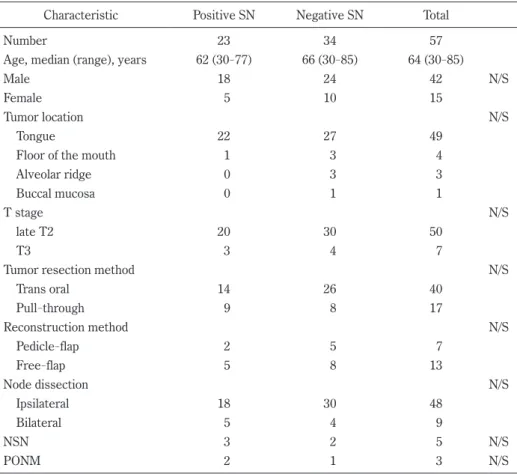
The patient characteristics are listed in Table 1.
Twenty
-three patients with metastasis
-positive SNs were divided into three groups according to the di- ameter of the metastatic lesions in the SNs.
Groups A, B and C consisted of 3, 7, and 13 patients, respectively. The rates of postoperative node me- tastasis in groups A, B, and C were 0% (0/3), 14%
(n=1/7), and 8% (1/13), respectively. In group C,
one patient had positive NSNs and developed
PONM. Thus, the rates of occult metastasis in
groups A, B, and C were 0% (0/3), 14% (1/7) and
23% (3/13), respectively. Although there was no
significant difference, the 3
-year overall survival
rates of all cases, groups A, B, and C were 83%,
100%, 57%, 83%, and the 3
-year disease
-free sur-
vival rates of all cases, groups A, B, and C were
74%, 100%, 77%, 74%, respectively.
Discussion
Lymph node metastasis is an important factor in the prognosis of OSCC. In the management of the neck for early OSCC, the ‘wait and see’ policy is not recommended, because both the local control rate and survival of patients with lymph node metas- tasis have been reported to be less than half in com- parison to patients without lymph node metastasis
4,5)and it is strongly suggested that END should be rou- tinely performed
6-8). The purpose of SNB for OSCC is to distinguish cases where metastasis is not detected in the SN and in which END is avoid-
able
9). SNB is also reported to be associated with significantly higher postoperative mobility and a bet- ter shoulder function in comparison to END
10). SNB is useful not only as an accurate diagnostic tool for detecting lymph node metastasis, but also as a tool for prognostic stratification in various fields of cancer
11-13). SNB for OSCC is still in the clinical re- search stage in Japan, but it has been established as a standard treatment in Europe
14)and the United States
15), and its consensus has already been reached all over the world
16).
In the treatment of breast cancer, micrometas- tasis is considered an important factor for predicting the prognosis and selecting surgery
17,18). Although a patient with either macrometastasis or microme-
Table 1. Patient characteristics.Characteristic Positive SN Negative SN Total
Number 23 34 57
Age, median (range), years 62 (30-77) 66 (30-85) 64 (30-85)
Male 18 24 42 N/S
Female 5 10 15
Tumor location N/S
Tongue 22 27 49
Floor of the mouth 1 3 4
Alveolar ridge 0 3 3
Buccal mucosa 0 1 1
T stage N/S
late T2 20 30 50
T3 3 4 7
Tumor resection method N/S
Trans oral 14 26 40
Pull-through 9 8 17
Reconstruction method N/S
Pedicle-flap 2 5 7
Free-flap 5 8 13
Node dissection N/S
Ipsilateral 18 30 48
Bilateral 5 4 9
NSN 3 2 5 N/S
PONM 2 1 3 N/S
SN : sentinel node, NSN : non-sentinel node, PONM : post-operative node metastasis
Table 2. Rate of occult metastasis in each group
Group SMSN n Positive NSN PONM Rate of occult metastasis
A 0.2 mm> 3 0 0 0% (0/3)
B =<0.2 mm, 2.0 mm> 7 0 1 14% (1/7)
C =<2.0 mm 13 3 1* 23% (3/13)
Total 23 3 2* 17% (4/23)
SMSN : size of metastatic lesion in positive sentinel node, NSN : non-sentinel node, PONM : post-operative node metastasis, *A case had both positive NSN and PONM.
146 T. Matsuzuka et al.
tastasis is considered pathologically positive for lymph node metastasis, ITCs are classified as node
-negative and its prognostic impact was reported to be weak
19,20). SN selective dissection is sufficient for obtaining regional and distant control in patients with early
-stage breast cancer and micrometastasis in the SN
21).
The current concept of the sentinel node navi- gation surgery (SNNS) for OSCC is that therapeutic neck dissection should be performed for SN
-positive cases, and that END is unnecessary for SN
-negative cases. Although SNB for OSCC has been clinically used in Western countries, and a multi
-institutional study of SNB for head and neck cancer has also been undertaken in Japan
2,22), the spread of the concept of SNB for OSCC is still insufficient. One of the rea- sons might be the aggressiveness of this concept.
To define the micrometetastasis for OSCC and dis- cover the possibility of the low invasive treatment for micrometastasis would be necessary. The pres- ent investigation would be an original and unique at- tempt to clarify these perspectives.
Occult metastasis did not occur in patients whose SMSNs were smaller than 0.2 mm. In other words, no cancer cell distribution to nodes other than SNs was observed in patients with SN meta- static lesions at least smaller than 0.2 mm, suggest- ing the possibility to define the micrometastasis for determination whether END is necessary for pa- tients with OSCC.
A limitation of the present study is its relatively small sample size. This analysis was conducted us- ing the available data of 57 patients in a phase II study. A further, larger scale study to establish the cutoff value for micrometastasis and to develop an individualized, minimally invasive approach is neces- sary.
Conclusion
No cancer cell distribution to nodes other than SNs was observed in patients with SN metastatic le- sions at least smaller than 0.2 mm, suggesting the possibility to determine whether END is necessary for patients with OSCC.
Conflict of Interest
The authors declare that they have no conflicts of interest associated with this manuscript.
References
1. Matsuzuka T, Kano M, Ogawa H, Miura T, Tada Y, Matsui T, et al. Sentinel node mapping for node positive oral cancer : potential to predict multiple metastasis. Laryngoscope, 118: 646-649, 2008.
2. Miura K, Hirakawa H, Uemura H, Yoshimoto S, Shiotani A, Sugasawa M, et al. Sentinel node bi- opsy for oral cancer : A prospective multicenter Phase II trial. Auris Nasus Larynx, 44: 319-326, 2017.
3. Singletary SE, Allred C, Ashley P, Bassett LW, Berry D, Bland KI, et al. Staging system for breast cancer : revisions for the 6th edition of the AJCC Cancer Staging Manual. Surg Clin North Am, 83: 803-819, 2003.
4. Argiris A, Karamouzis MV, Johnson JT, Heron DE, Myers E, Eibling D, et al. Long-term results of a phase III randomized trial of postoperative radio- therapy with or without carboplatin in patients with high-risk head and neck cancer. Laryngoscope, 118: 444-449, 2008.
5. Tai SK, Li WY, Yang MH, Chang SY, Chu PY, Tsai TL, et al. Treatment for T1-2 oral squamous cell carcinoma with or without perineural invasion : Neck dissection and postoperative adjuvant thera- py. Ann Surg Oncol, 19: 1995-2002, 2012.
6. Capote A, Escorial V, Munoz-Guerra MF, Rodri- guez-Campo FJ, Gamallo C, Naval L. Elective neck dissection in early-stage oral squamous cell carcinoma—does it influence recurrence and sur- vival. Head Neck, 29: 3-11, 2007.
7. Nieuwenhuis EJ, Colnot DR, Pijpers HJ, Castelijns JA, van Diest PJ, BrakenhoffRH, et al. Lymphos- cintigraphy and ultrasound-guided fine needle as- piration cytology of sentinel lymph nodes in head and neck cancer patients. RecentResults Cancer Res, 157: 206-217, 2000.
8. D’Cruz AK, Vaish R, Kapre N, Dandekar M, Gupta S, Hawaldar R, et al. Elective versus Therapeutic Neck Dissection in Node-Negative Oral Cancer.
N Engl J Med, 373: 521-529, 2015.
9. Matsuzuka T, Suzuki M, Saijo S, Matsui T, Nomoto Y, Ikeda M, et al. Usefulness of sentinel node navigation surgery in the management of early tongue cancer. Auris Nasus Larynx, 41: 475- 478, 2014.
10. Murer K, Huber GF, Haile SR, Stoeckli SJ. Com- parison of morbidity betweensentinel node biopsy and elective neck dissection for treatment of the n0 neck in patients with oral squamous cell carci- noma. Head Neck, 33: 1260-1264, 2011.
11. Takeuchi H, Kawakubo H, Nakamura R, Fukuda K, Takahashi T, Wada N, et al. Clinical Significance of Sentinel Node Positivity in Patients with Super- ficial Esophageal Cancer. World J Surg, 39:
2941-2947, 2015.
12. Cho JH, Lee YS, Sun DI, Kim MS, Cho KJ, Nam IC, et al. Prognostic impact of lymph node micro- metastasis in oral and oropharyngeal squamous cell carcinomas. Head Neck, 38: E1777-1782, 2016.
13. Duan Q, Xu M, Zhang X, Jia M, Yuan R, Gan M.
Clinical significance of cytokeratin in the cervical lymph nodes of patients with mandibular gingival squamous cell carcinoma. Oncol Lett, 16: 3135- 3139, 2018.
14. Giammarile F, Schilling C, Gnanasegaran G, Bal C, Oyen WJG, Rubello D, et al. The EANM practical guidelines for sentinel lymph node localisation in oral cavity squamous cell carcinoma. Eur J Nucl Med Mol Imaging, 46: 623-637, 2019.
15. Agrawal A, Civantos FJ, Brumund KT, Chepeha DB, Hall NC, Carroll WR, et al. (99m)Tc Tilmano- cept accurately detects sentinel lymph nodes and predicts node pathology status in patients with oral squamous cell carcinoma of the head and neck : results of a phase III multi-institutional trial. Ann Surg Oncol, 22: 3708-3715, 2015.
16. Schilling C, Stoeckli SJ, Vigili MG, de Bree R, Lai SY, Alvarez J, et al. Surgical consensus guidelines on sentinel node biopsy (SNB) in patients with oral cancer. Head Neck, 41: 2655-2664, 2019.
17. Märkl B, Herbst C, Cacchi C, Schaller T, Krammer
I, Schenkirsch G, et al. Prognostic significance of histologically detected lymph node micrometasta- ses of sizes between 0.2 and 2 mm in colorectal cancer. Int J Colorectal Dis, 28: 977-983, 2013.
18. Loong Chong CY, Mirbagheri N, Harris M, Fox J.
Sentinel node micrometastases in breast cancer : A survey of Australian and New Zealand breast surgeons. ANZ J Surg, 82: 766-767, 2012.
19. Apple SK. Sentinel Lymph Node in Breast Can- cer : Review Article from a Pathologist’s Point of View. J Pathol Transl Med, 50: 83-95, 2016.
20. Nasser IA, Lee AK, Bosari S, Saganich R, Heatley G, Silverman ML. Occult axillary lymph node metastases in “node-negative” breast carcinoma.
Hum Pathol, 24: 950-957, 1993.
21. Solà M, Alberro JA, Fraile M, Santesteban P, Ra- mos M, Fabregas R, et al. Complete axillary lymph node dissection versus clinical follow-up in breast cancer patients with sentinel node microme- tastasis : final results from the multicenter clinical trial AATRM : 048/13/2000. Ann Surg Oncol, 20: 120-127, 2013.
22. Yoshimoto S, Hasegawa Y, Matsuzuka T, Shiotani A, Takahashi K, Kohno N, et al. Sentinel node biopsy for oral and laryngopharyngeal squamous cell car- cinoma : a retrospective study of 177 patients in Japan. Auris Nasus Larynx, 39: 65-70, 2012.