• 検索結果がありません。

コミュニケーション能力:英語学習者の「できないこと」に注目して

N/A
N/A
Protected

Academic year: 2021

シェア "コミュニケーション能力:英語学習者の「できないこと」に注目して"

Copied!
11
0
0

読み込み中.... (全文を見る)

全文

(1)

埼玉大学紀要(教養学部)第53巻第2号 2018年

コミュニケーション能力:英語学習者の「できないこと」に注目して

Communicative Competence: A Focus on Incompetence

クルーグ,ネイサン ポール

* Krug, Nathan Paul

The principal reason for learning a language is to become a competent communicator (Hymes 1972;

Canale 1983). However, to better understand what comprises communicative competence, this monograph will dig into the communicative incompetence of a NNS from a pre-transcribed sample of authentic data. Having identified insufficiencies, some fundamental suggestions will be offered for enriching the NNS’s skill.

The data: “Umm…who’s calling!?!”

For the purposes of this paper, the data consists of a transcribed telephone conversation, summarised by Gass (2018:64) as follows:

The NNS had been given a class assignment to call and find out the price of a television set. What he did not realise was that when he looked up a number in the yellow pages, rather than looking under television sales, he had looked under television repairs. The NS is thus speaking from the perspective of a repair shop while the NNS is speaking as if talking to a sales shop.

Reference should be made to Gass (2018:64-65), as necessary.

Discussion and analysis:

Appendix 1 constitutes a first-pass analysis of the raw data. Columns 3 and 4 provide an interpretation of the dialogue from speech act and discourse analysis perspectives. It is interesting to note that the NNS was supposed to complete a simple task – a straightforward telephone fact-finding inquiry. Had the query been successful, it would have had a more linear-like structure, something such as:

くるーぐ・ねいさん ぽーる

埼玉大学教育機構英語教育開発センター准教授
(2)

Salutation Inquiry Result Obtained Closure

Instead, through uncertainties on behalf of both interlocutors (largely due to the NNS’s failure to be explicit) the structure was more cyclic in nature. The participants perpetually sought additional information, something like as follows:

Column 5 highlights this cyclic structure. It demonstrates that the NS dominated the conversation (grey shaded cells) through clarifying and questioning, in comparison to the NNS (white cells). The NS asked approximately 12 questions, whilst the NNS asked a mere 5. Importantly, as this was an interrogative task initiated by the NNS, the NNS himself was "supposed to" take on the role of questioner. Clearly this did not occur. Therefore, dominance of the NS in this case is indicative of the NNS’s incompetence. Communicative incompetence, in this exchange, generated a role reversal between the participants.

Lack of communicative competence:

Table 1 (below) relates the NNS to Canale’s (1983) key components of communicative competence.

Table 1: Communicative Incompetence of the NNS

Key Component NNS’s Proficiency Evidence in Data

Grammatical Competence

Has ability to construct grammar, but not faultlessly in free flowing real-world situations.

Line 4 marks the beginning of decay. Thereafter, utterances are truncated and grammatically incomplete.

Discourse Competence

Initiates, responds, takes turns, back-channels and so forth – however not always appropriately. Fails to repair.

Throughout transcript.

Inappropriate back-channelling and failure to repair seen in lines 22-32.

Sociolinguistic Competence

Limited. Calls wrong store. Fails to make

intentions clear. Back-channels Throughout transcript.

Inquiry Seeking Clarification

(3)

inappropriately. Fails to interpret NS’s dialogue.

Strategic Competence

Memorises opening line. Back-channels as a "bluff" (a strategy for "catching-up" when uncertain/lost). However, overall, fails to employ successful strategies to achieve communication goals.

No goal reached. No helpful information gained.

In examining Table 1, it is clear that the NNS was not able to understand what was meant by what was said (Thomas 1983:91). Importantly, the NNS’s first utterance is not explicit (line 2). It does not convey the speaker’s intentions clearly to the listener. Perhaps this lack of clarity is a result of inappropriate transference of speech act strategies from L1 to L2 – thereby being, as Thomas (1983:102) describes, pragmalinguistic failure. Nevertheless, form the outset, the NNS’s inability to assign sense and reference to the utterances within the conversation causes communication breakdown (Hatch 1992:122; Thomas 1983:91-3). Overall, the NNS is lacking in all four key components of communicative competence.

Possible formal classroom contributions to incompetence:

From a behaviouristic perspective, a reinforced response will become habitual (Brown 2014:24; Ur 1996:93-4). Possibly, the NNS has been exposed to this (teaching/learning) approach – as noted in line 2 by the — to all intents and purposes — apparent memorisation of prescripted material (a behaviouristic feature). Unfortunately, the NNS did not get an anticipated response, if this frame of reference is at all on the mark. Thus, he was unable to respond in a habitual or predetermined manner. The conversation began to immediately breakdown — compare, for example, lines 2 and 4.

In-class preparation for the NNS has here, then, failed to develop the ability to understand the constraints of real world contexts, which place restrictions upon what is said, when it is said, were it is said, who says it, and, how it is said (Thompson 2000:14). Thus, this NNS has minimal pragmatic competence and has next to no ability to cope with the unpredictable nature of real-life exchanges during transactional talk (McCarthy 1991:136-144).

We must note that memorisation of basic conversation structures and expressions, as Ur (1996:94) contends, should eventually stand this NNS in good stead for future verbal exchanges. Memorised formulaic utterances provide a language learner with a starting point and, eventually, contribute to language mastery.

Bialystok (1993 in Thompson 2000:11-18) identifies three elements of pragmalinguistic competence:

(4)

1. The ability to use language to achieve pragmatic goals.

 The NNS did not achieve any goal in this conversation, hence he failed to achieve this competency.

2. The ability to infer a speaker’s intentions from what is said (and, correspondingly, to imply one’s own intentions through the linguistic choices one makes as a speaker).

 The NNS spent a large portion of this conversation lost and/or confused. In addition, he did not make himself clearly understood at any point during the conversation. Thus the NNS failed to achieve this competency.

3. The ability to employ appropriate discourse resources (e.g. turn-taking, cohesive devices) to create a coherent interaction.

 The NNS’s salutation and closing utterances were present, however they were truncated and abrupt. Throughout, turn taking was constrained. Cohesion and the use of strategies such as interruption were poor. Thus, the NNS has minimal capability with regard to this competency.

Learning-based problems:

There are widely held distinctions between communicative competence and communicative performance (Brown 2014:34). The NNS shows considerable weakness in both. Tables 2 and 3 outline his incompetence:

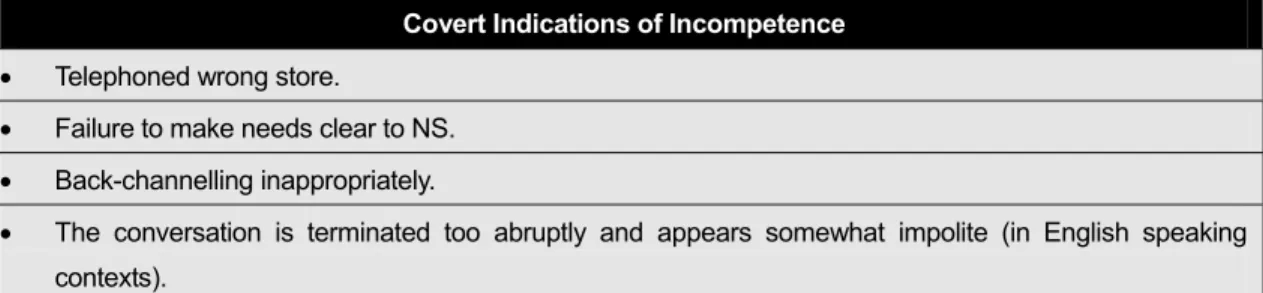
Table 2: Lack of Communicative Competence Covert Indications of Incompetence

 Telephoned wrong store.

 Failure to make needs clear to NS.

 Back-channelling inappropriately.

 The conversation is terminated too abruptly and appears somewhat impolite (in English speaking contexts).

Table 3: Lack of Communicative Performance Overt Observations of Incompetence

 Failure to nominate the topic clearly (as an utterance).

 Unable to adapt to the demands of the event (i.e. inability to seek clarification and/or interrupt the NS where necessary).

 Inability to employ strategic devices to achieve goal and/or engage "repair" (Canale and Swain 1980).

 Failure to attain the true intended goal. (It could be argued that “a goal” was achieved, in that no price

was available and, so, the call was concluded.)

(5)

Environmental problems:

As a listening only task, the challenges were many here for the NNS. The conversation provided no opportunity for extra-linguistic cues to aid comprehension (such as kinesics or eye contact). However, competent speakers need to be very adept at making appropriate selections from lexis, syntax, intonation (and more) to match the requirements of a particular context. Also, competent speakers use their knowledge about the implications of such selections to help them interpret what they hear (McCarthy 1991:136; Thompson 2000:12). It is clear that the NNS is not yet able to demonstrate a satisfactory standard of competence with regard to listening tasks. It could be said that the NNS did not match the situation adequately in any regard.

Affective interference:

Brown (2014:63) notes that people are influenced tremendously by their emotions. As this conversation flowed poorly from the outset, the NNS presumably experienced some fear and apprehension. Thus, the NNS’s confidence and concentration would have diminished. In fact, from the first utterance the NNS fails to provide controlled or selected attention toward the stimulus (NS) – a classic case of affective interference (Brown 2014:63-6, 141-158).

Social distance refers to the cognitive and affective proximity of two cultures that come into contact within an individual (Brown 2014:188). In this regard, the NNS possibly felt intrusive, invasive, culturally dissimilar and/or subordinate to the dominant NS culture. Such factors would also have interfered negatively with language production here.

Learner language:

Corder (1993) describes four broad stages of learner language. The NNS embraces the second, emergent, stage of Corder’s classification. This is shown by the learner beginning to internalise certain rules. These rules are not necessarily correct by TL standards, but they are nevertheless legitimate in the mind of the NNS. Examples include:

 functionally appropriate phatic communion marking the salutation and conclusion of the conversation;

 competent turn taking throughout (on the surface level); and,

 back-channelling (frequently inappropriately).

During the emergent stage the learner frequently exhibits "backsliding" (Brown 2014:245), in which the learner appears to have grasped a rule (or principle) but then regresses to some previous stage.

Upon examining line 2 (and perhaps line 4), the NNS appears to be ready to undertake this

(6)

real-world task. Here the NNS appears somewhat "confident," and appears prepared for the challenge of the task and ready for "expected" responses. However, the salesman’s unpredicted responses (lines 3, 5 and 7) quickly divert the exchange from the structure that the NNS had probably anticipated. Following line 4, the NNS’s output diminished. The NNS had no successful strategic devices to become re-involved in the conversation.

The true goal of the telephone conversation:

This task was an important learning experience for this NNS. On reflection, the NNS should attempt to ascertain what went wrong and why. In doing so the NNS ought to, in consultation with the TL teacher, develop simple strategies for future use that will allow intentions to be better (or more clearly) stated, clarification to be sought and interruptions to be made as necessary. For these reasons, following guided reflection, this telephone conversation could be a very successful learning experience and a tool of language learning.

Was this the true goal of the telephone conversation? The answer is most definitely "yes." This telephone conversation was an out-of-class task that endeavoured to improve the NNS’s TL competence. Therefore, on the whole, this task was an invaluable learning device.

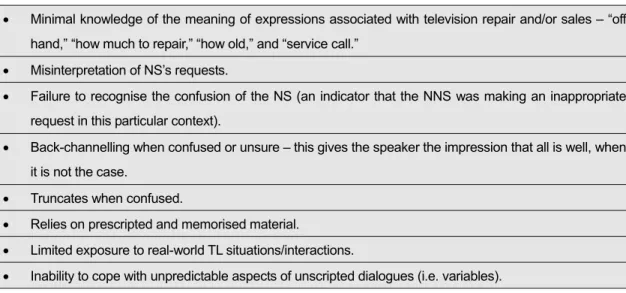
In summary, Table 4 lists the consistent errors made by the language learner:

Table 4: Consistent Errors

 Minimal knowledge of the meaning of expressions associated with television repair and/or sales – “off hand,” “how much to repair,” “how old,” and “service call.”

 Misinterpretation of NS’s requests.

 Failure to recognise the confusion of the NS (an indicator that the NNS was making an inappropriate request in this particular context).

 Back-channelling when confused or unsure – this gives the speaker the impression that all is well, when it is not the case.

 Truncates when confused.

 Relies on prescripted and memorised material.

 Limited exposure to real-world TL situations/interactions.

 Inability to cope with unpredictable aspects of unscripted dialogues (i.e. variables).

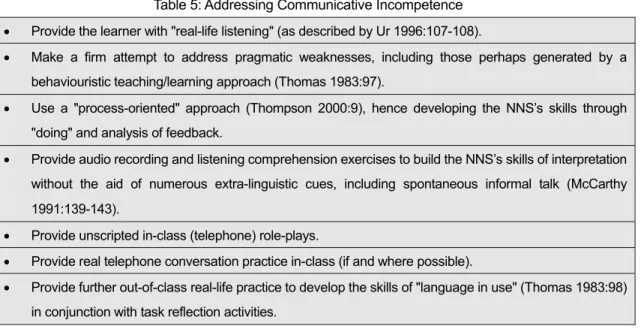
Table 5 offers suggestions for counteracting the NNS’s consistent errors:

(7)

Table 5: Addressing Communicative Incompetence

 Provide the learner with "real-life listening" (as described by Ur 1996:107-108).

 Make a firm attempt to address pragmatic weaknesses, including those perhaps generated by a behaviouristic teaching/learning approach (Thomas 1983:97).

 Use a "process-oriented" approach (Thompson 2000:9), hence developing the NNS’s skills through

"doing" and analysis of feedback.

 Provide audio recording and listening comprehension exercises to build the NNS’s skills of interpretation without the aid of numerous extra-linguistic cues, including spontaneous informal talk (McCarthy 1991:139-143).

 Provide unscripted in-class (telephone) role-plays.

 Provide real telephone conversation practice in-class (if and where possible).

 Provide further out-of-class real-life practice to develop the skills of "language in use" (Thomas 1983:98) in conjunction with task reflection activities.

The above suggestions are designed to develop the skills and abilities of the NNS so that he can better:

 extract required information from a single hearing of the TL at native speakers’ speed;

 employ coping strategies in difficult situations (e.g. listening for meaning, asking questions when confused, asking for repetition and so forth);

 clearly state the topic and his intention(s);

 develop all aspects of the 4 key components of communicative competence;

 act pragmatically for a given context in order to survive linguistically (McDonough 1995 in Thompson 2000:12); and,

 develop metapragmatic skills (Thomas 1983:98, 109-110) so that he has the ability to analyse language in a conscious manner – a process which Sharwood-Smith (1981:162-3 in Thomas 1983:98) terms "consciousness-raising."

Conclusion

Throughout this paper, basic facets of communicative competence have been explored. The NNS subject was unable to perform adequately due to weaknesses encompassing all skills of communicative competence. To classify this incompetence more accurately, the learner fails Bialystok’s (1993 in Thompson 2000:11-18) three competence criteria, and the learner barely falls within the second stage of Corder’s (1993) four-point scale of language development.

Through focusing on the incompetence of this language learner, consistent errors were identified.

These insufficiencies allowed for a number of solutions to be proposed that ought to boost this

(8)

NNS’s future real-world communicative performance.

In closure, exposure to realistic situations is crucial if communicative competence is to lead to communicative confidence (Canale and Swain 1980:38). However, the relationship of communicative confidence to communicative competence is perhaps just the reverse;

communicative confidence leads to communicative competence (Savignon 1997:45). The NNS should attempt this task a second time by contacting a more appropriate retail outlet. The transaction would obviously flow more smoothly for all interlocutors. In doing so, the NNS ought to achieve his goal without difficulty – boosting confidence and communicative competence.

References

Brown, H. D. (2014). Principles of language learning and teaching: A course in second language acquisition. Sixth Edition. New York: Pearson Education.

Canale, M. (1983). From communicative competence to communicative language pedagogy. In J. C.

Richards and R. W. Schmidt (Eds.), Language and communication (pp. 2-28). New York:

Longman.

Canale, M., & Swain, M. (1980). Theoretical bases of communicative approaches to second language teaching and testing. Applied Linguistics 1, 1-47.

Corder, S. P. (1993). Introducing applied linguistics. Harmondsworth, UK: Penguin Books.

Gass, S. M. (2018). Input, interaction, and the second language learner. Routledge Linguistics Classics Series. New York: Routledge.

Hatch, E. (1992). Discourse and language education. Cambridge: Cambridge University Press.

Hymes, D. H. (1972). On communicative competence. In J. B. Pride and J. Holmes (Eds.), Sociolinguistics: Selected readings (pp. 269-293). Harmondsworth, UK: Penguin Books.

McCarthy, M. (1991). Discourse analysis for language teachers. Cambridge: Cambridge University

Press.

(9)

Savignon, S. J. (1997). Communicative competence: Theory and classroom practice. Second Edition. New York: McGraw Hill.

Thomas, J. (1983). Cross-cultural pragmatic failure. Applied Linguistics 4(2), 91-112.

Thompson, S. (2000). Understanding spoken interaction: Recent development in the analysis of spoken discourse and their applications for language teaching. Applied Linguistics Association of Australia. Australia Review of Applied Linguistics 16, 9-29.

Ur, P. (1996). A course in language teaching: Practice and theory. Cambridge: Cambridge University

Press.

(10)
(11)

Table 1 (below) relates the NNS to Canale’s (1983) key components of communicative competence
Table 2: Lack of Communicative Competence  Covert Indications of Incompetence
Table 4: Consistent Errors
Table 5: Addressing Communicative Incompetence

参照

関連したドキュメント

工夫点(3) 英語が使えない学校英語と言われないよう

れば,ただの雑談になってしまう恐れがある。異文化間

Many students in the Department of English at Doshisha Women’s College of Liberal Arts feel that they are not good at speaking in English even though they have studied it for

□Input ・Teacher’s Talk ・Check Understanding ・Quick Fire ・Using pictures to introduce the textbook □Interaction

要旨 日本語学習者の接続詞の使用傾向を調べるため,金澤編(2014)『日本語教育のため

○対象:法学部・文学部・経済学部・政策創造学部・外国語学部・社会安全学部・理工系3学部)

「難民」に対する日本語教育に高い専門性が求められる理由

[r]