Initial waveform optimization based on the
adjoint variable and the finite element methoeds
Takahiko Kurahashi and Shigetoshi Tai
Abstract In this study, we present the initial waveform optimization analysis based on the adjoint variable and the finite element methods. As the governing equation, a shallow-water equation is employed to simulate flow behavior, and the finite ele- ment method using the stabilized bubble function element and the Crank-Nicolson method were used for spatial and temporal discretization. In addition, the rotating cone problem is carried out to investigate the numerical of the accuracy of the bub- ble function FEM using the stabilization parameter in the SUPG method. The results of the investigation for the adjoint boundary condition are shown in this paper.
1.1 Introduction
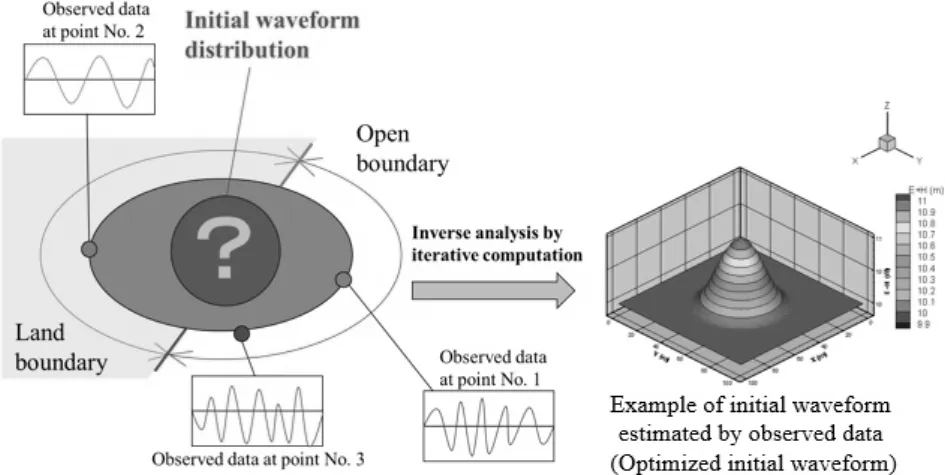
In this study, the initial waveform optimization analysis is carried out based on the adjoint variable and the finite element method. The image diagram of the waveform optimization is shown in Figure 1.1. To obtain the optimized initial waveform using the time history of observed water elevation, the performance function, i.e., the cost functional, should be defined[1],[2]. The performance function is defined as the sum of the squares of the residual between the computed and observed water elevations.
The performance function, is expressed as J = 1
2
∫ t
ft
0{ η − η obs. } T [Q] { η − η obs. } dt, (1.1)
Takahiko Kurahashi
Nagaoka University of Technology, 1603-1 Kamitomioka, Nagaoka, Niigata 940-2188, JAPAN e- mail: [email protected]
Shigetoshi Tai
Nagaoka University of Technology, 1603-1 Kamitomioka, Nagaoka, Niigata 940-2188, JAPAN e-mail: [email protected]
1
where [Q] is the weighting diagonal matrix, η is the computed water elevation and η obs. is the observed water elevation.
The purpose of this study is to find the distribution of the initial water elevation η (t
0) to minimize the performance function under the constraints of the shallow- water equation, the initial and the boundary conditions. Minimizing the performance function means that the computed water elevation should be as close as possible to the observed water elevation at the observation points. The results of the investiga- tion of the adjoint boundary condition in the inverse analysis based on the adjoint variable method are shown in this study. In addition, the performance function ex- tended by the governing equation, i.e., a shallow-water equation, and the adjoint variable is expressed by J
∗in this paper. J
∗is referred to as the Lagrange function and the extended performance function.
Fig. 1.1 The image diagram of the waveform optimization
1.2 Formulation by adjoint variable method
The finite element equation for the shallow-water equation is written as follows.
[M] { u ˙ i } + [S
,j (u adv j )] { u i } +g[S
,i] { η }
+ ν ([H
,j j ( ν
′)] { u i } + [H
,ji ( ν
′)] { u j } ) + f [M] { u i } = { T i }
in Ω t ∈ [t
0, t f ] (1.2)
[M] { η ˙ } + [S
,i(u adv i )] { h } + [S
,i(u adv i )] { η }
+[S
,i(h + η )] { u i } + [A( ν
′)] { η } = { 0 }
in Ω t ∈ [t
0, t f ] (1.3)
The boundary and the initial conditions are defined as follows.
u i = u ˆ i = ( u,0), ˆ η = η ˆ on Γ U t ∈ [t
0,t f ] (1.4) t i = ν (u i, j + u j,i )n j = (0, 0), on Γ D t ∈ [t
0, t f ] (1.5) t x = 0, ν = 0 on Γ S t ∈ [t
0, t f ] (1.6) u i (t
0) = 0, η (t
0) = η
0in Ω (1.7) Here, the parformance function, Equation (1.1), is extended by Equations (1.2), (1.3) and the adjoint variables { u
∗i } and { η
∗} .
J
∗= J +
∫ t
ft
0{ u
∗i } T ([M] { u ˙ i } + { C i } )dt +
∫ t
ft
0{ η
∗} T ([M] { η ˙ } + { D } )dt (1.8) where, { C i } and { D } are expressed as follows.
{ C i } = [S
,j (u adv j )] { u i } +g[S
,i] { η } + ν ([H
,j j( ν
′)] { u i } +[H
,ji ( ν
′)] { u j } ) + f [M] { u i } − { T i } t ∈ [t
0,t f ]
(1.9) { D } = [S
,i(u adv i )] { h } + [S
,i(u adv i )] { η }
+[S
,i(h + η )] { u i } + [A( ν
′)] { η }
t ∈ [t
0,t f ] (1.10)
To obtain the stationary condition of J
∗, the first variation of the extended perfor- mance function, Equation (1.11), is calculated. By calculating the first variation of the derivation of stationary condition extended performance functionm the follow- ing equation can be obtaind.
δ J
∗= 0 (1.11)
The Adjoint equations are written as follows.
− [M ] T { u ˙
∗i } + [ ∂ C i
∂ u i
] T
{ u
∗i } + [ ∂ D
∂ u i
] T
{ η
∗} = { 0 }
in Ω t ∈ [t
0, t f ] (1.12)
− [M] T { η ˙
∗} + [ ∂ C i
∂η ] T
{ u
∗i } +
[ ∂ D
∂η ] T
{ η
∗} + { η − η obs. } T [Q] = { 0 }
in Ω t ∈ [t
0, t f ] (1.13)
Here, the boundary and terminal conditions are denoted as follows.
u
∗= 0 t y
∗= 0 on Γ U t ∈ [t
0,t f ] (1.14) t i
∗= (0, 0) on Γ D t ∈ [t
0,t f ] (1.15) ν
∗= 0 t x
∗= 0 on Γ S t ∈ [t
0, t f ] (1.16) u
∗i (t f ) = 0 η
∗(t f ) = 0 in Ω (1.17) In addition, the gradient vector of the extended performance function with respect to the initial water elevation can be written as following equation.
{ ∂ J
∗∂η (t
0) }
= [M] t { η
∗(t
0) } in Ω (1.18) Therefore, the initial water elevation can be updated by using Equation (1.18).
The update equation of the initial waveform can be written as follows.
{ η (t
0) }
(l+1)= { η (t
0) }
(l)+ α
(l){ ∂ J
∗∂η (t
0) }
(l)in Ω (1.19)
1.3 Rotating cone problem
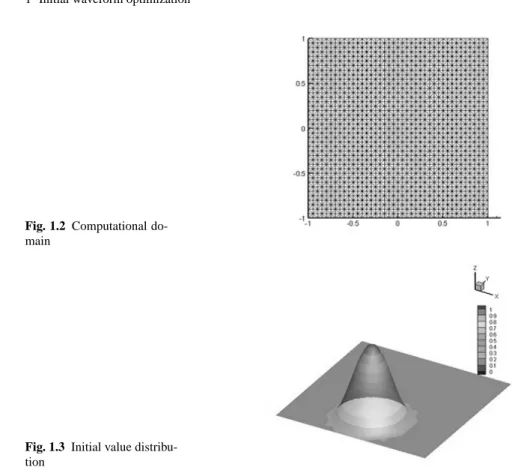
In this section, the rotating cone problem is carried out to investigate the advantages of the bubble function FEM using stabilization parameter in SUPG method. As the governing equation, the advection equation is employed. The spatial distribution of variable φ represented in the equation (1.20) (see Figure 1.3) is given as shown in Figure 1.2. The advection velocity field given by the u = − y and v = x. The bubble function element without the stabilization parameter is employed in case 1, the bubble function element with the stabilization parameter which is equivalent to that by the SUPG method is employed in case 2.
φ =
{ 0.5(cos(2 π r) + 1) r ≤ 0.5
0 r > 0.5 (1.20)
Fig. 1.2 Computational do- main
Fig. 1.3 Initial value distribu- tion
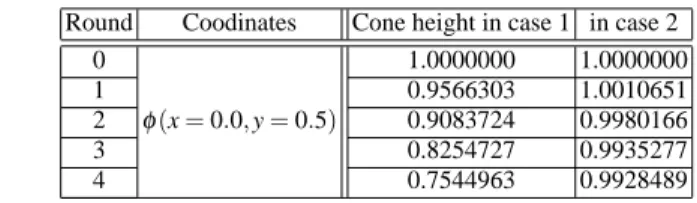
Computational conditions are shown in Table 1.1. In addition, computational re- sults are shown in Table 1.2. It is found that the numerical damping can be controlled by using the bubble function element with the stabilization parameter.
Table 1.1 Computational conditions
Number of nodes 1,681
Number of elements 3,200
Time increments 0.001
Time step 25,120
Table 1.2 Comparison of cone height in case 1 and 2
Round Coodinates Cone height in case 1 in case 2
0 1.0000000 1.0000000
1 0.9566303 1.0010651
2 φ (x = 0.0,y = 0.5) 0.9083724 0.9980166
3 0.8254727 0.9935277
4 0.7544963 0.9928489
1.4 Numerical experiment
1.4.1 Computational flow of waveform optimization
The computational flow of waveform optimization is shown below.
1. Assume initial water elevation η (t
0)
(0). 2. Compute state equation.
3. Compute performance function J
(0). 4. Compute adjoint equation.
5. Update initial water elevation η (t
0)
(l)by gradient vector g
(l).([W
(l)] T { η (t
0)
(l+1)} = [W
(l)] T { η (t
0)
(l)} + { g
(l)} )
6. Check of convetgence; if | J
(l+1)− J
(0)| < eps, then stop, else go to step 7.
7. Compute state equation.
8. Compute performance function J
(l+1). 9. Update weighting parameter W
(l).
a. if J
(l+1)< J
(l), then W
(l+1)= W
(l)× 0.9 and go to step 4.
b. if J
(l+1)> J
(l), then W
(l)= W
(l)× 2.0 and go to step 5.
1.4.2 Results of numerical experiments
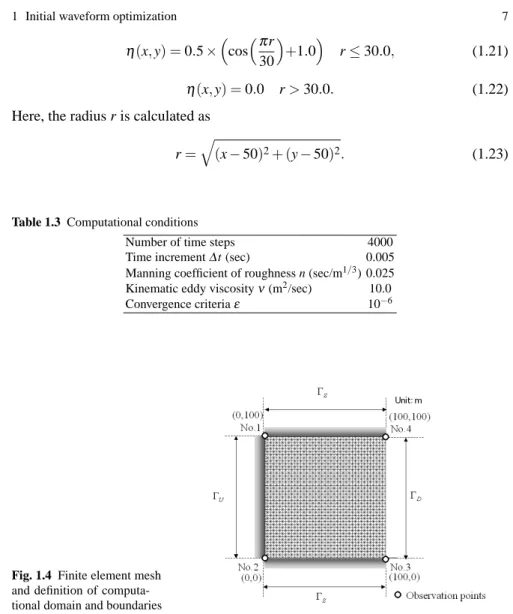
The purpose of this study is to determine the distribution of water elevation to bring the computed water elevation close to the observed water elevation at the observa- tion points based on the adjoint variable method. The finite element mesh and the location of observation points are shown in Fegure 1.4. The total number of nodes and elements are respectively 1681 and 3200. The computational conditions for this analysis are listed in Table 1.3. The weighting constant Q at the observation point is 1.0 and at the other points are 0.0. In this study, the artificial observed water el- evation obtained by using the exact initial water elevation shown in Figure 1.5 is employed. The mean water depth h is set at 10.0 m in the computational domain.
The distribution of the initial water elevation shown in Figure 1.5, is expressed in
the form of the following equations.
η (x, y) = 0.5 × ( cos
( π r 30 )
+1.0 )
r ≤ 30.0, (1.21)
η (x, y) = 0.0 r > 30.0. (1.22)
Here, the radius r is calculated as r =
√
(x − 50)
2+ (y − 50)
2. (1.23)
Table 1.3 Computational conditions
Number of time steps 4000
Time increment ∆ t (sec) 0.005
Manning coefficient of roughness n (sec/m
1/3) 0.025 Kinematic eddy viscosity ν (m
2/sec) 10.0
Convergence criteria ε 10
−6Fig. 1.4 Finite element mesh and definition of computa- tional domain and boundaries
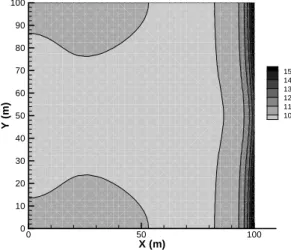
If the adjoint boundary condition on the open boundary Γ D is defined as the ad- joint flux s x = 0.0 the distribution of the gradient
∂η∂J
(t∗0)
at the first iteration is ob- tained, as shown in Figure 1.6. The adjoint flux s x is related variable with respect to the flow quantity flux for x direction. In this case, the iterative computation for the inverse analysis is not carried out, since the gradient distribution is not appro- priately expressed. The distribution of the initial water elevation is obtained as the linear combination for the gradient vector with respect to the initial water elevation.
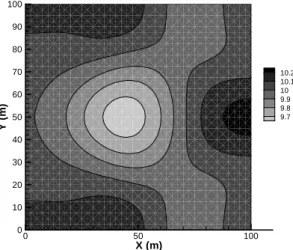
Therefore, if the gradient vector at the first iteration is not obtained precisely, the inverse analysis computation cannot be continued. In this case, it appears that if the gradient value is concentrically distributed, the analysis can be carried out. Here, let us consider the case where the adjoint boundary condition on the open boundary Γ D
is defined as λ x = 0.0. The adjoint variable λ x is related variable with respect to the
Fig. 1.5 Distribution of initial water depth ( η + h) (Exact solution for estimation of initial water elevation)
10 10.5 11
E+H(m)
0 20 40 60 80 100
X (m) 0
20 40
60 80
100 Y (m)
X Y
Z
E+H (m) 11 10.9 10.8 10.7 10.6 10.5 10.4 10.3 10.2 10.1 10 9.9
flow velocity for x direction. Consequently, the gradient distribution is obtained as shown in Figure 1.7. In this case, the iterative computation for the inverse analysis is carried out, and the distribution of the initial water elevation is appropriately ob- tained.
X (m)
Y(m)
0 50 100
0 10 20 30 40 50 60 70 80 90 100
15 14 13 12 11 10
Fig. 1.6 Distribution of gradient of extended performance function with respect to initial water
elevation ( conventional method )
X (m)
Y(m)
0 50 100
0 10 20 30 40 50 60 70 80 90 100
10.2 10.1 10 9.9 9.8 9.7
Fig. 1.7 Distribution of gradient of extended performance function with respect to initial water elevation ( present method )
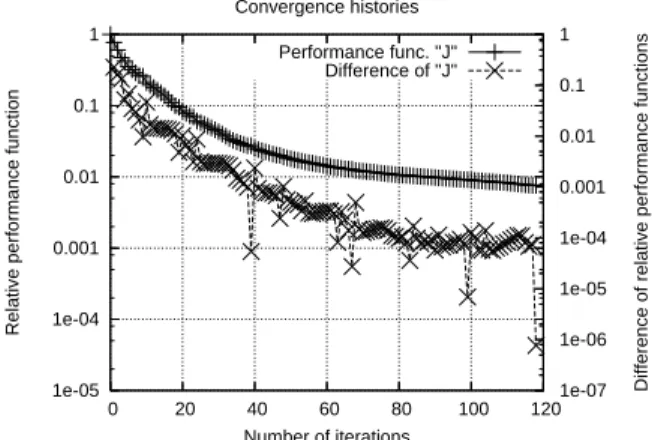
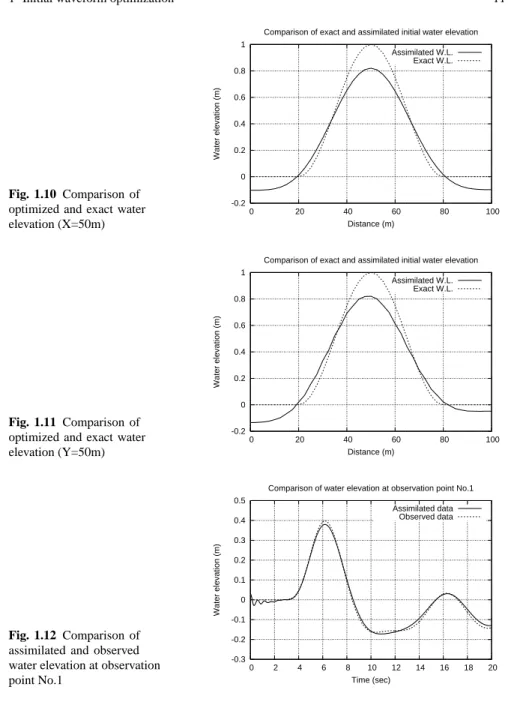
The computational results are shown as follows. Figure 1.8 shows the variation in the performance function. It can be seen that the performance function decreases and converges. This means the computed water elevation is close to the observed water elevation. The distribution of the initial water elevation, shown in Figure 1.9, can thus be obtained. Figures 1.10 and 1.11 show a comparison of the initial water level between the computed and the exact values on the lines X = 50.0 m and Y = 50.0 m. It can be seen that the computed initial water elevation is lower than the exact initial water elevation.
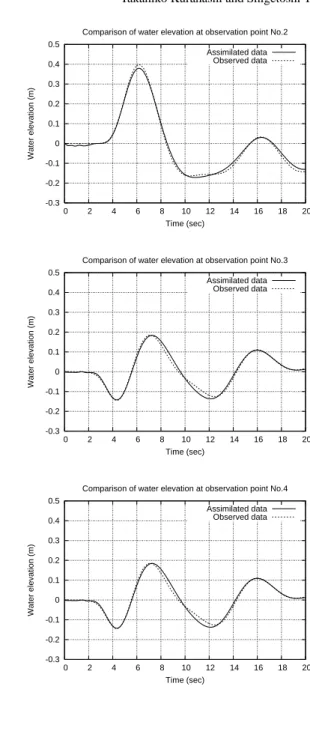
Figures 1.12 - 1.15 show the time histories of water elevation at the observation points Nos. 1 - 4. The solid line indicates the assimilated water elevation and the broken line indicates the observed water elevation. At all the observation points, the assimilated water elevation is in good agreement with the observed water elevation.
It is seen in Figures 1.12 and 1.13 that there is difference early on. It appears that
this is not a type of the error in the computation of the shallow water flow. This
is because the observed data in Figures 1.12 and 1.13 are also obtained by using
the shallow water code in the same way as the code used in the computation of
the estimation for the initial water elevation. There is thus the possibility of a kind
of numerical error in the computation of the inverse analysis, since the assimilated
data at No. 3 was the same as the data at No. 4. In this computation, the adjoint
boundary condition on the open boundary Γ D is defined as λ x = 0.0. The adjoint
flux s x integrated in time duration [t
0,t f ] and on the open boundary Γ D must there-
fore be zero to satisfy the stationary condition δ J
∗= 0, under conditions where the
performance function converges. This is because, in the equation of the first varia-
tion of the extended performance function, the term for the adjoint flux integrated
1e-05 1e-04 0.001 0.01 0.1 1
0 20 40 60 80 100 120 1e-07
1e-06 1e-05 1e-04 0.001 0.01 0.1 1
Relative performance function Difference of relative performance functions
Number of iterations Convergence histories
Performance func. "J"
Difference of "J"
Fig. 1.8 Variation of performance function and absolute value of difference of performance func- tion between (l) and (l + 1) iterations
10 10.5 11
E+H(m)
0 20 40 60 80 100
X (m) 0
20 40
60 80
100 Y (m)
X Y
Z
E+H (m) 11 10.9 10.8 10.7 10.6 10.5 10.4 10.3 10.2 10.1 10 9.9
Fig. 1.9 Distribution of optimized initial water depth ( η + h)
in time and on the open boundary should be zero. In general, the adjoint flux on
the open boundary is defined as zero to satisfy the stationary condition. However, in
this study, the initial water elevation can be obtained by computation in which the
adjoint boundary condition on the open boundary is defined as λ x = 0.0. Therefore,
it is necessary to investigate whether the value of the adjoint flux integrated in time
and on the open boundary is headed for zero if the type of adjoint boundary condi-
tion is changed, i.e., the adjoint boundary condition on the open boundary is defined
Fig. 1.10 Comparison of optimized and exact water elevation (X=50m)
-0.2 0 0.2 0.4 0.6 0.8 1
0 20 40 60 80 100
Water elevation (m)
Distance (m)
Comparison of exact and assimilated initial water elevation Assimilated W.L.
Exact W.L.
Fig. 1.11 Comparison of optimized and exact water elevation (Y=50m)
-0.2 0 0.2 0.4 0.6 0.8 1
0 20 40 60 80 100
Water elevation (m)
Distance (m)
Comparison of exact and assimilated initial water elevation Assimilated W.L.
Exact W.L.
Fig. 1.12 Comparison of assimilated and observed water elevation at observation point No.1
-0.3 -0.2 -0.1 0 0.1 0.2 0.3 0.4 0.5
0 2 4 6 8 10 12 14 16 18 20
Water elevation (m)
Time (sec)
Comparison of water elevation at observation point No.1 Assimilated data
Observed data
Fig. 1.13 Comparison of assimilated and observed water elevation at observation point No.2
-0.3 -0.2 -0.1 0 0.1 0.2 0.3 0.4 0.5
0 2 4 6 8 10 12 14 16 18 20
Water elevation (m)
Time (sec)
Comparison of water elevation at observation point No.2 Assimilated data
Observed data
Fig. 1.14 Comparison of assimilated and observed water elevation at observation point No.3
-0.3 -0.2 -0.1 0 0.1 0.2 0.3 0.4 0.5
0 2 4 6 8 10 12 14 16 18 20
Water elevation (m)
Time (sec)
Comparison of water elevation at observation point No.3 Assimilated data
Observed data
Fig. 1.15 Comparison of assimilated and observed water elevation at observation point No.4
-0.3 -0.2 -0.1 0 0.1 0.2 0.3 0.4 0.5
0 2 4 6 8 10 12 14 16 18 20
Water elevation (m)
Time (sec)
Comparison of water elevation at observation point No.4 Assimilated data
Observed data
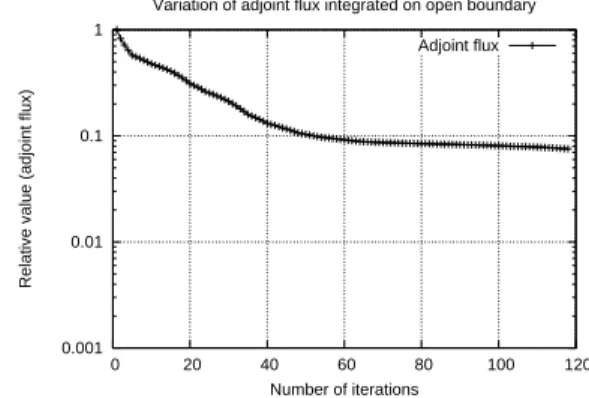
as λ x = 0.0. Figure 1.16 shows the history of the adjoint flux ∫ t t
0f∫
ΓD
s x d Γ dt. The value of the adjoint flux is reduced by 92.5% and can be close to zero. The adjoint flux on the open boundary has to theoretically converge to zero to satisfy the station- ary condition. However, the adjoint flux on the open boundary does not completely converge to zero, since this computation is carried out numerically and iteratively.
In this computation, the adjoint flux on the open boundary can consequently be re- duced sufficiently compared with the value at the first iteration, and can approach zero, as shown in Figure 1.16. It therefore appears that if the data assimilation prob- lem with open boundary can’t be solved based on the traditional method, the present method can be useful in solving for the problem.
Fig. 1.16 History of adjoint flux s
xintegrated in time and on open boundary Γ
D0.001 0.01 0.1 1
0 20 40 60 80 100 120
Relative value (adjoint flux)
Number of iterations
Variation of adjoint flux integrated on open boundary Adjoint flux