The World Congress of Structural and Multidisciplinary Optimization, May 20-24, 2019, Beijing, China
Identification of order of singularity around singular point of bonded structures using measured displacement values
Takahiko Kurahashi1*, Kengo Yamagiwa2
1Dept. of Mechanical Engineering, Nagaoka University of Technology, Niigata, Japan
* Corresponding author: [email protected]
2MinebeaMitsumi Inc., Nagano, Japan
Abstract
In this study, we present identification analysis order of singularity around singular point of bonded structures using measured displacement values. The identification analysis is performed based on the adjoint variable method. To derive the gradient of the Lagrange function with respect to the order of singularity, the Akin’s singular element is introduced.
Some numerical results based on the present method are shown in this paper.
Keywords : Parameter identification, Order of singularity, Adjoint variable method, Bonded structure, Singular element.
1. Introduction
The order of singularity near interface edge of bonded structure is very important parameter for judgement of the fracture on interface of the bonded structure. The order of singularity is generally obtained by the solution of characteristic equation with respect to characteristic root in two dimensional problem [1] and three dimensional problem [2]. In this procedure, the order of singularity is determined by the comparison of the result of stress analysis and eigen vector obtained by characteristic equation. Hence, in this study, we propose the methodology that the order of singularity is automatically identified by using the observed displacement in target bonded structure based on the adjoint variable method [3]. However, in the governing equation of the elastic deformation, the order of singularity is not explicitly included in the governing equation. Therefore, in this study, the Akin’s singular element [4] is introduced in the deformation analysis of the bonded structure, investigations of identification of the order of singularity is carried out based on the adjoint variable method.
2. Formulation for identification of order of singularity
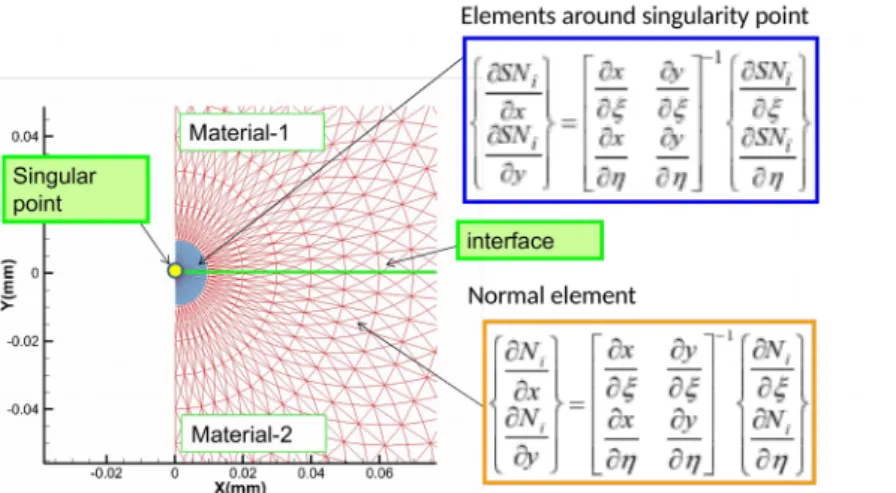
The shape function in the linear triangular element is written as Eq.(1). The parameters ξ and η represent the area coordinate. The interpolation function based on the shape function shown in Eq.(1) is represented as Eq.(2). On the other hand, the shape function for elements including the singular point is proposed by Akin [4], is defined as Eq.(3) (See Fig.1.). Summation of the shape function shown in Eq.(3) is equal to one, and the condition of the “Partition of Unity” is satisfied. In Eq.(3), the function R is given as Eq.(4), and the parameter λ indicates the order of singularity.
The interpolation function in the singular element is written as Eq.(5). The comparison of the shape function between the linear triangular and the singular elements is shown in Fig.2.
(1)
(2)
(3)
(4)
(5)
Figure 1. How to set of singular and normal elements
Figure 2. Comparison of shape function between linear triangular and singular elements.
The finite element equation for the deformation analysis for linear elastic body is written as Eq. (6). In this equation, the finite element equation for the singular element is also included, and the order of singularity λ is also explicitly included.
(6)
Here, the performance function is defined as shown in Eq. (7), and {u} and {uobs.} indicate the computed displacement and observed displacement. The matrix [Q] indicates the weighting diagonal matrix, and 1.0 is given at nodes of observation point, and 0.0 is given at the other nodes. The problem is to identify the order of singularity λ so as to minimize the performance function. Considering the constraint condition shown in Eq. (6) to Eq. (7), the Lagrange function is derived as Eq. (8). The vector {P} indicates the adjoint variable vector.
(7)
(8)
The gradient of Lagrange function with respect to displacement {u} and the order of singularity λ is derived as Eqs. (9) and (10). Eq.(9) is referred to as the adjoint equation. Eq.(10) is employed for the update of the order of singularity, and the update equation of the order of singularity is written as Eq.(11). The parameter γ indicates the step length.
(9)
(10)
(11)
The computational flow of the identification of the order of singularity is shown below.
Step 1) Input of initial value of order of singularityλ(0) and convergence criterion ε.
Step 2) Computation of displacement field by the finite element equation using the Akin’s singular element
Step 3) Judgement of order of singularity “λ”; if |λ(l+1) –λ(l)| < ε, then this iterative computation is terminated, else go to next step.
Step 4) Computation of adjoint variable field by the adjoint equation
Step 5) Computation of gradient of Lagrange function with respect to order of singularity “λ”.
Step 6) Update of order of singularity “λ” based on the gradient of Lagrange function with respect to order of singularity “λ”, return to “Step2”.
3. Numerical example
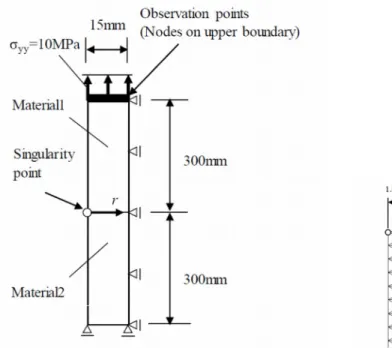
The computational model and boundary conditions are shown in Fig.3. The purpose of this study is to identify the order of singularity such that computed displacement is close to measurement displacement at observation points.
Observation points are set on at all nodes on upper surface (See Fig.4.), and displacement for x and y directions are employed as the observed value. Material properties are shown in Table 1. The order of singularity is obtained 0.0735 by the Bogy’s characteristic equation. The finite element mesh around singular point is shown in Fig.5. The computed displacements are employed as artificial observed displacements in case that the order of singularity is given as 0.0735 in singular elements. In the identification analysis, the initial value of the order of singularity is given as 0.150.
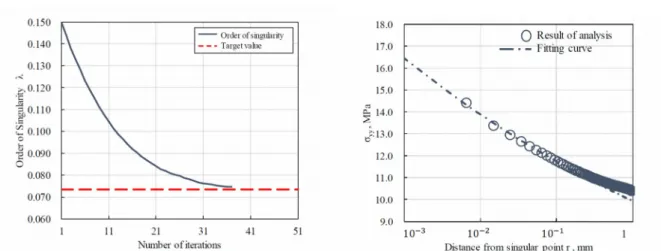
Computational results are shown in Figs. 6-8. Fig.6 shows the variation of gradient ∂J*/∂λ. It is seen that the gradient value gradually decreases and converges. Fig.7 shows the variation of the order of singularity. It is found that the initial value of the order of singularity gradually approaches to the correct value and finally converges. Fig. 8 shows the result of stress analysis at final iteration and fitting line based on the correct order of singularity (λ=0.00735.). It is
confirmed that the stress distribution at final iteration is appropriately obtained.
Figure 3. Computational model and boundary condition Figure 4. Position of observation points Table 1. Material properties
Material 1 : Young’s modulus, GPa 20.0
Material 1 : Poisson’s ratio 0.3
Material 2 : Young’s modulus, GPa 70.0
Material 2 : Poisson’s ratio 0.3
Figure 5. Finite element mesh around singular point Figure 6. Variation of gradient ∂J*/∂λ
Figure 7. Variation of order of singularity Figure 8. Result of stress analysis and fitting result
4. Conclusion
In this study, identification analysis of order of singularity for bonded structures using measurement displacement was carried out based on the adjoint variable and finite element methods using Akin’s singular element. Consequently, it was found that the order of singularity is appropriately identified. In future, it is necessary to investigate the relationship between the measurement accuracy and the accuracy of identification of order of singularity.
Acknowledgments
The contents of this work, i.e., stress singular analysis for bonded structures, is based on seminars by Professor Hideo Kuguchi at Niigata Institute of Technology, and Emeritus Professor Toshimi Kondo at National Institute of Technology, Nagaoka College. The computations were mainly carried out using the super computer at Kyushu University’s Research Institute for Information Technology. We wish to thank Professor Hideo Koguchi, Emeritus Professor Toshimi Kondo and the staff at Kyushu University’s Research Institute for Information Technology.
References
1. Bogy, D.B., Two Edge-Bonded Elastic Wedges of Different Materials and Wedge Angles under Surface Tractions, Journal of Applied Mechanics, 1971, 38: 377-386.
2. Pageau, S.S., and Bigger, JR, S.B., Finite element evaluation of free-edge singular stress fields in anisotropic materials, International Journal for Numerical Methods in Engineering, 1995, 38: 2225-2239.
3. Kurahashi, T., Maruoka, K. and Iyama, T., Numerical shape identification of cavity in three dimensions based on thermal non-destructive testing data, Engineering Optimization, 2016, 49: 434-448.
4. Akin, J.E., The generation of elements with singularities, International Journal for Numerical Methods in Engineering, 1976, 10: 1249-1259.