• 検索結果がありません。

Evaluation Constructions in Tinrin and Neku (New Caledonia)

N/A
N/A
Protected

Academic year: 2021

シェア "Evaluation Constructions in Tinrin and Neku (New Caledonia)"

Copied!
40
0
0

読み込み中.... (全文を見る)

全文

(1)

Evaluation Constructions in Tinrin and Neku (New Caledonia)

ῌῌ Survey with typological overview ῌῌ

Midori OHJB>

1. Introduction

1

In the last few decades more previously uninvestigated languages have been unveiled linguistically, and we have come across grammatically-encoded concepts that have not been so familiar or explicit in better-known languages. Such concepts may receive quite clear linguistic representation in some languages, while in other languages they may not be expressed at all. Should we think that these concepts lacking overt linguistic representation nevertheless exist in any language, perhaps in other subtle or inexplicit ways, including nonverbal forms, to compensate their lack? On the other hand, when a language has explicit and often elaborate linguistic forms centering around certain concepts which are not so salient in other languages, does it imply that its speakers are more aware of, or habitually interested in those concepts, which may constitute a central part of their culture?

In discourse, we often express our appreciation or disappointment explicitly or implicitly, concerning performances or events that happen around the speaker. Various concepts centering around this sense of evaluation have become grammaticalized in some languages. Tinrin and Neku,

2

two Austronesian languages of New Caledonia, have several ways to express a range of evaluations of result. In this paper I will examine these evaluation expressions in Tinrin and Neku, and provide some framework of evaluation types to further examine expressions

ῌ 139 ῌ

(2)

exhibiting similar concepts across languages. I will discuss shared semantic properties and scope, some related issues such as result inclusion in predicates, the agent’s initial volition and the speaker’s expectation and involvement in the events, as generally the evaluation is made with respect to an ideal action expected, as well as common syntactic and morphological strategies, and distributions of features.

This paper is a preliminary survey as it addresses diversities in semantic domains of evaluation expressions, which vary extensively from language to language, and are often highly pragmatic in nature, so that they have not attracted much attention so far as a linguistic system.

2. Result-evaluation in Tinrin and Neku

2.1 Result-evaluation and the scope of the study

When we describe what happens around us, we often express our appreciation for, or disappointment at the performance of the person involved, or the event as a whole. The evaluation may be based on whether or not the target of the action has been well achieved, whether the actor’s performance was e $ cient or slovenly, or how much the speaker feels empathy towards the event or the result gained through the action. Various structures and concepts centering around this sense of evaluation are observed in some languages. They may simply be manifested as adverbs or adpositional phrases modifying predicates, or by intonation patterns, which I do not survey in this paper. This paper is concerned only with result evaluations that have been grammaticalised as a verbal a $ x, a verb stem, a part of a verbal compound or serialization, a particle-like auxiliary or a resultative.

I would also like to note that examples used in this paper often have

multiple meanings, and so have sometimes been categorized in more

than two types of evaluation in the list proposed, and that their

meanings may extend further. Some ideas given in this paper are meant

to be a starting point for further study, so as to stimulate the gathering

and systematization of more widely-based information on this

(3)

phenomenon.

2.2 Tinrin and Neku verbs

Let us begin by looking at the following Tinrin examples.

(1) nra ˆ

3

hawi-dro ◊ ◊ o wo ◊ . 3sg speak-poorly

‘He spoke poorly.’

(2) nra ˆ wa-harru nrı ⁄ . 3sg press ῎ down-well 3sg

‘He pressed it down well (on the right spot).’

(3) nra ˆ go-veso ◊ nrı ⁄ . 3sg move-in ῎ vain 3sg

‘He moved (himself) in vain.’

(4) u dro-dhai nrı ⁄ .

1sg hit ῎ with ῎ fist-missed 3sg

‘I tried to hit him with my fist, but missed.’

(5) nra ˆ ho ˆ-pwu ◊ rru ◊ peci.

3sg hold-lost paper

‘He had a paper in hand but lost it.’

The above sentences involve verbs which are morphologically complex, comprising a prefix and a verb stem. The first part of the verbs in the above examples, except hawi- in (1) which can stand alone, are members of a closed set of event-classifying prefixes

4

(Osumi 1995: 118 ῍ 119;

Osumi 2007). The same prefixes occur in the following examples:

wa-: wa-ru ◊ ‘press down and break in two’, wa-ghorro ‘press down and break in pieces’, wa-via ‘press against something’,

wa-gidhi ‘press and crumple’

go-: go-dhai ‘do wrongly’, go-dro ◊ ◊ o wo ◊ ‘move clumsily’,

go-perrii ‘imitate another person’s behavior’

dro-: dro-dhai ‘miss with the fist’, dro-ghe ‘hit with the fist’

ῌ 141 ῌ

(4)

ho ˆ-: ho ˆ-ghai ‘squeeze in the hand’, ho ˆ-dhai ‘hold in a wrong way’, ho ˆ-so ˆrro ˆ‘prick the hand in gripping’, ho ˆ-wu ◊ rru ◊ ‘hold in the hand firmly’

Tinrin event-classifying prefixes can be categorized into four groups according to the parts or objects used, or the movements involved in the action. They are illustrated in the following examples as combined with the same verb stem -ru ◊ ‘cut/broken across in two’.

ῌ body parts ῍

u-ru ◊ ‘cut in two (widthwise) by hand’, o

ˆ-ru ◊ ‘cut in two with the fingers’, e-ru ◊ ‘cut in two with the teeth’, fo ◊ - ru ◊ ‘cut in two by stepping on’

ῌ instruments ῍

wi-ru ◊ ‘cut in two with a stick’, ju ◊ -ru ◊ ‘cut in two with a knife’, ki-ru ◊ ‘cut in two with a saw’

ῌ natural force ῍

nro ◊ -rau ‘(landslide) dig out’,

mi-ru ◊ ‘get severed in two by natural force’

ῌ manner ῍

wa-ru ◊ ‘break in two by pressing’, po ◊ -ru ◊ ‘break in two by turning’, dre-ru ◊ ‘break in two by falling’

The majority of derived verbs are transitive, though some are used reflexively as in (3), and some are intransitive. Most of the verb stems combined are bound forms, but some are intransitive verbs, which are transitivized by being a $ xed with a prefix of this group, thus changing valency: e.g. ho ˆ-vaju ◊ (holding, sick) ‘hurt (something) by holding firmly.’

They exhibit a very transparent morpho-semantic structure. The

‘action’ or ‘cause’ component is expressed in the prefix, where

instruments or manner/motion of the action are specified, while the

verbal stem refers to the state/condition of the object (less frequently of

(5)

the subject) brought about as a result of the action/cause indicated in the prefix. The resultant two-part verbs involve complex events comprising an activity leading to a change of state, as illustrated in (6):

(6)

ACTION/CAUSE ῌ EFFECT

῍ event-classifying prefix ῎ ῍ verb stem ῎ action, causal event resultant situation

The second element of the verb thus normally refers to the object’s (or subject’s) a # ected or changed state, such as ‘being hit, folded, injured, broken, crushed, dead,

5

buried,’ etc., but the verbs in (2) ῌ (5) are of a somewhat di # erent nature. While they share with other verb stems the semantic property of indicating result, they di # er from canonical action plus e # ect compounds in using the e # ect slot to give an evaluation of whether the action or event was carried out successfully or not. The meanings of the verb stems in (1) ῌ (5) would typically be as follows:

-dro ◊ ◊ o wo ◊ ‘the action was performed badly, clumsily’

(-)harru ‘the action was done well, and the target was caught’

(cf. free form harru, ‘good’)

-(v)eso ◊ ‘the action was carried out, but yielded nothing’

-dhai ‘the action was done wrongly, slipped to the side, or the target was missed’

-pwu ◊ rru ◊ ‘the action was done (wrongly), and the object involved went astray or became lost’

Neku contains similar structures. The following Neku sentences contain verbs with event-classifying prefixes,

6

whose verb stems show a remarkable semantic resemblance to those in Tinrin (2), (4), and (5).

(7) go ◊ ba-vu ◊ rre ¨ no ◊ . 1sg spear-right_on fish

‘I speared the fish (right on target)’.

(8) ◊ e ba-warri no ◊ . 3sg spear-missed fish

‘He tried to spear the fish but failed’.

ῌ 143 ῌ

(6)

(9) de ba-tja no ◊ . 1pl. inc spear-aside fish

‘We tried to spear the fish but just grazed the side’.

(10) go ◊ ra ˆ-bwirri be?e ˆ.

1sg throw_away-lost stick

‘I threw the stick, and it got lost.’

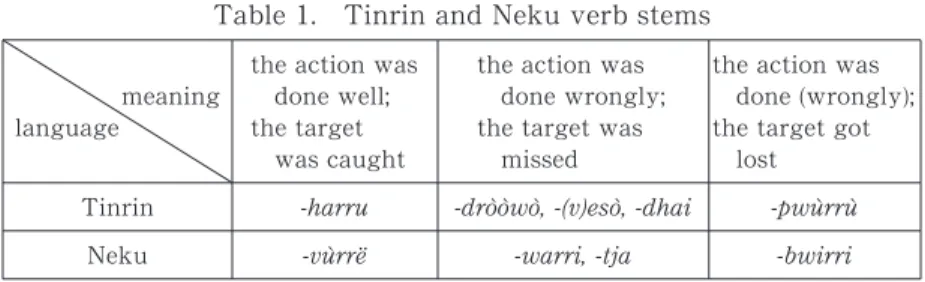
The following table shows the semantic correspondence between the verb stems of Tinrin and Neku.

We can argue from the Tinrin and Neku examples discussed above that these verb stems, which syntactically resemble other resultative verb stems in being a $ xed by event-classifying prefixes, also refer to a resultant state of the action or event referred to by their prefixes. They are distinguished from them, though, in that instead of indicating the physical state or outcome of an action, they indicate some judgment on the activity or the result, based on personal experience and attitude.

Because of the perfective/resultative connotation of verbs with -dhai and -bwirri, the following negative sentences are ungrammatical or strange in meaning. This can be compared with Finnish, where accusative objects cannot occur in negative sentences as no result is implied.

7

(11) ῍ nra ˆ see dro-dhai nrı ⁄ . 3sg NEG hit_with_fist-fail 3sg.O

‘He did not fail to hit him.’

Table 1. Tinrin and Neku verb stems

meaning language

the action was done well;

the target was caught

the action was done wrongly;

the target was missed

the action was done (wrongly);

the target got lost Tinrin -harru -dro ◊ ◊ o wo ◊ , -(v)eso ◊ , -dhai -pwu ◊ rru ◊

Neku -vu ◊ rre ¨ -warri, -tja -bwirri

(7)

(12) ῍ go ◊ ta ra ˆ-bwirri be?e ˆ 1sg NEG throw_away-lost stick

‘I did not throw the stick to lose it.’

When the manner of action is judged, i.e. (an action is done) well or badly, as with -dro ◊ ◊ o wo ◊ (1), it still can be considered as a ‘result’ of an activity rather than stating merely the way it is performed: in (1), the agent’s performance is evaluated as a whole activity. In general, such verbs refer to past events.

8

2.3 Pre-and post-verbal modifiers

The following constructions in Tinrin also indicate evaluation of the result but by particles that occur within verb phrases.

(13) toni he ˆrre ˆ nrerre ju ◊ rru ◊ hi-nrı ⁄ . Tony IMPN REGRET cut leg-3sg

‘Tony was cut on the leg (lit. somebody cut Tony’s leg), to my regret.’

(14) toni nra ˆ marra wake.

Tony 3sg WASTE work

‘Tony worked badly, and did not achieve anything.’

(15) nra ˆ nrorri nrooi nraasi ei rru.

3sg give in_vain rice DAT 3dl

‘He gave them two the rice for nothing (wasted, he should not have done so.)’

Nrerre in (13) shares the same pre-verbal slot ῌ between the subject pronoun and the head of the predicate or the pre-verbal modifier if any ῌ with the other tense-aspect markers in Tinrin (e.g. a ‘perfect, actual’, nra ˆ ‘imperfective, durative’).

9

The use of nra ˆ, ‘imperfective, durative’, for example, is illustrated in the following example:

(16) nra ˆ nra ˆ drarri nra ˆ hu ◊ ◊ u mu ◊ rru ◊ .

3sg IMPF cry SM child

‘A child is crying.’

Nrerre indicates a speaker’s negative feeling about the whole event:

the speaker expresses his regret or disappointment at what has happened. This particle can also occur in a sentence with irrealis aspect,

ῌ 145 ῌ

(8)

in which it means ‘against my will/wish’, or with the negative marker see which modifies the predicate as in (17).

(17) ri nrerre see maija to ◊ wo ◊ kafe.

1pl.inc REGRET NEG much pick co # ee

‘We did not collect many co # ee beans, unfortunately (to my regret).’

Marra in (14) is a pre-verbal modifier, which indicates a wasteful activity. It does not imply that the agent wastes time ‘intentionally’, but rather, the focus is on the ine $ ciency of the action and its fruitless result. It is often di $ cult to clearly separate the two phases of the evaluation of the activity, namely of the activity itself, and of the result.

Marra can be used with the future tense as in (18), and with another pre-verbal modifier maija ‘much’ as in (19):

(18) u barra pa wei nrı ⁄ marra wake.

1sg afraid lest 1sg.FUT EVE WASTE work

‘I am afraid that I will be wasting my time at work.’

(19) komu maija marra wake.

1dl.exc much WASTE work

‘We two wasted much time in working.’

This particle, from its semantics, basically occurs with activity verbs, which makes the sentence (20) with the verb nrorri ‘give’ strange.

The sentence (21) is also unacceptable as the ‘eating something’ implies the result that the food is consumed, which cannot be a wasteful activity.

(20) ῍ nra ˆ marra nrorri ei nrı ⁄ nraasi.

3sg WASTE give DAT 3sg rice

‘He wasted time in giving him rice.’

(21) ῍ nra ˆ marra hara nraasi nra ˆ toni.

3sg WASTE eat rice SM Tony

‘Tony wasted time in eating rice.’

Similarly fi ‘go’ and me ˆ ‘come’ do not occur with marra, as they

imply goals. If a loafing manner of walking, or unfinished activity is

implied, va ˆrra ˆ‘walk’ or kare ‘run, go’ as in (26) may be used as they imply

activities. If it is implied that the goal was reached but the whole

(9)

activity was wasted, nrooi should be employed as in (22).

Nrooi is a post-verbal modifier which occurs before any object that may be present. This indicates that although an action was carried out, its expected result was not achieved. It appears to have a similar meaning to marra, but whereas marra expresses the wastefulness of the activity or its process, nrooi emphasizes the inadequacy or wastefulness of the action with respect to a fruitless result. This makes it possible to occur with almost any verb, unlike marra.

(22) ke fi nrooi pwere numea

2sg go VAIN to Noumea

‘You went to Noumea, but it was a wasted trip.’ (You could not see the person you wanted to see.)

The above sentence can be compared with (23) where nrerre indicates the speaker’s disagreement with the action.

(23) ke nerre fi pwere numea

2sg REGRET go to Noumea

‘You went to Noumea, which I regretted.’ (I did not want you to go to Noumea.)

Though nrooi generally occurs in the past tense, it can also occur in the present or the future, providing that the anticipated result is given, as in the following example:

(24) u barra pa wei nrı ⁄ nrorri nrooi.

1sg afraid lest 1sg.FUT EVE give VAIN

‘I am afraid that I will give it in vain.’

In (24), the speaker hesitates to give something in fear that it may not be appreciated, and his present would be wasted. (25) and (26) show the contrast between nrorri and marra with the same verb, kare ‘run’:

(25) ke kare nrooi.

2sg run VAIN

‘You ran in vain.’ (You did not achieve your goal./ You ran in the hope to lose weight, but you did not lose weight.)

ῌ 147 ῌ

(10)

(26) ke marra kare.

2sg WASTE run

‘You ran, just wasting time.’ (You ran with no purpose./ You ran just idly.)

The evaluation could be objective, of the fruitless action, or could be subjective, indicating the speaker’s negative feeling towards an agent’s lack of e # ort or ability to perform e $ ciently. Both marra and nrooi can occur after nrerre in a sentence allowing the more explicit expression of a double evaluation: the (objective) bad performance or wasted action, and the speaker’s disappointment over the event.

(27) nra ˆ nrerre marra wake.

3sg REGRET WASTE work

‘To my regret, he worked badly.’

(28) nra ˆ nrerre nrorri nrooi.

3sg REGRET give VAIN

‘He gave (it) away for nothing (which I regret).’

2.4 Tinrin and Neku evaluation types

In this section, I will categorize Tinrin and Neku evaluation constructions discussed in 2.2 and 2.3 as well as some other evaluation constructions seen in these two languages into subtypes, according to the evaluation types, whether positive or negative, and what is evaluated ῌ the activity, the result of the action performed, or the whole event: (1.A) Positive evaluation of activity, (1.B) General negative evaluation of activity, (1.C) Specific negative evaluation, (2.A) Evaluation of outcome as successful, well done, (2.B) Evaluation of outcome: done but for no use, in vain, (2.C) Evaluation of outcome:

unsuccessful, target missed, (3) Evaluation of the whole event.

(1.A) Positive evaluation of activity

Tinrin harru ‘(be) good’, a stative verb, implies a positive evaluation of activity or state when serialized with another verb preceding it: puu harru [smell, be ῍ good] ‘smell good’.

Neku we ◊ ja ‘be good’, as well as ke ◊ ‘cut well’, similarly indicate a

(11)

positive evaluation in a verb serialization: wake we ◊ ja [work, good] ‘work well’, ge ¨ ke ◊ [speak, cut ῍ well] ‘speak well’. Neku we ◊ ja and ke ◊ are also compounded with ko ◊ ‘soul, vision’ to encode the same meaning: ko ◊ -we ◊ ja [soul-good] ‘like, be fond of’, ko ◊ -ke ◊ [vision-cut ῍ well] ‘see well’.

(1.B) General negative evaluation of activity

Tinrin -dro ◊ ◊ o wo ◊ ‘clumsy’ (1), bound verb stem a $ xed with a prefix, implies a negative evaluation of activity or state: go-dro ◊ ◊ o wo ◊ [moving-clumsy] ‘move clumsily’. Tinrin also has an inversive su $ x, -jaa, implying a negative aspect of a state. It is a $ xed to a verb in the following: nre ˆ-jaa [taste-bad] ‘taste bad, sour’, haa-jaa [to ῍ fish-bad] ‘be in famine’.

Neku mu ˆ ‘bad’ is compounded with ko ◊ ‘soul, vision’ to encode the negative evaluation: ko ◊ -mu ˆ[soul-bad] ‘hate’. Neku has also two su $ xes, -ii and -tja ˆre ◊ . -Ii adds the meaning that some activity does not work well:

ke ◊ -ii [cut, bad] ‘not cut well’, ge ¨-ii [talk-not ῍ well] ‘keep talking nonsense’.

-tja ˆre ◊ , expresses that the activities indicated by the verb are done against the speaker’s expectations: ve-tja ˆre ◊ [go-against] ‘go in a wrong direction,’

to ◊ -tja ˆre ◊ [stay-opposite], ‘be uncapable of.’

(1.C) Specific negative evaluation of loafing activity

Tinrin marra (14) ‘loafing around’ is a pre-verbal modifier: marra wake ‘work idly’.

(2.A) Evaluation of outcome as successful, well done

Tinrin verb stems, -harru (2) and Neku -vu ◊ rre ¨(7) express an action such as ‘(spear) hits right on the target’: Tinrin wa-harru [press-good]

‘press on the target’, Neku ba-vu ◊ rre ¨ [spear-right] ‘spear right on the target’; buu-vu ◊ rre ¨[hit ῍ with ῍ an axe-right] ‘hit with an axe or stick in dead center’ bo ◊ -vu ◊ rre ¨[by ῍ mouth-right] ‘catch right by mouth’.

(2.B) Evaluation of outcome: done but for no use, in vain

Tinrin has three morphemes to indicate that some action was carried out but did not yield a good result: a bound verb stem -(v)eso ◊ (3), a post-verbal modifier nrooi (15), and a verb used in verb serialization, gathu ‘to waste’. They occur in examples such as: fo ◊ -veso ◊ [with ῍ leg-in ῍ vain] ‘to come in vain,’ ke hosi nrooi [2sg, buy, in ῍ vain] ‘you bought in

ῌ 149 ῌ

(12)

vain,’ ke nrorri gadhu peci [2sg, give, waste, paper], ‘you gave a letter, but it was useless.’

(2.C) Evaluation of outcome: unsuccessful, target missed ῌ Failure to achieve the goal, or attain the target

The expressions categorized here indicate a wasted performance as those in (2.B), but imply the failure to achieve the goal, or attain the target. Tinrin -dhai (4), bound verb stem, occurs in: hidro ◊ -dhai [say-target ῍ missed] ‘say something wrong, not appropriate’; dro-dhai [by

῍ fist-target ῍ missed] ‘try to hit with the fist, but miss,’ ho ˆ-dhai ‘try to catch something, but miss.’

Neku -warri, bound verb stem, is used in the same way: ba-warri [spear-target ῍ missed] ‘try to spear, but miss’, bo ◊ -warri [with ῍ mouth-target ῍ missed] ‘try to bite and miss,’ buu-warri [hit ῍ with ῍ an axe- target ῍ missed] ‘try to hit with an axe, but miss.’ Neku -tja (9), bound verb stem, refers to the similar result, often implying that the action is done on the side to miss the target: te ◊ -tja (a ˆrra ˆ) [walking-slipped ῍ on ῍ the

῍ side (stone)], ‘slip on a stone, while walking’, ba-tja [spear-slipped ῍ on ῍ the ῍ side] ‘try to spear, but hit on the side’; de-tja [with ῍ hand-slipped ῍ on

῍ the ῍ side] ‘try to slap but hit on the side’.

ῌ Object lost

Tinrin pwu ◊ rru ◊ (5) and Neku bwirri (10), a $ xed verb stems, indicate an object getting lost: ho ˆ-pwu ◊ rru ◊ [holding-lost] ‘hold something in hand, but then lose it.’ buu-bwirri [hit ῍ with ῍ an axe-lost] ‘lose ball by hitting with a stick’, be ¨-bwirri [move-lost] ‘move and lose’, ka ˆ-bwirri [with ῍ hand-lost] ‘lose something’. Some derived verbs with bwirri have the meaning of ‘head turning, faint’ (subject is the one who is lost).

Neku -warri (8), bound verb stem, can also indicate an object ‘get lost’: ta ˆ-warri [throw-lost] ‘let fall and lose it’, jo ◊ -warri [with ῍ stick-lost]

‘hit the nail and it gets lost’.

(3) Evaluation of the whole event

While other expressions discussed so far imply some sort of

judgment on how the activities were carried out, or whether the aimed

for result was gained or not, Tinrin nrerre (13), pre-verbal modifier,

(13)

expresses a negative evaluation over the whole event, as well as the speaker’s disagreement or regret: e.g. nra ˆ nrerre ku ˆ sika [3sg, regret, smoke, cigarette], ‘he smoked the cigarette, which is bad,’ nra ˆnrerre fi [3 sg, regret, go], ‘he went away against my feeling.’

Neku -tja ˆre ◊ su $ xes to a verb to indicate an event against the speaker’s expectation: ◊ e wake-tja ˆre ◊ [3sg, work-against] ‘he worked, did opposite thing (to what the speaker said)’.

3. Evaluation constructions across languages 3.1 Evaluation types and grammatical structures

There are many expressions across languages encoding similar concepts to those in Tinrin and Neku discussed in 2. While some semantic properties are shared, their semantic scope and use often vary, along with di # erences in syntactic structures or types of verbs involved.

I will examine in this section whether the evaluation types observed in 2.4 in Tinrin and Neku are also seen in other languages, and if they are, what grammatical constructions are employed and whether any of them are preferred to encode particular evaluation types. I will also discuss some related issues which we come across in the constructions:

semantics of verbs in terms of result inclusion in predicates, object a # ectedness, the agent’s volitionality and the speaker’s empathy in statements, as the evaluation generally is made with respect to an ideal action expected by the speaker. The degree of speaker’s commitment to the event may also a # ect the evaluation and the interpretation of sentences.

At the end of each section, I will list languages which can express the evaluation type discussed, with the structural types employed. Two verb strings are grouped under ‘verb serialization’ in this paper, one verb sometimes being in a verbal participial form. When a verb stem is bound to the other verb, and/or two elements are closely tied as one unit, I group them as verbal compounds; however, it is sometimes di $ cult to judge whether they are serialized verbs or verbal compounds from the original texts as di # erent authors often term similar

ῌ 151 ῌ

(14)

expressions di # erently. I try also not to include sporadic lexicalized forms that are not productive. Though in principle adverbs are not discussed in this paper, I have included some morphemes as ‘verbal modifiers’ (often labeled as particles in the literature quoted), as they seem to occur with a verb more closely than ordinary adverbs do, such as in Tinrin where the verbal modifiers occur in the verb phrase and have a strict pre- or post-verbal position which distinguishes them from adverbs.

Languages examined apart from Tinrin and Neku are: Xa ˆra ˆcu ◊ ◊ u , Ne ˆle ˆmwa of New Caledonia, Paamese, Ambrym, Big Nambas of Vanuatu, Pileni of Solomon Islands, Tawala of Papua New Guinea, East Uvean of Wallis, Samoan of Polynesia, Kayardild, Bininj Gun-wok, Dyirbal, Yidi [ , Djaru of Australia, Tariana of Brazil, Mapudungun of Chile and Argentina, Amahuaca of Peru, English, Tamil of India, and Japanese.

3.2 Evaluation of activity/state

In addition to the three categories proposed in 2.4, a fourth category (1.D) is added, which I will describe later in this section:

The predicates that occur in these types are often intransitive.

When they are transitive, as with the Tamil examples to be discussed in this section, the activities with their objects incorporated, such as

‘house-build’, ‘cigarette-smoke’ are the ones evaluated by the speaker.

There is an inherent ambiguity with this type of evaluation, as it is often hard to separate whether the speaker’s focus is on the activity itself, or

Table 2. Evaluation of activity/state

(1) evaluation of activity/

state

(1.A) positive evaluation (1.B) general negative evaluation

(1.C) specific negative evaluation as loafing or wasting time

(1.D) negative evaluation as delayed and unaccomplished action

(15)

its outcome.

(1.A) Positive evaluation of activity

As with Tinrin and Neku described in 2.4, many Oceanic languages express this type using verb serialization: Xa ˆra ˆcu ◊ ◊ u

10

kwe xo ¨ru [dance, good] ‘dance well’, East Uvean

11

‘ilo’i lelei [know, be ῎ good] ‘know well’, Samoan

12

ola lelei ‘live well’, nofo lelei ‘sit properly’. In all these examples, the second element in the serializations, which can occur as predicate head on its own, acts as modifier of the preceding verb.

In Tamil, the verb ta ῌ l

ῌ lu ‘push’, a verb occurring after a main verb in verbal participle form indicates that the activity occurs at an accelerated rate or phase, which is viewed by the speaker either positively or negatively

13

:

(29) kumaar vii

ῌ tu ka ῌ t

ῌ t-i ῌ t ta ῌ l

ῌ lu-in n-aan n.

Kumar house build-vbp push-pst-3sm Kumar builds one house after another.’

Xa ˆra ˆcu ◊ ◊ u -nu ˆru ˆ ‘good’, a verb stem, expresses positive evaluation being a $ xed with prefixes: xe ˆ-nu ˆru ˆ[with_hand-good] ‘cut well’.

In Bininj Gun-wok,

14

positive evaluation of the activity or state is marked by a verbal a $ x, wernh- ‘properly’:

(30) djama ba-wernh-ngomga-yi.

not 3sg-properly-swim-IRR

‘He couldn’t swim properly.’

Tawala

15

marks this with a particle:

(31) i-ugo imahi.

3sg-bear ῎ fruit completely/properly

‘It bore fruit prolifically.’

ῌ Languages which can express (1.A) type and their structural types used ῍

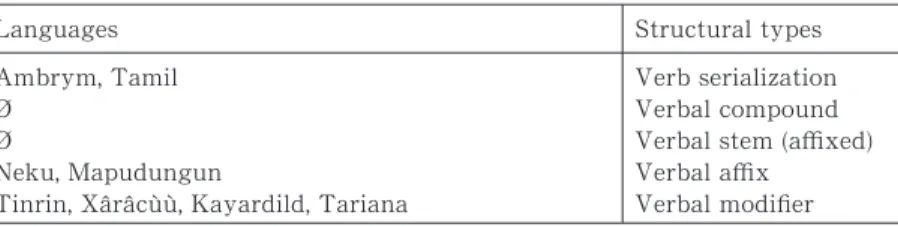
Languages Structural types

Tinrin, Neku, Xa ˆra ˆcu ◊ ◊ u , East Uvean, Samoan, Tamil Verb serialization

Neku, Verbal compound

Xa ˆra ˆcu ◊ ◊ u Verbal stem (a$xed)

Bininj Gun-wok Verbal a$x

Tawala Verbal modifier

῍ 153 ῍

(16)

(1.B) General negative evaluation of activity

Many Oceanic languages such as Ne ˆle ˆmwa

16

mwang, East Uvean kovi ‘bad’ express general negative evaluation of activity in a verb serialization: Ne ˆle ˆmwa diya mwang [do, bad], ‘act badly’; East Uvean hiva kovi [sing, bad] ‘sing badly’. Paamese rong which Crowley (1987: 78) notes as a borrowing from Bislama behaves similarly:

(32) nave atem rong eni

1sg-real-cop add wrong OBL-3sg

‘I added it incorrectly.’

The Tamil verb ta ῌ l

ῌ lu ‘push’ discussed in (1.A) can also expess the speaker’s negative attitude: kumaar cikaret uut-i ῌῌ t i ta

ῌ l

ῌ lu-kirr-aan n [Kumar, cigarette, smoke-vbp, push-pres-3sm] ‘Kumar smokes one cigarette after another (which the speaker does not like).’ Tamil also uses poo

ῌ tu ‘put’, combined with a transitive verb in verbal participle form, to express a speaker’s negative opinion about the subject lacking care in performing the action: kumaar jan n n nal-ai muu

ῌ t-i ῌ p poo

ῌ tu ῌῌ t-aan n [Kumar, window-acc, close-vbp, put-pst-3sm] ‘Kumar closed the window carelessly.’ Here, the evaluation is made not about the fact that Kumar closed the window, but on how the action was carried out.

Like Neku (2.4), Xa ˆra ˆcu ◊ ◊ u jaa ‘bad’ is compounded to a preceding verb: Xa ˆra ˆcu ◊ ◊ u na ˆra ˆ-jaa [think-bad] ‘regret, feel bad’, bwi-jaa ‘smell bad’.

The Japanese sokonau ‘impair, damage’, also compounds with another verb to indicate a bad performance or a result: utai-sokonatta [sing-fail.

PST] ‘failed to sing properly.’

Kayardild

17

has a productive prefix birdin- a $ xed to various verb stems to add the meaning ‘mistaken’ either in the performance, the target, the manner, or the place, etc.: birdin-karna-ja ‘cook in the wrong way (e.g. in violation of food taboos), birdin-nilatha ‘misname, call by the wrong name’.

Big Nambas

18

expresses ‘wrongly’ with a modifying particle: k-en

sali an-i [2sg: REAL-do, wrong, OBL-3sg], ‘You did it wrongly.’

(17)

(1.C) Specific negative evaluation as loafing or wasting time

Paamese

19

has two verbs which can be serialized to express a bad evaluation: tetaunu ‘do idly’, vuuti ‘do unwillingly’.

Tawala hota ‘idly’ occurs after the verbal element: me-hota ( ῎ mae

‘stay, live’) ‘wait idly’.

The Tariana

20

su $ x-kane used in a complex predicate indicates a loafing or lingering action: pi-na wa-kalite-de wa-kalite-kane [2sg-OBJ, 1 pl-tell-FUT. CERT, 1pl-tell-IRRES], ‘We will tell you (but not all of it).’

Xa ˆra ˆcu ◊ ◊ u

21

has similar pre-verbal modifiers as Tinrin marra (14), do ¨o ¨

‘with no purpose, with nothing’: ◊ e do ¨o ¨fa ¨de ¨‘he walks with no purpose.’

Big Nambas mam U ln gives the meaning ‘aimlessly, in a slovenly manner’ after the verb: a-v-an mam U ln a n U hau [3pl:REAL-PL-do, aimless, OBL, pudding], ‘They made the pudding in a slovenly manner’; i-v’el mam U ln [3sg: REAL-walk, aimless], ‘He walked about aimlessly’.

(1.D) Negative evaluation as delayed and unaccomplished action There are only three languages, Djaru, Mapudungun and Japanese that can express this type of negative evaluation in our data, two of which make use of verbal su $ xes for that purpose. The Djaru

22

verbal

Languages Structural types

Ne ˆle ˆmwa, Paamese, East Uvean, Samoan, Tamil Verb serialization Neku, Xa ˆra ˆcu ◊ ◊ u , Japanese Verbal compound

Tinrin Verbal stem (a$xed)

Tinrin, Neku, Kayardild Verbal a$x

Big Nambas Verbal modifier

ῌ Languages which can express (1.B) type and their structural types used ῍

ῌ Languages which can express (1.C) type and their structural types used ῍

Languages Structural types

Paamese Verb serialization

Tawala Verbal compound

Ø Verbal stem (a$xed)

Tariana Verbal a$x

Tinrin, Xa ˆra ˆcu ◊ ◊ u , Big Nambas Verbal modifier

ῌ 155 ῌ

(18)

su $ x -ngi which is glossed as ‘potential’ is used in a situation where an actor ‘tried (or wanted) to, but could not (or, did not).

(33) mawun-du mangari ngang-ngi man-ERG food eat-POT

‘The man wanted (or tried) to eat food, but he did/ could not.’

The Mapudungun verbal su $ x -Fı ¤ is combined in various ways with other Tense-Aspect-Modality markers. Golluscio (2000: 239 ῍ 240) describes that it can indicate situations that almost happen but are never realized: e.g. epe la-(ng)ı ¤ m-n ˜ma-F I -e-i-yu ta mi trewa [almost, die- CAUS-AFFECT-F I -PART ῌ MIN-IND-DU2, AP1, POS2SG, dog], ‘I almost killed your dog (to hurt you).’

23

Golluscio suggests that the epe ‘almost’

is not obligatory in the sentence, but the sentence is interpreted with the presence of -F I to mean that the result of the event is not realized to the frustration of the source’s intention. This also indicates that something the speaker wanted could not be realized: wiya kı ¤ pa-mate-tu-F I -n [yesterday, want-mate-VERB-F I -IND.1SG], ‘Yesterday, I wanted to drink mate (but I couldn’t).’

Japanese -sobireru ‘try to do something but miss the chance of doing

it,’ compounds to a preceding verb stem, expressing regret at not having

started an action: iki-sobireru [go-miss ῎ the ῎ chance], ‘hesitate and miss

the chance to go.’ As this is an expression of a strong feeling, it is

normally used with the 1

st

person as in other Japanese expressions of

feeling,

24

but it is also possible with other persons: kare ῌ wa gakko ῌ e

iki-sobireta [3sg ῌ TOP, school ῌ AL, go-miss_the_chance.PST], ‘He

missed the chance of going to school.’ There is also -aguneru, similar in

meaning, but this focuses more on the undecided attitude of an agent,

while -sobireru focuses on the result that the action was not realized

because of attitude: iki-aguneru [go-undecided], ‘think of going, but

cannot make mind up.’ Also, -aguneru does not involve any particular

negative feeling. -Sokonau (1.B) also implies ‘missed the chance of doing

because of undecided attitude,’ as in : tabe-sokonau ‘missed the chance of

eating’, as somebody else ate it before the agent did, or he was too busy

to sit and eat. Mi-sokonatta ‘failed to see’ has two meanings: ‘missed the

(19)

chance of seeing X’, and ‘was disappointed in X ( ῎ overestimated X).’

3.3 Evaluation of outcome

Evaluation of the outcome of activity/object is subcategorized in three ways as follows, where the last group is further divided in two:

Although the expressions in (2.B) and in (2.C) both indicate that some action is carried out but yield no good result, they di # er in that those in (2.B) focus on the wasted performance that ended in vain, and those in (2.C) emphasize the failure to achieve or catch a particular target. For instance, the former can be used in such a case that someone made a table, but his time and e # ort was wasted since his partner bought a new table. The latter type would be used when one tried to hit something but missed it, as we saw in Tinrin and Neku (2.C) examples in 2.4.

(2.A) Successful, well done

Only three New Caledonian languages in the data, Tinrin, Neku, Xa ˆra ˆcu ◊ ◊ u , can express this evaluation type, all using verbal stems, with an additional verbal modifier in Xa ˆra ˆcu ◊ ◊ u . Xa ˆra ˆcu ◊ ◊ u

25

-pe ◊ re ◊ /-we ´re ´ ‘(hit) right on the target’: gwe ´-pe ◊ re ◊ ‘throw and hit the target’, ji-pe ◊ re ◊ ‘throw a ῌ Languages which can express (1.D) type and their structural types used ῍

Languages Structural types

Ø Verb serialization

Japanese Verbal compound

Ø Verbal stem (a$xed)

Djaru, Mapudungun Verbal a$x

Ø Verbal modifier

(2) evaluation of outcome

(2.A) successful, well done (2.B) done, but for no use, in vain

(2.C) unsuccessful, target missed

(2.C-1) failure to achieve the goal, or attain the target

(2.C-2) object getting astray or lost

ῌ 157 ῌ

(20)

stone and hit the target’; Xa ˆra ˆcu ◊ ◊ u postverbal modifier pwipwiri indicates that the action has been carried out correctly.

(2.B) done, but for no use, in vain

While Tinrin has three ways to express this type of evaluation:

bound verb stem, post-verbal modifier and a verb serialization (2.4), Ne ˆle ˆmwa uses niiva (-lı ⁄ )

26

‘make a mistake’, in a verb serialization: pea ˆi niiva [fight, make ῍ a ῍ mistake] ‘fight without any reason’; diya niiva-lı ⁄ shaya eli [do, make ῍ a ῍ mistake -TR, work, that] ‘did this work wrong’.

Mapudungun su $ x -F I (also in (1.D)) indicates that the anticipated results were not forthcoming: kin ˜e kiyen dewma mawı ¤ n-Fı ¤ -i [one, month, already, rain-F I -IND(3)], ‘It rained a month ago (but to no avail)’.

Tariana tha- is cliticised to a verb, marking a frustrated result of an activity, or activity bound to fail. This is often used in narratives, describing failed actions (Aikhenvald 2003: 380): nuha nu-sata-tha-na nhuma [I, 1sg-ask-FR-REM.P.VIS, 1sg ῎ hear], ‘I did try in vain to ask.’

Tariana has another clitic -pada, marking unexpected action which goes against the speaker’s or the hearer’s expectations (Aikhenvald 2003:

396), which often occurs with a frustrative marker: diwesewya-nuku phia ha-ni ῌ i-tha-sika di-de-pada [now-TOP.NON.A/S, you, parent-MASC-FR- REC.P.INFR, 3sgnf-have-COUNTEREX], ‘Isn’t it the case that your father has it (tobacco) contrary to what we expect and to my frustration (since he has no use for it).’ -Pada, however, seems to not always point to a negative e # ect, but just to express the counter expectation (Ibid. 398).

Amahuaca, -pana, cliticised to a verb,

27

indicates various meanings combined with other morphemes, one of which is some type of ῌ Languages which can express (2.A) type and their structural types used ῍

Languages Structural types

Ø Verb serialization

Ø Verbal compound

Tinrin, Neku, Xa ˆra ˆcu ◊ ◊ u Verbal stem (a$xed)

Ø Verbal a$x

Xa ˆra ˆcu ◊ ◊ u Verbal modifier

(21)

frustration. The following sentence indicates that an action was carried out, but it did not bring the expected consequence because of a physical obstacle:

28

jii tucu vi-tan cosha-pana-n-mun haa yora-n jii tucupacu- u-tai-hqui [wood, piece, grab-SQ. IMM. CAN (SS), beat-FRUST-ERG-TH, tapir, body-LOC, wood, break_into_pieces-REFL-one_planting_season_

ago-DECL] ‘I grabbed a log to beat (the tapir to death) but it broke into pieces on the tapir’s body.’

Xa ˆra ˆcu ◊ ◊ u uses a postverbal modifier, ajari ‘for nothing’, no ¨i ‘in vain’, and Tawala, two post verbal modifiers (yaba)yababa and powa:

hi-winagana yababa-ya [3PL-choose, vain-3sg], ‘They chose him in vain’, ega o-na-inugonugotuhu powa [NEG, 2PL-POT-DUR-think, mistakenly],

‘Don’t mistakenly think that ῌ .’ Kayardild expresses unexpected outcome with a preverbal particle, nginja

29

: nginja ngumu-wa-th, nginja kamburi-ja muma-th, ja-warri [FRUST, black-INCH-ACT, FRUST, speak-ACT, thunder-ACT, rain-PRIV], ‘in vain the sky blackened, in vain the thunder spoke, there’s no rain.’ Djaru also has a particle, jaarr, jaarr-jaarr meaning ‘(tried) ῌ in vain, unsuccessfully’.

(2.C) Unsuccessful, target missed

(2.C-1) failure to achieve the goal, or attain the target

A wide range of expressions are included here. Tamil ki

ῌ zi ‘tear’, occurs after a verb in verbal participle form, expressing the speaker’s negative opinion that the subject will not be able to perform or accomplish the action: kumaar inta veelai ῌ y-ai ῌ c cey-tu ki

ῌ zi-tt-aan n [Kumar, this, work-acc, do-vbp, tear-pst-3sm], ‘Kumar was/is not able to

῍ Languages which can express (2.B) type and their structural types used ῎

Languages Structural types

Tinrin, Ne ˆle ˆmwa Verb serialization

Ø Verbal compound

Tinrin Verbal stem (a$xed)

Mapudungun Verbal a$x

Tinrin, Xa ˆra ˆcu ◊ ◊ u , Tawala, Kayardild, Djaru, Tariana, Amahuaca

Verbal modifier

῍ 159 ῍

(22)

do this work.’ This ki

ῌ zi resembles Japanese -sokonau (1.B)(1.D), which occurs in a verbal compound and refers to an unsuccessful result: tegami

῍ o kaki-sokonatta [letter ῍ O, write-fail.PST], ‘failed to write a reasonable letter’. Sokonau can also be compounded with intransitive verbs like iku

‘go’, e.g. iki-sokonatta, which implies that the expected result ῎ reaching a certain place ῎ was not achieved.

-Sonziru is also used but more limited in its combination with another verbal element, having a slightly stronger connotation of a very bad result or damage: kaki-sonjita ‘made a mistake in writing, wrote very badly.’

30

Japanese has a number of synonymous verbal elements which occur in compound verbs: -ayamaru ‘err’, -machigaeru ‘make mistake’, and -chigaeru ‘di # er, cross’. With -ayamaru and -machigaeru, the derived verbs have meanings like English verbs with the prefix mis-, as in: kaki-ayamaru or kaki-machigaeru ‘write wrongly, misspell’. Verbs with -chigaeru indicate that the agent mistakes one thing for something else, or, mistakenly acts on a wrong object: kaki-chigaeru meaning ‘write a wrong word.’

31

Ambrym

32

fahele ‘miss, err’ also occurs in a verbal compound: nam ho: fahele hal [1sg.PRES, arrive, miss, road] ‘I miss the road (lit. I arrive mistakenly (at) the road,’ hVro fah e l e ῌ ‘talk incorrectly, make a mistake in speech’.

Xa ˆra ˆcu ◊ ◊ u has a similar verb stem -che ¨e ‘miss’ with the Tinrin -dhai (4) and Neku -warri (8), -tja (9). -Che ¨e refers to an unsuccessful result in general as in fa ˆ-che ¨e ‘miscalculate’, as well as an action slipped to the side as in: chaa-che ¨e ‘try to cut, but miss’, gwe ´-che ¨e ‘throw but miss the target’.

Big Nambas sm T n‘miss’ and Mapudungun -Fı ¤ (2.B) occur as a su $ x.

Big Nambas: i-lua-s U m U n m’an U h [he/real.-shoot-missing ῏ bird], ‘He shot at the bird but missed it’; a-v-sr-s U m U n ntu [they/real.-pl.-trap-missing ῏ fowl], ‘They set a snare for a fowl but it escaped from it.’ Mapudungun:

llikatu-me-Fı ¤ -n nga kin ˜e choyke [bolear- DIR-Fı ¤ -IND.1SG, DISC, one, ˜andu n ´ ],

‘I went to lasso a ˜andu n ´ (but I failed).’

Kayardild uses a prefix birdin- ‘unsuccessful, bad result’ to indicate

a mistaken result: birdin-bala-tha [mistake-hit], ‘hit wrongly, mishit’;

(23)

birdin-ngudi-ja, [mistake-throw] ‘throw askew’. It often implies a wrong object or a wrong place, as does Bininj Gun-wok warrgah-: birdin-dii-ja, [mistake-land] ‘land in wrong place (missile)’; ba-warrgah-dulk-man.

ga-ng [3PST-wrong-tree-fall-PP], ‘The tree fell in the wrong place.’ It allows either object or indirect object scope in the following:

a-warrgah-warde-wo-ng mungu [1-wrong-money-give-PP accidentally] ‘I accidentally gave the money to the wrong person.’ It is essential to consider certain cultural assumptions about ways of being wrong; what is appropriate with certain actions, certain participants, and certain places (Evans 2003: 506 ῍ 508), which applies to other language cases, too.

Dyirbal

33

wara- also indicates that an event concerned the wrong person or thing as referent of the topic NP: bala yugu wara nudin ‘wrong tree was cut down.’ Yidi [

34

wara- is similar to Dyirbal but also indicates a mistaken place or an ill-advised manner: [undu dugi wara gunda:l ‘You cut the wrong tree down,’ \ ayu yi [ du: [ bama wara gali \ al [ u ‘I took this person to the wrong place.’

The English mis- also expresses ‘wrongly, unfavorably, the unsuccessful result’: he has miscalculated the mood of the people. The English prefix mis- exhibits a parallel function as that of Tinrin and Neku’s verb stems, of adding a resultative aspect, as Kageyama and Yumoto pointed out that verbs prefixed with mis- in English require the perfective aspect, as the mis- gives a negative meaning to the result of an activity indicated by the verb stem (Kageyama and Yumoto 1997: 62 ῍ 63). When we compare the meaning of this prefix, however, with Tinrin and Neku -dhai, -warri and Japanese -sokonau, we notice a significant di # erence in the choice of verbal object. The verbal objects of a mis- verb are those that are mistaken for (e.g. mishit something), while those of Tinrin, Neku and Japanese verbs are the ones that escaped from being caught or attained by the action. Compare the following Tinrin (34), Neku (35), Japanese (36), and English (37) sentences:

(34) nra ˆ dro-dhai jan nra ˆ toni.

3sg hit_with_fist-fail Jan SM Tony

‘Tony tried to hit Jan with the fist but his fist missed the target.’

ῌ 161 ῌ

(24)

(35) ◊ e nya ˆ-warri jan (na) toni.

3sg hit_with_fist-fail Jan SM Tony

‘Tony tried to hit Jan with the fist but his fist missed the target.’

(36) taro ῌ wa otoko ῌ o naguri-sokonatta.

Taro ῌ TOP man ῌ ACC punch-fail.PST

‘Taro tried to punch the man, but failed to do so. (Taro may have hit somewhere else.)’

(37) A golfer mishit his mother-in-law in the UK. (The mother-in-law was hit mistakenly.)

This can be explained from the syntactic di # erence. In naguri-sokonatta [punch-fail.PST] ‘fail to punch’, for example, two elements of the verb are bound syntactically, one being the complement of the other. These elements function syntactically as separate verbs, and the second part (-sokonatta) restricts the type of the first verbal element, which must be either an unergative or a transitive verb (Kageyama and Yumoto 1997:

78 ῍ 81). Accordingly, taro ῌ wa otoko ῌ o naguri-sokonatta ‘Taro tried to punch the man but failed to do so’ has the following structure:

Taro

i

failed [PRO

i

to punch the man]

In the Tinrin and Neku cases, though di # erent from Japanese where two

verbs are involved, the two bound elements behave exactly as in

Japanese, as if they were two separate verbs. The first element indicates

the activity done to an object, and that the whole event is assessed by

the second element. From this point of view, Ambrym, Kayardild,

Bininj Gun-wok, Dyirbal, and Yidi [ discussed in this section all fall

together with the English type, while Neku, Tinrin and Japanese come

together.

(25)

(2.C-2) Object getting astray or lost

Apart from Tinrin -pwu ◊ rru ◊ (5), Neku -bwirri (10), this meaning can be expressed by Ambrym helare, ‘cause to be lost’, juxtaposed with a verb:

na to: helar e n e k van l V n meha ‘I’ll throw you away into space’; jah e (he)lare ‘to lead astray’.

The Big Nambas su $ x sTmTn (2.C-1) also means an object ‘gets lost’

as in: ka-s U m U n-i [you/real-let_fall-missing-it], ‘You dropped it!’, while the Tawala prefix, welu- indicates the subject getting lost: hi-ne-nei u tahaya hi-welu-powa [3PL-DUL-come, LOC, path, 3PL-CLP-mistake],

‘While coming along the path they disappeared (got lost).’

3.4 Evaluation of the whole event

As we discussed in 2.4 with Tinrin nrerre (13), the whole event can be evaluated, often with the speaker’s strong feeling or attitude for or against what happened expressed. This is often realized in constructions which Crowley called ambient serial constructions (1987:

49, 2002: 41 ῍ 44, 62), in which the second (stative) verb has no specific referent associated with the subject of the serialized verb, but simply ῌ Languages which can express (2.C-1) type and their structural types used ῍

Languages Structural types

Tamil Verb serialization

Ambrym, Japanese Verbal compound

Tinrin, Neku, Xa ˆra ˆcu ◊ ◊ u Verbal stem (a$xed) Big Nambas, Kayardild, Mapudungun,

Bininj Gun-wok, Dyirbal, Yidi[, English

Verbal a$x

Ø Verbal modifier

ῌ Languages which can express (2.C-2) type and their structural types used ῍ Languages Structural types

Ambrym Verb serialization

Ø Verbal compound

Tinrin, Neku Verbal stem (a$xed) Big Nambas, Tawala Verbal a$x

Ø Verbal modifier

ῌ 163 ῌ

(26)

makes some kind of qualification about the manner in which an action is performed. This use, depending on the verbs used, may be interpreted such that it has semantic scope over the whole event, which is expressed by the first verb in the serialization and its arguments. Evaluation of the event may be either good or bad:

(3.A) Positive evaluation of the whole event

All four languages seen in this section express a positive evaluation of the whole event, in verb serialization. Paamese hemal, Ambrym tu, Pileni

35

la ¯voi, mbarava indicating the event referred to is good, or done properly: e.g. Paamese: i-hiteni-e hemal [3pl:DIST.FUT-say-3sg, 3SG:

DIST.FUT-correct], ‘They will say it correctly’; Ambrym: nar l V\ ne tu ‘I felt happy (lit. I heard, or felt, it was good)’; Pileni: lha-ko khaikhai ko la ¯voi [3dl-TA, RED.eat, TA, good], ‘They ate until they were full (lit. they ate, it was good)’; a hihiga mharu-ko pepena ˜ko mbarava [ART, RED.thing, 1pl.exc-TA, prepare, TA, good], ‘We have prepared everything properly.’

Tamil tiir ‘exhaust’, combines with another verb and expresses the speaker’s attitude that the subject has stopped an action by expending himself fully in it and got rid of an emotion: kumaar ti

ῌ t

ῌ t-i ῌ t tiir-tt-aan n [Kumar, scold-vbp, exhaust-pst-3sm], ‘Kumar scolded and got it o # his chest’; ava

ῌ l a

ῌ zu-tu tiir-tt-aa

ῌ l [she, weep-vbp, exhaust-pst-3sf], ‘She cried herself out (and got rid of it).’ A similar meaning can be expressed by Japanese kiru ‘cut’ combined with another verb as in naki-kiru ‘cry oneself out’, but in Japanese it rather emphasizes the subject’s attitude that he has really done it to completion, without any evaluation made to the event.

(3) event

(3.A) good

(3.B) bad

(27)

(3.B) Negative evaluation of the whole event

Neku -tja ˆre ◊ su $ xes to a verb to indicate an event against the speaker’s expectation: wake-tja ˆre ◊ ‘not work well, do opposite thing’.

Ambrym

36

hakebe, meaning ‘bad’, occurs in verb serialization and indicates the event referred to is bad: BwIca ra mae be hak e b e ‘they will do evilly (lit. it-will-be they’ll do it-will-be bad)’; h V ro hakebe ‘talk badly’.

Tamil has three verbs, tolai ‘get lost, lose’, ki

ῌ ta ‘lie’ and poo ‘go’ which combine with another verb in verbal participle form and express a negative evaluation of the event, and the speaker’s regret and disagreement about what happened: tolai: kumaar ellaam coll-i ῌ t tolai-nt-aan n/tolai-tt-aan n [Kumar, everything, say-vbp, get lost-pst-3sm, loose-pst-3sm], ‘Kumar told everything, damn it.’ Ki

ῌ ta ‘lie’ expresses the progressive or durative aspect of a state, and indicates the speaker’s negative attitude towards the state: anta arrai puu

ῌ t ῌ t-i ῌ k ki

ῌ ta-kkirr-atu [that, room, lock-vbp, lie-pres-3sn], ‘The room is kept locked.’ The poo ‘go’

expresses a change of state and indicates the speaker’s negative attitude towards this change of state: paan nai u

ῌ tai-ntu pooy-irr-rru [pot, break-vbp, go-pst-3sn], ‘The pot got broken’; en n-kku inta vipattu teri ῌ y-aa-mal pooy-irr-rru [I-dat, this, accident, know-neg-vbp, go-pst-3sn], ‘This accident went unnoticed by me.’ In this sentence poo occurs with a verb in the negative form, which is restricted to clauses with dative subjects.

The Mapudungun -F I described in (1.D) and (2.B) is used to express the speaker’s regret, or nostalgia for what used to be but is not any more:

kwifi tayı ¤ l-ke-F I -i-ngı ¤ n [in_ancient_times, tayı ¤ l-DUR-F I -IND-3PL], ‘A long time ago, they used to do tayı ¤ l (sacred songs) (but they do not do it any more).’

ῌ Languages which can express (3.A) type and their structural types used ῍

Languages Structural types

Paamese, Ambrym, Pileni, Tamil Verb serialization

Ø Verbal compound

Ø Verbal stem (a$xed)

Ø Verbal a$x

Ø Verbal modifier

῍ 165 ῍

(28)

The Xa ˆra ˆcu ◊ ◊ u pre-verbal modifier, me expresses a similar meaning as nrerre in Tinrin: nge ˆe ˆme ´fetaa ro ¨[1pl.exc, regret, abandon, 2sg], ‘We leave you to our regret’. Kayardild nginja expresses the speaker’s strong disagreement against the action

37

: nginja rikarrkali-n-da kularrin-d [FRUST, cry-N-NOM, brother-NOM], ‘(Your) baby brother is crying, go and look after him.’ Tariana particle -tha (2.B) also indicates negative evaluation of the event.

3.5 Distributions of evaluation types and their morpho-syntactic structures

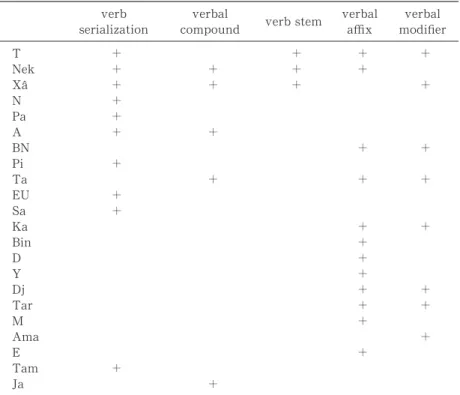
The evaluation types encoded in di # erent languages surveyed in this paper and the morpho-syntactic structures employed by them are summarized in the following Tables 3 and 4.

ῌ Languages which can express (3.B) type and their structural types used ῍

Languages Structural types

Ambrym, Tamil Verb serialization

Ø Verbal compound

Ø Verbal stem (a$xed)

Neku, Mapudungun Verbal a$x

Tinrin, Xa ˆra ˆcu ◊ ◊ u , Kayardild, Tariana Verbal modifier

Table 3. Distribution of evaluation types

T Nek Xa ˆ N Pa A BN Pi Ta EU Sa Ka Bin D Y Dj Tar M Ama E Tam Ja

1.A ῎ ῎ ῎ ῎ ῎ ῎ ῎ ῎

1.B ῎ ῎ ῎ ῎ ῎ ῎ ῎ ῎ ῎ ῎ ῎

1.C ῎ ῎ ῎ ῎ ῎ ῎

1.D ῎ ῎ ῎

2.A ῎ ῎ ῎

2.B ῎ ῎ ῎ ῎ ῎ ῎ ῎ ῎ ῎

2.C-1 ῎ ῎ ῎ ῎ ῎ ῎ ῎ ῎ ῎ ῎ ῎ ῎ ῎

2.C-2 ῎ ῎ ῎ ῎ ῎

3.A ῎ ῎ ῎ ῎

3.B ῎ ῎ ῎ ῎ ῎ ῎ ῎ ῎

(29)

4. Conclusion

We have discussed in ῍ 2 various evaluation expressions encoded in Tinrin and Neku, and clarified several semantic types based on them.

They exhibit a very elaborate system of expressing positive and negative feelings of speakers towards the actions, results, and the events as a whole. In addition, twenty more languages have been examined in

῍ 3 to see whether they have similar expressions that can be categorized in those evaluation types, and how these expressions are grammatically encoded. Those evaluation types discovered across languages and the grammatical structures employed in them are summarized in Tables 3 and 4.

Table 4. Morpho-syntactic structures of evaluation expressions verb

serialization

verbal

compound verb stem verbal a$x

verbal modifier

T ῌ ῌ ῌ ῌ

Nek ῌ ῌ ῌ ῌ

Xa ˆ ῌ ῌ ῌ ῌ

N ῌ

Pa ῌ

A ῌ ῌ

BN ῌ ῌ

Pi ῌ

Ta ῌ ῌ ῌ

EU ῌ

Sa ῌ

Ka ῌ ῌ

Bin ῌ

D ῌ

Y ῌ

Dj ῌ ῌ

Tar ῌ ῌ

M ῌ

Ama ῌ

E ῌ

Tam ῌ

Ja ῌ

ῌ 167 ῌ

(30)

It turns out that many of the rich evaluation expressions found in Tinrin and Neku are shared in other languages, though these two languages and Xa ˆra ˆcu ◊ ◊ u , another New Caledonian language, possess the most varied semantic types as shown in Table 3. Some expressions occur only with activity verbs which do not imply any particular outcome, while others occur with di # erent types of verbs, referring to di # erent phases of the result.

We have found Types (1.D) and (2.A) not so common as they occur only in three languages; these are respectively ‘negative evaluation as delayed and unaccomplished action’ and ‘positive evaluation of outcome’. Basically we can see from the list that the negative evaluation is expressed more widely among languages and in more varied constructions than is a $ rmative evaluation. For instance, expressions such as tu of Ambrym and la ¯voi of Pileni (3.A) seem to imply a speaker’s strong positive feeling towards the event or outcome of the action, but they are all expressed in verb serialization, while the negative attitudes of the speaker are encoded in verbal a $ xes, verbal modifiers and verb serialization.

Type (2.C-1), the evaluation of the outcome, is seen most frequently, which occurs in 13 languages. This type indicates a failure to achieve the goal, or attain the target, and we saw many languages sharing similar semantic meanings, but also having some di # erences among them. A significant di # erence in the choice of verbal object in several languages was discussed, with the explanation that it comes from their syntactic di # erences. From this point of view, we could put Tinrin, Neku and Japanese together in one group, and Ambrym, Australian Aboriginal languages such as Kayardild, and English in the other group.

The semantics of evaluation expressions is often closely related to

the agent’s initial intention or e # ort, as generally the evaluation is made

with respect to an ideal action expected. Tinrin and Neku verbs a $ xed

with event-classifying prefixes have the complex logical structures as

we saw in (6). The semantic subjects of the prefixal parts are actors or

causers, and the verb stems normally indicate the resultative states of

(31)

the objects or subjects of the action expressed by the prefix. Therefore, dro-ghe ro ◊ [hit ῍ with ῍ fist-injured, 1sg.O] ‘hit me with the fist,’ for example, has an actor ‘who hits me with the fist’ (his intention) resulting in me being injured. In sentences with evaluation verb stems such as -dhai and -bwirri the agents initially have the intention to do something, but the action deviates from their intended goal, against their intention.

38

Thus, Tinrin u dro-dhai nrı ⁄ [1sg, hit ῍ with ῍ fist-fail, 3sg.O] means ‘I intended to hit him with the fist, but the result was that the action failed.

Also, Neku go ◊ ra ˆ-bwirri be?e ˆ[1sg, throw-be ῍ lost, stick] means ‘I threw a stick (with the intention that it go in a certain direction) but it went in the wrong direction and got lost. Japanese verbs with -sokonau have parallel semantic structures: In tegami ῌ o kaki-sokonatta [letter ῌ O, write-fail.PST] (2.C-1), the meaning is ‘intended to write a reasonable letter, but did not succeed’.

‘Intention’ is not a property, as we have seen, of a single concept assignable to a predicate, but in di # erent languages its expression often overlaps with other concepts such as desiderative, providential, near or definite future (Aikhenvald 2003:383), inchoative, imperative, obligation, or even some propensity of an inanimate subject (Dixon 2004: 211). Djaru verbal su $ x -ngi ‘potential,’ for example, discussed in (1.D) indicates an activity which an actor ‘tried (or wanted) to, but could not (or, did not). These concepts may often be inseparable, and may manifest in di # erent ways, according to the relation between the activity envisaged and the outer reality, how realistic it can be, how much the actor’s e # ort or capacity is involved, whether the circumstances allow it, what is the speaker’s attitude or expectation towards it, and how much the speaker imposes influence on that activity.

It is also closely linked with the pragmatic, culturally specific sense which the expressions are associated with. Often ambiguous expressions take a concrete form in a context, with the relationship between the speaker and the addressee, the agent’s motivation, desirability, e # ort or ability, the di $ culty of the task, what the action or

ῌ 169 ῌ

(32)

event conceptually means to the speech community, all counted. It is often di $ cult to clearly separate the objective statement from deontic interpretation, too.

We found a range of grammatical constructions to express evaluation as listed in Table 4. The three New Caledonian languages which express many evaluation types also use the most varied grammatical devices in encoding evaluation, as shown in Table 4.

Verbal a $ xes are used by 12 languages out of 22 languages examined, being the most common means to encode a variety of evaluation patterns. Verb serialization is also common. However, it seems that if a language also has other grammatical strategies than verb serialization, it tends to use them, like Japanese, which uses verbal compounds to encode evaluation expressions rather than verb serializations that Japanese commonly employs.

The evaluation is encoded in verb stems only in those three languages of New Caledonia: Tinrin, Neku and Xa ˆra ˆcu ◊ ◊ u (2.B). They are unique to these languages as they get a $ xed with event-classifying prefixes and indicate a result situation as described in 2.2. Other languages having no such construction types often encode similar meanings in verbal a $ xes. Verbal a $ xes in many cases exhibit various meanings often combined with other a $ xes or particles. Tariana -pada, discussed in (2.B), for example, indicates a negative e # ect but sometimes it just expresses counter-expectation. The fact that Tinrin verbal modifiers encoding evaluation discussed in 2.3. occupy the tense-aspect slot in the sentences, taken into consideration with the semantics of di # erent evaluation morphemes in various languages imply that these expressions often exhibit aspectual and modal implications.

In various constructions discussed in this paper, whether the

expressions allow a modal reading or not, the interpretation of sentences

often depends on the context, with the degree of speaker’s involvement

being highly pragmatic. In addition, the speaker’s positive or negative

feelings often arise from the judgment based on his/her experiences as

a member of the particular speech community which has its own value

(33)

systems. We have discussed in the examples of Kayardild and Bininj Gun-wok (2.C-1), the need to understand the background cultural assumptions for certain evaluation expressions.

Di # erent morpho-syntactic structures presented in this paper may sometimes be better explained, with more detailed information regarding the data. Crowley argued that “seemingly similar constructions have been referred to in published descriptions variously as verbal adjuncts, adverbs, postposed verbal particles, auxiliary verbs, minor verbs, derivational su $ xes, and serialized verbs” (2002: 51).

Japanese compound verbs have created complex verbal concepts through co-lexicalization of two verb-stems. There were di $ culties as to what extent certain expressions in some languages should be included in this paper, and how much the semantic or syntactic di # erences can be di # erentiated and accounted for. Along with the question as to whether the evaluation classification presented in this paper is adequate or not, we can further investigate the pattern of selection and combination of semantic and syntactic properties in individual languages, the typology of the verbs that occur in these constructions, their frequency, the amount of semantic information a surface form can bear, and the many pragmatic and culture dependent factors that contribute to their interpretation. I hope this paper might provide a first step to look closer at the complicated but interesting mechanism of how judgments of result are grammaticalized.

Notes

1 An earlier version of this paper was presented at the Second Conference on the Syntax of the World’s Languages, Lancaster University, 2006. I am grateful to participants for their helpful comments and suggestions. I am also indebted to those who read my manuscript, especially Nick Evans and Alexandra Aikhenvald who provided valuable comments and encouragement. My deepest gratitude goes to my principal language consultants, Emmanuel Hole ´ro

for Tinrin, and Louis, Gise ◊ le, Marie-Paule, Ce ´cile Wimbe ´, Gustave Kaoupa, Marise Monawa, Augustine for Neku among many others who tried to teach me their languages. Many people o#ered me various kinds of help during my stay in New Caledonia, especially Euge ´nie Wimbe ´, Louise Vaudor, Agne ◊ s Hole ´ro, Emmanuel

ῌ 171 ῌ

(34)

Kasarherou and Katsuko LeBait. My field trips were supported by a Grants-in-Aid for Scienfitic Research (No. 12039203, No. 16520261 and No. 19520366) administered by the Japanese Ministry of Education, Science, Sports and Culture.

2 Tinrin and Neku are Melanesian languages spoken by a small number of people (c. 260 and 220 respectively) in the southern part of New Caledonia.

Tinrin data used in this paper were taken from Osumi 1995, and Neku data were collected during field research conducted in Ouaoue ´ between 2000 and 2009. The research on Neku is still underway.

3 The orthography for Tinrin and Neku used in this paper includes the following. Oral and nasal vowels: o ◊ [V], u ◊ [ ῍ ], e ¨ [T], a ˆ [a ˜], e ˆ [e ˜], ı ⁄[ı ˜], o ˆ [o ˜];

Consonants: b [

m

b], bw [

m

b

w

], c [t∫], dh [W], dr [

ῐ ], Yh [ ], nr [ ῑ ], pw [p

w

], rr [ ῎ ], s [∫], tr [ ῏ ], ? [ ῌ ]

4 These are called ‘classificatory prefixes’ in Osumi 1995. Similar verbal a$xes have developed in some North American languages, traditionally called instrumental a$xes (Talmy 1985, Mithun 1999, etc.), and in some Austronesian languages from the Papua New Guinea (Ezard 1978, Bradshaw 1982, Lichtenberk 1983). Several New Caledonian languages have also been reported as having similar set of prefixes (Ozanne-Rivierre and Rivierre 2004).

5 In Tinrin and Neku there are no words meaning just ‘to kill’ ῌ Tinrin, for example, has a verb ta, whose meaning ranges from ‘touch’, ‘hit, ’ to ‘kill’.

This means ta could be some repeatable activity (like hitting), or the activity already terminated with the result of its object’s death. Its exact meaning can only be guessed from its context, as with another Tinrin word vaju ◊ , meaning either ‘sick’ or ‘dead’. On the other hand, they abound in verbs which are complexes of event-classifying prefixes and verb stems -be

‘dead’ in Tinrin and -ma ‘dead’ in Neku. These verb stems cannot occur on their own, but are always bound to one of the event-classifying prefixes (except in the case of -ma which can be applied to animals’ death).

These derived verbs are transitive, and indicate accomplished activity, with the resultative meaning. Thus, Tinrin can produce a variety of verbs meaning ‘kill’ but with an obligatory specification of the methods and accomplished result on their objects. Examples include e-be ‘kill by biting,’

o

ˆ-be ‘kill by strangling,’ dro-be ‘kill with a fist,’ wi-be ‘kill by hitting with a club,’ for Tinrin, and nya ˆ-ma ‘kill with a fist,’ de-ma ‘kill by hitting,’ pwa ˆ-ma

‘kill with an axe’ for Neku.

6 The majority of these prefixes in both languages are bound morphemes with no independent meanings, and are prefixed to a particular set of bound verb stems. They di#er from the classificatory prefixes seen in Papuan Tip languages, that occur with free-form verbs (Bradshaw 1982).

Sometimes the prefix is used in various meanings, not really as concrete as it appears. For instance, Neku djo ◊ - would be used to indicate an action

‘with a car, a bulldozer, or even a human head.’ What in fact is implied is an

action that would provoke ‘a great shock imposed on an object or patient

Table 1. Tinrin and Neku verb stems
Table 3. Distribution of evaluation types
Table 4. Morpho-syntactic structures of evaluation expressions verb

参照

関連したドキュメント

1, XCourEva consists of the following five programs: (1) a default questionnaire entry program, (2) additional questionnaire entry program, (3) evaluation submission

In this section, Part 2, I asked about American life and culture shock and negative feelings after moving to America. In summary, responses are significantly influenced by

Colorectal Carcinoma: Ex Vivo Evaluation using q-Space Imaging; Correlation with Histopathologic Findings.. Ichiro Yamada, MD, 1 * Keigo Hikishima, PhD, 2 Norio Yoshino, DDS, 3

Now we will develop in this section another evaluation method, making use of linguistic decision analysis with the 2-tuple linguistic representation model [4]. The main reason

• The 2-tuple based screening model not only yields the screening evaluation by means of a linguistic expression as in the fuzzy set based screening model, but also

In the following Section 2 the main findings of this paper are reported, including in particular a description of two new solvable many-body problems (one featuring 3, the other only

Using the con- tinued fraction expansion of α (see Section 2), and the Three Distance Theorem (Theorem 1, Section 3), we obtain a new characterization of irrational numbers of

In Section 2 we show that the infinite measure-preserving transformation that was shown in [DGMS99] to be power weakly mixing is not multiply recurrent; we in fact show that it