A Short Typology of Applicative Constructions in Papua New Guinea
著者(英) Masahiko Nose
journal or
publication title
Senri Ethnological Studies
volume 77
page range 97‑111
year 2012‑03‑27
URL http://doi.org/10.15021/00002531
97
SENRIETHNOLOGICAL STUDIES 77: 97–111 ©2012
Objectivization and Subjectivization: A Typology of Voice Systems Edited by Wataru Nakamura and Ritsuko Kikusawa
A Short Typology of Applicative Constructions in Papua New Guinea
Masahiko Nose
Reitaku University
This study is an attempt to clarify the characteristics of applicative constructions in Papua New Guinea. A typological study conducted by Polinsky (2005) showed that applicative constructions among the world’s languages are semantically classifi ed as benefactive and non-benefactive. This typological study shows that there are not many languages with appli- cative constructions. However, languages with applicative constructions are observed in specifi c areas such as the Caucasus, Africa, South East Asia, and North America. This study examines the types and functions of applicative constructions in three different sample lan- guages (Amele, Usan, and Yimas) and compares them with a creole, Tok Pisin. Finally, the study claims that the languages of Papua New Guinea show a combination of benefactive applicative constructions but no passive constructions. In contrast, Tok Pisin lacks both applicative constructions and passive constructions.
Key words: applicative, passive, typology, WALS, Papua New Guinea
1. Introduction
2. The World Atlas of Language Structures (WALS) 3. Basic concepts of applicative constructions: a typology
3.1. Types of applicative constructions
3.2. Applicative constructions in Papua New Guinea 3.3. Discussion
4. Summary
1. Introduction
This paper examines the characteristics of applicative constructions in several languages of Papua New Guinea by observing valency-changing constructions. Furthermore, we contrast the above languages with the creole, Tok Pisin.
Amele is a Trans-New Guinea language spoken in Papua New Guinea.1) There are several ways to increase the valency of a verb in Amele. This study focuses on one of these,
specifi cally the use of benefactive applicatives, as shown in (1).
(1) Amele (Roberts 1987: 221) Jo ceh-ad-ih-en.
house build-3PL-2SG-3SG.REMOTE.PAST
‘He built houses for you.’
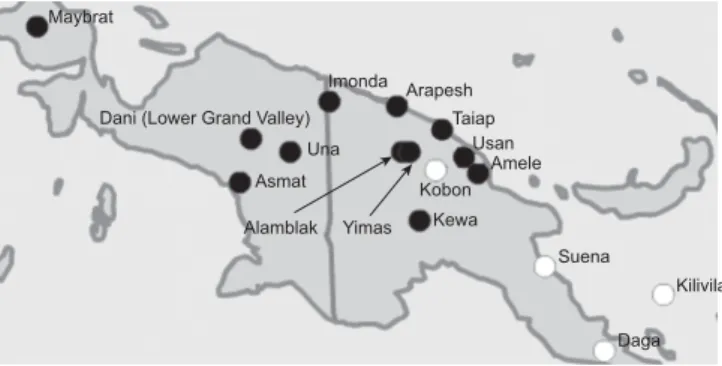
In (1), a 2nd person suffi x -ih marks an indirect object and functions as a marker of the benefactive applicative. In this way, “the number of object arguments selected by the predi- cate is increased by one with respect to the basic construction” (Polinsky 2005). This is called an applicative construction. Figure 1 above is a map showing the distribution of applicative constructions in New Guinea.
This study examines the characteristics of applicative constructions by using the World Atlas of Language Structures (WALS: Haspelmath, Dryer, Gil, and Comrie (2005)). I claim that WALS-based research is valuable for cross-linguistic as well as for small area research.
Characteristics of applicative constructions in Papua New Guinea in terms of a voice system and the contrast between the languages, Amele, Yimas, and Usan (Figure 1) and the creole Tok Pisin are explained. First, I introduce the typological database, WALS, giving a few examples to show some advantages of typological research. Next, I examine a voice system (with decreasing and increasing verb valency) and in particular, passive constructions (WALS, feature 107) and applicative constructions (WALS, feature 109) by focusing on the Papua New Guinea region. By examining passive and applicative constructions in several New Guinea languages, I try to clarify their functional characteristics.
2. The World Atlas of Language Structures (WALS)
WALS is a digital database of linguistic typology edited by Haspelmath, Dryer, Gil, and Comrie (2005) comprising 141 grammatical features of phonology, morphology, syntax, and simple and complex sentences, etc. Here, we can also observe cross-linguistic tendencies and
Figure 1 Applicative constructions in New Guinea (Polinsky 2005)
● Present (applicatives),○ Absent (applicatives)
A Short Typology of Applicative Constructions in Papua New Guinea 99
maps showing the distribution of each feature.
I have selected some features and provided their maps (see below) through which we can observe their general and geographical tendencies. Siewierska (2005) fi rst examined passive constructions in WALS. She chose 373 languages and classifi ed them as languages with and without passives. According to Siewierska (2005), there are 162 languages with passives and 211 languages without passives. Since English, German, and Japanese have passive construc- tions, we can perhaps consider that most of the world’s languages have passive constructions.
Nevertheless, there are no passives in more than half of the sample languages.
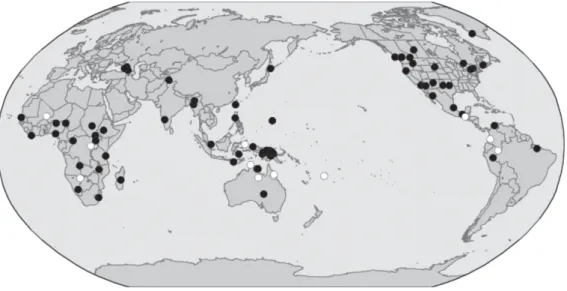
Figure 2 presents some remarkable points. There are many languages with passives in Europe and Eurasia, while languages without passives are commonly found in Central Africa, Southeast Asia, and New Guinea. Moreover, languages with and without passives are dis- tributed throughout North and South America.
In WALS, the map of passive constructions can be enlarged to observe it in greater detail.
Figure 3 shows the region of New Guinea and northern Australia. No languages with passives are present in the New Guinea area (according to the grammar check of sample languages in Siewierska (2005). It is remarkable to observe that there are a few languages with passives (Kayardild, Yukuta, etc.) in Australia (many Australian languages are analyzed as ergative- absolutive and have antipassive constructions instead).
Passive constructions are considered to be a type of voice system associated with active and middle voices, and these voice systems are closely related from the viewpoint of, and the relationship between, the speaker and the hearer. Moreover, a language by itself can gram- maticalize a passive construction in several ways. Observing geographical tendencies in the distribution of languages with passives in Figures 2 and 3, we fi nd, on the one hand, examples of a language with passives in an area where generally languages are without passives, and on
Figure 2 Passive Constructions (Siewierska 2005: WALS feature 107)
● Present (passives) 162 languages,○ Absent (passives) 211 languages
the other, an example of a language without passives in an area where languages generally have passives.
Thus, WALS is a useful tool for linguistic research in which we can observe the world- wide distributions (and markedness) of specifi c grammatical features and geographical tendencies.
3. Basic concepts of applicative constructions: a typology
Payne (1997: 172) pointed out that there are several devices for increasing and decreasing verb valency as shown in (2).
(2) Devices to increase and decrease verb valence:
a. Valence-increasing devices: causatives, applicatives, and possessor raising.
b. Valence-decreasing devices: refl exives, reciprocals, middles, subject omission, passives, inverses, object omission, antipassives, object demotion, and object incorporation.
(2a) shows the valency-increasing devices. Payne describes applicative constructions as
“those that upgrade a peripheral participant” and emphasizes that valency-adjusting operators appear in verbal morphology. Another valency-increasing device, causative, can be con- structed by adding a causative affi x to the verb. The following is an example of one of the valency-increasing devices, the Hungarian causative construction.
(3) Hungarian (Rounds 2001: 62)
Mátyás-sal hív-at-ott egy taxi-t.
Mátyás-INST call-CAUS-3SG.PAST one taxi-ACC
‘She had Mátyás call a taxi.’
Figure 3 Passive constructions in New Guinea and Northern Australia (Siewierska 2005)
●Present (passives),○ Absent (passives)
A Short Typology of Applicative Constructions in Papua New Guinea 101
Hungarian is a typical nominative-accusative language and has an agglutinative mor- phology. In (3), the verbhív‘to call’ needs the causative affi x -attand the 3rd person singular past infl ectional form -ott. The causative suffi x can be realized in verbal morphology and as a result, an instrumental causeeMátyás-sallis added to the causative construction. The verbal morphology needs the causative affi x as a marked form. In (4), we observe the applicative construction in Yimas.
(4) Yimas (Foley 1991: 307)
upntampiŋ k-n-taŋ-pampat-ntuk-nakn.
heart.SG SG-3SGA-COM-cook-REMOTEPAST-3SG
“She cooked the heart for him.”
Yimas is a language with applicative constructions spoken in the Sepik region of Papua New Guinea. In (4), the comitative form -taŋ is included in the verbal morphology and the sentence has a benefactive meaning.
In WALS, Polinsky (2005) focused on applicative constructions and examined them cross-linguistically. WALS feature 109 is a classifi cation of applicative constructions.
Polinsky chose 183 languages and classifi ed them into several types. There are two parame- ters for this classifi cation. One is transitivity of the base that includes three options: from a transitive verb base only, from an intransitive verb base only and from both bases. The other is the semantic role of the applied object: only benefactive and some other roles to the exclu- sion of the benefactive.
In Figure 4, I fi rst provide a map of applicative constructions giving a distribution of languages with and without applicative constructions.
Figure 4 Applicative constructions (Polinsky 2005: WALS feature 109)
●Present (applicatives) 83 languages, ○ Absent (applicatives) 100 languages
There are 83 languages with applicative constructions; however, there are few languages with applicative constructions in Eurasia except in the Caucasus. Applicative constructions are ubiquitous in Africa, New Guinea, and North America. Nevertheless, Aynu (Ainu) in Japan and languages from South Asia and the Pacifi c have applicative constructions.
Next, I make use of the feature selections of WALS and classify the languages with benefactives as one group and languages without benefactives as another. The result is shown in Figure 5.
Figure 4 shows 83 languages with applicative constructions. In Figure 5, I provide a map using these 83 languages by dividing them into 71 languages with a benefactive function and the remaining 12 languages without it. Thus, in Figure 5, it is assumed that a major func- tion of applicative constructions is benefactive. In addition to the benefactive function, func- tions of non-benefactive applicative constructions are also considered. Polinsky (2005) examined the semantic roles of applicative constructions and pointed out that they can func- tion as instrument (17), locative (18), and instrument or locative (12).
A non-applicative language is found in Yidiny, Australia. Yidiny has a derivational ver- bal suffi x marking comitative.
(5) Yidiny (Dixon 1977: 293): Comitative construction waguɖɖɖada-ŋgu buu a ɲ gali:-ŋal.
man-ERG woman.ABS go-COM
‘The man is going with the woman.’
In (5), Yidiny added the comitative suffi x -ŋal to the verb. This constitutes an applicative l meaning of the comitative function.
Figure 5 Meanings of Applicative constructions (Polinsky 2005)
● Benefactive applicatives 71 languages,○ Non-benefactive applicatives 12 languages
A Short Typology of Applicative Constructions in Papua New Guinea 103
3.1. Types of applicative constructions
This section illustrates Polinsky’s (2005) observations and considers the classifi cation of the characteristics of applicative constructions and geographical tendencies. Polinsky (2005) chose 183 languages and examined their behaviors. In (6), I divide applicative constructions into three types according to Polinsky (2005): (6a) benefactive function, (6b) non-benefactive function, and (6c) no applicative constructions.
(6) Types of Applicative Constructions (Polinsky (2005), partly modifi ed):
a. ▲ Benefactive object, both bases [16]/ Benefactive object, only transitive verb base [4]/ Benefactive and other, both bases [49]/ Benefactive and other, only transitive verb base [2]
b. ▲Non-benefactive object, both bases [9]/ Non-benefactive object, only transitive verb base [1]/ Non-benefactive object, only intransitive verb base [2]
c. ○ No applicative construction [100]
Polinsky classifi ed languages on the basis of verb transitivity. As a result, in (6), it is commonly observed that applicative functions of benefactive and other functions can be derived from both transitive and intransitive verb bases (49 languages). Finally, based on (6), we observe a world map (Figure 6) of applicative constructions.
In Figure 6, we observe the geographical distribution of applicative constructions.
Polinsky (2005) pointed out that the language families of Bantu in Africa, Austronesian in the Southeast Asia and the Pacifi c, and Salish, Mayan, and Uto-Aztecan in Meso America have a high incidence of applicative constructions. Moreover, Polinsky considered that “the dearth of applicative constructions in Eurasia may thus be due to the widespread presence of rich nominal morphology.” We can fi nd some languages with applicative constructions in the
Figure 6 Applicative Constructions based on (6) (Polinsky 2005)
Caucasus and Eurasia (Abkhaz and Abaza) that are “poor in nominal morphology” (Polinsky 2005).
3.2. Applicative constructions in Papua New Guinea
In WALS, the world map of applicative constructions can be enlarged to view it in detail (Polinsky 2005). In this study, we focus on the region of New Guinea (Figure 5). In this sec- tion, I specifi cally discuss the forms of applicative constructions in New Guinea (in particular, Papua New Guinea and the Indonesian section of New Guinea) from a functional perspective.
The study attempts to fi nd common characteristics of languages of the region and to contrast these languages with Tok Pisin, a creole spoken in Papua New Guinea.
First, I present a close-up map of New Guinea from Figure 5.
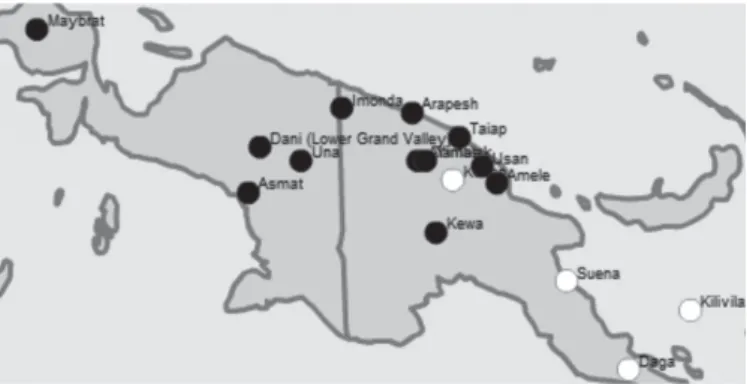
Polinsky (2005) shows fewer than 20 languages with applicative constructions found in New Guinea despite the linguistic richness (more than 1000 languages) of this region.
Observing Figure 7, it appears that some languages (Kobon, Kilivila, Suena, and Daga) lack applicative constructions, but many languages (Sepik, Trans-New Guinea, Austronesian, and Highland) have applicative constructions.
Next, I focus on the east coast of Papua New Guinea (from Sepik to Madang Province) in Figure 8.
In Figure 8, there are several different marks whose explanations are shown in (7).
(7) Classifi cation of applicative constructions in Papua New Guinea
▲ Benefactive object, both bases [16 languages overall] Alamblak, Amele, Usan
● Benefactive and other, both bases [49] Imonda, Arapesh2), Yimas
○ Benefactive and other, only transitive verb base [2] Taiap3)
According to the classifi cation in (7), languages in Papua New Guinea have applicative constructions primarily with a benefactive function, similar to most languages in other regions.
In particular, only a benefactive function is observed in Alamblak, Amele, and Usan. Rare
Figure 7 Applicative constructions in New Guinea Island (Polinsky 2005)
● Present (applicatives),○ Absent (applicatives)
A Short Typology of Applicative Constructions in Papua New Guinea 105
forms having benefactive and other functions and derived from only transitive verb bases are found in Taiap, the Gapun family (Gapun is located between the Sepik and Ramu rivers about 10 kilometers inland, Kulick & Stroud (1992: 203)) in Papua New Guinea. This type of appli- cative construction is found in two languages. One is Taiap and the other is Abkhaz in the Caucasus.
This study chooses Amele, Usan, and Yimas from the languages shown in Figure 8 in order to examine the detailed features of their applicative constructions. Amele and Usan belong to the Trans-New Guinea family spoken in Madang Province, while Yimas belongs to the Lower Sepik family. In addition, this study contrasts them with Tok Pisin. Tok Pisin is an English-based creole that lacks passives and applicative constructions.
First, Amele has a benefactive applicative and an indirect person marker carries a bene- factive function. In (8), the benefactive marker -ih indicates 2nd person indirect object.
Verbal structure in Amele is shown as follows: verb stem + subject agreement − (direct/indi- rect object) − tense (+ switch reference marker).
(8) Amele (Roberts 1987: 222) Age sab siw-i-ad-ih-ig-en.
3PL food distribute-PRED-3PL-2SG-1SG.FUT
‘I will distribute the food to them for you.’
Thus, the benefactive marker in Amele changes according to the person and number.
Second, Usan also has a benefactive construction as shown in (9). The benefactive verb bȃgȃtarr‘put.for.them’ is the form of the verb big ‘put’ when it incorporates a benefactive marker.
(9) Usan (Reesink 1987: 154–155)
narau ininou munon bȃnȃm wurit bȃgȃ ȃtar ig-unei.
betel-nut our man friend them-for put.for.them be-1PL.REMOTE.PAST
‘We were putting together betel-nut for our friends.’
Figure 8 Applicative constructions in the coastal area of Wewak-Madang (Polinsky 2005)
Third, I present applicative constructions in Yimas. The benefactive function of Yimas is shown in (10) and the allative forms are shown in (11).
(10) Yimas (Foley 1991: 307): benefactive (using a comitative marker) upntampiŋ k-n-taŋ-pampat-ntuk-nakn.
heart.SG SG-3SG A-COM-cook-REMOTEPAST-3SG
‘She cooked the heart for him.’
In (10), Yimas constructs the benefactive by adding the comitative marker -taŋ to the verb. In addition, there is a benefactive marker -ŋa, which also has the meaning “give” (for example, physical transfer) as shown in (11).
(11) Yimas (Foley 1991: 309): benefactive yara ya-ka-kra-ŋa-r-akn.
tree VERB.PL-1SG-cut-BEN-PERF-3SG
‘I cut trees for him (the wood will belong to him).’
Yimas has another valency-increasing morpheme -ira indicating allative meaning as shown in (12).
(12) Yimas (Foley 1991: 312): allative na-mpu-na-ira-wa-n.
3SG.OBJ-PL.SUBJ-DEF-ALL-go-PRES
‘They are going to him.’
In (12), the verb ‘go’ takes the allative affi x. By adding this affi x to the verb, the allative direction appears in the sentence as a new argument.
Finally, this study provides examples of Tok Pisin. Tok Pisin is spoken in Papua New Guinea as a lingua franca. In Papua New Guinea, many people are bilingual and speak Tok Pisin as well as an indigenous language, such as Amele, Yimas, etc. Tok Pisin is a creole and has a simple grammar and morphosyntax, as presented by McWhorter (2001). It has no verbal morphology and therefore lacks both passives and applicative constructions. Instead, it has a multifunctional prepositionlongthat can express many locations as shown in (13).
(13) Multifunctional preposition: long N
‘in, on, at, to, from, with, by, about, because, for, during’
Thus, Tok Pisin expresses a benefactive meaning (‘for’) with the preposition long as shown in (14). Sentence (15) expresses a benefactive meaning, but it is not an applicative.
Naturally, there is no verbal marking.
A Short Typology of Applicative Constructions in Papua New Guinea 107
(14) Tok Pisin (Mihalic 1986: 39): usage of ‘for’
Mi sori long yu.
I sorry preposition you
‘I am sorry for you.’
(15) Tok Pisin
Mi mekim kaikai long yu.
I make eat preposition you
‘I cook food for you.’
To summarize, Tok Pisin has a simple grammar and does not have verbal morphology of passives and applicative constructions. In contrast, many indigenous languages among Papuan, Trans-New Guinea, Sepik, and others are rich in nominal and verbal morphology and have complex grammatical structures such as applicative constructions, despite the absence of passive constructions.
3.3. Discussion
In this section, we discuss the relationships of valency-changing and valency-increasing applicative constructions with valency-decreasing passives. In addition, we will contrast both constructions in Papua New Guinea with those in Tok Pisin.
We fi rst examine the verbal morphology of valency-increasing applicatives and valency- decreasing passives. There is a valency-increasing device for applicative constructions and a valency-decreasing device for passives. Here, we use the composer function of WALS to create a map combining the two features. Thus, this study combines two features: passive constructions (Siewierska 2005) and applicative constructions (Polinsky 2005) as shown in the following Figure 9.
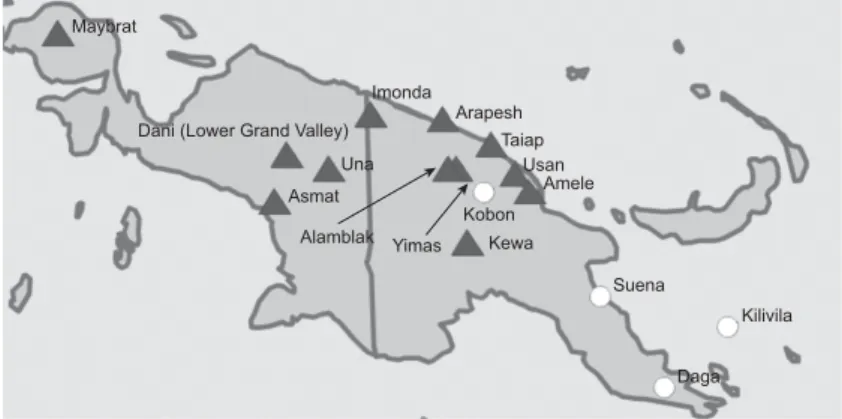
In Figure 9, we can classify the observed types as shown in (16).
(16) Combination of passive and applicative constructions
● Passive present and No applicative (41)
○ Passive absent and No applicative (38)
▲ Passive absent and Benefactive (31)
■ Passive present and Benefactive (7)
△ Passive absent and Non-benefactive (6)
▲ Passive present and Non-benefactive (6)
By combining passives and applicative constructions in WALS, there are 129 languages overall. The most frequent characteristic is a combination of Passive present and No applica- tive (41 languages). Next is a combination of Passive absent and No applicative (38 lan- guages). Thus, it appears that a majority of the world’s languages do not have applicative constructions. In contrast, half of the world’s languages have passives. We further examine languages with applicative constructions. The most popular combination is Passive absent and Benefactive present (31 languages). Other combinations that are not frequent include
Passive present and Benefactive present (7 languages), Passive absent and Non-benefactive (6 languages), and Passive present and Non-benefactive (6 languages).
Next we enlarge the map in Figure 9 to show New Guinea in Figure 10.
Figure 10 shows two marks,▲Passive absent and Benefactive and○ Passive absent and No applicative. It is a geographical tendency that languages of New Guinea lack passive constructions, and that Passive absent and Benefactive is a frequent combination. Thus, we summarize the characteristics of the languages of New Guinea as follows: when the lan- guages of New Guinea have applicative constructions, they possess at least the benefactive function and do not possess passive constructions.
This study also discusses reasons why Tok Pisin lacks both passives and applicative
Figure 10 Combination of passives and applicative constructions in New Guinea (Siewierska 2005, Polinsky 2005) Figure 9 Combination of passives and applicative constructions (Siewierska 2005, Polinsky 2005)
A Short Typology of Applicative Constructions in Papua New Guinea 109
constructions in verbal morphology. There are approximately 1000 languages spoken in New Guinea Island, and Tok Pisin is commonly spoken as a lingua franca in Papua New Guinea.
It has simple grammar and has more isolating characteristics than English, lacking verbal morphology. As a result, there is no valency-changing device, that is, no passives and no applicative constructions. McWhorter (2001) pointed out that creole grammars tend to lack complexity because of their recent emergence in the 18th and 19th centuries. Creole lan- guages, including Tok Pisin, are mainly used for everyday communication and do not have
“complex” infl ectional forms. Valency-changing devices always need certain markers in the verb and their grammatical demands are inconsistent with the simple grammar of Tok Pisin.
However, a causative construction exists as a valency-increasing device, and we examine how a causative construction is made by Tok Pisin. The causative in Tok Pisin (as well as Bislama,4) a creole spoken in Vanuatu) is formed by using the causative verbs mekem ‘make’ andletem
‘let’, creating a kind of serial verb construction as shown in (17).
(17) Bislama (Crowley 2004: 172)
Kava i mek-em yu drong.
kava copula make-transitive marker you drunk The kava made you drunk.
4. Summary
This study concludes that applicative constructions in the languages of Papua New Guinea generally possess a benefactive function and lack passive constructions. The combination of Passive present and Applicative present is not commonly observed worldwide. Even if some languages have applicative constructions, they don’t have a passive construction.
This study claims that the characteristics of applicative constructions in Amele, Usan, and Yimas are major types of applicative constructions worldwide (carrying a benefactive function), and in particular, two functional characteristics are observed in the New Guinea region. First, their applicative forms are different from each other: indirect object markers in Amele, verb fusional forms in Usan, and benefactive/allative affi xes in Yimas. Second, the speakers of Amele, Usan, and Yimas are bilingual, each speaking their indigenous language and Tok Pisin that has a simple grammar and lacks both applicative and passive forms.
Abbreviations
A Actor ABS absolutive
BEN benefactive ACC accusative
ALL allactive CAUS causative
COM comitative DEF defi nitive
ERG ergative FUT future
INST instrumental LOC locative
OBJ object PERF perfective
PRED predicate PRES present
PL plural SG singular
SUBJ subject 1, 2, and 3 1st, 2nd, and 3rd person, respectively.
Acknowledgments
I gratefully acknowledge the Grant-in-Aid for Young Scientists (20820033. 2008–2009) from the Japan Society for the Promotion of Science (JSPS).
Notes
1) Amele is one of the Trans-New Guinea languages spoken in suburban areas of Madang. Its speakers number around 5000 and every speaker is bilingual, each speaking Amele and Tok Pisin. Roberts (1987) is a description of the grammar. For my research, I have been visiting a village with Amele speakers since 2005 and studying Amele, Tok Pisin, and contact situations.
2) Arapesh is one of the Torricelli languages spoken in East Sepik Province. According to Lewis 2009, its speakers number around 5000. Fortune (1977) visited this region and described the grammar used before World War II. Fortune (1977: 73–76) stated that there are no passives but applicative constructions of benefactive and other functions in Arapesh. The particle m or um carries the functions of “for” and “toward (directions),” respectively.
3) Taiap belongs to the Gapun family, spoken in East Sepik Province (only 80 speakers; Lewis 2009).
Kulick and Stroud (1992) wrote a short grammatical sketch of Taiap. Taiap has ergative case marking and 6 cases for nominal morphology; moreover, it has the benefactive/recipient affi x -ta for verbal morphology.
4) There are three English-based creoles spoken in Melanesia. They are Tok Pisin in Papua New Guinea, Solomon Pijin in the Solomon Islands, and Bislama in Vanuatu. These three languages have the same origin (plantations of Australia and the South Pacifi c), and their syntax and clause structures are similar enough that communication between the languages is possible. In this study, I quoted a Bislama causative sentence, since I could not fi nd an appropriate example of a causative construction in Tok Pisin.
References
Crowley, Terry
2004 Bislama reference grammar. Honolulu: University of Hawai‘i Press.
Dixon, Robert. M. W.
1977 A grammar of Yidiny. Cambridge: Cambridge University Press.
Foley, William A.
1991 The Yimas languages of New Guinea. Stanford: Stanford University Press.
Fortune, Reo. F.
1977 Arapesh. American Ethnological Society Publications 19. New York: AMS Press.
Haspelmath, Martin, Matthew S. Dryer, David Gil, and Bernard Comrie (eds.)
2005 The World Atlas of Language Structures (WALS). Oxford: Oxford University Press.
A Short Typology of Applicative Constructions in Papua New Guinea 111
Kulick, Don and Christopher Stroud
1992 The structure of the Taiap (Gapun) language. InThe language game: Papers in memory of Donald C. Laycock, ed. by Tom Dutton, Malcolm Ross, and Darrell Tryon, 203–226. Pacifi c Linguistics C-110. Canberra: The Australian National University.
Lewis, Paul M. (ed.)
2009 Ethnologue: Languages of the world, 16th edition. Dallas, Tex: SIL International.
McWhorter, John
2001 The world’s simplest grammars are creole grammars. Linguistic Typology5: 125–166.
Mihalic, Francis
1986 The Jacaranda dictionary and grammar of Melanesian Pidgin. Milton: The Jacaranda Press/Web Books
Payne, Thomas E.
1997 Describing morphosyntax: A guide for fi eld linguists. Cambridge: Cambridge University Press.
Polinsky, Maria
2005 Applicative constructions. In: WALS feature 109.
Reesink, Ger P.
1987 Structure and their functions in Usan: A Papuan language of Papua New Guinea. Amsterdam and Philadelphia: John Benjamins.
Roberts, John R.
1987 Amele. London and New York and Sydney: Croom Helm.
Rounds, Carol
2001 Hungarian: An essential grammar. London and New York: Routledge.
Siewierska, Anna
2005 Passive constructions. In: WALS feature 107.