Japan Advanced Institute of Science and Technology
https://dspace.jaist.ac.jp/
Title
A comparative study of target-based evaluation of
traditional craft patterns using kansei data
Author(s)
Huynh, Van-Nam; Nakamori, Yoshiteru; Yan, Hongbin
Citation
Lecture Notes in Computer Science, 6291/2010:
160-173
Issue Date
2010
Type
Journal Article
Text version
author
URL
http://hdl.handle.net/10119/9566
Rights
This is the author-created version of Springer,
Van-Nam Huynh, Yoshiteru Nakamori, and Hongbin
Yan, Lecture Notes in Computer Science,
6291/2010, 2010, 160-173. The original
publication is available at www.springerlink.com,
http://dx.doi.org/10.1007/978-3-642-15280-1_17
Description
Knowledge Science, Engineering and Management 4th
International Conference, KSEM 2010, Belfast,
Northern Ireland, UK, September 1-3, 2010.
Proceedings
Evaluation of Traditional Craft Patterns using
Kansei Data
Van-Nam Huynh, Yoshiteru Nakamori, and Hongbin Yan
School of Knowledge Science
Japan Advanced Institute of Science and Technology Nomi, Ishikawa, 923-1292, JAPAN
Email: [email protected]
Abstract. Evaluation for ranking is very useful for users in their decision-making process when they want to select some item(s) from a large num-ber of items using their personal preferences. In this paper, we will focus on the evaluation of Japanese traditional crafts, in which product items are assessed according to the so-called Kansei features by means of the semantic differential method. In particular, two decision analysis based evaluation procedures, which take consumer-specified preferences on kan-sei features of traditional products into consideration, will be discussed and compared.
1
Introduction
Nowadays, in an increasingly competitive world market, it is important for manu-facturers to have a customer-focused approach in order to improve attractiveness in development of new products, which should satisfy not only requirements of physical quality, defined objectively, but also consumers’ psychological needs, by essence subjective [9]. This approach has actually received much attention since the 1970s from the research community of consumer-focused design and Kansei engineering, which is defined as “translating technology of a consumer’s feeling and image for a product into design elements” [7]. Kansei engineering has been developed and successfully applied to a variety of industries, especially, in Japan.
Kansei is a Japanese term which, according to Mitsuo Nagamachi – the founder
of Kansei engineering, is ‘the impression somebody gets from a certain artefact, environment or situation using all her senses of sight, hearing, feeling, smell, taste [and sense of balance] as well as their recognition’ as quoted from [11]. For building a kansei database on psychological feelings regarding products, the most commonly-used method is to choose (adjectival) kansei words first, and then ask people to express their feelings using those kansei words by means of the semantic differential (SD) method [8].
The focus of this paper is on the evaluation of traditional craft products for personalized recommendation using kansei data, taking consumer-specified pref-erences on kansei features of traditional products into consideration. It should
be emphasized here that artistic and aesthetic aspects play a crucial role in per-ception of traditional crafts, therefore kansei data are essential and necessary for evaluation. Such evaluation would be helpful for marketing or personalized rec-ommendation, which is particularly important in the current service-oriented economy where recommender systems are gaining widespread acceptance in e-commerce applications [1, 3]. In [6], we have developed a consumer-oriented evaluation model for traditional Japanese crafts based on the appealing idea of target-based decision analysis [2]. Particularly, given a consumer’s request, using available kansei assessment data the developed model aims to define an evalu-ation function that quantifies how well a product item meets the consumer’s feeling preferences.
Recently, Mart´ınez [12] has proposed to use linguistic decision analysis for sensory evaluation based on the linguistic 2-tuple representation model [4]. Note that the knowledge used for sensory evaluation is also acquired by means of human senses of sight, taste, touch, smell and hearing. Basically, Mart´ınez’s model considers the evaluation problem as a multi-expert/multi-criteria decision-making problem and assumes a consistent order relation over the qualitative evaluation scale treated as linguistic term set of a linguistic variable [16]. In fact, Mart´ınez’s model yields an overall ranking of evaluated objects, which is therefore inappropriate for the purpose of personalized recommendations.
In this paper we will first customize the linguistic 2-tuple representation model to make it applicable to the consumer-oriented evaluation problem for traditional Japanese crafts using kansei data, and then conduct a comparative study of these two methods. The rest of this paper is organized as follows. Sec-tion 2 describes the consumer-oriented evaluaSec-tion problem using kansei data for traditional crafts. Section 3 introduces two decision analysis based methods for solving the consumer-oriented evaluation problem, one is based on fuzzy target-based decision analysis and the other is target-based on the linguistic decision analysis using the 2-tuple linguistic representation model. Section 4 then provides an illustration of these methods to evaluation of Kutani coffee cups along with a comparative analysis of the obtained results. Finally, some conclusions are pre-sented in Section 5.
2
Kansei-based Evaluation Problem
For traditional crafts, decisions on which items to buy or use are usually influ-enced by personal feelings/characteristics, so an evaluation targeting those spe-cific requests by consumers would be very useful, particularly for the purpose of personalized recommendation. In this section, we will describe such a consumer-oriented evaluation problem using kansei data for traditional crafts [13]. Let us denote O the collection of craft patterns to be evaluated and N is the cardinality of O, i.e. N = |O|.
The first task in the Kansei-based evaluation process is to identify what kansei features people often use to express their feelings regarding traditional crafts. Each kansei feature is defined by an opposite pair of (adjectival) kansei
words, for example the fun feature determines the pair of kansei words solemn and funny. Let
1. {F1, . . . , FK} be the set of kansei features selected,
2. w+k and w−k be the opposite pair of kansei words corresponding to Fk, for
k = 1, . . . , K. Denote W the set of kansei words, i.e. W = {w+k, wk−|k =
1, . . . , K}.
Then, the SD method [8] is used as a measurement instrument to design the questionnaire for gathering kansei evaluation data. Particularly, the ques-tionnaire using the SD method for gathering information consists in listing the kansei features, each of which corresponds to an opposite pair of kansei words that lie at either end of a qualitative M -point scale, where M is an odd positive integer as used, for example, in 5-point scale, 7-point scale or 9-point scale. Let us symbolically denote the M -point scale by
V = {v1, . . . , vM} (1)
where w+
k and wk− are respectively assumed to be at the ends v1 and vM.
The questionnaire is then distributed to a population P of subjects who are invited to express their emotional assessments according each kansei feature of craft patterns in O by using the M -point scale. Formally, we can model the kansei data of each craft pattern oi ∈ O according to kansei features obtained
from the assessment of subjects sjin P as shown in Table 1, where xjk(oi) ∈ V,
for j = 1, . . . , P = |P| and k = 1, . . . , K.
Table 1. The kansei assessment data of pattern oi
Kansei Features Subjects F1 F2 · · · FK s1 x11(oi) x12(oi) · · · x1K(oi) s2 x21(oi) x22(oi) · · · x2K(oi) .. . ... ... . .. ... sP xP 1(oi) xP 2(oi) · · · xP K(oi)
The kansei assessment database built, as described above, will be utilized to generate the knowledge serving for the following evaluation problem. Assume that an agent as a potential consumer is interested in looking for a craft pat-tern which would meet her preference given by a proper subset W of the set W of kansei words as defined below. She may then want to rate craft patterns available in O according to her preference. In particular, we are concerned with consumer-specified requests which can be stated generally in forms of the fol-lowing statement:
“I should like craft items which would best meet LQ (of) my preference
where LQ is a linguistic quantifier such as all, most, at least half, as many as
possible, etc. Formally, the problem can be formulated as follows.
Given W = {w∗
k1, . . . , w
∗
kn} and LQ corresponding to the request specified
by an agent as linguistically stated in (F), where ∗ stands for either + or −, and
{k1, . . . , kn} ⊆ {1, . . . , K}, the problem now is how to evaluate craft patterns in
O using kansei data and the request specified as the pair [W, LQ]? Here, by ∗
standing for either + or − as above, it indicates that only one of the two wk+l and w−
kl (l = 1, . . . , n) presents in W , which may be psychologically reasonable
to assume. For example, if the agent is interested in craft items being funny according to kansei feature of fun, then she is not interested in those being
solemn, the opposite kansei word of funny.
In the following section, we will introduce two decision analysis based pro-cedures for solving this consumer-oriented evaluation problem. Namely, the first evaluation procedure is based on fuzzy target-based decision analysis approach, and the second one is based on the linguistic decision analysis approach with the 2-tuple linguistic representation model [12].
3
Two Decision Analysis Based Evaluation Procedures
3.1 Evaluation Method using Target-Based Decision Analysis Viewing multi-person assessments as uncertain judgments regarding kansei fea-tures of traditional craft items, the above-mentioned evaluation problem can be solved by applying the fuzzy target-based decision model recently developed in [5] as follows.
First, let us denote D the kansei assessment database about a finite set O of craft patterns using SD method as mentioned previously, and D[oi] the data of
pattern oi (i = 1, . . . , N ) as shown in Table 1.
For each pattern oi, we define for each kansei feature Fk, k = 1, . . . , K, a
probability distribution fik: V → [0, 1] as follows:
fik(vh) = |{sj ∈ P : xjk(oi) = vh}|
|P| (2)
This distribution fik is considered as an uncertain judgment of craft pattern
oi according to kansei feature Fk. By the same way, we can obtain a K-tuple
of distributions [fi1, . . . , fiK] regarding the kansei assessment of oi and call the
tuple the kansei profile of oi. Similarly, kansei profiles of all patterns in O can
be generated from D.
Having generated kansei profiles for all patterns oi ∈ O as above, we now
define the evaluation function V corresponding to the request (F) symbolically specified as [W, LQ], where W = {w∗
k1, . . . , w
∗
kn} and LQ is a linguistic
quanti-fier.
Intuitively, if a consumer expresses her preference on a kansei feature such as
color contrast with kansei word bright, she may implicitly assume a preference
the end v1 where bright is placed. Conversely, if the consumer’s preference on
color contrast was dark, i.e. the opposite kansei word of bright, she would assume
an inverse preference order on the scale towards the end vM where dark is placed.
In other words, in consumer-oriented evaluation using kansei data, the preference order on the semantic differential scale corresponding to a kansei feature should be determined adaptively depending on a particular consumer’s preference. This can be formally formulated as below.
For each w∗
kl∈ W , we define a linear preference order ºl on V according to
the kansei feature Fkl as follows
vhºlvh0 ⇔ ½ h0≥ h, if w∗ kl= w + kl h ≥ h0, if w∗ kl= w − kl (3) In addition, due to vagueness inherent in consumer’s expression of preference in terms of kansei words, each w∗
kl is considered as the feeling target, denoted by
Tkl, of the consumer according to kansei feature Fkl, which can be represented as
a possibility variable (Zadeh, 1978) on V whose possibility distribution is defined as πkl(vh) = ³ M −h M −1 ´m , if w∗ kl= w + kl ³ h−1 M −1 ´m , if w∗ kl= w − kl (4) where m ≥ 0 expresses the degree of intensity of the consumer’s feelings about the target. Intuitively, when a consumer expresses her feeling targets using kansei words combined with linguistic modifiers such as very, slightly, etc., to emphasize her intensity about targets, the degree of intensity m can then be determined similarly as in Zadeh’s method of modelling linguistic modifiers via power func-tions in approximate reasoning [16]. Fig. 1 graphically illustrates these concepts for the case m = 1, which exhibits a neutral-intensity toward targets.
1 1 vM vh v1 w+ kl w − kl w− kl ºl ºl w+ kl v1 ¹l vh ¹l vM (a) Tkl (b) Tkl
Fig. 1. The preference order ºl and the possibility distribution of feeling target Tkl:
(a) w∗
kl= w+kl; (b) w∗kl= w−kl
As such, with the consumer’s preference specified by W , we obtain n feel-ing targets Tkl (l = 1, . . . , n) accompanying with n preference orders ºl (l =
1, . . . , n) on the semantic differential scale of kansei features Fkl (l = 1, . . . , n),
craft pattern oiregarding the kansei feature Fklis represented by the probability
distribution fikl over V, as defined previously. Now we are able to evaluate, for
each l = 1, . . . , n, how the feeling performance of a pattern oi on Fkl, denoted
by Fkl(oi) and represented by fikl, meets the feeling target Tkl representing
consumer’s preference on Fkl. This can be done as follows.
Firstly, making use of the possibility-probability conversion method [15] we can transform the possibility distribution of feeling target Tkl into an associated
probability distribution, denoted by ˆpkl, via the simple normalization as follows
ˆ pkl(vh) = πkl(vh) P v∈V πkl(v) (5)
Then, by accepting the assumption that the feeling target Tklis stochastically
independent of feeling performance on Fkl of any pattern oi, we can work out
the probability that the feeling performance Fkl(oi) meets the feeling target Tkl,
denoted by P(Fkl(oi) º Tkl), in terms of the preference order ºl as
P(Fkl(oi) º Tkl) , P (fiklºlpˆkl) = M X h=1 fikl(vh)P (vhºlpˆkl) (6)
where P (vhºlpˆkl) is the cumulative probability function defined by
P (vhºlpˆkl) =
X
vhºlvh0
ˆ
pkl(vh0) (7)
Intuitively, the quantity P(Fkl(oi) º Tkl) defined above could be interpreted
as the probability of “the feeling performance on Fkl of oi meeting the feeling
target Tkl specified by a consumer on Fkl”. Then, after having these
probabil-ities P(Fkl(oi) º Tkl) = Pkli, for l = 1, . . . , n, we are able to aggregate all
of them to obtain an aggregated value with taking the linguistic quantifier LQ into account, making use of the so-called ordered weighted averaging (OWA) aggregation operator [14].
Under such a semantics of OWA operators, now we are ready to define the evaluation function, for any oi∈ O, as follows
V (oi) = F(Pk1i, . . . , Pkni) = n X l=1 wlPli (8)
where Pliis the l-th largest element in the collection Pk1i, . . . , Pkniand
weight-ing vector [w1, . . . , wn] is determined directly by using a fuzzy set-based
seman-tics of the linguistic quantifier LQ. As interpreted previously on quantities Pkli
(l = 1, . . . , n), the aggregated value V (oi) therefore indicates the degree to which
craft pattern oi meets the feeling preference derived from the request specified
3.2 Evaluation Method using Linguistic Decision Analysis
Now we will develop in this section another evaluation method, making use of linguistic decision analysis with the 2-tuple linguistic representation model [4]. The main reason for using the 2-tuple based evaluation approach is due to its ad-vantage over conventional fuzzy set-based and symbolic approaches; it overcomes the limitations of the loss of information yielded by the process of linguistic ap-proximation, and the lack of precision in final results inherently faced by these conventional approaches.
To make the 2-tuple linguistic representation model applicable to the eval-uation problem at hand, we will treat qualitative assessments regarding each kansei feature given in the 7-point scale as linguistic assessments accordingly taken from the set S of seven linguistic terms as described in Fig. 2.
Fk
w+
k s0s1s2s3 s4 s5 s6w−k
Fig. 2. Linguistic values and their relation to a pair of kansei words
In the 2-tuple representation model, linguistic information is represented by a linguistic 2-tuple (s, α) composed of a linguistic term s ∈ S and a number
α ∈ [−0.5, 0.5). More particularly, let S = {s0, . . . , sg} be a linguistic term set
on which a total order is defined as: si ≤ sj ⇔ i ≤ j. In addition, a negation
operator Neg can be defined by: Neg(si) = sj such that j = g − i. In general,
applying a symbolic method for aggregating linguistic information often yields a value β ∈ [0, g], and β 6∈ {0, . . . , g}, then a symbolic approximation must be used to get the result expressed in S.
In order to avoid any approximation process which causes a loss of informa-tion in the processes of computing with words, alternatively the 2-tuple linguistic representation model takes S × [−0.5, 0.5) as the underlying space for represent-ing information. In this representation space, if a value β ∈ [0, g] represents the result of a linguistic aggregation operation, then the 2-tuple (si, α) that
ex-presses the information equivalent to β is obtained by means of the following transformation: ∆ : [0, g] −→ S × [−0.5, 0.5) β 7−→ (si, α), with ½ i = round(β) α = β − i
and then α is called a symbolic translation, which supports the “difference of information” between the value β ∈ [0, g] obtained after a symbolic aggregation operation, and the closest value in {0, . . . , g} indicating the index of the best matched term in S.
Inversely, a 2-tuple (si, α) ∈ S × [−0.5, 0.5) can also be equivalently
repre-sented by a numerical value in [0, g] by means of the following transformation:
∆−1: S × [−0.5, 0.5) −→ [0, g]
(si, α) 7−→ ∆−1(si, α) = i + α.
Under such transformations, it should be noticed here that any original linguistic term si in S is then represented by its equivalent 2-tuple (si, 0) in the 2-tuple
linguistic model.
The comparison of linguistic information represented by 2-tuples is defined as follows. Let (si, α1) and (sj, α2) be two 2-tuples, then
– if i < j then (si, α1) is less than (sj, α2), – if i = j then
1. if α1= α2 then (si, α1) and (sj, α2) represent the same information, 2. if α1< α2 then (si, α1) is less than (sj, α2),
3. if α1> α2 then (si, α1) is greater than (sj, α2).
Using two 2-tuple transformations defined above, the negation operator over 2-tuples is defined as follows:
Neg((si, α)) = ∆(g − (∆−1(si, α))) (9)
Now the consumer-oriented evaluation method based on the 2-tuple repre-sentation model can be formulated as follows.
Given a request [W, LQ] with W = {w∗
k1, . . . , w
∗
kn} and LQ as a linguistic
quantifier, let us decompose the set of indices I = {k1, . . . , kn} into two disjoint
subsets I+ and I− such that
I+= {k j ∈ I|w∗kj = w + kj} and I −= {k j ∈ I|wk∗j = w − kj} (10)
Then, for each object oi∈ O, the performance of oi on the kansei feature Fkj is
evaluated by Vkj(oi) = ∆ Ã X s∈S fikj(s)∆ −1(s, 0) ! , if kj ∈ I− (11) and Vkj(oi) = ∆ Ã X s∈S fikj(s)∆ −1(Neg((s, 0))) ! , if kj∈ I+ (12) where fikj(s) is defined by fikj(s) = |{sh∈ P : xhkj(oi) = s}| |P| (13)
That is, Vkj(oi) is the mean value of uncertain linguistic assessment of oi
values Vkj(oi) have been computed for all features Fkj, kj ∈ I, the overall
per-formance of oi is calculated by aggregating all of them using an OWA operator
F of dimension n similar to (8), such as
V (oi) = F(Vk1(oi), . . . , Vkn(oi)) (14)
with the associated weighting vector [w1, . . . , wn] determined by using the fuzzy
set-based semantics of linguistic quantifier LQ.
4
Illustration to Evaluation of Kutani Coffee Cups
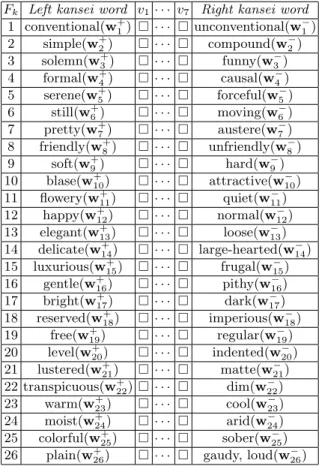
For illustration, we shall apply the proposed model to evaluating Kutani porce-lain, a traditional craft industry in Japan, historically back to the seventeenth century, of Kutani Pottery Village in Ishikawa prefecture1. A total of 35 patterns of Kutani coffee cup have been collected for the Kansei-based evaluation, and 26 opposite pairs of kansei words were used to design the answer sheet for gathering kansei assessment data of these items (i.e., Kutani coffee cups) for evaluation. Kansei words are approximately translated into English as shown in Table 2.
A total of 60 subjects were invited to participate in the kansei assessment process. The data obtained is 3-way data of which each Kutani coffee cup #i (i = 1, . . . , 35) is assessed by all participated subjects on all kansei features
Fk, k = 1, . . . , 26. The 3-way data is then used to generate kansei profiles for
patterns via (2) as mentioned previously. These kansei profiles are considered as (uncertain) feeling assessments of items serving as the knowledge for consumer-oriented evaluation.
4.1 Obtained Results of Two Methods Assuming a consumer’s request is specified as
[{w+7, w−10, w+11, w+17, w25−, }, as many as possible]
That is, verbally, she would ask for items meeting as many as possible of her feeling preferences of pretty, attractive, flowery, bright and pale.
We first determine preference orders on V = {v1, . . . , v7} for features F7, F10,
F11, F17 and F25. Using (3), we have º10=º25 and º7=º11=º17, where
v1º7. . . º7v7 and v7º10. . . º10v1
Then, using (4) for m = 2, we define feeling targets T7, T10, T11, T17 and T25for features F7, F10, F11, F17 and F25 respectively. In this case we have T10 ≡ T25 and T7≡ T11≡ T17with possibility distributions shown in Fig. 3.
We now determine the weighting vector of dimension 5, denoted by w = [w1, w2, w3, w4, w5], according to the fuzzy set-based semantics of linguistic quan-tifier ‘as many as possible’. Assume that, for example, the membership function
Table 2. Opposite pairs of kansei words used for the evaluation
Fk Left kansei word v1· · · v7 Right kansei word
1 conventional(w+ 1) ¤ · · · ¤ unconventional(w1−) 2 simple(w+ 2) ¤ · · · ¤ compound(w − 2) 3 solemn(w+3) ¤ · · · ¤ funny(w − 3) 4 formal(w+ 4) ¤ · · · ¤ causal(w4−) 5 serene(w+ 5) ¤ · · · ¤ forceful(w5−) 6 still(w+ 6) ¤ · · · ¤ moving(w−6) 7 pretty(w+ 7) ¤ · · · ¤ austere(w−7) 8 friendly(w+ 8) ¤ · · · ¤ unfriendly(w−8) 9 soft(w+ 9) ¤ · · · ¤ hard(w − 9) 10 blase(w+ 10) ¤ · · · ¤ attractive(w − 10) 11 flowery(w+ 11) ¤ · · · ¤ quiet(w−11) 12 happy(w+ 12) ¤ · · · ¤ normal(w−12) 13 elegant(w+ 13) ¤ · · · ¤ loose(w−13) 14 delicate(w+ 14) ¤ · · · ¤ large-hearted(w−14) 15 luxurious(w+ 15) ¤ · · · ¤ frugal(w15−) 16 gentle(w+ 16) ¤ · · · ¤ pithy(w−16) 17 bright(w+ 17) ¤ · · · ¤ dark(w − 17) 18 reserved(w+18) ¤ · · · ¤ imperious(w − 18) 19 free(w+ 19) ¤ · · · ¤ regular(w−19) 20 level(w+ 20) ¤ · · · ¤ indented(w−20) 21 lustered(w+ 21) ¤ · · · ¤ matte(w−21) 22 transpicuous(w+ 22) ¤ · · · ¤ dim(w22−) 23 warm(w+ 23) ¤ · · · ¤ cool(w−23) 24 moist(w+ 24) ¤ · · · ¤ arid(w − 24) 25 colorful(w+ 25) ¤ · · · ¤ sober(w − 25) 26 plain(w+ 26) ¤ · · · ¤ gaudy, loud(w−26)
of the quantifier ‘as many as possible’ is defined as a mapping Q : [0, 1] → [0, 1] such that
Q(r) =
½
0 if 0 ≤ r ≤ 0.5 2r − 1 if 0.5 ≤ r ≤ 1
We then obtain the weighting vector as w = [0, 0, 0.2, 0.4, 0.4] using Yager’s method proposed in [14].
With these preparations we are now ready to apply the target based evalu-ation method for ranking items Kutani cup#i, i = 1, . . . , 35, as follows. First, we use (5) and (6) for computing probabilities P7i, P10i, P11i, P17i and P25i of meeting corresponding feeling targets T7, T10, T11, T17 and T25for each item Kutani cup#i (i = 1, . . . , 35). Then, using (8) we have
V (Kutani cup#i) = F(P7i, P10i, P11i, P17i, P25i)
where F is the OWA operator of dimension 5 associated with the weighting vector w = [0, 0, 0.2, 0.4, 0.4].
0 1 v1 v2 v3 v4 v5 v6 v7 w+ 10, w+25 w− 10, w− 25 0 1 v1 v2 v3 v4 v5 v6 v7 w+ 7, w+11, w+17 w − 7, w− 11, w− 17
a) Targets T10and T25(m = 2) b) Targets T7, T11and T17(m = 2)
Fig. 3. Possibility distribution of feeling targets
Table 3 shows the top three patterns that would best meet the feeling prefer-ences pretty, attractive, flowery, bright and pale, with different typical linguistic quantifiers used.
Table 3. Quantifiers used and corresponding top 3 patterns
Linguistic quantifier Weighting vector The top 3 patterns
As many as possible (AMAP) [0, 0, 0.2, 0.4, 0.4] #4 º #8 º #11
All [0, 0, 0, 0, 1] #8 º #7 º #30
There exists [1, 0, 0, 0, 0] #13 º #18 º #29
At least haft (ALH) [0.4, 0.4, 0.2, 0, 0] #13 º #6 º #24
On the other hand, using the 2-tuple based evaluation method described above, we also obtain results of the top 3 recommended items with different linguistic quantifiers applied as shown in Table 4.
Table 4. Top 3 items recommended using the 2-tuple based method
Linguistic quantifier Weighting vector The top 3 patterns
As many as possible (AMAP) [0, 0, 0.2, 0.4, 0.4] #8 º #11 º #4
All [0, 0, 0, 0, 1] #7 º #9 º #8
There exists [1, 0, 0, 0, 0] #13 º #29 º #18
At least haft (ALH) [0.4, 0.4, 0.2, 0, 0] #13 º #6 º #24
4.2 Comparative Analysis
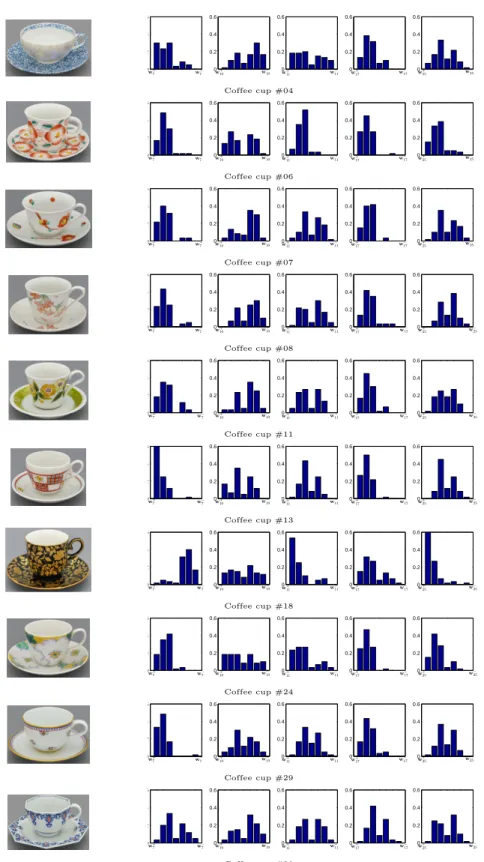
For the sake of facilitating the discussion of obtained results, all the recom-mended items by the target based evaluation method (according to typical lin-guistic quantifiers used) as well as their uncertain assessments on selected fea-tures F7, F10, F11, F17and F25are depicted in Fig. 4.
0 0.2 0.4 0.6 0 0.2 0.4 0.6 0 0.2 0.4 0.6 0 0.2 0.4 0.6 0 0.2 0.4 0.6 w+ 7 w− 7 w+ 10 w− 10 w+11 w− 11 w+17 w− 17 w+ 25 w− 25 Coffee cup #04 0 0.2 0.4 0.6 0 0.2 0.4 0.6 0 0.2 0.4 0.6 0 0.2 0.4 0.6 0 0.2 0.4 0.6 w− 25 w+ 25 w− 17 w+17 w− 11 w+11 w− 10 w+ 10 w− 7 w+ 7 Coffee cup #06 0 0.2 0.4 0.6 0 0.2 0.4 0.6 0 0.2 0.4 0.6 0 0.2 0.4 0.6 0 0.2 0.4 0.6 w+ 7 w− 7 w+ 10 w− 10 w+11 w− 11 w+17 w− 17 w+ 25 w− 25 Coffee cup #07 0 0.2 0.4 0.6 0 0.2 0.4 0.6 0 0.2 0.4 0.6 0 0.2 0.4 0.6 0 0.2 0.4 0.6 w− 25 w+ 25 w− 17 w+17 w− 11 w+11 w− 10 w+ 10 w− 7 w+ 7 Coffee cup #08 0 0.2 0.4 0.6 0 0.2 0.4 0.6 0 0.2 0.4 0.6 0 0.2 0.4 0.6 0 0.2 0.4 0.6 w− 25 w+ 25 w− 17 w+ 17 w− 11 w+ 11 w− 10 w+ 10 w− 7 w+ 7 Coffee cup #11 0 0.2 0.4 0.6 0 0.2 0.4 0.6 0 0.2 0.4 0.6 0 0.2 0.4 0.6 0 0.2 0.4 0.6 w+ 7 w− 7 w+ 10 w− 10 w+ 11 w− 11 w+ 17 w− 17 w+ 25 w− 25 Coffee cup #13 0 0.2 0.4 0.6 0 0.2 0.4 0.6 0 0.2 0.4 0.6 0 0.2 0.4 0.6 0 0.2 0.4 0.6 w− 25 w+ 25 w− 17 w+ 17 w− 11 w+ 11 w− 10 w+ 10 w− 7 w+ 7 Coffee cup #18 0 0.2 0.4 0.6 0 0.2 0.4 0.6 0 0.2 0.4 0.6 0 0.2 0.4 0.6 0 0.2 0.4 0.6 w+ 7 w− 7 w+ 10 w− 10 w+ 11 w− 11 w+ 17 w− 17 w+ 25 w− 25 Coffee cup #24 0 0.2 0.4 0.6 0 0.2 0.4 0.6 0 0.2 0.4 0.6 0 0.2 0.4 0.6 0 0.2 0.4 0.6 w− 25 w+ 25 w− 17 w+ 17 w+ 11 w− 10 w+ 10 w+7 w− 7 w− 11 Coffee cup #29 0 0.2 0.4 0.6 0 0.2 0.4 0.6 0 0.2 0.4 0.6 0 0.2 0.4 0.6 0 0.2 0.4 0.6 w+ 7 w− 7 w+11 w− 11 w+17 w− 17 w+25 w− 25 w− 10 w+10 Coffee cup #30
As we have seen from Tables 3 and 4, the results yielded by two methods are quite different, except the case of quantifier ‘at least half ’. Particularly, in the first case of quantifier ‘as many as possible’, though two methods produced the same top 3 items but these items were ranked differently. Item #4 was ranked first by the target-based method while it appears as the third by the 2-tuple based method. For the case of quantifier ‘all’, it is worth noting here that the uncertain judgments of items #7 and #8 on correspondingly selected features are somewhat similar. However, item #8 was ranked third by the 2-tuple based method and dominated by item #9 as the second and item #7 as the first, while it was ranked first by the target-based method. In the case of quantifier ‘there
exists’, a position interchange of items #18 and #29 happens, in particular item
#18 was dominated by item #29 with the 2-tuple based method and vice-versa with the target-based method. In fact, the target achievement of item #18 on target flowery (w+
11) is 0.7209 which is better than that of item #29 on target
pretty (w+
7) as 0.6804. This can be observed as illustrated in Fig. 4.
The difference in ranking results of the two methods can be explained as follows. In the 2-tuple based method, only preferences over the linguistic term set S induced from the consumer’s request are taken into account. While in the target-based method, not only these preferences but also feeling targets specified by the consumer are considered simultaneously. From a decision analysis point of view, after determining consumer-specified preferences the 2-tuple based method applies the expected value model (refer to (11) and (12)) to evaluate the per-formance of an object regarding each kansei feature specified by the consumer. Thus, as discussed in Huynh et al. [5], the 2-tuple based method works similarly to the target-based method when the ‘neutral target’ is used. In particularly, if we define targets as
πkl(vh) = 1
instead of the targets defined in (4), then the result obtained by the target-based method is the same as that produced by the 2-tuple target-based method. This means that the target-based method can provide recommendations which would interestingly reflect attitudes of consumer towards feeling targets as graphically illustrated by Fig. 4, whilst those recommended by the 2-tuple based method would not do so.
5
Conclusions
In this paper we have conducted a comparative study of two decision analysis based evaluation methods for the evaluation problem of Japanese traditional crafts, which take consumer-specified preferences on kansei features of traditional products into consideration. In doing so, we have first customized the linguistic 2-tuple representation model in linguistic decision analysis in order to apply it to the consumer-oriented evaluation problem using kansei data. It has been shown that the 2-tuple based evaluation method can be seen as a special case of the target-based evaluation method which would interestingly provide the evaluated results reflecting attitudes of consumers about feeling targets.
References
1. G. Adomavicius, A. Tuzhilin, Toward the next generation of recommender systems: A survey of the state-of-the-art and possible extensions, IEEE Trans. Know. Data
Eng. 17 (2005) 734–749.
2. R. Bordley, C. Kirkwood, Multiattribute preference analysis with performance tar-gets, Operations Research 52 (2004) 823–835.
3. N. Manouselis, C. Costopoulou, Analysis and classification of multi-criteria recom-mender systems, World Wide Web 10 (2007) 415–441.
4. F. Herrera, L. Mart´ınez, A 2-tuple fuzzy linguistic representation model for com-puting with words, IEEE Trans. Fuzzy Syst.8 (2000) 746–752.
5. V.N. Huynh, Y. Nakamori, M. Ryoke, T.B. Ho, Decision making under uncertainty with fuzzy targets, Fuzzy Optim. Decis. Making 6 (2007) 255–278.
6. V.N. Huynh, H.B. Yan, Y. Nakamori, A target-based decision making approach to consumer-oriented evaluation model for Japanese traditional crafts, IEEE Trans.
Eng. Manag. (in press).
7. M. Nagamachi, “Kansei Engineering: a new ergonomic consumer-oriented technol-ogy for product development,” Inter. J. Indus. Ergo. 15 (1995) 3–11.
8. C. E. Osgood, G. J. Suci, P. H. Tannenbaum, The Measurement of Meaning. Ur-bana, USA: University of Illinois Press, 1957.
9. J.-F. Petiot, B. Yannou, Measuring consumer perceptions for a better comprehen-sion, specification and assessment of product semantics, Inter. J. Indus. Ergo. 33 (2004) 507–525.
10. D. Ruan, X. Zeng (Eds.), Intelligent Sensory Evaluation: Methodologies and
Ap-plications. Berlin: Springer-Verlag, 2004.
11. S. Sch¨utte, Engineering Emotional Values in Product Design – Kansei Engineering
in Development. Link¨opings Universitet, Dissertation 951, 2005.
12. L. Mart´ınez, Sensory evaluation based on linguistic decision analysis, Inter. J.
Approx. Reason.44 (2007) 148–164.
13. H.B. Yan, V.N. Huynh, Y. Nakamori, A probability-based approach to consumer oriented evaluation of traditional craft items using kansei data, in: V.N. Huynh et al. (Eds.), Interval/Probabilistic Uncertainty and Non-Classical Logics, Springer-Verlag, 2008, pp. 326–340.
14. R.R. Yager, On ordered weighted averaging aggregation operators in multicriteria decision making, IEEE Trans. Syst., Man, Cybern.18 (1988) 183–190.
15. R.R. Yager, On the instantiation of possibility distributions, Fuzzy Sets Syst.128 (2002) 261–266.
16. L. A. Zadeh, The concept of a linguistic variable and its applications to approximate reasoning, Inf. Sci.8 (1975) 199–249; 310–357.