New method for evaluation of concrete durability in different curing condition
T. Iyoda1 and S. Matsuzaki2
1Department of Civil Engineering, Shibaura Institute of Technology, Tokyo, Japan
2 Department of Civil Engineering, Shibaura Institute of Technology, Tokyo, Japan E-mail: [email protected]
ABSTRACT: Concrete surface is very important to protect steel corrosion in concrete due to carbonation and chloride attacks. The quality of surface concrete is affected by the curing condition and curing period. In this study, the relative humidity of internal concrete specimen is measured using small censers. The results show that the simple method to evaluate durability of surface concrete is to use vacuum condition.
This new method is used to evaluate concrete surface by changing W/C, kind of cement, curing period and curing conditions. As a result, using this new method, it is easy to evaluate the durability of concrete with different concrete properties and curing conditions. It is also possible to evaluate concrete cores from concrete structures.
1. INTRODUCTION
In recent years, there are many reports which are deteriorations at earlier than designs for concrete structure, because of steel corrosion due to carbonation and chloride penetration. These deteriorated causes are CO2 gas, chloride ion, water and O2 gas penetration.
These factors penetrated the concrete inside. On structure design site, such as calculation for durability of carbonation and chloride penetration, we used the single diffusion co-efficient on the same concrete. Because it is assumed that the concrete is uniform. Of course, material design such as water cement ratio, using kind of cement, mix proportion changes and the diffusion co-efficient changes. However concrete surface area is effective the curing condition and curing period. Concrete surface is very important to protect steel corrosion in concrete. So, it is thought that durability, such as resistance for carbonation and chloride penetration, is different the surface area and inside area in concrete. Essentially, in the structure design, it is thought that a different diffusion value might have to be set the surface and internally on concrete. However it is difficult to separate of surface area and internal area. And there assumed that the following three purposes were solved. Firstly is no technique for measuring the surface and internal diffusion value in concrete.
In this research, it was, it aimed to distinguish the surface and internal area in concrete on variety curing condition. Secondly, it aimed at the development of new test methodology that was able to clarify the difference of surface and internal area on water permeability. Thirdly, it aimed to evaluate the influence that the mix proportion and curing condition gave to water diffusion value by using the developed test. Moreover, it was assumed that water permeability of concrete was evaluated with the specimens with different surface and internal area.
2. EXPERIMENTAL OUTLINE 2.1 Identification of range of dry influence
Figure 1 shows the specimen measured for identification of range of drying influence depth. Specimen size is 100 * 100 * 400mm prism shape that has set 6 pipes for measuring the internal relative humidity by small sensor. After casting concrete, specimens were sealed due to protect for evaporating water and the sensor was inserted into the setting pipe, after that the pipe was sealed up before starting measurement. The water cement ratio was 55% and using cement types were Ordinary Portland Cement and Blast-furnace slag cement type B.
2.2 Development for new permeability test
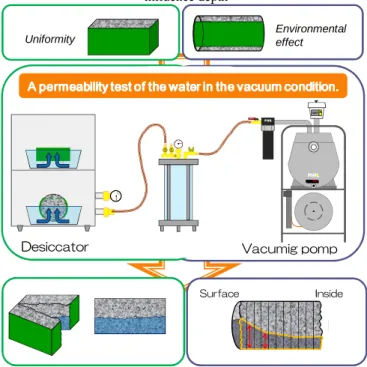
Figure 2 shows the system of developed permeability test. The feature of this system is to investigate the permeability in direction of depth on concrete. In short, it will investigate the permeability
1.5 5.0
10.0 20.0
2.0 7.0 (単位:cm)
両端解放
アクリルパイプ
(単位:mm)15 50 200
100 70 20
(Unit:mm)
Pipe by acrylic
Open at both ends
Figure 1 Specimen measured for identification of range of drying influence depth
PHIL PHIL
芝 浦工業大学 伊 代田研究室真空ポ ンプ
Vacumig pomp Desiccator
A permeability test of the water in the vacuum condition.
A permeability test of the water in the vacuum condition.A permeability test of the water in the vacuum condition.
A permeability test of the water in the vacuum condition.
Surface Inside
Uniformity
Environmental effect
Figure 2 System of developed permeability test
property of the surface area and internal area. The mechanism confirms the permeability property by comparing the area for penetrating water on different point in direction of concrete depth by sucking to the vacuum. The method of this system is following. The specimens were dried in oven on 1 day and the side of specimens was sealed by Aluminium tape due to protect penetrating water on vacuum condition. These specimens were set at a container, and poured water to half of the height of the specimen. The desiccator which a container was put in is done a vacuum condition by a vacuum pump for 1 hour, and water is penetrating by a specimen.
After divided into the half, the permeability property is evaluated by ratio of area for penetrating water per all section.
2.3 Evaluation for curing effect on new permeability test It was evaluated the permeability property for different mix proportion and different curing condition using by new permeability test. On the Step 1, it aimed that the evaluation for the influence of curing periods and water cement ratio using the uniformity concrete specimens. And on the Step 2, it aimed that the evaluation for the influence of direction on depth of concrete specimen by drying condition. In short, it is understood the difference of surface and internal area on permeability property. Finally using those results of Step 1 and 2, it tried to estimate the permeability property of concrete which exposed to construction site.
2.3.1 Casting the specimens
Table 1 shows that the concrete mix proportion of permeability test is used. Kinds of concrete are 6 mix proportions, a) water cement ratio is 3 kinds, 30, 45 and 55% and b) types of cement are 2 kinds, Ordinary Portland cement (N) and Blast furnace slag cement type B (BB). Figure 3 shows the curing period on this research. The Curing method adopted sealed curing and curing periods were assumed 1, 3, 7days.
The size of specimen is as follow. On Step 1, the specimen was adopted prism as 100 * 100 * 50mm, because it is not difference of the influence of environment such as drying condition, on the surface and internal concrete specimen. In short, all the specimens were uniformly received the influence of environment. On Step 2, the specimen was cylinder asφ100×200mm. The specimens took off the formwork of both ends after curing to evaluate the permeability property on the direction of depth from surface of concrete. In short, it was assumed that the concrete core from the structure whose thickness is 200mm.
Table-1 Concrete mix proportion
W/C s/a SL Air
(%) (%) W C BFS S G (cm) (%)
55 47 172 313 0 855 982 12.0 4.2
45 45 172 382 0 792 987 14.5 3.9
30 42 172 573 0 672 946 21.5 5.8
55 47 172 156 156 850 976 17.5 4.0 45 45 172 191 191 786 979 18.5 4.3 30 42 172 287 287 663 933 64×62 4.6
Amount of unit(kg/m3)
OPC
BB cement
1 5 7 28
Step2
Curing day Series
Step1
・・・
Drying
20℃, RH60%
Sealed test
Figure-3 Curing period
2.3.2 Permeability test
Permeability test was executed by specimens after age of 28 days passed. The permeability property was expressed the area ratio from penetrated water area in all sections. On Step 1, it was calculated with penetrated water area divided by all sections. On Step 2, it was calculated with penetrated water area divided by section each 10mm, because of evaluation for the permeability property on direction of the depth from surface of concrete.
3. RESULTS
3.1 Identification of range of dry influence
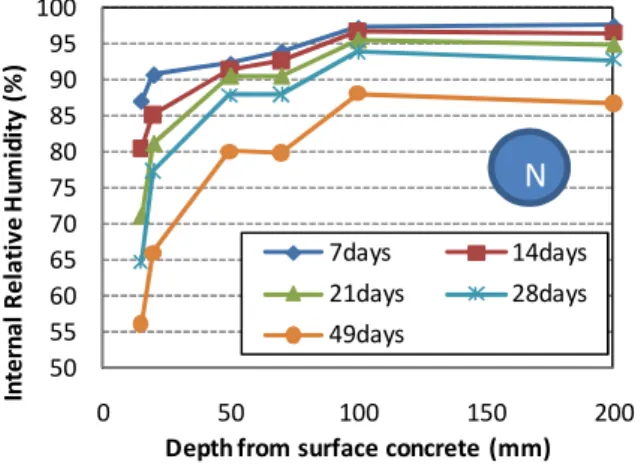
Figure 4 and 5 show the result of measurement for relative humidity on each depth from surface of different kinds of concrete. Internal
relative humidity decreased as a drying period become long. And the amount of the decrease of relative humidity on the surface was larger than that of the point where the distance from surface of concrete is long. It is estimated that influenced area for surround environment drying was 50mm.
3.2 Evaluation for curing effect on new permeability test 3.2.1 Effect of the water cement ratio and curing periods on uniform specimen (Step 1)
Photo 1 shows the result of new permeability test. The blue areas were penetrated water by vacuum conditions. Figure 6 and 7 show
50 55 60 65 70 75 80 85 90 95 100
0 50 100 150 200
Internal Relative Humidity (%)
Depth from surface concrete (mm)
7days 14days
21days 28days 49days
N
Figure 4 Result of relative humidity on each depth (Cement: N)
50 55 60 65 70 75 80 85 90 95 100
0 50 100 150 200
Internal Relative Humidity (%)
Depth from surface concrete (mm)
7days 14days
21days 28days 49days
BB
Figure 5 Result of relative humidity on each depth (Cement: BB)
Curing period : 7days
Curing period : 7days
Curing period : 1day
Photo 1 Result for new permeability test
0 0.1 0.2 0.3 0.4 0.5 0.6 0.7
1 2 3 4 5 6 7 8
Permeability property
Curing(day)
N:W/C=30 N:W/C=45 N:W/C=55
Figure 6 Result for new permeability test on different water cement ratio and curing period (Cement: N)
0 0.1 0.2 0.3 0.4 0.5 0.6 0.7
1 2 3 4 5 6 7 8
Permeability property
Curing(day)
BB:W/C=30 BB:W/C=45 BB:W/C=55
Figure 7 Result for new permeability test on different water cement ratio and curing period (Cement: BB)
Surface
Surface
Surface
Photo 2 Result for new permeability test on ununiformed specimen
the result of the effect on water cement ratio and curing period on uniform specimen by new permeability test. Figure 3 shows the result using N cement and Figure 4 shows the result using BB cement. For both cement types, permeability property decreased by water cement ratio decrease. In general, there are lots of pores in concrete on high water cement ratio, not depend on curing period.
On the other hand, the more it lengthens the curing period, the more permeability property decreases. It means that the hydration continues by curing, and the pore decreases. Permeability property depends on pore structures which formed by progress of cement hydration. Cement hydration stops due to evaporating water from concrete by drying condition at early age.
Comparing cement types, permeability property of BB cement is higher than it of N at short curing period, such as 1 day. However
0.0 0.1 0.2 0.3 0.4 0.5 0.6 0.7
0 5 10 15 20
Permeability property
Depth from surface of concrete(cm) N :W/C=30 N :W/C=45 N :W/C=55 Surface
Potential
Figure 8 Result of the permeability property by different depth point from surface of concrete (Cement: N)
0.0 0.1 0.2 0.3 0.4 0.5 0.6 0.7
0 5 10 15 20
Permeability property
Depth from surface of concrete(cm) BB:W/C=30 BB:W/C=45 BB:W/C=55 Surface
Potential
Figure 9 Result of the permeability property by different depth point from surface of concrete (Cement: BB)
permeability property of both cement types will be same value, if it secured an enough curing period such as 7 days. It means that BB concrete was more sensitive for curing than N concrete. Anyway,the curing period is very important to improve permeability property of concrete.
3.2.2 Effect for the direction of the depth from surface on ununiformed specimen (Step 2)
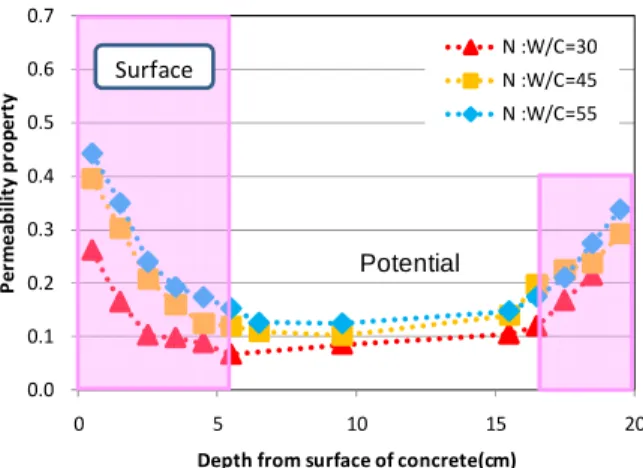
Photo 2 shows the result for new permeability test on effect for the depth from surface concrete. Figure 8 and 9 show the results of the permeability property by different depth point from surface of concrete on different cement types. The results of effect on water cement ratio are same as 3.2.1. On each cement types, the permeability property decreased by water cement ratio decrease.
Focus on the permeability property at the depth point from surface, the permeability property of the both ends points on those specimens were higher than it of internal point. Because, it was assumed that water in concrete evaporated from surface of concrete at early age due to lack of curing period. Water on the both ends area were lacks for cement hydration. Then, water permeability property decreased.
The results show that it distinguished two areas of permeability property. One is the pink area which has the inclination from the surface in the direction of depth. The other area is flat of permeability property, which was marked the internal point of concrete. The permeability property of this area means the potential permeability value of concrete depends on mix proportion. In short, this area does not influence of exposed environment. Also pink area is 50mm depth from surface of concrete. It means that the range to receive the influence of drying is 50mm from surface.
3.2.3 Application for the permeability test to specimen which exposed construction site
Figure 10 and 11 show that the relationship between the permeability property and the water cement ratio on different
0.0 0.1 0.2 0.3 0.4 0.5 0.6 0.7
25 30 35 40 45 50 55 60
Permeability property
Water cement ratio (%)
1day(Sealed) 5day(Sealed) 7day(Sealed)
Step1
Step2 Potential
N
Curing period
Figure 10 Relationship between the permeability property and the water cement ratio (Cement: N)
cement types arranged by the results of Step 1 and Step 2. It is able to estimate the water cement ratio and curing period using those figures. It is the example to apply the estimation of sample. The concrete specimen which exposed on construction site as into constructing tunnel was casted to formwork ofφ100×200mm. The upper end of specimen was exposed the environment as drying condition. The other sides were sealed by the formwork. It was examined in age 30 days from casting. The type of cement was BB, and then it will be estimated using figure 11. Photo 3 shows the result of new permeability test using this sample. The permeability value 0.55 marked on surface of concrete and 0.20 marked the internal of concrete. It was able to distinguish for the area by influence of drying condition. Figure 12 shows the estimation the water cement ratio and curing period. The estimated water cement ratio is about 53% and curing period is between 1 and 5 days.
Actually, mix proportion of this concrete was 52.5% and curing period was 2 days. Therefore it is possible that the estimation of curing period from new permeability test.
4. CONCLUSION
This research aimed to the development of new method for evaluation of permeability property of concrete structure. The obtaining results were as follows in this research.
(1) It is cleared that the influence depth from surface by drying condition at early age is 50 mm though the measurement for internal relative humidity in concrete.
(2) The new test method was developed the evaluation for permeability property for the depth from surface on concrete specimens using vacuum condition.
(3) It is cleared that the effect for permeability property by the water cement ratio, curing period and different kind of cement.
The biggest influence factor is curing period.
(4) It is able to measure the permeability property of the depth from surface concrete. The surface area of concrete was received by the influence of curing environment.
(5) It can be estimated the water cement ratio and curing period using the specimen which exposed on construction site in this research.
0.0 0.1 0.2 0.3 0.4 0.5 0.6 0.7
25 30 35 40 45 50 55 60
Permeability property
Water cement ratio(%)
1day(Sealed) 5day(Sealed) 7day(Sealed)
BB
Step1 Curing period
Step2 Potential
Figure 11 Relationship between the permeability property and the water cement ratio (Cement: BB)
Surface 0.55
Inside 0.20
Photo 3 Result of permeability test on exposed specimen
0.0 0.1 0.2 0.3 0.4 0.5 0.6 0.7
25 30 35 40 45 50 55 60
Permeability property
Water cement ratio(%)
1day(Sealed) 5day(Sealed) 7day(Sealed)
BB
Step1 Curing period
Step2 Potential Surface
Inside
Figure 12 Estimation for water cement ratio and curing period
REFERENCES
[1] Y. Dan, T Iyoda, Y. Ohtsuka, Y. Sgawa and H. Hamada: The relationship between curing condition and durability on concrete using blast-furnace slag cement, Journal of the Japan Society of Civil Engineers E, Vol.65 No.4, pp.431-441 (in Japanese)
[2] S. Okazaki, T. Yagi, T. Kishi and T. Yajima, 2006, Difference of sensitivity due to curing condition on strength and permeability, Cement Science and Concrete Technology, NO.60, 227-234, Japan Cement Association. (In Japanese) [3] T. Iyoda, Y. Dan, Y. Sagawa, H. Hamada, 2008, The effect of
curing period on the durability of concrete using Blast- furnace sag blended cement, The 3rd ACF International Conference-ACF/VCA 2008