Japan Advanced Institute of Science and Technology
JAIST Repository
https://dspace.jaist.ac.jp/
Title A New Linguistic Approach to Go/NoGo Evaluation at the Front End in New Product Development Author(s) Huynh, Van-Nam; Nakamori, Yoshiteru
Citation
Issue Date 2007-11
Type Conference Paper
Text version publisher
URL http://hdl.handle.net/10119/4122 Rights
Description
The original publication is available at JAIST Press http://www.jaist.ac.jp/library/jaist-press/index.html, Proceedings of KSS'2007 : The Eighth International Symposium on Knowledge and Systems Sciences : November 5-7, 2007, [Ishikawa High-Tech Conference Center, Nomi, Ishikawa, JAPAN], Organized by: Japan Advanced Institute of Science and Technology
A New Linguistic Approach to Go/NoGo Evaluation at the
Front End in New Product Development
Van-Nam Huynh† Yoshiteru Nakamori† †School of Knowledge Science
Japan Advanced Institute of Science and Technology Nomi, Ishikawa 923-1292, Japan
{huynh,nakamori}@jaist.ac.jp Abstract
This paper introduces a new linguistic ap-proach to new-product go/nogo evaluation at the frond end in new-product development, based on the 2-tuple linguistic representa-tion and the so-called preference-preserving 2-tuple transformation. A case study taken from the literature is used to illuminate the proposed technique and for a comparative study.
Keywords: New product screening, Lin-guistic assessment, Multi-criteria decision making, Computing with words
1 Introduction
New product development (NPD) is a dy-namically complex and multi-stage process which ranges from idea generation through product lunch [3; 19]. Among numerous of activities regarding a NPD project, the screening of new-product ideas is perhaps the most critical NPD activity [1]. However, it has been poorly or inadequately performed, as reported in the literature [2; 5; 4; 21]. Due to the incompleteness of information avail-able and the qualitative nature of most evalu-ation criteria regarding NPA process, a fuzzy linguistic approach may be necessary and a realistic approach for new-product screening, making use of linguistic assessments and the fuzzy-set-based computation [5; 6; 20]. How-ever, an inherent limitation of such a fuzzy linguistic approach is the loss of information caused by approximation processes, which eventually implies a lack of precision in the final results. This limitation even becomes more critical when applying the approach to new product screening.
This paper proposes an approach to new-product go/nogo evaluation at the frond end
in new-product development, based on the 2-tuple linguistic representation and the so-called preference-preserving transformation. It is shown that the proposed approach al-ways yields a consistent result, while main-taining the flexibility for managers in making their decisions as in the fuzzy-set-based ap-proach. Ultimately, this approach enhances the fuzzy logic-based screening model pro-posed in the previous studies by overcoming the mentioned limitation and with a low cost of computation. A case study taken from the literature is used to illuminate the proposed technique and to compare with the previous technique based on fuzzy computation.
2 A New-Product Screening
Framework
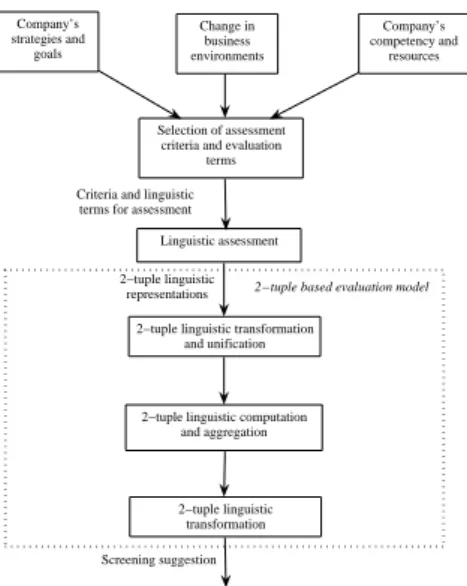
The evaluation framework for new-product screening using linguistic assessments is de-picted in Fig. 1, which consists of three main parts. The first part is the analysis of a new-product development situation and background. The second part of the frame-work is to select criteria as well as linguistic scales used by experts for assessing a new product project against criteria. And the third part is the development of a computa-tional model for processing and integrating linguistic assessments aimed at providing an overall linguistic evaluation to managers as a guidance for making screening decision. 2.1 Selecting Criteria for Evaluation Typically, a new product project is charac-terized by a multiple of factors and traits. Essentially, a screening evaluation for NPD depends not only on the new product’s char-acteristics but also on a firm’s technological competency and marketing competition. By referring to the factors proposed in previous
Table 1: Product Evaluation and Selected Criteria [5]
Criteria Description
Competitive Marketing timing (C11) Matches desired entry timing needed ny target segments marketing Price superiority (C12) Offers value for money to target segments
advantages Marketing competencies (C13) Conforms to our salesforce, channels of distribution and logistical strengths (C1) Marketing attractiveness (C14) Permits the company to enter into a growing, high-potential market Superiority Functional competency (C21) Has unique or special functions to meet and attract target segments
(C2) Featured differentia (C22) Has unique or special features to attract target segments Technological Design quality (C31) Is design for the quality needed by target segments
suitability Material specialization (C32) Uses materials of high quality and low rejection
(C3) Manufacturing compatibility (C33) Can be produced by our best manufacturing technology and flexibility Supply benefit (C34) Allows the company to use very best suppliers
Risk Market competitiveness (C41) Allows many competitive products in the market (C4) Technological uncertainty (C42) Uses new technological skills that cannot be addressed by research
Monetary risk (C43) Products total dollar risk profile of product
Company’s strategies and goals Change in business environments Company’s competency and resources Selection of assessment criteria and evaluation
terms
Linguistic assessment
Translation of linguistic variables
Fuzzy numbers aggregation and inference
Linguistic approximation Criteria and linguistic terms for assessment
Linguistic variables Fuzzy numbers Fuzzy possible success rating Screening suggestion Linguistic variables and membership functions of their terms
Fuzzy set based evaluation model
Figure 1: New product screening evaluation framework [5]
studies (e.g., [18; 22]), Lin and Chen [5; 6] suggested a selected set of criteria regarding the screening evaluation for a NPD project, which can be broadly categorized into four groups as shown in Table 1.
2.2 Selecting Linguistic Terms and Associated Semantics
In any linguistic approach to solving a prob-lem, the term set of a linguistic variable and its associated semantics must be defined first to supply the users with an instrument by which they can naturally express their infor-mation. In developing their fuzzy logic-based screening model, Lin and Chen [5; 6] have designed four linguistic term sets with asso-ciated fuzzy set semantics for use as follows.
• The first term set for linguistically
rat-ing different criteria of the factors re-garding the product-marketing competi-tive advantages, product superiority and technological suitability: S1 = {s10=
worst, s1
1= very poor, s12= poor, s13=
fair, s1
4= good, s15= very good, s16= best}
and the associated fuzzy set semantics is shown in Fig. 2.
0 0.1 0.2 0.3 0.4 0.5 0.6 0.7 0.8 0.9 1 0
1 Worst Very Poor Poor Fair Good Very Good Best
Figure 2: Linguistic effect rating values and their fuzzy number semantics
• The second term set for linguistically assessing risky factors such as market competitive, technological uncertainty and monetary risk regarding a NPD project: S2= {s2
0= low, s21= fairly low,
s2
2= medium, s23= fairly high, s24= high,
s2
5= very high, s26= extremely high} with
the associated fuzzy set semantics shown in Fig. 3.
• The third term set and associated fuzzy set semantics (Fig. 4) for linguistically evaluating the relative important of dif-ferent criteria: S3= {s30= very low, s31=
low, s3
2= fairly low, s33= fairly high, s34=
0 0.1 0.2 0.3 0.4 0.5 0.6 0.7 0.8 0.9 1 0
1 Low Fairly Low Medium Fairly High High Very High Extremely High
Figure 3: Linguistic risk possibility rating values and their fuzzy number semantics
0 0.1 0.2 0.3 0.4 0.5 0.6 0.7 0.8 0.9 1 0
1 Very Low Low Fairly Low Fairly High High Very High
Figure 4: Linguistic weights and their fuzzy number semantics
• The fourth term set S4 consists of
lin-guistic success levels associated with their fuzzy set semantics also as shown in Fig. 4 for approximating the so-called
fuzzy-possible-success-rating (FPSR) of
a NPD project which results from the computational procedure of the screen-ing evaluation.
2.3 Data Collection and Computational Model for Evaluation
Once the criteria for evaluation as well as measurement scales serving for linguistic as-sessments have been carefully selected and designed, a finite set of evaluators (i.e., ex-perts), denoted by P = {E1, . . . , Em}, is
called to assess the new product project un-der consiun-deration in terms of selected crite-ria, making use of linguistic assessments. In addition, the experts would be also asked to provide their opinions on the relative im-portant of the different criteria. Formally, the linguistic data obtained by this way can be described as in Table 2, where xij (i =
1, . . . , m; j = 1, . . . , k) is the linguistic rating of expert Ei regarding criterion cj, and wij
(i = 1, . . . , m; j = 1, . . . , k) is the linguistic weight which expert Ei assigns to cj.
From the linguistic evaluation data col-lected, we then aim at developing a suit-able computing method which allows for ag-gregation of linguistic information to ulti-mately derive an overall merit or attractive-ness value which is used to suggest for the screening decision of a NPD project. Ba-sically, this evaluation problem is a multi-expert/multi-criteria evaluation problem and a method for solving it would be developed appropriately depending on which seman-tics representation of linguistic terms was used [13; 7; 10]. In [5; 6], Lin and Chen have used the above-mentioned mixed se-mantics of linguistic terms and developed a fuzzy logic-based screening model, making use of a fuzzy set-based computation method and linguistic approximations. In the follow-ing we will propose a novel lfollow-inguistic based screening model based on the 2-tuple linguis-tic representation of linguislinguis-tic information [9] and preference-preserving 2-tuple transfor-mations. Before doing so, however, it is nec-essary to briefly review and analyze main fea-tures of Lin and Chen’s fuzzy set based eval-uation model taken in the following section.
3 Lin and Chen’s Evaluation
Model: A Fuzzy Set Based Approach
Lin and Chen [5] have recently proposed a fuzzy set based computational model to ag-gregate the different decision makers’ opin-ions for deriving the fuzzy-possible-success
rating of a new product project.
Essen-tially, this computational model is based on Zadeh’s extension principle [23] in computa-tion with fuzzy numbers and a linguistic ap-proximation method. In addition, their fuzzy logic-based screening model has been then il-lustrated detailedly with an application to go/no-go decision making for a new machin-ing center development at Taiwan Victory Company [6].
Formally, assume that linguistic assess-ments gathered for a screening evaluation is formally described in Table 2, where:
• each xij, for i = 1, . . . , m and j = 1, . . . , k1 (i.e., for favorable criteria or
Table 2: Linguistic Assessments and Ratings of Criteria by a Group of Experts
Experts
Criteria
Favorable Criteria Unfavorable Criteria
F1 F2 . . . Fk1 Fk1+1 Fk1+2 . . . Fk
E1 [x11, w11] [x12, w12] . . . [x1k1, w1k1] [x1k1+1, w1k1+1] [x1k1+2, w1k1+2] . . . [x1k, w1k] E2 [x21, w21] [x22, w22] . . . [x2k1, w2k1] [x2k1+1, w2k1+1] [x2k1+2, w2k1+2] . . . [x2k, w2k]
. . . .
Em [xm1, wm1] [xm2, wm2] . . . [xmk1, wmk1] [xmk1+1, wmk1+1] [xmk1+2, wmk1+2] . . . [xmk, wmk]
attractive factors), is a linguistic effect rating value semantically represented as a fuzzy number Rij taken from the
lin-guistic term set S1.
• each xij, for i = 1, . . . , m and j =
k1+1, . . . , k (i.e., for unfavorable criteria
or risk factors), is a linguistic risk pos-sibility rating value semantically repre-sented as a fuzzy number R0
ij taken from
the linguistic term set S2.
• each wij, for i = 1, . . . , m and j = 1, . . . , k, is a linguistic weight semanti-cally represented as a fuzzy number Wij
taken from the linguistic term set S3. Then Lin and Chen’s procedure for deriving an overall merit value can be briefly summa-rized as follows.
1. Experts’ Opinion Aggregation. For each
j = 1, . . . , k, the average effect rating Rj, the average risk possibility rating
R0
j, and the average important weight
Wj are computed as Rj = 1 m ⊗ (R1j ⊕ R2j⊕ . . . ⊕ Rmj) , j = 1, . . . , k1 (1) Rj0 = 1 m ⊗ ¡ R01j⊕ R02j⊕ . . . ⊕ R0mj¢, j = k1+ 1, . . . , k (2) Wj = m1 ⊗ (W1j ⊕ W2j⊕ . . . ⊕ Wmj) j = 1, . . . , k. (3)
where ⊗ and ⊕ stand for the extended multiplication and the extended addi-tion over fuzzy numbers.
2. Criteria Aggregation. Weighted
aggre-gation of criteria by means of fuzzy weighted averaging operator to obtain a
fuzzy-possible-success-rating (FPSR) F: F = k1 P j=1 Rj⊗ Wj⊕ k P j=k1+1 (1 ª R0 j) ⊗ Wj k P j=1 Wj (4) where ª stands for the extended sub-traction over fuzzy numbers. Comput-ing the expression of fuzzy weighted av-erage (4) for the FPSR F is carried out using the fractional programming ap-proach developed by Kao and Liu [16].
3. Linguistic Approximation. Once the
fuzzy-possible-success-rating F for new product has been obtained, a linguistic approximation method based on Euclid-ean distance is used to match F with lin-guistic success levels from S4 with its as-sociated fuzzy numbers semantics. The linguistic success level which matches best the FPSR F will be chosen as a guidance to the decision maker.
4 Linguistic 2-Tuple Based
Evaluation Model
4.1 2-Tuple Linguistic Representation Model
The 2-tuple linguistic representation model has been recently proposed in [9] as a tool for computing with words which aims at overcoming the limitation of the loss of information caused by the process of linguistic approximation in the traditional fuzzy set based approach. This model has been applied to group decision making [11; 14], distributed intelligent agent systems [8], information filtering [12], information re-trieval [17].
4.1.1 2-Tuple Representation of Linguistic Information
Let S = {s0, . . . , sg} be a linguistic term
set on which a total order is defined as: si≤
sj ⇔ i ≤ j. In addition, a negation operator
Neg can be defined by: Neg(si) = sj such that j = g − i, where g + 1 is the cardinality of S. In general, applying a symbolic method for aggregating linguistic information often yields a value β ∈ [0, g], and β 6∈ {0, . . . , g}, then a symbolic approximation must be used to get the result expressed in S.
To avoid any approximation process which causes a loss of information in the processes of computing with words, alternatively the 2-tuple linguistic representation model takes
S × [−0.5, 0.5) as the underlying space for
representing information. In this representa-tion space, if a value β ∈ [0, g] representing the result of a linguistic aggregation opera-tion, then the 2-tuple (si, α) that expresses
the equivalent information to β is obtained by means of the following transformation:
∆ : [0, g] −→ S × [−0.5, 0.5)
β 7−→ (si, α),
with ½
i = round(β) α = β − i
and then α is called a symbolic translation, which supports the “difference of informa-tion” between a counting of information β ∈ [0, g] obtained after a symbolic aggregation operation and the closest value in {0, . . . , g} indicating the index of the best matched term in S.
Inversely, a 2-tuple (si, α) ∈ S ×[−0.5, 0.5)
can be also equivalently represented by a nu-merical value in [0, g] by means of the follow-ing transformation:
∆−1 : S × [−0.5, 0.5) −→ [0, g]
(si, α) 7−→ i + α.
Under such transformations, it should be no-ticed here that any original linguistic term si
in S is then represented by its equivalent 2-tuple (si, 0) in the 2-tuple linguistic model.
Using two 2-tuple transformations defined above, the negation operator over 2-tuples is defined as follows:
Neg((si, α)) = ∆(g − (∆−1(si, α))) (5)
In addition, making use of 2-tuple trans-formations ∆ and ∆−1, linguistic informa-tion represented by 2-tuples can be trans-formed into numerical information and vice-versa without loss of information. Therefore, many aggregation operators proposed in the literature for dealing with numerical infor-mation can be easily extended to work out with linguistic 2-tuples [9; 12; 8].
4.2 Preference-Preserving 2-Tuple Transformation
In a numerical context of multi-criteria ag-gregation, information are often needed to be unified before performing any aggrega-tion process by means of normalizaaggrega-tion meth-ods. This is basically due to inhomogeneous nature of different measurement scales/units used for different criteria in the evaluation process. Such an unification operation is usually needed in the linguistic setting of multi-criteria aggregation as well. It should be emphasized here that a process of uni-fying linguistic information has been implic-itly used in [5; 6] by embedding membership functions of all linguistic terms from differ-ent term sets into the space of fuzzy numbers on [0, 1]. Therefore, in order to make the 2-tuple linguistic representation model applica-ble to the proapplica-blem of multi-expert/multi-criteria linguistic evaluation for go/no-go de-cision in NPD, it is necessary to find out a mechanism for unifying linguistic informa-tion represented by means of 2-tuples from different term sets.
To this end, we first define the follow-ing notion of preference-preservfollow-ing 2-tuple transformation between two term sets. Let
S = {s0, . . . , sg} and S0 = {s00, . . . , s0g0} be
two linguistic term sets. Note that the to-tal order on S, denoted by ≤S, (and S0 as
well) is either ‘in agreement with’ or ‘reverse to’ the preference order, denoted by ¹S,
im-posed on the criterion assessed by means of linguistic values in S. That is, for the case of ‘in agreement with’, the greater a linguistic value, the higher preference; and by contrast, the greater a linguistic value, the lower pref-erence for the case of ‘reverse to’. For exam-ple, the order relation on S1 defined above is
in agreement with the preference order im-posed on factors of the product-marketing
competitive advantages, product superiority and technological suitability, while the order relation on S2is reverse to the preference
or-der imposed on risky factors as market com-petitive, technological uncertainty and mon-etary risk. Now, without loss of generality, assuming that ≤S is in agreement with ¹S.
Having these considerations in mind, we are ready to define the preference-preserving 2-tuple transformation between S and S0as
fol-lows: Λ : S × [−0.5, 0.5) −→ S0× [−0.5, 0.5) (si, α) 7−→ (s0j, α0) (6) such that ( j = round(gg0(i + α)) α0 = g0 g(i + α) − j (7) if ≤S0is in agreement with ¹S0, i.e. ¹S0≡≤S0,
and ( j = round(g0−g0 g(i + α)) α0 = g0−g0 g(i + α) − j (8)
otherwise, i.e. ¹S0≡≤−1S0 – the inversion of
≤S0.
Due to the order-preserving property of ∆ and ∆−1 as well as the definition of Λ,
it then straightforwardly follows that Λ is preference-preserving. As such, the transfor-mation Λ allows us to transform inhomoge-neous linguistic information into the 2-tuple representation of a specific linguistic term set preserving the preference of all the criteria. 4.3 2-Tuple Linguistic Evaluation
Model
Let us return to the screening evaluation problem with linguistic information as de-scribed in Table 2. For the sake of sim-plicity but without loss of generality, we as-sume that the same linguistic term set S1
is used for rating favorable criteria Fj (j =
1, . . . , k1), and the same linguistic term set S2 is used for rating unfavorable criteria Fj (j = k1+ 1, . . . , k1+ k2). Also, the term set S3 is used for representing the relative
im-portant weights of criteria.
With all the preparations made previously, the screening evaluation procedure based on 2-tuple linguistic representation is described as following.
4.3.1 2-Tuple Linguistic
Transformation and Unification This step aims at transforming original linguistic information of a NPD project as-sessed by experts against a set of criteria into an unified representation by means of 2-tuples. It is composed of the following steps. i) Convert original linguistic assessments and weights as shown in Table 2 into cor-responding linguistic 2-tuples by adding a symbolic translation value of 0: xij ⇒
(xij, 0) and wij ⇒ (wij, 0).
ii) Choose a specific linguistic term set used for information unification. For exam-ple, in the context of screening evalua-tion problems, a term set of linguistic preferences Sp could be chosen.
iii) Transform 2-tuple linguistic assessments
(xij, 0) into 2-tuples represented in Sp×
[−0.5, 0.5), making use of the follow-ing preference-preservfollow-ing 2-tuple trans-formations:
Λ1: S1× [−0.5, 0.5) → Sp× [−0.5, 0.5)
Λ2: S2× [−0.5, 0.5) → Sp× [−0.5, 0.5)
where Λ1 and Λ2 are defined by (7) and
(8), respectively. Let us denote (yij, αij) =
½
Λ1((xij, 0)), j = 1, . . . , k1
Λ2((xij, 0)), j > k1
4.3.2 2-Tuple Linguistic
Computation and Aggregation i) Multi-expert aggregation for
comput-ing 2-tuples of the average important weights and the average preferences of criteria as (wj, αwj ) = ∆ Ã m X i=1 1 m∆ −1(w ij, 0) ! (9) (rj, αj) = ∆ Ã m X i=1 1 m∆ −1(y ij, αij) ! (10) for j = 1, . . . , k.
ii) Computing an overall figure of merit which typically expresses the preference
Company’s strategies and goals Change in business environments Company’s competency and resources Selection of assessment criteria and evaluation
terms
Linguistic assessment
2−tuple linguistic transformation and unification
2−tuple linguistic computation and aggregation
2−tuple linguistic transformation Criteria and linguistic terms for assessment
2−tuple linguistic representations
Screening suggestion
2−tuple based evaluation model
Figure 5: 2-Tuple based screening evaluation framework
regarding the NPD project under con-sideration as (r, α) = ∆ k P j=1 ∆−1(r j, αj)∆−1(wj, αwj) k P j=1 ∆−1(wj, αw j ) (11) 4.3.3 2-Tuple Linguistic Conversion
Convert the overall value of preference for the NPD project represented by 2-tuple (r, α) in Sp× [−0.5, 0.5) into the
correspond-ing 2-tuple of lcorrespond-inguistic success levels in S4×
[−0.5, 0.5), i.e. Λ((r, α)),which will be pro-vided to the decision maker as a guidance for his/her screening decision.
Integrating this 2-tuple based evaluation model into the new product screening evalu-ation framework, instead of fuzzy set based evaluation model developed by Lin and Chen [5], suggests a 2-tuple based screening evaluation framework as shown in Fig. 5.
5 Concluding Remarks
As for a comparative study, we have applied the 2-tuple based screening evaluation model to a case study of the TVcenter-HX project implemented by Lin and Chen [5; 6]. Due to the limitation of page number, we could not
report this comparative study in detail here (see [15]), but some interesting implications pointed as follows:
• While the computational processes in the fuzzy set based screening model may cause a loss of information, and conse-quently yield an imprecise result, these do not happen in the proposed evalua-tion model.
• The 2-tuple based screening model not only yields the screening evaluation by means of a linguistic expression as in the fuzzy set based screening model, but also supplies an additional information indicating how much difference exists between the true evaluation and linguis-tic one serving as a guidance for the screening decision making.
• By performing direct computation on linguistic terms in the proposed ap-proach, the burden of quantifying a qualitative concept is eliminated and then the computational cost is consid-erably reduced.
References
[1] R. Balachandra, “Critical signals for making go/nogo decisions in new product development,” J. Prod. Innov. Manag., vol. 1, no. 2, pp. 92–100, 1984.
[2] A. Griffin, “PDMA research on new product development practices: updating trends and benchmarking best practices,”
J. Prod. Innov. Manag., vol. 14, no. 6,
pp. 429–514, 1997.
[3] R. G. Cooper, E. J. Kleinschmidt, “An in-vestigation into the new product process: Steps, deficiencies, and impact,” J. Prod.
Innov. Manag., vol. 3, no. 2, pp. 71–85,
1986.
[4] D. Liginlal, S. Ram, L. Duckstein, “Fuzzy measure theoretical approach to screen-ing product innovations,” IEEE Trans.
Syst., Man, Cybern.–Part A, vol. 36,
no. 3, pp. 577–591, 2006.
[5] C.-T. Lin, C.-T. Chen, “A fuzzy-logic-based approach for new product go/nogo decision at the front end,” IEEE Trans.
Syst., Man, Cybern.–Part A, vol. 34,
no. 1, pp. 132–142, 2004.
[6] C.-T. Lin, C.-T. Chen, “New product go/nogo evaluation at the front end: A fuzzy linguistic approach,” IEEE Trans.
Eng. Manag., vol. 51, no. 2, pp. 197–207,
2004.
[7] S. M. Chen, “Fuzzy group decision mak-ing for evaluatmak-ing the rate of aggregative risk in software development,” Fuzzy Sets
Syst., vol. 118, pp. 75–88, 2001.
[8] M. Delgado, F. Herrera, E. Herrera-Viedma, M. Martin-Bautista, L. Mar-tinez, M. Vila, “A communication model based on the 2-tuple fuzzy linguistic rep-resentation for a distributed intelligent agent system on Internet,” Soft
Comput-ing, vol. 6, pp. 320–328, 2002.
[9] F. Herrera, L. Martinez, “A 2-tuple fuzzy linguistic representation model for com-puting with words,” IEEE Trans. Fuzzy
Syst., vol. 8, pp. 746–752, 2000.
[10] F. Herrera, E. Herrera-Viedma, “Lin-guistic decision analysis: steps for solv-ing decision problems under lsolv-inguistic in-formation,” Fuzzy Sets Syst., vol. 115, pp. 67–82, 2000.
[11] F. Herrera, L. Martinez, “A model based on linguistic 2-tuples for dealing with multigranular hierarchical linguistic con-texts in multi-expert decision-making,”
IEEE Trans. Syst., Man, Cybern.–Part B, vol. 31, pp. 227–234, 2001.
[12] E. Herrera-Viedma, F. Herrera, L. Mar-tinez, J.C. Herrera, A.G. Lopez-Herrera, “Incorporating filtering techniques in a fuzzy linguistic multi-agent model for in-formation gathering on the Web,” Fuzzy
Sets Syst., vol. 148, no. 1, pp. 61–83,
2004.
[13] V. N. Huynh, Y. Nakamori, “A satisfactory-oriented approach to multi-expert decision-making under linguistic assessments,” IEEE Trans.
Syst., Man, Cybern.–Part B, vol. 35,
no. 2, pp. 184–196, 2005.
[14] V. N. Huynh, C. H. Nguyen, Y. Nakamori, “MEDM in general multi-granular hierarchical linguistic contexts based on the 2-tuples
lin-guistic model,” Proceedings of IEEE
International Conference on Granular
Computing (GrC 2005), July 2005,
Beijing, China, IEEE, pp. 482–487. [15] V. N. Huynh, Y. Nakamori, “A
computing-with-words approach to go/stop evaluation at the front end in product innovations,” submitted to
IEEE Trans. Eng. Manag..
[16] C. Kao, S.-T. Liu, ‘Competitiveness of manufacturing firms: An application of fuzzy weighted average,’ IEEE Trans.
Syst., Man, Cybern.–Part A, vol. 29,
pp. 661–667, 1999.
[17] E. Herrera-Viedma, A. G. Lopez-Herrera, M. Luque, C. Porcel, “A fuzzy linguistic IRS model based on a 2-tuple fuzzy linguistic approach,” Int. J.
Un-certain. Fuzziness Knowl.-Based Syst.,
vol. 15, no. 2, pp. 225–250, 2007.
[18] R. J. Calantone, C. A. Di Benedetto, J. B. Schmidt, “Using the analytic hier-archy process in new product screening,”
J. Prod. Innov. Manag., vol. 16, no. 1,
pp. 65–76, 1999.
[19] M. Ozer, “A survey of new product eval-uation models,” J. Prod. Innov. Manag., vol. 16, no. 1, pp. 77–94, 1999.
[20] L.L. Machacha, P. Bhattacharya, “A fuzzy-logic-based approach to project selection,” IEEE Trans. Eng. Manag., vol. 47, no. 1, pp. 65–73, 2000.
[21] V. Mahajan, J. Wind, “New product models: Practice, shortcomings and de-sired improvements,” J. Prod. Innov.
Manag., vol. 9, no. 2, pp. 128–139, 1992.
[22] X. M. Song, M. E. Parry, “What sepa-rates japanese new product winners from losers,” J. Prod. Innov. Manag., vol. 13, no. 5, pp. 422–439, 1999.
[23] L. A. Zadeh, “The concept of a linguis-tic variable and its applications to ap-proximate reasoning. Part I,” Inf. Sci., vol. 8, pp. 199–249, 1975; Part II, Inf.
Sci., vol. 8, pp. 301–357, 1975; Part III, Inf. Sci., vol. 9, pp. 43–80, 1975.
![Table 1: Product Evaluation and Selected Criteria [5]](https://thumb-ap.123doks.com/thumbv2/123deta/6100398.1076322/3.892.108.758.165.355/table-product-evaluation-and-selected-criteria.webp)