Somchai CHATVICHIENCHAI
Abstract
This paper describes XCourEva, a new Web-based course evaluation system. XCourEva is intended to assist administrative staff in defining a default questionnaire for each academic unit as well as additional customized questionnaires for individual instructors. The advantages include easy development and maintenance of the default and additional questionnaires, automatic generation of Web pages for filling out a questionnaire using XML, and bi-directional communication between the instructor and anonymous students. Analysis of course evaluation results from various points of view is aided by automatically generated summaries, and a Microsoft Excel!spreadsheet is generated that presents a consolidate view of students’ feedback on the courseware. Instructors can harness the vast data presentation capabilities of the Microsoft Excel!2003 package to replace the bar chart with any convenient type of graph and to compare their evaluation results with those of previous academic years.
Keywords: XML; analysis tool; Web; evaluation; anonymous.
1. Introduction
Many colleges and universities conduct course evaluation programs to help instructors improve on future course offerings and teaching methodologies [1, 2]. The University of Nagasaki began these endeavours in 2003, which are conducted using machine-readable questionnaires during the last week of class in each semester. Over this period, however, three main problems have been identified with the rather old-fashioned paper-based method. The first concerns the high overhead costs involved in both conducting the evaluation and updating the questionnaire yearly. This cost includes, inter alia, that of printing newly designed questionnaires, processing the completed questionnaires, and preparing reports for each instructor. The second problem concerns the fact that the single questionnaire developed cannot suitably cover the requirements of all academic units. Some instructors report that the questionnaires do not include specific questions that they want to ask and so resort to their own independent evaluations. The last problem is that because evaluation reports are only available four months after the end of each semester, feedback cannot be immediately incorporated in a dynamic manner. A new Web-based course evaluation system called XCourEva is proposed to address these drawbacks. The objective of this work is to describe how XCourEva is being developed to meet the specific needs of the university’s academic units, in particular, (1) the ability to customize questionnaires to individual academic
units and instructors, (2) the need to improve the quality of students’ feedback, (3) the ability to generate proper statistical data, and (4) a low system development and maintenance cost.
Related work
The assessment of the quality of teaching in university courses has always been an issue of great interest in the academic domain and software development industry. The Free Assessment Summary Tool (FAST!) [3], developed at the Mount Royal University, Canada, together with an independent software designer, provides instructors with a user friendly tool for developing Web-based surveys. Survey results can be automatically tabulated and made available on the Web to those with proper authorization. CoursEvalTM[4] is a commercial Web-based tool that allows for
self-and-peer evaluation, which can be an effective tool for team-oriented courses. The peer review function, in particular, provides a means for students to evaluate other students within a class over the term of the course. SW3A [5] is a Web-based tool under development to support the assessment of academic activities and allow for students’ follow-up. With regard to the latter, SW3 A will allow course councils to monitor the development of teaching plans in order to guarantee precise syllabus fulfillment. The proposed system will also allow publishing of data related to the teaching plans (syllabi), grades obtained in the applied evaluations, and students’ attendance for each of the offered disciplines. IU-EVAL [6] is a Web-based course evaluation system developed at Indiana University (IU) South Bend. The design goal was to develop a customizable and scalable electronic evaluation system that fulfills the unique needs of an academic institution. Furthermore, the researchers sought to make the system freely available to the larger academic community through the World Wide Web. Note, however, that none of these tools provide a facility for bi-directional communication between an instructor and anonymous students.
2. Issues in Developing XCourEva
2.1 Customization of questionnaires for individual academic units and instructors
The ideal solution is a system that enables individual academic units to set their own questionnaires. They should be able to define different default questionnaires for different course types (e.g., faculty-level general lectures and department-level specialized labs). The default questionnaire should be used for all the courses in the academic unit and cannot be edited by individual instructors. This function is realized by having individual academic units send their default questionnaires to the educational affairs office for entry into XCourEva. Furthermore, individual instructors can submit additional questions that pertain directly to their courses through a user interface provided by XCourEva. Therefore, the questionnaire template for a course consists of the default questionnaire of the academic unit and additional questions sent by the instructor for the course. All questions are answered on a scale of 1−5, where 1 denotes strong
disagreement, 5 denotes strong agreement, and 3 denotes neutral. Feedback on the additional questions is sent only to the course instructor.
2.2 Improvement in the quality of student feedback
The ideal solution is a system that enables students complete their evaluation anywhere and
anytime, i.e., where and when they have access to a computer with a connection to the university network. XCourEva realizes this by exploiting Web technologies such as HTML, XML [7], and ASP [8]. In addition, XCourEva provides the ability for instructors to conduct course evaluation as often required during a semester so that they can dynamically collect and incorporate student feedback to improve their teaching before a semester finishes. They can modify the additional questions that they use in the default questionnaire each time they conduct an evaluation. And each questionnaire includes a section on suggested improvements, where students can, in full confidentiality, input information they believe will be useful to the instructor. XCourEva also allows for real-time online chat between the instructor and anonymous students by which the instructor can explain how feedback will be acted upon.
2.3 Flexibility in statistical analysis of data
The Web-based system stores feedback data in XML format and summarizes the results on the basis of course code. The system then coverts this data into a Microsoft Excel!(hereinafter, Excel) file [9] that instructors and department heads can use for analysis from various points of view (see section 3). Instructors can download an Excel file containing a statistical summary on a selected course. The vast functionality of Excel allows them to create an array of graphs and compare data with those from previous academic years.
2.4 Maintaining student anonymity and data confidentiality
The goal is to define a proper access control policy for feedback and statistical data. In XCourEva, users are classified as students, instructors, and staff. Students are allowed to fill out questionnaires pertaining to courses that that have enrolled for. Instructors are allowed to enter additional questions pertaining to their courses and are only allowed access to statistical summaries on these courses. Importantly, these data do not include any information that can be used to identify a particular student. Staff are allowed to enter the default questionnaires for academic units and summarize the statistical data.
3. System Architecture
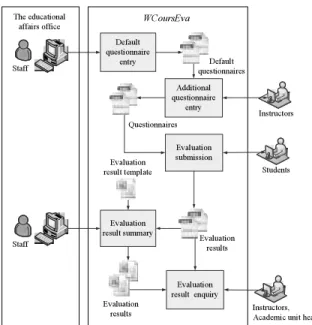
As shown in Fig. 1, XCourEva consists of the following five programs: (1) a default questionnaire entry program, (2) additional questionnaire entry program, (3) evaluation submission program, (4) evaluation result summary program, and (5) evaluation result enquiry program.
3.1 Default questionnaire entry program
Authorized administrative staff input the default questionnaires received from the heads of the academic units, which XCourEva stores in an XML file. The advantage of using the XML format instead of a relational database is the reduction in system development cost. Briefly, XML provides a way to describe structured data. That is, an XML file is a plain-text file that uses XML tags to define the logical structure of the document in a hierarchical fashion. XML uses a set of tags to delineate data elements, each of which comprise subelements and attributes. These
subelements, in turn, contain other subelements, and so on forming the hierarchy. Figure 2(a) illustrates an example of a questionnaire XML file for an academic unit whose code is “0202.” Here, the first two digits of the academic code are the faculty code, and the last two digits are the department code.
As seen in the schema diagram in Fig. 2(b), a default questionnaire XML file consists of academic data (defined by academic element) and questionnaire data (defined by q_section element). A subject_category value “1” denotes a lecture whereas a value of “2” denotes a
Fig. 1 Architecture of XCourEva system
(b) (a)
Fig. 2 (a) An example of questionnaire XML file; (b) the schema diagram of questionnaire XML file.
laboratory class. Default questionnaires are described by the q_section element, where the value of type attribute is set to “core.” The content of a questionnaire is described by the text subelement of the q element. The “core” questionnaires will be used for all the courses in the academic unit and cannot be edited by the course instructor. As the cardinality of the q element is 1..∞, then the number of questionnaires is greater than or equal to one. The value of the seq
attribute of the q element denotes the sequence number of the questionnaire. The content of the first questionnaire is “Overall, this is an excellent course.” In the schema diagram of Fig. 2(b), the comment element is optional. A comment value of “yes” for the second q element informs the system that a comment box must be presented. Therefore, the second additional question will be answered by the students on the 1−5 scale, together with a descriptive comment.
3.2 Additional questionnaire entry program
This program enables individual instructors to enter additional questions that pertain directly to their courses. The additional questions are defined by setting the value of the type attribute of the q element to “additional.” Note again that an instructor is allowed to read the default questionnaire but is not allowed to modify them.
3.3 Evaluation submission program
A student is allowed to participate in course evaluation via computers connected to the university network. After passing authentication, the student selects the course to evaluate from a list box showing the courses that the student is allowed to evaluate. The evaluation submission program reads the default and additional questionnaire XML file for the selected course and automatically generates a Web form. Once the students have submitted their entries, further changes will no longer be possible. The program then outputs the results for a subject answered by a student into an evaluation result XML file.
3.4 Evaluation result summary program
After course evaluation is complete, authorized administrative staff will execute the evaluation result summary program. For each course, this program computes the number of evaluators and average scores for each question from the submitted questionnaire XML files, and then generate a course evaluation result XML file that contains the average scores and comments, as shown in Fig. 3(a). The program also converts each a course evaluation result XML file into an Excel file with a bar chart. In order to reduce programmer burden, the built-in XML data import function of Excel is invoked. Briefly, the system manager adds the evaluation summary XML schema [10] shown in Fig. 3(b) to a workbook called the course evaluation template file through the XML map provided by Excel and binds data from elements of the XML schema to cells and columns on the worksheet. Thus, the XML data import method automatically imports the data from an evaluation summary XML file into the course evaluation template file, which is subsequently saved as an Excel file containing evaluation summary result of the course, as shown in Fig. 4. Note that in this figure, the right window is the XML structure task pane showing the XML schema elements being bound to cells and columns on the worksheet.
3.5 Course evaluation result enquiry program
The program allows only authorized users to retrieve the course evaluation results. After the user selects a course from a list of courses that the user is allowed to retrieve, the program opens the Excel file that contains the selected course’s evaluation results and presents a bar-chart. An example of an outputted course evaluation result Excel file is shown in Fig. 4. By selecting “yes” in the comment column, users can download the text file containing the students’ comments on the corresponding question.
(a)
(b)
Fig. 3 (a) example of an evaluation summary XML file; (b) schema diagram of the evaluation summary XML file
Fig. 4 Screenshot of questionnaire summary result of a course
4. System Implementation and Performance Evaluation
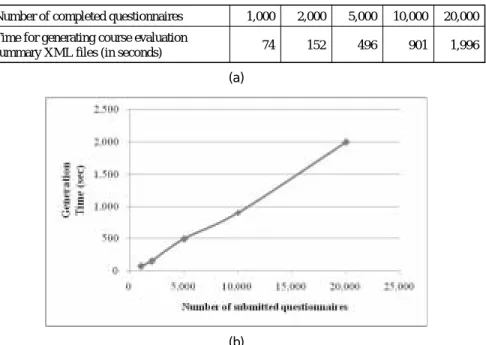
The programs and data files comprising this system run on the Windows Server 2003 R2 (Standard Edition with Service Pack 2) environment. Internet Information Services (IIS) 6.0 [11] is employed as the Web server for questionnaire input, and data retrieval is supported via the Microsoft Internet Explorer Web browser. XCourEva was developed using ASP.NET technology in order to efficiently handle dynamically generated Web pages. Since the generation of a course evaluation summary XML file is the most time consuming task, we use this generation time as a parameter to evaluate system performance. An experiment was performed on a server equipped with a Pentium!3.4 GHz processor and 1 GB of main memory, and the results are shown in Fig. 5(a) As seen in Fig. 5(b), a linear relationship was seen between the time taken and the number of completed questionnaires.
5. Conclusion
This paper introduced a new Web-based course evaluation system called XCourEva, which is being developed to meet the specific needs of individual university academic units. These needs include the ability to customize questionnaires for individual academic units and instructors, the need for improving the quality of student feedback, the ability to generate proper statistics, and low system development and maintenance cost. These needs are fulfilled by using XML technology: storing data in XML format and converting course evaluation summary XML files into Excel spreadsheets. Thus, XCourEva offers customized reporting options, exploiting the
Number of completed questionnaires 1,000 2,000 5,000 10,000 20,000 Time for generating course evaluation
summary XML files (in seconds) 74 152 496 901 1,996
(a)
(b)
Fig. 5 (a) Time taken in generating course evaluation summary XML files; (b) Course evaluation summary XML file generation test result
multiple data presentation methods provided by Excel. XCourEva also provides the ability for instructors to conduct course evaluation as often as they want during a semester so that they can obtain student feedback to improve their teaching methodology before a semester is complete. Each time an evaluation is conducted, additional questions can be added to the questionnaires.
Acknowledgment
The author would like to thank Matsumura Yuta and Kai Yumiko for their hard work and dedication during the analysis, design, implementation, and testing of this system.
References
1.H. Marsh, Students’ evaluations of university teaching, International Journal of Psychology,
n.39, v.5-6, p.40-40, 2004.
2.M.T. Thielsch, Y. Grabbe, K. Haaser and R. Moeck, Course evaluation online: Students’
evaluation of university teaching by web based assessment technology, http://www.gor.de/gor 05/index_4.html (13 August 2010).
3.J. Paskey, FAST!-Seeing Student Assessment in a Brand New Light, http://www.getfast.ca/ fast.pdf (14 Aug 2010).
4.Academic Management Systems, http://www.academicmanagement.com/products/course_
eval.php
5.J. Freire and C. José, SW3A: Web-Based System for Academic Assessment and Follow-Up,
Int. Conf. on Engineering and Education 2007, Coimbra, Portugal, Sep 2007.
6.H. Hakimzadeh and L. Williams, IU-EVAL: An Electronic Course Evaluation System,
Proceedings of the 34th annual ACM SIGUCCS fall conference (SIGUCCS’06), pp.131-134, November 5-8, 2006, Edmonton, Alberta, Canada.
7.W3C. 2006.“Extensible Markup Language (XML) 1.0 (Fourth Edition)”, http://www.w3.org
/TR/2006/REC-xml-20060816/.
8.J. Liberty, D. Hurwitz. 2003. Programming Asp.Net, Oreilly & Associates Inc.
9.Microsoft 2010. Microsoft Excel 2003/2007/2010 Help. http://office.microsoft.com/ja-jp/
excel-help/ (14 Aug 2010).
10.W3C. 2001. “XML Schema”, http://www.w3c.org/XML/Schema.
11.Microsoft. 2002. “Technical Overview of Internet Information Services (IIS) 6.0”, http://
www.microsoft.com/windowsserver2003/techinfo/overview/iis.mspx.