序論
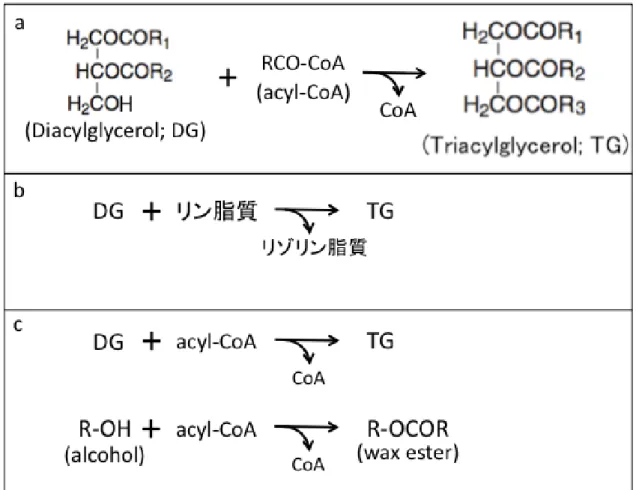
Triacylglycerol(TG; Fig. 0-1e)は全ての真核生物と一部の原核生物で産生されると言わ れている(Athenstaedt and Daum, 2006; Alvarez and Steinbuchel, 2002)。真核生物におい て 、 TG 合 成 に 関 与 す る 酵 素 は い く つ か 知 ら れ て お り 、 acyl-CoA diacylglycerol acyltransferase (DGAT) と し て DGAT1 お よ び DGAT2 や 、 phospholipid:diacylglycerol acyltransferase (PDAT)が挙げられる。DGAT は、acyl-CoA の acyl 基を DG に転移する活 性を示す(Fig. 0-2a; Liu et al., 2012; Shi and Cheng, 2009)。主要なものとして、膜結合 O- acyltransferase のスーパーファミリーに属する DGAT1 と、monoacylglycerol acyltransferase や wax alcohol acyltransferase と近縁な DGAT2 の異なる型のものがあり、両者は各々独 自に獲得されたと結論づけられている(Holmes, 2010; Turchetto-Zolet et al., 2011)。TG 合 成に acyl-CoA を用いない酵素として PDAT が知られている。PDAT はリン脂質からの アシル基を DG に転移する酵素として報告された(Fig. 0-2b; Dahlqvist et al., 2000)。
Chlamydomonas reinhardtii においては、PDAT がガラクト脂質をアシルドナーとして、
または 2 分子の DG から TG を合成し、更に TG、リン脂質、糖脂質およびコレステロ ールエステルを基質としてアシル基加水分解活性を示すことが報告されている(Yoon et
al., 2012)。原核生物において報告された TG 合成酵素の型は 1 つのみで、2 機能性の酵
素である wax ester synthase/diacylglycerol acyltransferase(WS/DGAT)によって触媒される (Fig. 0-2c; Stöveken et al., 2005; Wältermann et al., 2005; Röttig and Steinbüchel, 2013)。 TG はβ酸化の基質となる脂肪酸を含み、従来、炭素やエネルギーの貯蔵物質と捉え られてきた。植物における TG 蓄積の律速酵素は DGAT であり、Arabidopsis における DGAT の過剰発現は種子の TG 含有量を増加させたと報告された(Ichihara et al., 1988;
Perry and Harwood, 1993; Jako et al., 2001)。種子植物の種に蓄積された TG からは、
発 芽 の 際 に 構 成脂 肪 酸が β 酸 化 に よ るエ ネ ルギ ー 源 , あ る い は 糖 新生 の た め の 炭素源として動員される(Quettier and Eastmond, 2009; Murphy, 2005)。藻類におい ては、窒素源または硫黄源の欠乏等の環境ストレス条件下、細胞質に脂肪滴とし て蓄積することが広く知られている(Boyle et al., 2012; Breuer et al., 2012; Cakmak
et al., 2012; Sato et al., 2014; Hu et al., 2008; Wang et al, 2009)。藻類は TG 合成に
さ れ る た め 、 窒 素 欠 乏 条 件 の 感 受 性 が 強 く な っ た と 報 告 さ れ て い る (Li et al., 2012)。 TG は 細 胞 膜 構 造 の 恒 常 性 の 維 持 に お い て 役 割 を 果 た す と も さ れ て い る 。 Arabidopsis の葉緑体において、極性脂質のうち、非二重層脂質である MGDG は、 耐凍性獲得の際、膜構造維持のために分解される。その際生成する DG もまた膜 構造を乱し得るので、TG 合成系に入り膜から隔離される(Moellering et al., 2010)。 また、紅藻 Porphyridium cruentum や緑藻 Parietochloris incisa では窒素欠乏下、 多価不飽和脂肪酸を含む TG を蓄積し、窒素源を得た際には脂肪滴の消失と葉緑 体膜脂質の再生が行われる。TG に含まれる多価不飽和脂肪酸は低温環境で速や か に 膜 脂 質 の 不 飽 和 度 を 高 め る た め 役 立 つ と 言 う (Cohen et al., 2000; Khozin-Goldberg et al., 2005)。珪藻 Thalassiosira pseudonana の DGAT2 は、多価不飽和脂 肪酸に高い基質特異性を持つことが知られている(Xu et al., 2013)。脂質は細胞に とって毒ともなりえる。特に、多価不飽和脂肪酸は膜の流動性を高めるが、飽和 脂肪酸に比べて 活性酸 素種の影響を受 けやす い。脂質過酸化 反応は 連鎖的に起 こり、膜へ重大なダメージを及ぼす(Porter, 1986)。外因性の不飽和脂肪酸が過酸 化脂質蓄積の増 加を引 き起こすことは シアノ バクテリアや酵 母で示 されており (Sakamoto et al., 1998; Do et al., 1996)、酵母の TG 合成系欠損変異株は野生株に 比べて不飽和脂肪酸への感受性が高く、TG 合成系が脂肪酸による毒性の緩衝剤 としての役割を担っていると報告された(Petschnigg et al., 2009)。極性脂質の代 謝を支える中間代謝産物としての TG の役割も見出だされており、酵母では TG 代謝がリン脂質代謝に貢献することが知られている(Rajakumari et al., 2010; Mora
et al., 2012)。また哺乳類の表皮においては、アシルセラミドの合成に TG の加水
光合成生物の研究において、シアノバクテリアは葉緑体のモデル生物として用いられ る。特に単細胞性で窒素固定能を持たないシアノバクテリアである Synechocystis sp. PCC 6803(以下、PCC 6803)は全ゲノムの塩基配列が決定されており、遺伝子改変も容易であ ることから頻用される。16S rRNA 配列に基づく系統解析などから、葉緑体の起源は細 胞内共生をしたシアノバクテリアであるとされ(Turner et al., 1999)、光合成に関する生 化学反応や複合体,膜構造などに共通性が見られる。シアノバクテリアの極性脂質は主 に 、 3 種 の グ リ セ ロ 糖 脂 質 、 即 ち MGDG 、 digalactosyl diacylglycerol (DGDG) 、 sulfoquinovosyl diacylglycerol (SQDG)と唯一のリン脂質 phosphatidylglycerol (PG)から構 成される(Fig. 0-1a-d; Stanier and Cohen-Bazire, 1977; Sato and Wada, 2009)。SQDG を欠き、 チラコイド膜を持たない Gloeobacter を唯一の例外として(Selstam and Campbell, 1996)、 これら 4 種のグリセロ脂質は全ての酸素発生型光合成生物に共通しており、チラコイド 膜を構築し、光合成の場としてその機能の発現に貢献している(Gounaris et al., 1986)。チ ラコイド膜には光合成を担う膜タンパク質が多く存在し、膜の恒常性の維持は重要であ る。例えば、PCC 6803 において、SQDG は光化学系 II が十分な活性を示す上で必要で あり、PG は光化学系 I 複合体の構築やその高次構造の維持のためには欠かせない(Sato, 2004; Sato et al., 2000)。シアノバクテリアにおいて、極性脂質の合成経路や関与する遺 伝子も調べられている。 一方、シアノバクテリアの中性脂質としては、極性脂質合成の中間代謝産物あるいは 分解産物である free fatty acid(FFA), monoacylglycerol(MG), diacylglycerol(DG)の他に、種 によってはエネルギーや炭素の貯蔵物質として alkane や polyhydroxybutyrate(PHB; Fig. 0-1f) の存在が知られ、また TG の検出の報告もある(Taranto et al., 1993; Ramadan et al., 2008; Peramuna and Summers, 2014)。alkane, PHB, TG 等の中性脂質は、高度に疎水性の ため浸透圧に影響せず、高エネルギー化合物として貯蔵に適する。
alkane は、Synechococcus sp. PCC 7002(以下、PCC 7002)では産生されないが、Gloeobacter,
Prochlorococcus, Synechocystis など系統上の所属するクレード(第二章 Fig. II-14 の 16s
rRNA 系統樹参照)によらず多くのシアノバクテリアで貯蔵される。alkane 合成系として、 acyl-ACP を NADPH によってアルデヒドに還元する acyl-ACP reductase (PCC 6803 にお ける遺伝子は sll0209)および、得られたアルデヒドを脱カルボニル化し alkane を生成す る aldehyde decarbonylase (同 sll0208)がゲノム解析によって見出だされている(Schirmer et
al., 2010; Wang et al., 2013)。
CoA reductase; PhaB (slr1994), および PhaE (slr1829)と PhaC (slr1830)のヘテロ二量体に より構成される PHB synthase が知られている。PhaA は 2 分子の acetyl-CoA から acetoacetyl-CoA を 合 成 し 、 次 い で PhaB が NADPH を 用 い て acetoacetyl-CoA を hydroxybutyryl-CoA に還元する。最後に PhaE と PhaC によって hydroxybutyryl-CoA が
PHB に重合される。蓄積された PHB は、ストレスから解放されたとき PHB depolymerase によって分解され、生育の為の炭素源やエネルギー源として利用されると考えられる。 窒素欠乏時、PCC 6803 では、エネルギーと炭素の貯蔵物質としてグリコーゲンを蓄積 すると同時に、解糖系遺伝子群が活性化し、ピルビン酸, アセチル CoA を経て、PHB を蓄積する。また、同じくアセチル CoA を入り口とする TCA サイクルにより産生され る有機酸の量も大きく増加する(Osanai et al., 2014)。このように複数の炭素化合物を合 成することで、ストレス下での炭素源やエネルギーの制御を柔軟に行っていると考えら れる。また PHB は炭素やエネルギーの貯蔵物質として合成されるとともに、細胞内の レドックスバランスの変化も PHB 合成の要因となると考えられる。窒素欠乏下、同時 に光化学系 II の阻害剤である DCMU を添加すると NADPH/NADP+比の減少とともに PHB 合成活性が低下し、ATP 合成を抑制する CCCP や DCCD を添加した場合には逆に NADPH/NADP+比の増加とともに PHB 合成活性は高くなる(Hauf et al., 2013)。
【生物材料】
本研究に用いた株を Table M1 に記す。
・Cyanobacterium Synechocystis sp. PCC 6803(PCC 6803)
本研究第二章で主に用いた PCC 6803 は、C.P.Wolk が American Type Culture Collection から得た PCC 6803 を元に、John G.K.Williams らが自然 突然変異によ り単離したグルコース耐性株(所謂 GT 株)で、1996 年に全ゲノムの塩基配列が決 定された(Hirose et al., 2009)。この株は、当研究室の岡田克彦氏が理化学研究所 より譲り受け、継代培養していたものである。
【実験操作】 培養
フィルターを通して滅菌した Air で通気し、光強度 約 50 μmol photons・m-2・
s-1, 30℃で、培地には 炭素源となる酢酸やグルコース等を含まない無機培地で、
光独立栄養的培養で各実験を行った。光源には白色蛍光灯(東芝)を使用した。 C. kessleri の培地は市販のガンボーグ B5(和光, 399-00621 ; Gamborg et al., 1968) を規定の 4 倍に希釈。
C. reinhardtii には 3/10 HSM を用いた。
ストレス条件培養として、基本培地の希釈, NaCl や Sorbitol の添加, 希釈した 海 水 ま た は 人 工海 水 , あ る い は 特 定 の栄 養 元素 を 抜 い て 作 製し た 培地 を 用 い た 培養を行った。 株の保存 1.2 %寒天培地上で弱光, 30℃で保存し、約 1 ヶ月ごとに継代培養することに より維持した。 シアノバクテリアを冷凍保存する場合は 5 % DMSO を含む基本培地に細胞を 懸濁し、液体窒素で冷凍し、-85℃のディープフリーザーで保存した。 改変 DNA コンストラクトの作製 方法 1-3 は遺伝子の破壊を目的とした。破壊される遺伝子の両端に 500 bp 以 上の相同組換え可能な領域を設けるようにプライマーの位置を設定した。 方法 4 はシアノバクテリア中での遺伝子の過剰発現を目的とした。過剰発現 用ベクターには、スペクチノマイシン耐性遺伝子, 大腸菌 ConII プロモーターと その下流に遺伝子挿入部位(SmaI サイト)が設けられ、それらの両末端にシアノ バクテリアゲノムへの相同組換え領域が設けられているものを用いた。 使用したプライマーは Table M2 を参照。 方法1
方法 3
① primer set A で目的遺伝子を PCR にて増やした。
② PCR 産物と pGEM-T (Easy) Vector をライゲーションし、大腸菌(JM109)に導 入、プラスミドを抽出した。
③ primer set B で目的遺伝子の内側を末端として、ベクター全長を KOD -Plus- (TOYOBO)による PCR で増幅した(iPCR 法)。
④ 以下、方法 1 の④以降と同様。
方法 4
① primer set で目的遺伝子を KOD -Plus-を用いた PCR にて増やした。
培地(シアノバクテリア) BG11 培地(通常培地 ) Compound stockⅠ 2 mL stockⅡ 50 mL stockⅢ 2 mL stockⅣ 1 mL A6 1 mL 1M TES-KOH(pH 8.2) 20 mL Up to 1 L D.W. stockⅠ以外を上記のように混ぜ、オートクレーブ滅菌した後、stockⅠを 加えた。 ○stockⅠ Compound Citric acid 0.3 g
Ferric ammonium citrate 0.3 g
BG11 培地(栄養欠乏 培養実験用) Compound stockⅠ 2 mL stockⅡ* 50 mL stockⅢ 2 mL stockⅣ 1 mL A6** 1 mL Up to 1 L D.W. stockⅠ以外を上記のように混ぜ、HCl を用いて pH 8.2 に調製し、オートク レーブ滅菌した後、stockⅠを加えた。
* stock Ⅱ は 欠 乏 さ せ た い 栄 養 に 合 わ せ 、 通 常 培 地 の stock Ⅱ よ り NaNO3,
全脂質抽出
Bligh & Dyer の方法で行った(Bligh and Dyer, 1959; Sheng et al., 2011)。
①任意の濁度になるまで生育させた細胞培養液を 50 mL ネジ蓋付きガラス遠心 管(IWAKI)に移し、4℃、3000 rpm で 15 分間遠心し、沈殿させた。 ②上清をデカンテーションより取り除いた後、沈殿にメタノール 10 mL を加え、 ボルテックスミキサーにより 1 分間撹拌した。この混合液にクロロホルム 10 mL を加え、ボルテックスミキサーにより 1 分間撹拌した。さらに、精製水 5 mL を 加えて、ボルテックスミキサーにより 1 分間撹拌した。 ③この混合液を 4℃、3000 rpm で 10 分間遠心し、下層を 200 mL ナス型フラス コへ回収した。 ④この抽出液を、エバポレーターを用いて減圧濃縮した。 ⑤もう一度クロロホルム 10 mL を加え、ボルテックスミキサーにより 1 分間撹 拌し、4℃、3000 rpm で 10 分間遠心し、下層を先のナス型フラスコに回収した 後、再びエバポレーターを用いて、減圧濃縮を行った。 ⑥クロロホルム:メタノール(2:1, v/v)に溶解し、すりガラス付き試験管(IWAKI) に移した(すぐに使用しない場合は密封し−20℃で保存)。 薄層クロマトグラフィ(TLC)による脂質の分離 ①抽出した全脂質を、エバポレーターを用いて減圧濃縮し、これを約 100 μL の クロロホルム:メタノール(2:1, v/v)に溶解した。 ②120℃で 30 分間乾熱し、活性化させたシリカゲル TLC プレート(5721 Silicagel 60, Merck, Darmstadt, Germany)に①のサンプ ルを横 数 cm, 縦 1 cm の幅をもた せてスポットし た。横 幅は細胞量によ り適宜 変更した。総脂 質の展 開であれば 730 nm における濁度 1×50 mL 相当の細胞 量で 1.5 cm 程度が適 当。
③風乾後、必要に応じた各混合有機溶媒を展開溶媒として展開させ、ドライヤー を用いて乾燥させた後、プリムリン法を用いて脂質を検出した。
TG lipase による脂質の分解
①TLC 板より単離した中性脂質サンプルから有機溶媒を除去し、DMSO と水を 各 50 μL 加え、加温しつつ超音波を当てた。
②水 790 mL, lipase from Aspergillus niger (Sigma) (Hennen et al., 1988) 20 mg, 1 M
クロロフィル(Chl)の測定 ①1 mL のサンプルに 1 μL の 10 % tween20 を加えボルテックスにかけた。 ②20, 000 ×g で 5 分間遠心した後上清を捨てた。 ③沈殿物にメタノール 1 mL を加えボルテックスにかけた後、20, 000 ×g で 5 分 間遠心した。 ④分光光度計で OD665,あるいは OD650においてメタノールをブランクとし、遠心 したサンプルの上清を 1 mL とり、測定した。本研究のシアノバクテリアは Chl a, 緑藻では Chl a+b を測定した。 クロロフィル a (μg/mL) = OD665× 13.42 クロロフィル a+b (μg/mL) = OD665×6.1+OD650×20.04 (Mackinney, 1941) フィコビリソーム量の測定 ①小試験管にサンプルを 1 mL ずつ入れた。 ②100℃で 1 分間熱した後、室温まで冷ました。 ③分光光度計で、加熱前の OD620と OD750、加熱後の OD620と OD750を測定した。 フィコビリソーム量(相対値)
={(OD620(前)-OD750(前))-(OD620(後)-OD750(後))}×1000
遺伝子の検索
CyanoBase(Hirosawa et al., 1995; Fujisawa et al., 2016)等のデータベースを用い てシアノバクテリアのゲノム上の遺伝子を検索した。また、CyanoBase で得られ た ORF のコードするアミノ酸配列から、NCBI(National Center for Biotechnology Information)の BLAST(McGinnis and Madden, 2004)を用いてさらにホモログを検 索した。
水溶性タンパク質, 膜タンパク質の判別
ア ミ ノ 酸 配 列 か ら 、 膜 タ ン パ ク 質 を 予 測 す る ツ ー ル SOSUI(Hirokawa et al., 1998)または TMHMM(Krogh et al., 2001)により予測した。
アライメントの作製とアミノ酸配列比較
各 アミ ノ 酸配 列を 、Clustal W(Larkin et al., 2007)およ び Seaview(Galtier et al., 1996)用いてアライメントおよび比較した。
系統樹の作成
アライメント後ギャップを削除した配列等を元に、Clustal X(Larkin et al., 2007)により NJ 系統樹(Saitou and Nei, 1987; Felsenstein, 1985)を作成し、 NJplot(Perrière and Gouy, 1996)で表示した。
タンパク質の二次構造および三次構造の予測
アミノ酸配列から、構造が既知のタンパク質を参照し、構造を予測するサービ スである Phyre2(Kelley and Sternberg, 2009; Jefferys et al., 2010)を活用し、全体あ るいは部分的な構造の参考に役立てた。
第一章 緑藻 Chlorella kessleri における、高浸透圧あるいは栄養欠乏と その複合ストレスによる TG 蓄積 緒言 藻類は、種によって差異があるが、様々なストレス条件で脂質を蓄積する(Kalpesh et al., 2012)。その高い増殖速度やバイオマスあたりの脂質蓄積量により、単位土地面積あ たりの脂質生産量は植物を大きく上回るとされる(Chisti, 2007)。なお、脂質蓄積の尺度 は研究によって、非水溶性有機溶媒可溶性物質の総体重量で表される場合,脂肪滴の体 積などで表される場合,または TG 等の個々の物質が定量的に表される場合など、様々 に表現されることに留意すべきである。また藻類により産生される脂質は、TG, ワック スエステル(Tucci et al., 2011), 長鎖不飽和ケトン(Tsuji et al., 2009), パラフィン系炭化水 素あるいはテルペン系炭化水素(Eroglu et al., 2011; Kaya et al., 2011)など、種により様々 である。更に研究により培養条件に違いがあり、例えば初期細胞量, 温度, 光強度, グル コース(Kaya et al., 2011)や酢酸(Fan et al., 2012; Ota et al., 2016)といった炭素源の有無な どにより、脂質産生量の数値的結果には大きな差が生じる。したがって、異なる研究の 間で脂質の生産性の比較を行う際には注意が必要である。産業としての油脂生産を期待 できる程度の脂質を蓄積する藻類は油性藻類(oleaginous algae)と呼ばれ、藻体乾重量あ たり 20-50 %程の油脂を産生するとされる(Yoshida et al., 2012)。藻類による、食用油, さ らに化石燃料の代替物質としての油脂生産は 20 年以上に渡り検討されてきた(Ratledge, 1993; Ratledge and Wynn, 2002; Chisti, 2007; Yoshida et al., 2012)。
そのような動きも加わり、近年、脂質蓄積を誘導する様々な生理条件が見出だされて いる。窒素欠乏が効果的に TG 蓄積を誘導することは広範囲の藻類で知られている。窒 素欠乏の他に、Chlorella pyrenoidosa, Parachlorella kessleri や Chlamydomonas reinhardtii などの緑藻でリンや硫黄, 鉄の欠乏においても TG 蓄積が誘導される(Fan et al., 2014; Li
et al., 2013; Sato et al., 2014; Ota et al., 2016; Boyle et al., 2012; Urzica et al., 2013)。珪藻 Thalassiosira pseudonana では、ケイ素欠乏条件によって TG 含量が増加する(Eizadora et al., 2009)。栄養欠乏以外では、高 pH 条件で Chlorella の胞子からの細胞遊離が阻害され
これまでに当研究室では、ガラス繊維フィルター状での緩やかな風乾により、
Chlorella kessleri (Parachlorella kessleri と同義; Krienitz et al., 2004; Yamamoto et al., 2005)
の TG 蓄積が誘導されることを報告している(Shiratake et al., 2013)。この条件では、液体 培養した培養液をガラス繊維フィルターで濾過した後、フィルター上に固定した細胞を 98 %の湿度と穏やかな光条件(15 μmol photons・m-2・s-1)の下培養しており、ガラス繊 維フィルター上の水分は徐々に失われ 4 日目には初期のレベルの約半分まで減少して いる。すなわち細胞にとって当条件は、周囲の水分の蒸発に伴う細胞の脱水条件かつ培 地を除去したことによる全栄養制限条件という、複合ストレスであると考えられた。こ こで見られる TG 蓄積の誘導に関わる根本的な環境因子を解明する為に、申請者は、C. kessleri または C. reinhardtii を液体培養中で高浸透圧(≒脱水)条件および全栄養制限条 件, もしくは両者の複合ストレス条件下で培養し、脂質を分析した。また、TG の産業 的生産への可能性を探るため、この複合ストレス条件を安価かつ豊富に存在する海水を 用いて再現した。本研究成果は 2016 年の Scientific Reports | 6:25825 に掲載された(Hirai
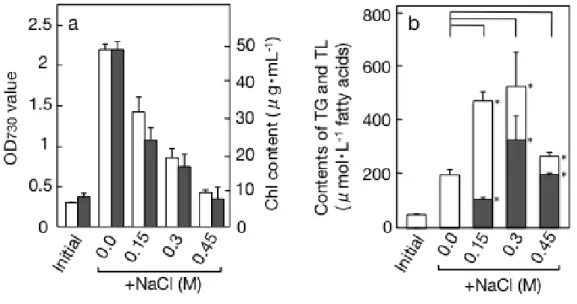
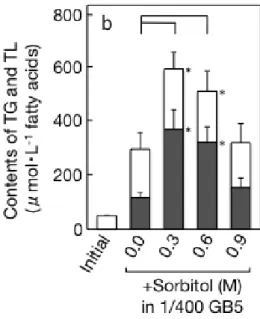
結果 高浸透圧ストレスが C. kessleri の TG 含量に及ぼす効果 当研究室では緩やかな空気乾燥が C. kessleri による TG 蓄積を誘発することを報告し ている。乾燥に伴う細胞の脱水が TG 蓄積を刺激することが示唆された。そこで、申請 者は、C. kessleri 細胞の脱水の影響を、液体培養にて高浸透圧環境に曝すことによって 評価した。前培養した細胞を、基本培地(無機培地 1/4 GB 5 による通常培養)あるいは高 浸透圧培地として低強度(0.3 M Sorbitol または 0.15 M NaCl), 中強度(0.6 M Sorbitol また は 0.3 M NaCl), 高強度(0.9 M Sorbitol または 0.45 M NaCl)に調製した培地で、それぞれ
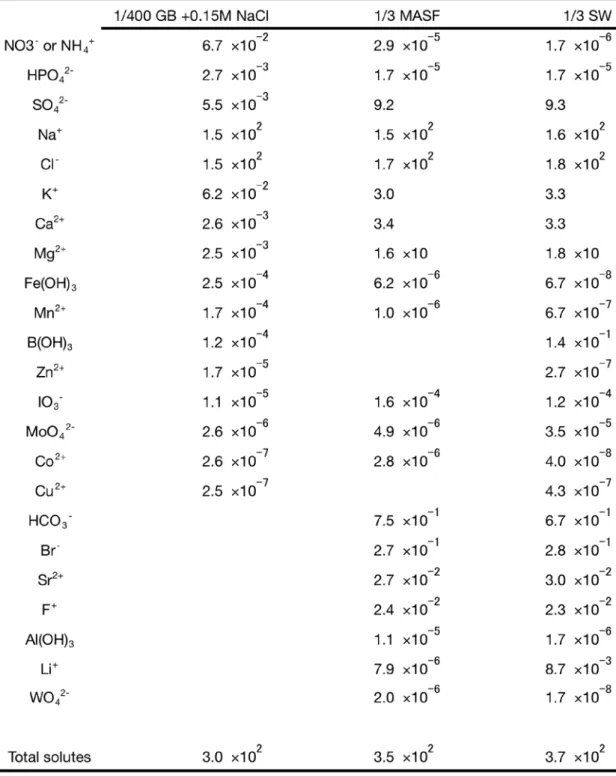
C. kessleri に対する混合ストレス培養への海水の利用 混合ストレスの容易な再現として、組成が公開されている人工海水(MASF; MARINE ART SF-1)と鎌倉海岸で採取した海水(SW; Seawater)を用いて実験を行った。MASF は、 高強度の高浸透圧ストレスと同等の、0.45M Na+と 0.51M Cl-を含み、全栄養欠乏培地と した 1/400 GB 5 に比べても N、P、Fe、Mn および Zn 源に乏しく、S に関しては 1/4 GB 5 よりも豊富に含まれる(Table 1)。この MASF の無希釈を高強度, 3 倍希釈したもの(1/3 MASF)を低強度の高浸透圧かつ栄養欠乏の混合ストレス培地として C. kessleri を培養し た。また、実際の海水を 3 倍希釈(1/3 SW)して用いた。この海水は組成未知であるが、 平成 26 年版 理科年表 第 87 冊(丸善, 東京)にある太平洋表層水の含有元素濃度を参照 し、Table 1 に付載した。
1/3 MASF, MASF, 1/3 SW とも、1 日目から脂肪滴が観察された(Fig. I-11)。
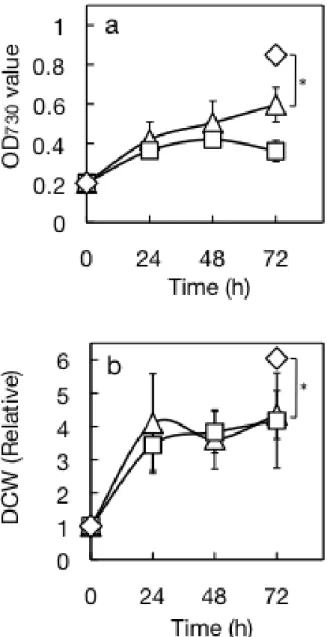
1/3 MASF で培養した細胞の生育は、濁度(OD730)と細胞乾重量(DCW; dry cells weight)
のどちらの指標で見ても、最初の 1 日の増加の後、停滞傾向に入った(Fig. I-8ab)。しか し培養液量あたりの TG は 1 日を過ぎても増え続け、3 日目で 294 μmol/L まで増加し た(Fig. I-9a)。総脂質も同様に増加し続けた(Fig. I-9b)。総脂質あたりの TG 含量はわずか 1 日で 64 mol%にまで急増し、その後の 2 日間は同水準を維持した(Fig. I-10a)。1 日目以 降、TG 極性脂質はほぼ同じ割合で増加していると読み取れた(Fig. I-9a,10a)。一方、乾 燥重量あたりの TG 含量は 1 日で 15.0 重量%、後の 2 日間でその倍近い 26.6 重量%に まで割合を増やし続けた(Fig. I-10b)。
MASF では、総脂質あたりの TG 含量は 1/3 MASF と同等だった(Fig. I-10a)が、生育 (Fig. I-8ab), 培養液あたりの脂質量(Fig. I-9ab)および乾重量あたりの TG 量(Fig. I-10b)に ついては傾向として 1/3 MASF より低水準であった。この結果は、1/400 GB 5 に NaCl を添加した時の結果と合致した(Fig. I-4ab, 5b)。
考察 本研究は、空気乾燥時の C. kessleri 細胞で TG 蓄積を誘導した因子の解明を目的とし て行った。得られた結論として、まず、高浸透圧が C. kessleri の TG 蓄積を導く新規の 環境因子であった。これは Sorbitol と NaCl の 2 種類の溶質を用いて示された。各溶質 による高浸透圧ストレスは、それぞれ TG 蓄積を誘導したが、同じ浸透圧の培地では、 NaCl の TG 蓄積誘導効果は Sorbitol のそれより顕著であった。例えば、総脂質あたりの TG 蓄積量が最も顕著だった 0.45 M NaCl での TG 蓄積は、脂肪酸ベースで 75.3 mol %
にのぼった。一方、0.9 M Sorbitol では、48.5 %にとどまった。NaCl は、Na+および Cl-イ
オンに解離し、これが細胞内へ流入することにより、細胞内のイオン恒常性を乱す。 Sorbitol による、培地の単純な浸透圧の上昇は、脱水による一時的な細胞内イオン濃度 の上昇を伴うだろうが、これは非イオン性の適合溶質の生産によってある程度解消され ると考えられ、イオンストレスの影響は限定的であろう。C. reinhardtii で、0.02-0.1 M の 低濃度 NaCl が TG 蓄積を誘導することは知られているが、高浸透圧の強度としては弱 く、イオンストレスに対する応答と考えられている(Siaut et al., 2011)。高塩濃度の NaCl による TG 蓄積の増強は、いくつかの研究で報告されてきたが、これは高浸透圧とイオ ンストレスの複合的なストレスが与えられるため、NaCl ストレスおける TG 蓄積の因 子を特定できていなかった。 興味深くは、Sorbitol あるいは NaCl による高浸透圧ストレスが、膜脂質合成を促すこ とが示唆された。これは TG 蓄積を誘導する窒素や硫黄などの栄養欠乏ストレスでは見 られない挙動であった。例えば、0.3 あるいは 0.6 M Sorbitol では、細胞濁度増加の抑制 が見られるにも関わらず、培養液あたりにおける極性脂質の量は通常培養より明らかに 増えていた。膜脂質の増加により、0.6 M Sorbitol における総脂質あたりの TG 含量は 40.4 %にとどまったが、TG と極性脂質を含む総脂肪酸の生産量は最も高い値を示した。
Cladophora vagabunda を含むいくつかの藻類や種子植物 Catharanthus roseus の懸濁細胞
ス繊維フィルター上の水分の減少は細胞の脱水より早いと考えられ、細胞内の水分は初 期の 50 %以上保持されていた可能性が高い。C. kessleri の通常培養下での細胞内浸透圧 が、Chlorella emersonii(Munns et al., 1982)と同等(0.24 osm/L)と仮定すると、空気乾燥細 胞の細胞内浸透圧は 0.48 M Sorbitol または 0.24 M NaCl に相当する。しかし、TG の生 産性は最終的には液体培地による複合ストレスのほうが優れていた。これはおそらく、 光強度の寄与が大きい(強光は液体培養中、TG 蓄積を促進するが、空気乾燥細胞では強 すぎる光が毒となる為、弱光により行った)。 C. kessleri も他の藻類と同じく、TG 合成に直接関わる遺伝子をゲノム中にいくつか 持ち、その遺伝子やあるいはその他の脂質代謝系遺伝子の発現も様々な調節および複数 通りの経路の内にあると思われる(Wang et al., 2014; Sato et al., 2014)。いまのところ、C.
Fig. I-1 Sorbitol 添加による C. kessleri の生育および培養液あたりの脂質含量への影響.
a, OD730値(白棒)またはクロロフィル含量(黒棒); b, 脂肪酸ベースでの脂質含量. TG(黒
Fig. I-2 NaCl 添加による C. kessleri の生育および培養液あたりの脂質含量への影響. a,
OD730値(白棒)またはクロロフィル含量(黒棒); b, 脂肪酸ベースでの脂質含量. TG(黒棒),
Fig. I-3 全栄養制限または, かつ Sorbitol 添加による C. kessleri の生育および培養液あ
たりの脂質含量への影響. a, OD730値; b, 脂肪酸ベースでの脂質含量. TG(黒棒), TL(総脂
Fig. I-4 全栄養制限または, かつ NaCl 添加による C. kessleri の生育および培養液あたり
の脂質含量への影響. a, OD730値; b, 脂肪酸ベースでの脂質含量. TG(黒棒), TL(総脂質;
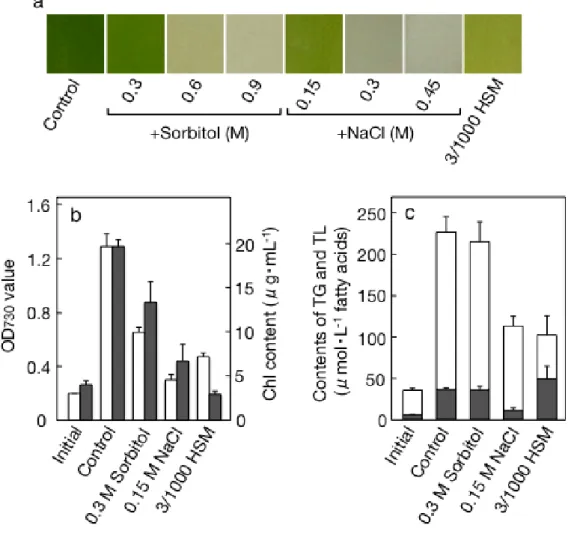
Fig. I-7 各条件での C. reinhardtii の生育および培養液あたりの脂質含量への影響. 基本 培地(Control; 3/10 HSM), 高浸透圧条件(Sorbitol あるいは NaCl 添加による)および全栄
養制限(3/1000 HSM). a, 細胞培養液の色; b, OD730値(白棒)またはクロロフィル含量(黒
Fig. I-9 海水を用いた高浸透圧かつ栄養制限条件下での C. kessleri の、液量あたりの脂
質含量. a, TG に含まれる脂肪酸量; b, 総脂質に含まれる脂肪酸量. △, 1/3 MASF;
□
,第二章 シアノバクテリアにおける TG の検討と合成酵素
緒言
Nostoc commun や Spirulina platensis が TG を含んだという報告があるが(Taranto et al., 1993; Ramadan et al., 2008) 、 そ れ は コ ン タ ミ に よ る も の の 可 能 性 が あ る 。 Nostoc
考察
緑藻の TG のような役目は、PCC 6803 では主に PHB が担うのではないだろう か。C. reinhardtii はタンパク質合成抑制時に TG を蓄積するが(Sato et al., 2014)、PCC 6803 においても、クロラムフェニコールの添加あるいはアルギニン合成系の遺 伝子破壊によってタンパク質合成を抑制した際、PHB 顆粒を蓄積することを申 請者は観察しており(Fig. S-1 下段左右)、これも緑藻における TG と PCC 6803 に おける PHB の役割の生理学的相似性を支持した。 申請者は修士課程までに、Syn-NLs の分解に関わる代謝系酵素の候補遺伝子と して、PCC 6803 ゲノム中に TG lipase のホモログをコードする 2 つの ORF、す なわち sll1969 および sll0482 を見出だしている。アミノ酸配列で、Sll1969 は
Bacillus subtilis の分泌性 lipase である lipase class2(Pouderoyen et al., 2001)と 32 %
の相同性(Fig. S-4a)を示し、phyre2 で予測された 3D 構造も Bacillus subtilis のも のと良く似ており、しかし Candida antarctica の lipase(Uppenberg et al., 1994)に 見 ら れ る 様 な Bacillus subtilis lipase に は 無 い lid( 蓋 ) 構 造 や Pseudomonas
aeruginosa の lipase にある酸性多糖に結合すると示唆される残基(Dimitrijevic et al., 2011; Tielen et al., 2013) が 見 受 け ら れ た ( 平 井 修 士 論 文 ) 。 Sll0482 は Thermomyces lanuginosus の lipase class3(Fernandez-Lafuente, 2010)と 32 %の相同
性(Fig. S-4b)を示していた。sll1969 と sll0482 の双方ともに、lipase に特徴的な GXSXG のモチーフと, lipase 活性に重要である触媒三残基を構成する H, S, D お よ び セ リ ン 側 に オ キ シ ア ニ オ ン ホ ー ル と 見 ら れ る 構 造 が 認 め ら れ た (Fig.S-5ab, 6ab)。また、sll1969 ホモログはシアノバクテリアの 16s rRNA の分 子系統樹中、
DGAT2 ホ モ ロ グ よ り 広 範 囲 の 種 に 見 ら れ た ( デ ー タ 非 公 開 ) 。 分 泌 性 の lipase
参考文献
Allen, M. M. (1968)
Simple condition for growth of unicellular blue-green algae on plates. J. Phycol. 4, 1-4
Alvarez, H. M. and Steinbuchel, A. (2002) Triacylglycerols in prokaryotic microorganisms. Appl. Microbiol. Biotechnol. 60, 367-376
Ariño, X., Ortega-Calvo, J. J., Hernandez-Marine, M. and Saiz-Jimenez, C. (1995)
Effect of sulfur starvation on the morphology and ultrastructure of the cyanobacterium Gloeothecesp. PCC 6909.
Arch. Microbiol. 163, 447-453
Athenstaedt, K. and Daum, G. (2006)
The life cycle of neutral lipids: synthesis, storage and degradation. Cell. Mol. Life Sci. 63, 1355-1369
Bansal, K., McCrady, J., Hansen, A. and Bhalerao, K. (2008)
Thin layer chromatography and image analysis to detect glycerol in biodiesel. Fuel 87, 3369-3372
Battistuzzi, F. U. and Hedges, S. B. (2009)
A major clade of prokaryotes with ancient adaptations to life on land. Mol. Biol. Evol. 26, 335–343
Bernstein, F. C., Koetzle, T. F., Williams, G. J., Meyer, E. F. Jr., Brice, M. D., Rodgers JR, Kennard, O., Shimanouchi, T. and Tasumi, M. (1977)
Boyle, N. R., Page, M. D., Liu, B., Blaby, I. K., Casero, D., Kropat, J., Cokus, S. J., Hong-Hermesdorf, A., Shaw, J., Karpowicz, S. J., Gallaher, S. D., Johnson, S., Benning, C., Pellegrini, M., Grossman, A. and Merchant, S. S. (2012)
Three acyltransferases and nitrogen-responsive regulator are implicated in nitrogen starvation-induced triacylglycerol accumulation in Chlamydomonas.
J. Biol. Chem. 287, 15811-15825
Breuer, G., Lamers, P. P., Martens, D. E., Draaisma, R. B. and Wijffels, R. H. (2012)
The impact of nitrogen starvation on the dynamics of triacylglycerol accumulation in nine microalgae strains.
Bioresour. Technol. 124, 217-226
Cakmak, T., Angun, P., Demiray, Y. E., Ozkan, A. D., Elibol, Z. and Tekinay, T. (2012)
Differential effects of nitrogen and sulfur deprivation on growth and biodiesel feedstock production of Chlamydomonas reinhardtii.
Biotechnol. Bioeng. 109, 1947-1957
Cao, H. (2011)
Structure-function analysis of diacylglycerol acyltransferase sequences from 70 organisms. BMC Res. Notes. 4, 249
Chisti, Y. (2007)
Biodiesel from microalgae. Biotechnol. Adv. 25, 294-306
Cohen, Z., Khozin-Goldberg, I., Adlerstein, D. and Bigogno, C. (2000)
The role of triacylglycerol as a reservoir of polyunsaturated fatty acids for the rapid production of chloroplastic lipids in certain microalgae.
Biochem. Soc. Trans. 28, 740-743
Dahlqvist, A., Stahl, U., Lenman, M., Banas, A., Lee, M., Sandager, L., Ronne, H. and Stymne, S. (2000) Phospholipid:diacylglycerol acyltransferase: an enzyme that catalyzes the acyl-CoA-independent
formation of triacylglycerol in yeast and plants. Proc. Natl. Acad. Sci. U. S. A. 97, 6487-6492
Dimitrijevic, A., Velickovic, D., Rikalovic, M., Avramovic, N., Milosavic, N., Jankov, R. and Karadzic, I. (2011)
Simultaneous production of exopolysaccharide and lipase from extremophylic Pseudomonas aeruginosa san-ai strain: A novel approach for lipase immobilization and purification.
Carbohydrate Polymers 83, 1397-1401
Do, T. Q., Schultz, J.R. and Clarke, C. F. (1996)
Enhanced sensitivity of ubiquinone-deficient mutants of Saccharomyces cerevisiae to products of autoxidized polyunsaturated fatty acids.
Proc. Nati. Acad. Sci. U. S. A. 93, 7534-7539
Dorne, A. J., Joyard, J. and Douce, R. (1990) Do thylakoids really contain phosphatidylcholine? Proc. Natl. Acad. Sci. U. S. A. 87, 71–74
Dvořák, P., Casamatta, D. A., Poulíčková, A., Hašler, P., Ondřej, V. and Sanges, R. (2014) Synechococcus: 3 billion years of global dominance.
Mol. Ecol. 23, 5538-5551
Eizadora, T. Y., Frank, J. Z., Pamela, D. L., Sara, G., Blake, A. S. and Todd, W. L. (2009) Triacylglycerol accumulation and profiling in the model diatoms Thalassiosira pseudonana and Phaeodactylum tricornutum (Baccilariophyceae) during starvation.
J. Appl. Phycol. 21, 669-681
Eroglu, E., Okada, S. and Melis, A. (2011)
Hydrocarbon productivities in different Botryococcus strains: comparative methods in product quantification.
J. Appl. Phycol. 23, 763-775
Fan, J., Andre, C. and Xu, C. (2011)
A chloroplast pathway for the de novo biosynthesis of triacylglycerol in Chlamydomonas reinhardtii. FEBS Lett. 585, 1985-1991
Fan, J., Yan, C., Andre, C., Shanklin, J., Schwender, J. and Xu, C. (2012)
Oil accumulation is controlled by carbon precursor supply for fatty acid synthesis in Chlamydomonas reinhardtii.
Plant Cell Physiol. 53, 1380-1390
Fan, J., Cui, Y., Wan, M., Wang, W. and Li, Y. (2014)
Lipid accumulation and biosynthesis genes response of the oleaginous Chlorella pyrenoidosa under three nutrition stressors.
Biotechnol. Biofuels. 7, 17
Felsenstein, J. (1985)
Confidence limits on phylogenies: an approach using the bootstrap. Evolution 39, 783-791
Fernandez-Lafuente, R. (2010)
Lipase from Thermomyces lanuginosus: Uses and prospects as an industrial biocatalyst. J. Mol. Catal. B: Enzymatic, 62, 197-212
Flemming, H. C. and Wingender, J. (2010) The biofilm matrix.
Galtier, N., Gouy, M. and Gautier, C. (1996)
SEAVIEW and PHYLO_WIN: two graphic tools for sequence alignment and molecular phylogeny. Comput. Appl. Biosci. 12, 543-548
Gamborg, O. L., Miller, R. A. and Ojima, K. (1968)
Nutrient requirements of suspension cultures of soybean root cells. Experimental Cell Research 50, 151-158
Good, N. E., Winget, G. D., Winter, W., Connolly, T. N., Izawa, S. and Singh, R. M. M. (1966) Hydrogen ion buffers for biological research.
Biochemistry 5, 467-477
Gounaris, K., Barber, J. and Harwood, L. (1986) The thylakoid membranes of higher plant chloroplasts. Biochem. J. 237, 313-326
Guckert, J. B. and Cooksey, K. E. (1990)
Triglyceride accumulation and fatty acid profile changes in Chlorella (Chlorophyta) during high pH-induced cell cycle inhibition.
J. Phycol. 26, 72-79
Hauf, W., Schlebusch, M., Huge, J., Kopka, J., Hagemann, M. and Forchhammer, K. (2013) Metabolic changes in Synechocystis PCC 6803 upon nitrogen-starvation: excess NADPH sustains polyhydroxybutyrate accumulation.
Metabolites 3, 101-118
Haverkamp, T. H., Schouten, D., Doeleman, M., Wollenzien, U., Huisman, J. and Stal, L. J. (2008) Colorful microdiversity of Synechococcus strains (picocyanobacteria) isolated from the Baltic Sea. ISME J. 3, 397-408
Hirai, K., Hayashi, T., Hasegawa, Y., Sato, A., Tsuzuki, M. and Sato N. (2016)
Hyperosmosis and its combination with nutrient-limitation are novel environmental stressors for induction of triacylglycerol accumulation in cells of Chlorella kessleri.
Sci. Rep. 6, 25825
Hirokawa, T., Boon-Chieng, S. and Mitaku, S. (1998)
SOSUI: classification and secondary structure prediction system for membrane proteins. Bioinformatics 14, 378-379
Hirosawa, M., Kaneko, T. and Tabata, S. (1995)
Cyanobase : visual presentation of information on genome of cyanobacterium Synechocystis sp. strain PCC 6803 through WWW.
Proceedings of Genome Informatics Workshop 1995, 102-103
Hirose, Y., Sato, M. and Ikeuchi, M. (2009) Cyanobacterium.
Inst. Low Temp. Sci. 67, 9-15
Holmes, R. S. (2010)
Comparative genomics and proteomics of vertebrate diacylglycerol acyltransferase (DGAT), acyl CoA wax alcohol acyltransferase (AWAT) and monoacylglycerol acyltransferase (MGAT).
Comp. Biochem. Physiol. Part. D Genomics Proteomics 5, 45-54
Hu, Q., Sommerfeld, M., Jarvis, E., Ghirardi, M., Posewitz, M., Seibert, M. and Darzins, A. (2008) Microalgal triacylglycerols as feedstocks for biofuel production: perspectives and advances. Plant J. 54, 621-639
Ichihara, K., Takahashi, T. and Fujii, S. (1988)
Diacylglycerol acyltransferase in maturing safflower seeds: its influences on the fatty acid composition of triacylglycerol and on the rate of triacylglycerol synthesis.
Jako, C., Kumar, A., Wei, Y., Zou, J., Barton, D. L., Giblin, E. M., Covello, P.S. and Taylor, D. C. (2001) Seed-specific over-expression of an Arabidopsis cDNA encoding a diacylglycerol acyltransferase enhances seed oil content and seed weight.
Plant Physiol. 126, 861-874
Jefferys, B. R., Kelley, L. A. and Sternberg, M. J. (2010) Protein folding requires crowd control in a simulated cell. J. Mol. Biol. 397, 1329-1338
Jittawuttipoka, T., Planchon, M., Spalla, O., Benzerara, K., Guyot, F., Cassier-Chauvat, C. and Chauvat, F. (2013)
Multidisciplinary evidences that Synechocystis PCC 6803 exopolysaccharides operate in cell sedimentation and protection against salt and metal stresses.
PLoS One 8, e55564
Kaczmarzyk, D. and Fulda, M.(2010)
Fatty acid activation in cyanobacteria mediated by acyl-acyl carrier protein synthetase enables fatty acid recycling.
Plant Physiol. 152, 1598-1610
Kalpesh, K. S., Holger, S. and Peer, M. S. (2012)
High Lipid Induction in Microalgae for Biodiesel Production. Energies 5, 1532-1553
Kaya, K., Nakazawa, A., Matsuura, H., Honda, D., Inouye, I. and Watanabe, M. M. (2011) Thraustochytrid Aurantiochytrium sp. 18W-13a accummulates high amounts of squalene. Biosci. Biotechnol. Biochem. 75, 2246-2248
Kelley, L. A. and Sternberg, M. J. (2009)
Krienitz1, L., Hegewald, E. H., Hepperle, D., Huss, V. A. R., Rohr, T. and Wolf, M. (2004)
Phylogenetic relationship of Chlorella and Parachlorella gen. nov. (Chlorophyta, Trebouxiophyceae). Phycologia. 43, 529-542
Krogh, A., Larsson, B., von Heijne, G. and Sonnhammer, E. L. (2001)
Predicting transmembrane protein topology with a hidden Markov model: application to complete genomes.
J. Mol. Biol. 305, 567-580
Larkin, M. A., Blackshields, G., Brown, N. P., Chenna, R., McGettigan, P. A., McWilliam, H., Valentin, F., Wallace, I. M., Wilm, A., Lopez, R., Thompson, J. D., Gibson, T. J. and Higgins, D. G. (2007) Clustal W and Clustal X version 2.0.
Bioinformatics 23, 2947-2948
Leray, C., Pelletier, X., Hemmendinger, S. and Cazenave, J. P. (1987)
Thin-layer chromatography of human platelet phospholipids with fatty acid analysis. J. Chromat. 420, 411-416
Li, X., Moellering, E. R., Liu, B., Johnny, C., Fedewa, M., Sears, B. B., Kuo, M. H. and Benning, C. (2012)
A galactoglycerolipid lipase is required for triacylglycerol accumulation and survival following nitrogen deprivation in Chlamydomonas reinhardtii.
Plant Cell 24, 4670-4686
Li, X., Přibyl, P., Bišová, K., Kawano, S., Cepák, V., Zachleder, V., Čížková, M., Brányiková, I. and Vítová, M. (2013)
The microalga Parachlorella kessleri - a novel highly efficient lipid producer. Biotechnol. Bioeng. 110, 97-107
Liu, Q., Siloto, R. M., Lehner, R., Stone, S. J. and Weselake, R. J. (2012)
McGinnis, S. and Madden, T. L. (2004)
BLAST: at the core of a powerful and diverse set of sequence analysis tools. Nucleic Acids Res. 32, W20-25
Mock, T. and Kroon, B. M. (2002)
Photosynthetic energy conversion under extreme conditions - I: important role of lipids as structural modulators and energy sink under N-limited growth in Antarctic sea ice diatoms.
Phytochemistry 61, 41-51
Moellering, E. R., Muthan, B. and Benning, C. (2010)
Freezing tolerance in plants requires lipid remodeling at the outer chloroplast membrane. Science 330, 226-228
Mora, G., Scharnewski, M. and Fulda, M. (2012)
Neutral lipid metabolism influences phospholipid synthesis and deacylation in Saccharomyces cerevisiae. PLoS One 7, e49269
Munns, R., Greenway, H., Setter, T. L. and Kuo, J. (1982)
Turgor pressure, volumetric elastic modulus, osmotic volume and ultrastructure of Chlorella emersonii grown at high and low external NaCl.
Journal of Experimental Botany 34, 144-155
Murphy, D. J. (2005)
Plant lipids : biology, utilisation and manipulation. Oxford: Blackwell Pub.
Nakamichi, Y., Yoshioka, A., Kawai, S. and Murata, K. (2013)
Conferring the ability to utilize inorganic polyphosphate on ATP-specific NAD kinase. Sci. Rep. 3, 2632
Ota, S., Oshima, K., Yamazaki, T., Kim, S., Yu, Z., Yoshihara, M., Takeda, K., Takeshita, T., Hirata, A., Bišová, K., Zachleder, V., Hattori, M. and Kawano, S. (2016)
Highly efficient lipid production in the green alga Parachlorella kessleri: draft genome and transcriptome endorsed by whole-cell 3D ultrastructure.
Biotechnol. Biofuels 9, 13
Pacheco, S. A., Hsu, F. F., Powers, K. M. and Purdy, G. E. (2013)
MmpL11 protein transports mycolic acid-containing lipids to the mycobacterial cell wall and contributes to biofilm formation in Mycobacterium smegmatis.
J. Biol. Chem. 288, 24213-24222
Panda, B., Sharma, L. and Mallick, N. (2005)
Poly-β-hydroxybutyrate accumulation in Nostoc muscorum and Spirulina platensis under phosphate limitation.
J. Plant Physiol. 162, 1376-1379
Peramuna, A. and Summers, M. L. (2014)
Composition and occurrence of lipid droplets in the cyanobacterium Nostoc punctiforme. Arch. Microbiol. 196, 881-890
Perrière, G. and Gouy, M. (1996)
WWW-query: an on-line retrieval system for biological sequence banks. Biochimie. 78, 364-369
Perry, H. J. and Harwood, J. L. (1993)
Changes in the lipid content of developing seeds of Brassica napus. Phytochemistry 32, 1411-1415
Piorreck, M., Baasch, K. H. and Pohl, P. (1984)
Biomass production, total protein, chlorophylls, lipids and fatty acids of freshwater green and blue-green algae under different nitrogen regimes.
Phytochemistry 23, 207-216
Porter, N. A. (1986)
Mechanisms for the autoxidation of polyunsaturated lipids. Acc. Chem. Res. 19, 262-268
Pouderoyen, G., Eggert, T., Jaeger, K. E. and Dijkstra1, B.W. (2001)
The crystal structure of Bacillus subtilis lipase: a minimal a/b hydrolase fold enzyme. J. Mol. Biol. 309, 215-226
Pouilly, N. and Mitchell, C. G. (1994)
The enzymes of beta-oxidation in Rhodococcus ruber. Biochem. Soc. Trans. 22, 223S
Quettier, A. L. and Eastmond, P. J. (2009)
Storage oil hydrolysis during early seedling growth. Plant Physiol. Biochem. 47, 485-490
Radner, F. P. and Fischer, J. (2013)
The important role of epidermal triacylglycerol metabolism for maintenance of the skin permeability barrier function.
Biochim. Biophys. Acta 1841, 409-415
Rajakumari, S., Rajasekharan, R. and Daum, G. (2010)
Triacylglycerol lipolysis is linked to sphingolipid and phospholipid metabolism of the yeast Saccharomyces cerevisiae.
Ratledge, C. (1993)
Single cell oils - have they a biotechnological future? Trends Biotechnol. 11, 278-284
Ratledge, C. and Wynn, J. P. (2002)
The biochemistry and molecular biology of lipid accumulation in oleaginous microorganisms. Adv. Appl. Microbiol. 51, 1-51
Rinke, C., Schwientek, P., Sczyrba, A., Ivanova, N. N., Anderson, I. J., Cheng, J. F., Darling, A., Malfatti, S., Swan, B. K., Gies, E. A., Dodsworth, J. A., Hedlund, B. P., Tsiamis, G., Sievert, S. M., Liu, W. T., Eisen, J. A., Hallam, S. J., Kyrpides, N. C., Stepanauskas, R., Rubin, E. M., Hugenholtz, P. and Woyke, T. (2013)
Insights into the phylogeny and coding potential of microbial dark matter. Nature 499, 431-437
Röttig, A. and Steinbüchel, A. (2013) Acyltransferases in bacteria.
Microbiol. Mol. Biol. Rev. 77, 277-321
Saitou, N. and Nei, M. (1987)
The neighbor-joining method: a new method for reconstructing phylogenetic trees. Mol. Biol. Evol. 4, 406-425
Sakamoto, T., Delgaizo, V. B. and Bryant, D. A. (1998)
Growth on urea can trigger death and peroxidation of the cyanobacterium Synechococcus sp. strain PCC 7002.
Appl. Environ. Microbiol. 64, 2361-2366
Sato, N. (2004)
Sato, N., Hagio, M., Wada, H. and Tsuzuki, M. (2000)
Requirement of phosphatidylglycerol for photosynthetic function in thylakoid membranes. Proc. Nati. Sci. U. S. A. 97, 10655-10660
Sato, A., Matsumura, R., Hoshino, H., Tsuzuki, M. and Sato, N. (2014)
Responsibility of regulatory gene expression and repressed protein synthesis for triacylglycerol accumulation on sulfur-starvation in Chlamydomonas reinhardtii.
Front. Plant Sci. 5, 444
Sayle, R. A. and Milner-White, E. J. (1995) RASMOL: biomolecular graphics for all. Trends Biochem. Sci. 20, 374
Schirmer, A., Rude, M. A., Li, X., Popova, E. and del Cardayre, S. B. (2010) Microbial biosynthesis of alkanes.
Science 329, 559-562
Selstam, E. and Campbell, D. (1996)
Membrane lipid composition of the unusual cyanobacterium Gloeobacter violaceus sp. PCC 7421, which lacks sulfoquinovosyl diacylglycerol.
Archives of Microbiology 166, 132-135
Sheng, J., Vannela, R. and Rittmann, B. E. (2011)
Evaluation of methods to extract and quantify lipids from Synechocystis PCC 6803. Bioresour. Technol. 102, 1697-1703
Shi, Y. and Cheng, D. (2009)
Beyond triglyceride synthesis: the dynamic functional roles of MGAT and DGAT enzymes in energy metabolism.
Siaut, M., Cuiné, S., Cagnon, C., Fessler, B., Nguyen, M., Carrier, P., Beyly, A., Beisson, F., Triantaphylidès, C., Li-Beisson, Y., Peltier, G. (2011)
Oil accumulation in the model green alga Chlamydomonas reinhardtii: characterization, variability between common laboratory strains and relationship with starch reserves.
BMC Biotechnol. 11, 7
Stanier, R. Y. and Cohen-Bazire, G. (1977) Phototrophic prokaryotes: the cyanobacteria. Annu. Rev. Microbiol. 31, 225-274.
Stone, S. J., Levin, M. C. and Farese, R. V. Jr. (2006)
Membrane topology and identification of key functional amino acid residues of murine acyl-CoA:diacylglycerol acyltransferase-2.
J. Biol. Chem. 281, 40273-40282
Stöveken, T., Kalscheuer, R., Malkus, U., Reichelt, R. and Steinbüchel, A. (2005)
The wax ester synthase/acyl coenzyme A:diacylglycerol acyltransferase from Acinetobacter sp. strain ADP1: characterization of a novel type of acyltransferase.
J. Bacteriol. 187, 1369-1376
Takagi, M., Karseno and Yoshida, T. (2006)
Effect of salt concentration on intracellular accumulation of lipids and triacylglyceride in marine microalgae Dunaliella cells.
J. Biosci. Bioeng. 101, 223-226
Tamaru, Y., Takani, Y., Yoshida, T. and Sakamoto, T. (2005)
Crucial role of extracellular polysaccharides in desiccation and freezing tolerance in the terrestrial cyanobacterium Nostoc commune.
Appl. Environ. Microbiol. 71, 7327-7333
Tsuji, Y., Suzuki, I. and Shiraiwa, Y. (2009)
Photosynthetic carbon assimilation in the coccolithophorid Emiliania huxleyi (Haptophyta): Evidence for the predominant operation of the c3 cycle and the contribution of β-carboxylases to the active
anaplerotic reaction.
Plant Cell Physiol. 50, 318-329
Tucci, S., Vacula, R., Krajcovic, J., Proksch, P. and Martin, W. (2011)
Variability of wax ester fermentation in natural and bleached Euglena gracilis strains in response to oxygen and the elongase inhibitor flufenacet.
J. Eukaryot. Microbiol. 57, 63-69
Turchetto-Zolet, A. C., Maraschin, F. S., de Morais, G. L., Cagliari, A., Andrade, C. M. , Margis-Pinheiro, M. and Margis, R. (2011)
Evolutionary view of acyl-CoA diacylglycerol acyltransferase (DGAT), a key enzyme in neutral lipid biosynthesis.
BMC Evol. Biol. 11, 263
Turner, S., Pryer, K. M., Miao, V. P. and Palmer, J. D. (1999)
Investigating deep phylogenetic relationships among cyanobacteria and plastids by small subunit rRNA sequence analysis.
J. Eukaryot. Microbiol. 46, 327-338
Tielen, P., Kuhn, H., Rosenau, F., Jaeger, K. E., Flemming, H. C. and Wingender, J. (2013) Interaction between extracellular lipase LipA and the polysaccharide alginate of Pseudomonas aeruginosa.
BMC Microbiol. 13, 159
Uppenberg, J., Hansen, M. T., Patkar, S. and Jones, T. A. (1994)
The sequence, crystal structure determination and refinement of two crystal forms of lipase B from Candida antarctica.
Wältermann, M., Hinz, A., Robenek, H., Troyer, D., Reichelt, R., Malkus, U., Galla, H. J., Kalscheuer, R., Stöveken, T., von Landenberg, P. and Steinbüchel, A. (2005)
Mechanism of lipid-body formation in prokaryotes: how bacteria fatten up. Mol. Microbiol. 55, 750-763
Wang, Z. T., Ullrich, N., Joo, S., Waffenschmidt, S. and Goodenough, U. (2009)
Algal lipid bodies: stress induction, purification, and biochemical characterization in wild-type and starchless Chlamydomonas reinhardtii.
Eukaryot. Cell 8, 1856-1868
Wang, W., Liu, X. and Lu, X. (2013)
Engineering cyanobacteria to improve photosynthetic production of alka(e)nes. Biotechnol. Biofuels 6, 69
Wang, D., Ning, K., Li, J., Hu, J., Han, D., Wang, H., Zeng, X., Jing, X., Zhou, Q., Su, X., Chang, X., Wang, A., Wang, W., Jia, J., Wei, L., Xin, Y., Qiao, Y., Huang, R., Chen, J., Han, B., Yoon, K., Hill, R. T., Zohar, Y., Chen, F., Hu, Q. and Xu, J. (2014)
Nannochloropsis genomes reveal evolution of microalgal oleaginous traits. PLoS Genet. 10, e1004094
Williams, K. J., Boshoff, H. I., Krishnan, N., Gonzales, J., Schnappinger, D. and Robertson, B. D. (2011) The Mycobacterium tuberculosis β-oxidation genes echA5 and fadB3 are dispensable for growth in vitro and in vivo.
Tuberculosis (Edinb). 91, 549-555
Wright, R. S. (1971)
A reagent for the non-destructive location of steroids and some other lipophilic materials on silica gel thin-layer chromatograms.
J. Chromatogr. 59, 220-221
Xu, J., Kazachkov, M., Jia, Y., Zheng, Z. and Zou, J. (2013)
Expression of a type 2 diacylglycerol acyltransferase from Thalassiosira pseudonana in yeast leads to incorporation of docosahexaenoic acid β-oxidation intermediates into triacylglycerol.
FEBS J. 280, 6162-6272
Yamamoto, M., Kurihara, I. and Kawano, S. (2005)
Late type of daughter cell wall synthesis in one of the Chlorellaceae, Parachlorella kessleri (Chlorophyta, Trebouxiophyceae).
Planta 221, 766-775
Yoon, K., Han, D., Li, Y., Sommerfeld, M. and Hu, Q. (2012)
Phospholipid:diacylglycerol acyltransferase is a multifunctional enzyme involved in membrane lipid turnover and degradation while synthesizing triacylglycerol in the unicellular green microalga Chlamydomonas reinhardtii.
Plant Cell 24, 3708-3724
Yoshida, M., Tanabe, Y., Yonezawa, N. and Watanabe, M. M. (2012) Energy innovation potential of oleaginous microalgae.
Biofuels 3, 761-781
Yuan, Y., Leeds, J. A. and Meredith, T. C. (2012)
Pseudomonas aeruginosa directly shunts β-oxidation degradation intermediates into de novo fatty acid biosynthesis.