Title
The Steric Effect of Alkyl Group on The Biodegradation of
Alkylphenol Polyethoxylate
Author(s)
吉川 博道
Citation
福岡工業大学研究論集 第40巻第2号 P237-P243
Issue Date
2008-2
URI
http://hdl.handle.net/11478/950
Right
Type
Departmental Bulletin Paper
Textversion
Publisher
福岡工業大学 機関リポジトリ
FITREPO
The
St
e
r
i
c
Ef
f
e
c
t
of
Al
kyl
Gr
oup
on
The
Bi
ode
gr
adat
i
on
of
Al
kyl
phe
nol
Pol
ye
t
hoxyl
at
e
Yayoi
I
CHIKI(Material Science and Production Engineering,Graduate School of Engineering)Tos
hi
e
I
SHIMOTO (Functional Materials Engineering,Graduate School of Engineering)Er
i
ko
N
ISHIO (Department of Biological Substances and Life Science,Kyushu Kyoritsu University)Hi
r
ot
o
T
AMURA (Department of Environmental Bioscience,Meijyo University)Hi
r
omi
c
hi
Y
OSHIKAWA (Material Science and Production Engineering,Graduate School of Engineering)Abstract
AP3EOs(alkylphenol triethoxylates)having various alkyl groups at the para position of the triethylene glycol side chain are prepared. The AP3EOs are fed with three strains of Pseudomonas putida as a sole carbon source. All strains of Pseudomonas putida decompose the AP3EOs and accumulate the corres pond-ing AP2EOs(alkylphenol diethoxylates)quantitatively when the alkyl group is tert-butyl group. When AP3EOs with small alkyl groups(R=H,methyl,ethyl)are fed,they decomposed the AP3EOs and left the AP2EO,AP1EO (alkylphenol monoethoxylates),and the corresponding carboxylic acids in the culture medium. These results indicate that the biodegradation of alkylphenol polyethoxylate is affected by the steric size of the alkyl group at the para position of the aromatic ring.
Key words:alkylphenol polyethoxylate,biodegradation,steric effect,Pseudomonas putida
Abbreviations:APEO:alkylphenol polyethoxylate,AP3EO:alkylphenol triethoxylate,AP2EO:alkylphenol diethoxylate,AP1EO:alkylphenol monoethoxylate,Ph3EO:phenol triethoxylate,Ph2EO:phenol diet hox-ylate,MP3EO:p-methylphenol triethoxylate,MP2EO:p-methylphenol diethoxylate,EP3EO:p-ethylphenol triethoxylate,EP2EO:p-ethylphenol diethoxylate,n-PP3EO:p-n-propylphenol triethoxylate,n-PP2EO: p-n-propylphenol diethoxylate,iso-PP3EO:p-iso-propylphenol triethoxylate,iso-PP2EO:p-iso-propylphenol diethoxylate,tert-BP3EO:p-tert-butylphenol triethoxylate,tert-BP2EO:p-tert-butylphenol diethoxylate.
1.Introduction
It has been revealed that many chemicals are able to disrupt the animal reproduction system by altering steroid receptor function웋욹웍웗. The chemicals include not only natural phytoestrogens and mycoestrogens but also synthetic chemicals as pesticides,polychlorinated biphenyls,polychlorinated dioxins,alkylphenolic c om-pounds and others웎웗. It has becoming evident that
alkylphenol polyethoxylates(APEOs)are the major origin of estrogenic alkylphenolic pollutants in the environment. APEOs contain two substituents at the para position of the aromatic ring,one is a hydrophilic polyethylene glycol unit and the other is a hydrophobic alkyl group. Whileω-oxidation and subseque ntβ-oxidation of the alkyl group occurs only when it is not highly branched웏욹웑웗,a branched alkyl group,especially tert-butyl structure at the end of the alkyl group is highly stable to microbial attack. The commercial APEO has such a bulky alkyl group as highly branched nonyl or tert-octyl group at the p-position of aromatic 平成19年10月30日受付
ring. It is well known that short chain homologs and alkylphenols exist in the environment웒웦웓웗. It is also known that the biological degradation of APEOs by such the microorganisms as Pseudomonas left AP2EO in the culture medium and further degradation from AP2EO is very slow웋웋웗. Whereas the APEOs with longer polyethoxylate side chain lack estrogenic acti v-ity,the short chain homologs and alkylphenols are estrogen agonists on aquatic organisms and some ani -mals웋월웗. Even after longer-term culture,no octylphenol monoethoxylate(OP1EO)and octylphenol were detect -ed by GCMS analysis. This suggested that these is o-lated bacteria could not shorten the side chain because of the existence of bulky alkyl group at the para posi -tion. This paper deals with a convenient synthetic route of alkylphenol diethoxylate(AP2EO)and alkyl -phenol triethoxylates (AP3EO) and their biode -gradability was studied by three strains of bacteria to confirm the steric effect of the alkyl group at the para position.
2.Materials and Methods
Materials and rea ents
All special grade reagents and HPLC grade solvents were purchased from Wako Pure Chemical Industries Ltd.(Osaka,Japan)or from Tokyo Kasei Kogyo Co. Ltd(Tokyo,Japan).
Apparatus
웋웍C-and웋H-NMR spectra were recorded on a JEOL AL400 instrument,using tetramethylsilane as an inter -nal standard.
GCMS analyses were performed using a Perkin Elmer GCMS Q-910 instrument equipped with a Supel -co SPB윣윃1 column(30m length,0.32mm diameter)and an automatic injector.
Preparation of 9-ar l-3, 6, 9-trioxanonan- 1-ol AP3EO
A mixture of phenol(0.02 mol),8-chloro- 3,6-dioxaoctanol(0.03 mol),potassium carbonate(0.03 mol),and potassium iodide(1.0 g)in dry DMSO (20 ml)was stirred for 7 hrs at 90℃. When the reaction
was over,the mixture was poured into crashed ice(200 g)and stirred for 30min. Then the mixture was extract -ed with ether(100 ml×2). The combined organic layer was washed with water(100 ml)twice and evapor -ated in vacuo to give a crude product as a pale yellow liquid. The product was purified by silica gel column chromatography using n-hexane-ethyl acetate(1:1)as an eluent to afford pure 9-phenyl-3,6,9-trioxanonanol (AP3EO).
9-Phenyl-3,6,9-trioxanonan-1-ol(Ph3EO:3.9 g;86.2 % yield):웋웍C-NMRδ (CDCl욾):61.7,67.2,69.7,70.3, 70.7,72.4,114.4,120.8,129.3,158.5.GCMS:t윒=8.49 min;m/z=226(M울).
9-(p-Methylphenyl)-3,6,9-trioxanan-1-ol (MP3EO: 4.2 g;87.5% yield):웋웍C-NMRδ (CDCl욾):15.8,28.0, 61.7,67.3,69.7,70.3,70.7,114.4,128.6,136.5,156.5. GCMS:t윒=9.10 min;m/z=240(M울).
9-(p-Ethylphenyl)-3,6,9-trioxanan-1-ol(4-EP3EO: 4.6 g;90.6% yield). 웋웍C-NMRδ(CDCl욾):15.9,28.0, 61.8,67.4,69.8,70.4,70.8,72.5,114.4,128.6,136.6, 156.6.GCMS:t윒=9.60 min;m/z=254(M울),122,107.
9-(p-n-Propylphenyl)-3, 6, 9-trioxanan-1-ol ( n-PP3EO:5.3 g;49.4%yield):웋웍C-NMRδ(CDCl욾):13.9, 24.8,37.2,61.7,67.3,69.8,70.3,70.8,72.5,76.7,77.0, 77.3,114.2,129.1,134.9,156.5.GCMS:t윒=10.60 min; m/z=268(M울),136,107.
9-(p-iso-Propylphenyl)-3,6,9-trioxanonan-1-ol(i -PP3EO:4.7 g;87.7%yield):웋웍C-NMRδ(CDCl욾):24.2, 33.2,61.7,67.3,69.7,70.3,70.7,72.4,114.3,127.0,141.1, 156.6.GCMS:t윒=9.92 min;m/z=268(M울),253,121. 9-(p-tert-Butylphenyl)-3, 6, 9-trioxanonan-1-ol (t -BP3EO:4.6 g;81.6%yield):웋웍C-NMRδ(CDCl욾):31.5, 34.1,61.7,67.3,69.8,70.3,70.7,72.4,114.0,126.1,143.5, 156.2.GCMS:t윒=10.27 min;m/z=282(M울),267,135. All AP2EO samples were prepared by the same method using 5-chloro-3-oxapentanol instead of 8-choloro-3,6-dioxaoctan-1-ol.
Bacterial strains and media
Three strains of Pseudomonas putida,S-2,S-3 and S-9 were used. The S-2 and S-3 strains were isolated from the topsoil of paddy field in Yamaguchi prefecture and the S-9 strain was from a paddy field in Osaka prefecture. All strains can grow on a medium contai
n-TheStericEffectofAlkylGrouponTheBiodegradationofAlkylphenolPolyethoxylate(ICHIKI・ISHIMOTO・NISHIO・TAMURA・YOSHIKAWA)
ing 0.2% Triton X-100 as a sole carbon source by shortening the polyethylene oxide chain and leave t -octylphenol diethoxylate in the medium under aerobic condition웋웏웗.
Anal sis for AP3EO biodegradation
Each strain of P.putida was preliminarily cultured on an agar slant of the culture medium. The culture medium was prepared as follows. The basal solution contains(grams/L)Triton X-100 or the corresponding AP3EO (2.0),Na욽HPO욿(6.8),KH욽PO욿(3.0),NaCl (0.5),(NH욿)욽SO욿(2.0),MgSO욿(0.24),CaCl욽(0.01). The vitamin solution contains (mg/L) pyridoxine hydrochloride(100),riboflavin(50),thiamine hydroc h-loride(50),nicotinic acid(50). lipoic acid (50) ,p-aminobenzoic acid(50),folic acid(20),biotin(20),and vitamin B욼욽(1)and the trace element solution contained (mg/L) MnCl욽・4H욽O (200), CoCl욽・6H욽O (40), Na욽MO욿・2H욽O (260),and FeCl욾・6H욽O (150). The culture medium (ml/100ml)was prepared from the basal medium (99.7),the vitamin solution(0.2)and the trace element solution(0.1).
The bacteria were suspended in the basal solution containing proper AP3EO to make up a bacterial sus -pension(OD=1.0 at 660 nm). This suspension(500 ml)was inoculated into fresh culture medium (20 ml) containing same AP3EO,and the medium was agitated at 30℃ and 120 rpm. Biodegradation was chased by GCMS. The culture medium (500 ml)was extracted with an equal volume of ethyl acetate,and the organic layer was analyzed.
Mass spectrometric anal sis
A model GCMS Q-910 instrument equipped with a Supelco SPB윣윃욹웋column(30 m length,0.32 mm diame -ter)and an auto-sampler(all hardware from Perkin Elmer Company)was used. Helium (99.999%,8 psi) was used as the carrier gas. The injector temperature was 250℃,set for split injections. The oven was set to 100℃ for 5 min,and then the temperature of the oven was increased to 250℃ at a rate of 20℃/min. The transfer line temperature was 260℃. Mass range was recorded from 50 to 350 mass units to charge ratio,with electron energy of 70 eV. For identification of
metabolites,coeluent analysis and comparison of the mass spectra with chemically synthesized reference c om-pounds were applied.
3.Results and Discussion
S nthesis of authentic samples
Although the known synthetic scheme of AP3EO is not difficult and complicated(Fig.1),no less than 4 steps of reaction for every AP2EO synthesis and 6 steps for every AP3EO is not so efficient route to synthesize them. Therefore,a direct alkylation of appropriate phenol by 5-chloro-3-oxapentan-1-ol or 8-chloro-3, 5-dioxaoctan-1-ol for corresponding AP2EO or AP3EO synthesis was tried to shorten the reaction steps. The alkylation of AP by 8-chloro-3-dioxapentan-1-ol was performed in dry dimethyl sulfoxide in the presence of K욽CO욾and catalytic amount of KI. By heating 7좚10 hr at 90℃,AP3EO could be obtained in high yield. This reaction could be also utilized for the syntheses of authentic AP2EOs by using 5-chloro-3-oxapentan-1-ol. As a result,the four reaction steps for AP2EO synthesis and six reaction steps for AP3EO were reduced to only one step reaction.
Biodegradation of AP3EO by three strains of P.putida S-2,S-3 and S-9.(R=H)
Fig.1 New and facile synthetic pathway for AP2EO and AP3EO
Among the biodegradation of Ph3EO by the three strains of P.putida,S-2,S-3 and S-9,the two strains S-2 and S-3 could degrade Ph3EO completely via the shor -ter ethylene glycol chain homolog Ph2EO after 24 hr incubation(Fig.2 and 3).
During the experiments no Ph1EO was detected as the degradation intermediate. On the other hand,P. putida S-9 showed a different degradation pattern from those of S-2 and 3 strains(Fig.4). As the degradation activity of the S-9 strain was so low,it needed 24 hr incubation to detect the degradation product Ph2EO.
Moreover,the obvious amount of Ph1EO was ac -cumulated in the culture medium as increase of the incubation time. The transformation ratio from Ph3EO to Ph1EO was 71.8% after 7-day incubation. P.putida S-2 and S-3 strains degraded MP3EO through 2EO as same as the case of Ph3EO degradation. The degradation rate,however,significantly decreased as shown in Tables 1 and 2. The shorter side chain homolog MP1EO could not be detected. The S-9 strain also showed weak degrading activity and it needed two days incubation for the beginning of the degradation(Fig.5).
The primary degradation product was MP2EO whose ethylene glycol side chain was then gradually shortened to MP1EO. The decrease of AP3EO degradation rate by the introduction of small substituent like methyl group at the para position suggests that the steric hindrance at para position affected the enzyme that oxidizes the terminal alcohol of polyethylene glycol side chain.
Biode radation of AP3EO b three strains of Pseudomonas putidaS-2,S-3 and S-9. R=meth l, eth l,n-prop l,iso-prop l and tert-But l
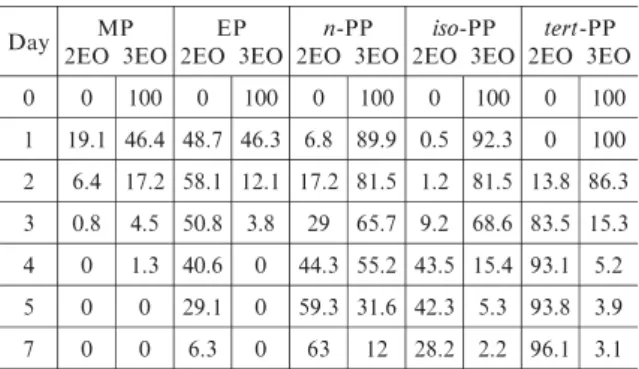
The S-2 strain could degrade MP3EO and EP3EO completely through the corresponding 2EO homolog (Table 1).
The most bulky tert-BP3EO,however,was quantitative -ly changed to tert-BP2EO,which accumulated in the culture medium.n-PP3EO and iso-PP3EO homologs seem to be biodegradable by the S-2 strain since the sum of 2EO and corresponding 3EO content was less than 100%. But the rate of their degradation was so slow Fig.3 Degradation of Ph3EO by P.putida S-3
Fig.4 Degradation of Ph3EO by P.putida S-9 Fig.2 Degradation of Ph3EO by P.putida S-2
Fig.5 Degradation of MP3EO by P.putida S-9
that the unchanged 3EOs were detected even after 7 days incubation. The S-3 strain indicated the similar degrading pattern to that of the S-2 strain as shown in Table 2.
The S-9 strain was far less active than S-2 and S-3 and AP2EOs(alkyl=ethyl,n-propyl,iso-propyl and tert -butyl)were slowly accumulated in the culture medium. The fact that the sum of unchanged AP3EO and corre -sponding AP2EO was almost 100%indicated that the S-9 strain couldnt degrade AP2EO (Table 3).
It is well known that there exist many APPEO degrading microorganisms with various degrading activity in the environment. Most of the bacteria were reported that they degraded the polyethylene glycol side chain of Triton X-100 by the oxidation of terminal hydroxyl group1. The degradation intermediate was the corresponding carboxylic acid that was further oxidized to glyoxalic acid and the one unit shorter chain homolog웋웍욹웋웏웗. It was also reported that such the degrading bacteria as P.putida distributed widely in the
environment and the degradation product was octyl -phenol diethoxylate웋웋웗. The reason why the degr ada-tion stopped at the octylphenol diethoxylate stage was not clear.
Our results indicated that S-2 and S-3 strains could degrade AP3EO when the alkyl group was hydrogen, methyl or ethyl group. All strains of P.puti da,how-ever,accumulated quantitative AP2EO in the culture medium when the alkyl group at the para position of the aromatic ring was substituted by a bulky tert-butyl group. It means that the biodegradation of AP2EO is controlled by the steric size of alkyl group at the para position of the aromatic ring. This result is consistent with the fact that the final product of microbial degr a-dation of tert-octylphenol polyethoxylate was the corre -sponding diethoxylate. As the alcoholic homologs were detected through the biodegradation,the rate -determining step of the degradation seems to be the oxidation step of the terminal hydroxyl group catalyzed by an alcohol dehydrogenase and the enzyme is largely affected by the steric size of alkyl group at the para position of the aromatic ring. The above data suggest that the difference of biodegradation ability of APPEO is largely dependent on the steric interaction between the size of para substituents and the cavity of the catalytic site of the enzyme웋웎웗.
A surfactant molecule is usually composed of a hydrophobic moiety and a hydrophilic moiety. In the alkylphenol surfactant,the 4-tert-octylphenyl and the 4-nonylphenyl groups are correspondent with the hydrophobic moiety and the polyethylene glycol side chain is correspondent with the hydrophilic moiety. Table 2. Biodegradation of AP3EO by P.putida S-3.(R=
Methyl,Ethyl,n-Propyl,iso-Propyl and tert-Butyl)
MP EP n-PP iso-PP tert-BP tert-BP Day 2EO 3EO 2EO 3EO 2EO 3EO 2EO 3EO 2EO 3EO 2EO 3EO
0 0 100 0 100 0 100 0 100 0 100 0 100 1 12.9 74.7 0 87.1 6.1 93.6 4.1 100 0 79.1 27.6 79.1 2 20.1 41.8 0 30.1 51.8 75.7 20.3 98.5 0.3 42.3 55.5 42.3 3 6.1 22.3 0 8.2 38.2 45.6 28.4 93.1 1.8 29.7 72.1 29.7 4 1.9 9.2 0 3.4 24.1 38.1 45.3 81.7 3.8 19.4 80.3 19.4 5 0.9 4.7 0 1.9 17.9 23.4 52.2 73.2 10.5 9.2 87.8 9.2 7 0.2 1 0 1.4 9.4 10.7 57.3 13.9 65.4 6.6 92.1 6.6 The abundance of the chemicals in the culture medium (%)
Table 3. Biodegradation of AP3EO by P.putida S-9.(R= Ethyl,n-Propyl,iso-Propyl and tert-Butyl)
EP n-PP iso-PP tert-BP Day 2EO 3EO 2EO 3EO 2EO 3EO 2EO 3EO
0 0 100 0 100 0 100 0 100 1 0 100 0 100 0 100 0 100 2 0 100 0 100 0 100 0 100 3 0 100 0 100 0 100 0 100 4 3.6 97.2 0 100 0 100 24.3 74.8 5 14.2 83.9 8.2 91 1.3 98.1 71.5 29.3 7 49.8 49.4 31.1 66.7 62.3 38 85.5 14.7 The abundance of the chemicals in the culture medium (%)
Table 1. Biodegradation of AP3EO by P.putida S-2.(R= Methyl,Ethyl,n-Propyl,iso-Propyl and tert-Butyl)
MP EP n-PP iso-PP tert-PP Day 2EO 3EO 2EO 3EO 2EO 3EO 2EO 3EO 2EO 3EO
0 0 100 0 100 0 100 0 100 0 100 1 19.1 46.4 48.7 46.3 6.8 89.9 0.5 92.3 0 100 2 6.4 17.2 58.1 12.1 17.2 81.5 1.2 81.5 13.8 86.3 3 0.8 4.5 50.8 3.8 29 65.7 9.2 68.6 83.5 15.3 4 0 1.3 40.6 0 44.3 55.2 43.5 15.4 93.1 5.2 5 0 0 29.1 0 59.3 31.6 42.3 5.3 93.8 3.9 7 0 0 6.3 0 63 12 28.2 2.2 96.1 3.1 The abundance of the chemicals in the culture medium (%)
These non-ionic surfactants are widely used as indus -trial detergents,emulsifying agents and agrochemical adjuvants. However,it has become a problem that AP2EO,AP1EO and AP,which are the microbial degradation products, have the estrogenic effect. Recent report that the branched alkylphenols as tert -octylphenol and nonylphenol are estrogenic to rainbow trout but the linear alkyl homologs are not웋워웗give us a clue to avoid such the undesirable problems on the alkylphenol surfactants. Our results also indicated that para substituents play an important role in mi -crobial biodegradation of alkylphenol surfactants. This means that the biodegradability of the alkylphenol surfactants may be controlled by the introduction of appropriate substituents. For example,the biode -gradability of the surfactants can be improved by avoi d-ing the introduction of alkyl substituents to the carbon atoms that exist near the aromatic ring. Further,the new surfactant may be possible by replacing the C-C bond between the hydrophobic alkyl group and the aromatic ring with more labile ether,ester or amide bond. The good biodegradability of the surfactants and the safety of the biodegradation products may be achieved by these molecular modifications. Our approach in this study may give an effective information to develop new surfactant.
Finally we strongly suggest the systematical biode -gradation study on the newly synthesized surfactant before practical application in order to assess the envi -ronmental and human risk.
ACKNOWLEDGEMENT
This work was partly supported by High-Tech Research Center Project for Private Universities: Matching fund subsidy from MEXT(Ministry of Edu-cation,Culture,Sports,Science and Technol ogy)2005-2009.
References
1)Witorsch,R.J.,Endocrine disruptors:can biologi -cal effects and environmental risks be predicted? Regul.Toxicol.Pharmacol.36,118-130(2002).
2)Safe,S.H.,Pallaroni,L.,Yoon,K.,Gaido,K., Ross,S.,and McDonnell,D.,Problems for risk assessment of endocrine-active estrogenic compounds. Environ.Health Perspect.,110(Suppl.6),925-929 (2002).
3)McLachlan,J.A.,Environmental signaling:what embryos and evolution teach us about endocrine disrupting chemicals.Endocr.Rev.,22,319-41(2001). 4)Ying,G.G.,Williams,B.,and Kookana,R., Environmental fate of alkylphenols and alkylphenol ethoxylates--a review.Environ.Int.28,215-226, (2002).
5)Schaeffer,T.L.,Cantwell,S.G.,Brown,J.L., Watt,D.S.,and Fall,R.R.,Microbial growth on hydrocarbons:terminal branching inhibits biode -gradation.Appl.Environ.Microbiol.,38,742-746 (1979).
6)McKenna,E.G.,and R.E.Kallio.Hydrocarbon structure:its effect on bacteria utilization of alkanes, p.1-4.In H.Heukelkian,and N.C.Dondero(ed.), Principles and applications in aquatic microbiology. John Wiley& Sons,Inc.,New York,N.Y.(1964). 7)Pirnik,M.P.,Microbial oxidation of methyl br
an-ched alkanes.CRC Crit.Rev.Microbiol.,5,413-422 (1977).
8)Ying,G.G.,Williams,B.,and Kookana,R., Environmental fate of alkylphenols and alkylphenol ethoxylates--a review.Environ. Int. 28, 215-226 (2002).
9)Metcalfe,C.D.,Metcalfe,T.L.,Kiparissis,Y., Koenig.B.,G,Khan,C.,Hughes,R.J.,Croley,T. R.,March,R.E.,and Potter,T.,Estrogenic potency of chemicals detected in sewage treatment plant effl u-ents as determined by in vivo assays with Japanese medaka(Oryzias latipes).Environ.Toxicol.Chem. 20,297-308(2001).
10)Scott,M.J.,and Jones,M.N.,The biodegradation of surfactants in the environment.Biochim.Biophys. Acta,1508,235-251(2000).
11)Nishio.E.,Ichiki,Y.,Tamura,H.,Morita,S., Watanabe,K.,and Yoshikawa,H.,Isolation of bacterial strains that produce the endocrine disruptor, octylphenol diethoxylates,in paddy fields.Biosci. Biotechnol.Biochem.,66,1792-1798(2002).
12)Pedersen SN,Christiansen LB,Pedersen KL, Korsgaard B,Bjerregaard,P.,In vivo estrogenic activity of branched and linear alkylphenols in rai n-bow trout(Oncorhynchus mykiss).Sci.Total Envi -ron.,233,89-96(1999).
13)Sato,H.,Shibata,A.,Wang,Y.,Yoshikawa,H., and Tamura,H.,Characterization of biodegradation intermediates of nonionic surfactants by MALDI-MS. 2.Oxidative biodegradation profiles of uniform octyl -phenol polyethoxylate in웋웒O-labeled water.Bi oma-cromolecules,4,46-51(2003).
14)Sato,H.,Shibata,A.,Yoshikawa,H.,and Tamura, H.,Biodegradation Mechanisms of Non-Ionic Sur -factants Evaluated by MALDI-MS. J. Mass Spectrom.Soc.Jpn.,51,415-420(2003).
15)Shibata,A.,Sato,H.,Yoshikawa,H.,and Tamura, H.,Development of a Novel Biodegradation Test Method of Non-ionic Surfactants using웋웒O-Labelled Water.J.Mass Spectrom.Soc.Jpn.,51,256-259 (2003).