Title
A Relevance-Theoretic Approach to the Effective Use of Lexical
Information,Visual Information, and English-Japanese Translation
in Cross-Cultural Understanding
Author(s)
Yoshiyuki OKAURA(岡裏 佳幸)
Citation
福岡工業大学研究論集 第52巻第1号 P25-P29
Issue Date
2019-9
URI
http://hdl.handle.net/11478/1366
Right
Type
Departmental Bulletin Paper
Textversion
Publisher
福岡工業大学 機関リポジトリ
FITREPO
INTRODUCTION
The purpose of this research is to examine how much lexical information, visual information, and English-Japanese transla-tion contribute to the English learners’ understanding of cross-culture in the framework of Relevance Theory which originates in Sperber & Wilson (1986, 19952). First, we will explain
Relevance Theory originating in Sperber & Wilson (1986, 19952) to be applied to English Learners’ understanding of
cross-culture with special emphasis on translation (Gutt, 2000). Secondly, we will construct and conduct two types of questionnaire on 38 English learners for collecting data; one questionnaire consists of questions about their knowledge of “How pure maple syrup is made,” and the other one is to ask how much they understand its production process at the four stages (Dörnyei, 2000). We conclude that lexical information, visual information, and translation make positive influences on learners’ cross-cultural understanding by satisfying the Communicative Principle of Relevance.
THEORETICAL FRAMEWORK
Relevance Theory is an approach to the field of pragmatics originated by Sperber & Wilson (1986, 19952). Sperber &
Wilson make two fundamental claims in Relevance, one about cognition, and the other about communication:
⑴ The First (or Cognitive) Principle of Relevance
Human cognition tends to be geared to the maximization of
relevance.
⑵ The Second (or Communicative) Principle of Relevance Every act of ostensive communication communicates a presumption of its own optimal relevance.
A stimulus which explicitly shows the intentions to communicate something, in other words, which has both
informative intention and communicative intention is called the
ostensive stimulus, which is defined in the presumption of
optimal relevance:
⑶ The presumption of optimal relevance
a. The ostensive stimulus is relevant enough for it to be worth the addressee’s effort to process it.
b. The ostensive stimulus is the most relevant one compatible with the communicator’s abilities and preferences. (Sperber & Wilson, 1986, 1995)
The communication which takes place based on the ostensive stimulus is the ostensive communication, and translation is also considered as a kind of ostensive communication in Relevance Theory.
One crucial notion to translation is the propositional form, which is defined in Sperber & Wilson (1986, 19952):
⑷ The propositional form of an utterance is an interpretation of the speaker which is an interpretation of an attributed thought.
Gutt (2000) applied this definition of the propositional form of
an utterance to translation, because in translation the
propositio-nal form of the utterance (‘translated text’) is an interpretation of
A Relevance-Theoretic Approach to the Effective Use of Lexical Information,
Visual Information, and English-Japanese Translation in Cross-Cultural Understanding
Yoshiyuki O
KAURA(Department of Socio-Environmental Studies)
Abstract
The purpose of this research is to demonstrate to what degree lexical information, visual information, and English-Japanese translation contribute to the English learners’ understanding of cross-culture in the framework of Relevance Theory. We construct two types of questionnaire asking 38 English learners about their existing knowledge of “How pure maple syrup is made,” and about how much they understand its production process at the four stages. We conclude that lexical information, visual information, and English-Japanese translation make positive influences on learners’ cross-cultural understanding by satisfying the Communicative Principle of Relevance.
Key words: Cross-cultural understanding, Relevance Theory, Translation, Disambiguation, Saturation
a thought of the speaker (‘translator’) which is an interpretation of a thought attributed to someone who expressed in another language (‘the original author’). To sum up, in translation the propositional form of the translated text is an interpretation of a thought of the translator which is an interpretation of a thought attributed to the original author. The communicator whose utterance the target audience is actually dealing with is that of the translator.
The four pragmatic processes contribute to the formation of
explicatures in Relevance Theory: disambiguation, saturation, free enrichment, and ad hoc concept construction. Recanati
(2004) defines saturation as follows:
⑸ Saturation is the process whereby the meaning of the sentence is completed and made propositional through the contextual assignment of semantic values to the constituents of the sentence whose interpretation is context-dependent (and, possibly, through the contextual provision of ‘unarticulated’ propositional constituents, if one assumes, as some philosophers do, that such constituents are sometimes needed to make the sentence fully propositional.
The process of saturation takes place whenever the meaning of the sentence includes something like a “slot” requiring completion or a “free variable” requiring contextual instantia-tion. Moreover, disambiguation is a crucial notion in this research which Blass (1990) defines as follows:
⑹ It is generally assumed that both sense of an ambiguous word are automatically recovered by the linguistic input system.
The process of disambiguation excludes the ambiguity of words and phrases to clarify their meaning in the context, and as a result achieving the optimal relevance for English learners. This means that disambiguation achieves the optimal relevance to increase English learners’ relevance.
DISCUSSION Data Collection
We construct the two types of questionnaire. A question-naire (A) is about the background knowledge of Pure Maple Syrup, the first question of which is to ask whether English learners know how pure maple syrup is made. If they answer “Yes” to the first question, then they will answer the next two questions; how they came to know it, and how pure maple syrup is made. However, if they answer “No” to the first question, then they will go on to the task of inferring; how they imagine
pure maple syrup is made. On the other hand, the questionnaire (B) is composed of the four questions about the degree to which English learners understand the readings of “About Pure Maple Syrup: How It’s Made,” cited from the official web site of “Pure Maple from Canada
(https://www.puremaplefromcanada.com/about/how-its-made/). We conduct the questionnaire research to collect data on the 38 Japanese freshmen at A University who attend an English communication course focused on the theme of “Living Abroad,” especially “Cross-cultural communication in authentic situations in a multicultural and multinational city, Toronto, CANADA.” They work on the reading tasks at four stages, and answer how much they are able to understand the production process of pure maple syrup by circling the number on the scale after reading each task, whose numbers show how much they understand the reading task; 0 means “Not at all understood,” 10 “Completely understood,” and 5 “Average.”
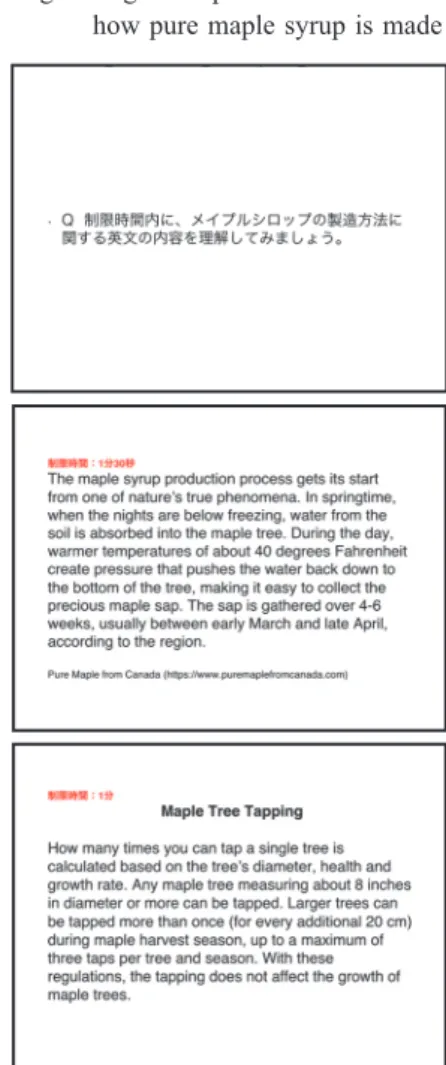
First, the 38 English learners work on the timed reading task which consists of three pages of English explanation about how pure maple syrup is made.
A Relevance-Theoretic Approach to the Effective Use of Lexical Information, Visual Information, and English-Japanese Translation in Cross-Cultural Understanding(OKAURA) ― 26 ―
Fig. 1 English explanation about how pure maple syrup is made
After reading the above pages, they circle the number on the scale to answer how much they understand.
Secondly, they read English explanation accompanied with some annotations of words and phrases with time limitation, and then answer how much they understand.
Adding semantic annotations facilitate their understanding to increase relevance. Presenting lexical information is regarded as one of the four pragmatic processes contributing to the formation of explicatures, disambiguation. The process of
disambiguation excludes the ambiguity of words and phrases to
clarify their meaning in the context, and as a result achieving the optimal relevance for English learners. This means that
disambiguation achieves the optimal relevance to increase
English learners’ relevance.
Thirdly, they look through the visual information representing the production process of pure maple syrup: one visual images showing the whole production process of pure maple syrup, and then the seven photographs showing each stage of its production process. Visual information works as saturation which is also one of the four pragmatic processes contributing to the formation of explicatures. The process of saturation takes place whenever the meaning of the sentence includes something like a “slot” requiring completion or a “free variable” requiring contextual instantiation.
Fig. 2 English explanation with some semantic annotations
Finally, they read the English-Japanese translation within the limited time so that they can completely understand the production process to satisfy the optimal relevance.
Gutt (2000)insists that translation is communication between the translator and target audience only. In translation the propositional form (‘translated text’)is an interpretation of a thought of the speaker (‘translator’)which is an interpretation of a thought attributed to someone who expressed it in another language (‘the original author’). In this research, we act as a translator to facilitate the English learners’ understanding, and English learners as its target audience. Therefore, the translated text of “About Pure Maple Syrup: How It’s Made” is an interpretation of a though of the translator which is an interpretation of a thought attributed to its original author of A Relevance-Theoretic Approach to the Effective Use of Lexical Information, Visual Information, and English-Japanese Translation in Cross-Cultural Understanding(OKAURA)
― 28 ―
“About Pure Maple Syrup: How It’s Made.” Data Analysis
The analysis of the questionnaire (B) presents an interesting result as shown in Table. 1:
The questionnaire (B) is composed of the four questions about the degree to which English learners understand the readings of “About Pure Maple Syrup: How It’s Made,” cited from the official web site of “Pure Maple from Canada.
The average point of the degree of understanding at the first stage is 5.237, after they read only English explanation about how pure maple syrup is made within the limited time.
They read the same English explanation with some annota-tions of words and phrases in the same way, with time limitation, at the second stage, and then the average point increases from 5.237 to 7.158 by 1.921. As I mentioned above, adding some semantic annotations, disambiguation excludes the ambiguity of words and phrases to clarify their meaning in the context, and as a result achieving the optimal relevance for English learners. The data analysis suggests that disambiguation achieves the optimal relevance to increase English learners’ relevance, leading to the improvement of the degree of their understanding. However, visual information makes a slight contribution to the degree of English learners’ understanding. At the third stage, they look through not only one visual image of the whole production process of pure maple syrup but also the seven photographs representing each production process, and the average point stands at 7.737. This means that it increases only by 0.579 from 7.158 to 7.737 through visual information.
On the other hand, English-Japanese translation advances the degree of understanding remarkably. The average point stands at 9.414 at the final and fourth stage, increasing by 1.677 points from 7.737 to 9.414 from visual information to English-Japanese translation, and moreover increasing by 2.234 points from 7.158 to 9.414 from English explanation with some semantic annotations to English-Japanese translation.
CONCLUSION
Grammar-translation method has been said to make bad influences on English learning since its earliest days in Japan, but
to make use of translation can facilitate English learners’ cross-cultural understanding in English communication courses, satisfying the optimal relevance for learners.
It is not useful to put emphasis on grammar-translation method for its own purpose, but it is important to consider how to make use of translation in order to facilitate English learners’ understanding. In this research, we facilitate English learners’ understanding of cross-culture step by step: only English explanation at the first stage, English explanation with some semantic annotations at the second stage, visual information at the third stage, and finally English-Japanese translation at the fourth stage. Each stage offers them an opportunity to infer a cross-cultural phenomenon which they have no/little knowledge of, and inference is one of crucial factors in promoting English learners’ motivation and advancing English language learning, and two notions of disambiguation and saturation in Relevance Theory help their inference. Furthermore, we act as a translator to facilitate the English learners’ understanding in this research so that translation contributes to the English learners’ complete understanding of cross-cultural phenomenon.
REFERENCES
Blass, R. 1990. Relevance Relations in Discourse: A Study with
Special Reference to Sissala. Cambridge: Cambridge
University Press.
Döenyei, Z. 2010. Questionnaires in Second Language
Research: Construction, Administration, and Processing. New
York and London: Routeldge.
Gutt, E. 2000. Translation and Relevance: Cognition and
Context. St. Manchester and Boston: Jerome Publishing.
Recanati, F. 2004. Literal Meaning. Cambridge: Cambridge University Press.
Sperber & Wilson. 1886, 19952. Relevance Theory:
Communication and Cognition. New York: Blackwell.