Introduction
Our own face is an important characteristic of
our identity and probably our most distinctive physical feature. As for visual preferences toward a specific person’s
face (e.g., infants’ own face, their mother’s face), it is
shown that faces infants prefer vary during early in life
[1,2]. Recently, there have been a large body of studies in adult investigating preferences and evaluations of average
faces and morphed faces including participants’ own face
[3,4]. A more recent study reported that much younger age,
that is, children at the age of 5 years old also expressed preferences for the faces resembled to their own face
compared to a familiar face and a novel face [5]. These
studies indicate that we have unique preferences toward
faces similar to our own face.
However, to date there has been relatively little
investigation for the self-resemblance preferences in
infancy, that is, visual preferences toward faces resembled to their own face. One infant study investigating visual
preferences toward morphed faces showed that 9-12 months
of age looked longer at their own face and another infant’s face than the morphed face [6]. The aim of the current study
was to investigate the self-resemblance preferences in
infancy by using morphed faces.
Experiment 1
The aim of Experiment 1 was to replicate
Yokoishi’s result. As the previous study, I examined
infants’ response to their own face, another infant’s face,
and a morphed face in a two-choice preferential looking paradigm.
Participants
Final sample was 16 infants Experiment 1
(Female = 9; M = 357.19 days, SD = 19.31, range = 333–399 days).
Stimuli
Self-face pictures in neutral facial expression were
presented as mirror images (flipped left-right). In Experiment 1, as in the previous study [6], I used the following three
faces: a participant’s own face (Self 100%), another infant’s
face (Self 0%), and the morphed face incorporating 50% of a
participant’s own face and 50% of another infant’s face (Self 50%). The pair of infants who were morphed together
matched in gender and age.
Apparatus
An experimenter who was outside the booth controlled the calibration, presentation of stimuli, and
recording of the infants’ eye movements using Tobii Studio
3.2.2 (Tobii Technology, Danderyd, Sweden).
Procedure
Participants were presented a pair of faces side
by side. Each trial was presented for 10 seconds and 6 trials were presented. The order of 6 trials and the side on which
a face presented are random and counterbalanced across
participants.
Results
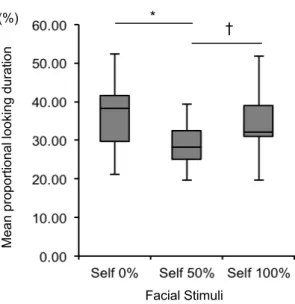
The Friedman test revealed that there were
significant overall effects for the looking duration (χ2(2) = 8.00, N = 16, p = 0.018, r = 0.590). As shown in Figure 1,
the non-parametric Wilcoxon signed-rank test revealed that there was significant difference in the looking duration
between Self 0% and Self 50% (Z = 2.07, N = 16, p = 0.039,
Development of sensitivity toward self-face in infancy, in comparison to morphed
faces
Keywords:infancy, face representation, preferential looking paradigm, visual preference, eye gaze
r = 0.517). There was a marginal effect between the looking
duration of Self 100% and Self 50% (Z = 1.84, N = 16, p =
0.065, r = 0.461).
Experiment 2
In Experiment 2, infants were presented with four facial stimuli at a time, that is, a participant’s own face,
another infant’s face, and two different morphed faces that
were morphed with 75% and 50% of the participant face. This four-choice preferential looking paradigm allowed
each infant to compare all stimuli faces directly at the same
time.
Participants
The final sample in Experiment 2 was 17
infants (Female =10; M = 357.82 days, SD = 18.88, range =
333–399 days).
Stimuli
The stimuli were identical to Experiment 1, except for additionally using another morphed face that was
consisted of 75% of a participant’s face and 25% of another
infant’s face (Self 75%).
Apparatus
The apparatus were identical to Experiment 1.
Procedure
The four faces were displayed for 16 seconds with
the direct gaze and 6 trials were presented for each individual.
In all the trials, the position of the stimuli on the screen (left or
right, top or bottom) were randomized and counterbalanced across the trials.
Results
The non-parametric Friedman test revealed that
there was a significant overall effects for the looking duration (χ2(3) = 8.51, N = 17, p = 0.037, r = 0.507). The
non-parametric Wilcoxon signed-rank test revealed that the
looking duration was significant different between Self 100% and Self 75% (Z = 2.16, N = 17, p = 0.031, r = 0.525).
There was a marginal effect, but infants also looked longer
at Self 0% than Self 75% (Z = 1.85, N = 17, p = 0.064, r = 0.450)(Fig.2).
Experiment 3
The purpose of Experiment 3 was to extend Yokoishi’s study and the finding of Experiment 1 and 2 by
considering the effect of the direction of eye gaze in a
two-choice and in a four-choice preferential looking paradigm.
Participants
The final sample in a two-choice paradigm was Figure 2. The box-and-whisker plots describe the mean proportion of looking durations toward each of the four stimuli types in Experiment 2. The boxes mean the first and fourth quartiles. The solid lines inside the boxes represent the medians. The solid lines outside the boxes describe the location of extreme values. †p < 0.10, *p < 0.05 (Friedman test).
Me
a
n
p
ro
p
o
rt
io
n
a
l
lo
o
k
in
g
d
u
ra
ti
o
n
(%)
Facial Stimuli * †
Me
a
n
p
ro
p
o
rt
io
n
a
l
lo
o
k
in
g
d
u
ra
ti
o
n
(%)
Facial Stimuli *
†
16 infants (Female = 9; M = 357.19 days, SD = 19.31, range
= 333–399 days) and the final sample in a four-choice
paradigm was 17 infants (Female =10; M = 357.82 days,
SD = 18.88, range = 333–399 days).
Stimuli
All facial stimuli used in Experiment 3 were taken
prior to the experiment. In a four-choice preferential looking
paradigm, 8 images (i.e., Self 100%, Self 75%, Self 50%, and Self 0% with the heads turned 40°to the left or right) in total
were prepared for each individual. In a two-choice preferential
looking paradigm, the same stimuli with the four-choice preferential looking paradigm were used, but Self 75% with
the heads turned 40°to the left and right were not used.
Procedure
In Experiment 3, the procedure in a two-choice
preferential looking paradigm was identical to Experiment
1. As for the procedure in a four-choice preferential looking
paradigm was identical to Experiment 2. However, the order of the averted gaze direction (face with the head
turned to left or one with the head turned to right was
presented first) were randomized and counterbalanced
across trials.
Results
In a two-choice preferential looking paradigm,
the Friedman test revealed for the looking duration that
there were significant overall effects for the looking duration (χ2(2) = 8.38, N = 16, p = 0.015, r = 0.607). The non-parametric Wilcoxon signed-rank test revealed that
infants significantly looked longer at Self 100% and Self 0% respectively than at Self 50% (Self 100% vs. 50%: Z =
2.13, N = 16, p = 0.03, r = 0.531; Self 0% vs. 50%: Z =
3.29, N = 16, p = 0.001, r = 0.822; Figure 3A). In a
four-choice preferential looking paradigm, the Friedman test revealed that there were marginally significant overall
effects for the looking duration (χ2(3) = 6.53, N = 17, p = 0.089, r = 0.413). The non-parametric Wilcoxon
signed-rank test revealed that there was a significant
difference in the looking duration between Self 0% and Self
50% (Z = 2.11, N = 17, p = 0.035, r = 0.513; Figure 3B).
Discussion
The aim of the current study was to investigate the
self-resemblance preferences in infancy by using morphed
faces. In Experiment 1, infants expressed less visual preferences toward the morphed face incorporating their own
face (Self 50%). The finding of the current study was Figure 3. (A) The mean proportion of looking durations toward each of the three stimuli types with averted gaze in Experiment 3. (B) The mean proportion of looking durations toward each of the four stimuli types with averted gaze in Experiment 3. The box-and-whisker plots show the response to each type of facial stimuli. The boxes mean the first and fourth quartiles. The solid lines inside the boxes represent the medians. The solid lines outside the boxes describe the location of extreme values. *p < 0.05, ***p < 0.001 (Friedman test).
A
Me
a
n
p
ro
p
o
rt
io
n
a
l
lo
o
k
in
g
d
u
ra
ti
o
n
(%)
Facial Stimuli ***
*
Me
a
n
p
ro
p
o
rt
io
n
a
l
lo
o
k
in
g
d
u
ra
ti
o
n
(%)
Facial Stimuli *
consistent with that of Yokoishi’s study, thus I replicated the
previous finding. In Experiment 2, the results showed that
infants looked at their own face and another infant’s face
longer than at the more self-resemble of the two stimuli morphs (Self 75%), but not Self 50%. Behavioral evidence
supports that experience allows infants to build up a specific
representation of experienced faces [7]. It is possible to
interpret that the result of the current study that the category boundary between infant’s own face and another infant’s face
is more closely situated toward their own face on a spectrum
ranging from self-face to the other’s face.
As for Experiment 3, infants looked facial
stimuli with averted gaze in similar manner to the stimuli
with direct gaze. One possible interpretation is that, as some research showed [8,9], infants might process faces with
direct and averted gaze in the similar manner by 8 months
of age. It is possible to interpret that infants in our research
might recognize the faces with averted gaze (Experiment 3) were identical with the faces with direct gaze (Experiment
1). In contrast, in a four-choice preferential looking
paradigm, there was not difference in visual preferences
toward facial stimuli. It is possible to expect that processing four types of facial stimuli with averted gaze at a time could
be tough for infants in terms of their facial processing
ability, so infants might spent on looking at all stimuli for
almost the same duration. It is thus plausible to interpret that the development of infants’ face recognition ability for
direct gaze could be followed by the development for
averted gaze.
In conclusion, the main goal of the current study
was to test infants’ visual preferences toward their own face,
another infant’s face and morphed face were composed of
their own face using the four-choice preferential looking paradigm. Our findings indicated that categorical boundary
between self-face and other’s faces for infants at the age of
about 1 year is closer to infants’ own face and that infants
are more sensitive to differences between their own face
and another infant’s face. Our findings also contribute to
the further understanding of the developmental origin of the
effects of self-resemblance preferences.
References
[1] Bahrick, L. E., & Moss, L. (1996). Development of
visual self-recognition in infancy. Ecological
Psychology, 8(3), 189-208.
[2] Nielsen, M., Dissanayake, C., & Kashima, Y. (2003). A longitudinal investigation of self–other discrimination
and the emergence of mirror self-recognition. Infant
Behavior and Development, 26(2), 213-226.
[3] Bailenson, J. N., Iyengar, S., Yee, N., & Collins, N. A.
(2008). Facial similarity between voters and
candidates causes influence. Public Opinion Quarterly, 72(5), 935-961.
[4] DeBruine, L. M. (2005). Trustworthy but not lust-worthy:
Context-specific effects of facial
resemblance. Proceedings of the Royal Society of London B: Biological Sciences, 272(1566), 919-922.
[5] Richter, N., Tiddeman, B., & Haun, D. B. (2016). Social
Preference in Preschoolers: Effects of Morphological
Self-Similarity and Familiarity. PloS one, 11(1), e0145443.
[6] Yokoishi, S. (2013). Self-face recognition in infancy.
Graduation thesis, G-13-4.
[7] Simion, F., & Di Giorgio, E. (2015). Face perception and processing in early infancy: inborn predispositions and
developmental changes. Frontiers in psychology, 6.
[8] Nakato, E., Otsuka, Y., Kanazawa, S., Yamaguchi, M. K., Watanabe, S., & Kakigi, R. (2009). When do infants
differentiate profile face from frontal face? A
near-infrared spectroscopic study. Human Brain
Mapping, 30(2), 462-472.
[9] Yamashita, W., Kanazawa, S., & Yamaguchi, M. K.
(2011). Infant learning ability for recognizing artificially
produced three-dimensional faces and objects. Journal