2009年度(3月修了)
早稲田大学大学院商学研究科
修 士 論 文
題
目
The impact of stakeholders on firm's capital structure
〜An empirical test of Japanese corporations〜
研究指導 企業金融
指導教員 広田 真一
教授
学籍番号 35081025
氏
名 TEA, Seanghy
概要書
本研究では、企業の資本構成に与えるステークホルダーの影響について実証分析 を行なった。これまで、企業の資本構成に関する理論および実証研究は、アメリカ やイギリスの企業を対象とした研究が数多くなされてきた。その標準的な考え方は 企業価値(株主価値のみ)を最大化することである。しかし、企業は、株主の他に、
従業員、マネージャーなどと言ったから構成しているために、彼らの利害も考慮す る必要だと考えている。特に、日本の企業は株主の他に、全てのステークホルダー の利害を考慮した上で、マネージャーが経営戦略を行っていると言われてきた。日 本企業は欧米と異なるいくつかの特徴をもっている。それらは、雇用システム(終 身雇用、年功序列、企業別労働組合)、企業とメインバンクの関係、株式の持合い などがあげられる。このような違いから、日本企業の資本構成の決定要因について も欧米企業と違いがあるのではないか。本研究の目的は、ステークホルダーが資本 構成に影響をもっているかどうかを考察する。更に、日本企業は実際にステークホ ルダーを重視するか否かも明らかにしたい。
本論文は、ステークホルダーを考慮して分析する理由は三つがある。第一に、資 本構成には全てのステークホルダーが影響を与えると考えている。現在まで資本構 成の決定に株主のみを考えて、他のステークホルダーを無視してきた。Modigliani
& Miller(1958)の資本コストの論文を発表してから、資本構成に関する研究が 盛んに行なわれてきた。それらの理論や実証研究は、法人税及び所得税 [Miller (1977)]、倒産コスト [Baxter (1967)、Litzenberger (1973)、Scott (1976)、Waner (1977)、Haugen & Senbet (1978)]、エイジェンシー問題 [Jenson (1986)]を用い たものが多かった。Miller (1977)はMM理論(無税金の世界)を拡張し法人税及 び所得税を考慮した場合、企業は節税効果がゼロになるまで、社債を発行し続ける。
また、エイジェンシー問題の理論においては、主に株主とマネージャーのみの間に 生じた利害関係の問題を考慮する。マネージャーは、自分の良いマネージメントに よって得た利益は100%もらえるわけではないのに、経営危機の際全てのコストを こうむることになる。例えば、交替されたり、評判が悪くなったりするのである。
それに対して株主はフリー・キャッシュフローを減らすために負債比率を引き上げ
たり、より多くのリターンを求めるため、高いリスクの投資をさせたりし、マネー ジャーにプレッシャーをかけ、企業価値最大化するように努力をさせる。
このように、一般的な資本構成の考え方は、企業は株主のみの価値を最大化する と考える。しかし、企業の中に様々なステークホルダー(株主、マネージャー、従 業員、クライアント、サプライヤー)が存在しており、各当事者が会社に貢献して いる。例えば、従業員が一生懸命に営業し、売上につながる。マネージャーは、優 れた経営戦略を実行し、会社の利益に貢献するなどである。従って、株主以外のス テークホルダーが影響を持っているかどうかを考察する。
第二に、日本企業はステークホルダーを重視するといわれている。資本構成の分 野において、現実にはステークホルダーを重視するかどうかを確かめたいのである。
日本企業は欧米企業と違って、様々な特徴があるため、資金調達行動も異なる可能 性がある。日本企業の特徴を見て行くと、雇用の面において、社員はある会社に入 社すれば、その会社で定年まで勤めるのが一般的である。給与や福利厚生も勤続年 数とともにあがる。そして、社員から部長、取締役あるいは社長の座に昇ることも できる。そういったことから、会社は社員・マネージャーのものだともいえる。次 に、資金調達のとき、日本企業は主にメインバンクに頼る。メインバンクは企業に 融資する債権者でもあり、企業の大株主でもある。さらに、企業は経営難に陥って も、メインバンクとの交渉しだいで、銀行が企業を助けたり、再生計画を実施した りする。そのようなことから日本企業とメインバンクは緊密な関係をもっている。
また、株主構成をみれば、尐数株主の合計が約 20%に対して、安定株主(金融機 関保有率や関連会社の株式持合い率の合計)が約 40%である。株式持合いのメリ ットは、長期的な関係・取引を築くこと、買収を防衛する有効な策などである。し たがって、資本構成の決定要因も異なるかもしれない。例えば、アメリカの株主は、
負債比率を高くしたいのに対して、日本の株主はできるだけ負債比率を下げる。な ぜならば、アメリカの株主は短期的なリターンを望む傾向があるから、負債を用い ることによって生じた節税効果を最大限に求める。また、負債が多ければ、企業は 常に倒産の危機にさらされているので、マネージャーの自己利益経営や無駄遣い防 止にもなるからである。日本企業の場合、企業同士が互いの株式を持ち合って、リ ターンや配当金よりも、むしろ長期かつ継続的な取引の方が望ましいであろうから、
負債比率を低くし、倒産を避けるのである。そういった目的の違いから、資本構成
の決定も異なり、ステークホルダーは実際に影響を持っているかを調べる。
第三に、ステークホルダーが資本構成に影響を与えるのであれば、どのステーク ホルダーが、どれだけの影響を与えるかを分析したい。これまで、ステークホルダ ーを用いた資本構成の理論は非常に尐ない。そのうち、Cornell & Shapiro (1987) のステークホルダー理論とBarton、Hill & Sundaram(1989)のCornell & Shapiro (1987)のステークホルダー理論の実証分析があげられる。だが、彼らの理論と実証 分析は、マネージャー、従業員、クライアントやサプライヤーなどをステークホル ダーという一つの変数として、分析を行なっていた。そのため、個々のステークホ ルダーがどのような及びどれぐらいの影響力をもっているかはわからないのであ る。ステークホルダーの影響力を明らかにすることによって、資本構成の決定要因 の解明に役立つと考えている。資本構成の議論は数十年なされてきたが、日本企業 を対象とした実証研究はわずかであることが現状である。そして、日本企業がステ ークホルダー重視とされているにもかかわらず、ステークホルダーを考慮した資本 構成の実証研究はほとんど行なわれていない。
研究仮説としては、
1)マネージャー:マネージャーは自分の利益を最大にするため、負債比率を下 げる。マネージャーは、倒産を避けたいと言うモチベーションがある。なぜなら、
企業が倒産すれば、マネージャーはマネージャーとしてのポストを失い、名誉や評 判も悪くなるからである。
2)株主:大株主は負債比率を上げる。理由は、負債を利用することにより節税 効果が得られるため、できるだけその節税効果を最大に求める。また、負債比率を 上げることはマネージャーの行動をモニターするためにもなる。負債を上げること によって、倒産リスクが高まるのでマネージャーの無駄遣いを減らすことができ、
マネージャーの努力も高めることができる。
3)従業員:長期雇用を有する企業ほど、負債比率と負の関係がある。日本はい まだ終身雇用のシステムが存在し、企業が安定した雇用を保障できなければ、優秀 な人材を確保できなくなる。就職する者から見れば、倒産しそうな企業には就職し たくないからである。また、従業員の退職給与引当金は負債比率と負の関係がある。
企業が倒産すれば、従業員の退職金や年金などが削減される可能性があるので、低 い負債比率の企業ほど望ましい。
4)クライアント及びサプライヤー:取引先が集中している企業ほど、負債比率 と負の関係を持つ。それは、倒産した場合、クライアントにとって、突然取引でき なくなるあるいは発注した商品やサービスが受取ることができなくなると、自分の 顧客に新商品やサービスを提供できなくなる可能性があるので、そのコストをこう むることになるからである。また、サプライヤーの立場から見れば、注文した製品 やサービスを受取ってもらえないあるいは、売った商品の代金を受取れないのであ る。したがって、倒産しそうな企業と取引したくないと考えるであろう。
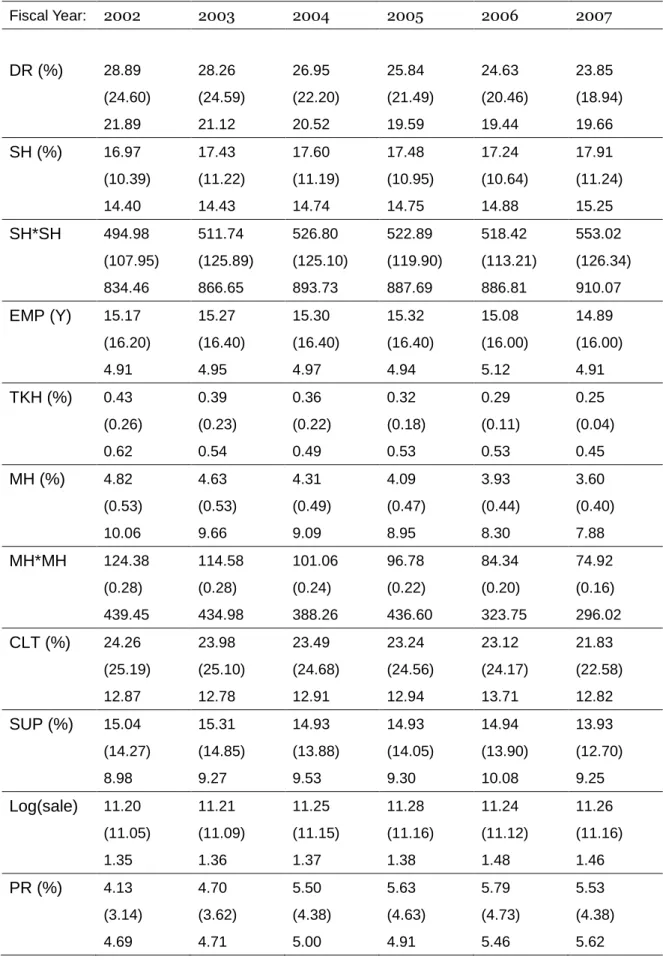
以上の仮説を実証するために、東京証券取引所に上場している一部上場企業を用 いて分析を行なった。負債比率は、固定負債合計を固定負債合計と資本合計の和で 割ったものであり、ステークホルダーの説明変数は、株主(SH)、マネージャー
(MH)、従業員(EMP、TKH)、クライアント(CLT)及びサプライヤー(SUP)
である。そして、コントロール変数として、Log(sale)、(総売上)、PR(収益率)、
FIXAR(有形固定資産比率)、及びAGE(設立年数)を用いる。
SH、MH と EMP はそれぞれ、第一大株主の持株比率、マネージャーの持株比
率、平均勤続年数である。TKHは退職給与引当金を資産合計で割ったものである。
また、CLTは受取手形と売掛金の和を総売上で割ったもの、そしてSUPは支払手 形と買掛金の和を総売上で割ったものである。
使用したデータは2002年度から2007年度の6年間である。各年度のサンプル 数はそれぞれ、1099、1113、1134、1142、1100、1158 である。分析サンプルに 入れた企業は二つの条件を満たすものである。一つは、全ての変数の値を持ってい ること。もう一つは、各年度において、3月に決算を行なった企業であることであ る。
分析方法として、最小二乗法を用いて以下の式の回帰分析を行なった。
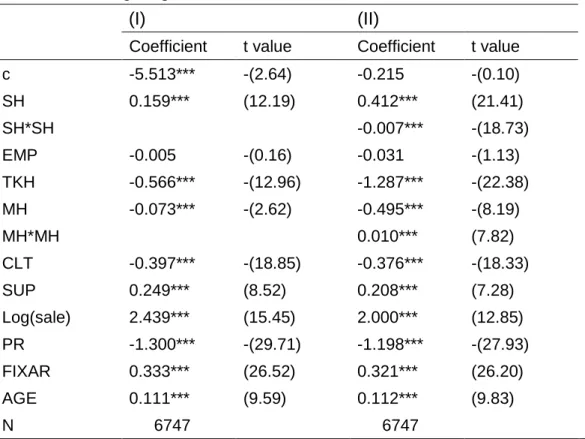
DR=a0 + a1SH + a2EMP +a3TKH + a4MH + a5CLT + a6SUP + a7Log(sale) + a8PR + a9FIXAR + a10AGE + U ( I )
DR=a0 + a1SH + a2SH*SH + a3EMP +a4TKH + a5MH + a6MH*MH + a7CLT + a8SUP + a9Log(sale) + a10PR + a11FIXAR + a12AGE + U ( II )
本研究の分析結果は次のようになる:
1)第一大株主の持株比率は負債比率と負の関係をもっている。日本企業の第一 株主は一般的に株式持合いの関連会社であり、短期よりも長期的な関係を望んでい る。そのために、短期的なリターンよりも、長期的かつ安定的な配当の方が好まし い。また、企業が倒産する場合、株価価値がなくなる上に、将来の取引もできなく なるので、そのコストが大きい。したがって、倒産を避けるために、負債比率を下 げるインセンティブをもっているのである。この点において、アメリカ企業の株主 と比較すると異なる行動をとっていることがわかった。アメリカ企業の株主は、企 業との取引関係を持っておらず、単に投資家としてキャピタルゲインや配当金を求 める。負債を上げることよって、節税効果を最大に求められ、マネージャーにプレ ッシャーをかけることもできるのである。
2)マネージャーの持株比率は負債比率と負の関係を持っている。仮説通りに、
日本のマネージャーにとって倒産コストは大きいのである。マネージャーのほとん どが内部昇進のため、企業が倒産すると、従業員からマネージャーになるまでの努 力が無駄になってしまうため、それを避けたいのである。
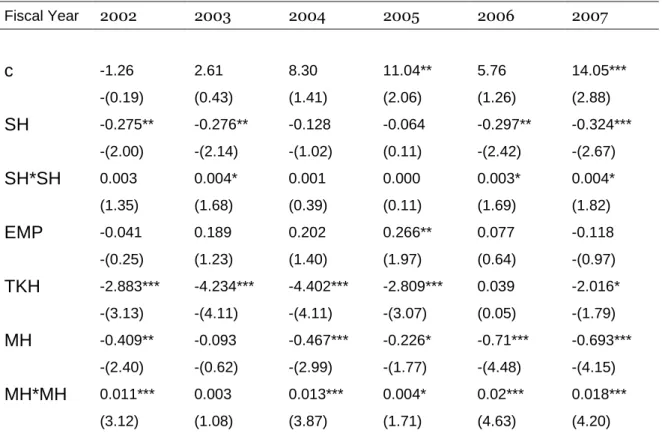
(I)式の推計では、SHが半分、MHが全部有意ではなかったが、(II)式で再推計
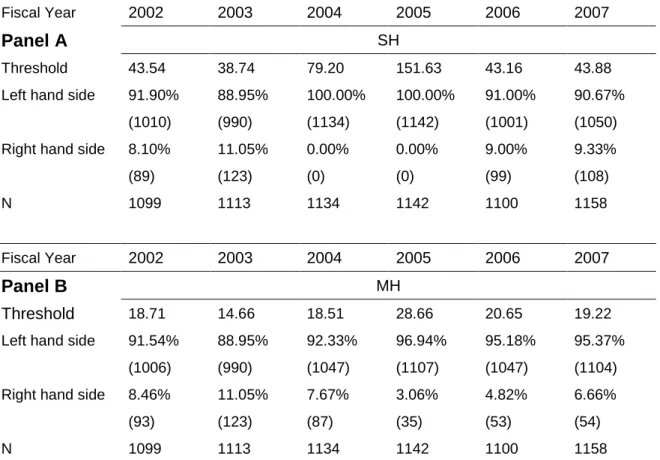
するとほとんどが有意になっている。そして、株主とマネージャーの持株比率があ る一定の水準に達すると、負債比率に対して正の関係になる。つまり、株主とマネ ージャーは負債比率に関して二次関数の関係をもっている。
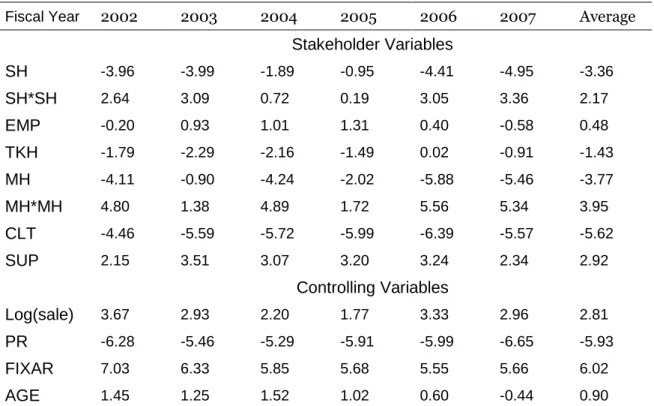
3) 全ての期間においてEMPは有意ではなかったため、平均勤続年数は負債比 率の決定とは無関係であるという結果になる。TKHの係数は有意で、負債比率と 負の関係になっている。よって、従業員の利害を考慮する企業は負債比率を下げる のである。しかし、従業員は負債比率に与える影響が他のステークホルダーに比べ ると一番小さいのである。
4)クライアント(CLT)は仮説通りにその係数が負になっているが、サプライヤ ー(SUP)の係数は仮説とは逆の符号になっている。その理由としては、CLTの交渉 力(Bargaining Power) がSUPより有利であることが考えられる。クライアント はたくさんの企業の中から健全な企業としか取引しないと言う選択権を有する。そ れに対して、サプライヤーは企業に選ばれる立場であるから、企業との交渉力は弱 いのである。よって、企業の負債比率が高くても取引を続けるだろう。その点に関
しては更に検証する必要がある。
5)最後に、全てのコントロール変数(総売上、収益率、有形固定資産比率、及 び設立年数)は、有意かつ標準の資本構成理論の予想符号と一致したので、アメリ カの企業と同様に日本企業に対しても説得力があると言える。この結果はHirota (1999)のバブル経済崩壊前の実証結果とも一致している。
本研究の実証結果によれば、資本構成の決定にステークホルダーの影響が見られ るが、本研究にはまだいくつかの限界があり、さらに検証していかなければならな い。まず、分析に用いた企業は製造業及び非製造業を含んだものの、ほとんどが日 本を代表する大手企業(売上額、資本金、従業員の数など)であったため、中小企 業に対して、同様に説明できるかどうかは更に実証分析をしなければならない。
次に、回帰式の中に債権者(銀行など)が含まれていなかった。大手企業は債券 市場などからも資金調達できるが、中小企業の大半はそういった資金調達手段をも っていないため、銀行からの融資が最も重要である。さらに、銀行や証券会社は融 資する他に、企業の大株主でもあるため、普通の株主と異なる行動をとるかもしれ ない。したがって、ステークホルダーに債権者も考慮する必要があると考えられる。
また、ステークホルダーの変数である株主、マネージャー、従業員、クライアン ト、サプライヤーはそれぞれ、持株比率、退職給与引当金、受取手形・売掛金、支 払手形・買掛金を用いたが、果たしてそれらの変数は本当にステークホルダーの代 理変数として妥当であるかどうかは疑問が残っている。
それに、SUP変数が全ての期間において有意であったが、仮説とは逆の符号に なっている。SUPはサプライヤーの代理変数として不適切だったかもしれない。
よって、企業とサプライヤーの関係についてより深く調べる必要がある。最後に、
本研究の分析において、クロス・セクション・データを用いたが、パネル・データ を利用する場合同様の結果が得られるかについても確かめなければならない。
本研究の実証結果から結論をいうと、日本企業の資本構成には株主の他にステー クホルダーが有意な影響を与えている。従って、資本構成を議論する際、株主価値 だけ最大化するのではなく、全てのステークホルダーの価値を最大化するように考 えていくと合理的である。
謝辞
この論文の作成に当たって、多くの先生方にご指導、アドバイスやコメントをい ただき、そして、早稲田大学商学研究科の職員の方々に様々なご協力をいただきま した。そういったサポートあったからこそ、この論文を作成することができました。
心から感謝いたします。
まず、広田真一先生に深く感謝します。修士一年生から丁寧に指導してくださり、
どんなに忙しくても、相談があるときは、迅速に対応してくださいました。また、
本研究において、たくさんのコメントやアドバイスをいただきました。先生のご指 導なしでは、この論文を完成させることができなかったと思います。
また、谷川寧彦先生と宮島英昭先生にも感謝の意を表わしたいです。谷川先生は ファイナス論や数理ファイナンスの授業で熱心に指導してくださいました。授業で 得た知識はこの論文の作成に非常に役に立ちました。本論文に関しても、問題点を 指摘してくださいました。そして、宮島先生は中間発表で、分析の改善方法や貴重 なコメントをいただきました。お二方の先生からのアドバイスがあったからこそ、
不足した部分や説明できなかった部分を改善し、より良い論文を仕上げることがで きました。
商学研究科の職員の皆さんにも感謝したいと思います。事務室職員の方々は二年 間学生生活を常にサポートしてくださり、困ることやわからないことがあれば、丁 寧に対応してくださいました。また、データを収集するとき、商学図書室の方々に はいつもプログラムの使い方優しく説明していただいたり、閉室の時間ぎりぎりま で使わせていただいたりしました。誠にありがとうございました。
最後に、留学の奨学金を与えていただいた日本国に感謝します。この奨学金がな ければ、日本への留学もできなかったでしょう。この奨学金のおかげで、優れた学 習環境で学び、充実した学生生活を送ることができました。
これからも感謝の気持ちを抱きながら、日本で勉強した知識や経験をいかし、立 派な社会人になって頑張っていきたいと思います。
The Impact of Stakeholders on Firm’s Capital Structure
~ An Empirical Test of Japanese Corporations ~
TEA, Seanghy
- Content -
I- Background of the Study ………1
1) Special Characteristics of Japanese Corporations ……….. 1
2) The Changes of Japanese Corporations and Financial Deregulations …... 4
A) Changes in Ownership Structure ……… 4
B) Financial Deregulations and Changes in Bank-Firm Relationship ……. 5
C) Employment and Payment System ……….. 6
D) Bankruptcy ………. 7
3) Shareholder-Oriented Capital Structure Theory ……… 8
4) Purpose of the Study ………10
II- Introduction ………11
III- A Review of Previous Studies ………13
1) Cornell and Shapiro (1987) .………13
2) Barton, Hill and Sundaram (1989) ……… 15
3) Friend and Lang (1988) ……….. 16
IV Research Hypotheses ……… 18
1) Hypotheses ……… 18
2) Hypotheses Explanation ………. .18
V- Variables and Data Used in the Analysis ……… 20
1) Definition of Debt Ratio ………. 20
2) Independent Variables ……… 23
3) Data ……… 26
VI- Estimation Result ………... 28
1) Regression Result of Equation ( I ) ………. 28
2) Regression Result of Equation ( II ) ……….. 32
3) Economic Impact of Stakeholder and Controlling Variables on Debt Ratio …37 VII- Testing for Robustness ………39
1) Stability of Variables over Time ………. 39
2) Pooling Regression ………..39
3) Checking for the Outliers of SH and MH ……….41
VIII- Limitations and Future Research ………..42
IX- Conclusions ………..43
References ………46
I- Background of the Study
1) Special Characteristics of Japanese Corporations
Japanese corporations have many special characteristics which are different from other developed capitalist countries especially, the United States and United Kingdom where most financial theories have been developed. These features seemingly deviated from the shareholder-oriented and liberal market principles. A great amount of researches show that Japanese firms competitive advantage after the World War II seemed not to rely on the efficiency of the market but the organizational efficiency of the firm generated by all stakeholders in developing and maintaining firm-specific strengths. These differences are characterized by the features of Japanese firms and that of the corporate governance, such as employment system and industrial relationship (including lifetime employment, seniority based payment, in-house labor union), main bank based relationship and ownership structure (cross-shareholding).
A corporation is considered as a community of people where employees’ interest play a predominant role. An employee who enters a firm upon graduation is expected to work for that firm until retirement. He will be offered firm-specific skills training upon entering the firm and the company will maintain a flexible movement of human resource within the firm or to related firms. The firm also provides promotion opportunities, salary and benefit packages according to the length of time in serving the firm. Therefore, average tenure of office is also high and mid-career hiring remains low. Most firms’ president is often promoted within the firm rather than the representative of shareholders. The board of directors may grow up to 20 or 30 members, but almost all of them have been promoted internally through the ranks of the company as an employee [Miyajima (2007, Ch 12)]. As long as the firm does not go bankrupt, he can enjoy the job security and have no worry of being dismissed. However, if the firm goes bankrupt, this is costly because, Japanese firms usually employ only new graduate, thus make job
switching difficult and rarely happened before the fall of Japan’s golden economy era. Furthermore, the in-house labor union also plays an important role in the Japanese firms. It represents employees when negotiating wages, protects employees from downsizing plans, and when labor conflicts happen; it does not stand against the employer but acts as a mediator between employees and employer to solve the conflict. This is different from most countries where there are big labor unions comprise of many firms in the same industry rather than within each firm.
For financing, Japanese firms rely heavily on their main bank (the biggest bank a firm has transaction with) for receiving loans and for borrowing to finance their projects. This is due to the existence of many financial regulations and rules which restrict firms from issuing bonds and equity. Thus, firms that do not meet the requirements for issuing depend on the bank. This is crucial, particularly to those firms that don’t have access to financial markets for finance. In some firms, main banks not only lend but also hold the firm’s equity. Debt and equity were usually concentrated with a small number of banks that made up the largest blocks of Japanese firms. Main bank plays an important role as an effective monitor on management on behalf of shareholders and other banks. Besides offering credit, main bank also extended its role by providing financial services and advice to maintain long-term relationship with clients. Those services include payment settle accounts, bonds issue related services, information services and supply of management consulting services [Aoki, Patrick and Sheard (1994, Ch 1)]. In addition, when a firm performance declines or faces financial distress, the main bank intervenes as a delegated member of the board and is active in corporate rescues by bailing out the firm or restructuring the firm. This relationship mechanism avoids expensive formal bankruptcy procedures and safeguards the firm from formal liquidation that affects long-term business relation with suppliers, clients or employees [Jackson and Miyajima (2007, Ch 1)].
Furthermore, the ownership structure of a Japanese firm is characterized by the so called “stable shareholders” (cross-shareholding plus shares held by long-term
investors such as financial institutions or related business firms) who hold inter-firm shares among corporations and banks. Generally, the main bank is one of the largest shareholders of a firm but does not exceed 5% (under the provisions of Article 11 of the Japanese Anti-monopoly Act prohibits banks and insurance companies from holding up over five per cent of a firm’s shares). In contrast, small reciprocal cross-shareholding typically accounts for 20% and stable shareholding accounts for over 40% of shares [Kester (1992)]. This ownership ties form a stable network of long-term business relationships among corporation groups which include both the bank-based horizontal keiretsu such as the Sumitomo group, and the vertical structure keiretsu such as the buyer-supplier relationship in the automobile industry. There are many merits of this cross-shareholding, for example, stable shareholders can protect the firm from hostile takeover or short-term shocks of the financial markets such as the fall of share prices. In return, they expect long-term grow in share prices and dividends as well as future business. At the same time, institutional investors such as insurance companies did not exist until early 1990s after the collapse of Japan’s bubble economy.
These features of Japanese firms and corporate governance mentioned above may suggest that Japanese corporations behave differently than companies in other countries, particularly on the aspect of financing. Firm’s wealth (or shareholders value) maximization is the standard corporate finance theory.
However, Japanese firms seem to act differently, because a firm is considered as a community of people, thus all stakeholders’ interest is concerned rather than just that of the shareholders [Yoshimori (1995)]. In Yoshimori (1995), he argued that:
“The central characteristic of the Japanese pluralistic concept is the alignment of the company’s goals and interests with those of the stakeholders. This leads to a higher degree of cohesion between the firm’s stakeholders, i.e. shareholders, management, employees, the main bank, major suppliers and distributors. They pull together toward a common purpose: the company’s survival and prosperity (pp. 34)”.
For this reason, financial decision in Japanese firms may also differ and are unique compared to other countries. A closer examination into Japanese firms’
financial decisions may yield interesting results.
2) The Changes of Japanese Corporations and Financial Deregulations
As mentioned in the previous section, Japanese firms have several special corporate finance characteristics which differ from those of the United States such as main bank relationship, cross-shareholding and unique employment system such as lifetime employment and seniority based wages. However, many changes have occurred when Japan faced economic recession after the fall of the bubble economy in early 1990s, such as changes in ownership structure, bank crisis and deregulations in the financial market in 1990s and early 2000s.
A) Changes in Ownership Structure
One obvious change in Japanese firms’ structure is the growing impact of foreign investors into Japanese financial markets from late 1990s. In 2000, foreign investors owned 13% of total shares listed on the Tokyo Stock Exchange and increased to 25.5% in 2007 or 18.6% to 28% respectively in term of market value (TSE various years). Transactions made by foreign investors accounted for just 9.8% in 1990 but 34.3% in 2005. The appearance of foreign investors thus plays a key role in the market movement and, to some extend, changes the mechanism of stable shareholders and cross-shareholding among firms. Among large Japanese firms, they have shifted from relying only on bank loans toward corporate bonds which targeted foreign and institutional investors. Meanwhile, stable and cross-shareholders have decreased considerably. For example, stable shareholders and cross-shareholders accounted for 40.1% and 15% in 1990 but fell to just 26%
and 7.2% respectively in 2002 [Kuroki (2003)]. The foreign investors may influence and put pressure for changes in Japanese corporate finance and
governance but not it is sufficient to explain these phenomena. One reason is that the proportion of the firm exposed to foreign investors, listing requirements and bonds rating remains small [Jackson and Miyajima (2007, Ch 1)], [see also Ahmadijian (2007, Ch 4)].
B) Financial Deregulations and Changes in Bank-Firm Relationship
Financial deregulations’ process in Japan had gradually been spanning from the mid 1970s to the mid 1990s in the so-called deregulation big bang [Toya (2006)].
After the oil shock and the widening of public debt in 1970s, in 1977, the government deregulated the secondary market for government bonds. Since then, criteria for issuing bonds also were loosened. The bonds market also benefits from the abandon of interest rate control and the stop of controlling on foreign exchange as well as the development of new financial products. In addition, deregulations further allowed firms to issue bonds at market price. All these factors led to the increase of equity finance particularly during the bubble period of late 1980s when stock market reached its peak. As a result, large firms began to increase external funds by directly issuing corporate bonds or equity and often refinance bank loans with this funding. Japanese bonds also benefit from very low interest rate in Japan that makes bonds more attractive to fund foreign expansion.
The growing of financial choices for Japanese firms also led to the erosion of the relationship between the main bank and the firm. In spite of the deregulations of bond issuing rules in the mid 1990s, the overall firms still depend on bank borrowing. While large firms have loosened their ties with the main bank by beginning to finance themselves through bonds or equity, small and medium size firms that lack the ability to access to bonds market have become even more dependent on borrowing from banks [Arikawa and Miyajima (2005)]. During the bubble years of 1987-1990, large Japanese corporations had a net surplus of funds;
thus aggregate bank lending to large manufacturing firms also slowed. Therefore, banks compensated this decline of loans to large borrowers by starting to lend to
new clients with higher risk particularly venture construction firms during the land price boom period. Following the collapse of the Japanese stock market in the early 1990s and the slow down in macroeconomic stagnation, Japanese banks suffered losses on stock buying during the bubble period and remained holding a huge legacy of non-performing loans (NPL). At its peak in March 2002, major banks such as city banks, trust banks and long-term credit banks held ¥28.4 trillion or 9.6% of outstanding loans. However, this was reduced to ¥7.6 trillion or 3.2% following the passage of the Financial Revitalization Program in October 2002. Therefore, main banks not only faced their own financial distress and loss of large firms as clients but also became less effective in the governance relationship in the remaining firms [Jackson and Miyajima (2007, Ch 1)].
C) Employment and Payment System
The undergone substantial changes since the mid 1990s have put new pressure on employees. The erosion of banks’ ability in monitoring a firm and the increase in ownership of institutional and foreign investors in Japanese firms have exposed firms to greater pressure from the financial markets to produce higher return for shareholders. The trend of becoming more shareholder-oriented may lead to the conflict of interests with stakeholders, particularly employees. First, shareholders may demand the firm to focus on profitable business portfolio; therefore, disinvest or close of non-profitable business units that were used as diversified strategy to maintain employment. Second, shareholders may pressure the firm to adopt performance-oriented pay to link employee incentive with business unit performance, and managerial stock options may also lead to the issue of income inequality. Finally, shareholders may demand higher return through higher dividends.
However, Jackson (2007, Ch 10) used data from the survey made by the Ministry of Economy, Trade and Industry (METI) on the corporate system and employment found that, over 80% of firms still continue their commitment to
lifetime employment. Nevertheless, only 8% keep the traditional seniority-based pay system, while 43% adopted wage payment based on individual performance or moved to a more complicated payment system which combines both seniority based payment and performance-oriented payment. At the same time, he found no significant impact of foreign ownership on the employment system. One explanation is that external market pressure could be less importance than insider style of corporate governance in determining employment patterns.
Despite of the changes in wage system which has moved from traditional Japanese seniority based payment to a combination of traditional seniority based payment and merit payment that is close to that of the Anglo-American system, lifetime employment still exists and remains one of the internal features of Japanese corporations.
D) Bankruptcy
Until the early 1990s, Japanese main banks had been providing more effective private alternatives to bankruptcy reorganization at a lower cost to financially distressed firms as well as debt restructuring. Bankruptcy resolutions were rarely happen for large Japanese firms since most large firms facing financial distress usually negotiated privately with their main bank to restructure debts rather than filing for formal bankruptcy procedures. However, after mid 1990s, banks were less likely to rescue financially distressed firms than they were in the past [Hirota and Miyajima (2001)]. Consequently, the number of firms filing for legal bankruptcy has increased. As a response, the Civil Rehabilitation Law was passed and took effect in April 2000 to facilitate and encourage managers to file for bankruptcy at an early stage under Rehabilitation Law by reducing their personal burdens. In addition, Civil Rehabilitation Law also simplifies the bankruptcy restructuring since secured creditors do not take part in the procedure [see also Xu (2007, Ch 6)]. As a result of restructuring, the bankrupt firms may restructure their business portfolio by giving up low profit or lost business units and downsize
labor force to cut labor cost. In these cases, employees will strongly be affected by wage cuts or higher risk of being dismissed.
Changes in Japanese corporations such as ownership structure, main bank relationship, financial deregulations and employment system lead to the co-existence of traditional J form (the continuing of lifetime employment, dependency on banks for finance, high level of cross-shareholding etc.), and an hybrid pattern based on market-oriented finance and ownership characteristics (institutional and foreigner, more transparent disclosure, alongside with relative lower level of bank loan and cross-shareholding). All these changes expose firms to get more pressure from the financial markets thus moving towards a more liberal market-oriented strategy by promoting shareholders’ value. As a result, this provokes more conflicts with other stakeholders, particularly regular employees, managers, clients and suppliers.
3) Shareholder-Oriented Capital Structure Theory
In most capital structure theories, the primary focus is on how to maximize shareholders’ value. In the study of capital structure by Modigliani and Miller (MM) in 1958, pointed out that in the perfect market which taxes and transaction costs do not exist, the firm value is independent from its capital structure.
Following this study, a great number of theories and empirical studies have been developed to determine the determinants of capital structure. Among those, taxes, bankruptcy costs and agency problems dominated the field. Miller (1977) extended the MM model by including corporate and personal taxes stated that a firm issues bonds until it reaches the point (optimal) where tax saving effect becomes zero.
Bankruptcy costs have been used, for example, by Baxter (1967), Litzenberger (1973) and Scott (1976) to explain the choice between debt and equity. However, the significance of these costs was disputed by Warner (1977) and Haugen and Senbet (1978). Warner, in a study of railroads bankruptcy found that the direct bankruptcy costs were small thus cannot explain capital structure choice. On the
other hand, Haugen and Senbet pointed out that, indirect costs associate only with firms going out of business, in other word, liquidating. They urged that debt holders and stockholders agree that the firm should liquidate whenever the operating value is lower than the liquidating value.
In most agency theories, the main concern is on the conflict between managers and shareholders. Managers do not capture the entire gain from their profit enhancing management because they do not hold 100% of the residual claim in the firm. In stead, they bear the entire cost that result from their management. For example, in case of bankruptcy, they will at least loss their reputation and the benefit of being a manager at that firm. Shareholders, on the other hand demand more return by pushing manager to invest in a risky but high return project. As pointed out by Jenson (1986), debt payment reduces the amount of free cash flow available for mangers to engage in project that transfer firm resources to their own interests. At the same time higher debt means higher probability of bankruptcy, thus if managers are sensitive to factors such as reputation, then they will put more effort in managing the firm to generate higher shareholder value.
In sum, the theories regarding strategy uses in financial decision such as taxes, bankruptcy costs or agency problems are all converge to maximize only shareholders’ value. In reality, a firm consists of many stakeholders such as managers, employees, clients and suppliers. Managers and employees are those who work hard to generate high sales, raise profit and so on for the firm while clients and suppliers are the two pillars supporting firm’s sustainability.
Shareholders’ liability is limited and their investments are generally diversified thus even in the event of bankruptcy, their loss is limited. In contrast, a firm’s liquidation can impose costs on its stakeholders [Titman (1984)]. For example, employees will lose their job and as a result this may also affect their entire family.
Clients (or suppliers) may not be able to obtain the product, parts or services.
Therefore, in addition to shareholders, stakeholders should also be considered in the financial decision.
4) Purpose of the Study
The reason for choosing to study the impact of stakeholders on capital structure and the use of Japanese firms in the empirical test is because:
First, stakeholders shall be considered in firm’s financial decision. As mentioned in the previous section, almost all capital structure theories focus only on how to maximize shareholder’s value, ignoring other stakeholders, particularly employees, managers, suppliers and clients. In the circumstances of financial distress, shareholders may exit from the investment, liquidating or in the worse case losing stake in the firm. However, stakeholders bear expensive costs such as the loss of jobs (employees), the loss of reputation and/or the loss of management post (managers), inability to obtain promised products or services and loss of future business (suppliers or clients). Since a firm is a community of people, therefore, all parties’ value should be maximized not just that of shareholders. Adding stakeholders in the capital structure decision may lead to a new interpretation of capital structure theory.
Second, Japanese firms’ managers tend to maximize all stakeholders’ value (including themselves) rather than just shareholders’ value [Kester (1991)].
Therefore, this is a good chance to examine whether the basic factors used to explain capital structure in shareholder-oriented theory are also applicable in explaining stakeholder-oriented firms.
Third, as mentioned earlier, Japanese firms have possessed many features that are unique to other countries such as ownership structure, bank-firm relationship and employment system. These features have still remained although Japanese firms have experienced corporate finance and governance changes since the mid 1990s from bank-oriented to market-oriented. With these special characteristics (co-existence of the traditional J form and the hybrid between J form and Anglo-American), it can be suggested that Japanese firms’ financial behavior may also be different form those of Anglo-American firms. For example, shareholders in the United States may increase debt to reduce free cash flow in order to prevent
the manager from building his empire, while Japanese shareholder may decrease debt to avoid bankruptcy.
Finally, in spite of continuing theoretical debate on corporate capital structure, there are relatively little empirical studies focusing on Japanese firms especially the relationship between stakeholders and capital structure decision. In addition, Cornell and Shapiro (1987); Barton et al (1989) have discussed the impact of stakeholder on debt ratio using American firms, but they did not clearly detail which stakeholders (shareholders, managers, employees, clients and suppliers) and to what extent each of them have an impact on the debt ratio decision. This study aims to take a closer look at the impact of stakeholders, which include shareholders, managers, employees, clients and suppliers, on debt ratio and make a brief comparison between the two countries.
II- Introduction
Japanese firms are said to maximize all stakeholders’ wealth rather than just shareholders’. Due to this special characteristic, Japanese firms may decide their capital structure differently from other developed countries.
Which stakeholders have an influence on firm capital structure decision? How and to what extent? Are capital structure theories developed in the United States also compatible in explaining Japanese firms? This paper is trying to provide empirical answers to these questions and explain how Japanese firms decide their financial structure based on stakeholders consideration.
A firm’s capital structure decision is one of the most important topics in corporate finance and many theories and empirical studies have been conducted in the United States over the past few decades about this subject. Dating back to the study by Modigliani and Miller (1958) concerning the cost of capital and optimal capital structure, it is said that in the absence of taxes, the firm’s value does not differ at all between leveraged and unleveraged firms. However, such consumption is far beyond reality because taxes do exist. Later studies have been extended to
range from models based on agency costs [Jensen and Meckling (1976)], models based on asymmetric information [Ross (1977)], to models based on stakeholders [Cornell and Shapiro (1987); Barton et al (1989)]. However, both the theoretical and empirical studies are most developed to fit with United States firms. This raises the question that whether such findings also applicable with other countries where corporate governance, accounting and financial regulations are different from that of the United States. Such factors, therefore, may affect a firm’s decision to choose its finance between debt and equity.
In Japan, there are some empirical researches on capital structure.
Prowse (1990) observed the determinants of capital structure based on agency problems between debt holders and shareholders of Japanese and United States firms. Japanese institutional investors are large shareholders in the firm they lend particularly in firms more capable of being affected with agency problems, while in the United States law restricted institutional investors from doing so. He found that the leverage of United States firms is negatively related to agency factors whereas Japanese firms show no such relation. He explained this finding as meaning that the agency problems decrease to a great level as a result of effective monitoring by financial institutions.
However, Rajan and Zingles (1995), who compared the capital structure in the G-7 countries, argued that determinants which affect United States firms’ debt ratio are found significant in Japanese firms as well. However, a deeper examination into the institutional differences is necessary in order to indentify the fundamental determinants of capital structure. Therefore, with these different findings we still do not have a common agreement on the theory of Japanese firms’
capital decision. This lead to another empirical research by Hirota (1999) using both manufacturing and nonmanufacturing companies listed on the first section of Tokyo Stock Exchange to test, first, if basic factors in capital structure theories developed in the United States (market-oriented economy) are also valid to Japanese firms (bank-oriented economy). Second, he tested whether institutional and regulatory factors existing in Japanese capital market can affect a firm’s
financial decision. As a result, he found some interesting results regarding Japanese firms. Basic determinants of leverage in United States firms and institutional and regulatory factors in Japan both have significant effect on capital structure decision in Japanese firms.
From the above studies we can conclude that institutional regulations and corporate governance system differences do affect a firm’s financial behavior.
However, it is said that Japanese firms’ objective is to maximize all stakeholders’
wealth. From this point of view, stakeholders are thought to have more or less impact on capital structure as well. Therefore, in addition to real factors in capital structure theories, in this paper, I conducted an empirical test to study the impact of stakeholders on debt ratio.
The remaining parts are structured as follows. Chapter III makes a brief review of previous studies on the relationship between stakeholders and capital structure.
Chapter IV presents the hypotheses. Chapter V explains the variable and data used in the analysis. Chapter VI discusses the estimated results while chapter VII presents the robustness check. Chapter VIII discusses the limitation of this paper and some future study suggestions and chapter XI is the conclusion of this paper.
III- A Review of Previous Studies
1) Cornell and Shapiro (1987)
Cornell and Shapiro developed a theory to study the relationship between stakeholders and firm’s financial decision. They concluded that stakeholders play a very important role in a firm’s capital structure decision. This is because a firm is a collective of various claims held by different parties, thus maximizing of a firm’s value is subject to the consideration of non-investor stakeholders. From this point of view, a firm’s claimants go beyond explicit claimants (debt holders and shareholders) to include implicit claimants (suppliers, clients or consumers, employees, managers and so on) who play a very important role in financial
decision and serve as a key to explain the problems in financial theory, especially a firm’s financing policy.
Claims such as product warranty and wage contracts that a firm provides to stakeholders are called explicit claims and claims such as after-service to customers and job security to employees are called implicit claims. Since explicit claims have higher priority than implicit claims, if default risk is small and only explicit claims are of concern, implicit claims are meaningless. Thus, this cannot explain the changes in a firm’s wealth and stakeholders’ relation; that is, in the condition of no bankruptcy risk, then stakeholders’ claims are not important [Titman (1984)].
Cornell and Shapiro use the concept of net organizational capital (NOC) as the firm’s only expected positive net present value to measure a firm’s wealth and as a proxy to examine stakeholders’ relationship with firm’s financial decision. NOC is the difference between organizational assets (OC), the present value of expected future implicit claims sells to stakeholders (e.g. consumers) and organizational liabilities (OL), the present value of the cost to honor its payout for future implicit claims to stakeholders. The higher the positive NOC, the higher the firm’s wealth will increase. A firm’s value depends on the sale of implicit claims to its stakeholders. The selling price of implicit claim depends on the financial condition of the firm. Therefore, A firm which relies heavily on sale of future implicit claims should lower its debt ratio to avoid default risk by issuing equity instead of bonds, though equity financing is costly compared to bonds [Myers (1984)]. This is because if a firm faces financial distress, the payout on implicit claims will also be cut considerably and this affects all stakeholders’ interests. When stakeholders doubt its ability to payout future explicit claims, they will buy at a lower price or they will refuse to buy those claims at all which leads to the decrease of a firm’s wealth.
Therefore firms must consider stakeholders as an important factor in their financial decision to show the firm’s utmost honor in paying out future implicit claims. This means that stakeholders do affect a firm’s financial decision.
2) Barton, Hill and Sundaram (1989)
Based on Cornell and Shapiro’s stakeholder theory, Barton et al conducted an empirical study to examine the efficiency of stakeholder theory in interpreting capital structure decision in a firm. They tested the hypothesis that a firm with high NOC should finance itself with equity; that is, lower its debt ratio. They found that the stakeholder variable has significant negative impact on debt ratio.
In Cornell and Shapiro’s stakeholder theory, they use NOC as a proxy for examining stakeholders’ impact on capital structure. However, NOC and claims are not directly priced nor traded in any market so their value cannot be conjectured. Therefore, they use the concept of related firm and unrelated firm to express a firm’s NOC. A related firm is a firm that produces or sells closely related products, has similar stakeholders (suppliers and clients) with the same trade mark or market, whereas an unrelated (diversified) firm is a firm which has many lines of businesses with many different stakeholders and market channels. Their hypothesis is that a related firm has higher level of NOC because such firm’s business is not diversified and highly correlated so a failure in one product may lead to the failure of all its businesses; therefore, such a firm will be motivated to honor implicit claims in the future. While an unrelated firm has relatively low NOC because stakeholders will doubt if the firm will payout future implicit claims since the spillover effect in this kind of firms is relatively small because a failure in one business could hardly affect the others. Thus, it has less incentive to honor stakeholders’ implicit claims in low profit or lost businesses. Hence, the debt ratio in related firms is expected to be lower than that in unrelated firms.
They performed a cross-sectional study of 179 United State firms (119 related and 60 unrelated firms) from 1970-1974. For the whole period, the proxy variable of NOC was significant and negative as predicted in the hypothesis. This gives supports for stakeholders’ effect of NOC on debt ratio.
However, their sample size was small and comprised of only big companies and the proxy for NOC was unclear whether it is an appropriate proxy for stakeholders.
Therefore, we cannot generalize their finding to be valid for all the firms in an economy.
3) Friend and Lang (1988)
Friend and Lang provided an empirical test of managerial influence on firm’s financial decision. They asserted that capital structure decision is in part motivated by managerial self-interest. They have shown that managerial shareholding has negative impact on debt ratio which means that managers have no incentive to diversify risk compared to public investors to maintain a low debt ratio in order to avoid bankruptcy costs even if this is conflict with shareholders’ interests. This leverage level may lower than the optimal level that maximizes a firm’s value. In this kind of firms, debt ratio will remain low unless there is a non-managerial principal shareholder who effectively monitors the managers’ performance and prevents managers from building his empire using the firm’s resources. As a result of this effective monitoring, the existence of a non-managerial principal shareholder may also solve the conflict of interest between managerial and public shareholders by adjusting debt ratio that is close to the optimal level.
In their study, they used the ownership of shares held by managerial insiders to test the hypothesis that the capital structure of a firm is determined in part by optimizing of managerial insiders’ interests even when these interests conflict with shareholders’ interests. That is, the higher the ownership of managerial insiders, the lower the debt ratio of a firm will be. This is because if managers also bear the bankruptcy costs (lose their stake and management position), they have the incentive to lower debt ratio that is less than the optimum to reduce the bankruptcy risk which may result from high debt financing. Another hypothesis is that, if a firm has a non-managerial principal shareholder, the debt ratio is expected to be higher than where such investors do not exist. This is because the effective monitoring by a n0n-managerial principal shareholder can limit the managers’ ability to adjust debt ratio by their own interests.
In their tests to analyze the effect of manager’s ability to adjust the debt ratio among different firms, they divided the firms into two categories depend on the percentage held by managers and the existence of non-managerial principal shareholders. The first category is “closely held” (CHC), which further subdivided into CHH1 and CHC0, closely held by management with and without non-managerial principal shareholders respectively. The second category is
“publicly held” (PHC), which is subdivided into PHC1 and PHC0, publicly held with and without non-managerial principal shareholders respectively.
They found that, in CHC firms, manager’s ownership has significantly negative impact on debt ratio regardless the existence of a non-managerial principal shareholder. This means that managers have the ability and desire to lower debt ratio to avoid bankruptcy. Meanwhile, in PHC1 firms, the negative impact still exist but at a lower level which reflect that managers have less ability to adjust debt ratio in a firm where their ownership is small and non-managerial principal shareholders exist. However, in PHC0, the debt ratio increases as the percentage of management holding increases. They explained this result as that, in the absence of both signal, sufficient ownership of managers and possible monitoring from non-managerial principal shareholders, a new signal is needed. For example, the managers may increase the debt ratio to ensure the dispersed shareholders about their quality in managing the firm.
The above previous studies can be summarized as follow:
Stakeholders (clients, suppliers, employees, etc.) have a significant negative relationship with debt ratio. While the ownership of insider managers also has a negative impact and shareholders have a positive relationship with the debt ratio.
The next section is based on these findings and takes a closer step to evaluate the relationship between stakeholders and a firm’s financial decision by using Japanese corporations’ data.
IV Research Hypotheses
1) Hypotheses
In the shareholder-oriented capital structure theory, only shareholders are the most concerned. However, since a firm is a community of people, each party’s claims should be considered. As in the stakeholder theory pointed out by Cornell and Shapiro (1987), said that the corporate capital structure is in part depended on the role of non-investor stakeholders. Based on both theories which subject to the consideration of both shareholders and stakeholders, I constructed the following hypotheses to test the impact of each party on debt ratio:
H1: Managers: the higher the proportion of insider managerial holding, the lower the debt ratio will be.
H2: Shareholders: the higher the percentage of non-managerial principal shareholders, the higher the debt ratio will be.
H3: Employees: the longer the long term employment system a firm possesses, the lower its debt ratio will be.
H4: Also represents employees: The higher reserve of Taishoku Kyuyo Hikiatekin (accrued employee retirement benefit) a firm has, the more negative the impact on debt ratio will be.
H5: Clients and Suppliers: The higher level of concentrated trading partners a firm has, the lower debt ratio will be.
2) Hypotheses Explanation:
H1: Friend and Lang (1988) reported that managers also bear losses in case of bankruptcy; therefore, to avoid these costs, they have the incentive to adjust debt ratio that is lower than the optimal level to fit their own interest even this is in conflict with the shareholders interests. Japanese firms are said to give
stakeholders priority to shareholders and likely to take a strategy which will maximize all stakeholders rather than just shareholders’ interests. If a firm faces bankruptcy, all stakeholders will critically be affected especially employees. As a result, Japanese managers tend to lower the firm’s debt ratio.
H2: In contrast with managers, shareholders’ incentive for investment is purely the return on capital they have invested. One advantage of debt financing is tax saving benefit in which payment of interest to lender is tax free and this benefit will be returned to the shareholders in the form of capital gain or dividends. In addition, large principal shareholders have stronger ability to monitor management behavior compared to small dispersed shareholders. One way is to increase debt ratio to put pressure on managers to achieve good performance.
Therefore, this kind of firm should have higher debt ratio than a firm that does not have a large principal shareholder.
H3: Lifetime employment is still common among large Japanese firms [Jackson (2007, Ch 10)]. Employees consider this criterion important because, for one reason, Japanese firms usually recruit only new graduate which make its hard for an employee to seek a new job at a new company. A firm that has financial distress or offers uncertain employment will also face hardships in hiring talented employees compared to a firm that has a healthy financial and a stable employment environment. Thus, a firm should lower its debt ratio to avoid default risk.
H4: Taishoku Kyuyo Hikiatekin (below referred to as TKH) or accrued employees retirement benefit is the reserve for the payment for employees upon retirement. When a firm faces financial distress, this reserve may be cut substantially and as a result the pension fund used to pay for retired employees can also be cut, thus employees face the possibility of receiving a lower amount of money or losing their pensions completely. One example is Japan Airlines’ case. It is facing financial distress (now it is surviving because of the government support) and it is working on a restructuring plan. The restructuring plan includes downsizing and the cut of pension paid to retired or former JAL employees. The
proposal is under negotiation with its retired employees. Therefore, from the point of view of employees, the firm should lower its debt ratio to avoid financial difficulty because they do not want their retirement benefits to be cut if the firm goes bankrupt.
H5: Lastly, a firm that has concentrated trading partners should lower its debt ratio in exchange for future businesses [Cornell and Shapiro (1987); Barton et al (1989)]. From the standpoint of clients, if a firm goes bankrupt, then the goods or services they have ordered will be canceled or delayed; as a result, this may lead to the loss of their own business because they cannot use the ordered goods or services to deliver on to their customers on time. Besides, the purchase deposit might not be returned. Suppliers also have the same problems as clients, for instance, they might not be able to claim the unsettled payment of delivered goods or services. For this reason, such a firm is expected to have lower debt ratio.
V- Variables and Data Used in the Analysis
1) Definition of Debt Ratio
In most empirical research, the capital structure of a firm is normally expressed by its debt ratio (leverage level) and can be defined in several ways. One commonly known way is the ratio of total liabilities to total assets. However, total liabilities include short-term transaction liabilities such as accounts payable which is not for the purpose of financing so it is not a good indicator for explaining a firm’s capital structure [Rajan and Zingales (1995)]. The other way is to define the debt ratio as the ratio of total debt (the sum of short-term and long-term borrowing plus corporate bonds) to capital (total debt plus total equity) [Hirota (1999)].
In my study, the debt ratio is defined as the ratio of total fixed liabilities to capital (total fixed liabilities plus total equity). The reasons are, first, long-term borrowing and bonds are included in total fixed liabilities and they are mainly used for the purpose of financing. In contrast, short-term borrowing is included in the
current liabilities and is similar to accounts or notes payable which is used for short-term transactions or short-term funding. Second, fixed liabilities have more critical impact on the financial condition of the firms. For example, if a firm issues bonds, then it needs to pay out interest periodically and pay out the principal at maturity. However, for short-term borrowing, a firm may borrow short-term borrowing from other sources (e.g. another bank) to re-finance its old short-term borrowing, but a firm may not be able to issue bonds or borrow more long-term borrowing when the value of its outstanding bonds or long-term borrowing is already sufficiently high. In this case, even if the firm issues more bonds, the bonds’ creditability will decrease due to the increase of default risk; thus the bonds may not be sold at market prices. For these reasons, I used total fixed liabilities rather than total debt in my study (I also performed the regression using total debt, but there is no significant change in the result between the two definitions).
Moreover, market value of debt may probably be a better measure to book value but due to the constraint of data for market value of debt and the fact that Bowman (1980) shows that the cross-sectional correlation between the book value and market value is relatively high, so the error from using book value is consider to be very small. Hirota (1999) also shows that no significant change is observed between the use of market value and book value in his study.
Table 1 reports the sample means, medians and standard deviations of debt ratio by the three definitions for each fiscal year from 2002 to 2007. (I) defined by the ratio of total debt (sum of short-term, long-term borrowing and bonds) to capital (total debt plus total equity) multiplied by 100, (II) is defied by total fixed liabilities divided by total capital (total fixed liabilities plus total equity) multiplied by 100 and (II) is the ratio of total liabilities to total assets multiplied by 100. All factors used for the calculation are book value.
Table 1: Means of Firms’ Debt ratio
Fiscal Year: 2002 2003 2004 2005 2006 2007
(I)
Mean 34.598 33.346 31.488 29.263 28.941 29.419 Median (30.496) (30.547) (28.616) (26.051) (26.167) (26.978) Std Dev 24.550 23.390 22.316 21.052 20.832 20.852
N 941 936 942 935 897 939
(II)
Mean 28.889 28.261 26.946 25.842 24.63 23.850 Median (24.599) (24.588) (22.202) (21.489) (20.46) (18.944) Std Dev 21.893 21.121 20.525 19.595 19.44 19.656
N 1099 1113 1134 1142 1100 1158
(III)
Mean 52.637 51.322 50.186 49.054 48.641 48.113 Median (52.663) (51.719) (50.351) (49.224) (48.720) (48.188) Std Dev 21.597 21.023 20.739 20.129 20.410 20.583
N 1099 1113 1134 1142 1100 1158
Note: The table shows the sample means of debt ratio by the three definitions for each fiscal year. (I) defined by the ratio of total debt (sum of short-term, long-term borrowing and bonds) to capital (total debt plus total equity) multiplied by 100. (II) defined by total fixed liabilities divided by total capital (total fixed liabilities plus total equity) multiplied by 100 and (II) is the ratio of total liabilities to total assets multiplied by 100. N is the number of the sample.
From Table 1, debt ratio in definition (III) is highest, around 50% compared to (I) around 30% and (II) around 25%. This may be due to the huge amount of short-term transaction liabilities that add up to form total liabilities. Debt ratio has declined about 5% over the period of this study. For instance, debt ratio in (II) has fell from 28.89% in 2002 to 23.85% in 2007. This phenomenon may be due to the abundant surplus of internal fund; thus firms’ reliance on bank finance also decreases. The other reason may due to the rise of Japanese stock market after the lost decade; for instance, the Nikkei Stock Index has risen from 7831.42 in April 2003 to 12525.54 in March 2008 and peaked at 18138.36 in June 2007 (See figure 1). During this period, firms may turn to equity finance rather than debt finance.