早稲田大学大学院環境・エネルギー研究科 博士学位論文
Analysis and proposals for the development of sustainable municipal solid waste management methods in
developing Asian countries
アジア新興国におけるサステナブルな都市廃棄物の 処理・管理手法の開発に関する分析と提案
2013 年 2 月
早稲田大学大学院環境・エネルギー研究科 サステナブル技術・社会システム研究
Andante Hadi Pandyaswargo
Table of Contents
Chapter 1 Introductory chapter 1-1
1. 1 Introduction 1-1
1.1.1 Background of the study 1-1
1.1.2 Objective of the study 1-1
1.2. Research method 1-2
1.2.1 Literature review of previous studies, existing LCA and economic
assessment models for MSWM 1-2
1.2.2 World Analysis of MSWM technologies and practices 1-6 1.2.3 Comparative analysis of LCA methodologies 1-6 1.2.4 Application of ELP in the developing Asian countries municipal solid
waste management scenarios 1-7
1.2.5 Economic assessment on the proposed solution 1-7 1.2.6 Comparative analysis of the weighting approaches 1-11
1.3 Research framework 1-11
Chapter 2 SWOT analysis of MSWM practices in the developed European
countries and developing Asian countries 2-1
2.1 Introduction 2-3
2.2 Description of the available MSWM technologies 2-1
2.2.1 Composting 2-2
2.2.2 Anaerobic Digestion (AD) 2-3
2.2.3 Landfill gas (LFG) utilization 2-5
2.2.4 Incineration 2-5
2.3 SWOT Analysis of MSWM practices 2-7
2.3.1 In the developing Asian countries 2-7
2.3.1 In the developed European countries and Japan 2-20
2.3.3 Comparison and recommendation 2-23
2.4 Summary 2-24
Chapter 3 Comparative analysis of LCA methodologies with application to
Jakarta MSWM 3-1
3.1 Introduction 3-1
3.1.1 Research objective and methodology 3-1
3.2 Past LCA methods comparative studies 3-2
3.3 Overview of the compared LCA methodologies 3-3
3.3.1 ELP 3-3
3.3.2 Eco Point 3-4
3.3.3 Eco-Indicator 99 3-4
3.4 Indonesian waste scenario 3-5
3.5 Results and Discussion 3-7
3.5.1 Financial projection for anaerobic digestion plant implementation in
Jakarta 3-8
3.5.2 SWOT analysis for Anaerobic digestion technology implementation in
Indonesia 3-10
3.6 Summary 3-11
Chapter 4 Comparative analysis of LCA Methodologies with application to
Jakarta MSWM 4-1
4.1 Introduction 4-1
4.1.1 Objectives and Methodology 4-1
4.2 Inventory data analysis 4-2
4.2.1 MSWM technology emission inventory 4-2
4.2.2 Electricity grid emission 4-4
4.3 Constructed scenarios 4-4
4.4 Results and discussion 4-6
4.4.1 Indonesia 4-9
4.4.2 India 4-9
4.4.3 China 4-10
4.5 Parameter sensitivity analysis 4-11
4.5.1 Category importance and electricity grid 4-11
4.5.2 Actual practice and national policies 4-13
4.6 Summary 4-16
Chapter 5 Cost Benefit Analysis of Municipal Waste Composting in Indonesia,
Sri Lanka, and China from real data 5-1
5.1 Introduction 5-1
5. 1. 2 Objective and methodology 5-2
5. 2 Real data of composting plants in Indonesia, Sri Lanka, and China 5-3
5.2.1 Small scale composting plants 5-3
5.2.2 Medium scale composting plant 5-4
5.2.3 Large scale composting plants 5-5
5. 3 Financial results and discussions 5-7
5.3.1 NPV, CBR and Amortization time 5-7
5.3.2 Cost and benefit components 5-8
5.4 Sensitivity Analysis 5-10
5.5 Summary 5-11
Chapter 6 Cost Benefit Analysis of Municipal Waste Composting in Indonesia,
Sri Lanka, China from real data 6-1
6.1 Introduction 6-1
6.1.1 Research objective and methodology 6-1
6.2 Weighting coefficient data collection methodology 6-3
6.2.1 AHP approach 6-3
6.2.2 Text mining approach 6-4
6.4 Comparative analysis between AHP and text mining 6-4 6.4.3 AHP and text mining survey results from Indonesia, China and Thailand 6-4
6.4.4 Results and discussions 6-7
6.4.5 Features of AHP and text mining 6-9
6.5 Summary 6-10
Chapter 7 Concluding Chapter 7-1
7.1 Conclusion of the study 7-1
7.2 Future work 7-4
References
Acknowledgement Appendices
Appendix A Appendix B Research Achievements
CHAPTER I
INTRODUCTORY CHAPTER
TABLE OF CONTENTS CHAPTER I
Introductory chapter ... 1-1 1. 1 Introduction ... 1-1 1.1.1 Background of the study ... 1-1 1.1.2 Objective of the study ... 1-1 1.2. Research method ... 1-2
1.2.1 Literature review of previous studies, existing LCA and economic
assessment models for MSWM ... 1-2 1.2.2 World Analysis of MSWM technologies and practices ... 1-6 1.2.3 Comparative analysis of LCA methodologies ... 1-6 1.2.4 Application of ELP in the developing Asian countries municipal solid waste management scenarios ... 1-7 1.2.5 Economic assessment on the proposed solution ... 1-7 1.2.6 Comparative analysis of the weighting approaches ... 1-11 1.3 Research framework ... 1-11
List of Table
1.1 LCA case studies for municipal waste management in developing Asian countries ... 1-3 1.2 Existing Life Cycle Assessment models for waste management ... 1-6 1.3 Frameworks and guidelines for CBA/LCC application in waste management ... 1-8 1.4 Previous LCC case studies in developing Asian countries ... 1-10
List of Figure
1.1 Framework of the study ... 1-12
1. 1 Introduction
1.1.1 Background of the study
Municipal Solid Waste (MSW) in the developing Asian countries is changing rapidly in its composition and volume along with the growth of population, urbanization, industrialization, and economic development. These growths come with increased of waste production. They may lead to severe environmental damage to the air, water, and soil if not accompanied with a sustainable waste management.
Developing countries in Asia have similarity in terms of its waste composition and characteristics. High moisture due to the high percentage of organic waste results in low calorific value and in methane gas potential. This particular characteristic makes them less suitable for thermal treatments and more suitable for biological treatment such as composting and anaerobic digestion. The organic waste, when dumped in landfills will not only pollute the air by releasing green house gases such as the methane and carbon dioxide, but also requires an energy intensive leachate water treatment. Unfortunately, landfilling is still the main practice of waste handling and the rate of waste collection is still rather low1. Many landfills in Asian developing countries are not sanitary landfills. Therefore, often the leachate water contaminates the underground water that will cause diseases for the community living around the dumpsite.
Major disasters caused by improper MSWM including the one occurred in Bandung city, Indonesia in 2005 where 31 people were killed and buried under the collapsing municipal waste landfill landslides following heavy rains2. Improper waste incinerations also cause health problems such as the one affecting the community living near an incineration plant in Jiangsu province, China3. Moreover, flooding in the big cities of Asia is often caused by drainage blocked by uncollected municipal waste such as the case in Jakarta city Indonesia4.
1.1.2 Objective of the study
To address the complex issues related to MSWM, the conduction of a comprehensive Life Cycle Assessment (LCA) study is necessary. Moreover, a Strength, Weakness, Opportunity and Threats (SWOT) analysis may help to find out how the new and more sustainable technology could adapt in the concerned location.
Energy consumption and pollution should be known for the assessment. There are many uncertainties including humidity, temperature, and the different kinds of waste characteristics that are fed in to the waste treatment plant. These uncertainties are often very different from one region to another. The research objectives include, the elaboration of the current practices and the problems that come with it, identification of the previous researches that have been done and the room for improvements, and the proposal of environmentally sound strategies and its economic sustainability assessment. Three pillars of sustainability; environmental, economic, and social
1 (IGES , 2012)
2 (The Guardian, 2005)
3 (The Guardian, 2012)
4 (The Jakarta Globe, 2009)
dimensions are to be analyzed and carefully measured in this study to ensure long- term sustainability of waste management technology adaptation. By touching upon the three aspects evaluation, a holistic and sustainable solution is hoped give contribution in the development of sustainable MSWM in the developing countries in Asia.
1.2. Research method
1.2.1 Literature review of previous studies, existing LCA and economic assessment models for MSWM
For environmental assessment, the tool chosen in this study was Life Cycle Assessment (LCA). A customable model of LCA methodology, the Environmental load Point (ELP) has been utilized to integrate the social aspect in the quantification process. To assess economic feasibilities, the tool practiced in this study was Cost Benefit Analysis (CBA), which is similar to Life Cycle Cost (LCC)5.
Some of the previous studies of LCA application on Asian MSW were done for Yogyakarta6, Bali7, Indonesian food markets8, Thailand9, and China10. These studies mostly used SimaPro or BUWAL softwares with European inventory data (Julian, 2009) and some derived data from the existing plant in the country. The scenarios constructed in the above mentioned studies include landfilling, AD, incineration, composting and biological mechanical treatment (BMT)11. Table 1.1 explains the detailed literature review of previous studies that are similar to our study. Three LCA on MSW case study were done at the same year, 2006, in three Asian countries;
Indonesia, Thailand and China. The Indonesian case study was done in the University of Melbourne in Australia with focus on market waste in Indonesia. The Thailand case study was done in King Mongkut University of Technology in Thailand with focus on technology options with energy recovery. The Chinese case study conducted by Shanghai University in China focused on Material Biological Treatment (BMT) in Pudong province. The three studies were using the similar LCA methodology based on ISO 14040 and the European emission factors provided by softwares like simaPro.
The use of generic inventory data from European country is common due to the inexistence of local data in that period of time. The impact categories they employed were also similar, which are global warming, acidification, eutrophication, and photochemical formation. The study from Thailand was quite more advanced than the other two because it has covered additional category impacts such as ozone depletion, resource consumption and generation of solid waste to be disposed in the landfill.
Results from the three studies showed a similarity where biological waste treatment is more preferable than the other options. The Indonesian market waste case study proposed composting due to its medium environmental impact and more affordable cost. The Thai waste-to-energy case study proposed anaerobic digestion over incineration due to the high moisture and low calorific value of Thai waste
5 (Finnveden, Bjorklund, Moberg, & Ekvall, 2007)
6 (Gunamantha and Sarto, 2012)
7 (Zurbrügg et al., 2012)
8 (Aye and Widjaya, 2006)
9 (Liamsanguan and Gheewala, 2008; Wirawat and Gheewala, 2007)
10 (Hong et al., 2006)
characteristics. And the Chinese case study proposes BMT in parallel with composting.
Table 1.1 LCA case studies for municipal waste management in developing Asian countries
Site of case
study Year Author’s Institution Methodology
and Scenarios Impact categories Results INDONESIA
MSW in
Karamantul Region, Yogyakarta ,
2012 Gadjah Mada University and Ganesha University of Education
Methodology:
Simplified LCA Scenarios:
Landfilling without energy recover, Landfilling with energy recovery, Incineration +AD,
Gasification + AD, Direct Incineration, Direct Gasification
Global warming, Acidification, Eutrophication, Photochemical oxidant formation
The best scenario is direct
gasification + landfilling (in global
warming, eutrophication and
photochemical oxidant
categories) and Gasification +
AD +
landfilling (in acidification category)
INDONESIA (Traditional market waste only)
2006 The University of Melbourne(Australia)
Methodology:
LCA with SimaPRO with European emission factors Scenarios:
Composting in labor intensive plants,
Composting in centralized plants,
Biogasification in centralized plants, Landfill gas capture
Greenhouse effect, Acidification, Eutrophication, Photochemical oxidant effect
The best scenario is Biogasification with energy recovery (lowest env.
Impact) but Centralized composting is supported due to economic feasibility and community support
INDONESIA
MSW in
Gianyar, Bali
2012 Swiss Federal Institute of Aquatic
Science and
Technology (Switzerland)
Methodology:
Analysis from Observations, Group
discussion, and Interviews Scenario:
Composting
Indicator:
Technical Appropriateness, Health &
Environment, Economic Aspects, Social Aspects,
Organization and Institution
The study was not able to determine the relative
importance of the indicators to contribute to the success of the composting project AHP is recommended to be done
THAILAND,
MSW in
Thailand
2006 King Mongkut’s Institute of Technology
(Thailand)
Methodology:
LCA according to ISO 14040-1 as outlined in Wenzel et al.
1997 Scenarios:
Incineration with electricity recovery, Anaerobic digestion with electricity recovery
Global warming, Acidification, Nutrient Enrichment, Photo-oxidant formation, Stratospheric ozone depletion, Heavy metals, Consumption of energy resources, Generation of solid waste to landfill
Anaerobic digestion is more preferred than
incineration due to high biodegradable waste
percentage and high waste moisture
THAILAND,
MSW in
Phuket
2008 King Mongkut’s University of Technology
(Thailand)
Methodology:
Energy and GHG emission LCA
Scenarios:
Incineration and Landfilling
Greenhouse gas emission from direct activity and life cycle, Energy
consumption
Incineration is superior to landfilling
CHINA,
MSW in
Pudong
2006 Shanghai University, China
Methodology:
LCA Scenarios:
Landfill, incineration,
BMT +
landfill, BMT + Incineration, BMT+compost
Global warming, Acidification, and
Eutrophication
landfill = highest global warming &
eutrophication potential incineration = highest
acidification potential, Best is
BMT+compost Source: Compiled by author
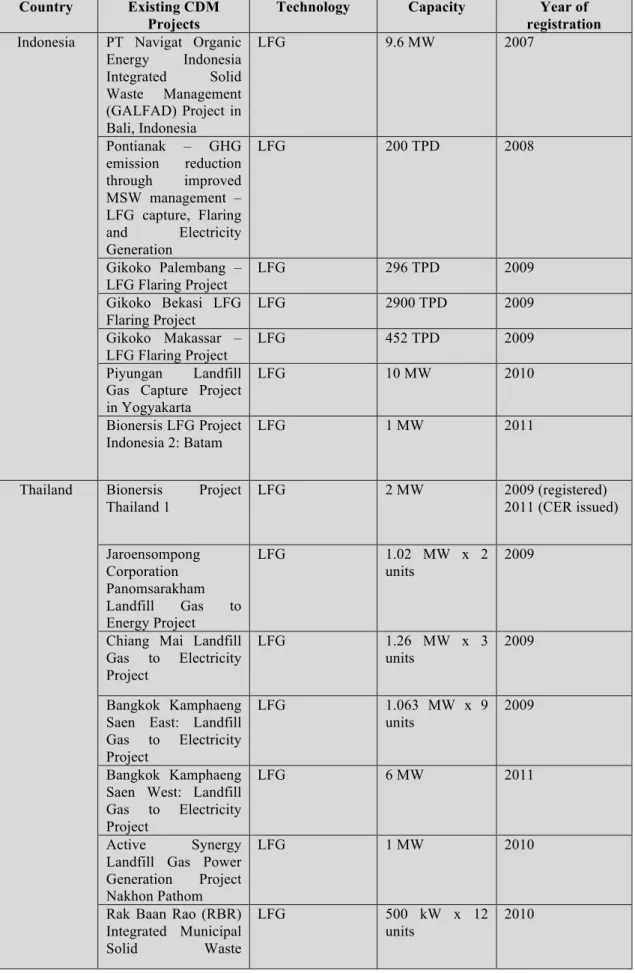
The later LCA studies conducted by universities and research institutes evolved in line with the demand of knowledge and the development of the real practices. The real practices often involve international funding, privatization, and partnerships between the government and the private or international organization sectors. For example, the option of landfill gas (LFG) collection for energy recovery is involved in the Indonesian case study in 2012. At the same time, the Indonesian CDM projects related to MSW registered in the UNFCCC are dominated with LFG energy recovery projects. The 2008 Phuket, Thai case study also focused more on the Green House Gas (GHG) emission and proposes incineration over landfilling for better energy recovery and GHG emission reduction.
The popularity of covering more comprehensive parameters such as the social aspects, organizational and institutional issues, economic aspects, and technical appropriateness was apparent in the newer studies. Swiss Federal Institute of Aquatic Science and Technology cover all these parameter in their study of Gianyar Bali in 2012. This trend might be the result of unsustainability of projects which decision making only relied purely from the traditional LCA that only involves environmental aspects. The Bali study emphasizes the need of community group discussions and
sustainability. The recommended methodology by the Bali study was Analytic Hierarchical Process (AHP) questionnaire. Our study used this approach to weight the result of our LCA study.
In its early development, Life Cycle Assessment (LCA) was intended to assess product manufacturing. LCA framework, data quality standards and impact assessments were developed in 1989 to 1992 at the SETAC’s code of practice workshop I to IV in Vermont, Leiden, Virginia and Florida12. One of the earliest studies on the application of LCA to Municipal Solid Waste (MSW) was conducted in 1999 at the Stockholm University in Sweden. They determined the system boundaries and Life Cycle Impact Assessment (LCIA) methodological aspects of life cycle assessment of integrated solid waste management. One of the earliest and widely used guidelines for LCA application was prepared by Nordtest organization from Finland in 2002. Although the focus was for Nordic countries, the guideline is modifiable for application in other countries. This guideline contains the boundaries and general assumptions that may be made in conduction LCA for Municipal Solid Waste Management (MSWM) for different technologies, namely, incineration, aerobic composting, anaerobic digestion, landfills, biocells, and how to address the substituted energy and mineral compost fertilizer.
In 2006, a study from Ryerson University, Canada compared different LCA models for waste management. This study elaborate and proposed an LCA model called WASTED (Waste Analysis Software Tool for Environmental Decisions). This model is a Microsoft excel based model with the basis of Material Flow Assessment (MFA) approach13. In 2007, Swedish Environmental Research Institute from Sweden analyzed the mechanism to incorporate indirect impacts into LCA quantification and also discussed the applicability of LCA results for policy making. The main finding of this study is the need of including economic data in addition to the technological and environmental data to make it a more comprehensive tool of assessment for decision- making.
In addition to popularly used software of LCA such as SimaPro, GaBi and GEMIS, there are other models that are specifically used for waste management such as IWM 2, ARES, EA SEWASTE, WASTED, ORWARE, EPIC / CSR, DST, and Umberto14. Comparative study has shown that the existing models are useful for environmental engineers, waste managers, and decision makers for determining the environmental implications of solid waste management. However they cannot provide the inclusion of geographic, social and political factors15. Other comparative studies of the existing models16, argue that the models are most suitable only in the country they were designed, for example EA SEWASTE in Denmark, EPIC ICSR in Canada, IWM 2 in UK, ORWARE in Sweden. Table 1.2 lists the existing methodologies used for municipal waste management LCA.
This study distinguishes itself from other studies in the sense that it proposes an LCA model called ELP (Environmental Load Point) formulated in Japan (Waseda University, Nagata Laboratory, Tokyo) that allows higher flexibility of adjustability to the local social, political and other sustainability factors, and higher transparency of data and calculation, which often is lacking in the commercially sold models17.
12 (Shahorly et. al., 2008)
13 (Diaz et al., 2006)
14 (Jörg and Bilitewski, 2007; Gentil et al., 2010)
15 (Diaz and Warith, 2006)
16 (Gentil et al., 2010)
17 (Diaz and Warith, 2006)
Table 1.2 Existing Life Cycle Assessment models for waste management
Model Developer Software
Number of substances modelled ELP Waseda University,
Nagata laboratory EXCEL Total: 186 IWM 2 Procter & Gamble corp.
(UK) SQL Database Air: 24
Water: 27 ARES ARES Energiesysteme
GmbH (GERMANY) EXCEL Air: 121
Water: 153
ORWARE
Swedish University of Agricultural Sciences and other institutions*
(SWEDEN)
Matlab/Simulink Air: 69 Water: 68
EPIC / CSR
Environment and Plastics Industry Council EPIC (CANADA)
EXCEL Air: 12
Water: 5 DST University of North
Carolina (USA) EXCEL / CPLEX Air: 23 Water: 17
UMBERTO
Institute fuer Umweltinformatik Hamburg GmbH (GERMANY)
Borland Database
Engine Not limited
Source: Jorge Winkler, 2007. *Other institutions: * Swedish Institute of Agricultural and Environmental Engineering, Royal Institute of Technology, Kungliga Tekniska Högskolan, Swedish Environmental Research Institute
1.2.2 World Analysis of MSWM technologies and practices
Advanced technologies and management strategies adaptation for better municipal waste management in the developing countries is often a challenging task to do, especially because there are many factors of uncertainties. These uncertainties may be the result of lack of understanding of the business as usual, values, habits and regulations in the region. It may also be due to different climate that affects varieties in temperature, humidity, waste characteristics, energy security, and the required human resources capacity. This study elaborated and analyzed the municipal waste trend and characteristics, regulatory frameworks, and analysis of the technologies that are in practice in the region in a form of Strength, Weakness, Opportunity and Threat (SWOT) analyses for both the developing Asian countries and the developed European countries and Japan as comparison.
1.2.3 Comparative analysis of LCA methodologies
There are many available LCA methodologies in the market. Some are based on excel workbooks and the other are software based. Some methodologies only provide the LCA step, while some other is complete with the Life Cycle Impact Assessment (LCIA) steps. Some of them put importance in the problem of waste
disposal, some other neglect it completely. For the purpose of selecting the appropriate methodology, this study compares several of the available methodologies.
The compared methodologies in this study are ELP, Eco Points and Eco Indicator 99.
1.2.4 Application of ELP in the developing Asian countries municipal solid waste management scenarios
Natural resource scarcity and the effects of environmental destruction have pushed societies to use and reuse resources more efficiently. Waste should no longer be seen as a burden but rather as another source of material including energy fuel.
This study analyses the material and energy recovery potential of three scenarios combining four waste management technologies; incineration with energy recovery, composting, anaerobic digestion and sanitary landfill gas collection as ways to recover energy and material from municipal solid waste in the three selected countries.
The study utilized the ELP method with the selected approach for application in the MSWM situation of India, Indonesia and China as case studies. For better applicability, this LCA study was followed by a discussion around the real practice and the national policy related to the proposed technology.
1.2.5 Economic assessment on the proposed solution
A Cost Benefit Analysis (CBA) was conducted to follow up and support the Life Cycle Assessment (LCA) result. In other words, instead of conducting CBA in parallel with the LCA, CBA was applied to one selection of technology from the LCA study. In this way, ecological aspect has a higher priority over the economic aspect.
Moreover, by this approach, an immediate and realistic solution to improve the current waste management practices may be conducted.
CBA has been commonly used for decision-making in projects, product and service assessments18. Life Cycle Costing (LCC) and CBA are quite similar in the methodology and model approaches. The inventory data involved are mainly the investment cost and the operational cost. Some framework studies recommend the inclusion of environmental cost even when the authorities are not yet concern about the environmental cost19. There are several ways to monetize environmental cost. One way is by for calculating the health damages caused or avoided by the implementation of a project. Another other way is by the monetizing the pollution costs, the land change or the job opportunity made or eliminated due to the project implementation.
Table 1.4 elaborates the frameworks and guidelines prepared by universities and research institutes to conduct Life Cycle Costing. Graz University of Technology in Austria recommends the A Zero emission Agro-based Industrial Ecosystem AIEZES model to address the costing aspect of waste management options in Southeast Asian countries. This model mainly uses CBA approach employing the investment cost of machinery used and the annual cost from the operation and maintenance. The other framework was constructed by a study in University of California in 2004. This study constructed a LCC model for for furnaces and boilers, which is applicable for waste management as well. This study recommends including installation cost of the machineries and the Net Present Value (NPV) of the operating cost.
18 (Finnveden, Bjorklund, Moberg, & Ekvall, 2007)
19 (Menikpura, Gheewala, & Bonnet, 2012)
Reich from Swedish Environmental Institute did another study that employs NPV approach for LCC in 2005. Reich’s study is one of the earliest studies of LCA together with LCC for waste management; therefore it is often referred in the more recent studies of this field. Reich argued that using an LCC in combination with an LCA would provide difficulties due to the two different scientific disciplines and objects of analysis. For example, the functional unit in LCA is often in mass unit such as in tonne or in Kg while in the LCC it is on currency unit such as United States Dollars (USD), Euro (EUR), or Japanese Yen (JPY). The other problem that could arise is the allocation of cost. For example, the investment cost should be allocated overtime depending on the depreciation period. There are also other financial parameters included such as interest rate for any loaned costs and discounting rate to get the present value. On the other hand, in MSWM LCA, the allocation of emission could also differ over time. For example, the release of CH4 gas from the landfill only starts significantly on the second year. Also in composting, the amount of nitrogen released to soil from mineral fertilizer is 80% in the first year while it is only 10% for composting fertilizer and the rest are released on the following years. All of these unit and allocation complications should be broken down carefully and a way to integrate them could be very challenging.
Table 1.3 Frameworks and guidelines for CBA/LCC application in waste management
Publication
title Year
Author, Institution,
location
LCC model used Recommended inventory data Sustainable
solutions for solid waste management in Southeast Asian countries20
2009 Uyen Nguyen Ngoc and Hans Schnitzer, Institute for Process Engineering (IPE), Graz University of Technology, AUSTRIA
Cost Benefit Analysis (CBA) approach included in the (A Zero emission Agro-based Industrial Ecosystem) AIZES methodology
Investment cost per unit machinery used and the annual cost from operation
Life-Cycle Cost Analysis of Energy Efficiency Design Options for Residential Furnaces and Boilers21
2004 James Lutz, et.
al., University of California, UNITED STATES
LCC = installation cost +
!"#$%&'() !"#$
(!!!"#$%&'( !"#$)!
!"#$%"&$
!!!
Paybackoption =
!"#$%&'()!"#$!%!!"#$%&'()(!"#$)
!"#$%&'!"#$!!"#$%&'(!"#$!%)
Investment cost (including installation cost) for equipment and the operating cost over the equipment lifetime (including the finance cost: discount rate, energy cost, and maintenance cost) Economic
assessment of municipal waste management systems – case studies using a
2005 Marcus Carlsson Reich, Swedish Environmental Research
Net Present Value (NPV) The present value of all monetary costs of the studied system, including: investment costs, operative costs, decommissioning
20 (Ngoc & Schnitzer, 2009)
combination of life cycle assessment (LCA) and life cycle costing (LCC)22
Institute, SWEDEN
costs, and sales revenues; all discounted to present value
Nordic guideline for cost-benefit analysis in waste management23
2007 Scovgaard et al. Nordic Council of Ministers
NPV Investment,
Operational costs including labor, natural resources, and import of goods. Also environmental effects and health effects Environmental
and economic assessment methods for waste management decision- support;
possibilities and limitations24
2007 Goran Finnveden et.al.,
Environmental Strategies Research, Stockholm, SWEDEN
Cost Benefit Analysis (CBA)
Cost Effectiveness Analysis (CEA)
Life Cycle Costing (LCC)
CBA: All cost and benefits, including environmental costs should be included and monetized.
CEA: focus on efficient way to achieve goals
LCC: including external costs such as environmental
pollution. LCC can be similar to CBA Cost for
Municipal Waste
Management in the EU, Final Report to Directorate General Environment, European Commission
2002 Dominic Hogg et. al., Eunomia research &
consulting
CBA Cost for collection and
treatment, land acquisition, plant utilization rate, treatment of flue as, engineering, collection of methane gas, conditions for utilization of digestate and liquor from Anaerobic digestion, choice of technology, daily costs, revenues of sales, treatment and disposal of residues, recovery of energy and material, after care, price support of energy production
Source: Compiled by author
A comprehensive inventory guideline for MSW was prepared for the European Commission in 2002, titled, Cost for Municipal Waste Management in the EU. This guideline comprehensively lists the entire possible inventory data that should be included in the MSW CBA for different technologies namely incineration plant, landfill, compost plant, and anaerobic digestion. This guideline is later summarized and further elaborated in the Nordic guideline for cost-benefit analysis in waste management.
22 (Reich, 2005)
23 (Skovgaard, Ibenholt, & T, 2007)
24 (Finnveden, Bjorklund, Moberg, & Ekvall, 2007)
Life Cycle Costing done in the developing Asian countries were done in Indonesia and Thailand using slightly different approach. The Indonesian case study was done in 2006. It employed the traditional NPV formula that involves the present value of investment cost, price coefficient, operation and maintenance cost discounted throughout the project lifetime. The one done in Thailand was conducted in 2012 and it has added the sophistication of including willingness to pay to the mitigation of pollution and health damage avoidance. Table 1.4 complies the information of these two case studies.
Table 1.4 Previous LCC case studies in developing Asian countries
Publication title Year
Author, Institution, location
LCC model used Recommended inventory data Environmental and
economic analyses of waste disposal options for traditional markets in
Indonesia25
2006 Lu Aye, E.R.
Widjaya, University of Melbourne, AUSTRALIA
NPVcost = (I x SP) + OM (!!(!!!)!
! )
NPVrevenue = (Rp + Rghg) + (!!(!!!)!
! )
NPVbenefit= NPVrevenue - NPVcost
I: Investment cost, SP:
Shadow price coefficient, OM:
Operation and maintenance cost, i:
discount rate, t: project lifetime
Framework for life cycle sustainability assessment of municipal solid waste management systems with an application to a case study in Thailand26
2012 SNM Menikpura et. al., King Mongkut University of Technology, THAILAND
LCCgross = CE + OMC + EC
EC = (!"#! x !!) LCCnet=LCCgross- LCR
LCR = Revenues from selling by- products + tipping fee + credited EC
CE: Capital expenditure, OMC:
Operational and maintenance cost, EC*
Environmental cost, LCR: Life Cycle Revenue, WTPi:
willingness to pay for the mitigation of emissions of ithsubstance or avoiding health damages caused by ith substance, Qi:
magnitude of substance i Source: compiled by author
The two approaches differ in the scope and boundary of inventory data involved in the calculation as well as the involvement of finance parameters (discounting and interest rate). The CBA that has been conducted in this study only offers one technology chosen from LCA. The scenarios offered in the CBA in this study only differ in scale of project, therefore the environmental damage including the health damage avoided is considered to have linear correlation. Due to the assumed linear correlation, environmental cost is excluded from the CBA study.
25 (Aye & Widjaya, 2006)
1.2.6 Comparative analysis of the weighting approaches
Weighting, is one important step of the life cycle impact assessment. It reflects the views and values of the concerned stakeholders. Weighting also shows the priority order of the project at hand. This study presents and compares two different weighting approaches. These are, Analytic Hierarchical Process (AHP) and text mining. By testing the different approaches, the level of objectivity may be increased.
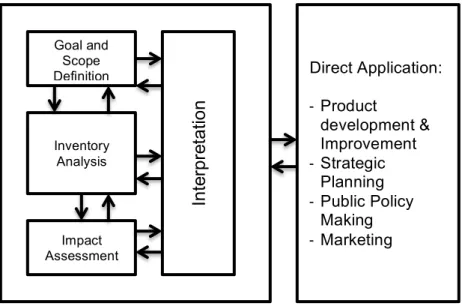
1.3 Research framework
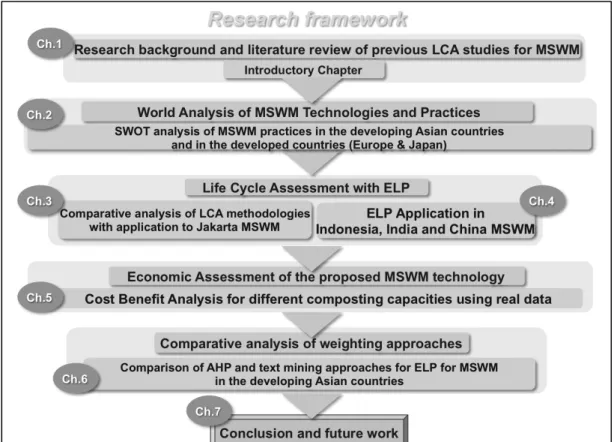
This study consists of seven chapters. Figure 1.1 shows the flow of this study. The first chapter elaborated the history, frameworks, and the previous studies done in the field of LCA and LCC of Municipal Solid Waste Management (MSWM). Other existing models and a number of international guidelines were identified in this chapter. From the literature analysis it was found that the importance of real practice observation to identify the social aspects, organizational and institutional issues, economic aspects, and technical appropriateness. To response to this finding, our study conducted field observation, interviews with key persons and opinion survey to the local community. This effort of personalization is reflected thought the dissertation.
The second chapter provided the overview of the existing waste management practices and technologies in the region of developing countries in Asia. Based on the overview, a Strength, Weakness, Opportunity, and Threats (SWOT) analysis has been conducted to get a better understanding of the trend and practices in the region. The waste characteristics and trends, transportation, treatment technology, policies and regulation, as well as the existence of national or international program on MSWM especially in the field of composting and 3R are elaborated for the six selected countries: Indonesia, China, Thailand, India, Bangladesh, and Sri Lanka. These countries were selected because of their growing concern on waste management27. A brief explanation on each of the technologies was elaborated in this chapter to present a general technical understanding. Moreover, SWOT analysis of the MSWM practices in the developed European countries was also included for comparison.
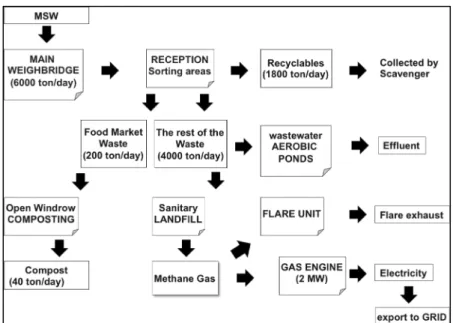
The third chapter compared ELP methodology with Eco-Indicator 99 and Eco Point for validation of model selection and to examine how the weighting factors from the three models are different. The analysis was supported by an application to Jakarta MSWM scenarios for better understanding. The purpose of this chapter is not only to see whether ELP gives valid results as compared to the other methodologies but also to estimate the amount of environmental impact that may be avoided by the improved scenario which may be implemented in the future in the Jakarta integrated landfill site.
The fourth chapter consisted of the implementation of ELP methodology selected in chapter three to the 3 selected countries: India, Indonesia and China. These countries were selected for their high potential as the most populous developing countries and their potential of material and energy recovery from waste that has not yet been done optimally. The conclusion of four was, until the waste in the region is segregated, the practice of composting is still more feasible than anaerobic digestion because of its simple technology, medium environmental impact and lower investment cost28.
27 (Institute for Global Environmental Strategies, 2012)
28 (Aye & Widjaya, 2006)
Figure 1.1 Framework of the study
Chapter five provided the suggestion for improvement of the currently existing composting plants. Another LCA of different composting scenario may give similar result in ELP/unit because the inventory data used would be the same, to avoid this, an economic feasibility improvement study using BCA was proposed instead. A BCA study of different scale of composting projects was conducted to find an optimum capacity of a composting plant. Five real operating plants in developing Asia represented the three different capacity of composting plant. The capacities were categorized into: small scale (0 to 50 Ton Per Day (TPD) capacity) composting plant, medium scale (50 to 400 TPD capacity) composting plant, and large scale (400 to 1000 TPD capacity) composting plant. The selected countries for small scale case study is Indonesia and Sri Lanka, the selected countries for medium scale case study is Indonesia, and the selected countries for large scale case study is China and Indonesia.
To give an alternative of weighting approach in the ELP methodology, this study presents and compares two different weighting approaches in chapter six. These are, Analytic Hierarchical Process (AHP) and text mining. By testing the different approaches, the level of objectivity may be increased and represent a wider scope of stakeholder opinion. Weighting values are given to 9 impact categories addressed in ELP. The 9 impact categories are; global warming, energy depletion, acid precipitation, ocean and water pollution, air pollution, resource consumption, waste disposal, ecosystem influence and ozone depletion. The result of text mining weighting approach showed higher attention in the field of waste disposal. Therefore, this approach may be useful in the future waste management ELP studies.
Chapter seven contained the conclusion of this study. Aspects of regulation and practices, environmental and economic assessment results, general remarks of what could be recommended were provided in this chapter. The way forward for MSWM in Asian developing countries were provided based on the conclusion of the study.
CHAPTER II
SWOT ANALYSIS OF MSWM PRACTICES IN THE DEVELOPING ASIAN COUNTRIES AND DEVELOPED
COUNTRIES (EUROPE AND JAPAN)
TABLE OF CONTENTS CHAPTER II
SWOT analysis of MSWM practices in the developing Asian countries and developed countries (Europe and Japan) ... 2-1
2.1 Introduction ... 2-3 2.2 Description of the available MSWM technologies ... 2-1 2.2.1 Composting ... 2-2 2.2.2 Anaerobic Digestion (AD) ... 2-3 2.2.3 Landfill gas (LFG) utilization ... 2-5 2.2.4 Incineration ... 2-5 2.3 SWOT Analysis of MSWM practices ... 2-7 2.3.1 In the developing Asian countries ... 2-7 2.3.1 In the developed European countries and Japan ... 2-20 2.3.3 Comparison and recommendation ... 2-23 2.4 Summary ... 2-24
List of Tables
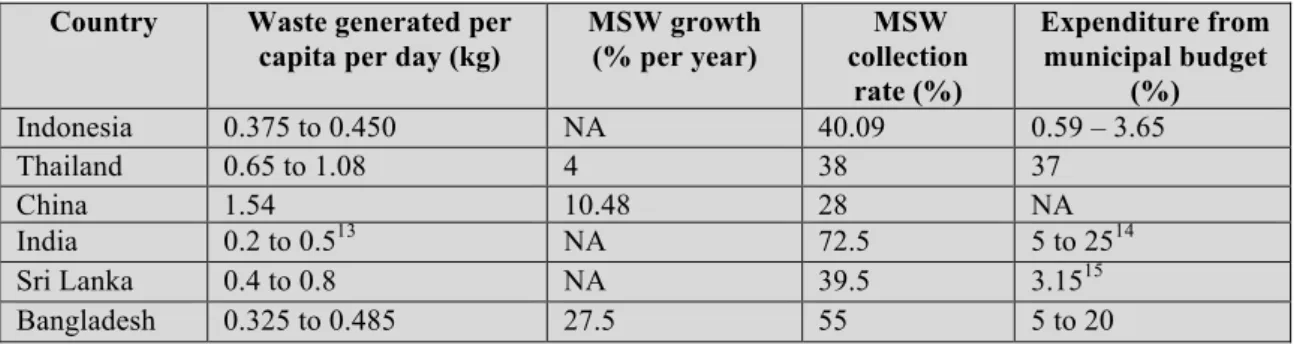
2.1 Municipal waste generation and collection rate in the 6 developing Asian
countries………... 2-8
2.2 Municipal waste generation and recycling rate in the 6 developing Asian
countries………... 2-8
2.3 Type of municipal waste composition in 6 Asian developing
countries………... 2-8
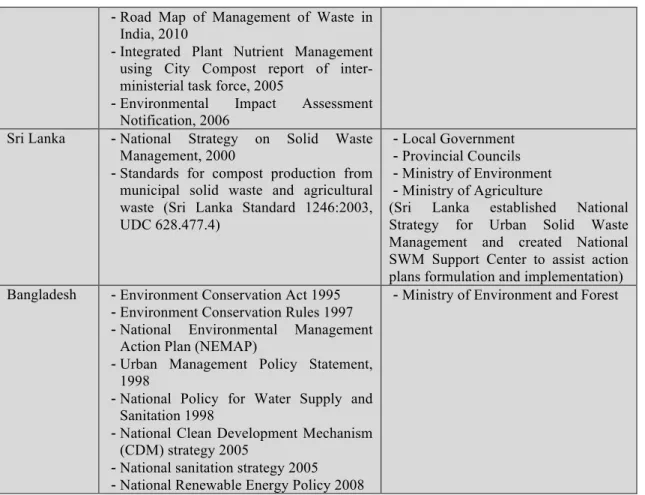
2.4 Laws, regulation, and institution or governmental body in charge………... 2-9 2.5 Situation of the existing MSW technologies and treatment plants in the
region………... 2-11
2.6 The situation and development of 3R activities in the region……… 2-12 2.7 Existing Large Scale Municipal Waste Management CDM projects in the
region………... 2-14
2.8 Large scale AD using MSW mixed waste with MBT system in European
countries……….. 2-21
2.9 Pro and contra points of solid waste technology options……… 2-23 2.10 Summary of MSWM technologies SWOT analysis……… 2-24
List of Figures
2.1 Open windrow composting pile turning scheme ……….………. 2-2 2.2 AD Electricity generation scheme………. 2-3 2.3 Four stages in biogas generation ………...
2.4 Landfill gas collection system ………..
2-4 2-5
2.1 Introduction
Adapting advanced technologies and management strategies for better municipal waste management in the developing countries could be very challenging, especially because there are many factors of uncertainties. These uncertainties may be the result of lack of understanding of the business as usual, community values and habits and regulations in the region. Just like any type of technology implementation in a new region, understanding the social and political situation of a country is as important as understanding technical information such as the different climate that affects varieties in temperature, humidity, waste characteristics, energy security, and the required human resources capacity. This chapter provides SWOT analysis of the MSWM practices in developing countries in Asia. Through SWOT analysis, the municipal waste trend and characteristics, regulatory frameworks, and technology appropriateness that are in practice in the region would be elaborated and analyzed for a better understanding. As comparison, SWOT analysis of the MSWM practices in the developed countries in Europe are also provided.
2.2 Description of the available MSWM technologies
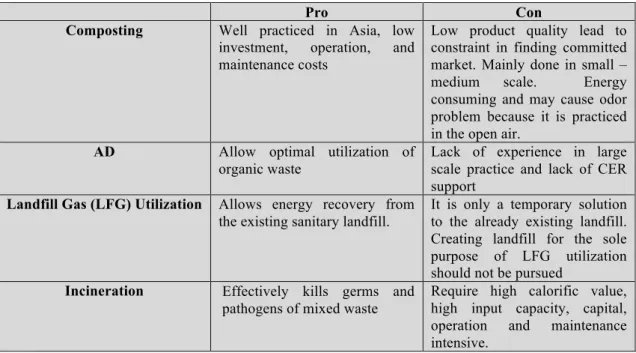
The traditional method of municipal waste management, landfilling, is no longer desired due to its side effects such as pollution from leachate to the ground water, release of methane gas with 21 times global warming potential compared to carbon dioxide, permanent damage on the land which leaves the land as a hazardous waste for decades after rehabilitation, and social and ethical issues of scavengers working in such unsafe condition. The heat on the landfill that could reach to about 70° and there are risk that the scavengers are being knocked off by the excavators. More sustainable technologies should be implemented to treat solid waste. The rapid population and economic growth that lead to increase of waste generation, waste diversity, and land scarcity, add the urgency of decision makers to implement better strategies and technologies. The best way to manage waste is to go along with the waste management hierarchy, which is: avoidance, recovery, and only all of recovery failed, treatment and disposal may be conducted. This paper focused on the material and energy recovery part of the hierarchy by analyzing different waste treatment technologies.
The first part of this chapter analyzed some energy-efficient technologies for treating municipal solid waste. Energy – efficient in this context refer to the least possible energy required to treat solid waste and at the same time consider the energy recovery potential of the technology. This is due to insufficiency of electricity availability in many places in the developing Asian region. The technologies elaborated in this paper are composting, anaerobic digestion (AD), landfill gas (LFG) collection and Incineration. Majority of the municipal solid waste in the developing Asian countries has low calorific value (800 to 1000kcal/kg)1, and high organic content (about 60%) are more favorable for biological processes such as composting and anaerobic digestion. Energy and capital intensive technology, such as incineration is less likely to be suitable for this region.
Taking into consideration the waste characteristics and the ongoing practices in the region, a Strength, Weakness, Opportunity, and Threats (SWOT) analysis is given at
the end of this paper to give a better confidence on deciding the best technology to be implemented in the developing Asian countries.
(Unnikrishnan, 2010) 2.2.1 Composting
The most commonly practiced solid waste management technology (aside from landfilling) in Asian region is composting. Composting is simple and it is one of the most known methods for recycling organic waste. There are several techniques for composting. The most practiced one are aerated windrow and vermin-composting.
Aerated Windrow
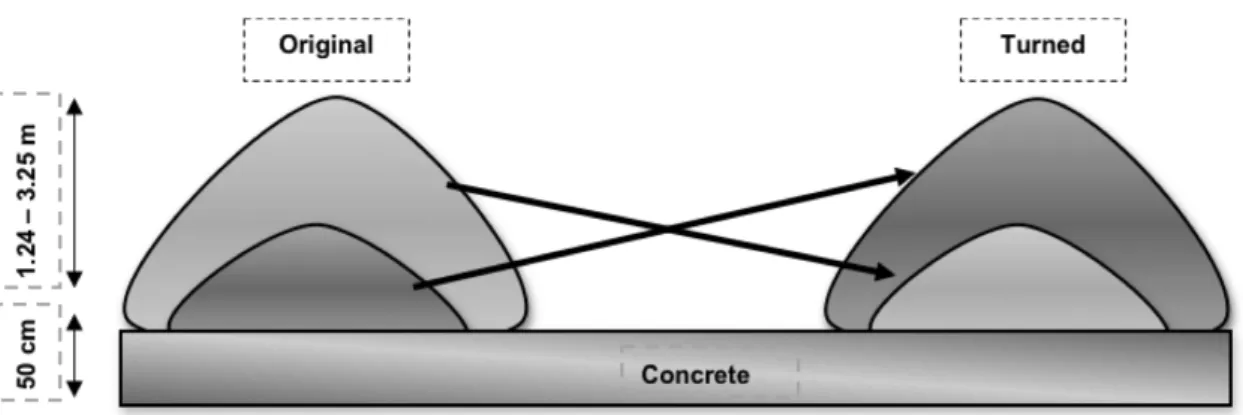
Windrow refers to the long row of piles of organic waste in an open area in the height of 1.25 meters to 3.25 meters that is the ideal height for the pile to maintain higher warmer temperature in the inner part of the pile. Every about 5 days, the pile is turned inside out / outside in, either manually or mechanically in order to ensure sufficient oxygen supply to maintain aerobic activity. The temperature inside the heap could rise up to 75 degrees Celsius and this ensures proper composting and killing the pathogens. For leachate catchment, concrete floor should be prepared under the windrow with less than 10-7cm/sec permeability coefficients, 1 – 2% slope to allow the leachate to flow into the drains built surrounding the piles2. The whole process takes about 4 – 6 weeks and the quality of the compost rely not only to the optimum environment condition but also the composition of waste. Although food waste is desired for this process, meat and bones should not be used as it will attract unwanted germs and flies. Due to the simplicity of this technology, large scale (50TPD – 500TPD) of composting with this system is possible. The end product should have the dark brown soil-like color and texture, and sometimes, for better transportation and marketability, pelletization can also be applied before packaging.
2 (Dayalane, 2006)
Figure 2.1 Open windrow composting pile-turning scheme
Vermin-composting
Vermin composting is a composting technique that utilizes earthworm, working together with microorganism, as the composting agents. Organic waste and worms are put together in a bin and as the worm decompose the waste; nutrient-rich soil called castings will be released from the worm body. These castings contain 2 times richer in magnesium, 15 times nitrogen, and 7 times potassium compared to the surrounding soil3. Various techniques can be introduced in order to achieve better harvest such as substrate aeration, mixing, grinding, and water spraying to keep the ideal moisture content of 45 – 55%4. Utilizing local worms also help in the composting process as the local worm works best for the local temperature. For India case, the local worms that are good for vermin-composting are Eudrilus euginae, Parionyx excavatus, and Eisenia fetida. For every half a kilogram of organic waste, about 800 – 1000 worms are needed. The whole process takes up 3 to 4 months, and when the worms have eaten up all the waste, worms are removed; castings and worm tea are collected for fertilizer.
2.2.2 Anaerobic Digestion (AD)
Anaerobic Digestion, also called biogasification or biomethanation, is the anaerobic process of organic waste degradation with the assistance of microorganisms. This process is by far more efficient when compared to just collecting LFG because the waste is processed in a closed container with conditioned temperature and the absent of oxygen creates the optimal environment for biogas generation. A study shows that 1 ton of waste in a controlled anaerobic digestion produces 2 to 4 times of methane in 3 weeks in comparison to what 1 ton of waste in landfill will produce in 6 – 7 years5. The input of AD should contain relatively pure organic material and the output would be biogas with 55% - 60% CH4 and 40 – 45%
CO2 that can be burned in the gas engine to generate electricity and the residue in form of digestate can be used as soil conditioner.
The flow of AD to generate energy from the organic waste (either sorted in the source or in MRF) is similar to the LFG capture. Methane gas is collected to be burned in the gas engine, excess heat can be recovered to electricity with Combined Heat and Power (CHP) and after self-consumption, and excess energy can be exported to the grid.
Figure 2.2 AD electricity generation scheme
There are four basic stages in AD; Hydrolysis, Acidogenesis, Acetogenesis, Methanogenesis. The first stage, hydrolysis, breaks down carbohydrates, fats, and
3 (Kaviraj, 2003)
4 (Singh, 2011)
Organic
Waste AD Tank Gas
Engine
CHP (optional)
Electricity
proteins into simple sugars, fatty acids and amino acids. The second stage, acidogenesis, further processes these molecules into Carbonic acids, alcohols, Hydrogen, Carbon dioxide, and Ammonia. The third stage, Acetogenesis, is the stage where acetic acids, hydrogen and carbon dioxide produced by acetogens (microorganisms that produces acetate) to allow the final stage where methanogens (microorganisms that produces methane) produce Methane and Carbon dioxide to be burned in the gas engine to generate electricity.
Figure 2.3 Four stages in the biogas generation
Based on the type of methanogen utilizes in the digester, the process can be done either in mesophilic temperature (30-40 °C) or in thermophilic temperature (50 – 60
°C)6. The mesophilic one is more stable because it can still work in ambient temperature (20-45 °C) therefore it requires less energy to operate.
The digestion process can be done at once or in multiple stages. The one-stage process has lower capital investment, but less optimal productivity due to its inability to create pH or better control for the microorganisms to work efficiently. The multiple stage digesters yield more gas but takes longer retention time. The disadvantage of AD technology is the relatively long retention time compared to the other technologies. Based on various case studies, retention time for AD ranges from 8 – 21 days.7
AD is quite common in India, especially for small-scale biogas plants with animal slurry as input. But municipal waste AD is also practiced such as the 14 MW capacity AD plant in Naghpur, Maharashtra.
This technology is recognized as one of the renewable energy options and especially helpful to provide energy considering the scarcity and high GHG emission of petrol based energy. Burning biogas from organic waste as a way of electricity generation is counted as an emission neutral practice since organic materials basically have absorbed CO2 from the atmosphere and energy from the sun in order to grow. Organic waste is one type of biomass. The definition of biomass is biological material from living or recently living organisms. Fossil fuel in the other hand is not counted as biomass because it has gone through geological processes into the form of coal and petroleum. The replacement speed of petrol-based fuel by far cannot compete with organic waste. AD as renewable energy is also justified by the fact that it is one of the projects that could be registered as a Clean Development Mechanism (CDM) project.
6 (Sambo, 1995)
7 (Shekdar, 2004)
Acidogenesis
Hydrogen Acetic
acid Carbon dioxide Carbonic acids
and alcohols
Hydrogen Carbon dioxide
Ammonia
Acetogenesis
CH4
CO2
Methanogenesis Sugar
Fatty acids
Amino acids Carbohydrate
s Fats
Proteins
Hydrolysis
2.2.3 Landfill gas utilization (LFG)
Landfill gas contributes to about 10% of the global warming due to the high methane gas global warming potential. Capturing methane gas from a landfill allows energy generation as well as reducing global warming. Even without energy generation, flaring LFG reduces the potential by 21 to 23. The gas produced in the landfill is the result of degradation of Municipal Solid Waste (MSW) by microorganisms. The quantity and quality of yielded gas depends highly on the waste composition, presence of oxygen, temperature, physical geometry, and time elapsed since disposal time. The desired composition of waste is the organic waste such as kitchen waste since they release more gas. When oxygen does not present, microorganisms could degrade the waste better and the more yield of gas is generated.
In the absence of oxygen, biogas generated contains of about 50% CO2 and 50% CH4.
Methane gas (CH4) is the more desired type of gas since its high calorific value (33.95 MJ/Nm3)8 , this means it generates more electricity. Since the existence of oxygen leads to aerobic process instead of anaerobic, the gas produced in the presence of oxygen results in higher CO2 content instead. The longer time elapsed since disposal means the deeper the waste has gone under the pile and the less oxygen exist, thus the better anaerobic condition is created and the higher CH4 is released. The gas is captured at the relatively lower part of the landfill by flowing it through the well, to the pipe and finally to the plant to run the gas engine to produce electricity. When the amount of gas exceeds the engine capacity, it would be flared to prevent engine malfunction.
Figure 2.4 Landfill gas collection system Source: U.S. Environmental Protection Agency 2009