1 (報告様式4) 【16ek0610003h0003】 平成 29年 5月 31日 平 成 2 8 年 度 委 託 研 究 開 発 成 果 報 告 書 I. 基本情報 事 業 名 : (日本語)慢性の痛み解明研究事業
(英 語)Research Project on Elucidation of Chronic Pain
研究開発課題名: (日本語)慢性疼痛に対する画期的核酸医薬の開発
(英 語)Development of innovative antisense drugs for refractory chronic pain
研究開発担当者 (日本語)東京医科歯科大学大学院・脳神経病態学・教授 横田 隆徳
所属 役職 氏名: (英 語)Department of Neurology and Neurological Science, Graduate School, Tokyo Medical and Dental University, Professor and Chair, Takanori Yokota
実 施 期 間: 平成 26 年 4 月 1 日 ~ 平成 29 年 3 月 31 日
分担研究 (日本語)慢性疼痛に対する画期的核酸医薬の開発
開発課題名: (英 語)Development of innovative antisense drugs for refractory chronic pain
研究開発分担者 (日本語)大川 淳:東京医科歯科大学 整形外科学分野 教授
所属 役職 氏名: (英 語)Atsushi Okawa, Tokyo Medical and Dental University, Department of Orthopaedic Surgery, Professor and Chair
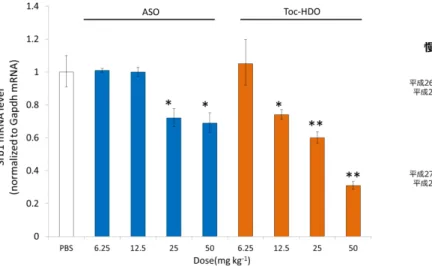
2 Ⅱ.成果の概要(総括研究報告) 研究開発代表者による報告: 和文 慢性疼痛の有症率は全国ランダム抽出サンプルに対する疫学調査において 15.4%と報告されてお り、多くの国民が何らかの痛みを有していると考えられる。特に外傷による脊髄・末梢神経損傷、脊 椎変性疾患に伴う四肢、体幹の痛みは大きな苦痛に加えて日常・社会活動に影響を与え、難治例にも 特効する新たなバイオ医薬が望まれる。 本研究事業では、慢性疼痛の原因となる後根神経節(DRG)の内因性遺伝子の制御におけるヘテロ 核酸(HDO)による核酸構造、核酸修飾、デリバリーリガンドの最適化による基盤技術の開発を実施 することを目的としている。このうち、横田隆徳教授(東京医科歯科大学大学院・脳神経病態学)は プロジェクトの総合的推進及び分子構造の最適化、新規ヘテロ核酸構造の構築に関わる技術開発、研 究分担者の大川淳教授(東京医科歯科大学大学院・整形外科学分野)は疼痛標的分子の探索に関わる 研究開発と神経障害性疼痛モデル動物の作製を実施した。また、両研究グループでカニクイザルに対 して HDO の静脈投与を安全性評価として実施した。また、疼痛とは無関係の内因性遺伝子を標的し た HDO 静脈投与の場合、DRG での遺伝子抑制効果も得られた(図1)。同マウスの後肢知覚機能は、PBS を投与した対照群と比較して差を認めなかった。さらに HDO の週 1 回の反復投与によって長期間の 遺伝子抑制効果が得られ、本事業の慢性疼痛に対する創薬として HDO の反復投与による有効性が 持続し、安全性が確認されたことが非常に高い意義があるものと考えている。安全性評価として霊長 類であるカニクイザルの内因性遺伝子に対する HDO を準備し、静脈投与を行った。行動学的異常は 認めず、投与 3 日後の血液データで肝・腎障害がなかったことが分かり、安全性に大きな問題がない ことが検証された。 本研究事業成果から HDO の核酸構造を最適化することで副作用なく、経静脈的に DRG での内因性 遺伝子を制御可能となった。さらにカニクイザルでの HDO 投与の安全性にかかる非臨床データが得 られた。当初目標であったライセンスアウトは今後早期に目指す計画である。 図1 DRG における従来アンチセンスおよ びヘテロ核酸による内因性遺伝子の発現抑 制効果 図2 本事業のロードマップ
3 英文
A cross-sectional survey in Japan reported that the prevalence of chronic musculoskeletal pain was 15.4%. Even with current treatments, chronic musculoskeletal pain adversely affects everyday activities and social functioning. Therefore, better treatments are needed for refractory pain, especially pain due to neurotrauma and degenerative spondylosis.
Dorsal root ganglion (DRG) neurons are critical in facilitating pain signaling from peripheral nerves to the central nervous system. The current program proposes the use of modified DNA/RNA heteroduplex oligonucleotide (HDO) as a non-virally delivered therapeutic to directly modulate the expression of pain-related genes in the DRG (Figure 1). It is projected that further refinement of HDO should lead to enhancement of both potency and safety of HDO for clinical application.
Professor Yokota heads the current program, of structurally modifying HDO for high efficacy and reduced adverse effects. Professor Okawa hunts for molecular targets in DRG in preclinical animal models of chronic pain. HDO was recently administered to nonhuman primates (Macaca fascicularis) for safety evaluation.
Administration of modified HDO for mice non-coding RNA showed no adverse effects and decreased DRG target gene expression by 70% compared vehicle-treated animals. Furthermore, repeated weekly intravenous injections of the modified HDO for four weeks decreased the target gene expression by 90% compared vehicle-treated animals. Based on these results, a strategy was developed to inhibit endogenous gene expression in the DRG using intravenous administration of modified HDO.
Additionally, HDO was administered in nonhuman primates and no abnormal behaviors, liver and kidney dysfunction were observed. Preliminary results suggest the modified HDO is relatively safe.
The current findings indicate that systemic administration of newly developed HDO significantly inhibits gene expression in mouse DRG. The preliminary safely findings from nonhuman primates suggest that the modified HDO could be nontoxic in humans and, furthermore, could have efficacy against clinical chronic pain. Although license-out of our technique, defined as final target, is never done so far, we plan to develop it near future.
Figure 2. Road map of the study. Figure 1. Silencing efficacy of HDO for
4 Ⅲ.成果の外部への発表
(1)学会誌・雑誌等における論文一覧(国内誌 3件、国際誌 8件)
1. Efficient Gene Suppression in Dorsal Root Ganglia and Spinal Cord Using Adeno-associated Virus Vectors Encoding Short-Hairpin RNA. Enomoto M, Hirai T, Kaburagi H, Yokota T. Methods Mol Biol. 2016, 1364, 277-290.
2. Drug delivery system of therapeutic oligonucleotides. Drug Discoveries & Therapeutics. Asami Y, Yoshioka K, Nishina K, Nagata T, Yokota T. 2016;10(5):256-262
3. Bone marrow stromal cells combined with a honeycomb collagen sponge facilitate neurite elongation in vitro and neural restoration in the hemisected rat spinal cord. Ukegawa M, Bhatt K, Hirai T, Kaburagi H, Sotome S, Wakabayashi Y, Ichinose S, Shinomiya K, Okawa A, Enomoto M. Cell Transplant. 2015, 24(7), 1283-97.
4. Enteral siRNA delivery technique for therapeutic gene silencing in the liver via the lymphatic route. Murakami M, Nishina K, Watanabe C, Yoshida-Tanaka K, Piao W, Kuwahara H, Horikiri Y, Miyata K, Nishiyama N, Kataoka K, Yoshida M, Mizusawa H, Yokota T. Sci Rep. 2015, 5, 17035.
5. Blood-brain barrier: a novel therapeutic target in multiple sclerosis. Kuwahara H, Nishina K, Yokota T. Clin Exp Neuroimmunol. 2015, 6(2), 129-138.
6. DNA/RNA heteroduplex oligonucleotide for highly efficient gene silencing. Nishina K, Piao W, Yoshida-Tanaka K, Sujino Y, Nishina T, Yamamoto T, Nitta K, Yoshioka K, Kuwahara H, Yasuhara H, Baba T, Ono F, Miyata K, Miyake K, Seth PP, Low A, Yoshida M, Bennett CF, Kataoka K, Mizusawa H, Obika S, Yokota T. Nat Commun. 2015, 6, 7969.
7. Chimeric Antisense Oligonucleotide Conjugated to α- Tocopherol. Nishina T, Numata J, Nishina K, Yoshida-Tanaka K, Nitta K, Piao W, Iwata R, Ito S, Kuwahara H, Wada T, Mizusawa H, Yokota T. Mol Ther Nucleic Acids. 2015, 4, e220.
8. Intrathecal AAV Serotype 9-mediated Delivery of shRNA Against TRPV1 Attenuates Thermal Hyperalgesia in a Mouse Model of Peripheral Nerve Injury. Hirai T, Enomoto M, Kaburagi H, Sotome S, Yoshida-Tanaka K, Ukegawa M, Kuwahara H, Yamamoto M, Tajiri M, Miyata H, Hirai Y, Tominaga M, Shinomiya K, Mizusawa H, Okawa A, Yokota T. Mol Ther. 2014, 22, 409-419. 9. 桑原宏哉、横田隆徳 核酸医薬のナノ DDS. 細胞工学 34(10):2-8, 2015 10. 仁科一隆, 吉岡耕太郎, 桑原宏哉, 横田隆徳 神経疾患に対する核酸医薬による遺伝子治療神経 内科 83(4):283-288, 2015 11. 永田哲也、横田隆徳 神経変性疾患の RNA 創薬は 5 年以内に成功するか?. Frontiers in Parkinson Disease 8(3):16-20, 2015
5 (2)学会・シンポジウム等における口頭・ポスター発表
1. Role of voltage-gated sodium channels and calcium channel subunit alpha-2/delta-1 in the lumbar dorsal root ganglions of persistent peripheral neuropathic pain model mice, ポスタ ー発表, Kaburagi H, Sumi A, Hirai T, Wakabayashi Y, Yokota T, Okawa A, Enomoto M, The 46th annual meeting of the Society for Neuroscience, 2016/11/15, 国外.
2. An EGFR inhibitor induces Schwann cell proliferation and promotes functional recovery with remyelination in injured proneal nerve after end-to-side neurorrhaphy, ポ ス タ ー 発 表, Enomoto M, Ukegawa M, Kaburagi H, Hirai T, Yagishita K, Okawa A, Wakabayashi Y, The 44th annual meeting of the Society for Neuroscience, 2016/11/15, 国外.
3. DNA/RNA heteroduplex oligonucleotide a novel concept of therapeutic oligonucleotide, 口頭, Yokota T, 18th Annual TIDES: Oligonucleotide and Peptide Therapeutics, 2016/5/11, 国外. 4. DNA/RNA heteroduplex oligonucleotide for highly efficient gene silencing(口頭)Yokota T
Honolulu(2015 International Chemical Congress of Pacific Basin Societies)2015.12.15 5. DNA/RNA heteroduplex oligonucleotide - a novel concept of therapeutic oligonucleotides.(口
頭) Yokota T Canton Nucleic Acids Forum2015 2015.11.18 国外.
6. A model of chronic pain from human prostate cancer cells implanted into the mouse tibia, ポ スター発表, Enomoto M, Kaburagi H, Hirai T, Yagishita K, Yokota T, Okawa A. The 45th annual meeting of the Society for Neuroscience, 2015/10/18, 国外.
7. 神経障害性疼痛モデルにおける腰部後根神経節での電位依存性ナトリウムおよびカルシウムチ ャネル α2δ サブユニットの役割, ポスター発表, 鷲見晶 鏑木秀俊 平井高志 大川淳 榎本 光裕 第 31 回日本整形外科基礎学術集会, 2016/10/13, 国内. 8. 新規核酸医薬、ヘテロ核酸の創生(口頭)横田隆徳 第 22 回 JBIC バイオ関連基盤技術研究会 2015.12.11 国内 9. DNA/RNA ヘテロ核酸を用いた生体内での血液脳関門の機能制御(口頭)下浦貴大、桑原宏哉、 宋金東、田中(吉田)規恵、仁科一隆、永田哲也、横田隆徳 日本核酸医薬学会第一回年会 2015.12.1 国内 10. ヘテロキメラ 2 本鎖核酸医薬による新規マイクロ RNA 抑制機構の解明(口頭)吉岡耕太郎、筋 野裕美子、國枝泰希、田中規恵、朴文英、桑原宏哉、仁科一隆、永田哲也、横田隆徳 日本核酸 医薬学会第一回年会 2015.11.30 国内 11. 末梢神経損傷モデルにおける後根神経節でのカルシウムチャネル α2δ サブユニットの発現変化, ポスター発表, 鏑木秀俊, 榎本光裕, 平井高志, 横田隆徳, 大川淳, 日本整形外科基礎学術集会, 2015/10/23, 国内. 12. 第3の核酸医薬の「ヘテロ二重鎖核酸」の開発.(口頭)横田隆徳 日本人類遺伝学会 第 60 回大 会2015.10.17 国内 13. TRPV1 を標的とした shRNA-AAV9 くも膜下腔投与は神経障害性疼痛マウスの熱刺激過敏を有 意に抑制する, 口頭, 平井高志, 榎本光裕, 鏑木秀俊, 早乙女進一, 四宮謙一, 横田隆徳, 大川淳, 第29 回日本整形外科学会基礎学術集会, 2014/10/10, 国内.
6
(3)「国民との科学・技術対話社会」に対する取り組み
無し
(4)特許出願 無し