フォトン・アップコンバージョンにおける三重項増 感過程に関する研究
奥村, 佳亮
https://doi.org/10.15017/4060108
出版情報:Kyushu University, 2019, 博士(工学), 課程博士 バージョン:
権利関係:
Studies on Triplet Sensitization Processes for Photon Upconversion
Keisuke Okumura
Department of Chemistry and Biochemistry Graduate School of Engineering
Kyushu University
March 2020
Table of Contents Chapter 1. Introduction
1-1. Solar energy and photon upconversion
1-2. Photon upconversion based on triplet-triplet annihilation (TTA-UC) 1-3. Current state of TTA-UC system
1-4. New class of molecular sensitizers for extended anti-Stokes shifts 1-4-1. TADF molecules
1-4-2. Osmium complexes with S-T absorption 1-4-3. Other new molecular sensitizers
1-5. Inorganic sensitizers
1-5-1. Metal chalcogenide quantum dots 1-5-2. Perovskite nanocrystals
1-6. Overview of thesis References
Chapter 2. Development of TTA-UC System Sensitized by Quantum Dots
2-1. Introduction
2-2. Results and discussion
2-2-1. Surface modification of quantum dots with transmitter ligands 2-2-2. TTA-UC properties in solution system
2-2-3. TTA-UC properties in solid system 2-3. Conclusion
2-4. Experimental References
Chapter 3. Development of TTA-UC System Sensitized by Perovskite Nanocrystals
3-1. Introduction
3-2. Results and discussion
3-2-1. Surface modification of perovskite nanocrystals with transmitter ligands 3-2-2. TTA-UC properties
3-3. Conclusion 3-4. Experimental References
Chapter 4. Development of Sensitizer-free TTA-UC System based on S-T Absorption
4-1. Introduction
4-2. Results and discussion
4-2-1. Sensitizer-free TTA-UC properties of anthracene derivatives 4-2-2. Sensitizer-free TTA-UC properties of perylene derivatives 4-3. Conclusion
4-4. Experimental References
Chapter 5. Conclusion
Acknowledgments
1
Chapter 1. Introduction
1-1. Solar energy and photon upconversion
Reserves of fossil fuels on which humanity depends are declining rapidly, causing demand for alternative energy sources. Clean alternative energy supplies should emit no greenhouse gases, which cause global warming, climate change, and ocean acidification.
Solar energy has been widely harnessed as a clean, abundant and sustainable energy source. Vast quantities of energy are constantly released by the sun and power the oceanic and atmospheric currents on earth. The amount of energy consumed annually by humans, 4.6 × 10²⁰ joules, is provided to earth by the sun in one hour.[1]
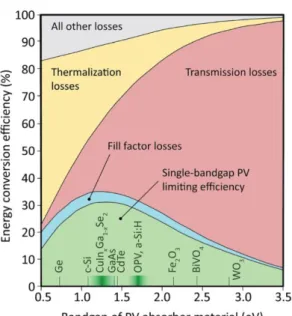
To utilize the energy in sunlight, many solar energy conversion systems have been developed, in which sunlight is converted into electricity, fuel, and heat. Solar energy conversion systems such as photovoltaics and photocatalysis, however, harness only a part of the overall solar energy. This is primarily because of the limited optical absorption of the light-harvesting materials used (Figure 1-1).
If the photon energy is higher than the bandgap of the material, the excess energy is wasted in the production of heat by the thermalization of excited charge carriers. Photons with sub-bandgap energy are not harvested thoroughly.[2]
Photon upconversion (UC), the process of converting two or more photons into one higher-energy photon, has attracted interest for a broad range of applications. Firstly, UC is considered a promising method to improve solar energy conversion efficiencies in photovoltaic systems. Because amorphous silicon solar cells and perovskite solar cells are not sensitive to the infrared region, which contains almost half the energy in solar radiation, the upconversion of near-infrared (NIR) photons would contribute significantly to overcoming the Shockley-Queisser efficiency limit (33.7% for a single junction solar cell)[3] by harnessing a larger number of photons. Trupke et al. published the first theoretical study on upconversion-assisted solar cells based on detailed balance calculations. They showed that the upconversion of sub-bandgap photons improves the conversion efficiency in combination with ideal upconversion materials. The maximum energy conversion efficiency was calculated to be 47.6% under non-concentrated sunlight, assuming 6000 K thermal blackbody radiation.[4] While crystalline silicon solar cells can operate with NIR light, high cost and time- consuming production processes have limited their commercial use.
2
Figure 1-1. Relative importance of fundamental loss mechanisms in solar energy conversion as a function of photovoltaic absorber bandgap, with examples of absorber materials.[2]
The production of high-energy photons in the ultraviolet (UV) region from visible light by a UC system is particularly useful for photocatalysis applications because most current photocatalytic systems are driven only by UV light or high-energy visible light due to the bandgaps of the component materials.
By taking advantage of high permeability of NIR light in living tissues, NIR-to-visible UC could be used for biological applications including photoinduced drug release, photodynamic therapy, and optogenetics.
3
1-2. Photon upconversion based on triplet-triplet annihilation (TTA-UC)
Of some UC mechanisms, triplet-triplet annihilation-based UC (TTA-UC) is particularly promising for a broad range of applications from energy to biology because it works with low-intensity, noncoherent incident light such as sunlight.[2, 5-16]
In a conventional TTA-UC system, excited triplet states of emitter molecules are populated by triplet energy transfer (TET) from molecular sensitizers with high intersystem crossing (ISC) efficiency. This is followed by annihilation between two triplets of the emitter, which produces a higher-energy excited singlet state of the emitter that results in the emission of upconverted delayed fluorescence (Figure 1-2).
Figure 1-2. Scheme for the mechanism of conventional TTA-UC, showing the energy levels involved (S = singlet, T = triplet, ISC = intersystem crossing, TET = triplet energy transfer, TTA = triplet-triplet annihilation).
4 1-3. Current state of TTA-UC system
Until recently, many TTA-UC studies focused on finding sensitizer and emitter molecules for efficient TTA-UC, and various wavelength conversions have been reported with different sensitizer-emitter combinations (Figure 1-3, top).[17] Most TTA-UC studies, however, have been targeted at visible-to- visible UC, especially green-to-blue UC, for which platinum (II) octaethylporphyrin (PtOEP) sensitizer and 9,10-diphenylanthracene (DPA) emitter are a benchmark combination. Though there have been recent works on NIR-to-visible and visible-to-UV TTA-UC, they remain major challenges in TTA-UC research.
Figure 1-3. Representative combinations of sensitizer (right) and emitter (left) and their respective excitation and emission wavelengths. The widths of the anti-Stokes shift are also shown.[17]
5
Although conventional TTA-UC systems can work with low excitation intensity and give high UC efficiencies, there are some fundamental problems related to triplet sensitizers. Conventional sensitizer molecules harvest only a limited range of light because of their narrow absorption bands. Additionally, laborious molecular design and organic syntheses are required to obtain sensitizer molecules with appropriate photophysical properties. Large intrinsic energy losses in the triplet sensitization processes, namely ISC and TET, reduce the attainable anti-Stokes shifts. The anti-Stokes shift, defined as the energy difference between excited and emitted light, is an important parameter for UC systems. While other UC mechanisms based on multistep excitation or multiphoton absorption give large anti-Stokes shifts, their applications are limited because they usually require high-power excitation (W cm-2 ~ MW cm-2).[18-20] By contrast, TTA-UC mechanism works with much lower excitation intensity (~ mW cm-2) and has a wider range of potential applications.
6
1-4. New class of molecular sensitizers for extended anti-Stokes shifts
1-4-1. TADF molecules
New classes of triplet sensitizers can help achieve large anti-Stokes shifts in TTA-UC (Figure 1-3, bottom).[17] Several reports demonstrated molecules that exhibit thermally activated delayed fluorescence (TADF) can function as triplet sensitizers.[21-26] TADF molecules have remarkably small S1-T1 energy gaps, which circumvent the significant energy loss in the ISC process (Figure 1-4). The absence of heavy metals such as Pt or Pd is an added benefit in terms of toxicity and cost.
Figure 1-4. Schemes for the mechanism of (a) TTA-UC with conventional molecular sensitizers and (b) TTA-UC with TADF sensitizers.
The first example of a TADF molecule-sensitized TTA-UC system was reported by Wu and co- workers.[21] To sensitize DPA, they used a red TADF molecule, 2,3,5,6-tetrakis(3,6-diphenylcarbazol-9- yl)-1,4-dicyanobenzene (4CzTPN-Ph), developed by Adachi and co-workers.[27] The DPA/4CzTPN-Ph bilayer thin film showed upconverted emission from DPA under laser excitation at 532 nm. In this solid- state system, the overall UC efficiency was limited (0.28%) because of the low TET efficiency of 9.1%.
Peng et al. applied a bichromophoric strategy for a TADF sensitizer to enhance TET efficiency, in which 2,7-di-tert-butylpyrene (DBP) was covalently tethered to a TADF molecule, 3,4,5,6-tetrakis- (carbazol-9-yl)-1,2-dicyanobenzene (4CzPN).[22] Polyurethane films containing 4CzPN-nDBP sensitizers and DBP emitters showed more efficient visible (450 nm)-to-UV (378 nm) TTA-UC compared to the film of unmodified 4CzPN and DBP, thanks to the suppressed reverse ISC and TADF pathways.
7
By utilizing the full potential of a TADF sensitizer, Yanai et al. achieved TTA-UC with large anti- Stokes shifts.[23] They used a typical TADF molecule, 2,4,5,6-tetrakis(carbazol-9-yl)isophthalonitrile (4CzIPN), to sensitize a UV emitter, p-terphenyl (TP), with high triplet and single energy levels. A deaerated solution of 4CzIPN and TP in benzene exhibited efficient visible (445 nm)-to-UV (343 nm) TTA-UC with a large anti-Stokes shift of 0.83 eV.
Very recently, Chen et al. reported red (635 nm)-to-blue (428 nm) TTA-UC with a large anti-Stokes shift of 0.94 eV.[26] As a TADF sensitizer, they used a derivative of 2’,7’-dichlorofluorescein (DCF) named DCF-MPYM, which absorbs in the red spectral region and has a long triplet state lifetime of 22 µs. Blue UC emission was clearly observed from a deaerated solution of DCF-MPYM and DPA in THF. The UC efficiency of 11.2% was substantially higher than that of other TADF molecule-sensitized TTA-UC systems.
8 1-4-2. Osmium complexes with S-T absorption
To avoid the energy loss inherent in the ISC process, a totally different strategy based on direct singlet- to-triplet (S-T) absorption has recently been proposed.[28-32] In this approach, an excited triplet state of the sensitizer is directly generated through S-T absorption, thus bypassing the S1-to-T1 ISC process. The absence of an ISC process decreases the energy loss in the triplet sensitization process, resulting in a larger anti-Stokes shift (Figure 1-5). Although direct S-T transition is generally considered to be a spin- forbidden process, it becomes weakly allowed in some metal complexes because of strong spin-orbit coupling, resulting in relatively large absorption coefficients.[33-37]
Figure 1-5. Schemes for the mechanism of (a) TTA-UC with conventional molecular sensitizers and (b) TTA-UC with S-T absorption sensitizers.
Amemori and Sasaki et al. used an osmium complex, Os(atpy)(tbbpy)Cl+ (atpy = tris(2-ethylhexyl)- [2,2’:6’,2”-terpyridine]-4,4’,4”-tricarboxamide; tbbpy = 4,4’-di-tert-butyl-2,2’-bipyridine) as a sensitizer with direct S-T absorption.[28] They observed NIR (938 nm)-to-yellow (570 nm) TTA-UC with an anti-Stokes shift of 0.86 eV in a dichloromethane solution containing the Os complex and rubrene.
The TET process was found to be very inefficient in solution because of the short triplet lifetime of the Os complex (12 ns) caused by the large spin-orbit coupling. This problem was resolved by taking advantage of triplet energy migration-based UC in chromophore assemblies.[12, 13, 38-42] Nanoparticles of amorphous rubrene doped with the Os complex were prepared by re-precipitation and dispersed into poly(vinyl alcohol) (PVA) to prevent oxygen from quenching the triplet states. The resultant PVA film showed NIR-to-yellow TTA-UC with a high UC efficiency of 3.1% under aerated conditions. This indicates that TET from sensitizers to emitters is efficient because of the short distance between them.
9
Using the same approach with a different Os complex, Sasaki et al. demonstrated the first example of NIR (724 nm)-to-blue (462 nm) TTA-UC with a large anti-Stokes shift of 0.97 eV.[29] They carefully designed a sensitizer with S-T absorption, Os(bptpy)22+ (bptpy = 4’-(4-bromophenyl)-2,2’:6’,2”- terpyridine) to have the appropriate triplet energy level for a blue-emitting molecule, 2,5,8,11-tetra-tert- butylperylene (TTBP). A deaerated solution of Os(bptpy)22+ and TTBP in DMF showed NIR-to-blue TTA-UC with UC efficiency of 2.7%. In addition, solid-state NIR-to-blue TTA-UC was observed even under aerated conditions by encapsulating a ground solid mixture of Os(bptpy)22+ and TTBP in a PVA matrix.
Sasaki et al. also reported the first example of optogenetics based on NIR-to-blue TTA-UC hydrogels utilizing an S-T absorber.[32] They developed a new complex, Os(peptpy)22+, that has an interlinked structure of Os(ptpy)2 (ptpy = 4’-phenyl-2,2’:6’,2”-terpyridine) units and phenyl-perylene units. The perylene moieties have a long-lived triplet state that results in energy-pooling by intramolecular energy transfer. This gives the sensitizer an exceptionally long excited-state lifetime, which is advantageous for TET, especially in viscous matrices such as hydrogels. In comparison with their previous system, higher UC efficiency of 5.9% was obtained from a deaerated solution of Os(peptpy)22+ and TTBP in DMF.
Using the molecular sensitizers with S-T absorption are a promising method of sensitization for TTA-UC to reduce energy losses and achieve large anti-Stokes shifts. The direct population of excited triplets in emitter molecules by S-T absorption is also attractive because it can eliminate energy losses from both ISC and TET. While the S-T absorption of organic crystals has been studied in the field of triplet photophysics since the 1960s,[43-45] they have not been used as UC materials because S-T absorption is spin-forbidden. However, when the molecule is modified with heavy halogen atoms, S-T absorption becomes feasible because of strong spin-orbit coupling, and occurs at relatively low excitation intensity.[46] We exploited this behavior to demonstrate sensitizer-free TTA-UC in pure organic crystals (Chapter 4).
10 1-4-3. Other new molecular sensitizers
In addition to the two approaches described in the preceding section, some new approaches have been recently demonstrated to extend anti-Stokes shifts. Han et al. proposed a new triplet sensitization route, excited doublet-triplet energy transfer (DTET).[47] As a triplet sensitizer, they used a π-radical dye, (4- N-carbazolyl-2,6-dichlorophenyl)-bis(2,4,6-trichlorophenyl)-methyl (TTM-1Cz), with superior doublet emission. The excited doublet of TTM-1Cz was directly generated by photoexcitation, which was followed by direct sensitization of DPA through DTET. In this system, red (635 nm)-to-blue (432 nm) TTA-UC with a large anti-Stokes shift of 0.92 eV was achieved.
In another new strategy to increase anti-Stokes shifts in TTA-UC, Wang et al. focused on spin- allowed charge transfer absorption.[48] They used a covalently-linked BODIPY-perylene derivative that allowed spin-orbit charge transfer intersystem crossing (SOCT-ISC). The SOCT-ISC sensitizer creates a red-shifted charge transfer absorption band. Direct S0-to-1CT photoexcitation followed by 1CT-to-T1
ISC results in a smaller energy loss in the sensitization process than conventional routes. The triplet sensitization of perylene with the sensitizer led to red (589 nm)-to-blue (450 nm) TTA-UC with an anti- Stokes shift of 0.65 eV.
Fan et al. reported a chemical modification strategy to tune both the singlet and triplet excited-state energy levels of triplet sensitizers.[49] They precisely adjusted the excited energy levels of Pt-salophen complexes to minimize energy loss in the triplet sensitization of DPA by conjugation with each other or with an alternate chromophore via an ethynylene or butadiynylene bridge. The resulting Pt-salophen derivatives allowed red (635 nm)-to-blue (409 nm) TTA-UC with a large anti-Stokes shift of 1.08 eV.
Although successful examples are still limited, the development of new types of triplet sensitizer holds great promise for TTA-UC with the large anti-Stokes shifts required for practical applications.
11 1-5. Inorganic sensitizers
1-5-1. Metal chalcogenide quantum dots
Inorganic semiconductor materials have also been used as alternative triplet sensitizers to solve some of the problems of molecular triplet sensitizers. Metal chalcogenide quantum dots (QDs) have attracted particular attention. Quantum dots are quantum-confined semiconductor nanocrystals such as cadmium selenide (CdSe) and lead sulfide (PbS). Quantum confinement results in unique optoelectronic properties that differ substantially from the properties of bulk state. Potential applications include photovoltaics, light-emitting diodes, displays, lasers, transistors and biomedical imaging.
Quantum dots are excellent light absorbers with broad absorption properties. The bandgap of a QD is finely tunable by varying the particle size, and QDs have emissions with small Stokes shifts. These properties are entirely unlike those of common organometallic complexes. Quantum dots have a mixed- spin character because of the small exchange interaction and the strong spin-orbit coupling.[50, 51] This implies that energy transfer between QDs and molecular triplet states is spin-allowed.
In 2014, two research groups independently demonstrated that triplet excitons generated through singlet fission in organic semiconductor film can transfer the energy to inorganic semiconductor QDs.[52,
53] Tabachnyk et al. reported that interfacial energy transfer occurs from the excited triplets of pentacene to PbSe QDs in the bilayer sample.[52] They investigated the dynamics of triplet excitons by using ultrafast optical absorption spectroscopy. The photoexcitation of pentacene was followed by singlet fission to produce excited triplet states. Subsequently, the triplet was found to rapidly (<1 ps) transfer to QDs at the interface. They also revealed that the energy transfer occurs efficiently only when the QD bandgap is resonant with the triplet energy of pentacene (less than ±0.2 eV).
Thompson et al. demonstrated direct energy transfer from excited triplets of tetracene to PbS QDs in the bilayer sample.[53] After preferentially exciting tetracene, the singlet excitons in the thin tetracene film first underwent singlet fission. The triplets thus generated were transferred to the QDs. This energy transfer was confirmed by observing the appearance of tetracene peaks in the excitation spectrum of QD luminescence. They also found that the energy transfer efficiency had an exponential dependence on the lengths of the QD ligands, which is consistent with Dexter-type energy transfer.
12
Shortly after these results were published in 2014, at least four research groups including ours independently reported triplet energy transfer in the opposite direction (i.e., from QDs to molecules) as a new triplet sensitization process.[54-57] Unlike conventional TTA-UC sensitized by molecular sensitizers, the energy losses in the triplet sensitization process are lower because of their single-triplet mixed-spin character, which enables TTA-UC with a large anti-Stokes shift (Figure 1-6).
Figure 1-6. Schemes for the mechanism of (a) TTA-UC with molecular sensitizers and (b) TTA-UC with inorganic sensitizers (VB = valence band, CB = conduction band).
The first published example of triplet sensitization by QDs for TTA-UC was by Huang and co- workers (Figure 1-7a).[54] They demonstrated NIR (980 nm)-to-yellow (568 nm) TTA-UC in solution using PbSe QDs and rubrene as the sensitizer and emitter, respectively. The UC efficiency was measured to be 0.01%. They also observed green (532 nm)-to-blue (432 nm) TTA-UC with a higher UC efficiency of 9% in a solution with CdSe QDs/9-anthracenecarboxylic acid (ACA)/DPA as a sensitizer/
transmitter/emitter combination. The transmitter molecules anchored on the QD surface mediate TET between QDs and emitters to improve the efficiency. The transmitter molecules are discussed in detail later.
Wu et al. demonstrated solid-state NIR (>1 µm)-to-red (612 nm) TTA-UC that used PbS QDs and rubrene as the sensitizer and emitter, respectively (Figure 1-7b).[55] Upon photoexcitation of submonolayer PbS QDs, spin-triplet excitons were generated and transferred to the adjacent rubrene/
dibenzotetraphenylperiflanthene (DBP) layer, followed by TTA in rubrene and emission from DBP.
Under laser excitation at λ = 808 nm, this solid-state material had a UC efficiency of 1.2%.
13
Mongin et al. experimentally provided proof-of-concept that triplet excitons can be extracted from QDs via interfacial Dexter-like energy transfer (Figure 1-7c).[56] Using transient absorption spectroscopy, they observed direct TET from CdSe QDs to surface-attached polyaromatic carboxylic acid acceptors, ACA and 1-pyrenecarboxylic acid (PCA). The experimental results also demonstrated the secondary TET process from surface-attached molecules to freely diffusing molecules with low-lying triplet levels.
Figure 1-7. (a) Schematic illustrations and energy diagrams for TTA-UC system using PbSe/rubrene (left) and CdSe/ACA/DPA (right).[54] (b) Schematic illustration and energy diagram for TTA-UC system using PbS/rubrene/DBP, and the solid-state device structure.[55] (c) Schematic illustration of QD-to- solution triplet energy transfer, the associated energy levels, and the various TET and decay pathways investigated in the study.[56]
14
Around the same time, our work (described in Chapter 2) was conducted independently of these pioneering works.[57] Our research focused on core-shell CdSe/ZnS QDs, while other workers studied core-only QDs without shell layers. The photophysical properties of core-shell QDs are generally superior compared with core-only QDs because non-radiative recombination sites on the core surface are passivated by a wider bandgap semiconductor shell layer, which can improve TET efficiency.[58, 59]
The core-shell structure is especially important when ligand exchange is performed because the process of ligand exchange can damage the surface and create trap states.[60]
Another means of promoting energy transfer is the modification of the QD surface with energy transmitter molecules. The surfaces of as-prepared QDs are usually capped by long-chain ligands such as oleic acid and octadecylamine, which are necessary to passivate dangling bonds for the suppression of non-radiative recombination and to increase solubility in various organic solvents.[59, 61] The mechanism of TET from QDs to organic molecules is of the Dexter-type, based on wave function overlap, and has an exponential dependence on the donor-acceptor distance. The long-chain ligands on the as-prepared QD surface spatially separate QDs from surrounding emitter molecules, which results in low TET efficiencies.[62] We modified the QD surface with energy transmitter molecules, and the short distance between the QDs and surface-attached transmitter ligands allowed for efficient Dexter energy transfer. It is expected that transmitter molecules mediate TET to free emitter molecules in bulk solution because triplet lifetimes becomes long enough on transmitter ligands to allow sufficient time for TET. Energy transmitters were also used in the work of Huang et al., who used ACA.[54] Though the molecules including their metal-binding moieties were different, the results are consistent with each other.
The importance of both the core-shell structure of QDs and transmitter molecules for efficient triplet sensitization has been supported by the results of Tang and co-workers.[63-68] They studied PbS/CdS QDs,[63] CdS/ZnS QDs,[64] and CdSe/ZnS QDs,[65] and found that UC efficiency is strongly dependent on the thickness of the shell layer. The shell enhances TET by passivating the surface trap, but a thick shell acts as an energy barrier that diminishes TET. There is an optimal shell thickness at which the UC efficiency is maximized.
15
The surface density of transmitter ligands is one of the keys to facilitating TET. The efficiency of UC reaches a maximum and then decreases as the surface density of transmitter ligand increases.[66]
Additional transmitter ligands can cause TTA between neighboring transmitters on the surface, lowering the efficiency of transmitter-to-emitter TET. The molecular design of the transmitter ligand is also important. Because orbital overlap is crucial for Dexter-type TET, the distance between the QD and chromophore (polyacene moiety),[67] and the binding geometry[68] greatly affect TET efficiency. In addition, the binding moiety (functional group) and consequent binding affinity are important because they impact the surface density of transmitter ligands and the stability of the QD-transmitter hybrid.[69]
Recent advances described here provide strategic insight into the optimal design of hybrid interfaces for QD-sensitized TTA-UC systems.
16 1-5-2. Perovskite nanocrystals
Perovskite is a class of optoelectronic materials that have been intensively studied for various applications.[70-72] Three-dimensional metal halide perovskites have attracted significant attention as solar cell materials because of their tunable bandgaps and low exciton binding energy.[73-75] In nanometer-sized structures such as thin layers and nanocrystals, the spatial confinement of electrons and holes facilitates radiative recombination.[76, 77] Magneto-optical studies of perovskites showed that singlet and triplet excitons are generated after relaxation of the spin-antiparallel and spin-parallel electron-hole pairs, respectively.[78, 79] In addition, Becker et al. recently showed that the lowest-lying exciton in CsPbX3 perovskite nanocrystals (PNCs) involves an optically bright triplet state, while that of most organic and inorganic semiconductor materials is known to be dark. Because of the small energy splitting of the singlet and triplet state in PNCs, these states undergo rapid population exchanges at room temperature.[80] These findings imply that PNCs are potentially capable of sensitizing molecular excited triplets, as is the case with metal chalcogenide QDs. A PNC-sensitized TTA-UC system is expected to have similar advantages to a QD-sensitized system.
Lead halide PNCs are photoluminescent with narrow full width at half maximum (FWHM) in the entire visible spectral range.[81, 82] Electronic surface passivation with wide-gap shell materials is not necessary for lead halide PNCs to achieve high photoluminescence quantum yield. This defect tolerance is attributed to their unique electronic structure in which defect states form only shallow traps or are enclosed in the conduction or valence band.[82] They possess two other advantages over metal chalcogenide QDs. The synthesis of PNCs is possible even under ambient conditions, while synthesizing QDs involves high-temperature reactions under an inert atmosphere. Bandgap tuning is easily accomplished by varying the halide composition in the precursors for the synthesis or by conducting post-synthesis anion exchange, although exacting size control is required in the case of QDs.[82]
Earlier studies demonstrated the extraction of triplet energy from 2-dimensional (2D) perovskites.
The excited triplet state of naphthalene chromophores in organic-inorganic hybrid perovskite was generated by TET from inorganic layers.[83, 84] Younts et al. recently reported the formation of excited triplet states in a (MA)2Pb(SCN)2I2 2D perovskite film (MA = CH3NH3+) and subsequent interfacial TET to an adjacent organic layer of rubrene or 9,10-bis(phenylethenyl)-anthracene as well as to perylene solution. TTA-UC emission from perylene was observed after selective excitation of 2D perovskite film using a 570 nm laser.[85]
17
Our group demonstrated the first example of triplet sensitization by PNCs for TTA-UC (Figure 1- 8).[86] We used cesium lead halide CsPb(Br/I)3 PNCs as inorganic triplet sensitizers. The surface was modified with energy transmitter ligands, 2-(4-(10-phenylanthracen-9-yl)-phenyl)ethan-1-amine (AEDPA). Under excitation at 532 nm, UC emission was observed from a deaerated solution of AEDPA- modified CsPb(Br/I)3 and DPA in toluene, which showed UC efficiency of 1.3%. The transmitter molecule was found to play a crucial role in the TET process as observed in QD-sensitized TTA-UC because as-synthesized PNCs are also capped with long-chain passivating ligands. Importantly, this system showed red (635 nm)-to-blue (434 nm) TTA-UC with a large anti-Stokes shift of 0.90 eV, thanks to the small energy loss in the triplet sensitization process.
Figure 1-8. Scheme for TTA-UC sensitized by CsPbX3 perovskite nanocrystals.[86]
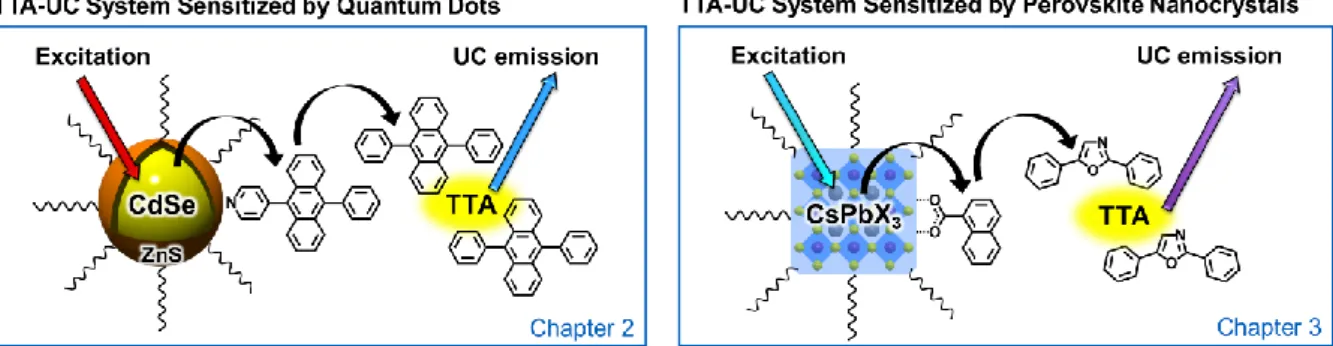
The work described in Chapter 3 is the first demonstration of visible-to-UV TTA-UC sensitized by PNCs.[87] We generalized our previous work[86] by using lead halide PNCs with a different halide composition. The strategy of triplet energy relay by surface-attached transmitter molecules was also verified to work. We observed blue (488 nm)-to-UV (363 nm) TTA-UC with a large anti-Stokes shift of 0.88 eV. The details are discussed in Chapter 3.
18
Triplet energy transfer from PNCs to surface-bound acceptors has been confirmed by recent transient absorption spectroscopy studies by Wu and co-workers.[88, 89] They prepared CsPbBr3 PNCs of varying sizes and modified the surface with 1-pyrenecarboxylic acid and 1-naphthalenecarboxylic acid. They directly monitored the dynamics of interfacial TET, and found quantum confinement to be essential for efficient TET. The TET rates scaled approximately linearly with the carrier probability density at the surface. This result was consistent with a Dexter-type TET mechanism that relies on the donor-acceptor wave function overlaps. After our report on the first example of visible-to-UV TTA-UC sensitized by PNCs, the authors also demonstrated efficient visible (443 nm)-to-UV (355 nm) TTA-UC.[90]
19 1-6. Overview of thesis
The aim of this work was to develop triplet sensitization processes in TTA-UC systems for the extension of anti-Stokes shift (Figure 1-9).
In Chapter 2, CdSe/ZnS core-shell quantum dots (QDs) were used as a triplet sensitizer for TTA- UC. This mechanism involves absorption of incident light by QDs followed by interfacial energy transfers from QDs to the triplet states of an emitter, and then TTA. There is no significant energy loss from ISC, which makes it possible to achieve a larger anti-Stokes shift compared with conventional TTA-UC systems sensitized by molecular sensitizers.
In Chapter 3, CsPb(Cl/Br)3 perovskite nanocrystals (PNCs) were employed as another type of inorganic triplet sensitizer and the first example of visible-to-UV TTA-UC sensitized by PNCs was demonstrated. This system has a similar mechanism and similar advantage to the QD-sensitized system described in Chapter 2. The surface modification of PNCs with energy transmitter ligands played a key role in effective triplet sensitization, resulting in high UC efficiency.
Chapter 4 describes a new concept for sensitizer-free TTA-UC, in which excited triplet states of emitter molecules are generated by direct singlet-to-triplet (S-T) absorption. This system does not contain any energy-loss processes during ISC and TET, and is expected to offer a larger anti-Stokes shift than sensitized TTA-UC systems. Sensitizer-free TTA-UC was observed for crystals of brominated anthracene and perylene derivatives, which showed NIR-to-visible UC with remarkably large anti- Stokes shifts.
20
Figure 1-9. Schematic illustrations of the studies described.
21 References
[1] G. W. Crabtree, N. S. Lewis, Phys. Today 2007, 60, 37-42.
[2] T. F. Schulze, T. W. Schmidt, Energy Environ. Sci. 2015, 8, 103-125.
[3] W. Shockley, H. J. Queisser, J. Appl. Phys. 1961, 32, 510-519.
[4] T. Trupke, M. A. Green, P. Würfel, J. Appl. Phys. 2002, 92, 4117-4122.
[5] S. Baluschev, T. Miteva, V. Yakutkin, G. Nelles, A. Yasuda, G. Wegner, Phys. Rev. Lett. 2006, 97, 143903.
[6] T. N. Singh-Rachford, F. N. Castellano, Coord. Chem. Rev. 2010, 254, 2560-2573.
[7] J. Z. Zhao, S. M. Ji, H. M. Guo, RSC Adv. 2011, 1, 937-950.
[8] A. Monguzzi, R. Tubino, S. Hoseinkhani, M. Campione, F. Meinardi, Phys. Chem. Chem. Phys. 2012, 14, 4322-4332.
[9] Y. C. Simon, C. Weder, J. Mater. Chem. 2012, 22, 20817-20830.
[10] J. H. Kim, J. H. Kim, J. Am. Chem. Soc. 2012, 134, 17478-17481.
[11] Q. Liu, B. R. Yin, T. S. Yang, Y. C. Yang, Z. Shen, P. Yao, F. Y. Li, J. Am. Chem. Soc. 2013, 135, 5029- 5037.
[12] N. Yanai, N. Kimizuka, Chem. Commun. 2016, 52, 5354-5370.
[13] N. Kimizuka, N. Yanai, M. Morikawa, Langmuir 2016, 32, 12304-12322.
[14] K. Kamada, Y. Sakagami, T. Mizokuro, Y. Fujiwara, K. Kobayashi, K. Narushima, S. Hirata, M. Vacha, Mater. Horiz. 2017, 4, 83-87.
[15] S. P. Hill, K. Hanson, J. Am. Chem. Soc. 2017, 139, 10988-10991.
[16] V. Gray, K. Moth-Poulsen, B. Albinsson, M. Abrahamsson, Coord. Chem. Rev. 2018, 362, 54-71.
[17] N. Yanai, N. Kimizuka, Acc. Chem. Res. 2017, 50, 2487-2495.
[18] H. Dong, L. -D. Sun, C. -H. Yan, Chem. Soc. Rev. 2015, 44, 1608-1634.
[19] J. Zhou, Q. Liu, W. Feng, Y. Sun, F. Y. Li, Chem. Rev. 2015, 115, 395-465.
[20] C. Ye, L. Zhou, X. Wang, Z. Liang, Phys. Chem. Chem. Phys. 2016, 18, 10818-10835.
[21] T. C. Wu, D. N. Congreve, M. A. Baldo, Appl. Phys. Lett. 2015, 107, 031103.
[22] J. Peng, X. Guo, X. Jiang, D. Zhao, Y. Ma, Chem. Sci. 2016, 7, 1233-1237.
[23] N. Yanai, M. Kozue, S. Amemori, R. Kabe, C. Adachi, N. Kimizuka, J. Mater. Chem. C 2016, 4, 6447- 6451.
[24] D. Wei, F. Ni, Z. Zhu, Y. Zou, C. Yang, J. Mater. Chem. C 2017, 5, 12674-12677.
[25] Q. Chen, Y. Liu, X. Guo, J. Peng, S. Garakyaraghi, C. M. Papa, F. N. Castellano, D. Zhao, Y. Ma, J. Phys.
Chem. A 2018, 122, 6673-6682.
[26] W. Chen, F. Song, S. Tang, G. Hong, Y. Wu, X. Peng, Chem. Commun. 2019, 55, 4375-4378.
[27] H. Uoyama, K. Goushi, K. Shizu, H. Nomura, C. Adachi, Nature 2012, 492, 234-238.
[28] S. Amemori, Y. Sasaki, N. Yanai, N. Kimizuka, J. Am. Chem. Soc. 2016, 138, 8702-8705.
[29] Y. Sasaki, S. Amemori, H.I Kouno, N. Yanai, N. Kimizuka, J. Mater. Chem. C 2017, 5, 5063-5067.
[30] D. Liu, Y. Zhao, Z. Wang, K. Xu, J. Zhao, Dalton Trans. 2018, 47, 8619-8628.
[31] Y. Wei, M. Zheng, L. Chen, X. Zhou, S. Liu, Dalton Trans. 2019, 48, 11763-11771.
[32] Y. Sasaki, M. Oshikawa, P. Bharmoria, H. Kouno, A. Hayashi-Takagi, M. Sato, I. Ajioka, N. Yanai, N.
22
Kimizuka, Angew. Chem. Int. Ed. 2019, 58, 17827-17833.
[33] S. Lamansky, P. Djurovich, D. Murphy, F. Abdel-Razzaq, H. E. Lee, C. Adachi, P. E. Burrows, S. R.
Forrest, M. E. Thompson, J. Am. Chem. Soc. 2001, 123, 4304-4312.
[34] S. Altobello, R. Argazzi, S. Caramori, C. Contado, S. Da Fre, P. Rubino, C. Chone, G. Larramona, C. A.
Bignozzi, J. Am. Chem. Soc. 2005, 127, 15342-15343.
[35] T. Kinoshita, J. Fujisawa, J. Nakazaki, S. Uchida, T. Kubo, H. Segawa, J. Phys. Chem. Lett. 2012, 3, 394- 398.
[36] T. Kinoshita, J. T. Dy, S. Uchida, T. Kubo, H. Segawa, Nat. Photonics 2013, 7, 535-539.
[37] X. Zhang, S. E. Canton, G. Smolentsev, C. J. Wallentin, Y. Liu, Q. Kong, K. Attenkofer, A. B. Stickrath, M. W. Mara, L. X. Chen, K. Warnmark, V. Sundstrom, J. Am. Chem. Soc. 2014, 136, 8804-8809.
[38] P. Duan, N. Yanai, N. Kimizuka, J. Am. Chem. Soc. 2013, 135, 19056-19059.
[39] H. Kouno, T. Ogawa, S. Amemori, P. Mahato, N. Yanai, N. Kimizuka, Chem. Sci. 2016, 7, 5224-5229.
[40] S. Baluschev, V. Yakutkin, G. Wegner, B. Minch, T. Miteva, G. Nelles, A. Yasuda, J. Appl. Phys. 2007, 101, 023101.
[41] O. V. Mikhnenko, P. W. M. Blom, T.-Q. Nguyen, Energy Environ. Sci. 2015, 8, 1867-1888.
[42] R. Vadrucci, C. Weder, Y. C. Simon, J. Mater. Chem. C 2014, 2, 2837-2841.
[43] G. F. Moore, I. H. Munro, Nature 1965, 208, 772-773.
[44] V. Ern, H. Bouchriha, M. Bisceglia, S. Arnold, M. Schott, Phys. Rev. B 1973, 8, 6038-6042.
[45] L. Peter, G. Vaubel, Chem. Phys. Lett. 1973, 21, 158-160.
[46] N. J. Turro, V. Ramamurthy, J. C. Scaiano, Modern Molecular Photochemistry of Organic Molecules, University Science Books, Sausalito, CA, 2010.
[47] J. Han, Y. Jiang, A. Obolda, P. Duan, F. Li, M. Liu, J. Phys. Chem. Lett. 2017, 8, 5865-5870.
[48] Z. Wang, J. Zhao, M. Di Donato, G. Mazzone, Chem. Commun. 2019, 55, 1510-1513.
[49] C. Fan, L. Wei, T. Niu, M. Rao, G. Cheng, J. J. Chruma, W. Wu, C. Yang, J. Am. Chem. Soc. 2019, 141, 15070-15077.
[50] G. D. Scholes, Adv. Funct. Mater. 2008, 18, 1157-1172.
[51] J. Kim, C. Y. Wong, G. D. Ssholes, Acc. Chem. Res. 2009, 42, 1037-1046.
[52] M. Tabachnyk, B. Ehrler, S. Gelinas, M. L. Bohm, B. J. Walker, K. P. Musselman, N. C. Greenham, R.
H. Friend, A. Rao, Nat. Mater. 2014, 13, 1033-1038.
[53] N. J. Thompson, M. W. Wilson, D. N. Congreve, P. R. Brown, J. M. Scherer, T. S. Bischof, M. Wu, N.
Geva, M. Welborn, T. V. Voorhis, V. Bulovic, M. G. Bawendi, M. A. Baldo, Nat. Mater. 2014, 13, 1039- 1043.
[54] Z. Huang, X. Li, M. Mahboub, K. M. Hanson, V. M. Nichols, H. Le, M. L. Tang, C. J. Bardeen, Nano Lett. 2015, 15, 5552-5557.
[55] M. Wu, D. N. Congreve, M. W. B. Wilson, J. Jean, N. Geva, M. Welborn, T. Van Voorhis, V. Bulović, M.
G. Bawendi, M. A. Baldo, Nat. Photonics 2016, 10, 31-34.
[56] C. Mongin, S. Garakyaraghi, N. Razgoniaeva, M. Zamkov, F. N. Castellano, Science 2016, 351, 369-372.
[57] K. Okumura, K. Mase, N. Yanai, N. Kimizuka, Chem. Eur. J. 2016, 22, 7721-7726.
[58] X. G. Peng, M. C. Schlamp, A. V. Kadavanich, A. P. Alivisatos, J. Am. Chem. Soc. 1997, 119, 7019-7029.
23
[59] J. J. Li, Y. A. Wang, W. Z. Guo, J. C. Keay, T. D. Mishima, M. B. Johnson, X. G. Peng, J. Am. Chem. Soc.
2003, 125, 12567-12575.
[60] M. A. Boles, D. Ling, T. Hyeon, D. V. Talapin, Nat. Mater. 2016, 15, 364.
[61] Z. A. Peng, X. G. Peng, J. Am. Chem. Soc. 2001, 123, 1389-1395.
[62] L. Nienhaus, M. Wu, V. Bulovic, M. A. Baldo, M. G. Bawendi, Dalton Trans. 2018, 47, 8509-8516.
[63] M. Mahboub, Z. Huang, M. L. Tang, Nano. Lett. 2016, 16, 7169-7175.
[64] V. Gray, P. Xia, Z. Huang, E. Moses, A. Fast, D. A. Fishman, V. I. Vullev, M. Abrahamsson, K. Moth- Poulsen, M. Lee Tang, Chem. Sci. 2017, 8, 5488-5496.
[65] Z. Huang, P. Xia, N. Megerdich, D. A. Fishman, V. I. Vullev, M. L. Tang, ACS Photonics 2018, 5, 3089- 3096.
[66] Z. Huang, D. E. Simpson, M. Mahboub, X. Li, M. L. Tang, Chem. Sci. 2016, 7, 4101-4104.
[67] X. Li, Z. Huang, R. Zavala, M. L. Tang, J. Phys. Chem. Lett. 2016, 7, 1955-1959.
[68] X. Li, A. Fast, Z. Huang, D. A. Fishman, M. L. Tang, Angew. Chem. Int. Ed. 2017, 56, 5598-5602.
[69] Z. Huang, M. L. Tang, J. Am. Chem. Soc. 2017, 139, 9412-9418.
[70] J. S. Manser, J. A. Christians, P. V. Kamat, Chem. Rev. 2016, 116, 12956-13008.
[71] Y. Zhao, K. Zhu, Chem. Soc. Rev. 2016, 45, 655-689.
[72] S. A. Veldhuis, P. P. Boix, N. Yantara, M. Li, T. C. Sum, N. Mathews, S. G. Mhaisalkar, Adv. Mater. 2016, 28, 6804-6834.
[73] H.-S. Kim, S. H. Im, N.-G. Park, J. Phys. Chem. C 2014, 118, 5615-5625.
[74] S. D. Stranks, H. J. Snaith, Nat. Nanotechnol. 2015, 10, 391-402.
[75] B. Saparov, D. B. Mitzi, Chem. Rev. 2016, 116, 4558-4596.
[76] G. Li, Z. K. Tan, D. Di, M. L. Lai, L. Jiang, J. H. Lim, R. H. Friend, N. C. Greenham, Nano Lett. 2015, 15, 2640-2644.
[77] Z. Xiao, R. A. Kerner, L. Zhao, N. L. Tran, K. M. Lee, T.-W. Koh, G. D. Scholes, B. P. Rand, Nat.
Photonics 2017, 11, 108-115.
[78] C. Zhang, D. Sun, C. X. Sheng, Y. X. Zhai, K. Mielczarek, A. Zakhidov, Z. V. Vardeny, Nat. Phys. 2015, 11, 427-434.
[79] Y. C. Hsiao, T. Wu, M. Li, B. Hu, Adv. Mater. 2015, 27, 2899-2906.
[80] M. A. Becker, R. Vaxenburg, G. Nedelcu, P. C. Sercel, A. Shabaev, M. J. Mehl, J. G. Michopoulos, S. G.
Lambrakos, N. Bernstein, J. L. Lyons, T. Stoferle, R. F. Mahrt, M. V. Kovalenko, D. J. Norris, G. Raino, A. L. Efros, Nature 2018, 553, 189-193.
[81] M. V. Kovalenko, L. Protesescu, M. I. Bodnarchuk, Science 2017, 358, 745-750.
[82] Q. A. Akkerman, G. Raino, M. V. Kovalenko, L. Manna, Nat. Mater. 2018, 17, 394-405.
[83] M. Era, K. Maeda, T. Tsutsui, Chem. Phys. Lett. 1998, 296, 417-420.
[84] K. Ema, M. Inomata, Y. Kato, H. Kunugita, M. Era, Phys. Rev. Lett. 2008, 100, 257401.
[85] R. Younts, H.-S. Duan, B. Gautam, B. Saparov, J. Liu, C. Mongin, F. N. Castellano, D. B. Mitzi, K.
Gundogdu, Adv. Mater. 2017, 29, 1604278.
[86] K. Mase, K. Okumura, N. Yanai, N. Kimizuka, Chem. Commun. 2017, 53, 8261-8264.
[87] K. Okumura, N. Yanai, N. Kimizuka, Chem. Lett. 2019, 48, 1347-1350.
24
[88] X. Luo, R. Lai, Y. Li, Y. Han, G. Liang, X. Liu, T. Ding, J. Wang, K. Wu, J. Am. Chem. Soc. 2019, 141, 4186-4190.
[89] Y. Han, X. Luo, R. Lai, Y. Li, G. Liang, K. Wu, J. Phys. Chem. Lett. 2019, 10, 1457-1463.
[90] S. He, X. Luo, X. Liu, Y. Li, K. Wu, J. Phys. Chem. Lett. 2019, 10, 5036-5040.
25
Chapter 2. Development of TTA-UC System Sensitized by Quantum Dots
2-1. Introduction
In this work, the surface of CdSe/ZnS core-shell QDs (denoted as csQD) was modified with energy transmitter molecules, 4-(10-phenylanthracene-9-yl)pyridine (PPA). PPA has a pyridyl moiety, and the nitrogen atom coordinates to the QD surface, which has been previously used in the post-modification of QDs.[1, 2]
Figure 2-1 shows the schematic illustration of the present system. In a mixed solution containing PPA-modified csQD and excess 9,10-diphenylanthracene (DPA), excitation of csQD is followed by energy transfer to the excited triplets of the surface-bound PPA, which relay the triplet energy to the free DPA molecules in the bulk. The subsequent TTA process leads to the UC emission. Interestingly, csQD- based system had a UC efficiency 50 times higher than the system using core-only CdSe QDs. Moreover, UC emission was also observed for the cast film of PPA-modified csQD and DPA.
Figure 2-1. Scheme for TTA-UC sensitized by core-shell quantum dots.
26 2-2. Results and discussion
2-2-1. Surface modification of quantum dots with transmitter ligands
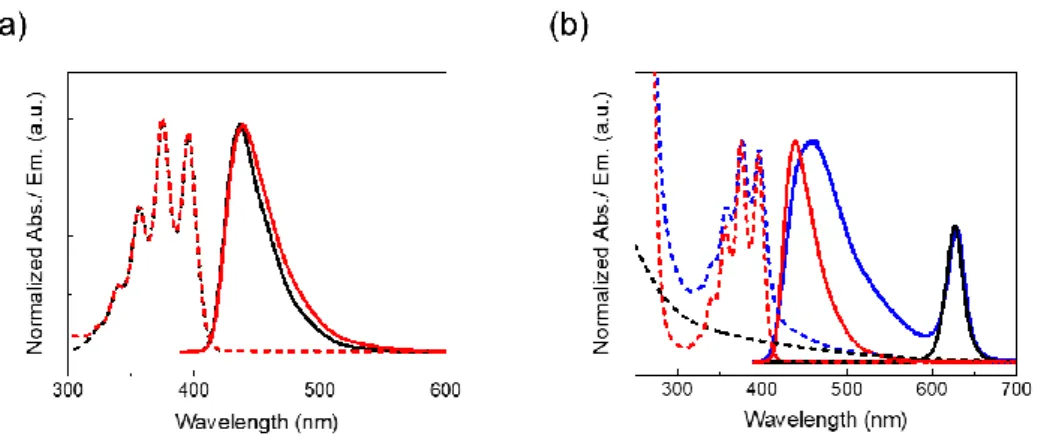
The transmitter ligand PPA in chloroform showed almost identical absorption and fluorescence spectra to those of DPA (Figure 2-2a). This indicates that the singlet energy level of PPA is basically same to that of DPA, which would also be the case for triplet energy levels.[3] The triplet energy level of transmitters should be carefully selected in consideration of the trade-off between triplet energy transfer (TET) efficiency and conservation of energy.[4] Although the energy cascade from QDs to emitter would be beneficial to realize high TET efficiency, such an energy-level alignment results in a smaller anti- Stokes shift because of the energy losses. In the current system, the transmitter and emitter molecules have an almost identical triplet level, which allows for a large anti-Stokes shift. This strategy shares similarity with the recent report by Nishimura et al., in which NIR-to-visible TTA-UC with a large anti- Stokes shift of 0.86 eV was demonstrated.[5] A deaerated PPA solution in chloroform had a high fluorescence quantum yield of 86% ([PPA] = 10 mM).
Figure 2-2. (a) Normalized absorption spectra (dashed lines) of DPA (black) and PPA (red) in chloroform (1 mM), and fluorescence spectra (solid lines, λex = 370 nm) of DPA (black) and PPA (red) in chloroform (10 mM). (b) Normalized absorption (dashed lines) and emission (solid lines, λex = 370 nm) spectra of csQD (black), PPA (red), PPA-csQD (blue) in chloroform.
27
The surface of csQD is initially capped by octadecylamine (ODA) according to the manufacturer.
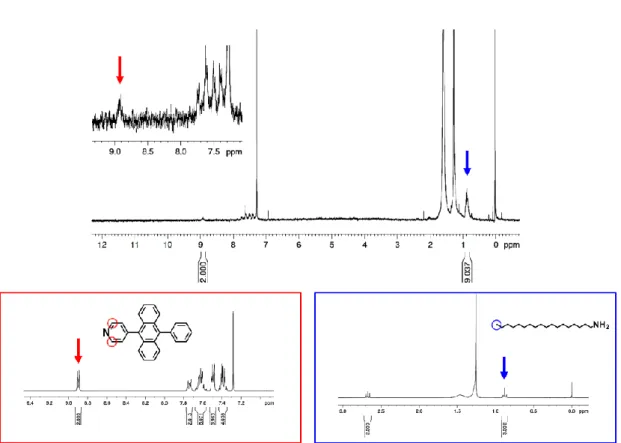
The surface modification with PPA was conducted (see Experimental section for details). The surface modification was confirmed by absorption, emission and 1H NMR spectra. The absorption peaks of PPA were observed from the modified csQD solution, and they showed small red-shifts from 356, 375, and 395 nm to 357, 376, and 396 nm, which is attributable to the coordination to csQD (Figure 2-2b). The fluorescence band of PPA in the modified csQD showed a slight broadening and a peak shift from 439 to 458 nm, reflecting the heterogeneous environment for chromophores on the surface. The molar ratio of PPA to the original ligand ODA on the csQD surface was determined as 1:3 from 1H NMR spectrum (Figure 2-3).
Figure 2-3. 1H NMR spectrum (300 MHz, solvent: CDCl3) of PPA-csQD. Inset: 1H NMR spectra (300 MHz, solvent: CDCl3) of PPA (red box) and ODA (blue box).
28 2-2-2. TTA-UC properties in solution system
First, UC measurement was conducted with a 532 nm continuous-wave laser as an excitation source.
Under excitation at 532 nm, UC emission was clearly observed from a deaerated solution containing PPA-csQD and free DPA in chloroform (Figure 2-4). The UC emission peak at 433 nm indicates that the UC emission originates from free DPA molecules in the bulk solution.
Figure 2-4. UC emission spectrum of PPA-csQD and DPA (10 mM) in deaerated chloroform using a laser with excitation wavelength λex = 532 nm. A notch filter (λ = 532 nm) and a short-pass filter (λ = 510 nm) were used to remove the scattered incident light. The measurement was performed at room temperature under Ar atmosphere.
29
The UC emission had millisecond-scale decay profiles, indicating that the long-lived triplet-based mechanism (Figure 2-5a). The emitter triplet lifetime T of 1.24 ms was obtained based on the relationship of IUC(t) exp(-2t/T).[6, 7]
The threshold excitation intensity Ith is a useful figure-of-merit of TTA-UC, at which the dependence of UC emission intensity on the excitation intensity changes from quadratic to linear.[8] The efficiency of TTA (ΦTTA) depends on the triplet concentration in the system, and ΦTTA becomes 50% at Ith. Figure 2-5b shows the double logarithmic plot of the UC emission intensity as a function of excitation intensity for the above UC sample. The slope showed a transition from 2 to 1, and the cross-section between these two lines gave the Ith value of 290 mW cm-2. This Ith value is considerably smaller than those of the previous reports using core-only QDs (~10 W cm-2).[9, 10]
Figure 2-5. (a) Photoluminescence decay at 433 nm of PPA-csQD and DPA (10 mM) in deaerated chloroform under pulsed excitation at 531 nm. Single exponential fitting of the tail part (red line) provides the emitter triplet lifetime of 1.24 ms. The measurement was performed at room temperature under Ar atmosphere. (b) Dependence of UC photoluminescence intensity of PPA-csQD and DPA (10 mM) in deaerated chloroform at 433 nm on the excitation intensity. Red lines show the fitting results with slopes of 2 and 1. The measurement was performed at room temperature under Ar atmosphere.
For further confirmation of the mechanism illustrated in Figure 2-1, control experiments using solutions of the original ODA-capped csQD, PPA-csQD, or DPA were carried out. No UC emission was observed from the single-component solutions of the original csQD nor DPA. The PPA-csQD solution showed UC emission derived from PPA but its intensity was very weak. This is reasonable because PPA molecules are pinned to the csQD surface, which hinders TTA processes.
30
The UC mechanism is also supported by the photoluminescence decay measurements of csQD (Figure 2-6). The decay profile of the original ODA-capped csQD was not changed by the presence of excess DPA. In stark contrast, the decay became much faster in PPA-csQD, indicating the efficient energy transfer to the surface ligand PPA. Interestingly, coexistence of the excess DPA with PPA-csQD made the decay even faster. Therefore, the excited triplet energy should be transferred from surface- bound PPA to free DPA, followed by the inter-DPA annihilation process (Figure 2-1).
Figure 2-6. Photoluminescence decays at 630 nm of csQD (black), csQD and DPA (green), PPA-csQD (blue), and PPA-csQD and DPA (red) in deaerated chloroform under pulsed excitation at 590 nm. The measurements were performed at room temperature under Ar atmosphere.
31
To optimize the UC properties, we measured the TTA-UC quantum yield ΦUC by changing the concentration of PPA-csQD. ΦUC was determined relative to an external standard (see Experimental section for details). In general, the quantum yield is defined as the ratio of absorbed photons to emitted photons. The bimolecular TTA-UC process requires two photons to produce one higher-energy photon, and thus the theoretical maximum yield is 50%.[11, 12] In many reports, however, this value is multiplied by 2 to set the maximum efficiency as 100%. To avoid the confusion between these different definitions, the UC efficiency is written as Φ’UC (= 2ΦUC) when the maximum efficiency is normalized to be 100%.
In all the measurement, a sufficiently high excitation intensity (2500 mW cm-2) was used, at which the Φ’UC of all the systems reached their saturated values. Starting from the identical stock solution of PPA- csQD, the relative concentration of PPA-csQD varied from 1 to 0.01, while fixing the concentration of DPA at 10 mM. As the relative concentration of PPA-csQD decreased from 1 to 0.05, the Φ’UC value greatly increased from 0.012 to 1.4% (Figure 2-7a).
To understand this behavior, we examined the singlet and triplet lifetime of DPA. No significant change in the fluorescence lifetime of DPA was observed in the presence of PPA-csQD compared with that of the single-component solution of DPA (Figure 2-7b), indicating negligible back energy transfer from the excited singlet of DPA to PPA-csQD.
Figure 2-7. (a) Dependence of Φ’UC on the relative concentration of PPA-csQD in deaerated chloroform.
The measurements were performed at room temperature under Ar atmosphere. (b) Fluorescence decays at 433 nm of DPA (black), the mixture of PPA-csQD (the relative concentration of 0.5) and DPA (blue), and the mixture of PPA-csQD (the relative concentration of 0.05) and DPA (red) in deaerated chloroform under pulsed excitation at λex = 365 nm. Gray dots represent the instrument response function (IRF).
Three samples followed the single exponential behavior with lifetimes of 9.4 ns. The measurements were performed at room temperature under Ar atmosphere.
32
On the other hand, the triplet lifetime of DPA (T) increased from 0.31 ms to 1.24 ms when the relative concentration of PPA-csQD was decreased from 0.5 to 0.05 (Figure 2-8). This result suggests the partial quenching of DPA triplet by PPA-csQD, which contributes to the reduced UC efficiency at high PPA-csQD concentration. Considering that the absorbance of the PPA-csQD (relative concentration of 1) at the peak of UC photoluminescence (433 nm) was 0.20, the re-absorption of upconverted emission by PPA-csQD might also take place. The further reduction of the relative PPA-csQD concentration from 0.05 to 0.01 decreased the Φ’UC, probably due to the insufficient emitter triplet concentration for the efficient TTA process. Therefore, there is an optimal sensitizer concentration (the relative concentration of 0.05), which is used for all other UC measurements in this study.
Figure 2-8. Photoluminescence decays at 433 nm of the mixture of PPA-csQD (the relative concentration of 0.5) and DPA (blue) and the mixture of PPA-csQD (the relative concentration of 0.05) and DPA (red) in deaerated chloroform under pulsed excitation at 531 nm, of which single exponential tail-fittings provide the triplet lifetimes of 0.31 ms and 1.24 ms, respectively. The measurements were performed at room temperature under Ar atmosphere.
0 2 4 6 8
Normalized photon counts (a.u.)
Time (ms)
33
To understand the effect of the surface modification with transmitter ligands for the TTA-UC properties described above, the control experiment was carried out by employing the original ODA- capped csQD as a sensitizer. The surface modification of csQD with transmitter ligands (PPA) reduced the Ith value from 810 to 290 mW cm-2, and improved the UC efficiency (Φ’UC) from 0.090 to 1.4%
(Table 1). This should be mainly because of the enhanced TET efficiency by the conjugation of csQD with transmitter molecules.
Table 1. The effect of surface modification with transmitter ligands (PPA) and of QD structure (core- shell or core-only) upon Ith and Φ’UC values.
34
Furthermore, the control experiment using core-only CdSe QDs (denoted as cQD) was also carried out to examine the effect of the shell structure. The validity of the cQD used here as a target for comparison with csQD was ascertained by 1H NMR, emission and absorption spectra.
According to the manufacturer, the surface ligands of the cQD contain trioctylphosphine oxide (TOPO) as well as hexadecylamine (HDA). Although it was difficult to determine the molar ratio between TOPO and HDA on the surface due to the overlap of 1H NMR spectra, the ratio between their alkyl chains and transmitter ligand PPA (3:1, Figure 2-9) was identical to the case of PPA-csQD (Figure 2-3). This result indicates the surface environment of PPA-modified cQD (PPA-cQD) is analogous to that of PPA-csQD.
Figure 2-9. 1H NMR spectrum (300 MHz, solvent: CDCl3) of PPA-cQD.
35
The cQD showed an emission band at 643 nm (Figure 2-10), which is close to that of csQD (629 nm). In addition, PPA-cQD showed clear absorption peaks originated form PPA at 357, 367, and 396 nm (Figure 2-10), which are identical to those of PPA-csQD (Figure 2-2b). This result also supports the similar environment of PPA on csQD and cQD surfaces.
Figure 2-10. Normalized absorption (dashed lines) and emission (solid lines, λex = 370 nm) spectra of cQD (black), PPA-cQD (blue) in chloroform.
The PPA-cQD/DPA system gave a much higher Ith value of 1290 mW cm-2 and a lower Φ’UC of 0.026%, compared with the PPA-csQD/DPA system (Table 1). This is probably because core-only QDs have more surface defects than core-shell QDs, which decreases TET efficiency. This indicates that using core-shell QDs with fewer surface defects can improve the UC properties.
36
More importantly, TTA-UC was also achieved for the PPA-csQD/DPA system under excitation at 635 nm. UC emission was clearly observed at 433 nm (Figure 2-11), which is identical to the spectrum obtained under excitation at 532 nm. The anti-Stokes shift was calculated to be 0.91 eV. This result supports the advantage of TTA-UC system sensitized by QDs with a broadband absorption and without significant energy loss during intersystem crossing.
Figure 2-11. UC emission spectrum of PPA-csQD and DPA (10 mM) in deaerated chloroform using a laser with excitation wavelength λex = 635 nm. Short-pass filters (λ = 510 nm, λ = 625 nm) were used to remove the scattered incident light. The measurement was performed at room temperature under Ar atmosphere.
37 2-2-3. TTA-UC properties in solid system
The UC emission at 433 nm was clearly observed for the cast film of PPA-csQD and DPA under excitation at both 532 nm and 635 nm, respectively (Figure 2-12). However, both UC emission and csQD emission became weaker with time under continuous laser irradiation. While further efforts to suppress the photo-degradation of csQD are required, our approach provide an important step towards the efficient TTA-UC in the solid state based on core-shell QD sensitizers.
Figure 2-12. UC emission spectra of the solid samples. (a) λex = 532 nm, excitation intensity = 8.6 W cm-2. A notch filter (λ = 532 nm) and a short-pass filter (λ = 510 nm) were used to remove the scattered incident light. (b) λex = 635 nm, excitation intensity = 62.0 W cm-2. Short-pass filters (λ = 510 nm, λ = 610 nm, λ = 625 nm) were used to remove the scattered incident light. The measurements were performed at room temperature under Ar atmosphere.
38 2-3. Conclusion
In conclusion, TTA-UC system sensitized by core-shell QDs was firstly developed here. The surface modification of core-shell QDs with transmitter molecules and the presence of excess emitter molecules in solution facilitated the successive energy-transfer relay from QDs to the transmitter ligand, and then to the free emitters that were used for TTA process. There is an optimal concentration of core-shell QDs, at which the UC efficiency was enhanced and the Ith value was lowered. Furthermore, it was indicated that the fewer surface defects of core-shell QDs allow for the much lower Ith and higher Φ’UC compared with the system using core-only QDs. Whereas further improvement of Φ’UC and Ith values is required, the present work offers a promising strategy of using surface-functionalized core-shell QDs as triplet sensitizers for TTA-UC. Recent reports demonstrated that the QD sensitizers enable the upconversion of near-infrared (NIR) light into visible light,[10] which has been difficult to achieve with conventional molecular sensitizers. The combination of these advances and our findings may lead to the highly efficient NIR-to-visible TTA-UC at weak excitation intensity.
For future development of this work, the directional control of triplet diffusion would be an effective strategy. In the current system, back energy transfer from emitter (DPA) triplets to sensitizers (PPA- csQD) was one of the primary causes that constrain the energy transfer efficiency, which result in relatively low UC efficiency. This issue can be solved with the controlled triplet diffusion by introducing energy gradients to allow triplet species to escape from sensitizers within their long lifetime. For example, building a multi-layer structure in the solid system is a conceivable way to apply energy cascades, where the triplet diffusion layer exists between the sensitizer layer and the emitter (annihilator) layer.
39 2-4. Experimental
Materials
All reagents and solvents for synthesis and sample preparation were used as received without further purification. 9-Bromo-10-phenylanthracene (>98%), 4-pyridylboronic acid (contains varying amounts of anhydride) and 9,10-diphenylanthracene (DPA, >95%) were purchased from TCI.
Synthesis of 4-(10-phenylanthracene-9-yl)pyridine
4-(10-Phenylanthracene-9-yl)pyridine (PPA) was synthesized by modifying the reported methods of 9- (4-formylphenyl)-10-(4-pyridyl)anthracene[13] and 4-(anthracene-9-yl)pyridine.[14] Under Ar atmosphere, 9-bromo-10-phenylanthracene (666.4 mg, 2.00 mmol), 4-pyridylboronic acid (245.7 mg, 2.00 mmol), K2CO3 (1.386 g, 10 mmol), Pd(PPh3)4 (46.6 mg, 0.04 mmol), two drops of Aliquat 336 and degassed THF/H2O (2:1, 15 mL) were added to a reaction tube. This mixture was heated (130 °C) by microwave (Biotage Initiator 2.5) for 5 h. The obtained slurry was extracted with ethyl acetate (150 mL), washed with brine, and dried over Na2SO4. After filtration, washed with ethylacetate and evaporated to dryness under reduced pressure, column chromatography (silica gel, dichloromethane) and recrystallization from hot acetone gave pale yellow powder (473.7 mg, 1.43 mmol, 71.5%).
Figure 2-13. Scheme for the synthesis of PPA.
1H NMR (300 MHz, CDCl3, TMS standard)
= 8.88 (dd, J1 = 4.35 Hz, J2 = 1.59 Hz, 2H), 7.75-7.67 (m, 2H), 7.65-7.53 (m, 5H), 7.51-7.42 (m, 4H), 7.41-7.31 ppm (m, 4H).
40 Elemental analysis
Calculated (%) for C25H17N: C 90.60, H 5.17, N 4.23; Found: C 90.47, H 5.13, N 4.26.
Surface modification procedure
In an Ar-filled glovebox (oxygen concentration <0.1 ppm), CdSe/ZnS core-shell quantum dots (2.0 mg, stabilized with octadecylamine, fluorescence peak at λem = 630 nm, Sigma-Aldrich, denoted as csQD) and PPA (10.1 mg) were dissolved in chloroform (3.3 mL). The resulting solution was heated at 40 °C for 4 h under stirring, followed by stirring at room temperature for overnight. After being taken out from the glovebox, acetone (7.5 mL) was added. After centrifugation, orange-colored precipitate was obtained, and the supernatant was then removed. The precipitate, washed with acetone to remove free PPA, was dried under reduced pressure, giving PPA-modified csQD. In the glovebox, the resulting PPA-csQD was dissolved in chloroform (4.0 mL). The absorbance at 532 nm of this stock solution was 0.0069. This solution of PPA-csQD was stored at room temperature under light-shielded conditions. The same process was also conducted for CdSe core-only quantum dots (stabilized with hexadecylamine and trioctylphosphine oxide, fluorescence peak at λem = 640 nm, Sigma-Aldrich).
Sample preparation for TTA-UC measurements (solution)
The sample preparation was carried out in an Ar-filled glovebox. The PPA-csQD chloroform stock solution was diluted 20-fold with chloroform (otherwise the relative concentration is noted), and the DPA (10 mM) was added. The prepared solution samples were sealed in quartz cells of 1 mm thickness.
Sample preparation for TTA-UC measurements (solid)
The sample preparation was carried out in an Ar-filled glovebox. The PPA-csQD chloroform stock solution was diluted 10-fold with chloroform, and the DPA (100 mM) was added. The obtained solution (0.2 mL) was spin-coated (150 rpm) on a glass substrate, dried, and sealed under Ar atmosphere.


![Figure 1-8. Scheme for TTA-UC sensitized by CsPbX 3 perovskite nanocrystals. [86]](https://thumb-ap.123doks.com/thumbv2/123deta/9799120.1881275/21.892.270.595.453.711/figure-scheme-tta-uc-sensitized-cspbx-perovskite-nanocrystals.webp)