•
•
of Some Glycols
Tadao Matsumoto and Mitsuyoshi Hayatsu*
Abstract: The surface tensions of aqueous solutions of 1,2-ethanediol, 1,2-propane- diol, 1,3-propanediol, 1,3-butanediol, and 1,4-butanediol were measured at 20, 30, and 40°C. The correlation between the surface tension of pure glycols at different temperatures and the volume contraction in an aqueous solution and volume fraction in surface phase of an aqueous solution are studied.
1. Introduction
Various behavior of aqueous glycol solutions has been reported in properties such as excess and partial volumes.(1) Although no complete study has been made of the laws gov- erning hydrate formation and the transfer of glycol from bulk phase to surface phase in water. For the purpose of the study of hydrate formation, the surface tension of aqueous alcohol solutions have been reported, (2) no surface tension data have been published except our paper(3) for glycol- water solutions.
The surface tensions of aqueous solutions of five glycols were measured at 20. 00, 30.
00, and 40.00°C. The glycols used were 1,2-ethanediol (12ED), 1,2-propanediol (12PD), 1,3-propanediol (13PD), 1,3- butanediol (13BD), and 1,4- butanediol (14BD). Among the surface tensions, the data measured at 30°C were reported previously.(3) However, for the purpose of a comparison of these data with the data measured at other temperatures, we used again.
2. Experimental
The samples used were of G. R. grade ]IS guaranteed reagent and were purified further by dehydrating over anhydrous salts such as Na2SO, and distilling repeatedly with a fractionating column until their gas chromatogram (polyethylene glycol as column and H 2 as carrier gas) showed minimum impurities. Estimated purity was 99.8%.
The capillary height method was used throughout the surface tension measurements.
The uniformity in the inner diameter of capillaries was checked by measuring the length of a known amount of mercury in the capillary. The two-capillary method, a modifi- cation credited to Sugden (,) and Richards et al. ,(5) was used. The diameters· of capillaries
*
Chemistry Laboratory, Nagano Technical College, Nagano, Japanwere O. 50 and O. 27 mm. The height of capillary rise was determined with a traveling microscope. All the measurements were made at 20. 00, 30. 00, and 40. oooe, in a water thermostat, the temperature of which was controlled to +0. 01°e. The accuracy of surface tension determination was estimated to be ±0.3 dyn/cm.
3. Results
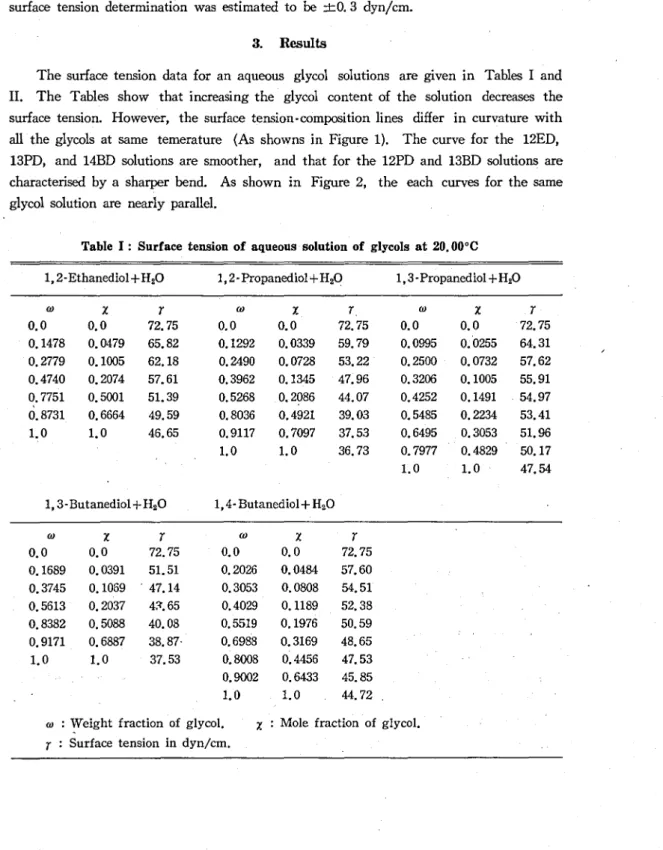
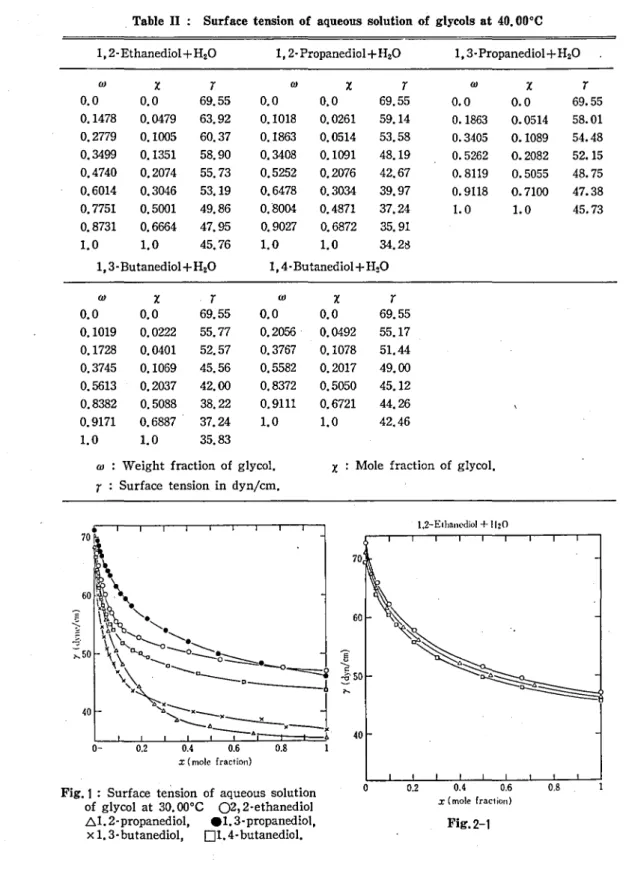
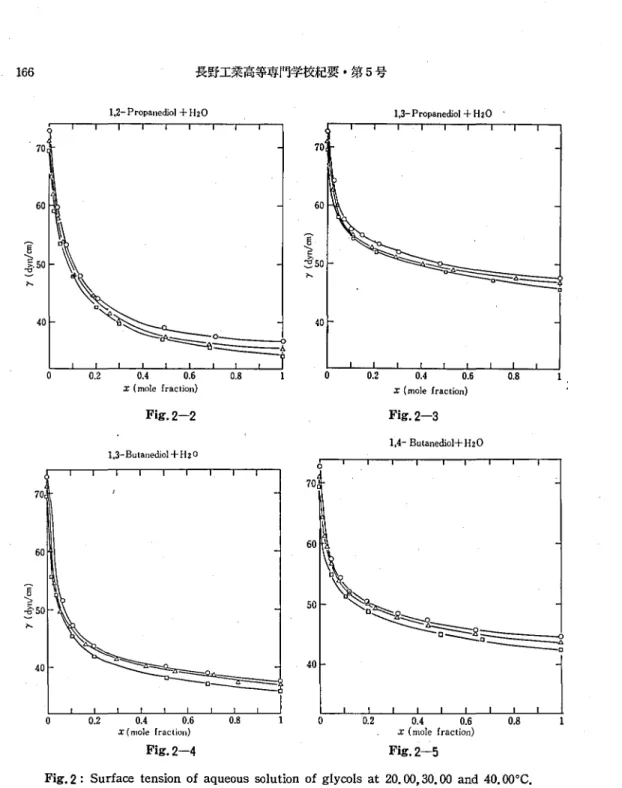
The surface tension data for an aqueous glycol solutions are given in Tables I and II. The Tables show that increasing the glycol content of the solution decreases the surface tension. However, the surface tension-composition lines differ in curvature with all the glycols at same temerature (As showns in Figure 1). The curve for the 12ED, 13PD, and 14BD solutions are smoother, and that for the 12PD and 13BD solutions are characterised by a sharper bend. As shown in Figure 2, the each curves for the same glycol solution are nearly parallel.
Table I: Surface tension of aqueous solution of glycols at 20.00°C 1,2-Ethanediol + H2O 1,2-Propanedio!+H2O 1,3 -Propanediol + H2O
Cd X
r
Cd Xr
Cd Xr
0.0 0.0 72.75 0.0 0.0 72.75 0.0 0.0 72.75
0.1478 0.0479 65.82 0.1292 0.0339 59.79 0.0995 0.0255 64.31 0.2779 0.1005 62.18 0.2490 0.0728 53.22 0.2500 0.0732 57.62 0,4740 0.2074 57.61 0.3962 0.1345 47.96 0.3206 0.1005 55.91 0.7751 0.5001 51.39 0.5268 0.2086 44.07 0,4252 0.1491 .54.97 0.8731 0.6664 49.59 0.8036 0.4921 39.03 0.5485 0.2234 53.41
1.0 1.0 46.65 0.9117 0.7097 37.53 0.6495 0.3053 51.96
1.0 1.0 36.73 0.7977 0.4829 50.17
1.0 1.0 47.54
1,3-Butanediol+H2O 1,4- Butanediol + H2O
Cd X
r
Cd Xr
0.0 0.0 72.75 0.0 0.0 72.75
0.1689 0.0391 51.51 0.2026 0.0484 57.60 0.3745 0.1069 . 47.14 0.3053 0.0808 54.51 0.5613 0.2037 4:'l'.65 0.4029 0.1189 52.38 0.8382 0.5088 40.08 0.5519 0.1976 50.59 0.9171 0.6887 38.87· 0.6988 0.3169 48.65
1.0 1.0 37.53 0.8008 0.4456 47.53
0.9002 0.6433 45.85
1.0 1.0 44.72
Cd : Weight fraction of glycol. X : Mole fraction of glycol.
r ;
Surface tension in dyn/cm.. Table II: Surface tension of aqueous solution of glycols at 40.00o
e
1,2-Ethanediol+H2O 1,2'Propanediol + H2O 1, 3· Propanediol + H2O
W X r Cd X r ClI X r
0.0 0.0 69.55 0.0 0.0 69.55 0.0 0.0 69.55
0.1478 0.0479 63.92 0.1018 0.0261 59.14 0.1863 0.0514 58.01 0.2779 0.1005 60.37 0.1863 0.0514 53.58 0.3405 0.1089 54.48 0.3499 0.1351 58.90 0.3408 0.1091 48.19 0.5262 0.2082 52.15 0.4740 0.2074 55.73 0.5252 0.2076 42.67 0.8119 0.5055 48.75 0.6014 0.3046 53.19 0.6478 0.3034 39.97 0.9118 0.7100 47.38
0.7751 0.5001 49.86 0.8004 0,4871 37.24 1.0 1.0 45.73
0.8731 0.6664 47.95 0.9027 0.6872 35.91
1.0 1.0 45.76 1.0 1.0 34.211
1,3-Butanediol + H2O 1,4'Butanediol + H2O
W X r w X r
0.0 0.0 69.55 0.0 0.0 69.55
0.1019 0.0222 55.77 0.2056· 0.0492 55.17 0.1728 0.0401 52.57 0.3767 0.1078 51.44 0.3745 0.1069 45.56 0.5582 0.2017 49.00 0.5613 0.2037 42.00 0.8372 0.5050 45.12 0.8382 0.5088 38.22 0.9111 0.6721 44.26
0.9171 0.6887 37.24 1.0 1.0 42.46
1.0 1.0 35.83
ClI Weight fraction of glycol. X : Mole fraction of glycol.
r : Surface tension in dyn/cm.
l,2-Et},ancdiol+1120 70~
Fig. 1 : Surface tension of aqueous solution of glycol at 30. OQ°C 02,2·ethanediol .61.2-propanediol, .1.3-propanediol, xl. 3· butanediol, 01. 4- butanediol.
o 0.2 0.4 0.6 x(mole fraction)
Fig.2-1
0.8
1,2- Propanediol +H20 1.3- Propanediol +H20 .
70 70
60 60
~ ~
~
~.50...\
D~ "-250..."40
~~O
0~ 400.2 0.4 0.6 0.8 0 0.2 0.4 0.6 0.8
x(mole fraction) X(mole fraction)
Fig. 2-2 Fig.2-g
1,4- Butanediol+H2O 1.3-Butanediol +H2O
0 70 70
60 \ 60
"
~';,
~50... 50
c~
~~::::::...
0 _ --A-<>- 0
40 40
0.2 0.4 0.6 0.8 0 0.2 0.4 0.6 0.8
X(mole fraction) X(mole fraction)
Fig. 2-4 Fig. 2-5
Fig.2: Surface tension of aqueous solution of glycols at 20.00,30.00 and 40.00·C.
():20.00·C ~:30.00·C []:40.00·C.
4. Discussion
The best calculated method available is probably that proposed by Tamura et
at.
(6) forrnura:In {Vi (
I-VL )P}
VL
I-ViP(rA-rB) nkT
..
r: Surface tension of solution. rA : Surface tension of water. rB : Surface tension of glycol.
VL:
Volume fraction of bulk phase. Vi: Volume fraction of surface phase. P:Number of carbon atms in glycol. k: Constant of Boltzmann.
n:
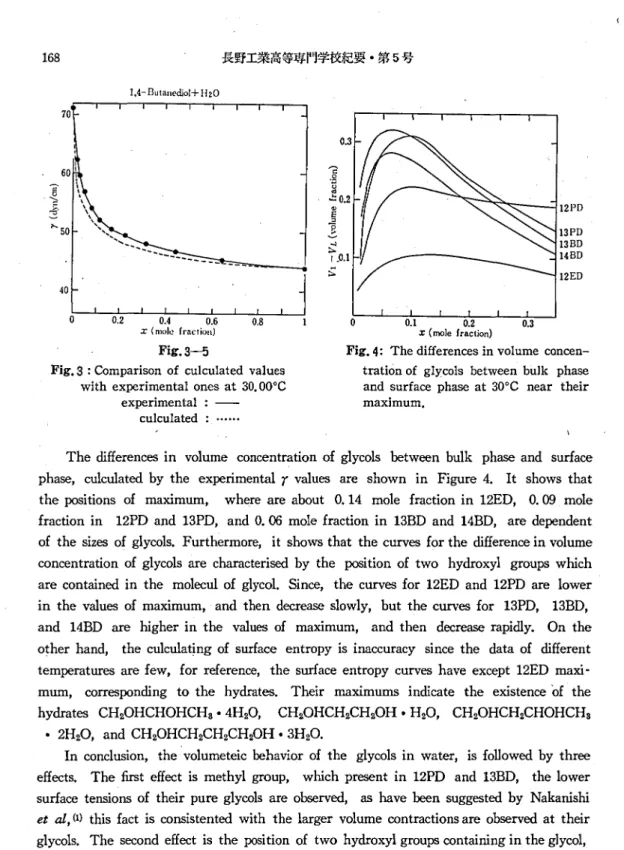
Number of molecules of water in a unit area.Comparison of this method with the experimental data at 30°C indicates that the calculated
r
value of I3PD is almost same value, and that the other calculatedr
valuesare lower than the experimental ones, indicating an over-estimating of the surface concen- tration of the glycol (As shown in Figure 3).
1,2- Ethanediol+ 1120 1,2-Propancdiol+H20
70 70
0.8
0.4 0.6
X(mole fraction)
o 0.2 40 40!---l-::-':---'--::":-'0.2 0.4
~'::---,--::,:-'
0.6 0.8-l.-j
r (mole fraction) 60
-
.... 50Fig. 3-1 Fig. 3-2
1,3- Propancdio!+ 1120
1.3- Butanediol+ 1120
..
70 700.8
•
0.2 0.4 0.6
X(mole Iraction) 0.8
0.4 0.6
X(molc Iraction)
o 0.2 40
.. e
' - 60"
~ 3:-.Fig. 3-3 Fig. 3-4
1,4- Butanediol+ 1120 70
40
]
g
.:: 0.2
"
§
!
""-~~--:j12PD
12ED
o 0.2 0.4 0.6 x(mole fraction)
0.8 o 0.1 0.2
x(mole fraction) 0.3
Fig.3-5
Fig. 3 : Comparison of culculated values with experimental ones at 30.00°C
experimental: - - culculated : .
Fig.4: The differences in volume concen- tration of glycols between bulk phase and surface phase at 30°C near their maximum.
The differences in volume concentration of glycols between bulk phase and sudace phase, culculated by the experimental
r
values are shown in Figure 4. It shows that the positions of maximum, where are about O. 14 mole fraction in 12ED, O. 09 mole fraction in 12PD and 13PD, and O.06 mole fraction in 13BD and 14BD, are dependent of the sizes of glycols. Furthermore, it shows that the curves for the difference in volume concentration of glycols are characterised by the position of two hydroxyl groups which are contained in the molecul of glycol. Since, the curves for 12ED and 12PD are lower in the values of maximum, and then decrease slowly, but the curves for 13PD, 13BD, and 14BD are higher in the values of maximum, and then decrease rapidly. On the other hand, the culculating of surface entropy is inaccuracy since the data of different temperatures are few, for reference, the surface entropy curves have except 12ED maxi- mum, corresponding to the hydrates. Their maximums indicate the existence of the hydrates CH20HCHOHCHs • 4H20, CH20HCH2CH20H • H20, CH20HCH2CHOHCHs• 2H20, and CH20HCH2CH2CH20H • 3H20.
In conclusion, thevolumeteic behavior of the glycols in water, is followed by three effects. The first effect is methyl group, which present in 12PD and 13BD, the lower sudace tensions of their pure glycols are observed, as have been suggested by Nakanishi et al,(1) this fact is consistented with the larger volume contractions are observed at their glycols. The second effect is the position of two hydroxyl groups containing in the glycol, in the aqueous 12ED and 12PD solutions, the smaller differences in volumeconcentration of their glycols between bulk phase and sudace phase are observed at low mole fraction.
This fact is suggest, which may be due strong intermolecular hydrogen bonding between
•
to neighboring hydroxyl groups. The third effect is the number of methylene groups, the positions of maximum of difference in volume concentration of glycols between bulk phase and surface phase shift to low mole fraction as the numver of methylene groups increase. Furthermore, as the surface tensions of aqueous glycol solutions at different temperatures are nearly parallel, these three effects are stronger as the temperature rise, but it may be not seen that the quit different behavior of the glycols in water takes place.
Acknowledgment
The authors are gratefully indebted to Dr. Nakanishi for his kind directions.
References
(1) Nakanishi, K., Kato, N., Maruyama, M., J. Phys. Chern., 71, 814 (1967).
(2) Yu. V. Efremov, Russian, J. Phys. Chern., 42, 8 (1968).
(3) Nakanishi, K., Matsumoto, T., Hayatsu, M., J. Chern. Eng. Data, 16, 44 (1971).
(4) Sugden, S., J. Chern. Soc., 119, 1438 (1921).
(5) Richards, T. W., Speyers, C. L., Carver, E. K., J. Arner. Chern. Soc., .46, 1196 (1924).
(6) Tamura, M., Kurata, M., Odani, H., Bull. Chern. Soc. Japan, 28, 83 (1955) .