
Crystallization of Palladium(II)-Pyridylazophenol Complex at the Liquid-Liquid Interface
7
0
0
全文
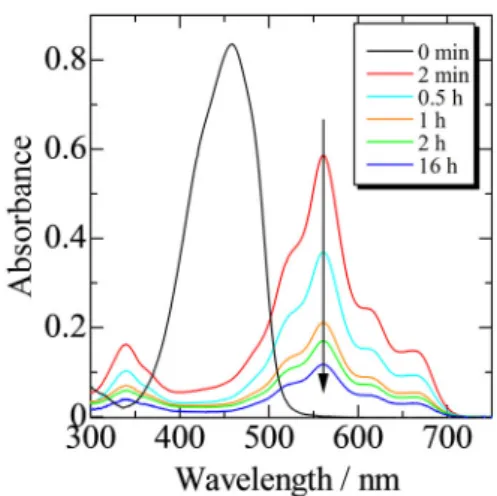
(2) 2. Experimental 2.1 Reagents 5-Br-PADAP (HL) was purchased from Tokyo Chemical Industry Co., Ltd. and used as received. Heptane and toluene (HPLC grade, Kanto Chemical Co., Inc.) were used as received. A stock solution of palladium(II) was prepared by dissolving palladium(II) chloride (GR, Kanto Chemical Co., Inc.) in 0.1 M hydrochloric acid (GR, FUJIFILM Wako Pure Chemical Co.). Sodium chloride (GR) was purchased from FUJIFILM Wako Pure Chemical Co. Water was distilled and deionized with a Milli-Q system (Milli-Q SP.TOC., Millipore). 2.2 Liquid-liquid extraction The batch method was carried out to investigate the extraction behavior of Pd(II) with HL. Equal volumes (5 ml) of 1.0 × 10⁻³ M Pd(II) aqueous solution and 2.0 × 10⁻⁵ M HL organic solution (Toluene, heptane, or their mixture) were shaken in a glass tube for 8 h in a thermostated room at 298 K. After the centrifugal separation, the absorption spectra of the organic phase were measured with a spectrophotometer (V-560, JASCO) to determine the extractability of PdLCl into the organic phase. The pH and ionic strength were fixed at 1.0 and 0.1 M with HCl, respectively. 2.3 Observation of microscopic images A Pd(II) aqueous solution (1.5 mL) was introduced in a covered petri dish, and then 1.0 × 10⁻⁴ M HL organic solution (1.0 mL) was carefully added onto the aqueous phase. The microscopic images of the PdLCl crystals formed at the liquid-liquid interface were obtained directly above the organic phase at 60-fold magnification by a digital microscope (Intel Play QX3 Computer Microscope) connecting to a computer at predetermined time intervals. The inner diameter and inner height of the petri dish were 27 mm and 12 mm, respectively. Heptane and its mixtures with toluene were used as an organic solvent. Size distribution of interfacial PdLCl crystal at equilibrium was observed in the following way. The crystals formed at the liquidliquid interface were pipetted and transferred on a glass slide. The 150 crystals on a glass slide were randomly selected and imaged at 200-fold magnification by a digital microscope. The size distribution of the 150 crystals was obtained from their images. The Pd(II) concentration was changed from 5.0 × 10⁻⁴ to 5.0 × 10⁻³ M. The pH value was varied from 1.0 to 3.0 with HCl and NaCl. The ionic strength was fixed at 0.1 M. A PdLCl crystal produced from the bulk was prepared in the following way. A saturated toluene solution of PdLCl was placed in a petri dish, and toluene was volatilized over 2 days at room temperature. This operation was repeated 2 – 3 times to grow the crystals larger. Dark-purple and prismatic crystals were obtained. Crystal structure analysis was performed by the same method previously reported [12]. 3. Results and Discussion 3.1 Extractability of PdLCl into the heptane-toluene mixed phase Previously, we reported that PdLCl was completely extracted into the toluene phase but hardly into the heptane phase [7,11]. The extraction behavior of Pd(II) with HL into the heptane-toluene mixed phase was investigated by the batch method. Figure 1 shows the effect of toluene percentage on the PdLCl concentration in the heptane-toluene mixed solution at equilibrium. The PdLCl concentration in the organic phase was estimated from the absorbance at 564 nm using molar absorptivity (564 = 4.33 × 10⁴ M-1 cm-1 [11]) of PdLCl in toluene. It was assumed that the molar absorptivity of PdLCl in the organic phase did not. - 134 -.
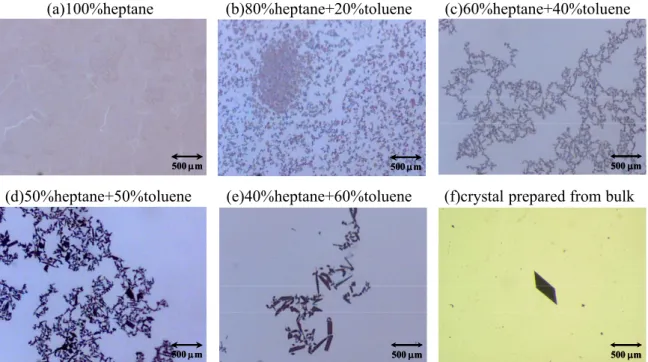
(3) Figure 1. Effect of toluene percentage on the. Figure 2. Absorption spectral change of the. equilibrium concentration of PdLCl in the. organic phase in the 50% heptane-50% toluene. heptane-toluene mixed phase. [Pd(II)] = 1.0 10. system. [Pd(II)] = 1.0 10-3 M, [HL] = 2.0 10-5. M, [HL] = 2.0 10-5 M, pH 1.0.. -3. M, pH 1.0.. change even if the ratio of toluene and heptane changed. At equilibrium, absorption for HL in the organic phase was not observed at all in all systems, indicating that all HL reacted with Pd(II). In the 100% toluene system, formed PdLCl was completely extracted into the organic phase at equilibrium. However, the equilibrium concentration of PdLCl in the organic phase decreased with a decrease in toluene percentage. Purple solids were observed at the liquid-liquid interface in the low toluene ratio systems. Figure 2 shows absorption spectral change of the organic phase in the 50% heptane-50% toluene system. After 2 minutes of shaking, the absorption spectrum of HL was not observed due to the rapid complexation and only that of PdLCl was observed. A relatively high concentration of PdLCl was observed in the organic phase immediately after the start of the reaction. However, the concentration of PdLCl in the organic phase decreased over time. At equilibrium, PdLCl was hardly observed in the organic phase, and purple solids were observed at the liquid-liquid interface. These results suggest that PdLCl was once extracted into the heptanetoluene mixed phase and then precipitated at the liquid-liquid interface. 3.2 Crystals of PdLCl formed at the liquid-liquid interface 3.2.1 Effect of ratio of heptane and toluene An organic solution containing HL was carefully added onto the Pd(II) aqueous solution in a covered petri dish. The solid species formed at the liquid-liquid interface were observed by a digital microscope. Figures 3(a)-3(e) show microscopic images of PdLCl solid species at the liquid-liquid interface in systems with various heptane and toluene ratios at equilibrium. Figure 3(f) shows an image of a PdLCl crystal produced from the bulk of a PdLCl toluene solution. It was confirmed that the structure of this crystal was the same as that previously produced from an PdLCl acetone solution [12]. In the 100% heptane system, a film-like solid species was observed at the interface. However, crystalline solid species at the interface increased as the proportion of toluene increased. The shape of the crystalline solid species produced at the interface was like that of the crystal produced from the bulk. This similarity suggests that the structure of the interfacial crystalline solid species is the same as that of the crystals formed from the bulk, though the. - 135 -.
(4) (a)100%heptane. (b)80%heptane+20%toluene. 500 m. (d)50%heptane+50%toluene. (c)60%heptane+40%toluene. 500 m. 500 m. (e)40%heptane+60%toluene. 500 m. (f)crystal prepared from bulk. 500 m. 500 m. Figure 3. Microscopic images of PdLCl solid species at the liquid-liquid interface in systems with various heptane and toluene ratios and a PdLCl crystal prepared from the bulk. structure of the crystalline solid species formed at the interface has not yet been confirmed. PdLCl was notextracted into heptane but was extracted once into the heptane-toluene mixed phase. It was found that the extraction of PdLCl into the organic phase is important for the crystallization at the liquid-liquid interface. The effect of the ratio of heptane and toluene on the size of crystals formed at the interface was investigated. Figure 4 shows the size distributions of the interfacial PdLCl crystals at various ratios of heptane and toluene. The crystal size increased as the toluene ratio increased. The averages of crystals were 81 m2 in the 60% heptane-40% toluene system, 3.6 × 10² m2 in the 50% heptane-50% toluene system, and 9.8 × 10² m2 in the 40% heptane-60% toluene system. It is well known that crystal size distribution mainly depends on the crystallization kinetics [13]. This kinetics is controlled by supersaturation. We reported that the formation rate of PdLCl was faster in the toluene/water system than in the heptane/water system [7,11]. Therefore, the formation rate of PdLCl is slower in higher toluene ratio system. Moreover, the solubility of PdLCl in the organic phase is higher in the higher toluene ratio system. These cause the slower crystal formation rate at the interface by lower supersaturation in the higher toluene ration system. These results are thought to produce the formation of larger interfacial crystals in higher toluene ratio systems. 3.2.2 Effect of Pd(II) concentration The effect of the Pd(II) concentration on the size of crystals formed at the interface was investigated in the 50% heptane-50% toluene system. The pH value was fixed at 1.0. At equilibrium, it was confirmed that all HL reacted with Pd(II) in all systems. The averages of the interfacial crystals at [Pd(II)] = 5.0 × 10⁻⁴ M, 1.0 × 10⁻³ M, and 5.0 × 10⁻³ M were 9.0 × 10² m2, 3.6 × 10² m2, and 1.2 × 10² m2, respectively. The lower the Pd (II) concentration, the larger the crystals formed at the interface. The formation rate of PdLCl become slower as the Pd(II) concentration is lower, causing the lower supersaturation in the lower Pd(II). - 136 -.
(5) concentration system. Therefore, it is thought that the formation of larger interfacial crystals in the lower Pd(II) concentration system.. Fraction. (a). 0 0. Fraction. (b). Ave. 81 m. 0.2. 500. 2. 1000 1500 2000 2500 3000 3500 4000 4500 5000 2. S / m 0.4. 2. Ave. 3.6 x 10 m. 2. 0.2 0 0. 500. 1000 1500 2000 2500 3000 3500 4000 4500 5000 2. S / m Fraction. (c). 2. Ave. 9.8 x 10 m. 2. 0.1. 0 0. 500. 1000 1500 2000 2500 3000 3500 4000 4500 5000 2. S / m. Figure 4. Size distribution of PdLCl crystals formed at the liquid-liquid interface. (a) 60% heptane + 40% toluene, (b) 50% heptane + 50% toluene, (c) 40% heptane + 60% toluene; [Pd(II)] = 1.0 × 10⁻³ M, [HL] = 1.0 × 10⁻⁴ M, pH 1.0. 3.2.3 Effect of pH The effect of pH on the size of crystals formed at the interface was investigated in the 50% heptane50% toluene system. The Pd(II) concentration was fixed at 1.0 × 10⁻³ M. At equilibrium, it was confirmed that all HL reacted with Pd(II) in all systems. Figure 5 shows the dependency of PdLCl crystal growth on time at the liquid-liquid interface. The rate of the crystal growth at pH 3.0 was slower than that at pH 1.0, and the larger crystals were formed at pH 3.0 than pH 1.0. The averages of the interfacial crystals at pH = 1.0, 2.0 and 3.0 were 3.6 × 10² m2, 9.1 × 10² m2, and 1.6 × 10³ m2, respectively. Previously, we reported that the formation rate of PdLCl became faster with the decrease in pH, because the concentration of 5-BrPADAP in the aqueous phase and at the interface increased due to the protonation. Therefore, smaller interfacial crystals were formed by faster nucleation under the lower pH condition.. - 137 -.
(6) Figure 5. Dependency of PdLCl crystal growth on time at the liquid-liquid interface. [Pd(II)] = 1.0 × 10⁻³ M, [HL] = 1.0 × 10⁻⁴ M, 50% heptane + 50% toluene. 4. Conclusion We performed a detailed study on the interfacial crystallization of PdLCl in the heptane-toluene mixture/water system. It was found that the crystal size distribution formed at the liquid-liquid interface depends on the solubility and the formation rate of PdLCl. The crystals formed at the liquid-liquid interface became larger under the higher toluene ratio, higher Pd(II) concentration and higher pH conditions. By finding optimal conditions, larger crystals could be generated at the liquid-liquid interface. Crystal formation at the liquid-liquid interface is very simple and easy since it does not require concentration of the solution and can be performed simply by bringing the aqueous phase into contact with the organic phase. The liquidliquid interface can be expected as a useful reaction field for crystal formation. Acknowledgement This work was supported by JSPS KAKENHI Grant Number 17K05893. References 1). A. G. Volkov, D. W. Deamer, “Liquid-Liquid Interfaces. Theory and Methods”, CRC Press, Boca Raton, FL (1996).. 2). A. G. Volkov, “Liquid Interfaces in Chemical, Biological, and Pharmaceutical Applications”, Marcel Dekker, New York (2001).. 3). S. Tsukahara, Anal. Chim. Acta, 556, 112-120 (2006).. 4). K. Kubota, S. Tanida, Y. Shirakawa, A. Shimosaka, J. Hidaka, J. Chem. Eng. Jpn., 26, 9556-9564 (2010).. 5). S. Lee, P. Sanstead, J.M. Wiener, R. Bebawee, A.G. Hilario, Langmuir, 26, 9556-9564 (2010).. - 138 -.
(7) 6). W. Wang, C. Y. Li, ACS Macro Lett., 3, 175-179 (2014).. 7). A. Ohashi, H. Watarai, Anal. Sci., 17, 1313-1319 (2001).. 8). A. Ohashi, H. Watarai, Langmuir, 18, 10292-10297 (2002).. 9). S. I. Busev, V. A. Vin’kova, Zh. Anal. Khim., 22, 552-556 (1967).. 10) D. A. Johnson, T. M. Florence, Talanta, 22, 253-265 (1975). 11) A. Ohashi, S. Tsukahara, H. Watarai, Anal. Chim. Acta, 364, 53-62 (1998). 12) A. Ohashi, T. Tsukuda, H. Watarai, Anal. Sci., 19, 1085-1086 (2003). 13) A. Mersmann, KONA, 16, 60-67 (1998).. - 139 -.
(8)
図
![Figure 4. Size distribution of PdLCl crystals formed at the liquid-liquid interface. (a) 60% heptane + 40% toluene, (b) 50% heptane + 50% toluene, (c) 40% heptane + 60% toluene; [Pd(II)] = 1.0 × 10 -3 M, [HL] = 1.0 × 10 -4 M, pH 1.0.0 500 1000 1500 2000](https://thumb-ap.123doks.com/thumbv2/123deta/6833451.1168623/5.892.197.689.191.663/figure-distribution-crystals-interface-heptane-toluene-heptane-toluene.webp)
![Figure 5. Dependency of PdLCl crystal growth on time at the liquid-liquid interface. [Pd(II)] = 1.0 × 10 -3 M, [HL] = 1.0 × 10 -4 M, 50% heptane + 50% toluene .](https://thumb-ap.123doks.com/thumbv2/123deta/6833451.1168623/6.892.129.767.141.493/figure-dependency-pdlcl-crystal-growth-interface-heptane-toluene.webp)
関連したドキュメント
Standard domino tableaux have already been considered by many authors [33], [6], [34], [8], [1], but, to the best of our knowledge, the expression of the
To deal with the complexity of analyzing a liquid sloshing dynamic effect in partially filled tank vehicles, the paper uses equivalent mechanical model to simulate liquid sloshing...
In the present work we suggest a general method of solution of spatial axisymmetric problems of steady liquid motion in a porous medium with partially unknown boundaries.. The
The inclusion of the cell shedding mechanism leads to modification of the boundary conditions employed in the model of Ward and King (199910) and it will be
We study existence of solutions with singular limits for a two-dimensional semilinear elliptic problem with exponential dominated nonlinearity and a quadratic convection non
We recall here the de®nition of some basic elements of the (punctured) mapping class group, the Dehn twists, the semitwists and the braid twists, which play an important.. role in
pole placement, condition number, perturbation theory, Jordan form, explicit formulas, Cauchy matrix, Vandermonde matrix, stabilization, feedback gain, distance to
Applications of msets in Logic Programming languages is found to over- come “computational inefficiency” inherent in otherwise situation, especially in solving a sweep of
