For Peer Review
A phase II study of palonosetron, aprepitant, dexamethasone, and olanzapine for the prevention of cisplatin-based chemotherapy-induced nausea and vomiting
in patients with thoracic malignancy
Journal: Japanese Journal of Clinical Oncology Manuscript ID JJCO-17-0189.R1
Manuscript Type: Original Article Date Submitted by the Author: n/a
Complete List of Authors: Nakashima, Kazuhisa Murakami, Haruyasu Yokoyama, Kouichi Omori, Shouta Wakuda, Kazushige Ono, Akira Kenmotsu, Hirotsugu Naito, Tateaki Nishiyama, Fumie Kikugawa, Mami Kaneko, Masayo Iwamoto, Yumiko Koizumi, Satomi Mori, Keita Isobe, Takeshi Takahashi, Toshiaki
Sub-category: Palliative and supportive care
Keywords: Supportive care, Lung Medicine, Clinical Trials
For Peer Review
A phase II study of palonosetron, aprepitant, dexamethasone, and
1
olanzapine for the prevention of cisplatin-based chemotherapy-induced
2
nausea and vomiting in patients with thoracic malignancy
3
4
Authors:
5
Kazuhisa Nakashima1, Haruyasu Murakami1, Kouichi Yokoyama2, Shota Omori1,
6
Kazushige Wakuda1, Akira Ono1, Hirotsugu Kenmotsu1, Tateaki Naito1, Fumie
7
Nishiyama2, Mami Kikugawa2, Masayo Kaneko2, Yumiko Iwamoto2, et al.
8
9
Affiliations:
10
1
Division of Thoracic Oncology, Shizuoka Cancer Center, Shizuoka, Japan
11
2Nursing Department, Shizuoka Cancer Center, Shizuoka, Japan
12
13
Corresponding Author: Kazuhisa Nakashima, MD
14
Division of Thoracic Oncology, Shizuoka Cancer Center, 1007, Shimonagakubo,
15
Nagaizumi-cho, Sunto-gun, Shizuoka 411-8777, Japan
16
Telephone: +81-55-989-5222
17
Fax: +81-55-989-5783
For Peer Review
E-mail:[email protected]
19
20
Running head: Olanzapine for the prevention of CINV
21
For Peer Review
Abstract23
Background: The three-drug combination of a 5-hydroxytryptamine type 3
24
receptor antagonist, a neurokinin 1 receptor antagonist, and dexamethasone is
25
recommended for patients receiving highly emetogenic chemotherapy. However,
26
standard antiemetic therapy is not completely effective in all patients.
27
Methods: We conducted an open-label, single-center, single-arm phase II study
28
to evaluate the efficacy of olanzapine in combination with standard antiemetic
29
therapy in preventing chemotherapy-induced nausea and vomiting in patients
30
with thoracic malignancy receiving their first cycle of cisplatin-based
31
chemotherapy. Patients received 5 mg oral olanzapine on days 1–5 in
32
combination with standard antiemetic therapy. The primary endpoint was
33
complete response (no vomiting and no use of rescue therapy) during the overall
34
phase (0–120 h post-chemotherapy).
35
Results: Twenty-three men and seven women were enrolled between May and
36
October 2015. The median age was 64 years (range: 36–75 years). The most
37
common chemotherapy regimen was 75 mg/m2 cisplatin and 500 mg/m2
38
pemetrexed, which was administered to 14 patients. Complete response rates in
39
acute (0–24 h post-chemotherapy), delayed (24–120 h post-chemotherapy), and
For Peer Review
overall phases were 100%, 83%, and 83% (90% confidence interval: 70–92%;
41
95% confidence interval: 66–93%), respectively. There were no grade 3 or grade
42
4 adverse events. Although four patients (13%) experienced grade 1
43
somnolence, no patients discontinued olanzapine.
44
Conclusions: The addition of 5 mg oral olanzapine to standard antiemetic
45
therapy demonstrates promising efficacy in preventing cisplatin-based
46
chemotherapy-induced nausea and vomiting and an acceptable safety profile in
47
patients with thoracic malignancy.
48
49
A mini-abstract: The addition of 5 mg oral olanzapine to standard antiemetic
50
therapy demonstrates promising efficacy in preventing cisplatin-based
51
chemotherapy-induced nausea and vomiting in patients with thoracic
52
malignancy.
53
54
Keywords: Chemotherapy-induced nausea and vomiting, Highly emetogenic
55
chemotherapy, Cisplatin, Olanzapine
56
For Peer Review
58
Introduction
59
Chemotherapy-induced nausea and vomiting (CINV) is a distressing symptom
60
that reduces patient quality of life [1]. Cisplatin combination therapy, which is
61
classified as a highly emetogenic chemotherapy (HEC), is a standard treatment
62
for advanced lung cancer. Prophylactic antiemetic therapy is important for HEC.
63
The three-drug combination of a 5-hydroxytryptamine type 3 receptor antagonist,
64
a neurokinin 1 receptor antagonist, and dexamethasone is recommended for
65
patients receiving HEC [2, 3]. Previous phase III studies have reported that the
66
complete response (CR; no vomiting and no rescue therapy) rate with this
67
three-drug therapy in patients receiving HEC is approximately 60–70% in the
68
overall phase (0–120 h post-chemotherapy) [4–7], suggesting that there is room
69
for improvement with standard antiemetic therapy.
70
Olanzapine is an atypical antipsychotic drug. It inhibits neurotransmitter
71
pathways known to be involved in nausea and vomiting, including serotonergic,
72
dopaminergic, alpha-1 adrenergic, histaminic, and muscarinic receptors. Several
73
studies have reported the efficacy of olanzapine for CINV. Phase III trials
74
demonstrated that the antiemetic efficacy of olanzapine in patients treated with
For Peer Review
HEC was higher than that of dexamethasone and equal to that of aprepitant [8,
76
9]. Navari et al. [10] reported that the efficacy of olanzapine was higher than that
77
of metoclopramide as a rescue therapy for standard antiemetic
78
therapy–refractory CINV. Abe et al. [11] administered 5 mg olanzapine in
79
combination with standard antiemetic therapy as a preventive therapy to patients
80
treated with cisplatin who experienced grade 3 nausea (Common Terminology
81
Criteria for Adverse Events ver. 4.0) despite receiving standard antiemetic
82
therapy. The researchers retrospectively evaluated control of nausea and found
83
that olanzapine improved the nausea control rate from 0% to 90% in the overall
84
phase. Previous studies reported no grade 3 or grade 4 adverse events related
85
to olanzapine.
86
To evaluate the efficacy of olanzapine in combination with standard antiemetic
87
therapy for the prevention of CINV, we conducted an open-label, single-center,
88
single-arm phase II study in patients with thoracic malignancy receiving
89
cisplatin-based chemotherapy.
90
91
Patients and methods
92
Patient selection
For Peer Review
Eligible patients were 20 years of age or older with histologically or cytologically
94
confirmed thoracic malignant disease who were scheduled to receive
95
first-course cisplatin (≥ 60 mg/m2) combination therapy. For inclusion in the study,
96
patients were required to have an Eastern Cooperative Oncology Group (ECOG)
97
performance status ≤ 1 and adequate organ function (alanine aminotransferase
98
< 100 IU/L, aspartate aminotransferase < 100 IU/L, total bilirubin concentration <
99
2.0 mg/dL, and creatinine clearance ≥ 60 mL/min).
100
Patients were excluded if they had a history of severe hypersensitivity to
101
aprepitant, palonosetron, corticosteroids, or olanzapine; had severe
102
complications; were pregnant or breastfeeding; were receiving abdominal or
103
pelvic radiation therapy during the period between 6 days before and 6 days
104
after the date of first chemotherapy; had diabetes mellitus or a history of
105
diabetes mellitus; had abnormal glucose tolerance (hemoglobin A1c ≥ 6.5 and
106
fasting blood glucose ≥ 126 mg/dL or non-fasting blood glucose ≥ 200 mg/dL);
107
had emetic episodes requiring administration of antiemetics prior to
108
chemotherapy; had a personal or familial history of malignant syndrome; had
109
creatine phosphokinase levels greater than 2.5 times the institutional upper
110
normal limit; had active infection; could not stop smoking during this study; had a
For Peer Review
body mass index ≥ 35; or took an antiemetic medicine regularly.
112
113
Study treatment
114
Enrolled patients received standard antiemetic therapy and olanzapine.
115
Palonosetron was intravenously administered at a dose of 0.75 mg 30–60 min
116
prior to chemotherapy administration on day 1. Aprepitant was orally
117
administered at a dose of 125 mg 60–90 min prior to chemotherapy
118
administration on day 1 and at a dose of 80 mg on days 2 and 3.
119
Dexamethasone was intravenously administered at a dose of 9.9 mg 30–60 min
120
prior to chemotherapy administration on day 1 and was then orally administered
121
at a dose of 8 mg on days 2–4. Olanzapine was orally administered at a dose of
122
5 mg once per day at night on days 1–5. Patients were permitted to receive a
123
rescue therapy of the treating investigator’s choice for nausea or emesis based
124
on clinical circumstances. Patients were not allowed to take prophylactic
125
antiemetic therapy other than the study treatment before breakthrough emesis.
126
127
Outcome measures
128
The enrolled patients were hospitalised for treatment from the day prior to and up
For Peer Review
to day 6 of chemotherapy. Episodes of nausea and vomiting were recorded in a
130
patient diary for the acute phase (0–24 h post-chemotherapy) and the delayed
131
phase (24–120 h post-chemotherapy). The degree of nausea was evaluated by
132
each patient using an 11-point (0–10) numeric rating scale (NRS).
133
The primary endpoint was the CR (no vomiting and no use of rescue therapy)
134
rate during the overall phase. Secondary endpoints were CR rates in the acute
135
and delayed phases and rates of complete control (CC; no vomiting, no rescue,
136
no significant nausea [NRS score of 0–2]), total control (TC: no vomiting, no
137
rescue, no nausea [NRS score of 0]), and adverse events in the acute, delayed,
138
and overall phases.
139
140
Statistical methods
141
In a phase III trial, the overall phase CR rate for the three-drug combination of
142
palonosetron, aprepitant, and dexamethasone was 65.7% [7]. Therefore, we set
143
the threshold overall CR rate at 65% and the expected CR rate at 85% for the
144
present study. To reach 5% (one-sided) significance and 80% statistical power,
145
we calculated that a minimum sample size of 28 patients was required [12].
146
Assuming a 10% exclusion rate, the planned sample size was 30 patients.
For Peer Review
148
Ethics
149
Our institutional review board approved the design of this study. All enrolled
150
patients provided written informed consent.
151 152 Results 153 Patient characteristics 154
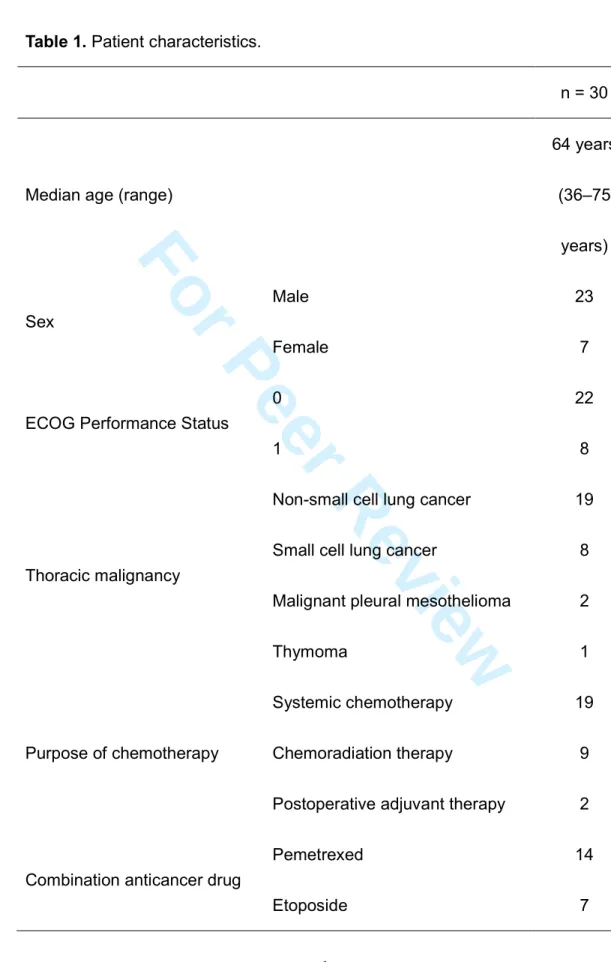
Thirty patients with thoracic malignancy were enrolled from May 2015 through
155
October 2015. Patient characteristics are listed in Table 1. The most common
156
type of thoracic malignancy in this study was non-small cell lung cancer.
157
Nineteen patients received systemic chemotherapy, with the rest receiving
158
chemoradiation therapy or postoperative adjuvant therapy. Cisplatin was
159
administered at a dose of 60–80 mg/m2, and pemetrexed (14 patients),
160
etoposide (seven patients), vinorelbine (four patients), irinotecan (two patients),
161
S-1 (two patients), or gemcitabine (one patient) were administered as the
162
combination anticancer drug.
163
164
Efficacy
For Peer Review
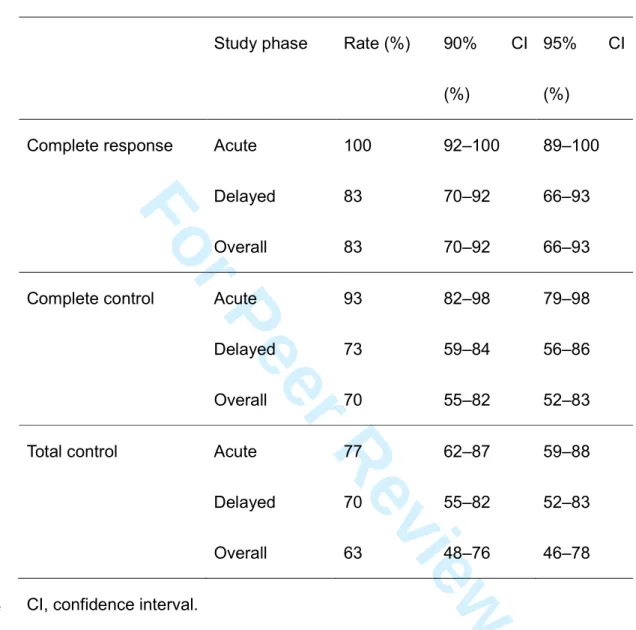
Antiemetic effects are shown in Table 2. Although outcome measures were
166
evaluated based on the diary submitted by each patient, there were no missing 167
data. The overall phase CR rate (primary endpoint) was 83% (90% confidence
168
interval: 70–92%; 95% confidence interval: 66–93%). CR rates for the acute and
169
delayed phases were 100% and 83%, respectively. In the acute, delayed, and
170
overall phases, CC rates were 93%, 73%, and 70%, respectively, and TC rates
171
were 77%, 70%, and 63%, respectively. No vomiting was reported in 100% of
172
patients in the acute phase and in 90% of patients in both the delayed and
173
overall phases. Likewise, rates of no rescue therapy were 100%, 90%, and 90%
174
for the acute, delayed, and overall phases, respectively. In the acute, delayed,
175
and overall phases, no significant nausea was reported in 93%, 77%, and 73%
176
of patients, respectively, while no nausea was reported in 77%, 70%, and 63% of
177 patients, respectively. 178 179 Safety 180
There were no grade 3 or grade 4 adverse events during treatment. Grade 1
181
constipation was observed in 20 patients (67%). Grade 1 hiccupping was
182
observed in 16 patients (53%), and grade 2 hiccupping was observed in one
For Peer Review
patient (3%). Although four patients (13%) experienced grade 1 somnolence,
184
which is an adverse event thought to be caused by olanzapine, no patients
185
discontinued olanzapine. We conducted blood tests on days 6–8. Grade 1
186
elevated levels of alanine aminotransferase were observed in 11 patients (37%).
187
There was no incidence of hyperglycemia or increase in creatine
188 phosphokinase. 189 190 Discussion 191
The 83% CR rate observed during the overall phase met the primary endpoint,
192
and the lower limit of the 90% confidence interval for the overall phase CR rate
193
was 70%, suggesting that the addition of 5 mg oral olanzapine to standard
194
antiemetics may reduce CINV in patients with thoracic malignancy receiving
195
cisplatin-based chemotherapy. The secondary endpoints and safety profiles
196
were also favorable in this study. The results of the present study are consistent
197
with a recently published phase II study that investigated the efficacy and safety
198
of the addition of 5 mg oral olanzapine to standard antiemetics for the prevention
199
of CINV in patients with gynecological cancer (n = 40) receiving HEC [13]. CR
200
rates during the overall phase were reported in 37 (92.5%) of the 40 patients with
For Peer Review
gynecological cancer. Although all patients were female and the cisplatin dose
202
was 50 mg/m2 in most of the patients included in the previous study, our study
203
demonstrated the efficacy of this treatment in a patient group that was mostly
204
male and receiving a higher cisplatin dose (60–80 mg/m2).
205
Navari et al. [14] reported the results of a phase III trial that evaluated the
206
additional efficacy of 10 mg oral olanzapine for the prevention of CINV in patients
207
receiving their first course of HEC. In that study, 380 patients were randomised
208
at a 1:1 ratio for treatment with either olanzapine and standard triplet antiemetic
209
therapy (n = 192) or placebo and standard triplet antiemetic therapy (n = 188).
210
The proportion of patients who reported no nausea and the CR rates were
211
significantly higher in the olanzapine arm compared with the placebo arm.
212
However, sedation was observed more frequently in patients receiving
213
olanzapine compared with those receiving placebo. Hashimoto et al. conducted
214
a randomised phase II study to compare the efficacy and safety of administering
215
10 mg versus 5 mg oral olanzapine for the prevention of CINV in patients
216
receiving HEC [15]. Somnolence was higher in the 10 mg arm than in the 5 mg
217
arm. In our study, only four patients (13%) experienced grade 1 somnolence.
218
Five milligrams of olanzapine may result in less somnolence than 10 mg.
For Peer Review
Thus, three phase II studies, including the present study, have shown the
220
efficacy of adding 5 mg olanzapine to standard antiemetic therapy for HEC [13,
221
15]. Although Navari et al. demonstrated the efficacy of 10 mg oral olanzapine
222
plus standard antiemetics in a phase III study [14], the optimal dose of
223
olanzapine for CINV may be 5 mg, considering efficacy and safety. In addition,
224
Navari et al.’s phase III study had some limitations. First, the majority of subjects
225
were female (72%), had breast cancer (63%), and received anthracycline and
226
cyclophosphamide therapy as chemotherapy (63%). The findings cannot be
227
generalised to all patients who receive HEC. Second, the CR rate in the placebo
228
arm (41%) was lower than that in standard three-drug therapy in other previous
229
phase III studies [4–7]. This is also open to interpretation. The efficacy of
230
additional olanzapine in standard antiemetic therapy for CINV should be
231
investigated further.
232
The present study has several limitations. First, it was a small single-arm study
233
(n = 30) conducted at a single institution. Second, this study was conducted only
234
in subjects with thoracic malignancy. Third, the majority of subjects were male;
235
olanzapine clearance is known to be higher in men than in women [16]. 236
Therefore, a phase III study to verify the efficacy and safety of 5 mg oral
For Peer Review
olanzapine with standard triplet antiemetic therapy is under contemplation
238
(UMIN000024676).
239
In conclusion, the addition of 5 mg oral olanzapine to standard antiemetic
240
therapy demonstrates promising efficacy for the prevention of CINV and
241
provides an acceptable safety profile in patients with thoracic malignancy.
242
243
Conflict of interest
244
This research did not receive any specific grant from funding agencies in the
245
public, commercial, or not-for-profit sectors.
246
Haruyasu Murakami and Hirotsugu Kenmotsu received remuneration from Eli
247
Lilly Japan. Toshiaki Takahashi received remuneration from Eli Lilly Japan and
248
ONO PHARMACEUTICAL CO., LTD. Other authors declare no conflicts of
249 interest. 250 251 References 252
[1] Bloechl-Daum B, Deuson RR, Mavros P, Hansen M, Herrstedt J. Delayed
253
nausea and vomiting continue to reduce patients’ quality of life after highly and
254
moderately emetogenic chemotherapy despite antiemetic treatment. Clin Oncol
For Peer Review
2006;24:4472–8.
256
[2] Roila F, Herrstedt J, Aapro M, et al. Guideline update for MASCC and ESMO
257
in the prevention of chemotherapy- and radiotherapy-induced nausea and
258
vomiting: results of the Perugia consensus conference. Annal Oncol
259
2010;21:v232–43.
260
[3] Hesketh PJ, Bohlke K, Lyman GH, et al. Antiemetics: American Society of
261
Clinical Oncology focused guideline update. J Clin Oncol 2016;34:381–6.
262
[4] Poli-Bigelli S, Rodrigues-Pereira J, Carides AD, et al. Addition of the
263
neurokinin 1 receptor antagonist aprepitant to standard antiemetic therapy
264
improves control of chemotherapy-induced nausea and vomiting. Results from a
265
randomized, double-blind, placebo-controlled trial in Latin America. Cancer
266
2003;97:3090–8.
267
[5] Schmoll HJ, Aapro MS, Poli-Bigelli S, et al. Comparison of an aprepitant
268
regimen with a multiple-day ondansetron regimen, both with dexamethasone, for
269
antiemetic efficacy in high-dose cisplatin treatment. Ann Oncol 2006;17:1000–6.
270
[6] Hesketh PJ, Grunberg SM, Gralla RJ, et al. The oral neurokinin-1 antagonist
271
aprepitant for the prevention of chemotherapy-induced nausea and vomiting: a
272
multinational, randomized, double-blind, placebo-controlled trial in patients
For Peer Review
receiving high-dose cisplatin—the Aprepitant Protocol 052 Study Group. J Clin
274
Oncol 2003;21:4112–9.
275
[7] Suzuki K, Yamanaka T, Hashimoto H, et al. Randomized, double-blind, phase
276
III trial of palonosetron versus granisetron in the triplet regimen for preventing
277
chemotherapy-induced nausea and vomiting after highly emetogenic
278
chemotherapy: TRIPLE study. Ann Oncol 2016;27:1601-6.
279
[8] Tan L, Liu J, Liu X, et al. Clinical research of olanzapine for prevention of
280
chemotherapy-induced nausea and vomiting. J Exp Clin Cancer Res
281
2009;28:131–7.
282
[9] Navari RM, Gray SE, Kerr AC. Olanzapine versus aprepitant for the
283
prevention of chemotherapy-induced nausea and vomiting: a randomized phase
284
III trial. J Support Oncol 2011;9:188–195.
285
[10] Navari RM, Nagy CK, Gray SE. The use of olanzapine versus
286
metoclopramide for the treatment of breakthrough chemotherapy-induced
287
nausea and vomiting in patients receiving highly emetogenic chemotherapy.
288
Support Care Cancer 2013;21:1655–1663.
289
[11] Abe M, Komeda S, Kuji S, et al. Clinical research of olanzapine for
290
prevention of chemotherapy-induced nausea and vomiting resistant to standard
For Peer Review
antiemetic treatment for highly emetogenic chemotherapy. Palliative Care Res
292
2013;8:127–134.
293
[12] Fleiss JL. Statistical methods for rates and proportions. San Francisco:
294
Wiley; 1981.
295
[13] Abe M, Hirashima Y, Kasamatsu Y, et al. Efficacy and safety of olanzapine
296
combined with aprepitant, palonosetron, and dexamethasone for preventing
297
nausea and vomiting induced by cisplatin-based chemotherapy in gynecological
298
cancer: KCOG-G1301 phase II trial. Support Care Cancer 2016;24:675–682.
299
[14] Navari RM, Qin R, Ruddy KJ, et al. Olanzapine for the prevention of
300
chemotherapy-induced nausea and vomiting. N Engl J Med 2016;375:134–142.
301
[15] Hashimoto H, Yanai T, Nagashima K, et al. A double-blind randomized
302
phase II study of 10 versus 5 mg olanzapine for emesis induced by highly
303
emetogenic chemotherapy with cisplatin. J Clin Oncol 2016;34 (suppl; abstr
304
10111).
305
[16] Callaghan JT, Bergstrom RF, Ptak LR, Beasley CM. Olanzapine. 306
pharmacokinetic and pharmacodynamic profile. Clin Pharmacokinet
307
1999;37:177–193. 308
For Peer Review
309
Appendix
310
The other authors: Satomi Koizumi2, Keita Mori3, Takeshi Isobe4, Toshiaki
311
Takahashi1
312
313
1
Division of Thoracic Oncology, Shizuoka Cancer Center, Shizuoka, Japan
314
2
Nursing Department, Shizuoka Cancer Center, Shizuoka, Japan
315
3Clinical Research Center, Shizuoka Cancer Center, Shizuoka, Japan
316
4
Division of Medical Oncology and Respiratory Medicine, Shimane University
317
Faculty of Medicine, Shimane, Japan
For Peer Review
Table 1. Patient characteristics.
1
n = 30
Median age (range)
64 years (36–75 years) Sex Male Female 23 7
ECOG Performance Status
0 1
22 8
Thoracic malignancy
Non-small cell lung cancer Small cell lung cancer
Malignant pleural mesothelioma Thymoma 19 8 2 1 Purpose of chemotherapy Systemic chemotherapy Chemoradiation therapy
Postoperative adjuvant therapy
19 9 2
Combination anticancer drug
Pemetrexed Etoposide
14 7
For Peer Review
Vinorelbine Irinotecan S-1 Gemcitabine 4 2 2 1 Cisplatin dose 60 mg/m2 75 mg/m2 80 mg/m2 4 14 12 ECOG, Eastern Cooperative Oncology Group.For Peer Review
Table 2. Antiemetic effects.
3
Study phase Rate (%) 90% CI
(%)
95% CI
(%)
Complete response Acute 100 92–100 89–100
Delayed 83 70–92 66–93
Overall 83 70–92 66–93
Complete control Acute 93 82–98 79–98
Delayed 73 59–84 56–86
Overall 70 55–82 52–83
Total control Acute 77 62–87 59–88
Delayed 70 55–82 52–83
Overall 63 48–76 46–78
CI, confidence interval.