密度成層流体中の物体により励起される
3
次元非線形内部重力波
-Navier-Stokes
方程式の解と外力項を持った
KP
方程式の解
–
国立環境研究所 花崎秀史 (Hideshi HANAZAKI)
1.Introduction
Recent studies
on
thewaves
excited byan
obstacle in the flow have revealed the basic nonlinearwave-generationmechanism. The mechanism isnow
found tobe essentially thesame
for the water waves, internal gravitywaves
in stratified flows and for the inertialwaves
in swirling flows. The two-dimensionalwaves
excitednear
resonance are
foundtobe well described by the forced Boussinesqequation
or
the forced $KdV(fKdV)$equation.Thesemodel equations have been derived by Wu(1981) andAkylas(1984) for the water
waves, by Grimshaw&Smyth(1986) for the internalwaves, and by Grimshaw(1990) for
the swirling flows. The applicability of these equations and their extensions has been verifiedexperimentally
or
numerically byLee,Yates&Wu(1989) forthe waterwaves, byZhu,Wu&Yates(1986),
Melville&Helfrich(1987)
and Hanazaki(1992) for the internalwaves, and Hanazaki$(1991, 1993a)$ for the swirling flows.
However, for the three-dimensionalwaves, sufficient results have not been obtained. In
an
experiment for the water wave, Ertekin,Webster&Wehausen(1985) found that theupstream
waves
become straight crested. To know the applicability of the weaklynonlinear theories, Ertekin,Webster
&Wehausen(1986)
solved the Green-Naghdiequation, Katsis
&
Akylas(1987) solved the forced KP(fKP) equation andPedersen(1988) solved the forcedBoussinesqequation. They foundthat,
near
resonance,upstream
waves
become two-dimensional and the generationperiod of theupstreamwave
agrees
withexperiments. From theirresults, Katsis&Akylas(1987) andPedersen(1988)argued that the mechanism of the two-dimensionalisation is the Mach reflection of the
upstream
waves
at the side wall ofthe channel. However, Tomasson&Melville(1991)solved
an
equation for thewaves
excited bya
side wall perturbation in the two-layer flow. Theequation is similartothe $fKP$equation, and withan
additional assumption [see their (21)] itbecomes the$fKP$equation. Because the solution of thatequationagreedwell with the solution of the linearized version of that equation when the flow is subcritical,they argued that the phenomenon
can
be explained by the differences in thegroup
velocity ofthe lateral modes of the linear
wave.
Sinceno
experimental results exist thatcan
follow the time development of the three-dimensionalpatterns of the upstream wave,quantitative verification of the $fKP$
or
the forced Boussinesq equationsas a
time-dependent weakly nonlinearmodelhasnotbeen done sufficiently.For the
waves
ina
flow of linearly stratified Boussinesq fluid, thereare a
number ofexperiments, but
none
of these givethree-dimensionalperspective of the upstreamwave.
Hanazaki(1989a) has found that theupstream
waves
become two-dimensional by solvingthethree-dimensional Navier-Stokes equations.However,the channel width used
was
toosmall forthe understanding oftheprocess of the two-dimensionalisation of theupstream
for the two-dimensional resonant flow and its quantitative verification
was
done numerically by Hanazaki(1993b). However, corresponding theory for the three-dimensionalwaves are
notyetdeveloped. Because the linearly stratified Boussinesq fluidis
one
of the most typical type of density stratification that has been studied extensively, the investigationof its three-dimensional flowis also of much interest.In this study, time-dependent three-dimensional Navier-Stokes equations
are
solved numerically. First,near
resonant flow of the nearly two-layer fluid is considered. It isshown if the
waves
resonantly excited byan
obstacleare
describable by the equationsderived by the weaklynonlinear theory andifthe abnormal reflection similartothe Mach reflection
occurs
atthe side$waU$ and also iftheprocess
oftwo-dimensionalisationof theupstream
waves
can
be explained by the differences in thegroup
velocity of the lateralmodes of the linear
wave.
Inthiscase, thewaves are
expectedtobe governed bythe $fKP$equation
or
its extensions and the comparisons with their solutionsare
given. Next, the results for the flow of the linearlystratified Boussinesq fluidis given.2.$Theory$
Thegoverning equations
are
theNavier-Stokesequations foran
imcompressiblestratified fluid.$\frac{\partial_{\mathcal{V}}^{\vee}}{\partial r}+(varrow\cdot\vec{\nabla})\vec{v}=-\frac{1}{\rho}\vec{\nabla}p-g^{\wedge}zarrow+\frac{\mu}{\rho}\nabla^{2}\vec{v}$, (2.1a)
$\frac{\partial p}{\partial t}+(varrow\cdot\tilde{\nabla})p=0$, (2.1b)
$divv=0$ (2.1c)
where $\vec{v}=(u,v,w)$ is the velocity, $p$ is the
pressure,
$r$ is the density, $m$ is the viscositycoefficient, $g$is the acceleration duetogravityand
$\overline{z}\wedge$
is theunitvectoralong the$z$ axis.
To derive the forced KP(fKP)equationand the forced extendedKP(flEKP) equationffom the inviscid form of(2.1),
we
rescalex,y
and $t$as
$X=\epsilon^{1/2}x,$$Y=q,$$T=\epsilon^{3/2}r$, (2.2)
where $\epsilon$ is
a
smallparameterand expand the dependentvariables inpowers
of $\epsilon$.
At $O(\epsilon)$,
we
obtaina
Sturm-Liouville equation$\frac{d}{dz}(\overline{\kappa}_{n}^{2}\frac{d\phi_{n}}{dz})-g\frac{d\overline{p}}{dz}\phi_{n}=0$,
$\}_{2.4}^{2.3}\{$
$\phi_{n}(0)=\phi_{n}(D)=0$,
where $C_{n}(C_{1}>C_{2}>\ldots)$ and $\phi_{n}(z)$
are
respectively the nth eigenvalue and the ntheigenfunction and $\overline{p}(z)$ is the undisturbed density.
If
we
scale the obstacle height$h$as
$h=\epsilon^{2}H(X,Y,T)$, (2.5)
we
obtain the $fKP$ equation at $O(\epsilon^{2})$, and ifwe
consider also the effect of the cubicnonlinearity of higherorder,$O(\epsilon^{3})$,
we
obtain the$fEKP$equation$- \frac{1}{C_{\hslash}}(A_{T}+\Delta A_{X})+a_{7}AA_{X}+\epsilon a_{2}A^{2}A_{X}+a_{3}A_{XXX}+\frac{1}{2}\int_{-\infty}^{X}dKA_{YY}+G_{X}=0$, (2.6)
$\Delta=\frac{U-C_{n}}{\epsilon}$, (2.7a) $a_{1}= \frac{3\int_{0^{D}}\overline{\rho}(\frac{d\phi_{n}}{dz})^{3}dz}{2L_{\hslash}}$ , (2.7b) $a_{2}= \frac{3\int_{0^{D}}\overline{\rho}(\frac{d\phi_{n}}{dz})^{4}dz}{L_{n}}$ , (2.7c) $a_{3}= \frac{\int_{0^{D}}\overline{\rho}\phi_{\hslash}^{2}dz}{2L_{\hslash}}$ , (2.7d)
$G(X,Y)=( \overline{\rho}\frac{d\phi}{dz})_{z=0}\frac{H(X,Y,T)}{2L_{n}}$, (2.7e)
and $L_{\hslash}= \int_{0^{D}}\overline{\rho}(\frac{d\phi_{n}}{dz})^{2}dz$
.
(2.7f)The$fKP$equation is obtained by neglecting the cubic nonlinearterm $\epsilon a_{2}A^{2}A_{X}$ in(2.6). In
a
two-dimensional two-layerflow,Melville&Helfrich(1987)
found by experiments thatthe effect of the cubic nonlinearity cannot be neglected. Later, Hanazaki(1992) showed that theratio $\epsilon a_{2}/a_{1}$ is
very
large compared tothecase
of thewaterwave
and thewaves
would be well described by the $fKP$ equation only when the amplitude of the
wave
isvery
small.In thecase
of the linearly stratified Boussinesqfluid, (2.3)becomes$\frac{d^{2}\phi_{\hslash}}{dz^{2}}-\frac{N^{2}}{C_{\hslash}^{2}}\phi_{\hslash}=0$, (2.8a)
where the constantBrunt-Vaisala frequency isgiven by
$N^{2}=- \frac{g}{\overline{p}}\frac{d\overline{\rho}}{dz}$
.
(2.8b)Therefore, $\phi_{\hslash}(z)$ and $C_{n}$become
$\phi_{n}(z)=\sin\frac{n\pi z}{D}$, (2.9a)
and
$C_{n}= \frac{ND}{n\pi}$
.
(2.9b)Substituting (2.9a) into ($2.7b,f\gamma$ and setting $\overline{\rho}(z)$
constant in the integrand,
we
know that$a_{1}=0$, which
means
that the quadratic nonlinearterm in the $fKP$and the $fEKP$ equationvanishes. In this
case
the nonlinear correction of the linearwave
speed would bevery
small. This
can
be expected from the solution of the equation derived by Grimshaw&Yi(1991) and from the numerical solution of the two-dimensional Navier-Stokes
equations [Hanazaki(1992,1993b)].
3.Numerical method
The numerical method is essentially the
same as
in the previousstudies[Hanazaki(1989a,b),(1992)]. The computation
was
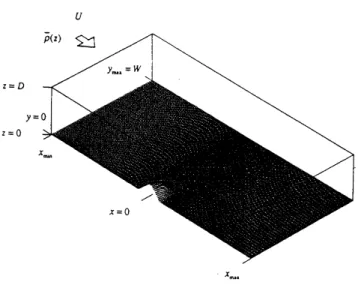
done in the domain ofwhere$W(=40D)$is the half width ofthechannel,$D$ is thechannel depth and the obstacle
shapeis given by
$h(x,y)=h_{m*x} \cross\frac{1}{2}[1+\cos(\pi\{(\frac{X}{5D})^{2}+(\frac{y}{10D}I^{2}\}^{\frac{1}{2}}]]$,
where $( \frac{X}{5D})^{2}+(\frac{y}{10D}I^{2}\leq 1$ (3.2)
and $h(x,y)=0$elsewhere [$h_{mx}=0.1D$,
see
Figure 1].The computation is done only for $y\geq 0$ because
we assume
the symmetry of the flow against the plane of $y=0$.
At $y=W$ and $z=D$, rigid walls exist and thewaves
are
reflected by these walls. The boundary conditions for the nearly two-layer flow
are
the three-dimensional counterpartoftheprevious studies [Hanazaki(1989a,b), (1992)].Theundisturbed density distribution $\overline{p}(z)$ is givenby
$\overline{p}(z)=\frac{1}{2}[\overline{\rho}(0)+\overline{\rho}(D)]-\frac{1}{2}[\overline{\rho}(0)-\overline{\rho}(D)]\tanh[\frac{50(z-f_{b})}{D}]$,
(3.3)
with $\overline{\rho}(D)=0.9\overline{p}(0)$, and $h_{2}=0.3D$
.
Inthis study, Froude numberis defined by
$F= \frac{U}{C_{1}}$
.
(3.4)where $C_{1}$ is the maximum eigenvalue of the Sturm-Liouville problem (2.4). Specifically,
in the
case
of the linearly stratified Boussinesq fluid, $C_{1}$ is given by (2.9b) (with $n=1$).The Froudenumberisvaried
as
$0.6\leq F\leq 1.4$.
The Reynolds numberisdefined by${\rm Re}=^{\underline{\overline{\rho}(0)Uh_{\max}}}$
.
(3.5)
$\mu$
andis fixedtobe
1000.
4.Results
In Figure 2, time development of the resonant(F$=1.0$) flow of
a
nearly two-layer fluidover
topographyisdescribed. Here $A(x,y,t)=Al$(x,y,t) is calculatedusing the horizontalvelocity $u(x,y,z,t)$
.
In the initial time development(Ut/D$=40$) the upstreamwaves
are
curved backwards [Figure $2(a)$]. At around $Ut/D=60$, the far side end of the upstream
waves
reaches the side wall anditbegins tobe reflected. Afterthat, the upstreamwaves
become gradually straight crested
as
time proceeds. Downstream of the obstacle, flat depression is formed andit becomes longeras
timeproceeds. Further downstream, leewaves
are
generated[Figure$2(d)$].To
compare
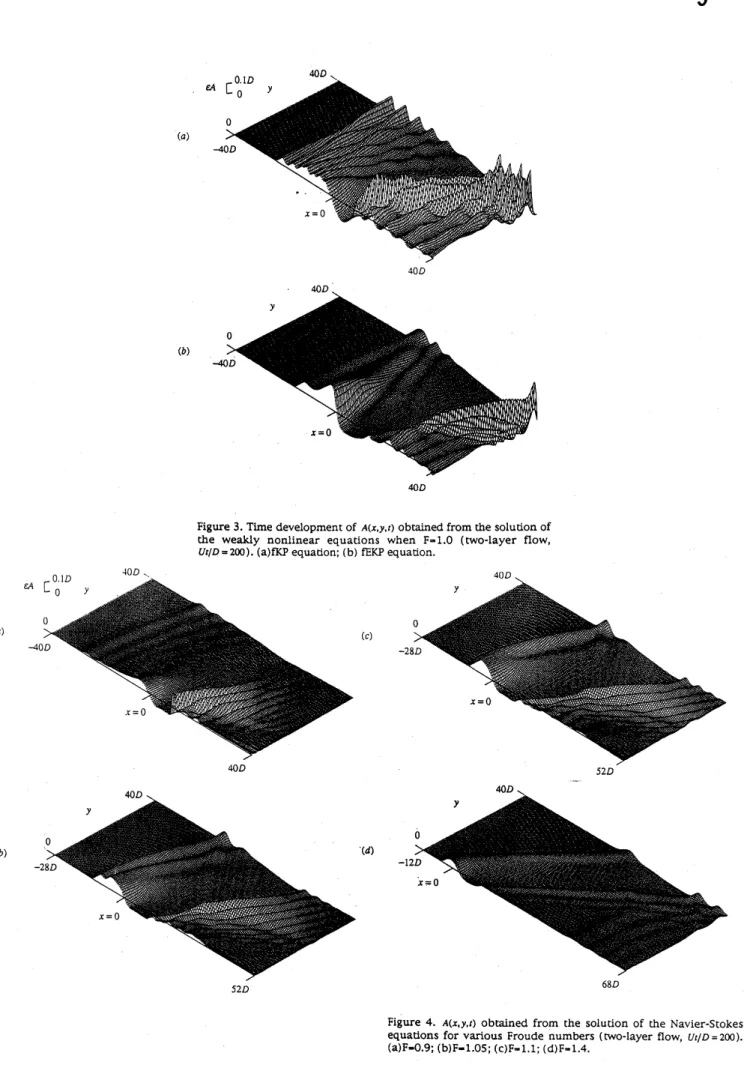
this solution with the weakly nonlinear theory, the solutions of the$fKP$ and the $fEKP$ equation [see (2.6)] when$F=1.0(UUD=200)$are
shown in Figure3.
Theover
all qualitative feature agree with the solution of the fully nonlinear Navier-Stokes
equations. However, there
are
some
quantitative differences. Nearly flat depressionjust downstream ofthe obstacle(x$>0,$$y\equiv 0$), whichis typical in the two-dimensionalwaves
and also
seen
in the three-dimensional solution of the Navier-Stokes equations, does notthe$fKP$equation[Figure$3(a)$],the generationperiod of theupstream
waves
is shorter and the upsffeam-advancing speedis larger. Although theupstreamwaves
have comparable amplitude, lee-wave amplitude is highlyover
predicted. In the solution of the $fEKP$equation[Figure$3(b)$], the amplitude of theupstream
wave
isover
predicted although thelee
wave
amplitude is smaller than the solution of the $fKP$ equation. The generation period of the upsffeamwave
is longer and the upsffeam-advancing speed is smaller thanthe solution of the Navier-Stokes equations. It
seems
that, exceptjust upstream of theobstacle(x$\leq 0,$$y\leq 20D$), the $fEKP$ equation shows better agreement with the
Navier-Stokesequations comparedto the$fKP$equation. However, solution ofthe $fEKP$equation
shows large differencesjustupstream ofthe obstacle(x$\leq 0,$$y\leq 20D$)where
we
have themost
concern.
Therefore,we
can
notsay
straightforwardly that the $fEKP$ equation isa
sufficientlyaccuratemodelof the phenomenon. We note that, although thecomparisons
are
made here only for$F=1.0$, typical qualitative differenceswere
thesame
for the otherFroude numbers
near resonance.
To
see
the Froude-number dependenceof the wave,results forvariousFroude numbers at$UuD=2\alpha\}$
are
shown in Figure4. When$F=0.9$,upstreamwaves
are
weak comparedtothecase
of$F=1.0$[Figure $2(c)$]. The upstream-advanCing speedis faster because of the faster linear-wave speed and the wave-generation period is shorter. The length of the downstream depressionis smaller and the lee-wave amplitude is larger. When $F=1.05$,theupstream
waves
have larger amplitude and longer wave-generation period. Even when$F\geq 1$, upstream
waves are
generated ina
long-time developmentas
has been predictedby the weakly nonlinear theories. When $F=1.1$, the upstream
waves
haveeven
larger amplitude but have further longer wave-generation period. When $F=1.4$ and the flowissupercritical, the upstream
waves
are
no
longer generated andan
elevation of fluid just above thetopographyis trailingobliquely downstream.A controversial issue raisedhere has been themechanism of the two-dimensionaliSation
ofthe upstream
wave.
Tosee
the two-dimensionalisationmore
clearly, the contours of$A(x,y,t)$ correspondingtoFigure2
are
shown in Figure5. At first$[UUD=40,Figure5(a)]$ ,the upstream
wave
is curvedbackwards, but after thewave
reaches theside wall at about$UD=60$,the
wave
is reflected anda
thirdwave
whosewave
crestis perpendicular totheside wall
appears
[Figure$5(b)$]. This thirdwave
is similarto the Mach stemthatappears
in the Mach reflection. The length of this thirdwave
becomes longeras
time proceeds forminga
straight-crestedwave
front. The upstream-advancing speed of the Mach-stem likewave
is faster than thewave
near
thecenterplane because the amplitude islarger. Inaddition, the lengthof the stem becomes longer roughly proportional totime. Therefore,
the upstream front becomes two-dimensional
as
time proceeds. The amplitude of thereflected
wave
isvery
weak comparedto the incidentwave.
Also, the angle ofreflectionis largerthan the incident angle in Figure 5(b), (c) and (d) [see also Table 1]. These all features
agree
with theMachreflection mechanism.InFigure 6, the contours of$A(x,y,t)$ for various Froude numbers when
a
short time has passed after the foremost upstreamwave
begins to be reflectedare
shown. Whenupstream advancing
waves
are
generated ($F=1.0,1.05$ and 1.1) [see Figure $5(b),6(a,b)$],the reflection angle is larger than the incident angle and the reflection pattern is qualitatively the
same
for all the Froude numbersnear resonance
$(F\cong 1)$.
The reflectionangleis consistently
more
than 5 degree larger than the incident angleas
shown Table 1.As is typical in the Mach reflection, the amplitude of the reflected
wave
is weaker compared to the incident wave, although the reflectionprocess
is unsteady and the amplitude of the reflectedwave
is still growing in these figures. It should be noted that the Miles‘ theory is intended fora
Boussinesq solitarywave
of $\sec h^{2}$ profile. In thisstudy, theupstream
wave
profile doesnotagree
with thesolution of the $fKP$equationandthe upstream
wave
may
not have the exact $\sec h^{2}$ profile. However, this is similarto theBoussinesq solitary
wave
and wouldshowa
qualitatively similarreflectionpattern. When the flow is supercritical andno
upstreamwaves are
generated [$F=1.4$, Figure $6(c)$], theincident angle andthe reflection angle
agree
$(41^{o})$ [seeTable 1] andthe amplitude ofthe reflectedwave
is comparable to the incidentwave.
Thismeans
that the reflection isa
normal reflection. Note that the
wave
patternsare
quite similar to the solution of the forced Boussinesqequationatthesame
Froude number[Pedersen(1988),Figure 1(a,b)].To
see
if thetwo-dimensionalization
isa
result of the linear dispersion relation,we
consider the dispersion relation of the unforced linearized KP equation
as
done byTomasson&Melville(1991).
Ifwe
substitute$A(X,Y,T) \propto e^{i(b-ox)}\cos\frac{l_{J}U}{W}$, (4.1) intothelinearizedKPequationwithout
a
forcingterm $[c.f.(2.6)]$ notingthatx,y, and$ta\infty$scaled
as
in (2.2),we
obtain the dispersionrelation$\omega=C_{*}(a_{3}k^{3}-\frac{l^{2}\pi^{2}}{2W^{2}k})+\epsilon\Delta k$
.
(4.2)To
see
if the lineardispersionrelationcan
be appliedtothe solution ofthe Navier-Stokes equations,the timedevelopment of thelateralwave
modes $l=0$ and $l=1$ when$F=1.0$isshown in Figure
7.
Because $A(x,y,t)$can
be decomposed by complete orthogonalfunctions
as
$A(x,y,t)= \sum_{\iota\underline{\sim}0}^{\infty}\tilde{A}_{l}(x,t)\cos\frac{lv}{W}$, (4.3)
the amplitude of the each lateral
wave
mode is calculatedby$\tilde{A}_{l}(x,t)=\frac{2}{W}\int_{0^{W^{r}}}A(x,y,t)\cos\frac{\iota v}{W}dy$
.
(4.4)At$UD=2\alpha$}, the distance between the position of the foremost upstream
wave
ofmode$l=0$ and $l=1$ estimeated by (4.2) is
7.
$2D$.
However,we see
in Figure 7 that the propagation speed of the upstream frontis almost thesame
in modes $l=0$ and $l=1$ Intheinitial timedevelopment,notonly the lowest mode $l=0$ butalsohighermodes$(l\geq 1)$
are
excited andpropagate upstream atan
equal speed. Therefore, the upstreamwave
isnot governed by the linear dispersion relation at least
near resonance.
AlthoughTomasson&Melville(1991)
showed the separation of transverse modes when $F=0.6$which
may
be the result of the linear dispersion relation, they did not report sucha
separation when the flow is
near
resonance
$(F=1.05)$.
They argued that only the lowestmode $(l=0)$
can
beresonantand develop nonlinearlytoforn two-dimensional upstreamwaves.
However, thepresentsolution oftheNavier-Stokes equations shows that also thehighermodes$(l\geq 1)$develop nonlinearly andpropagate upstream.
Next
we
consider thecase
of the linearly stratified Boussinesq flow. Because thetwo-dimensionalisation of the upstream
wave
has been shown also in the subcritical flow of the linearly stratified Boussinesq fluid[Hanazaki(1989a),Figure 8], it isofinteresttosee
what
occurs
in these flows. Asan
example,we
show thecase
of$F=0.6$ in Figure8.
Wesee
the clear separation of the mode $l=0$ and $l=1$ in thiscase.
Thiscauses
thetwo-dimensionalisationoftheupstream
wave.
Byassuming$\rho\propto e^{i(k-\alpha)}\cos\frac{lv}{W}\sin\frac{n\pi z}{D},$$etc.$, (4.5)
$\omega=N[\frac{k^{2}+(\frac{l\pi}{W})^{2}}{k^{2}+(\frac{l\pi}{W})^{2}+(\frac{n\pi}{D})^{2}}]^{\frac{1}{2}}$ (4.6)
At time$UVD=80$, thedifference in the positionof the foremost
wave
of mode $l=0$ and$l=1(n=1, F=0.6, W=20D)$is
7.
$9D$.
The wavelength of the foremostwave
of mode $l=1$is $11.9D_{;}$ These values
are
consistentwith Figure8.
Because the upstreamwave
in thiscase
is sinusoidal and not similar to the Boussinesq solitary wave, abnormal reflectionsimilar tothe Mach reflection does not
occur.
Weknow that the nonlinear correction of the linearwave
speed is small in thecase
of the two-dimensional linearly stratified Boussinesq fluid. This would be applied also tothe three-dimensional fluid. Therefore,althoughthe propagation speedis consistentwith the prediction of thelineartheory, this doesnot
mean
directlythat theupstreamwaves
are
governed by thelinear equations.5.Conclusion
Wehave found that the three-dimensional
waves
excitedbyan
obstaclenear
resonance
in nearly two-layer floware
describedqualitatively by the $fKP$or
the $fEKP$equation. In theprocess
of the two-dimensionalisation of the upstream wave, itwas
found that theabnormal reflectionsimilartotheMachreflection of
a
Boussinesq solitarywave
playsan
importantrole. The phenomenon could not be explained by the difference in the
group
velocityofthelateral mode of thelinear
wave.
In the
case
of the linearly stratifiedBoussinesq flow, the two-dimensionalisation of theupstream
wave
could be explained by the difference in thegroup
velocity ofthe lateralmode of the linear wave, because the upstream
wave
hada
sinusoidal structure and the abnormal reflection that is typical to the Boussinesq solitarywaves
could notoccur.
However,this does notdirectly
mean
that theupstIeamwaves
can
be described governedby the linear theory because the nonlinear correction of the linear
wave
speed would bevery
small in analogywiththeresults for the two-dimensionalwaves.
ReferencesAkylas,T.R.
1984
J.Fluid Mech. 141,455-466.Ertekin,R.C.,Webster,W.C.
&Wehausen,J.V. 1985
Proc.15th Symp. Naval Hydrodyn.Ertekin,R.C.,Webster,W.C.
&Wehausen,J.V. 1986
J.Fluid Mech. 169,275-292.Grimshaw,R.H.J. &Smyth,N.
1986
J.FluidMech.169,429-464.Grimshaw,R.
1990
Studies in Appl.Math.83,249-269.Grimshaw,R.
&Yi,Z. 1991
J.FluidMech.229,603-628.Hanazaki,H.
1989a
Fluid Dyn.Res.4,317-332.Hanazaki,H. 1989b Phys.FluidsA1,1976-1987.
Hanazaki,H.
1991
Phys.Fluids A3,3117-3120.Hanazaki,H.
1992
Phys.FluidsA4,2230-2243.
Hanazaki,H.
1993a
Phys.Fluids A5 (inpress).Hanazaki,H. 1993b Phys.Fluids A5 (inpress).
Kakutani,T.
&Yamasaki,N. 1978
J.Phys.Soc.Japan 45,674-679.Katsis,C.
&Akylas,T.R. 1987
J.FluidMech.177,49-65.Melville,W.K.
&Helfrich,K.R. 1987
J.Fluid Mech.178,31-52.Pedersen,G.
1988
J.FluidMech.196,39-63.Tomasson,G.G.
&Melville,W.K. 1991
J.Fluid Mech. 232,21-45.Wu,T.Y. 1981J.Eng. Mech.Div. ASCE 107,501-522.
$U$
Figure1. Schematlcalviewoftheflowgeometry.
40$D$
$(b)$
$40D$
Figure2.Timedevelopment of$A(x.y.r)ob\mathfrak{c}alned$from the solutionof
theNavier-Stokesequations when$P\Rightarrow 1.0$($\mathfrak{c}wo$-layerflow). (a)$U\iota/D=40$;
$(a)$
40$D$
$(b)$
40$D$
Figure3.Timedevelopmentof$A(x.y.\iota)$obtained from thesolution of
the weakly nonlinear equations when $Farrow 1.0$ (two-layer flow,
$U\iota/D=20)$.$(a)fKP$equation;(b) $fEKPeqUaQon$.
$(a)$
$(c)$
40$D$
$(b)$
Figure 4. $A(x.y,\iota)$ obtained from the solution of the Navier-Stokes
equationsfor variousFroude numbers(two-layer flow, $Ut/D=2\infty$). $(a)F-O.9,\cdot\langle b)F-1.05;(c)Farrow 1.1;\langle d)F\approx 1.4$.
$(c)$
Figure 5. Time developmentof the contour$ofA(x.y.\iota)$obtained from
the solution of theNavier-Stokesequations when$F\Leftrightarrow 1.0$ (two-layer
flow).$ta$)$Ut/D–40;(b)Ut/D=80,\cdot(c)U\iota/D=20;(d)U\iota/D=40$.
Figure6. Thecontourof $A(x,y.t)$obtainedfrom the solutlon of the
Navier-Stokes equations forvarious Froude numbers (two-layer flow).$(a)F\approx 1.05(Ut/D=\iota\alpha));(b)F=1.1(Ut/D=120);(c)F\approx 1.4(Ur/D=200)$.
The interval of thecontouris$\Delta(\epsilon A)=0.01D$and thebroadUne shows
Froude tune channel inciden$t$ reflection difference
number $(U\iota/D)$ width angle angle
(degree) (degree) (degree)
0.6 70 $20D$ 11 18 7 0.9 80 $40D$ 29 36 7 1.0 80 $40D$ 36 45 9 1.05 100 $40D$ 33 39 6 1.1 120 $40D$ 38 43 5 1.4 200 $40D$ 41 41 $0$
Table1.Incidentandreflecdonanglesof$\iota he$upstreamwaveatche
side$waU$forvanousFroudenumbers.
$(0)$
$(b)$ $(b)$
$(c,)$
$(c)$
Figure7.$T_{1}me$development of thelateral mode $\overline{4}_{0}(x.r)$and
4$(x.t)$in chesolutlonof theNavier-Stokesequations when$F-1.0$ (two-layer flow)$ta$)$Ut/D\simeq 40;(b)Ur/D=1\alpha);(c)U\iota/D=20$.
Figure 8.Timedevelopmentof$A(x,y.\iota)$obtainedfrom the solutionof
the Navier-Stokes equations when $F-0.6$ (linearly stratified Boussinesaflow).$(a1U\prime\prime D=20;(b)U’/0=50(c)Ut/D=\partial 0$