
An obstruction to trivializing links by $n$-moves (Intelligence of Low-dimensional Topology)
7
0
0
全文
(2) 74 prime. p. there exist links which are not p‐move equivalent to trivial links by using their pth. Burnside groups. More precisely, they proved that the closure of the 5‐braid (\sigma_{1}\sigma_{2}\sigma_{3}\sigma_{4})^{10}. and the 2‐parallel of the Borromean rings are not 3‐move equivalent to trivial links [2], and that the closure of the 3‐braid (\sigma_{1}\sigma_{2})^{6} is not p‐move equivalent to a trivial link for any prime number p\geq 5[3] . That is, they gave counterexamples for the Montesinos‐Nakanishi 3‐move conjecture.. It is easy to see that the pth Burnside group is preserved by p‐moves. While the pth. Burnside group is a powerful invariant, it is hard to distinguish pth Burnside groups of given links in general. Hence to find a way to distinguish given Burnside groups is very. important. In this article, we give an efficient way to distinguish pth Burnside groups of a. given link and a trivial link (Theorem 3.1). In fact, by using Theorem 3.1, we show that there exist links, each of which is not p‐move equivalent to a trivial link for any odd prime p. (Theorem 3.3). Our method is naturally extended to both virtual and welded links. We. prove that there exists a welded link which is not. any odd prime. 2. p. p ‐move. equivalent to a trivial link for. (Remark 3.5).. Burnside groups of links Let. L. a group. be a link in the 3‐sphere S^{3} and. \Pi_{D}^{(2)}. crossing of and. y. of. D. D. D. is defined as follows.. an unoriented diagram of D. Each arc of. gives a relation yx^{-1}yz^{-1} , where. x. and. z. L.. In [4, 5, 6, 13],. yields a generator, and each. correspond to the underpasses. corresponds to the overpass at the crossing, see Figure 2.1. The group. invariant of. L.. We call it the associated core group of. L. and denote it by. \Pi_{L}^{(2)}.. \Pi_{D}^{(2)}. is an. \backslash yx^{-1}yz^{-1} Figure 2.1: Relation of the associated core group. Remark 2.1. M. Wada [13] proved that. \Pi_{L}^{(2)}. is isomorphic to the free product of the. fundamental group of the double branched cover. infinite cyclic group. M_{L}^{(2)}. of S^{3} branched along. L. and the. \mathbb{Z}:\Pi_{L}^{(2)}\cong\pi_{1}(M_{L}^{(2)})*\mathbb{Z} . Moreover, Dabkowski and Przytycki D of L, \pi_{1}(M_{L}^{(2)}) is obtained from the group \Pi_{D}^{(2)} of \lrcorner. pointed out that for a diagram putting any fixed generator. [2, 3] D. by. x=1.. In [2, 3], for each positive integer n , DaJbkowski and Przytycki introduced n‐move equiv‐ alence invariants of. L. by using. \Pi_{L}^{(2)}. and. \pi_{1}(M_{L}^{(2)}). as follows..
(3) 75 x_{m} Definition 2.2 ([2, 3]). Suppose that \Pi_{L}^{(2)}=\{x_{1}, { x_{1}, x_{m}|R, x_{m}\rangle . Let W_{n} denote a set \{w^{n}|w\in\{x_{1},. is the free group of rank. m. . The unreduced nth Burnside group. as \{x_{1}, x_{m}|R, W_{n}\} . The nth Burnside group B_{L}(n) of R, x_{m}, W_{n}\}.. Proposition 2.3 ([2, 3]).. R\rangle . Then \pi_{1}(M_{L}^{(2)})\cong x_{m}\}\} , where \langle x_{1} , , x_{m} }. L. \hat{B}_{L}(n). of. L. is defined. is defined as \langle x_{1},. x_{m}|. \hat{B}_{L}(n) and B_{L}(n) are preserved by ‐moves. n. \hat{B}_{L}(n). \hat{B}_{L}^{q}(n) \hat{B}_{L}(n) by the qth term of the lower central series of \hat{B}_{L}(n) that \hat{B}_{L}(n) is not always finite but \hat{B}_{L}^{q}(n) is a finite group for. We will focus on the unreduced nth Burnside group. from now on. Let. denote the quotient group of. (q=1,2, \ldots) .. We remark. all q , see for example [12, Chapter 2]. Then the proposition above immediately implies the following corollary.. Corollary 2.4.. \hat{B}_{L}^{q}(n). and. |\hat{B}_{L}^{q}(n)|. are preserved by. n. ‐moves for any. Remark 2.5. Let \mathb {Z}_{n} denote the cyclic group \mathbb{Z}/n\mathbb{Z} of order L.. a diagram of A map f : {arcs of f(x)+f(z)=2f(y) for each crossing of. D. and. y. D,. arrow \mathbb{Z}_{n} is a Fox. where. x. and. z. n. n. is isomorphic to. L.. . Let. L. ‐coloring of. be a link and D. if f satisfies. correspond to the underpasses. corresponds to the overpass at the crossing. The set of Fox. an abelian group and is an invariant of. 3. D}. q.. n. ‐colorings of. D. forms. Moreover, it is known that the abelian group. \hat{B}_{L}^{2}(n) [ 10 , Proposition 4.5].. Obstruction to trivializing links by p‐moves Let. The Magnus \mathb {Z}_{p} ‐expansion E^{p} is a homomorphism from X_{m} \{x_{1}, x_{m}\} into the formal power series ring in non‐commutative variables X_{1}, with \mathb {Z}_{p} coefficients defined by E^{p}(x_{i})=1+X_{i} and E^{p}(x_{i}^{-1})=1-X_{i}+X_{i}^{2}-X_{i}^{3}+ p. be a prime number.. (i=1, \ldots, m) . Then we have the following theorem.. Theorem 3.1 ([8, Theorem 4.1]). Let. \hat{B}_{L}^{2}(p)\cong \mathbb{Z}_{p}^{m} .. If. L. L. be a link with. \Pi_{L}^{(2)}\cong\{x_{1}, x_{m}|R\}. and. is p ‐move equivalent to a trivial link, then for any r\in R,. E^{p}(r)=1+ \sum_{(i_{1},\ldots,i_{p})}c(i_{1}, \ldots, i_{p})X_{i_{1} \cdots X_{i_{p} +d(p+1) for some c(i_{1}, \ldots, i_{p})\in \mathbb{Z}_{p} such that c(i_{1}, \ldots, i_{p})=c(i_{\sigma(1)}, \ldots, i_{\sigma(p)}) for any permutation \sigma of \{ 1, p\} , where (i_{1}, \ldots, i_{p}) runs over \{ 1, m\}^{p} and d(k) denotes the terms of degree \geq k.. Even though 4 is not prime, we have the following theorem..
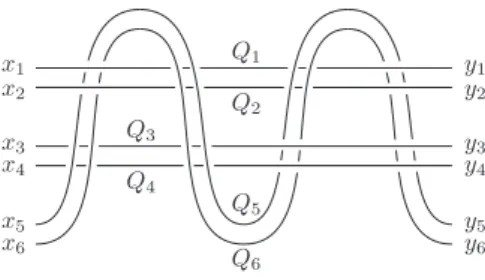
(4) 76 Theorem 3.2 ([8, Theorem 4.2]). Let L be an m ‐component link with R\} . If L is 4‐move equivalent to a trivial link, then for any r\in R,. \Pi_{L}^{(2)}\cong\{x_{1},. x_{m}|. E^{2}(r)=1+, \sum_{(i_{1^{\dot{i} 2},i_{3}i_{4})},c(i_{1}, i_{2}, i_{3}, i_{4}) X_{i_{1} X_{i_{2} X_{i_{3} X_{i_{4} +d(5) for some c(i_{1}, i_{2}, i_{3}, i_{4})\in \mathbb{Z}_{2} such that c(i_{1}, i_{2}, i_{3}, i_{4})=c(i_{\sigma(1)}, i_{\sigma(2)}, i_{\sigma(3)}, i_ {\sigma(4)}) for any. permutation. \sigma. of {1, 2, 3, 4}, where (i_{1}, i_{2}, i_{3}, i_{4}) runs over \{ 1,. m\}^{4}.. By applying Theorem 3.1, we have the following theorem.. Theorem 3.3 ([8, Theorem 4.3]). The closure of the 5‐braid (\sigma_{1}\sigma_{2}\sigma_{3}\sigma_{4})^{10} and the 2‐ parallel of the Borromean rings are not. p ‐move. equivalent to trivial links for any odd. prlme p.. Remark 3.4. Dabkowski and Przytycki proved Theorem 3.3 for p=3 [ 2 , Theorem 6]. \lrcorner. In their proof, the condition that p=3 is essential, and hence it seems hard to show Theorem 3.3 by using their arguments. Proof of Theorem 3.3. Let. \gamma. be the 5‐braid (\sigma_{1}\sigma_{2}\sigma_{3}\sigma_{4})^{10} described by a diagram in Fig‐. ure 3.1. We put labels x_{i}(i=1,2,3,4,5) on initial arcs of the diagram. Progress from left to right, then the arcs are labeled by using relations of the associated core group.. Thus we obtain labels Q_{i} of terminal arcs of. \gamma. as follows (see [2, Lemma 5]):. Q_{i}=x_{1}x_{2}^{-1}x_{3}x_{4}^{-1}x_{5}x_{1}^{-1}x_{2}x_{3}^{-1}x_{4}x_{5}^{- 1}x_{i}x_{5}^{-1}x_{4}x_{3}^{-1}x_{2}x_{1}^{-1}x_{5}x_{4}^{-1}x_{3}x_{2}^{-1} x_{1}.. Let \overline{\gam a} be the closure of \gamma . Since we have relations Q_{i}x_{i}^{-1} for \Pi_{\frac{(2}{\gam) a} , \Pi_{\frac{(2}{\gam a} ) has the presentation \{x_{1}, x_{2}, x_{3}, x_{4}, x_{5}|r_{1}, r_{2}, r_{3}, r_{4}, r_{5}\} , where r_{i}=Q_{i}x_{i}^{-1} We note that. \hat{B}\frac{2}{\gamma}(p)\cong \mathb {Z}_{p}^{5}. for any. odd prime p . On the other hand, by computing E^{p}(r_{1}) , then the coefficient of X_{2}X_{3}X_{4} is 0 and that of X_{4}X_{2}X_{3} is 2 in E^{p}(r_{1}) . Theorem 3.1 implies that \overline{\gam a} is not p‐move equivalent to a trivial link.. Let \gamma' be the 6‐braid described by a diagram in Figure 3.2. We put labels. arcs,. y_{i}. x_{i}. on initial. on terminal arcs, and Q_{i} on arcs of the diagram as illustrated in Figure 3.2. (i=1,2,3,4,5,6) . By using relations of the associated core group, the labels Q_{i} are 1 2 3 4 5. Figure 3.1: 5‐braid \gamma=(\sigma_{1}\sigma_{2}\sigma_{3}\sigma_{4})^{10}.
(5) 77. 1 2. 3 4. 5. 6. Figure 3.2: 6‐braid \gamma' whose closure is the 2‐parallel of the Borromean rings L_{2BR}. expressed as follows:. Q_{i}=\begnary}{l x_12}^{-x_56}^{-1x_2 }^{-1x_i }^{-1x_26}^{-1x_5 2}^{-1x_ =y{1}_2^-y{3}_4^-1y{5}_6^-1y{4}_3^-1y{2}_^-1 y{i}_^-1y{2}_3^-1y{4}_6^-1y{5}_4^-1y{3}_2^-1y{} (i=,2)x_{6}5^-1x_{i}5^-1X_{6} =Q _{5}^-1yiQ_{5}^-1 6=x_{}2^-1x_{6}5^-1x_{2} ^- 1y_{i}x^-1_{2}x5^-1_{6}x2^-1_{}(i=3,4) x_{1}2^-x_{i}2^-1x_{}=y43^{-1}y_ 2^{-1}y_34^{- 1}y_i4^{-1}y_32^{-1}y_ 3^{-1}y_4(i=5,6). \end{ary}. Since the closure of \gamma' is the 2‐parallel of the Borromean rings L_{2BR}, presentation \{x_{1},. x_{2}, x_{3}, x_{4}, x_{5},. x_{6}|r_{1},. r_{2}, r_{3}, r_{4}, r_{5},. r_{6}\rangle , where. \Pi_{L_{2BR}}^{(2)}. has the. r_{i}=\begin{ary}l (x_{1} 2^-1}x_{5 6}^-1x_{2} 1^-}x_{i 1^-}x_{2 6}^-1 x_{5} 2^-1}x_{)^-1} \crosx_{1} 2^-1}x_{3 4}^-1x_{5} 6^-1}x_{4 3}^-1x_{2} 1^- }x_{i 1^-}x_{2 3}^-1x_{4} 6^-1}x_{5 4}^-1x_{3} 2^-1} x_{(i=1,2) (x_{6} 5^-1}x_{i 5^-1}x_{6)^-1}x_{ 2}^-1x_{6} 5^-1}x_{2 1}^{-x_i {1}^-x_{2} 5^-1}x_{6 2}^-1x_{}(i=3,4) (x_{1} 2^-1}x_{i 2^-1}x_{)^-1}x_{4 3}^-1x_{} 2^-1}x_{3 4}^{-1x_i {4}^-1x_{3} 2^-1}x_{ 3}^-1x_{4}(i=5,6). \end{ary}. We note that. \hat{B}_{L_{2BR}}^{2}(p)\cong \mathbb{Z}_{p}^{6}. for any odd prime. p.. On the other hand, by computing. E^{p}(r_{6}) , then the coefficient of X_{2}X_{4}X_{6} is 1 and that of X_{4}X_{6}X_{2} is 0 in E^{p}(r_{6}) . Theorem 3.1 implies that L_{2BR} is not p‐move equivalent to a trivial link.. Remark 3.5. For a welded link. L,. \square. we can similarly define the associated core group. and the unreduced nth Burnside group. \hat{B}_{L}(n). of. L.. \Pi_{L}^{(2)}. We note that Theorems 3.1 and 3.2. hold for welded links. Hence, we can show that there exists a welded link which is not p‐. move equivalent to a trivial link for any odd prime. p. as follows. Let. described by a virtual diagram in Figure 3.3. We put labels. x_{i}. b. be the welded 4‐braid. and Q_{i}(i=1,2,3,4) on. initial and terminal arcs of the diagram, respectively. By using relations of the associated core group, the labels Q_{i} are expressed as follows:. Q_{i}=\{\begin{ar ay}{l } x_{4}x_{1}^{-1}x_{2}x_{4}^{-1}x_{1}x_{2}^{-1}x_{3}x_{2}^{-1}x_{1}x_{4}^{-1}x_{2} x_{1}^{-1}x_{4} if =3, x_{i} otherwise. \end{ar ay}.
(6) 78. 1 2. 3 4. Figure 3.3: Welded 4‐braid. Let \overline{b} be the closure of b , then. for any odd prime. p.. \Pi_{\frac{(}{b} ^{2)}\cong\{x_{1}, x_{2}, x_{3},. b. x_{4}|Q_{3}x_{3}^{-1}\rangle . We note that \hat{B}\frac{2}{b}(p)\cong \mathb {Z}_{p}^{4} E^{p}(Q_{3}x_{3}^{-1}) , we have that the 0 is in E^{p}(Q_{3}x_{3}^{-1}) . Therefore, we have. On the other hand, by computing. coefficient of X_{4}X_{2}X_{3} is 1 and that of X_{4}X_{3}X_{2} that \overline{b} is not p‐move equivalent to a trivial link by Theorem 3.1.. Remark 3.6. All of the three links \overline{\gam a}, L_{2BR} and \overline{b} above are not 4‐move equivalent to. trivial links by Theorem 3.2 because terms of degree 3 survive in E^{2}(r) for some relation r. of. \Pi_{L}^{(2)}(L=\overline{\gamma}, L_{2BR}, \overline{b}) .. Acknowledgements. This work was supported by JSPS KAKENHI Grant Numbers JP17J08186, JP17K05264. References. [1] Q. Chen, The 3‐move conjecture for 5‐braids, Knots in Hellas 98 (Delphi), 36‐47, Ser. Knots Everything 24, World Sci. Publ., River Edge, NJ (2000). [2] M. K. Dabkowski> and J. H. Przytycki, Burnside obstructions to the Montesinos‐ Nakanishi 3‐move conjecture, Geom. Topol. 6 (2002), 355‐360. [3] M. K. Dabkowski and J. H. Przytycki, Unexpected connections between Burnside groups and knot theory, Proc. Natl. Acad. Sci. USA 101 (2004), 17357‐17360. [4] R. Fenn and C. Rourke, Racks and links in codimension two, J. Knot Theory Rami‐ fications 1 (1992), 343‐406. [5] D. Joyce, A classifying invariant of knots, the knot quandle, J. Pure Appl. Algebra 23 (1982), 37‐65. [6] A. J. Kelly, Groups from link diagrams, Ph.D. Thesis, U. Warwick (1990).. [7] R. Kirby, Problems in low‐dimensional topology; Geometric Topology, from” Proceed‐ ings of the Georgia International Topology Conference, 1993. Mathematics 2 (W Kazez, Editor), AMS/IP (1997), 35‐473.. Studies in Advanced.
(7) 79 [8] H. A. Miyazawa, K. Wada and A. Yasuhara, Burnside groups and n ‐moves for links, arXiv:1801.09863 (2018). [9] J. H. Przytycki, Elementary conjectures in classical knot theory, Quantum topology, 292‐320, Ser. Knots Everything 3, World Sci. Publ., River Edge, NJ (1993). [10] J. H. Przytycki, On Slavik Jablan’s work on 4‐moves. J. Knot Theory Ramifications 25 (2016), 1641014, 26 pp. [11] J. H. Przytycki and T. Tsukamoto, The fourth skein module and the Montesinos‐ Nakanishi conjecture for 3‐algebraic links, J. Knot Theory Ramifications 10 (2001), 959‐982.. [12] M. Vaughan‐Lee, The restricted Burnside problem, second edition, London Mathe‐ matical Society Monographs, New Series 8, The Clarendon Press, Oxford University. Press, New York (1993). [13] M. Wada, Group invariants of links, Topology 31 (1992), 399‐406. Institute for Mathematics and Computer Science Tsuda University Tokyo 187‐8577 JAPAN. E‐mail address: [email protected]. Faculty of Education and Integrated Arts and Sciences Waseda University Tokyo 169‐8050 JAPAN. E‐mail address:. k. [email protected]. Faculty of Commerce Waseda University. Tokyo 169‐8050 JAPAN. E‐‐mail address: [email protected].
(8)
図


関連したドキュメント
Can every fibred link L be obtained as a the preimage of a braid axis O of an s-1 ‐component unlink L_{branch} under a simple s ‐sheeted branched covering \pi:S^{3}arrow S^{3}
One can construct a homology theory for ribbon graphs that, if applied to the all‐A ribbon graph of a link diagram, yields the (reduced) Khovanov homology of the corresponding
By many numerical checks and proofs of several non‐trivial examples of our Volume Conjecture, it is clear that Reshetikhin‐Turaev/Turaev‐Viro invariants evaluated at root of
On handlebody-links and Milnor's link-homotopy invariants (Intelligence of Low-dimensional Topology)
In [13], we construct HL‐homotopy invariants for handlebody‐links by us‐ ing Milnors \overline{ $\mu$} ‐invariants for links.. We then give a necessary and
Park, Prime knots with arc index up to 11 and an upper bound of arc index for nonalternating knots, J. Kanenobu, Infinitely many knots with the same
Iwakiri, Triple point cancelling numbers of surface links and quandle. cocycle invari
one component of a 2-component hyperbolic link is excep- tional, i.e., it yields a non-hyperbolic 3-manifold with torus boundary, if and only if the obtained manifold
(1) These invariants, together with Milnor invariants of length $\leq 5$ , give classffica- tions of n-string links up to $C_{k}$ -equivalence for $k\leq 5$ , and give a complete
