Torus-covering links and
their
triple
linking
numbers
Inasa Nakamura
(RIMS,
Kyoto
University)
Abstract
This report is a survey of [14]. A torus-covering link is an oriented
surface link in the form ofa covering over the standard torus. Triple
linkingnumber is aninvariant defined for an oriented surfacelink with
atleast threecomponents, analogous tothelinking numberof classical
links. A torus-covering $T^{2}$-link is determined from two commutative
classical braids, which we call basis braids. We present the triple
link-ing numbers ofa torus-covering $T^{2}$-link by using the linking numbers
of the closures of its basis braids, in the case when the basis braids
are pure braids.
1
Introduction
A
surface
link isa
smooth embedding of a closed surface into the Euclidean4-space $\mathbb{R}^{4}$
.
A $T^{2}$-link isa
surface link whose each component is of genusone.
In this paper we consider a certain “torus-covering $T^{2}$-link”, which isan m-component $T^{2}$-link determined from two commutative pure m-braids $a$
and $b$. The triple linking number of an oriented surface link is defined in [1]
as an analogical notion of the linking number of a classical link. The aim of
this paper is to present the triple linking number of such a $T^{2}$-link, by using
the linking numbers of the closures of $a$ and $b$
.
Further, we study the triplepoint number. The triple linking numbers give
a
lower bound of the triplepoint number. In
some
cases, we can determine the triple point number,which is
a
multiple of four.This paper is organized
as
follows. InSection
2,we
give the definitionof
a
torus-covering link. In Section 3,we
review the linking numbers ofa
classical link and the triple linking numbers of an oriented surface link. In
Section 4,
we
give the main theorem (Theorem 3). In Section 5, we give2
Torus-covering
links
We consider torus-covering $T^{2}$-links, i.e. torus-covering links
whose each
component is of genus one. In this section
we
review the definition of atorus-covering $T^{2}$-link. See [13] for the original definition and properties of
torus-covering links.
Let $T$ be the standard torus in $\mathbb{R}^{4}$, i.e. the boundary of the standard
solid torus in $\mathbb{R}^{3}\cross\{0\}$
.
Let $N(T)$ be a tubular neighborhood of $T$ in $\mathbb{R}^{4}$.
Definition 1. A torus-covering $T^{2}$-link is a surface link $F$ in $N(T)\subset \mathbb{R}^{4}$
such that $p|_{F}$ : $Farrow T$ is an unbranched covering map of degree $m$, where
$p:N(T)arrow T$ is the projection.
Remark. It is known [10, 11] that any oriented surface link
can
be presentedin the form of a simple branched covering
over
the standard 2-sphere $S^{2}$ i.e.in the form of a surface link embedded in a tubular neighborhood of $S^{2}$ in
such
a
way that the projection of it to $S^{2}$ is a simple branched coveringover
$S^{2}$.
A torus-covering linkis
an
oriented surface link in the form of asimple branched covering
over
the standard torus $T$ (see [13]), introduced byconsidering the standard torus instead of the standard 2-sphere in this fact.
Let us fix a point $x_{0}$ of $T$, and take a meridian $\mu$ and a longitude
$\lambda$ of
$T$ with the base point
$x_{0}$
.
A meridian is an oriented simple closed curveon $T$ which bounds the 2-disk of the solid torus whose boundary is $T$. A
longitude is
an
oriented simple closedcurve on
$T$ which is null-homologousin the complement of the solid torus in the three space $\mathbb{R}^{3}\cross\{0\}$. For a
torus-covering $T^{2}$-link $F$, we obtain classical m-braids by cutting $F\cap p^{-1}(\mu)$
and $F\cap p^{-1}(\lambda)$ at the 2-disk $p^{-1}(x_{0})$. We call them basis braids.
Lemma 2 ([13]). (1) The basis bmids are commutative.
(2) For any commutative m-braids $a$ and $b$, there is a unique
torus-covering $T^{2}$-link with basis braids
$a$ and $b$
.
Thus a torus-covering $T^{2}$-link is determined from basis braids. We denote
by $S_{m}(a, b)$ the torus-covering $T^{2}$-link with basis m-braids
$a$ and $b$
.
3
Linking numbers and triple
linking
num-bers
The triple linking number of an oriented surface link is defined in [1] as an
analogical notion of the linking number of a classical link. In this section, we
review the linking numbers of a classical link and the triple linking numbers of a surface link.
a
positive crossinga
negative crossing Figure 1: A positive crossing and a negative crossing.3.1
Linking
numbers of
a
classical
link
We review the linking number of an oriented classical link $L$
as
follows. For$i$ and $j$ with $i\neq j$, the linking number of the ith and jth components of $L$
is the total number of positive crossings minus the total number of negative crossings of
a
diagram of $L$ such that the under-arc (resp. over-arc) is fromthe ith (resp. jth) component;
see
Fig. 1. We denote it by $Lk_{i,j}(L)$.
It isknown [16] that $Lk_{j,i}(L)=$ Lk$i,j(L)$
.
3.2
Triple
linking number of
a
surface
link
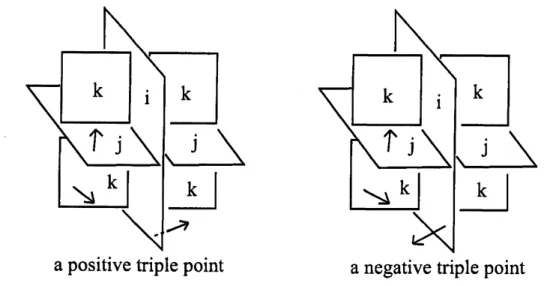
The triple linking number of
an
oriented surface link $F$ is defined as follows(see [1, Definition 9.1], see also [3]). For $i,$ $j$, and $k$ with $i\neq j$ and $j\neq k$, the
trtple linking number of the ith, jth, and kth components of $F$ is the total
number of positive triple points minus the total number of negative triple points of
a
surface diagram of$F$ such that the top, middle, and bottom sheetis from the ith, jth, and kth component of $F$ respectively [1];
see
Fig. 2. Wedenote it by $Tlk_{i,j,k}(F)$
.
We enumerate several properties of triple linking numbers.
Property 1 ([1]). $Tlk_{k,j,i}(F)=-Tlk_{i,j,k}(F)$
if
$i,$ $j,$ $k$are
mutually distinct,and otherwise $Tlk_{i,j,k}(F)=0$
.
Property 2 ([1]). $Tlk_{1,2,3}(F)+Tlk_{2,3,1}(F)+$
Tlk3
$1,2(F)=0$.
Property 3 ([1]). From the above two properties, it is
seen
thatfor
anythree-component
surface
link $F$, there existsa
pairof
integers $\alpha$ and $\beta$ suchthat
$\{\begin{array}{l}Tlk_{3,1,2}(F)=-Tlk_{2,1},3 (F)=\alpha,Tlk_{1,2,3}(F)=-Tlk 32,1 (F)=-(\alpha+\beta),Tlk_{2,3,1}(F)=-Tlk_{1,3,2}(F)=\beta.\end{array}$
a
positive triple pointa
negative triple pointFigure 2: A positive triple point and anegative triple point, where we denote
the orientations of sheets by normals.
Property 4 ([3]).
If
$K_{2}$ is homeomorphic to a 2-sphere, then$Tlk_{1,2,3}(F)=0$,and
if
bothof
$K_{1}$ and $K_{3}$are
homeomorphic to a 2-sphere, then $Tlk_{1,2,3}(F)=$$0$
.
In other words;
if
$\alpha\neq 0$ and $\beta=0$, then $g(K_{i})\geq 1(i=1,2)$, andif
$\alpha\neq 0,$ $\beta\neq 0$ and $\alpha+\beta\neq 0$, then $g(K_{i})\geq 1(i=1,2,3)$, where $g(K_{i})$
denotes the genus
of
$K_{i}$.
There isa
surface
link which realizes this (see [3],see
also [4]$)$.
Property 5 ([4]). Triple linking number is a link bordism invariant.
4
Main Result
Here we consider
a
torus-covering $T^{2}$-link for the case when the basis braidsare pure m-braids for $m\geq 3$
.
Then the triple linking numbers ofthe $T^{2}$-linkis presented by the linking numbers of the closures of the basis braids. For
an m-braid $c$, let us denote by $\hat{c}$ the closure of
$c$
.
Theorem 3 ([14]). Let $a$ and $b$ be commutative pure m-bmids
for
$m\geq 3$.
Then the triple linking number $Tlk_{i,j,k}(S_{m}(a, b))(i\neq j$ and $j\neq k)$ is given
$by$
$Tlk_{i,j,k}(S_{m}(a, b))=-Lk_{i,j}(\hat{a})Lk_{j,k}(\hat{b})+Lk_{i,j}(\hat{b})Lk_{j,k}(\hat{a})$ ,
where $Lk_{i,j}(\hat{a})$ (resp. $Lk_{i,j}(\hat{b})$) is the linking number
of
the $ith$ and$jth$com-ponents
of
$\hat{a}$ (resp. $\hat{b}$for
$c=a$or
b$)$ by the component containing the $lth$ stringof
the basis braids(resp. c)
for
$l=1,2,$$\ldots,$$m$.
5
Application
The triple point number of
a
surface link $F$, denoted by $t(F)$, is themini-mal number oftriple points among all possible generic projections of $F$
.
Bydefinition, we
can see
that $t(F) \geq\sum_{i\neq j,j\neq k}|Tlk_{i,j,k}(F)|$; thus the triplelink-ing numbers of $F$ give a lower bound of the triple point number of $F$
.
Inparticular, we have the following theorem.
Theorem 4 ([14]). Let $m\geq 3$
.
Let $b$ be a pure m-bmid, and let $\triangle$ be afull
twistof
a
bundleof
$m$ pamllel strings. Put $\mu=\sum_{i<j}|Lk_{i,j}(\hat{b})|$, and let$\nu=\sum_{i<j<k}(\nu_{i,j,k}+\nu_{j,k,i}+\nu_{k,i,j})$, where $l \text{ノ_{}i,j,k}=\min_{i,j,k}\{|Lk_{i,j}(\hat{b})|, |Lk_{j,k}(\hat{b})|\}$
if
$Lk_{i,j}(\hat{b})Lk_{j,k}(\hat{b})>0$ and otherwisezero.
Then$t(S_{m}(b, \Delta^{n}))\geq 4n(\mu(m-2)-v)$
.
Insomecases, we
can
determine thetriple point number. Let$\sigma_{1},$ $\sigma_{2},$$\ldots,$$\sigma_{m-1}$
be the standard generators of the m-braid group.
Theorem 5 ([14]). Let $m\geq 3$. Let $b$ be an m-bmid presented by a bmid
word which consists
of
$\sigma_{i}^{2(-1)^{i}}(i=1,2, \ldots, m-1)$; note that $b$ isa
purebmid. Then
$t(S_{m}(b, \triangle^{n}))=4n(m-2)(\sum_{i<j}|Lk_{i,j}(\hat{b})|)$
.
Further the triple point number is realized by a
surface
diagmm in theform
of
a
coveringover
the torus.It is known [4] (see also [5]) that any oriented surface link is bordant to
the split union of oriented ”necklaces”, and [5] any surface link is
unorient-edly bordant to the split union of necklaces and connected sums of standard
projective planes; see also [17]. A necklace has the triple point number $4n$
(see [4]). For other examples of surface links (not necessarily orientable)
which realize large triple point numbers,
see
[6, 12, 15, 18]. In the papers[6, 12, 15] (resp. [18]), they
use
quandle cocycle invariants (resp. normalEu-ler numbers) to give lower bounds of triple point numbers. Quandle cocycle
invariants [1, 2, 3] can be regarded
as
an extended notion of triple linkingnumbers ([1, 4]), useful to give lower bounds of triple point numbers;
see
Acknowledgements
The author would like to express her sincere gratitude to the organizers of ILDT for giving her an opportunity to talk at ILDT. The author is supported by GCOE, Kyoto Unlversity.
References
[1] J. S. Carter, D. Jelsovsky, S. Kamada, L. Langford and M. Saito,
Quan-dle cohomology and state-sum invariants
of
knottedcurves
and surfaces,$T\}ans$.
Amer.
Math. Soc. 355 (2003),3947-3989.
[2] J. S. Carter, S. Kamada, and M. Saito, Geometric interpretations
of
quan-dle homology and cocycle knot invariant, J. Knot Theory Ramificartions
10 (2001), 345-358.
[3] J. S. Carter, S. Kamada, M. Saito,
Surfaces
in 4-space, Encyclopaediaof Mathematical Sciences 142, Low-Dimensional Topology III
(Springer-Verlag, Berlin, 2004).
[4] J. S. Carter, S. Kamada, M. Saito and S. Satoh, A theorem
of
Sandersonon link bordisms in dimension 4, Algebraic and Geometric Topology 1
(2001),
299-310.
[5] J. S. Carter, S. Kamada, M. Saito and S. Satoh, Bordism
of
unorientedsurfaces
in 4-space, Michigan Math. 50 (2002), 575-591.[6] J. S. Carter, K. Oshiro and M. Saito, Symmetric extensions
of
dihedralquandles and triple points
of
non-orientable surfaces, Topology AppI. 157(2010), 857-869.
[7] J. S. Carter and M. Saito, Knotted
surfaces
and their diagmms,Mathe-matical Surveys and Monographs 55 (Amer. Math. Soc., 1998).
[8] E. Hatakenaka, An estimate
of
the triple point numbersof surface-knots
by quandle cocycle invariants, Topology Appl. 139 (2004),
129-144.
[9] M. Iwakiri, Triple point cancelling numbers
of surface
links and quandlecocycle invari ants, Topology Appl. 153 (2006) 2815-2822.
[10] S. Kamada, A characterization
of
groupsof
closed orientablesurfaces
in[11] S. Kamada, Bmid and Knot Theory in Dimension Four, Math. Surveys
and Monographs
95
(Amer. Math. Soc., 2002).[12] S. Kamada and K. Oshiro, Homology groups
of
symmetric quandles and cocycle invari antsof
links andsurface
links, Thrans. Amer. Math. Soc.362 (2010), 5501-5527.
[13] I. Nakamura,
Surface
links which are coverings over the standard torus,Algebraic and Geometric Topology 11 (2011), 1497-1540.
[14] I. Nakamura, Triple linking numbers and triple point numbers
of
certain$T^{2}$-links, arXiv: math.GT/1102.3736.
[15] K. Oshiro, Triple point numbers
of surface-links
and symmetric quandlecocycle invariants, Algebraic and Geometric Topology 10 (2010),
853-865.
[16] D. Rolfsen, Knots and Links, (Publish
or
Perish Press, Berkley, 1976).[17] B. J. Sanderson, Bordism
of
links in codimension 2, J. London Math. Soc. 35 (1987), no. 2, 367-376.[18] S. Satoh, Minimal triple numbers
of
some non-orientable surface-links,Pacific J. Math. 197 (2001), 213-221.
[19]
S.
Satoh, $Tr\dot{\tau}ple$ point invariantsof
non-orientable surface-links,Topol-ogy Appl. 121 (2002),
207-218.
[20] S. Satoh and A. Shima, The 2-twist-spun
trefoil
has the triple pointnumberfour, Trans. Amer. Math. Soc. 356 (2004), 1007-1024.
[21] S. Satoh and A. Shima, mple point numbers and quandle cocycle
in-variants