On
handlebody‐links
and \mathrm{M}\mathrm{i}\mathrm{l}\mathrm{n}\mathrm{o}\mathrm{r}\mathrm{s}link‐homotopy
invariants Yuka KotoriiGraduate School of Mathematical
Science,
TheUniversity
ofTokyo
1 Introduction
This is asurvey of thejointwork
[13]
withAtsuhiko Mizusawa.A handlebody‐link
[11, 27]
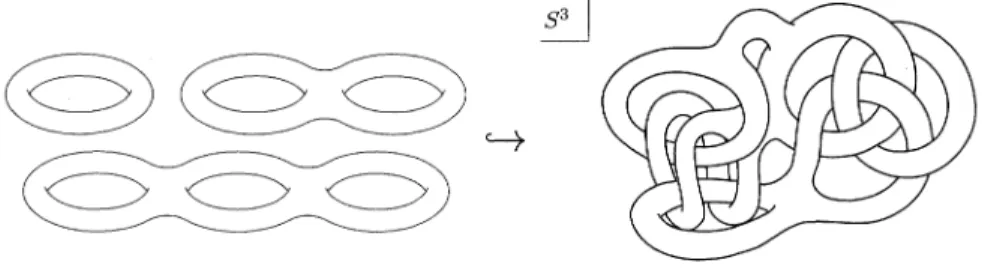
is a disjoint union of embeddings of handlebodies in the3‐sphere S^{3}
(Figure
1). Twohandlebody‐links are equivalent if there is an ambient iso‐FIGURE1. Ahandlebody‐link.
topy which transforms one tothe other. An HL‐homotopyis an equivalencerelation on
handlebody‐links, which is analogous to link‐homotopy oflinks. Here, link‐homotopyis
generated by ambientisotopies andself‐crossing changes. In
[22]
,Mizusawa and Nikkunishowed that the HL‐homotopy classes of 2‐component handlebody‐links were classified
completely by the linking numbers for handlebody‐links, which was defined by Mizu‐
sawa in
[21].
In[13],
we construct HL‐homotopyinvariants for handlebody‐links by us‐ ing Milnors \overline{ $\mu$}‐invariants for links. We then give a necessary and sufficient conditionofthat a handlebody‐link is HL‐homotopic to a separable one by the extended Milnors
\overline{ $\mu$}‐invariants. Here, a handlebody‐link is separable if there exists a disjoint union of 3‐ balls such that each component ofthe handlebody‐link is contained ina distinct 3‐ball.
Moreover, we give a bijection between the set of HL‐homotopy classes of n‐component
handlebody‐linkswithsomeassumptionandaquotientofatensorproduct of\mathbb{Z}‐modules
2 Preliminaries
J. Milnor defined a family of invariants for an ordered oriented link in S^{3} as a gen‐
eralization of the linking numbers, in
[19, 20].
These invariants are called Milnors \overline{$\mu$}-invariants. For anordered orientedn‐componentlink L, Milnors\overline{ $\mu$}‐invariant isspecified
by a sequence Iofindices in
\{
1, 2,...,n\}
and denotedby\overline{ $\mu$}_{L}(I). If the sequence is withdistinct indices, then this invariant is also link‐homotopy invariant and called Milnors
link‐homotopy invariant.
We introduce thedefinition ofMilnorslink‐homotopyinvariants, andtogiveinvariants
forhandlebody‐links, weshowthat these areadditive underabundsum forcomponents.
Let L=L_{1}\cup\cdots\cup L_{n}beanordered orientedn‐componentlink inS^{3}. Consider the link
group
$\pi$=$\pi$_{1}(S^{3}\backslash L_{1}\cup\cdots\cup L_{n-1})
ofL_{1}\cup\cdots\cup L_{n-1} anddenote thei‐thmeridianbym_{i}for
i(1\leq i\leq n-1)
.Given afinitely generatedgroup G, the reduced group\overline{G}is definedtothe quotientof G
byits normalsubgroup generated by
[g, hgh^{-1}]
for any g,h\in G, where[a, b]
means thecommutatorofa and b. Then\overline{ $\pi$} is generated bythe meridiansm_{1}, m_{2},...,m_{n-1}.
Let
\mathbb{Z}[[X_{1}, . . . , X_{n-1}]]
be the non‐commutative formal power series ring generated by X_{1},...,X_{n-1}. Denoteby\hat{Z}itsquotient ringbythetwo‐side ideal generated byallmono‐mials inwhichatleastoneofthegeneratorsappear atleast twice. TheMagnusexpansion $\varphi$ is a homomorphism from the free group
F(m_{1}, \ldots, m_{n-1})
generated by m_{1}, ...,m_{n-1}into
\mathbb{Z}[[X_{1}, . . . , X_{n-1}]]
, definedby sendingm_{i} to 1+X_{i}andm_{i}^{-1}
to1-X_{i}+X_{i}^{2}-\cdots
. Itinduces ahomomorphism from
\overline{F(m_{1},\ldots,m_{n-1})}
into \hat{Z}. Letw_{n}\in F(m_{1}, . . . , m_{n-1})
be awordrepresenting L_{n}in\overline{ $\pi$}. We thendefine
$\mu$_{L}(i_{1}i_{2}\ldots i_{r}n)
fordistinct indicesi_{1}, i_{2},. ..,i_{r},nasthecoefficient ofthe Magnus expansionofw_{n} in\hat{Z}:
$\varphi$(w_{n})=1+\displaystyle \sum$\mu$_{L}(i_{1}i_{2}\ldots i_{r}n)X_{i_{1}}X_{i_{2}}\ldots X_{i_{r}},
where the summation isover all sequences i_{1}i_{2}\ldots i_{r} with distinct indices between 1 and
n-1. Similarly, we define
$\mu$_{L}(i_{1}i_{2}\ldots i_{s})
for any distinct indices between 1 and n. Wedefine
\overline{ $\mu$}_{L}(i_{1}i_{2}\ldots i_{r}n)
as the residue class of$\mu$_{L}(i_{1}i_{2}\ldots i_{r}n)
modulo the indeterminacy\triangle_{L}(i_{1}i_{2}\ldots i_{r}n)
whichis the greatest commondivisor of$\mu$_{L}(j_{1}j_{2}\ldots j_{s})' \mathrm{s}
, wherej_{1}j_{2}\ldots j_{s}ranges over all sequences obtainedby deleting at least one of theindices i_{1}, i_{2},...,i_{r},n
and permuting the remaining ones cyclicly. Moreover we define
\triangle_{L}(i_{1}n)=
O. Similartothis, for anyn‐component link L, we candefine
\overline{ $\mu$}_{L}(I)
for anysequence I of distinctindices in
\{
1,2,...,n\}
Theorem 2.1
([19,
20 IfL and L' are link‐homotopic, then\overline{ $\mu$}_{L}(I)=\overline{ $\mu$}_{L},(I)
for any sequence I with distinct indices.Lemma 2.2
([20]).
Let L be an ordered oriented link. Then thefollowing relations hold.(1) \overline{ $\mu$}_{L}(i_{1}i_{2}\ldots i_{m})=\overline{ $\mu$}_{L}(i2. . . i_{m}i_{1})
(2)
Ifthe orientation ofthek‐th componentofL isreversed, then\overline{ $\mu$}_{L}(i_{1}i_{2}\ldots i_{m})
ismulti‐plied by+1 or-1 according asthe sequencei_{1}i_{2}\ldots i_{m} containsk aneven orodd number
oftimes.
Thefollowing lemma is used for Proposition 3.4. This lemma is showed by usingthe
definition of Milnors link‐homotopyinvariants.
Lemma 2.3. LetL=L_{1}\cup L_{2}\cup\cdots\cup L_{n-1} be an
(n-1)
‐componentlink inS^{3}. Let K andK' be disjoint knots in
S^{3}\backslash L
. Let I be a sequence with distinct indices in\{
1,2,...,n\}.
IfI contains the indexn,
$\mu$ L\cup(K_{b}\# K')(I)\equiv$\mu$_{L\cup K}(I)+$\mu$_{L\cup K'}(I)
mod\mathrm{g}\mathrm{c}\mathrm{d}(\triangle_{L\cup K}(I), \triangle_{L\cup K'}(I))
,where K\#_{b}K' is a band sum ofK and K' with respect to any band, and
L\cup(K\#_{b}K')
,L\cup K andL\cup K' are n‐component links whose n‐th components are K\#_{b}K', K andK', respectively.
Remark 2.4. By apropertyof the\overline{ $\mu$}‐invariant,we canobtain thesameresult for aband
sum ofthei‐thcomponentinstead of the n‐thcomponent.
Remark 2.5. In
[14],
V. S. Krushkal showed Milnors \overline{ $\mu$}‐invariants are additive underconnected sumfor links whichareseparated bya 2‐sphere.
3
\mathrm{M}\mathrm{i}\mathrm{l}\mathrm{n}\mathrm{o}\mathrm{r}\mathrm{s}\overline{ $\mu$}
‐invarinats forhandlebody‐links
Inthissection,wedefinetheHL‐homotopy,whichisanequivalencerelationonhandlebody‐
links and construct HL‐homotopy invariants for handlebody‐links by using Milnors \overline{
$\mu$}-invariants.
Definition 3.1
(HL‐homotopy).
Let H_{0} be n handlebodies andH_{i}(i=1,2)
two n‐component handlebody‐links obtainedby embedding H_{0} to S^{3} by f_{i}. Twohandlebody‐
linksH_{1} andH_{2} arecalled HL‐homotopicif there ishomotopyh_{t} fromf_{1} tof_{2}where the
components of
h_{t}(H_{0})
aremutually disjoint at any0\leq t\leq 1.Remark 3.2. In
[22],
the notation of neighborhood homotopy of spatial graphswas in‐ troduced. A spatial graph is an embedding of graph in S^{3}. We can represent the HL‐homotopyofhandlebody‐links bytheneighborhood homotopyofspatialgraphs.
Let H=L_{1}\cup\cdots\cup L_{n} be an n‐component handlebody‐link with genus g_{i} for each i. Let
\{e_{1}^{i}, . . . , e_{g}^{i_{i}}\}
be a basis ofH_{1}(L_{i};\mathbb{Z})
and\mathcal{B}=\{e_{1}^{1}, . . . , e_{g_{1}}^{1}, . . . , e_{1}^{n}, . . . , e_{g_{n}}^{n}\}
. We canregardanelementofBas anembeddedclosed oriented circle inS^{3}. Sothe disjointunion
e_{k_{1}}^{1}\cup e_{k_{2}}^{2}\cup\cdots\cup e_{k_{n}}^{n}
canberegarded as anordered orientedlink for eachk_{i}(1\leq k_{i}\leq g_{i})
.Let Ibea sequence oflength
m(m\leq n)
with distinctindices in\{
1, 2,. ..,n\}
. For eachI,wedefineanelement
M_{H,\mathcal{B}}(I)
oftensorproductspace(\mathbb{Z}/\triangle_{I}\mathbb{Z})^{g_{1}}\otimes\cdots\otimes(\mathbb{Z}/\triangle_{I}\mathbb{Z})^{g_{n}}
as\mathbb{Z}/\triangle_{I}\mathbb{Z}
‐module defined byM_{H,B}(I):=\displaystyle \sum_{k_{1},.,k_{n}=1}^{g_{1}.'.\cdot,g_{n}}\overline{ $\mu$}_{e_{k_{1}}^{1}\cup\cdots\cup e_{k_{n}}^{n}}(I)e_{k_{1}}^{1}\otimes\cdots\otimes e_{k_{n}}^{n},
where
\overline{ $\mu$}_{e_{k_{1}}^{1}\cup\cdots\cup e_{k_{n}}^{n}}(I)
is in\mathbb{Z}/\triangle_{I}\mathbb{Z},
\triangle_{I} isthe greatestcommon divisorofall\triangle_{e_{k_{1}}^{1}\cup\cdots\cup e_{k_{n}}^{n}}(I)
for allk_{1},...,k_{n}, where\triangle_{e_{k_{1}}^{1}\cup\cdots\cup e_{k_{n}}^{n}}(I)
is indeterminacyof the original Milnors invariant for the linke_{k_{1}}^{1}\cup e_{k_{2}}^{2}\cup\cdots\cup e_{k_{n}}^{n}
ande_{k_{i}}^{i}
is the canonical basis(0, \ldots, 0,\check{1}, 0, \ldots, 0)k_{i}
of(\mathbb{Z}/\triangle_{I}\mathbb{Z})^{9i}
as\mathbb{Z}/\triangle_{I}\mathbb{Z}
‐module.Remark 3.3. If the first homologygroup ofeach component ofH is \mathbb{Z}, the
M_{H,B}(I)
isidentifiedwith theoriginal Milnorslink‐homotopyinvariant foralink, essentially.
We consider a natural action of
GL(g_{1}, \mathbb{Z})\times\cdots\times GL(g_{n)}\mathbb{Z})
on(\mathbb{Z}/\triangle_{I}\mathbb{Z})^{g_{1}}\otimes\cdots\otimes
(\mathbb{Z}/\triangle_{I}\mathbb{Z})^{g_{n}}
and denotebyM_{H}(I)
theresidueclass ofM_{H,I3}(I)
bythe action for(\mathbb{Z}/\triangle_{I}\mathbb{Z})^{g_{1}}\otimes
...
\otimes(\mathbb{Z}/\triangle_{I}\mathbb{Z})^{g_{n}}.
Proposition 3.4. Let H bean n‐componenthandlebody‐link. Then
M_{H}(I)
isindependentofa basis\mathcal{B} of
H_{1}(H, \mathbb{Z})
and anHL‐homotopyinvariant.Proof. Theproofisbyinductiononthe lengthmofsequence I. Wecanshow itby using
properties of\overline{ $\mu$}‐invariantsforlinks
(Lemma
2.2 and2.3).
See[13]
fordetails. \squareExample 3.5. Let H be ahandlebody‐linkwhicharetheregularneighborhoodofgraph
illustrated in Figure 2. Let I=123. Then,
\triangle_{e_{1}^{1}\cup e_{1}^{2}\cup e_{1}^{3}}(I)=\triangle_{e_{1}^{1}\cup e_{1}^{2}\cup e_{2}^{3}}(I)=2
and\triangle_{e_{k_{1}}^{1}\cup e_{k_{2}}^{2}\cup e_{k_{3}}^{3}}(I)=0
inothercases. So \triangle_{I}=2andM_{H}(I)=1e_{1}^{1}\otimes e_{1}^{2}\otimes e_{1}^{3}+1e_{2}^{1}\otimes e_{2}^{2}\otimes e_{2}^{3}\in(\mathbb{Z}_{2})^{2}\otimes(\mathbb{Z}_{2})^{2}\otimes(\mathbb{Z}_{2})^{2}
We canshow the following corollary by using clasper theoryintroducedby Habiro
[8].
Corollary3.6. Ann‐componenthandlebody‐linkH is HL‐homotopictoaseparable handlebody‐
linkifand onlyif
M_{H}(I)=0
for any I.Remark 3.7. T. Fleming defined a numerical invariant
$\lambda$_{ $\Phi$}(H)
of a pair of a spatialgraph $\Phi$ and its subgraph H undercomponent homotopyin
[3].
Now, we define $\Phi$ as ahandlebody‐linkinsteadofaspatial graphand Hasitscomponentinsteadofasubgraph.
Wethen can naturally extendthis invariant to a pairofa handlebody‐link and itscom‐
ponent underHL‐homotopy. Then,the valueof
$\lambda$_{ $\Phi$}(H)
isthelengthof firstnon‐vanishingFIGURE2. Handlebody‐linkH.
4 Main Theorem
Let
\mathbb{H}[g_{1}, g_{2}, \cdots, g_{n}]
betheset ofn‐componenthandlebody‐linkswith genus g_{i} foreach 1\leq i\leq nsuch that its any(n-1)
‐component subhandlebody‐linkis HL‐homotopicto aseparable handlebody‐link. By Corollary 3.6, this condition isequivalent tothat its any
M(I)
s oflengthless than nvanishes.Let S be apermutation group on
\{2, 3, . . . , n-1\}
. For any element a in S, wedefineI_{ $\sigma$} as asequence
1 $\sigma$(23\cdots n-1)n.
Theorem 4.1. For any element $\sigma$ in S, themap
$\varphi$:\mathbb{H}[g_{1}, \cdots , g_{n}]\rightarrow\oplus_{ $\sigma$\in S}(\mathbb{Z}^{g_{1}}\otimes\cdots\otimes \mathbb{Z}^{g_{n}})
H\mapsto(M_{H}(I_{ $\sigma$}))_{ $\sigma$\in S}
induces a bijection between the set ofHL‐homotopy classes of
\mathbb{H}[g_{1}, g_{2}, \cdots, g_{n}]
and theresidue class
of\oplus_{ $\sigma$\in S}(\mathbb{Z}^{g_{1}}\otimes\cdots\otimes \mathbb{Z}^{g_{n}})
by diagonalaction of general linear group.Wegive twoexamples.
Example 4.2. Let I=123. Let H_{1} and H_{2} be two handlebody‐links which are the
regular neighborhoodofgraphs depictedinFigure 3. Then, \triangle_{I}=0 and
M_{H_{1}}(I)=1e_{1}^{1}\otimes e_{1}^{2}\otimes e_{1}^{3}+1e_{1}^{1}\otimes e_{2}^{2}\otimes e_{1}^{3}+1e_{1}^{1}\otimes e_{3}^{2}\otimes e_{1}^{3}
+2e_{1}^{1}\otimes e_{1}^{2}\otimes e_{2}^{3}+2e_{1}^{1}\otimes e_{2}^{2}\otimes e_{2}^{3}+2e_{1}^{1}\otimes e_{3}^{2}\otimes e_{2}^{3}
\in \mathbb{Z}^{2}\otimes \mathbb{Z}^{3}\otimes \mathbb{Z}^{2}.
M_{H_{2}}(I)=1e_{1}^{1}\otimes e_{1}^{2}\otimes e_{1}^{3}+1e_{1}^{1}\otimes e_{2}^{2}\otimes e_{1}^{3}+1e_{2}^{1}\otimes e_{1}^{2}\otimes e_{1}^{3}+1e_{2}^{1}\otimes e_{2}^{2}\otimes e_{1}^{3}
1 e_{1}^{1}\otimes e_{1}^{2}\otimes e_{2}^{3}+1e_{1}^{1}\otimes e_{2}^{2}\otimes e_{2}^{3}+1e_{2}^{1}\otimes e_{1}^{2}\otimes e_{2}^{3}+1e_{2}^{1}\otimes e_{2}^{2}\otimes e_{2}^{3}
\in \mathbb{Z}^{2}\otimes \mathbb{Z}^{3}\otimes \mathbb{Z}^{2}.
Wehave that
M_{H_{1}}(I)
is transformedtoM_{H_{2}}(I)
bythediagonal action ofgeneral linear group. ThereforeH_{1} andH_{2} areHL‐homotopic.FIGURE3. Handlebody‐linksH_{1} andH_{2}.
Example 4.3. Let I=123. Let H3 and H_{4} be two handlebody‐links which are the
regular neighborhoodofgraphs depictedin Figure 4. Then, \triangle_{I}=0 and
M_{H_{3}}(I)=1e_{1}^{1}\otimes e_{1}^{2}\otimes e_{1}^{3}+1e_{1}^{1}\otimes e_{2}^{2}\otimes e_{1}^{3}+1e_{2}^{1}\otimes e_{1}^{2}\otimes e_{1}^{3}
+1e_{2}^{1}\otimes e_{2}^{2}\otimes e_{1}^{3}+1e_{1}^{1}\otimes e_{3}^{2}\otimes e_{2}^{3}+1e_{2}^{1}\otimes e_{3}^{2}\otimes e_{2}^{3}
\in \mathbb{Z}^{2}\otimes \mathbb{Z}^{3}\otimes \mathbb{Z}^{2}.
M_{H_{4}}(I)=2e_{1}^{1}\otimes e_{1}^{2}\otimes e_{1}^{3}+2e_{2}^{1}\otimes e_{1}^{2}\otimes e_{1}^{3}+1e_{1}^{1}\otimes e_{2}^{2}\otimes e_{2}^{3}+1e_{2}^{1}\otimes e_{2}^{2}\otimes e_{2}^{3}
\in \mathbb{Z}^{2}\otimes \mathbb{Z}^{3}\otimes \mathbb{Z}^{2}.
Wecan show that H_{1} isnot HL‐homotopicto H_{2} by usingsomeinvariantsforthe action
ofgenerallinear group
\mathrm{o}\mathrm{n}_{3}\mathrm{t}\mathrm{h}\mathrm{e}
tensorproduct space. See[13]\mathrm{f}\mathrm{o}\mathrm{r}3
details.H_{3}:
Acknowledgements
Theauthor would like tothank Professor Tomotada Ohtsukiforinvitingmethe work‐
shop
Intelligence of Low‐dimensional Topology 2016 She would also liketo thank
Professor Sadayoshi Kojimaand Professor MitsuhikoTakasawa foryour advice.
References
[1]
A. Cayley. On the theory oflinear transformations. Cambridge Math. J., 4: 193‐209,1854.
[2]
A. Cayley. On the theory ofdeterminants. Trans. Cambridge Philos. Soc., 8, no. 7:75‐88, 1849.
[3]
T. Fleming. Milnorinvariantsfor spatial graphs. Topology Appl. 155(2008),
no. 12,1297‐1305.
[4]
T. Fleming, A.Yasuhara, Milnorsinvariants andself C_{k} ‐equivalence, Proc. Amer.
Math. Soc. 137
(2009)
761‐770.[5]
M.N. Gusarov, Variations of knotted graphs. The geometric technique of n‐equivalence.
(Russian),
Algebra i Analiz 12(2000),
no. 4, 79−125; translation inSt. PetersburgMath. J. 12
(2001),
no. 4, 569‐604.[6]
N. Habegger and X.‐S. Lin,The classification oflinks up to link‐homotopy, J. Amer.Math. Soc. 3:2
(1990),
389‐419.[7]
K. Habiro, Clasp‐pass moves on knots, unpublished, 1993.[8]
K. Habiro, Claspers andfinite type invariants of links, Geom. Topol. 4(2000),
1‐83.[9]
F. L. Hitchcock. The expression ofa tensor or apolyadic as a sum of products. J. Math. Phys.,6(1):
164‐189, 1927.[10]
F. L.Hitchcock, Multipleinvariants andgeneralizedrankofap‐way matrixortensor.J. Math. Phys.,
7(1):
39‐79, 1927.[11]
A. Ishii, Moves and invariants for knotted handlebodies, Algebr. Geom. Topol. 8(2008),
1403‐1418.[12]
K. Johannson, Topology and combinatorics of 3‐manifolds, Lecture Notes in Mathe‐matics1599,
(1995)
Springer‐Verlag, Berlin.[13]
Y. Kotorii andA. Mizusawa, HL‐homotopy of handlebody‐links and Milnorsinvari‐ ants, arXiv:math
/1603.09067.
[14]
V.S.Krushkal, Additivityproperties ofMilnor s\overline{ $\mu$}‐invariants, J. KnotTheoryRam‐ifications7
(1998),
no. 5, 625‐637.[15]
K.MakinoandS. Suzuki, Notesonneighborhoodcongruence of spatial graphs,Gaku‐jyutu Kenkyu, SchoolofEducation,WasedaUniv., Ser. Math., 43
(1995),
15‐20.[16]
S. V. Matveev, Generalizedsurgeries ofthree‐dimensionalmanifolds andrepresenta‐tions of homology spheres
(Russian),
Mat. Zametki 42(1987),
268‐278, 345.[17]
J‐B. Mailhan, invariants de type fini des cylindres dhomotogie et des string links,Thèse de Doctorat
(2003),
Université de Nantes.[1S]
J‐B. Meilhan, Y.Yasuhara, On C_{n}‐movesforlinks. Pacific J. Math. 238(2008),
no.1, 119‐143.
[19]
J. Milnor, Link groups,Annals of Mathematics(2),
59(1954),
p177‐195.[20]
J. Milnor, Isotopy of links, Algebraic geometry andtopology,Asymposiuminhonorof S. Lefschetz, pp. 280‐306, PrincetonUniversity Press, Princeton, N. J., 1957.
[21]
A. Mizusawa, Linkingnumbersfor handlebody‐links, Proc.JapanAcad. Ser.AMath.Sci. 89
(2013),
60‐62.[22]
A. Mizusawa and R. Nikkuni A homotopy classification of two‐component spatialgraphs up to neighborhood equivalence, Topology Appl. 196
(2015),
partB, 710‐718.[23]
T. Motohashi andK. Taniyama, Deltaunknotting operation and vertexhomotopy ofgraphs inR^{3},KNOTS 96
(Tokyo),
185‐200, WorldSci. Publ., RiverEdge, NJ, 1997.[24]
H. Murakami and Y. Nakanishi, On acertainmovegenerating link‐homology, Math.Ann. 284
(1989),
75‐89.[25]
T. Soma, H. Sugaiand A. Yasuhara,Disk/band
surfaces of spatial graphs. Tokyo J.Math. 20
(1997),
1‐11.[26]
S. Suzuki, Local knots of 2‐spheres in 4‐manifolds, Proc. Japan Acad. 45(1969),
34‐38.
[27]
S. Suzuki, On lineargraphs in 3‐sphere, OsakaJ. Math. 7(1970),
375‐396.[28]
S. Suzuki, On surfaces in 3‐sphere: prime decompositions, Hokkaido Math. J. 4(1975),
179‐195.[29]
K. TaniyamaandA. Yasuhara, Clasp‐passmoves onknots, links and spatial graphs,[30]
A. Yasuhara, Self Delta‐equivalence for Links Whose Milnors Isotopy InvariantsVanish, Trans. Amer. Math. Soc. 361 (2009), 4721‐4749.
Graduate School of Mathematical Science
The University ofTokyo
Tokyo153‐8914
JAPAN
\mathrm{E}‐mail address: [email protected]‐tokyo.ac.jp