Oliver Dasbach
Department of Mathematics, Louisiana State University
1 Introduction
Turaev constructed to each knot diagram a closed, orientable surface on which the knot projects [Tur87]. In this short survey, we briefly recall the construction, and then discuss
how Turaev surfaces relate to knot invariants. Most results extend to links as well. 1.1 Turaev surfaces
Kauffman defined an A‐splicing and a B‐splicing at a crossing of a knot diagram that are
depicted in Figure 1.
\backslash ) (
Figure 1: A‐splicing (middle) and B‐splicing (right) of a crossing
For a diagram of a knot one can define a closed oriented surface: Let \Gamma\subset S^{2} be
the planar, 4‐valent graph of the knot diagram. Thicken the projection plane to a slab
S^{2}\cross[-1,1], so that \Gammalies in S^{2}\cross\{0\}. Outside a neighborhood of the vertices (crossings),
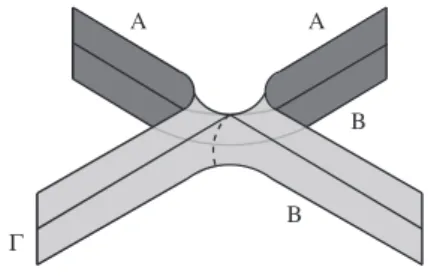
the surface will intersect this slab in \Gamma\cross[-1,1]. In the neighborhood of each vertex, we insert a saddle, positioned so that the boundary circles on S^{2}\cross\{1\} are the state circles of the all‐A resolution, and the boundary circles on S^{2}\cross\{-1\} are the state circles of the all‐B resolution. (See Figure 2.) The boundary circles are capped off with disks, obtaining a closed oriented surface \Sigma.
It is shown in [DFKLS08] that the surface \Sigma is unknotted. In other words, S^{3}\backslash \Sigma is
a disjoint union of two handlebodies. Armond, Druivenga and Kindred [ADK15] further studied the Heegaard splittings given by the Turaev surfaces, and showed that there is a one‐to‐one correspondence between Turaev surfaces of connected link diagrams on
S^{2}\subset S^{3} and Heegaard diagrams with certain conditions.
Define the Turaev genus g_{T}(K) of a knot Kto be the minimal genus of the Turaev genus
of all diagrams of the knot. The knot projects alternatingly on this surface [DFKLS08], and it follows that the Turaev genus is 0 if and only if the knot is alternating.
Figure 2: Near each crossing of the diagram, a saddle surface interpolates between state circles of the all‐A resolution and state circles of the all‐# resolution.
Turaev [Tur87] used the Turaev surfaces to show that the span of the Jones polynomial of a knot Kwith crossing number c(K) is bounded from above by
span V_{K}(t)\leq c(K)-g_{T}(K).
2
The Jones polynomial as an evaluation of the Bollobás‐Riordan‐
Tutte polynomial
Thistlethwaite [Thi87] gave an interpretation of the Kauffman bracket of an alternating knot projection as an evaluation of the Tutte polynomial of a checkerboard graph of the knot. To extend this approach naturally to non‐alternating knots the following generaliza‐ tion is useful: Instead of working with alternating knot projections on the plane one uses the alternating projections on a Turaev surfaces. Those projections admit a checkerboard coloring and thus the two checkerboard graphs are ribbon graphs, i.e. graphs with an em‐ bedding on a surface such that every face is a disk. Bollobás and Riordan [BROI, BR02] extended the two variable Tutte polynomial to a three variable polynomial for ribbon graphs. In [DFKLS08] it is shown that the Kauffman bracket is a suitable evaluation of this Bollobás‐Riordan‐Tutte polynomial.
More specifically, the surface minus the knot projection can be shaded in black and white. Here we suppose that the white colored faces correspond to the all‐A resolution. The vertices of the graph correspond to the white regions and two vertices are connected by an edge if and only if the two faces meet at a crossing of the knot projection. This graph \mathbb{D} is a ribbon graph, i.e. a graph embedded on a surface such that every face is
a disk. Note, that ribbon graphs can be represented by graphs together with a cyclic orientation of the edges at every vertex. The ribbon graph will be frequently referred to as the all‐A ribbon graph. Figure 3 shows the knot 8_{21}, its all‐A resolution, and the associated ribbon graph.
The dual graph on the surface is the all‐B ribbon graph. Bollobás and Riordan defined an extension of the Tutte polynomial to ribbon graphs. The Bollobás‐Riordan‐Tutte polynomial is given by
Figure 3: The knot 8_{21} with all‐A resolution and associated ribbon graph.
C( \mathbb{D};X, Y, Z)=(X-1)^{-k(\mathbb{D})}\sum_{\mathbb{H}\subset \mathbb{D}}(X-1)^{k(\mathbb{H})}Y^{n(\mathbb{H})}Z^{g(\mathbb{H})}
Here, \mathbb{H} ranges over all spanning subribbon graphs of \mathbb{D}, i.e. the set of vertices in \mathbb{H} and \mathbb{D} are the same. Let v(\mathbb{H}) denote the number of vertices and e(\mathbb{H}) denote the
number of edges in \mathbb{H}. The number of components of \mathbb{H} is denoted by k(\mathbb{H}), the nullity,
i.e. e(\mathbb{H})-v((\mathbb{H})+k((\mathbb{H}), by n((\mathbb{H}) and the genus is the genus of a minimal genus orientable surface on which (\mathbb{H} embeds. The following relation to the Kauffman bracket was discovered in [DFKLS08], and in particular one obtains a topological description of the Jones polynomial in terms of the Turaev surface:
Theorem 1 ([DFKLS08]) For a connected link projection P, and \mathbb{D} the all‐A ribbon
graph of P as constructed above, the Kauffman bracket \{P\rangle of P is given by:
For an extension by Chmutov to virtual links and for further discussions see [Chm09, CK14, EMM13].
Of particular interest are subgraphs of the ribbon graphs that are called quasi‐trees [DFKLS10], More explicitly, a spanning subgraph \mathbb{H} of a ribbon graph \mathbb{D} is called j‐
quasi‐tree if \mathbb{H} is of genus j and he complement of the embedding of \mathbb{H} on the surface
is connected. Quasi‐trees are a generalization of spanning trees for planar graphs. The 0‐quasi‐trees in a ribbon graph are the spanning trees in the ribbon graph. The general advantage of developing a theory of the Jones polynomial from the ribbon graph approach is that one has one additional parameter at hand, the genus. To show an application where the genus determines the sign: Let s(\mathbb{D}, j) be the number of j‐quasi‐trees in the all‐A ribbon graph of diagram D of the knot K. Then the determinant \det(K) of the
knot can be computed by [DFKLS10]:
\det(K)=|\sum_{j=0}(-1)^{j}s(\mathbb{D}, j)|
3 Turaev surfaces, and knot invariants
The approach to knot and link theory via projections on Turaev surfaces turns out to be quite fruitful for the study of knot invariants:
3.1 Knot Homology Theories
By its very nature every knot homology theory expresses the coefficients of the underlying knot polynomial of a knot K as Euler characteristic of a homology. Thus, it gives a
splitting of the coefficients into an alternating sum of \mathbb{Z}‐valued knot invariants. Khovanov
homology [KhoOO] can be naturally defined via the Turaev surface approach. One can construct a homology theory for ribbon graphs that, if applied to the all‐A ribbon graph of a link diagram, yields the (reduced) Khovanov homology of the corresponding link (see [DL14] for details on the construction). The ribbon graph chain complex retracts onto a complex with generators that correspond to spanning quasi‐trees of the ribbon graph. More specifically, the two gradings are determined by the polynomial grading and (up to a shift) the genus of the quasi‐trees. Thus the homological degree is interpreted in a purely topological way.
For (reduced) Khovanov homology it was shown by Manturov [Man05] and Cham‐ panerkar, Kofman and Stoltzfus [CKSII] that the number of terms in this splitting is generally bounded from above by the Turaev genus g_{T}(K) increased by 1. More specifi‐ cally, the non‐trivial groups in the bi‐graded Khovanov homology H_{Kh}^{ij}(K) of the knot K
lie on slope‐one lines with respect to the (i, j)‐grading, and their width w_{Kh} is bounded
from above by g_{T}(K)+1.
Surprisingly, Lowrance was able to show that this result also holds for the width w_{HF}(K) of the Ozsváth‐Szabó knot Floer homology [Low08]:
\sigma(K)=s_{A}(D)-n_{+}(D)-1 , (2) where s_{A}(D) is the number of components in the all‐A Kauffman resolution of D and
n_{+}(D) is the number of positive crossings in D.
Equation (1) can be generalized using the Turaev genus [DLII]:
| \tau(K)+\frac{\sigma(K)}{2}|\leq g_{T}(K)
,\frac{|s(K)+\sigma(K)|}{2}\leq g_{T}(K)
, and| \tau(K)-\frac{s(K)}{2}|\leq g_{T}(K)
.For a diagram D of a knot Kequation (2) generalizes to [DLII]:
s_{A}(D)-n_{+}(D)-1\leq\sigma(K)\leq(s_{A}(D)-n_{+}(D)-1)+2g_{T}(D) . (3) 4 Further aspects
4. 1 Adequate knots
Adequate knots are knots that admit a Turaev surface where neither of the two checker‐ board ribbon graphs contain a loop, i.e. an edge that connects a vertex with itself. Alternating knots are examples of adequate knots. Khovanov studied the Khovanov ho‐ mology of adequate knots [Kho03]. Using Khovanov’s results, Abe [Abe09b] was able to determine the Turaev genus of adequate knots: It is realized by an adequate diagram of the knot. Moreover, for an adequate knot K of crossing number c(K) and Turaev genus
g_{T}(K) the span of the Jones polynomial satisfies:
span V_{K}=c(K)-g_{T}(K).
4.2 Knots with small Turaev genus
Knots with Turaev genus 0, i.e. alternating knots, are well understood. Menasco [Men84]
showed that prime alternating knots are hyperbolic, unless they are (2, k)‐torus knots. Moreover, Tait’s flyping theorem [MT93] gives a classification of alternating diagrams of an alternating knot: Given an oriented, prime alternating knot Kwith reduced alternating
diagrams D_{1} and D_{2}, D_{1} can be transformed to D_{2} by a finite sequence of moves, called flypes.
Armond and Lowrance [AL15] classify link diagrams whose Turaev surface has genus one or two, and prove that similar classification theorems exist for all genera. A similar result was independently and with different methods proven by Seungwon Kim [Kim18] for Turaev genus one and two.
For knots with Turaev genus 1 Equation (3) strengthens to
Theorem 2 [DL16] Let K be a knot with diagram D whose Turaev surface has genus
one. The signature of K is determined by
\sigma(K)=s_{A}(D)-c_{+}(D)\pm 1 and \sigma(K)=\det(K)-1mod 4.
By using results from Adams [Ada94] and Abe [Abe09a] the result of Menasco [Men84] on the hyperbolicity of prime, alternating knots that are not torus knots, extends to: Theorem 3 [DL16] If Kis a prime knot of Turaev genus one, then Kis either hyperbolic or a torus pretzel knot.
References
[Abe09a] Tetsuya Abe, An estimation of the alternation number of a torus knot, J. Knot Theory Ramifications 18 (2009), no. 03, 363‐379.
[Abe09b] —, The Turaev genus of an adequate knot, Topology Appl. 156 (2009), no. 17, 2704‐2712.
[Ada94] Colin C. Adams, Toroidally alternating knots and links, Topology 33 (1994), no. 2, 353‐369.
[ADK15] Cody W. Armond, Nathan Druivenga, and Thomas Kindred, Heegaard diagrams corresponding to Turaev surfaces, J. Knot Theory Ramifications 24 (2015), no. 4, 14
pp.
[AL15] Cody W. Armond and Adam M. Lowrance, Turaev genus and alternating decom‐ positions, Alg. Geom. Top. 17 (2015), no. March, 793‐830.
[BROI] Béla Bollobás and Oliver M. Riordan, A polynomial invariant of graphs on ori‐ entable surfaces, Proceedings of the London Mathematical Society 83 (2001), no. 3,
513‐531.
[BR02] —, A polynomial of graphs on surfaces, Math. Ann. 323 (2002), no. 1, 81‐96. [Chm09] Sergei V Chmutov, Generalized duality for graphs on surfaces and the signed
Bollobás‐Riordan polynomial, J. Comb. Theory, Ser. B 99 (2009), no. 3, 617‐638. [CK14] Abhijit Champanerkar and Ilya Kofman, A Survey on the Turaev Genus of Knots,
[DFKLS10] —, Alternating Sum Formulae for the Determinant and Other Link In‐ variants, J. Knot Theory Ramifications 19 (2010), no. 06, 765‐782.
[DLII] Oliver T. Dasbach and Adam M. Lowrance, Turaev genus, knot signature, and the knot homology concordance invariants, Proc. Amer. Math. Soc. 139 (2011), no. 7,
2631‐2645.
[DL14] —, A Turaev surface approach to Khovanov homology, Quantum Top. 5 (2014), no. 4, 425—‐486.
[DL16] —, Invariants for Turaev genus one links, to appear in: Comm. Anal. Geom. (2016), no. arXiv:1604.03501,17pp.
[EMM13] Joanna A Ellis‐Monaghan and Iain Moffatt, Graphs on surfaces, Springer Briefs in Mathematics, Springer, New York, 2013.
[GL78] Cameron McA. Gordon and Richard A. Litherland, On the signature of a link, Invent. Math. 47 (1978), no. 1, 53‐69.
[KhoOO] Mikhail Khovanov, A categorification of the Jones polynomial, Duke Math. J. 101 (2000), no. 3, 359‐426.
[Kho03] —, Patterns in knot cohomology, I, Experiment. Math. 12 (2003), no. 3,
365‐374.
[Kim18] Seungwon Kim, Link diagrams with low Turaev genus, Proc. Amer. Math. Soc. 148 (2018), no. 2, 875‐890.
[Low08] Adam M. Lowrance, On knot Floer width and Turaev genus, Alg. Geom. Top. 8 (2008), no. 2, 1141‐1162.
[Man05] Vassily O. Manturov, Minimal diagrams of classical and virtual links, arXiv: math/0501393 (2005).
[Men84] William Menasco, Closed incompressible surfaces in alternating knot and link complements, Topology 23 (1984), no. I, 37‐44.
[MT93] William Menasco and Morwen B. Thistlethwaite, The Classification of Alternat‐ ing Links, Ann. of Math. 138 (1993), no. 1, 113‐171.
[OS03] Peter Ozsváth and Zoltán Szabó, Knot Floer homology and the four‐ball genus, Geom. Topol. 7 (2003), 615‐639.
[Ras10] Jacob A. Rasmussen, Khovanov homology and the slice genus, Invent. Math. 182 (2010), no. 2, 419—‐447.
[Thi87] Morwen B. Thistlethwaite, A Spanning tree expansion of the Jones Polynomial, Topology 26 (1987), no. 3, 297‐309.
[Tra04] Pawel Traczyk, A combinatorial formula for the signature of alternating diagrams, Fund. Math. 184 (2004), no. 1, 311‐316.
[Tur87] Vladimir G. Turaev, A simple proof of the Murasugi and Kauffman theorems on alternating links, Enseign. Math.(2) 33 (1987), no. 3‐4, 203‐225.
Department of Mathematics Louisiana State University Baton Rouge, LA, 70803
USA