
Surface-links which bound immersed handlebodies (Intelligence of Low-dimensional Topology)
8
0
0
全文
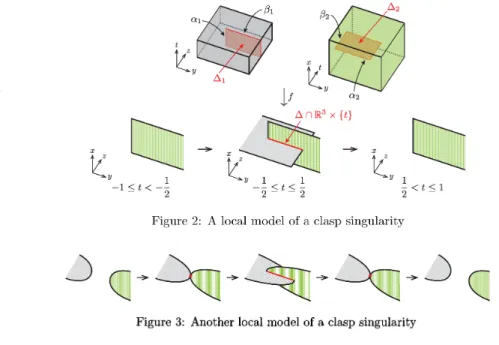
(2) 31. \downar owf. 1: A local model of. Figure. a. ribbon. singularity. We say that \triangle is a clasp singularity if \triangle is a 2‐disk in \mathbb{R}^{4} and the preimage of \triangle is the union of embedded 2‐disks \triangle_{1} and $\Delta$_{2} in M such that for each i\in\{1 , 2 \}, \partial\triangle_{i} is. disjoint. the union of two. arcs. $\alpha$_{i} and. $\beta$_{i}. ,. where $\alpha$_{i} is. a. in \partial M which connects. simple a clasp singularity arc. properly embedded Figures 2 and 3. endpoints of $\alpha$_{i} in the motion picture method.. Figure. 2: A local model of. a. .. in M and. is. a. \ovalbox{\t smalREJ CT} Figure. 3: Another local model of. 2.1 A Montesinos twin is. a. a. clasp singularity. surface‐link which is the. boundary of. a. embedded 3‐disks B_{1} and B_{2} with a single clasp singularity between B_{1} and B_{2} 4 shows a Montesinos twin T=S_{1}\cup S_{2} , where S_{i}=\partial B_{i}(i\in\{1,2 A Montesinos twin has two double points with opposite signs. Note that the as a surface‐link, of a Montesinos twin is unique.. class,. $\beta$_{i}. show local models of. clasp singularity. \mathscr{M}. Example. arc. .. pair of. Figure. equivalence.
(3) 32. S_{1}\cup S_{2}. Figure. 4: A Montesinos twin. Definition 2.2 An M ‐trivial 2‐link is. a. split. T=S_{1}\cup S_{2}. union. of. a. trivial 2‐link and. some. (or no). Montesinos twins.. 1‐handle. 3. Let F be. surgeries and finger. surface‐link. A chord attached to F. a. means an. unoriented. simple. arc. $\gamma$ in. \mathbb{R}^{4}. F\cap $\gamma$=\partial $\gamma$ which misses the double points of F Two chords attached to F equivalent if they are ambient isotopic by an isotopy of \mathbb{R}^{4} keeping F setwise fixed.. such that are. moves. .. ,. A1‐handle attached to F union of. means an. embedded 3‐disk B in \mathb {R}^{4} such that F\cap B is the. pair of mutually disjoint 2‐disks. a. in. \partial B, F\cap B misses the double points of F, opposite to the orientation induced from. and the orientation of F\cap B induced from \partial B is F. Put. .. \mathrm{h}(F;B) :=\mathrm{C}1(F\cup\partial B-F\cap B) which. Cl. we. means. are. call the surface‐link obtained from F the. ambient. closure.). .. local model of. an. are. .. a. 1‐handle surgery. Figure A. finger. 1‐handle surgery along B. (Here, are said to be equivalent if they. ,. obtained from F a. a. Two 1‐handles attached to F. isotopy of \mathb {R}^{4} keeping F setwise fixed. It is known [1, 3] that equivalent if and only if their cores are equivalent as chords For a chord $\gamma$ attaching to F we denote by \mathrm{h}(F; $\gamma$) the surface‐link by a 1‐handle surgery along a 1‐handle whose core is $\gamma$ Figure 5 shows. isotopic by. 1‐handles attached to F. attached to F. by. ,. move. along. $\gamma$.. 5; A local model of. is the inverse. a. 1‐handle surgery. along. $\gamma$. operation of the Whitney trick; for details,. see. [2, 7].. We.
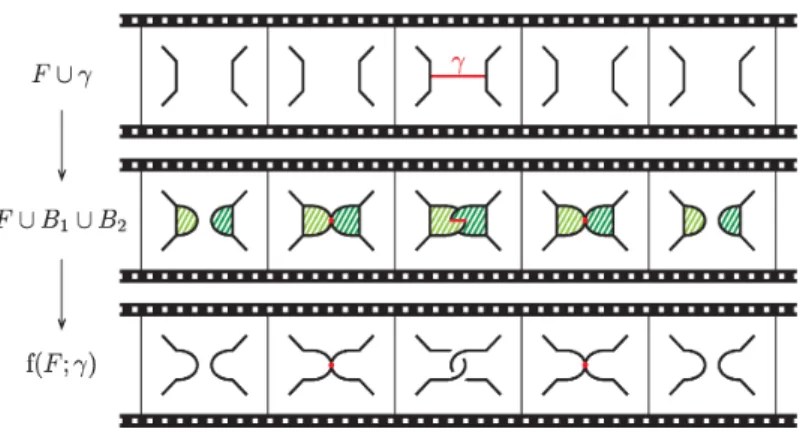
(4) 33. give an alternative definition of surgeries as follows.. finger. a. by using. move. Montesinos twin and 1‐handle. a. a 4‐disk in \mathbb{R}^{4} disjoint from F Put a Montesinos twin B_{1} and B_{2} be embedded 3‐disks in U with a single clasp singularity with S_{i}=\partial B_{i}(i\in\{1,2 Take a point p_{1}\in S_{1}-S_{1}\cap S_{2} a point p_{2}\in S_{2}-S_{1}\cap S_{2} and two distinct points q_{1}, q_{2} in F missing the double points of F Let $\gamma$_{1} and $\gamma$_{2} be oriented. Let F be. T=S_{1}\cup S_{2}. a. surface‐link and U. .. in U and let. ,. .. chords attached to F\cup T such that for and. $\gamma$_{i}\cap(B_{1}\cup B_{2})= {pi}.. surgeries along. ,. 2 \}, $\gamma$_{i} starts from p_{i} and terminates at q_{i}. Let F' be the surface‐link obtained from F\cup T. two 1‐handles whose. which is the concatenation of F' is obtained from F. i\in\{1. $\gamma$_{1}^{-1}. ,. $\gamma$_{1} and $\gamma$_{2}. by 1‐handle. Let $\gamma$ be a chord attached to F a simple arc from p_{1} to p_{2} in U and $\gamma$_{2} We say that move along $\gamma$ , which we denote by \mathrm{f}(F; $\gamma$) It is seen cores are. .. .. by finger equivalent chords attached to F then \mathrm{f}(F; $\gamma$) is equivalent to \mathrm{f}(F; $\gamma$ a local model of a finger move along $\gamma$ where two 1‐handles attached to F\cup T whose cores are $\gamma$_{1} and $\gamma$_{2} are omitted for simplicity.. that if $\gamma$ and $\gamma$' Figure 6 shows. a. ,. Figure In terms of 1‐handle. surface‐links. are. Theorem 3.1. 2‐link. by. 6: A local model of. surgeries and finger. characterized. ([6, 8]). 1‐handle. Theorem 3.2. .. are. as. A. For. a. F is. (2). F is obtained. from. a. ribbon. (3). F is obtained. from. a. trivial 2‐link. (4). F is obtained. from. an. It is. seen. move. along. $\gamma$. moves, ribbon surface‐links and. is ribbon. surface‐link. (1). a. finger. ribbon‐clasp. follows.. surface‐link surgeries.. ([4]). a. F , the. if and only if it. is obtained. following conditions. are. from. equivalent.. ribbon‐clasp surface‐link. surface‐link by finger. that Theorem 3.2 is. a. moves.. by 1‐handle surgeries and finger. M ‐trivial 2‐link. by 1‐handle surgeries.. generalization of Theorem. 3.1.. a. moves,. trivial.
(5) 34. Normal forms for surface‐links. 4. Normal forms for embedded surface‐links. 4.1. Let L be. an. oriented link in \mathbb{R}^{3}. A band attached to L. such that L\cap B is the union of. means an. oriented 2‐disk B in \mathbb{R}^{3}. pair of mutually disjoint arcs in \partial B and the orientations of L\cap\partial B induced from \partial B and L are opposite. We say that a link L' is obtained from L by a band surgery along B if L'=\mathrm{C}1(L\cup\partial B-L\cap\partial B) see Figure 7. Let \mathcal{B}=B_{1}\cup\ldots\cup B_{ $\tau$ r $\iota$} a. ,. \rightarrow. ) (\rightar ow. \rightarrow. $\Gamma$ \mathrm{V}L . L. Figure be. 7: A band surgery from L to L'. mutually disjoint oriented 2‐disks. in. along. a. band B. \mathbb{R}^{3} such that each B_{i} is. a. band attached to L. \mathrm{A}. along \mathcal{B} is denoted by L\rightarrow BL' or simply L\rightarrow L'. L\rightarrow BL' the realizing surface is a compact oriented surface, \mathbb{R}^{3}\times[a, b] defined by:. band surgery from L to L' For. a. properly. band surgery embedded in. ,. say. \mathrm{F},. F\cap\mathb{R}^3\times\{t}=\left{\begin{ar y}{l L'\times\{t}&\mathrm{f}\mathrm{o}\mathrm{}t\in(a+b)/2,b]\ L\cup\mathcl{B}\times\{t}&\mathrm{f}\mathrm{o}\mathrm{}t=(a+b)/2\ L\times\{t}&\mathrm{f}\mathrm{o}\mathrm{}t\in[a,(+b)/2. \end{ar y}\right. This. realizing surface. Let \mathcal{L}. is denoted. by. F(L\rightarrow BL')_{[a,b]}.. realizing surface a=t_{1}<t_{2}<\ldots<t_{m}=b is the union of the for i=1, m-1 see the left of Figure 8. (Note realizing that the ambient isotopy class of the realizing surface F(\mathcal{L})_{[a,b]} does not depend on the choice of a division.) If the links L_{1} and L_{m} are trivial links, then there exist disk systems \mathcal{D} and \mathcal{D}' in \mathb {R}^{3} with \partial D=L_{1} and \partial D'=L_{m} Then we obtain a closed oriented surface. F(\mathcal{L})_{[a,b]}. L_{1}\rightarrow L_{2}\rightarrow\ldots\rightarrow L_{m} be. :. a. band surgery sequence.. \mathbb{R}^{3}\times[a, b] surfaces F(L_{i}\rightarrow L_{i+1})_{[t_{i},t_{i+1}]}. of L in. with. a. The. division. ,. .. \overline{F}(\mathcal{L})_{[a,b]}:=\mathcal{D}\times\{a\}\cup F(\mathcal{L})_{[a,b]}\cup \mathcal{D}'\times\{b\} in. \mathbb{R}^{3}\times[a, b]. ,. which. we. call the ctosed. that. realizing surface of \mathcal{L} see the right of Figure 8. Note [5], the equivalence class of \overline{F}(L)_{[a,b]} does not ,. by Horibe‐Yanagawas depend on choices of disk systems \mathcal{D} and \mathcal{D}' We say that an embedded surface‐link is in a normal form if it is a closed realizing surface \overline{F}(\mathcal{L})_{[a,b]} of a band surgery sequence \mathcal{L}. lemma shown in. .. Theorem 4.1. equivalent. ([5]) Every. to the closed. embedded surface‐link with $\mu$ components and realizing surface of a band surgery sequence. g total genus is. O\rightarrow L_{-}\rightarrow L_{0}\rightarrow L_{+}\rightarrow O', where O and O'. are. trivial links, L_{-} and. L_{+}. are. $\mu$ ‐component links and. L_{0}. is. component link. A ribbon surface‐link is characterized in terms of normal forms. as. follows.. a( $\mu$+g)-.
(6) 35. 8: The. Figure. realizing surface. L_{3})_{[-2,2]}. ([5]). Theorem 4.2 the closed. F(L_{1^{-}}^{B}3L_{2^{-}}^{B}SL_{3})_{[-2,2]}. An embedded. realizing surface of. a. surface‐link. ,. and the closed. is ribbon. realizing. surface. if and only if. it is. \overline{F}(L_{1}\rightar ow^{B}L_{2^{-} ^{B}3 equivalent. to. band surgery sequence. O\rightarrow L\rightarrow O, where O is. Let L be a. with. of O\rightarrow L.. Normal forms for immersed surface‐links. 4.2. is. trivial link and the band surgery L\rightarrow O is the inverse. a. a. link and L'. a. link obtained from L. homotopy (g_{s} : M^{1}\rightarrow \mathbb{R}^{3}|s\in[0,1]) of. by applying the. source. some. crossing changes. There. circles M^{1} of the link into \mathbb{R}^{3}. g_{0}(M^{1})=L and g_{1}(M^{1})=L' such that each g_{s} except s=1/2 is an embedding s=1/2 intersections occur. We call such a homotopy a crossing change ,. ,. of M^{1} and at. change deformation from L to L' is denoted by L\rightarrow L'. the realizing crossing change deformation L\rightarrow L' by a homotopy (g_{s}|s\in[0,1 is a oriented \ m a t h r m { F } immersed in surface compact surface, say properly \mathbb{R}^{3}\times[a, b] defined by: A crossing. deformation. For. a. ,. F\cap \mathbb{R}^{3}\times\{t\}=g_{s}(L)\times\{t\} s=(t-a)/(b-a). for. t\in[a, b],. realizing surface is denoted by F(L\rightarrow L')_{[a,b]}. Hopf links if it is a split union of a trivial link and k Hopf links for some k\geq 0 An H ‐trivial link with k Hopf links can be transformed into a trivial link by k crossing changes. We call a crossing change deformation determined by the crossing changes a Hopf‐splitting deformation. Let \mathcal{L} : L_{1}\rightarrow L_{2}\rightarrow\ldots\rightarrow L_{m} be a band surgery sequence with H‐trivial links L_{1} and L_{m} The realizing surface F(\mathcal{L})_{[a+ $\epsilon$,b-$\epsilon$']} in \mathbb{R}^{3}\times[a+ $\epsilon$, b- $\epsilon$ for some small $\epsilon$, $\epsilon$'>0 is where. A link is called. an. .. This. H ‐trivial link with k .. ,. .. extended to. oriented surface. an. F(\mathcal{L})_{[a,b]}^{\mathrm{x} :=F(L_{1}'\rightar ow L_{1})_{[a,a+ $\epsilon$]}\cup F(\mathcal{L})_{1- $\xi$ j'}a+ $\epsilon$,b]\cup F(L_{m}\rightar ow L_{m}')_{[b-$\epsilon$',b]} in. \mathbb{R}^{3}\times[a, b]. L_{m}\rightarrow L_{m}'. exist disk. is. ,. Lí \rightarrow Ll is the inverse operation of a Hopf‐splitting deformation and Hopf‐splitting deformation. Since links Lí and L_{m}' are trivial links, there. where a. systems \mathcal{D} and \mathcal{D}'. oriented surface. in. \mathbb{R}^{3} with \partial \mathcal{D}=L\'{i} and \partial \mathcal{D}'=L_{m}' Then .. \overline{F}(\mathcal{L})_{[a,b]}^{\times}:=\mathcal{D}\times\{a\}\cup F(\mathcal{L})_{[a,b]}^{\times}\cup \mathcal{D}\times\{b\}. we. obtain. a. closed.
(7) 36. 9: The closed. Figure. \mathbb{R}^{3}\times[a, b]. in. a. which. ,. call the closed. we. immersed surface‐link is in. an. realizing. a. \overline{F}(L_{1^{-3L_{2}-3L_{3})_{[-3,3]}^{\times} }^{B\mathcal{B}. realizing surface of \mathcal{L} See Figure 9. We say that form if it is a closed realizing surface \overline{F}(\mathcal{L})_{[a,b]}^{\times} of .. normal. band surgery sequence \mathcal{L}.. ([4]) Every. Theorem 4.3. equivalent. surface. to the closed. immersed surface‐link with $\mu$ components and realizing surface of a band surgery sequence. g total genus is. O\rightarrow L_{-}\rightarrow L_{0}\rightarrow L_{+}\rightarrow O', where O and O'. H ‐trivial. are. links,. L_{-} and. component link. A. ribbon‐clasp surface‐link. Theorem 4.4 to the closed. ([4]). L+. are. $\mu$ ‐component links and. is characterized in terms of normal forms. An immersed. realizing surface of. a. surface‐link. is. L_{0}. as. is. a( $\mu$+g)-. follows.. ribbon‐clasp if and only if it. is. equivalent. band surgery sequence. O\rightarrow L\rightarrow O, where O is. an. H ‐trivial link and the band surgery L\rightarrow O is the inverse. These theorems. are. generalization. of O\rightarrow L.. of Theorem 4.1 and Theorem 4.2.. References. [1]. J.. Boyle, Classifying 1‐handles attached. (1988),. 306. [2]. surfaces,. Trans. Amer. Math. Soc.. A. J.. Casson, Three lectures on new‐infinite constructions in 4‐dimensional manifolds, la Recherche de la Topologie Perdue, (Eds. L. Guillou and A. Marin), Progr. Math. 62, pp. 201‐214, Birkhäuser Boston, Boston, MA, 1986. In:. [3]. to knotted. 475‐487.. À. F. Hosokawa and A.. J. Math. 16. (1979),. Kawauchi, Proposals for unknotted surfaces 233‐248.. in four‐spaces, Osaka.
(8) 37. [4]. S. Kamada and K. Kawamura, On ribbon‐clasp singular surface‐links, arXiv:1602.07855.. [5]. A. Kawauchi, T.Shibuya and S.Suzuki, Descriptions on surfaces in Normal forms, Math. Sem. Notes, Kobe Univ. 10 (1982) 75‐125.. [6]. A. Kawauchi, T.Shibuya and S.Suzuki, Descriptions on surfaces in four‐space, II: Singularities and cross‐sectional links, Math. Sem. Notes, Kobe Univ. 11 (1983) 31‐. surface‐links. and normal. forms of. four‐space,. I:. 69.. [7]. R. Kirby, The topology of 4‐manifolds, Verlag, Berlin, 1989.. [8]. T.. Yanagawa, On ribbon 2‐knots:. Math. 6. Osaka. (1969). Lecture Notes in Mathematics. the. 3‐manifold. bounded. 1374, Springer‐. by the 2‐knots, Osaka. J.. 447‐464.. City University. Advanced Mathematical Institute. Osaka 558‐8585 JAPAN \mathrm{E} ‐mail address:. kengok©sci.. osaka‐cu.. ac.. jp. * $\beta$ h\mathrm{f}\mathrm{f}\mathrm{i}^{\leftrightar ow}\underline{}\angle \mathrm{X}\mp \mathscr{X}\mp \mathrm{f}\mathrm{f}\mathrm{l}_{i $\iota$ \mathrm{f}^{\mathrm{J} ^{F\mathrm{n} \mathrm{H}. ỳnJI \mathrm{U}\backslash \ovalbox{\t \smal REJECT}_{\text{ロ} ^{ $\Xi$}.
(9)
図
![Figure 8: The realizing surface F(L_{1^{-}}^{B}3L_{2^{-}}^{B}SL_{3})_{[-2,2]} , and the closed realizing surface \overline{F}(L_{1}\rightarrow^{B}L_{2^{-}}^{B}3 L_{3})_{[-2,2]}](https://thumb-ap.123doks.com/thumbv2/123deta/5949482.1054739/6.744.111.637.99.247/figure-realizing-surface-closed-realizing-surface-overline-rightarrow.webp)
![Figure 9: The closed realizing surface \overline{F}(L_{1^{-3L_{2}-3L_{3})_{[-3,3]}^{\times}}}^{B\mathcal{B}}](https://thumb-ap.123doks.com/thumbv2/123deta/5949482.1054739/7.744.248.494.98.266/figure-the-closed-realizing-surface-overline-times-mathcal.webp)
関連したドキュメント
We show that a discrete fixed point theorem of Eilenberg is equivalent to the restriction of the contraction principle to the class of non-Archimedean bounded metric spaces.. We
Two numerical examples are described to demonstrate the application of the variational finite element analysis to simulate the hydraulic heads and free surface in a porous medium..
Two numerical examples are described to demonstrate the application of the variational finite element analysis to simulate the hydraulic heads and free surface in a porous medium..
Acknowledgement.This work was partially done while the second author was visiting the University of Texas at Austin and Texas A&M University, and in the Linear Analysis Workshop
Definition An embeddable tiled surface is a tiled surface which is actually achieved as the graph of singular leaves of some embedded orientable surface with closed braid
(See [7] for a theory of the rationality of the Kontsevich integral of a knot or a boundary link.) It observes a generalisation of Casson’s formula (Equation 1) of the following
Two numerical examples are described to demonstrate the application of the variational finite element analysis to simulate the hydraulic heads and free surface in a porous medium..
In particular, if (S, p) is a normal singularity of surface whose boundary is a rational homology sphere and if F : (S, p) → (C, 0) is any analytic germ, then the Nielsen graph of
