2018
年(平成 30 年)度 博士学位論文
日本人の高校生のライティング力の発達における
エクステンシヴ・ライティングの効果に関する実証的研究
京都外国語大学大学院外国語研究科 博士後期課程
異言語・文化専攻
言語教育領域
2013DC0001
小見山 和栄
目次
目次 図表リスト 抄録(英文) ... ⅰ 抄録(和文) ...ⅹⅳ 第 1章 課題設定の理由 ... 1 1. 研究の目標 ... 1 2. 高等学校における英語教育の現状について ... 1 2.1 「英語教育改善のための英語力調査」から見える課題 ... 1 2.2 「『外部検定試験の活用による英語力の検証』報告書」から見える課題 ... 3 2.3 現行の学習指導要領―教科書の問題 ... 5 3.ライティング指導の必要性
... 6
3.1 コミュニケーションとしてのアウトプット ... 6 3.2 ビジネス社会の要請 ... 7 3.3 ライティング指導の抱える問題 ... 7 4.課題設定の理由
... 9
第 2章 Extensive writing の必要性と研究課題 ... 11 1. Extensive Writing 教育の必要性について ... 11 1.1 アプローチとしての extensive 指導 ... 11 1.2 Extensive writing の定義 ... 12 1.3 本研究における extensive writing ... 13 2. 研究課題 ... 14 第 3章 先行研究 ... 16 1. アウトプット仮説 ... 16 2. プロセス・アプローチ ... 16 3. Extensive writing の実践的研究 ... 18 3.1 自由作文への取り組み ... 18 3.2 10-minute writing の先行研究 ... 193.3 教室外での extensive writing ... 20 4. 流暢さの測定 ... 21 5. ライティング研究の課題 ... 22 5.1 評価について ... 22 5.1.1 総合的評価 ... 23 5.1.2 分析的評価 ... 25 5.1.3 ポートフォリオ ... 26 5.2 フィードバックについて ... 26 6. まとめ ... 29 第 4章 Extensive Writing の効果について... 31 1. はじめに ... 31 2. 研究の目的 ... 33 3. 研究仮説 ... 33 4. 研究の背景 ... 34 5. 実験方法 ... 35 5.1 10-minute writing について ... 35 5.2 実験参加者 ... 36 5.3 日常の指導 ... 36 5.3.1 グループ A に対する指導 ... 37 5.3.2 グループ B に対する指導 ... 38 5.4 効果測定の方法 ... 38 5.4.1 実験前の英語力測定 ... 38 5.4.2 ライティング力の評価法 ... 39 6. 分析結果 ... 40 6.1 総合評価 ... 40 6.2 分析的評価 ... 42 7. 考察 ... 45 7.1 総合的な書く能力(仮説 1 について) ... 45 7.2 流暢さの伸び(仮説 2 について) ... 47 7.3 文法 ... 48
7.4 学習態度 ... 48 7.5 コミュニケーション活動としてのライティング ... 49 7.6 実験の問題点 ... 49 8. まとめ ... 50 9. 今後の課題 ... 51 9.1 フィードバックにおける課題 ... 51 9.2 Extensive writing の量に関する課題 ... 52 9.3 文法的正確さにおける課題 ... 52 第 5章 10 minute writing の文法への影響 ... 54 1. はじめに ... 54 2. 研究の目的 ... 55 3. 研究仮説 ... 55 4. 研究の背景 ... 56 5. 実験 ... 56 5.1 効果測定の方法 ... 56 5.2 実験参加者 ... 58 5.3 事前指導 ... 58 5.4 実験前グループ間の差 ... 60 5.5 分析結果 ... 63 5.5.1 ポストテストの結果 ... 63 5.5.2 グループ内の指導前後の比較 ... 63 5.5.3 グループ間比較の結果 ... 65 6. 考察 ... 67 6.1 文法の定着について ... 67 6.2 総合点の変化について ... 68 7. まとめ ... 69 8. 今後の課題 ... 70 第 6章 10-minute writing の流暢さへの影響 ... 72 1. はじめに ... 72 2. 研究の目的 ... 73
3. 研究仮説 ... 73 4. 研究計画 ... 74 5. 実験 1 について ... 74 5.1 研究計画と抽出サンプル ... 74 5.2 実験 1 の結果 ... 78 5.2.1 グループ内比較 ... 82 5.2.2 グループ間比較 ... 83 5.3 実験1に関する考察 ... 85 6. 実験 2 ... 90 6.1 実験 2 における流暢さの変化について ... 91 6.2 実験 2 に関する考察 ... 93 7. 実験 1、実験 2 を通しての考察 ... 94 8. まとめ ... 97 9. 今後の課題 ... 98 第 7章 ライティングにおける improvement---ケース・スタディから ... 100 1. はじめに ... 100 2. 研究の背景 ... 100 3. 研究の目的 ... 101 4. 生徒 1 について ... 101 4.1 指導の経緯と分析方法 ... 101 4.2 生徒 1 の作品研究 ... 102 4.2.1 初回と最終回の比較 ... 102 4.2.2 指導過程での作品の変化 ... 104 4.2.3 生徒1のまとめ ... 110 5. 生徒 2 について ... 110 5.1 指導の経緯 ... 110 5.2 生徒 2 の作品研究 ... 111 5.2.1 初回と最終回の比較 ... 111 5.2.2 指導過程での作品の変化 ... 112 5.2.3 生徒 2 のまとめ ... 114
6. 2017 年度生からの 4 事例 ... 114 6.1 指導の経緯... 115 6.2 生徒 3 から生徒 6 の作品研究 ... 116 7.分析 ... 119 7.1 総使用単語数、使用異語数、1 文当たりの使用単語数の変化 ... 119 7.2 語彙レベルについて ... 126 7.3 後置修飾について ... 132 7.4 結束性と構成・展開について ... 138 7.5 文法について ... 139 8. 考察 ... 140 9. まとめ ... 143 10. 問題点と今後の課題 ... 144 第 8章 ライティング指導における extensive writing の位置づけ ... 145 1. 研究のまとめ ... 145 2. 量と質との関連に対する考察 ... 147 3. 教育現場への提言 ... 148 3.1 ライティング・フルエンシーへの注目 ... 148 3.2 Extensive writing の勧め ... 148 3.3 授業で行う 10-minute writing ... 149 3.4 宿題を活用した extensive writing ... 150 第 9章 研究の問題点と課題 ... 152 1. 研究の問題点 ... 152 2. 今後の課題 ... 153 謝辞 ... 155 参考文献 ... 156 資料 .... ... 162
図表リスト
図一覧 図3-1 図3-2
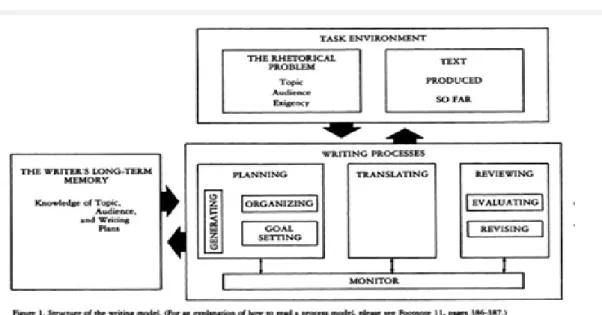
ライティングの思考過程を表す認知モデルFlower & Hayes (1981) ··· 17
ライティングの思考過程を表す認知モデル Hayes (2012) ··· 17 図5-1 研究計画 ··· 57 図5-2 指導前の総合点分布(全体) ··· 62 図5-3 指導前の総合点分布(抽出グループ) ··· 62 図5-4 指導後の総合点分布(抽出グループ) ··· 67 図6-1 研究計画 ··· 75 図6-2 10-minute writingの練習回数と総使用単語数(グループA) ··· 95 図6-3 10-minute writingの練習回数と総使用単語数(グループC) ··· 95 図7-1 練習回数による総使用語数の変化(生徒1) ··· 119 図7-2 練習回数による異語数の変化(生徒1) ··· 120 図7-3 練習回数による1文の長さの変化(生徒1) ··· 121 図7-4 練習回数による総使用単語数の変化(生徒2) ··· 121 図7-5 練習回数による異語数の変化(生徒2) ··· 122 図7-6 練習回数による1文の長さの変化(生徒2) ··· 123 図7-7 練習回数による総使用単語数の変化(生徒3~6) ··· 124 図7-8 練習回数による使用異語数の変化(生徒3~6) ··· 125 図7-9 練習回数による1文当たりの語数の変化(生徒3~6) ··· 126 図7-10 判別不能語使用割合の変化(生徒1) ··· 128 図7-11 レベル1の語彙使用割合の変化(生徒1)··· 128 図7-12 判別不能語使用割合の変化(生徒2) ··· 130 図7-13 レベル1の語彙使用割合の変化(生徒2)··· 130 図7-14 判別不能語使用割合の変化(生徒3~6) ··· 131 図7-15 レベル1の語彙使用割合の変化(生徒3~6) ··· 132 図7-16 後置修飾の使用回数の変化(生徒1・2)··· 134 図7-17 後置修飾の使用回数の変化(生徒3~6) ··· 137
表一覧 表4-1 「英語Ⅱ」後期期末考査成績 ··· 39 表4-2 後期期末考査成績の検定統計量 ··· 39 表4-3 英語母国語話者による総合評価 ··· 41 表4-4 項目別信頼性 ··· 41 表4-5 信頼性統計量 ··· 41 表4-6 英語母国語話者平均点による総合評価 ··· 42 表4-7 総合評価の検定統計量 ··· 42 表4-8 総使用単語数、文数、異語数の比較 ··· 43 表4-9 使用文法項目数(誤りを含む) ··· 44 表4-10 正しく使用した文法項目数 ··· 44 表4-11 流暢さに関わる要因の効果量 ··· 44 表4-12 「ライティング」学年末考査成績 ··· 45 表4-13 学年末考査成績の検定統計量 ··· 45 表5-1 各グループの事前指導内容 ··· 59 表5-2 指導前の総合点と文法点 ··· 60 表5-3 指導前のグループ間の比較と効果量 ··· 60 表5-4 抽出サンプルによる指導前の総合点と文法点 ··· 61 表5-5 抽出サンプルによる指導前のグループ間の比較と効果量 ··· 61 表5-6 指導後の総合点と文法点 ··· 63 表5-7 指導前後の総合点と効果量 ··· 64 表5-8 指導前後の文法点と効果量 ··· 64 表5-9 指導前後の総合点と効果量(抽出サンプル) ··· 65 表5-10 指導前後の文法点と効果量(抽出サンプル) ··· 65 表5-11 抽出サンプルによる指導後のグループ間の比較(総合点) ··· 66 表5-12 抽出サンプルによる指導後のグループ間の比較(文法点) ··· 66 表6-1 各グループの事前指導内容 ··· 75 表6-2 指導前のグループ平均点 ··· 76 表6-3 総使用単語数の指導前グループ間の差 ··· 76 表6-4 指導前のグループ平均点(抽出サンプル) ··· 77
表6-5 総使用単語数の指導前グループ間の差 (抽出サンプル) ··· 77 表6-6 語彙点の指導前のグループ間比較 (抽出サンプル)(n =38) ··· 78 表6-7 構成・展開点の指導前のグループ間の差 (抽出サンプル)(n =38) ··· 78 表6-8 指導前後のグループ平均点 ··· 80 表6-9 指導前後のグループ平均点(抽出グループ) ··· 81 表6-10 グループAの効果量 (n =80) ··· 82 表6-11 グループBの効果量 (n =80) ··· 82 表6-12 グループCの効果量 (n =40) ··· 83 表6-13 グループDの効果量 (n =80) ··· 83 表6-14 総使用単語数の指導後グループ間の差(抽出サンプル) ··· 84 表6-15 語彙点の指導後のグループ間比較(抽出サンプル)(n =38) ··· 84 表6-16 構成・展開点の指導後のグループ間の差(抽出サンプル)(n =38) ··· 84 表6-17 グループAとグループBの使用語数の平均(n=38) ··· 86 表6-18 指導前のグループAとグループBの使用語数の比較(n=38) ··· 86 表6-19 指導後のグループAとグループBの使用語数の比較(n=38) ··· 86 表6-20 グループAとグループBの語彙点の平均(n=38) ··· 88 表6-21 指導前のグループAとグループBの語彙点の比較(n=38) ··· 88 表6-22 指導後のグループAとグループBの語彙点の比較(n=38) ··· 88 表6-23 グループAとグループBの構成・展開点の平均(n=38) ··· 89 表6-24 指導前のグループAとグループBの構成・展開点の比較(n=38) ··· 89 表6-25 指導後のグループAとグループBの構成・展開点の比較(n=38) ··· 89 表6-26 Quick writingの使用語数と文数の平均 ··· 91 表6-27 総使用単語数のグループ間比較と効果量··· 92 表6-28 文数のグループ間比較と効果量 ··· 92 表6-29 1文当たりに使用した語のグループ間比較と効果量 ··· 93 表6-30 ALT評価のグループ間比較と効果量 ··· 93 表6-31 トピックごとの総使用単語数 ··· 96 表7-1 作品1と作品11の比較 ··· 107 表7-2 総使用単語数を予測変数とした単回帰分析の結果(生徒1)··· 119 表7-3 使用異語数を予測変数とした単回帰分析の結果(生徒1) ··· 120
表7-4 1文当たりの使用単語数を予測変数とした単回帰分析の結果(生徒1) ··· 120 表7-5 総使用単語数を予測変数とした単回帰分析の結果(生徒2)··· 121 表7-6 使用異語数を予測変数とした単回帰分析の結果(生徒2) ··· 122 表7-7 1文あたりの使用単語数を予測変数とした単回帰分析の結果··· 123 表7-8 近似値線の切片の傾き ··· 124 表7-9 総使用単語数を予測変数とした単回帰分析の結果(生徒3~6) ··· 124 表7-10 使用異語数を予測変数とした単回帰分析の結果(生徒3~6) ··· 125 表7-11 1文当たりの使用単語数を予測変数とした単回帰分析の結果 (生徒3~6) ··· 125 表7-12 コミュニケーション英語Ⅲの教科書の語彙レベル(実数) ··· 127 表7-13 コミュニケーション英語Ⅲの教科書の語彙レベル(パーセンテージ) ··· 127 表7-14 判別不能語を予測変数とした単回帰分析の結果(生徒1) ··· 128 表7-15 レベル1の語彙を予測変数とした単回帰分析の結果(生徒1) ··· 128 表7-16 生徒1の語彙レベル(実数) ··· 129 表7-17 生徒1の語彙レベル(パーセンテージ)··· 129 表7-18 判別不能語を予測変数とした単回帰分析の結果(生徒2) ··· 129 表7-19 レベル1の語彙を予測変数とした単回帰分析の結果(生徒2) ··· 129 表7-20 判別不能語を予測変数とした単回帰分析の結果(生徒3~6) ··· 131 表7-21 レベル1の語彙を予測変数とした単回帰分析の結果(生徒3~6) ··· 131 表7-22 練習回ごとの後置修飾の出現回数(生徒1) ··· 133 表7-23 練習回ごとの後置修飾の出現回数(生徒2) ··· 133 表7-24 後置修飾の使用回数を予測変数とした単回帰分析の結果(生徒1・2) ··· 134 表7-25 課題ごとの後置修飾の出現回数(生徒3~6) ··· 134 表7-26 課題ごとの後置修飾の出現回数(生徒3) ··· 135 表7-27 課題ごとの後置修飾の出現回数(生徒4) ··· 135 表7-28 課題ごとの後置修飾の出現回数(生徒5) ··· 135 表7-29 課題ごとの後置修飾の出現回数(生徒6) ··· 136 表7-30 練習回数との後置修飾の出現回数(生徒3~6) ··· 137 表7-31 後置修飾の使用回数を予測変数とした単回帰分析の結果(平均) ··· 137
i
Abstract
This dissertation begins with the understanding that language is a means or tool for
communication and that the purpose of foreign language teaching is to help learners acquire
the skills necessary to make effective use of this social tool in a language other than their
native language. These skills are often divided into receptive skills, listening and reading,
and productive skills, speaking and writing. Too often this view of language as a tool for
communication tends to be lost and the acquisition of a certain number of vocabulary words
or the correct use of a specified grammatical pattern or construction for reading becomes the
focus of instruction in the school setting. That is, “covering” a lesson becomes the goal of
instruction rather than developing the ability to actually use the target language for
communication. In this dissertation, I propose an approach to the teaching of one of the four
skills, writing, that is true to the view of language as a communication tool.
Chapter 1 describes the goal of this study and the state of writing education in
English language programs in public high schools in Japan. The Ministry of Education,
Culture, Sports, Science and Technology (below, MEXT) set the goal of at least 50% of
students graduating from a public high school to be able to read, write, comprehend through
listening, and speak at the A2 level of the CEFR-J standard rubric (MEXT, 2017). The A2
level is defined as an ability to deal with simple, straightforward information and begin to
express oneself in familiar contexts. Very likely, a lack of attention to writing as a
productive, communicative skill is one major reason for this lack of achievement. In
comparison, the goal for speaking is met by only 12.9 %, the goal for reading is met by
33.5%, and that for listening is met by 33.6%. Clearly the achievement is much higher for
the receptive skills than for the productive skills. Previous surveys show a lack of attention
to writing activities in Japanese public high schools. As many as 47.5% of students
reported not doing any writing-oriented activities.
Writing education is beneficial to encourage output communication skills. The
previous course of study focused on oral communication skills, which ended up lessening
the time and effort for writing. The current course of study focuses on output skills, where
ii
the improvement of both writing and speaking skills should be encouraged. Writing is a
needed skill in the real world. As global business continues to grow in importance, writing
is becoming even more important in negotiations with other countries and contracts with
foreign companies.
Besides, rather few activities focused on writing are carried out. Free essay writing
is generally avoided. Reasons given for this lack of attention to writing varied, but the most
common reasons are: 1) a lack of confidence on the part of many English teachers in their
own ability to make such corrections; 2) the amount of time needed to read and provide
explicit corrective feedback, especially grammatical correction, for a typical high school
class of 40 or more students together with a lack of class time for in-class writing activities;
3) the difficulty of setting clear goals and standards for evaluation; 4) lack of perceptible
progress in a short time; and, 5) a lack of confidence in their students ability to write essays
in English.
Considering these ‘lacks’, research on the area of writing is most needed since
the next course of study, which will be introduced in 2020, emphasizes output abilities
even more.
Chapter 2 explains why a need is felt for the introduction of extensive writing to
writing instruction and clarifies the research goals of this dissertation. The term “extensive”
describes an approach to second language education and had drawn considerable attention,
especially in reading instruction. It is an activity that treats English as a communication tool,
is realistic, and has been shown to encourage the acquisition of English skills. In this
approach, reading itself is considered important and no demands beyond the act of reading,
such as vocabulary learning, explication of content, or acquisition of grammatical patterns,
are placed on students.
Following the concept embodied in extensive reading, extensive writing is conceived
of as a writing activity treating English as a tool for communication. Extensive writing was
conceived as a way to give instructors who have been teaching sentence-level
Japanese-English translation under the guise of “writing” an opportunity to consider a new
approach to evaluation and to thus contribute to English language instruction in Japanese
iii
high schools, where balance has been lacking among instruction of the four skills. The
following are the questions this research program hopes to answer:
1) Is extensive writing beneficial to Japanese high school students?
2) What changes can be expected from the introduction of extensive writing?
3) Will students’ grammar skills decrease as a result of the introduction of extensive
writing, a concern from the viewpoint of wanting students to acquire English correctly?
Chapter 3 consists of a review of previous literature on writing instruction in foreign
language education, including output hypotheses, process approach, types of evaluation
and the reliability of different evaluation methods, the role of feedback, and ways of
measuring fluency. One approach to evaluation of students’ written work is a holistic
evaluation, whereby the work is given a score based on an overall judgement of the
work’s quality. In general, holistic ratings have a subjective component to them but both
interrater reliability and consistency of rating for each rater can be improved by training
and discussion among raters.
Another approach is to use an analytic rating system in which the students’ work is
rated on predetermined discrete items, such as those found in the ESL Composition Profile
of Jacobs et al (1981). While seemingly more objective than the holistic rating approach,
Kondo-Brown (2002) showed that consistent application of the standards also requires
training.
Although these two approaches to rating focus on different aspects of written works,
the ratings given by trained raters in each approach have a correlation relation, as shown
by Mizumoto (2008).
Measurements of fluency generally reflect the quantity of written material produced
in a fixed length of time and include total number of words, number of words per sentence,
and number of different words. Reflecting oral fluency measures, process-related
measures such as hesitations, crossing-outs, deletions, and number of incomprehensible
units may be added. Fraser (2014) used all these measures, together with a holistic
measure of fluency, to compare the results of writing activities in two environments, an
international understanding course and a general academic course, finding that the
students in the international understanding course wrote essays that, on the whole, were
longer in total words and used a wider set of vocabulary.
One of the reasons given earlier for the neglect of essay-type writing practice in
Japanese high schools is the perceived need for extensive grammar correction feedback.
As improved accuracy is not a specific objective of the ten-minute writing program
examined in this dissertation, feedback given students emphasized the use of writing as a
means of communication and consisted either of follow up questions (e.g. “What
happened after that?”) or comments on the content (e.g. “I like XX, too.” or “That was
interesting.”). Whether error correction actually leads to greater accuracy is an argument
that began with Truscott (1996) and is still with us today. What is not an issue, however, is
that even the most intensive grammar correction, explicit or implicit, does not lead to
improved accuracy unless students are motivated enough to take the corrections to heart
and make an effort to use the correct expressions and constructions in future work.
As increased fluency is one desired outcome of the modified ten-minute writing
program, an experiment was designed to test the effectiveness of the program in
increasing fluency. This experiment is described in Chapter 4.
Because of an unexpectedly large enrollment in the elective English Writing class
for third-year students, beyond the limit on class size, the class was divided into two
equal-sized classes taught by two different teachers using the same textbook and
following the same curriculum, with one exception. In one class, the teacher gave a
ten-minute grammar quiz once a week. In the other class, the teacher used this time for the
ten-minute writing program. Based on average scores for each class on the final
examinations in English at the end of the previous year, the two classes did not differ
significantly in their initial overall English ability. At the end of the semester over which
the experiment was conducted, both classes took the same final exam, which included an
essay question asking the students to argue for or against Saturday classes. The essays
from both classes were typed up and put in random order. They were then rated
holistically on a 1 to 10 scale by four native English speakers for whom interrater
reliability was very high. In addition, such fluency measures as total number of words,
v
number of different words (word types), average number of words per sentence, and
number of grammatical patterns used were all calculated.
The average ratings assigned to the essays from ten-minute writing group by the
native speaker raters were significantly higher than those of the other group. The
ten-minute writing group was also significantly higher on each of the fluency measures,
except variety of grammar patterns used, on which it was higher but not at a p < .05 level.
The design of the experiment, although serendipitous, was fortuitous in that it
allowed the comparison of two closely matched groups following the same curriculum
with the exception of the ten-minute writing activity. The results showed that it is possible
to increase students’ writing fluency in an efficient and effective way that meets the
objections cited in the surveys introduced in Chapter 1.
Part of the resistance on the part of Japanese high school English teachers to free or
semi-free writing activities lies in the belief that unfocused, explicit grammatical error
correction is necessary for the writing exercise to be effective. With a typical class size of 40
or more students, provision of such feedback is highly time consuming. As the ten-minute
writing program described in this dissertation does not incorporate any grammar correction,
focusing instead on the communicative function of writing, there may be a fear that students’
grammatical knowledge and accuracy is sacrificed in the process. Chapter 5 describes
another experiment designed to measure any difference in changes, either positive or
negative, in the grammatical knowledge of students in the ten-minute writing program
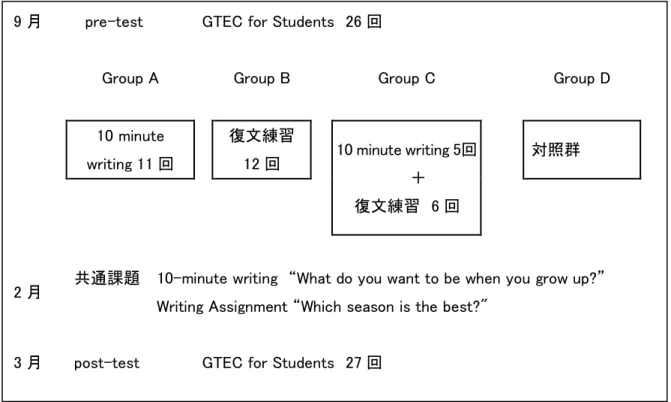
compared to students not in the program. Two hundred eighty first-year students were
divided into four groups. One group of 80 students (Group A) practiced ten-minute writing
11 times over the semester. Another group of 80 students (Group B) practiced retranslating
into English the Japanese translations of English sentences appearing in the textbook as
illustrations of grammatical patterns 12 times over the semester. A third group of 40 students
(Group C) practiced ten-minute writing five times and retranslating English sentences six
times. The last group, which consisted of 40 students, practiced neither of these activities,
but did ordinary class activities. All students took the test, GTEC for STUDENTS twice,
once in September and once in the following March. The experiment examined the
average grammar scores on the essay portion for each group for both test administrations
and also calculated fluency measures on the same tests.
A statistical analysis of the changes in the average grammar scores for each group
showed that while all four groups improved, the gains of both Group A and Group C were
significantly larger than those of Groups B and D. That is, far from leading to a decrease
or a plateauing of grammatical knowledge as measured by the difference in average
grammar scores on a standardized test, addition of written communicative activities with
no grammar correction feedback actually led to improved performance.
This result is especially interesting in the light of the findings of Herder and King
(2011). They found that a ten-minute writing program implemented at an academically
highly ranked private girls high school increased the fluency of students at all levels and,
additionally, led to greater complexity in the writing of higher-level students and increased
accuracy for lower-level students. As mentioned in the description of this experiment, the
students in the experiment reported in Chapter 4 were all first-year students. The increase
in grammatical knowledge found comports well with Herder and King’s findings.
Using the data from the experiment described in Chapter 5, the first analysis
described in Chapter 6 examined the fluency measures total number of words used,
number of different words, number of sentences, and number of words per sentence, in
addition to the vocabulary scores and essay structure scores from GTEC for STUDENTS.
Examination for changes between the pre- and post-instruction period tests showed for
group A, a small effect for total words used, no effect for number of different words, no
effect for number of sentences moderate effect for words per sentence and small effects
for vocabulary and structure scores. For group B, the effects were small for total words,
small for different words, small for number of sentences, moderate for number of words
per sentence, small for vocabulary scores and no effect on structure scores. Comparison of
post-instruction test scores between groups showed no effect on total words used, small
effect on different words, no effect on words per sentence or vocabulary scores, and small
effect on essay structure scores. While group B scored slightly higher on different words
vii
used and group A was slightly on essay structure, overall there was almost no difference
between the two groups on the fluency measures.
The second experiment described in Chapter 6 looked as writing speed in an in-class
writing exercise. The same groups as in the first experiment were asked to write for ten
minutes on the topic “What do you want to be when you grow up?” An ALT was asked to
holistically rate the essays, paying attention to grammar, content, and length. The JET
measured total number of words used, number of sentences, and words per sentence.
Comparison of the two groups showed a small effect on total number of words used,
moderate effect on number of sentences, small effect on words per sentence, and a small
effect on the ALT’s holistic rating. In all measures except words per sentence, group A was
higher. In the first experiment, then, there was almost no difference observed between
groups A and B, but in the second experiment, group A was slightly higher on most
fluency measures than group B.
One source of difference may have been the difference in the test format. GTEC for
STUDENTS is described as a proficiency test. Students are graded on accuracy as well as
fluency. It is quite likely that, as pointed out in Hyland (2003), students avoid taking
chances and write using only the patterns they are most confident of.
When the four groups were compared with each other statistically, Groups A and C
were significantly higher on total number of words and number of sentences. The two
groups that had practiced retranslating Japanese versions of English sentences from the
test book both wrote longer sentences (had more words per sentence), which may indicate
a role for this activity among the varied activities conducted in a high school English class.
The two groups that had ten-minute writing (Groups A and C) also received higher holistic
ratings from the native English rater.
In 2016, the author was approached by students who were trying to prepare for
college entrance examinations that would include an essay portion. These requests and
another activity undertaken in 2017 allowed the author to conduct a series of case studies
to examine the process through which students’ writing abilities change. These case
studies are described in Chapter 7.
viii
The first student, a third-year student, wrote 23 essays over a period of four weeks
on topics from an exam preparation book. He wrote them at home, spending 20 minutes
(self-timed) on each. He received general comments on paragraph structure and overall
organization of an argument form essay as well as unfocused, explicit grammatical
feedback and suggestions on vocabulary choice. Although the period over which he wrote
his series of essays was only a month, examination of his first and last essays showed a
clear improvement. Some of the improvement was due to a better overall essay structure
and some was due to improvement in such fluency measures as total number of words,
number of word types, and number of words per sentence. Although the numbers of each
fluctuated with the topic of each essay, linear least squares regression showed a clear
increase in each of these fluency measures.
The second student, also in his third year, wrote 11 essays on topics that had actually
appeared on previous entrance exams of his target university. As was the case with the
first student, he spent 20 minutes on each essay and received both general comments on
organization and specific, explicit grammatical and vocabulary feedback. Again, even
though the number of essays written was about half that of the first student, both his
overall essay structure and fluency improved.
Both of these students received extensive feedback, and both showed similar results.
The four third-year students included as additional case studies in this chapter were
similar to the first two in terms of their English ability as reflected in their class ranking
and performance on mock entrance exams. However, they had different feedback
conditions. They all wrote 11 or more essays on topics adapted from the textbook. One
student, however, did not turn in all his essays and so his results are based on the eight he
submitted. These students were given general comments on essay structure but little or no
grammar correction feedback. As with the first two cases, fluency measures were
calculated, and, with one exception, all showed least squares regression lines with positive
slope. The exception was that in the case of one student, the number of words per sentence
decreased slightly.
Unlike the ten-minute writing cases described in Chapters 4 and 5, none of the
students whose work is examined here were told to write as much as they could in the
ix
time allowed. Nonetheless, with the one exception mentioned above, all showed improved
fluency on all the measures used.
Another observation, probably related to the fluency measures of total number of
words and number of words per sentence, is that later essays intuitively strike the reader
as better than the earlier essays, even when they have the same overall structure. One
hypothesis that would relate this intuition to the length-based fluency measures is that the
better, later essays include more detail. The addition of modifiers, both prenominal and
postnominal would be compatible with this hypothesis.
Both English and Japanese share prenominal modification structures, but of the two,
only English has postnominal structures. An increase in the use of postnominal
modification structures would also demonstrate the development of greater complexity, as
suggested by Herder and King (2011). The number of postnominal modification structures
used in the four cases from 2017 were counted by type, but only total numbers are
reported in this chapter as the number of occurrences for some types was quite small.
The total for all four cases in the number of postnominal modifier constructions used
varied by topic but showed a clear increase over time; that is, the least squares regression
line shows a positive slope. The first and second cases also showed the same pattern.
The increase in the number of postnominal modification structures found in the
totals of cases three through six and individually for cases one and two support the
hypothesis that the intuitive impression of the better quality of the later essays is due, at
least in part, to a greater use of modifiers, in particular, postnominal modifiers. The same
observation also supports the use of words per sentence as a measure of fluency. A
sentence can only become longer by using more modifiers and, usually, by using more
complex structures.
Chapter 8 summarizes the findings in the dissertation and suggest ways both the
program examined in this dissertation and extensions and variations of it could be
implemented in Japanese high school classrooms. As explained in Chapter 1, writing is the
most neglected of the four skills in spite of the fact that writing allows students to produce
English output and develop English communication skills. Teachers often lack confidence
in their ability to correct errors in an open-ended, free writing essay, as opposed to those
x
found in a Japanese-to-English sentence translation task. Even if they have such
confidence, they do not have time to correct all the errors in essays from multiple classes
of 40 or more students. With an eye to teaching discrete grammar points, there is also little
class time for in-class writing exercises. The three experiments described in this
dissertation address these concerns.
The first experiment, described in Chapter 4, showed that students in the ten-minute
writing group wrote with more fluency as measured by number of words written in a unit
of time, length of each sentence, and number of word types than did the students in the
group that did translation exercises and grammar quizzes. Their essays also received
higher holistic ratings from native English speaker readers. It can be surmised that they
displayed less error avoidance than the other group and made fuller use of the grammar
and vocabulary they had learned in their previous English classes.
The second experiment, described in Chapter 5, used the proficiency test GTEC for
STUDENTS as a pre- and post-test. The ten-minute writing groups showed greater gains
in overall score (effect size medium) and grammar (effect size medium) compared to
groups that did Japanese to English sentence translation or retranslation exercises. These
two experiments showed that students’ ability to use English grammar improved despite
the lack of explicit grammar correction feedback.
In Chapter 6, the fluency measures from the experiment described in Chapter 5 were
examined. Unexpectedly, students in the ten-minute writing group did not show an
improvement in fluency measures. This is likely due to the fact that, unlike the first
experiment in which the students were in their third year, the students in the second
experiment were first-year students. The difference in the nature of the testing
environment, proficiency test and no instruction to write as much as possible, may also
have been a factor. The influence of the testing situation was examined by giving the same
groups of students as participated in the second experiment a ten-minute writing task with
the instruction to write as much as they could in the ten minutes. In this testing
environment, the ten-minute writing groups showed significantly higher performance on
fluency measures (effect sized small to medium) than did the other groups.
xi
The nature of the changes in the students’ written product over time were examined
in the six case studies described in Chapter 7. Even though students in the case studies
were not instructed to write as much as possible, measured over time their essays grew
longer overall with more words per sentence. One factor in this growth, also reflected in
the impressionistic rating of the quality of the essays, was the increase in the number of
postnominal modifiers used.
All of the experiments and case studies suggest that free writing exercises without
grammar correction feedback improve the overall quality of students’ writing and their
ability to use the grammar and vocabulary they have learned to communicate in English
significantly more than the approaches generally used in the past without putting an undue
burden on the teacher.
Depending on the size of the class, variations and extensions of the extensive
writing approach described here are possible. With a small class, the author has assigned
book reports combined with extensive reading, cooperative pair-work compositions, and
group compositions with each student adding a sentence to what previous students had
written. Even with a normal size class, however, simply telling students to write as much
as they can in ten minutes and then to record the number of words they have written,
combined with content-based feedback has proven to be effective.
Another conclusion that can be drawn from the research reported in this dissertation
is that quantity and quality are not mutually exclusive. More extensive writing activities
led to statistically significant improvement in grammatical accuracy and fluency. The
effect size ranged from small to medium, and the absolute quantity of writing done by the
students was objectively not all that large. However, this improvement was realized with
an approach that answers teachers’ lack of confidence in their ability to make grammar
corrections in free writing essays and their lack of time to do so for large classes.
Students’ confidence in their ability to communicate in English also grew
tremendously. At the beginning of the semester, some students would add Japanese
sentences to their English because they were not sure their English communicated their
intended meaning. By the end of the semester, most had given up this practice explaining,
“I was pretty sure you would understand what I was trying to say.” This growth in
xii
confidence is probably a result of the communicative nature of the activity. The lack of
grammar correction probably also contributed to the students’ willingness to use a variety
of constructions and vocabulary to communicate as they had no reason to be conservative
and avoid errors.
The final chapter, Chapter 9, describes the weak points of the research described in
this dissertation and looks at possible future research that could build on that reported here.
One problem with the first experiment was the limited number of participants.
While the results were consistent with previous research, the specific results may not be
generalizable to a larger population. Also, the populations of the first experiment
(third-year students) and the other two (first year students) were different. Their levels of
English knowledge were different, as was reflected in the results. A research program
spanning three years of study could find ways to better integrate writing instruction into
the differing curricula of the different levels.
Students in the classes examined began with vastly differing abilities in English. In
the second experiment, the students who began at the lowest level showed the greatest
improvement. It may be that ten-minute writing is more effective with students of certain
levels of ability.
Although the GTEC for STUDENTS was used in the second experiment to test the
level of students’ knowledge of grammar, strictly speaking it cannot be said to have
measured the accuracy of their writing. Measurement of accuracy was not an objective of
the research program reported here, but in future studies accuracy measures such as the
number of error-free T-units may be instructive.
Speaking and writing are both output activities, and the experimenter did observe an
improvement in students’ speaking ability following the ten-minute writing program, but
no data collection or analysis was made.
Swain (1985) proposed an output hypothesis whereby learners noticing the gap
between their own output in the L2 compared to their prior language knowledge and the
language input they have received leads to further language acquisition. The output
hypothesis does not deny the importance of input. Before a learner can produce written or
xiii
spoken output, he needs to have gained a knowledge of vocabulary and grammar through
input received.
Future research should consider the relation between output like ten-minute writing
and input such as extensive reading. In the “round method” described in Suzuki (2006), as
a communications activity in the last round, students are asked to write on a topic related
to the current textbook lesson and to share their observations in their group.
How to simultaneously develop fluency, accuracy, and communicative abilities
continues to be a topic for future research.
xiv 抄録 この学術論文は、言語はコミュニケーションの手段や道具であり、外国語教育の目 的は、学習者が、その言語を社会で効果的に利用するのに必要な技能を取得する手助 けをすることである、という前提に立っている。言語の技能は、通常、受動技能とし ての「聞くこと」、「読むこと」、と、産出技能としての「話すこと」、「書くこと」に分 けて論じられる。従来、学校教育の中では、「読むこと」を中心に、習得すべき語彙の 練習や、指定された文法のパターンや文構造の説明や解説が行われてきた。「コミュニ ケーション重視の教育」と言われる今も、言語がコミュニケーションのための道具で あるという観点からの授業は、なかなか実施が難しい状況である。本論文では、コミ ュニケーションのための道具として英語を指導するという観点から、4 技能のうち、 「書くこと」について研究・分析し、教室に持ち込める 1 つの具体的なアプローチを 提案した。 第 1 章では、研究の目標と、高等学校の英語教育で「書くこと」がどのように教え られているのか、ライティング教育の現状とあわせて説明した。文部科学省(以下 MEXT)は、少なくとも 50%の高校生が、設定した基準となるルーブリック CEFR-J で、A2 レベルを超えることを目標に定めた。これは、「ごく基本的な個人情報や家族 情報、買い物、地元の地理、仕事など、直接的関係がある領域に関しては、文やよく 使われる表現が理解できる。簡単で日常的な範囲なら、身近で日常の事柄について、 単純で直接的な情報交換に応じることができる」ようになることを目指すということ である。しかし、高校生のライティングの達成率は、目標に対して、わずか 19.7% と 極めて低い(MEXT, 2017)。また、スピーキングは 12.9%、リーディングは 33.5%、 リ スニングは 33.6%の達成率であり、明らかに、発信力は、受信力に劣っている。この 「英語力調査」では、また、高等学校のライティング活動が不足していることも明ら かにされた。授業でまとまった英語を書く体験についてきいたところ、47.5%の生徒 はそうした体験がなかった、もしくはあまりなかったと答えている。この達成率の低 さは、アウトプット重視と言いながら、産出的なコミュニケーションとしてのライテ ィング活動が学校教育では行われていないことを示している。 ライティング指導は、発信型コミュニケーション技能を磨くものとして有益である。 旧指導要領では、オーラル・コミュニケーションに力を入れ、結果として、書かせる 時間が減った。現行指導要領では、発信力の育成が強調され、「書くこと」と「話すこ と」、両方の技能習得を目標としている。ライティングのスキルは、ビジネスが世界規 模で行われる現状で、他国とのやり取り、契約に用いられる実用的技能として、今後、 ますます重要になる。
xv その一方で、ライティング指導は現場では進んでおらず、自由作文は避けられる傾 向にある。指導する側が抱える一般的な問題として、(1) 自分には訂正を行うだけの英 語力がないと思う指導力不信、(2) 授業活動として確保できる時間、作品を読み、文法 の訂正など指導の時間確保の困難さ、(3) 目標設定が難しく、はっきりしない評価基 準、(4) 現れにくい成果、(5) 生徒には英語で作文が書けないという心配、があるので はないだろうか。現行の指導要領より、更に発信力を重視している 2022 年導入の新学 習要領を前にして、これらの問題を解決するとともに、アウトプットとしてのライテ ィングという分野の研究が求められているものと考える。 第 2 章では、ライティングの指導の中でも、なぜ extensive writing に必要性を感じた か述べ、研究課題を明らかにした。Extensive アプローチは、第 2 外国語を教える上で は、特にリーディングの指導で注目を集めている。これは、英語をコミュニケーショ ンの道具とするという意味において実践的であり、その実践活動を通して、やがては 英語を習得することにつながることが期待できるアプローチである。ここでは、英語 を使って活動すること自体に意味があり、リーディングの場合は、精読活動で求めら れるような、語彙学習や、内容理解、文法など、読書の本質を離れたことは生徒に要 求しない。それに倣って、extensive writing も、英語をコミュニケーションの道具とし て使うライティング活動として設定した。1 文単位の和文英訳を「ライティング」と して長年教えてきた日本の英語教育において、extensive writing は、ライティング指導 の新しい側面に目を向けるきっかけとなり、正確さを過度に要求して、バランスを欠 いた高等学校のライティング指導に大きく貢献できると考えた。この論文での extensive writing は、高等学校教育での現状を踏まえて、教室内活動が可能な 10-minute writing と、宿題を利用したエッセイ・ライティングを対象とした。 研究課題は、(1) Extensive writing はインプットが少なく、語彙や文法力も高くない 日本人高校生においても有益か、(2) Extensive writing によって学習者のライティング 力にはどのような変化が生じるのか、(3) Extensive writing が文法習得を主目的としな いことで、正確さにマイナスの影響を与えないか、の 3 点である。 第 3 章は、本論文の研究に関わる先行研究について記載した。習得に関しては、Swain (1985, 1995)のアウトプット仮説の立場に立った。これは、インプット、アウトプッ トの両方が機能した時に、言語習得はより効果的に起こり得るとする仮説である。日 本の高等学校で行う外国語教育は、意図的な学習活動であり、習得はゴールではない。 しかし、ライティング活動で、学習者にとって必要な comprehensive input と共に comprehensive output の機会が与えられることは、学習においても、高い効果が期待で きると考えた。ライティング指導では、プロセス・アプローチの立場をとり、Elbow
xvi
(1973)の提唱した non-stop writing を基に、10-minute writing を行った。これは、教 師がプロセスとして、認知されるそれぞれの段階に指導を加えるのではなく、学習者 主体の練習活動そのものに意味があるとした Elbow の思考の言語化の訓練を、日本の 高等学校の現状に合わせてアレンジしたものである。 高校生を対象とした自由作文の指導の報告や研究は、主にライティングの制度を高 めることを目的とした実践である。コミュニケーションを重視した extensive writing の研究は、extensive reading に比べると、極めて少ない。また、分析方法や実験結果も、 それぞれに異なる。しかし、教室内外の実践で、書く機会を増やすことは、書くこと に対する態度の向上や、文法を含めた技能の伸びにつながったことが報告されている。 Extensive writing で、最も期待できる技能の伸びは、流暢さであるが、流暢さは、一 般的には定まった時間内に産出された文章の量を反映し、総使用単語数、1文当たり の語数、異語数を含んで測定される。口頭表現での流暢さの測定に合わせて、躊躇や、 取り消し、削除、理解不可能箇所など、プロセスに関連した測定も加えられることが ある。Fraser(2014)はこれらの項目に総合的評価も加え、「書く」、「話す」というア ウトプットの量を増やすことで、流暢さが増したことを検証した。 研究論文としてライティングに取り組んだものは少なく、その原因は、評価・分析 が難しく、そこにフィードバックの要素が加わると、更に実践、分析に時間がかかる ためである(柏木, 2016)。代表的な評価の1つは総合的評価であり、作品は作品の質 に基づいて総合的な判断から評価される。総合的評価は、主観的要素を持つが、評価 者内、評価者間の訓練や共通認識を高めることで、信頼性が増すとされる(Leki, 1995; Oshima, 2000)。別の評価方法に、ESL Composition Profile(Jacobs et al., 1981)のよう な個別の項目によって生徒の作品を採点する分析的評価がある。総合的評価に比べる と客観性のある評価法のように思われるが、Kondo-Brown(2002)は一貫性のある採 点には分析的評価でも、採点者の訓練が必要であると指摘した。総合的評価、分析的 評価はそれぞれ目的が異なるが、訓練を受けた評価者が評価すると、双方に関連性が 強く、一方から他方を推測することが充分可能である(水本, 2008; 山西, 2004)。 ライティングが日本の高等学校で実践されていない理由の一つに、フィードバック の問題がある。今回の 10-minute writing の実践は、ライティングの制度を高める目的 で行わなかったこともあり、生徒に与えられたフィードバックはライティングをコミ ュニケーションの手段とすることを奨励するための、フォローアップの質問(例 “What happened after that?”)か、内容に対するコメント(例 “I like XX, too.”, “That was interesting.”)のようなコメントを中心とした。文法修正のフィードバックが正確さに 結びつくのか、Truscott(1996)が始めた議論には、まだ答えは出ていない。しかし、 明示的にせよ暗示的にせよ、徹底的な文法訂正をしたとしても、添削の効果は受動的 で(O’Flaherty, 2016)、生徒が覚えようという動機を持ち、次の機会には正しい表現
xvii を使ってみようという努力なしには正確さの向上にはつながらない。 以上の先行研究を踏まえたうえで、次章からの実験と分析を行った。 第 4 章では、10 分間の extensive writing 活動を行ったグループと、10 分間の文法問 題練習を行ったグループとを比較した。高校 3 年生の選択教科である「writing」に、 上限の 40 名を超える数の生徒が受講を希望したので、2 講座が同時展開で開かれるこ とになり、2 名の教員が 2 つに分けられたクラスのそれぞれを担当した。教科書、カ リキュラムは同じであったが、1 つのクラスは毎週、10-minute writing を行い、もう 1 つのクラスでは教科書の exercise から文法問題の小テストを行った。2 クラスに分か れた生徒群には、当初、全般的な英語力に有意な差はなかった。実験が行われた年度 末に、両グループは「土曜日に授業すること」に関して賛成か反対かの意見文を英語 で書くというライティング問題を含んだ学年末考査を受けた。意見文は、すべてデー タ化され、ランダムに並べ替えられ、4 名の英語母国語話者によって、10 段階で総合 的に評価をされた。また、総使用単語数、異語数、1 文当たりの使用語数の平均、使 用した文法項目を調べた。 その結果、英語母国語話者によって採点された 10-minute writing 練習グループの平 均点、流暢さの指標となる要因、正しく使えた文法項目は、対照群に比べ有意に高か った。効果量は、総使用単語数では大であり、他のものは中であった。10-minute writing の練習により、生徒は、文法問題の小テストをしたグループに比べ、より流暢な英文 を書き、それらのエッセイは英語母国語話者から、より高い総合評価を受けた。また、 英語の授業において学んだ文法と語彙を、対照群より多く使い、間違いは少なかった。 以上の事から、extensive writing は、第 1 章で引用した 5 項目の問題に対応して、生徒 のライティングの流暢さを効率的、効果的な方法で伸ばすことが可能であることを示 した。 しかし、一部の日本の高校英語教員の、自由作文や課題作文活動への抵抗は、全般 に渡っての明示的な文法間違いの訂正が、ライティング運動に必要であるという確信 に基づいている。典型的なクラスサイズが 40 人であるため、そのようなフィードバッ クでは時間がかかりすぎる。この研究で用いた 10-minute writing 活動は、ライティン グのコミュニカティブな面に注目し、文法訂正のフィードバックを行わないため、練 習過程で生徒の文法の知識や精度が伸びない、あるいは悪影響を受けるかもしれない という問題が残った。 第 5 章では、前章で課題となった extensive writing へのコメントのみのフィードバッ クは、文法にどのような影響を及ぼすのかについて研究した。280 名の高校 1 年生を 4 グループに分け、3 グループにはそれぞれ違ったライティング活動を行い、残りの 1
xviii
グループを統制群とした。グループ A(n=80)は、11 回の 10-minutewriting 活動を行 った。グループ B(n=80)は、12 回の復文練習を行った。これは、教科書の英文を使 い、日本語訳したものを、英語に再翻訳する活動である。グループ C(n=40)は、10minute writing 活動を 5 回行い、復文練習を 6 回行った。グループ D(n=80)は、これらの活 動を行わず、通常の授業を行った。全ての参加者は実験の前後に GTEC for STUDENTS を受験したので、それぞれのグループの総合点、文法点の平均点を調査し、エッセイ を分析した。その結果、個々のグループの総合点は、統制群であるグループ D を除く 3 グループで上昇した。グループ内比較では、グループ A、グループ C では効果量の 大きさは中であり、グループBでは効果量は小であった。グループ間比較では、AC 間、 AD 間、BD 間、CD 間に効果量の大きさ小が見られたが、統計的に有意な差となった のは、CD 間のみであった。また、文法点も、統制群であるグループ D を除く 3 グル ープで上昇した。グループ内比較では、グループ A、グループ C では効果量の大きさ は中であり、グループ B、グループ D では効果量は無であった。グループ間比較では、 AD 間、BC 間、BD 間、CD 間に効果量の大きさ小が見られたが、統計的に有意な差 はなかった。この比較には、グループ毎の実験参加者人数に差があったため、グルー プ内比較では全参加者からデータを取り、グループ間比較では抽出したデータを用い て比較している。以上のことから、extensive writing として用いた 10-minute writing は、 文法訂正フィードバックを行わなくても、文法学習への悪影響を引き起こさず、むし ろ上達へと導き、総合評価から見ても練習の効果が高かったことが確認できた。
第 6 章では、10-minute writing を行ったグループと、教科書を再生する復文練習を行 ったグループを対象に、流暢さに関する 2 つの実験分析を行った。1 つ目の実験は、 第 5 章と同じデータを用い、総使用単語数、使用異語数、使用文数、1文当たりに使 用した単語数を調べ、また、GTEC for STUDENTS の語彙点、構成・展開点を調べた。 グループ内比較で指導前後の伸びを調べると、グループ A の効果量は、総使用単語数 で小、異語数で無、文数で無、1 文当たりに使用した単語数で中、語彙点で小、構成・ 展開点で小であった。グループ B の効果量は、総使用単語数で小、異語数で小、文数 で小、1 文当たりに使用した単語数で中、語彙点で小、構成・展開点で無であった。 グループ A とグループ B の指導後の結果をグループ間比較した効果量は、総使用単語 数で無、異語数で小、文数で無、1 文当たりに使用した単語数で無、語彙点で無、構 成・展開点で小と、両者にはほぼ差が見られなかった。なお、異語数の使用において は復文練習群が勝っており、構成・展開点では 10-minute writing 群が勝っていた。第 1 の実験では、分析した流暢さに関わる項目に、両グループ間での差はほとんど現れな かった。また、最も流暢さに関わると思われる総使用単語数について、10-minute writing を行ったグループ A と統制群を比較しても、効果量の大きさは小であり、どのグルー
xix
プ間にも目立った効果量の大きさは見られなかった。
第 2 の実験では、授業中のライティング活動により、書く速さを調べた。1 つ目の 実験と同じ 4 グループが、"What do you want to be when you grow up?" というタイトル で 10 minute writing を行い、総使用単語数、文数、1 文当たりの語数を比較した。また、 ALT は 1~4 点で文法、内容、長さを観点に含んで総合的に採点を行った。また、グ ループ A とグループBのグループ間比較をすると、それぞれの効果量は総使用単語数 では小、文数では中、1 文当たりの語数では小、ALT の評価では小であり、1 文当たり の使用語数以外は、いずれもグループ A が上回っていた。以上のように、第1の実験 ではグループ A、グループBに流暢さの差がほとんど見られなかったが、第 2 の実験で は 10-minute writing 群の方が、流暢さに関わる多くの項目で復文練習群をわずかに上 回っていた。また、統制群のグループ D と総使用単語数を比較すると、10-minute writing の練習を行ったグループ A の効果量の大きさは中となり、復文練習を行ったグループ B の効果量は無であったことから、グループ A の方が、より練習の効果が高かったと 言える。 分析結果を踏まえて、生徒は、英語運用能力を測る試験を用いた第 1 の研究では、 多く書くことより正確に書くことを重視していたのではないかと推測した。1 つ目の 実験で用いた GTEC for STUDENTS は英語運用力を測る試験であり、生徒は流暢さと 同様、正確さもテストされる。このようなテストでは、Hyland(2003)が指摘してい るように、生徒は間違う危険を冒さず、最も自信のある形式に従って文章を書いた可 能性があり、量を多く書こうとは考えなかったのではないかと考えた。 第 5 章の文法と総合点においても、第 6 章の流暢さにおいても、最も大きな効果を 上げたのは、10-minute writing と復文練習を交互に行ったグループ C であり、なぜグ ループ C では練習効果が高かったのかという疑問が残った。グループ C は、もともと プレテストでの平均点が最も低かった。しかし、グループ間比較に用いたサンプルは、 実験前には均一なグループであったため、単に伸び代が大きかったというのではない。 考えられるのは、復文練習が適切なインプットとなり、アウトプットでの効果が高ま った可能性だ。ライティングにおける適切なインプットとはどのようにあるべきか、 今後考えるべき課題である。 第7章では、ライティングにおける上達とは何かについて考察した。2016年に 2名 の生徒が大学入試に向けて自由英作文の練習をした。この指導と 2017 年の活動から、 生徒の書く力がどのように変化するのか、その過程を調べるケース・スタディを行っ た。高校 3 年生である生徒 1 は、4 週間、TOEFL の問題集から 23 題の問題に取り組 み、教室外活動として、20 分を計測して課題に取り組んだ。その後生徒 1 は、段落構 成、文章展開について全般的なコメントと、全般にわたる明示的な文法訂正と語彙選 択に関してフィードバックを受けた。4 週間の取り組みであったが、初回の作品と最
xx 後の作品を比較すると明らかな上達を示した。上達したと考えられる理由の一つに、 接続語にバラエティが増えたことで、文章構成の組み立てが良くなったことがあるが、 流暢さの指標にも変化が表れた。トピックによる影響をできるだけ排除するために、 練習回数を定数とし、総使用単語数、異語数、1 文当たりの単語数のそれぞれを変数 として散布図に表し、近似値線を引くことで全体的な傾向を調べると、それらの流暢 さを表す要因は、練習回数が増えるにつれ増加した。 同じく高校 3 年生の生徒 2 は、大学入試の既出問題を用いて 11 回のエッセイ練習を した。生徒 1 と同様、教室外の取り組みで、総合的コメントと、文法訂正、語彙訂正 のフィードバックを受けた。取り組み回数は生徒 1 の半分であったが、エッセイの構 成、流暢さについて上達した。 翌年度、新たにケース・スタディに加えた 3 年生の 4 名は、校内での英語の順位、 模擬試験の結果で先の 2 名と同ランクに属していた。この 4 名は先の 2 名とは違い、 内容に対するコメントだけをフィードバックされ、文法訂正はほとんど受けなかった。 生徒 4 名は教科書から、少なくとも 11 の課題をトピックとし、宿題として提出した。 ただし、1 名の提出回数は 8 回であった。先の 2 ケース同様、トピックによる影響を できるだけ排除するために、練習回数を定数とし、総使用単語数、異語数、1 文当た りの単語数のそれぞれを変数として散布図に表し分析したところ、1 人の生徒が、1 文当たりに使用する単語数が減る傾向を見せたが、その他の生徒は全ての項目で練習 回数が増えると、流暢さの指標となる要因は増える傾向を示した。前章までの取り組 みと異なり、ここでは、語数を多く書くことは指示されなかったにもかかわらず、6 人の生徒の全てに、より多く文章を書こうとする傾向が見られた。 ケース・スタディからは、練習が進むにつれ、同じ文章構成の作品でも、読み手に 上達した印象を与えた事例が見られた。おそらく、総使用単語数と 1 文当たりの語数 が増えたことに関連するのであろうが、1 つの仮説として、練習後期の作品ほど上手 に感じるというのは、多くの単語を使って、長く書かれた文章は、より状況を詳しく 説明しているからではないかと考えた。そこで、作品に表れた後置修飾に注目した分 析を行った。前置修飾は、英語でも日本語でも起こるが、後置修飾は英語にしか見ら れないからである。また、後置修飾の増加は、複雑な文構造の使用ができることを示 してもいる(Herder & King, 2011)。それぞれのケースの後置修飾の使用数を、後置修 飾のタイプごとに調べた。6 人とも、エッセイのトピックによって、後置修飾の使用 回数はまちまちであったが、練習回数を定数とした散布図に引いた近似値線は、練習 回数が増えるにつれ、後置修飾の使用回数が増える傾向を示した。6 人のケースから 明らかになった後置修飾の使用の増加は、エッセイ練習では後期作品の方が上達した という直観的な印象が、修飾部の増加、特に後置修飾に起因しているという仮説をサ ポートした。また、1 文当たりに使用される語数が、流暢さと上達の指標になる可能