平成30年度
博士後期学位論文
Study on Patients’ EEG Analysis and
Realization of Online Diagnostic System
I
概要
脳波(EEG、electroencephalograph)は脳死判定および癲癇診断重要なツ ールた。本論文は患者脳波データの解析及びオンライン診断システムの実現に 関する研究である。 脳死とは脳幹を含めた全脳の機能が不可逆的に停止した状態と定義され ている。脳死の定義に基づいた、多くの国が脳死判定の基準を確立している。 日本においては(1)深昏睡である、(2)瞳孔散大、(3)脳幹反射の消失、 (4)自発呼吸の消失、(5)平坦脳波の基準で脳死判定を行っている。脳死 判定の実施中に、自発呼吸の有無検査のリスクや長い脳死判定時間によるリス クを避けするため、脳波予備検査システムを導入された。本論文では脳波予備 検査システムで脳死患者と昏迷患者の脳波のエネルギー特徴を解析する。V
Abstract
EEG (electroencephalography) is an important tool for brain death determination
and seizure detection. In this thesis, patients’ EEG analysis and online diagnostic
system are studied.
Brain death is defined as the complete, irreversible and permanent loss of brain and
brain-stem functions. Many countries have established the criteria of BDD (brain
death determination). The criteria of BDD in Japan includes: (1) deep coma; (2) pupil
dilatation; (3) disappearance of brainstem reflex; (4) disappearance of spontaneous
breathing; (5) flat EEG. In order to avoid the risks existed in the test of disappearance
of spontaneous breathing and the risk caused by long time of brain death
determination, the EEG preliminary examination system was introduced. In this thesis,
coma and brain-death patients’ EEG energy features in EEG preliminary examination
system were analyzed.
Both EMD (empirical mode decomposition) and MEMD (multivariate empirical
mode decomposition) can be used to compute EEG energy features. But EMD is not
capable to process multi-channel signals. And though MEMD can be used to analyze
multi-channel signals, computational complexity is increased as it is necessary to
project signals onto a hyperplane during analysis. So 2T-EMD (turning tangent
empirical mode decomposition) is proposed. Compared with the MEMD, the
2T-EMD method analyzes the signal without projecting the signal on the hyperplane,
which reduces the computational complexity. In order to illustrate the optimality of
2T-EMD, the three algorithms EMD, MEMD, and 2T-EMD were compared from
algorithm principle and experiment, in which the experiments were based on standard
VI
optimality of 2T-EMD in three EEG energy calculation algorithms. Then coma and
brain-death patients’ EEG energy are computed by using Dynamic 2T-EMD.
Hereafter the EEG energy features are analyzed by descriptive statistics to get EEG
energy differences between coma patients’ EEG and brain-death patients’ EEG.
Results show that EEG energy in coma state is higher than EEG energy in brain-death.
Moreover, the EEG energy distribution is more dispersed.
Epilepsy is a chronic disease, which is transient brain dysfunction caused by the sudden and intense electrical excitement of brain neurons. It is one of the most
frequent neurological diseases. EEG examination is important examination in the
diagnosis of epilepsy. Currently, the clinical diagnosis of epilepsy is basically based
on the doctor's own clinical experience, using visual detection to find "epileptic
waves" from continuous EEG. Due to the uncertainty of the seizure, long-term
detection of the subject is necessary, which leads to disadvantages such as long
manual detection and low efficiency. Therefore it is necessary to apply signal
processing methods for automatic detection of epilepsy EEG in the diagnosis of
epilepsy. In this thesis, PAC (phase-amplitude coupling) was used to detect seizures.
Phase-amplitude coupling is explained as that the high-frequency amplitude is
modulated by the low-frequency phase. Based on the Bonn dataset, the coupling
features between the low frequency phase and the high frequency amplitude of EEG
in seizures and EEG in seizure-free interval were analyzed. And then these PAC
strength features are classified by SVM (support vector machine). Hereafter, the
classification results are presented by using ROC with CV (receiver operating curve
with cross validation). Results showed that there existed a strong coupling strength of
EEG in the seizure period between the theta band and the gamma band.
VII
doctors timely analysis reference. In this paper, the online diagnosis system is
proposed. The online system is developed based on API (Application Programming
Interface) of g.tec. The system consists of a laptop and an EEG recording device.
Finally, we develop the API (Application Programming Interface) between EEG
recording device and EEG analysis software. By using the developed API, online data
streams can be transferred from EEG recording device to the EEG analysis software,
thereby realize the function of online EEG recording and online EEG analysis.
Furthermore, a warning function is added when the analysis result is larger than a
preset threshold value, which can remind the doctor timely to take appropriate
medical treatment to the patient. In future research more efficient algorithms to
analyze EEG will be developed and the system performance will be improved.
Specifically, the thesis is divided into five Chapters. Chapter 1 is the research
background and purpose. Chapter 2 is the EEG analysis for brain death determination.
This chapter illustrates the proposed Dynamic 2T-EMD algorithm, and the results
analyzed by using Dynamic 2T-EMD and statistical analysis method. Chapter 3 is the
EEG analysis for seizure detection. This chapter illustrates PAC method was used to
extract coupling features between low phase frequency and high amplitude frequency
for seizure detection. Chapter 4 is the realization of online EEG diagnostic system.
This chapter illustrates the composition and realization of the system. Chapter 5 is the
IX
Acknowledgement
My sincere and deep gratitude goes first and foremost to my supervisor, Prof.
Jianting Cao, for his careful guidance, valuable suggestions, great patience and
constant encouragement throughout my study. And I would like to express my sincere
appreciate for the valuable study opportunities and support provided by Prof. Jianting
Cao.
I would like to express my sincere gratitude to Prof. Toshihisa Tanaka in Tokyo
University of Agriculture and Technology, for his valuable guidance on data analysis
methodology.
I would like to express my sincere appreciate to Saitama Institute of Technology
and Hangzhou Dianzi University for the sponsorship of the international exchange
program.
I would like to express my sincere gratitude to Vice President/ Prof. Dongying Ju
for providing me the valuable opportunity of studying in Japan and ongoing help.
I would like to express my sincere thanks to Prof. Yoshizawa, Prof. Watabe, Prof.
Yamasaki and Dr. Qibin Zhao in RIKEN Center for Advanced Intelligence Project for
sparing time out of their busy schedules in reviewing my dissertation and giving
precious comments in revising the thesis.
I would like to express my sincere appreciation to researchers I met in Brain
Science Institute, RIKEN for their valuable guidance and help.
I would like to thank students and teachers I met in Saitama Institute of Technology
for their help.
At last but not least, I would like to express my heartfelt gratitude to my beloved
parents and elder brother for their encouragement and support. I am really indebted to
XI
Table of Contents
Chapter 1 Introduction ... 1
1.1 Background of Coma and Brain-Death EEG Analysis ... 1
1.2 Background of Epilepsy EEG Analysis ... 4
1.3 Thesis Outlines ... 7
1.4 Chapter Summary ... 9
Chapter 2 Coma and Brain-Death EEG Analysis ... 10
2.1 Materials ... 10
2.1.1 Standard Artificial Signals ... 10
2.1.2 Coma and Brain-Death EEG ... 10
2.2 Energy Feature Extraction Methods ... 11
2.2.1 Static EMD-Based Algorithms ... 11
2.2.2 Dynamic 2T-EMD ... 17
2.3 Results ... 19
2.3.1 Results of Comparison among 3 Static EMD-Based Algorithms ... 19
2.3.2 Results of Dynamic 2T-EMD Based on Patients’ EEG ... 24
2.4 Chapter Summary ... 31
Chapter 3 Epilepsy EEG Analysis ... 33
3.1 Materials ... 33
3.2 Methodology ... 34
3.2.1 Phase-Amplitude Coupling ... 34
3.2.2 Support Vector Machine (SVM) ... 39
3.2.3 k-fold ROC Based on Cross-Validations... 42
3.3 Results ... 44
XII
3.3.2 Results of Comodulogram ... 46
3.4 Chapter Summary ... 47
Chapter 4 Realization of Online Diagnostic System ... 48
4.1 Introduction ... 48
4.2 Online Diagnostic System Platform ... 48
4.2.1 Composition of System ... 48
4.2.2 Framework of System ... 49
4.3 Experiment ... 51
4.3.1 Experiment Setting... 51
4.3.2 Experiment Base on Online Calibration Signal ... 51
4.4 Chapter Summary ... 54
Chapter 5 Conclusions and Future Work ... 55
5.1 Conclusions ... 55
5.2 Future Work ... 56
5.3 Chapter Summary ... 56
1
Chapter 1 Introduction
1.1 Background of Coma and Brain-Death EEG Analysis
The concept of brain death was first proposed by Mollaret and Goulon in 1959 and
then constantly being corrected [1]. In 1968, the Ad Hoc Committee of the Harvard
Medical School to Examine the Definition of Brain Death proposed the definition of
irreversible of coma, also known as the Harvard criteria, which is the first diagnostic
criteria of brain death in human history [2]. From then on, there is a strict definition of
brain death in medicine and law, which is the complete, irreversible and permanent
loss of brain and brain-stem functions. Hereafter, many countries have established the
determination criteria of brain death based on the definition [3]. For example,the
criteria of brain death determination in Japan is as shown below.
(1) Coma test.
(2) Pupils test. Both sides of pupils dilate more than 4mm and pupils fixation.
(3) Brainstem reflexes test. It includes the test of pupils light reflection, corneal reflex,
ciliary spinal reflex, oculocephalic reflex, vestibular reflex, swallow reflex and cough
reflex.
(4) Apnea test. The patients lost spontaneous breathing function without connecting
the ventilator.
(5) EEG confirmatory test. There is no EEG higher than 2𝜇𝑉.
The above steps are needed to check twice, and the interval of duration between the
two checks is not less than 6 hours.
So there may exist two risks in the above mentioned criteria of brain death
determination. One risk is that it takes long time of the checks since the EEG
2
is more than 6 hours. The other risk exists in apnea test as the apnea test requires close
monitoring of the patient under the circumstance that all ventilator support is
temporarily removed and PaCO2 (Pressure of carbondioxide) levels are allowed to
rise [4]. Based on the risks explained above, an EEG preliminary examination system
between the brainstem reflex test and apnea test for the brain death determination was
introduced [5]. The establishment of this preliminary system is helpful to reduce
clinical risk and prevent clinical misjudgment.
Fig. 1.1 Procedures of EEG preliminary examination based on brain death determination. The procedure of EEG preliminary examination based on brain death determination
is described in figure 1.1. In details, in the procedures of EEG preliminary
examination, patients in quasi-brain-death state are conducted coma test, pupil test
and brainstem reflex test firstly. Then the procedure of EEG preliminary examination
is introduced to evaluate whether the patient has an obvious rhythmic EEG. If exists,
the procedures stop and further medical assistance is provided timely to the patient
according to the patient’s condition. On the contrary, if there is no brain activity, the
procedures of brain death determination are conducted continuously. So in order to
3
necessary to develop advanced EEG signal processing algorithms. This is also the
purpose of the first part in the thesis.
Several EEG analysis algorithms were applied to analyze quasi-brain-death state
patients’ EEG by extracting different features such as energy and complexity. In this
thesis, we mainly focus on the algorithms development based on EEG energy features.
EMD-based algorithms, as fully data driven algorithms, can be used to analyze
nonlinear and nonstationary signals and compute EEG energy of signal at any time to
avoid the loss of signal information. In related work, EMD was applied to process
quasi-brain-death patients’ EEG and good results were obtained in terms of EEG
energy to distinguish between coma and brain death [6]. But EMD can’t be used to
analyze multivariate EEG signals. So MEMD was introduced [7]. Dynamic MEMD
was proposed as it was difficult to display the EEG energy fluctuation over time for
the results analyzed by static EMD-based results [8]. However, it was needed to
project the multivariate signals to the hyperplane for Dynamic MEMD algorithm,
which resulted in a large amount of computation.
Therefore, in this thesis, the Dynamic 2T-EMD algorithm is proposed to process
multi-channel coma and brain-death patients’ EEG, where no signal projection is
required. Firstly, the dataset used in this part were illustrated. Secondly, principles of
three static EMD-based (EMD, MEMD, 2T-EMD) algorithms were compared as well
as the Dynamic 2T-EMD algorithm was explained. Thirdly, experiments for three
static EMD-based algorithms were conducted to verify the optimal performance of
2T-EMD from experimental perspective, where the experiments were based on
standard artificial signals and patients’ EEG. Moreover, EEG energy of 36 cases of
coma and brain-death patients’ EEG were computed by Dynamic 2T-EMD from
4
and brain-death state respectively as well as one special patient’s EEG who was from
coma to brain-death were also analyzed by Dynamic 2T-EMD to obtain EEG energy
features from individual aspect. Finally, the EEG energy features were analyzed by
descriptive statistical method. Final results showed that there existed significant
differences of EEG energy between coma EEG and brain-death EEG. In detail, the
EEG energy in coma state was higher than EEG energy in brain-death state, and the
EEG energy distribution of coma patients’ EEG was more dispersed than that of
brain-death patients’ EEG.
1.2 Background of Epilepsy EEG Analysis
The International League Against Epilepsy (ILAE) formulated conceptual
definitions of seizure and epilepsy in 2005, that is, an epileptic seizure is defined as a
transient occurrence of signs and/or symptoms due to abnormal excessive or
synchronous neuronal activity in the brain by the International League Against
Epilepsy (ILAE), as well as epilepsy is a disorder of the brain characterized by an
enduring predisposition to generate epileptic seizures, and by the neurobiological,
cognitive, psychological, and social consequences of this condition. Moreover, the
definition of epilepsy requires the occurrence of at least one epilepsy seizure [9].
Epilepsy is a common complex spectrum disorder that can affect individuals of all
ages [10]. Approximately 50 million people worldwide have epilepsy, making it the
most common neurological disease globally [11, 12]. Epilepsy is characterized by
unpredictable seizures, which influence the quality of life for patients and their
families. Long-term anti-epileptic drugs therapy is the one form of treatment, up to
70% of people could have their seizures fully controlled with appropriate drugs
therapy [13, 14]. For patients of drug-resistance epilepsy, epilepsy surgery is the
5
temporal lobe surgery find that the surgery stops their seizures [17]. The success of
epilepsy surgery is directly related the location and resect or disconnect accurately the
epileptogenic cortex [18]. There are some tools to be used currently in the location
and characterization of seizures, such as single photon emission computed
tomography/position emission tomography scans, magnetic resonance imaging,
surface or and intracranial EEG recordings [19]. Computed tomography can cause
damage to the human body. And the cost of magnetic resonance imaging is high,
which may cause economic burden for patient. Compared with computed tomography
and magnetic resonance imaging, EEG is the primary diagnostic tool for epilepsy
because it is harmless to human body with low cost. In this paper, we mainly focus on
EEG recordings.
EEG recordings are time-varied non-stationary signals, which are mainly composed
by basic elements of frequency, amplitude and phase. Currently the clinical diagnosis
of epilepsy is basically based on the doctor's clinical experience by visually observing
the patient's EEG. In details, the EEG of a patient with epilepsy appears interictal
epileptiform discharges, such as EEG spike and EEG sharp waves, which were
well-recognized hallmarks of epilepsy [20]. However due to the predictable of the
seizure, long-term detection of the subject is necessary. But this leads to a large
amount of EEG data, which leads to disadvantages such as long manual detection and
low efficiency for doctors. In addition, due to the large individual differences in
seizures, doctors are susceptible to subjective factors when diagnose by visually
observing EEG. Moreover, some important features of the seizures are difficult to
observe directly from the EEG, such as high-frequency oscillation characteristics and
coupling characteristics of EEG. Therefore it is necessary to apply signal processing
6
improve detection efficiency and reduce the work pressure for doctors. In this thesis,
PAC (phase-amplitude coupling) was used to detect coupling features of seizures.
Phase-amplitude coupling, one type of cross-frequency coupling (CFC), is a
common method used for analysis of EEG analysis, as it reveals the coupling on
high-frequency amplitude modulated by low-frequency phase. Some studies have
shown that coupling is closely related to brain activity. For example, Coupling of high
frequency oscillation and low frequency oscillation was an important basis for
completing brain function [21]. And the cross-frequency coupling between theta band
and gamma band has improved working memory performance [22]. And many studies
have shown the differences of coupling between epilepsy zone and normal zone. For
example, research has shown that the phase-amplitude coupling was elevated in the
seizure-onset zone for the children with medically-intractable epilepsy secondary to
focal cortical dysplasia [23]. And delta-modulated high-frequency oscillation may
provide accurate localization of epileptogenic zone by identifying the regions of
interest for extratemporal lobe patients [24]. Moreover, the phase-amplitude coupling
in seizure onset zone was higher than normal zone [25]. Furthermore, the
cross-frequency coupling information can be used to locate the epileptogenic zone
[26]. In this thesis, in order to identify EEG of seizure activity and EEG of
seizure-free interval, 5 methods of computing PAC features were introduced to
analyze the coupling features between low frequency phase and high frequency
amplitude. Specifically, phase-amplitude coupling features between different low
frequency oscillation and high frequency oscillation were extracted respectively by 5
PAC methods. And based on extracted coupling features, the EEG of seizures activity
and EEG of seizure-free intervals were classified by using support vector machine.
7
characteristics with k-fold cross-validation. Final results showed that there existed
obvious coupling features between 𝜃 band phase and 𝛾 band amplitude for EEG in seizures, with the classification result was up to 0.99 for the EEG of seizures within
epileptogenic zone and the EEG of seizure-free intervals not in epileptogenic zone.
And the results analyzed by 5 different methods of computing PAC were close.
1.3 Thesis Outlines
In this thesis, we mainly study on the patients’ EEG analysis and propose an online
EEG diagnostic system. Specifically, there are three parts of content, coma and
brain-death patients’ EEG analysis by using newly proposed Dynamic 2T-EMD
algorithm, epilepsy EEG analysis by applying 5 methods of computing PAC, and the
realization of online EEG diagnostic system. The outlines of this thesis are organized
as below.
Chapter 1 illustrates the background of coma and brain-death patients’ EEG
analysis as well as the background of epilepsy EEG analysis. Firstly, this chapter
explains the definition of brain death, the criteria of brain death determination, and the
procedures of EEG preliminary examinations based on brain death determination
firstly. And it illustrates current research methods of coma and brain-death patients’
EEG analysis based on EEG energy features. Then based on the insufficient of existed
algorithms for extracting EEG energy features in coma and brain-death state, the first
research content is proposed of this thesis. Secondly, in this chapter, the definition and
research significance of epilepsy, as well as the current research progress of epilepsy
EEG analysis based on phase-amplitude coupling are briefly clarified. Then in order
to detect accurately features of phase-amplitude coupling in seizure activity, the
second research content is proposed of this thesis.
8
algorithms, and compares the three algorithms to get the optimal static algorithm
based on principle and experiments, in which experiments are based on standard
artificial signals and patients’ EEG respectively. Then Dynamic 2T-EMD is newly
proposed based on optimal performance of static 2T-EMD. Hereafter, 36 cases of
coma and brain-death patients’ EEG are processed by Dynamic 2T-EMD, and the
results are analyzed by descriptive statistics from 3 group measures. Overall results
show that there is significant different of EEG energy between coma patients’ EEG
and brain-death patients’ EEG.
Chapter 3 describes epilepsy EEG dataset used in this chapter and five algorithms
of computing phase-amplitude coupling strength firstly. Soon afterwards, the epilepsy
EEG dataset are processed by five methods of PAC at 9 frequency bands to extract
PAC strength features respectively. And these PAC strength features are classified by
using support vector machine according to different PAC computing method and
different bands in order to obtain the coupling features of seizure activity. The
classification performance is presented by using k-fold ROC based Cross-Validations.
Furthermore, phase-amplitude comodulograms measures based on five PAC methods
are used to provide visual verification of classification results. Results show that there
exists obvious phase-amplitude coupling strength in EEG during seizure activity at
𝜃 − 𝛾 band, and the classification results is up to 0.96 at band 𝜃 − 𝛾 within epileptogenic zone. Results also show that the accuracy is 0.99 for classify
seizure-free intervals not in epileptogenic zone and seizures within epileptogenic
zone.
Chapter 4 illustrates the realization of online EEG diagnostic system. This chapter
explains the composition and framework of the system. And the experiment based on
9
function of online recording and online analysis based on existing algorithms.
Furthermore, the system can also realize the alarm function when the analysis results
higher than the preset threshold.
Chapter 5 states the conclusion and future work based the existing content in this
thesis. For coma and brain-death EEG analysis, the Dynamic 2T-EMD algorithm is
proposed and used. It is show that compared with brain-death patients’ EEG, the EEG
energy of coma patients’ EEG is obvious higher. For epilepsy patients’ EEG analysis,
the five methods of computing PAC strength as well as support machine vector are
used to process epilepsy EEG during seizure activity and seizure-free intervals. From
the classification results, there exists stronger coupling strength at 𝜃 − 𝛾 for patients’ EEG of seizure activity. The comodulogram results verify the classification results.
The above contents are based on offline patients’ EEG, so an online EEG diagnostic
system is proposed in order to realize the combination of online recording and online
analysis based on existed algorithms. In future work, deep learning methods will be
applied in classification of quasi-brain-death patients’ EEG as well as the detection of
seizure. Moreover, the function of system will be optimized from interactive interface
and stability.
1.4 Chapter Summary
This chapter illustrates the background of coma and brain-death patients’ EEG
analysis, epilepsy patients’ EEG analysis and the realization of online EEG diagnostic
10
Chapter 2 Coma and Brain-Death EEG Analysis
2.1 Materials
2.1.1 Standard Artificial Signals
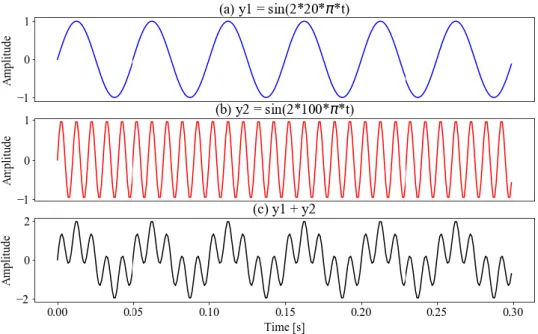
Since the frequency of coma and brain-death EEG was lower than 40Hz, 80 sets of
standard artificial signals were selected to test the computational performance of 3
static EMD-based algorithms. Each of standard artificial signals was composed of a
low frequency sinusoidal signal of each different frequency and the high frequency
sinusoidal signal of 100 Hz, in which the frequency range of the low frequency
sinusoid signals was 0∼40Hz and the interval frequency was 0.5Hz. Take a simple
example shown in figure. 2.1.
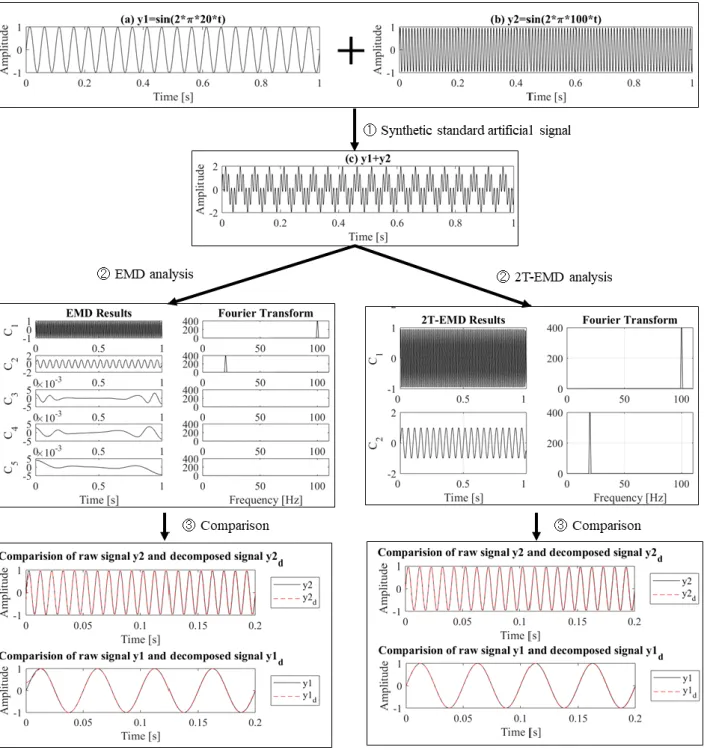
Fig. 2.1 Standard artificial signals. (a) was the low frequency sinusoidal signal of 20Hz, (b)
was the high frequency sinusoidal signal of 100 Hz, (c) was the standard artificial signals composed by (a) and (b).
2.1.2 Coma and Brain-Death EEG
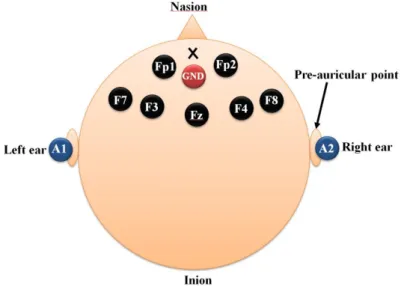
The EEG data we used in the paper were recorded in EEG preliminary examination
11
families [27]. During the EEG recording, patient was lying on the bed in the ICU. And
the EEG data was detected by the portable NEUROSCAN ESI-64 system and a laptop
computer. Six exploring electrodes (Fp1, Fp2, F3, F4, F7, F8) as well as one ground
electrode (GND) were placed on the forehead, and two reference electrodes (A1, A2)
were placed on earlobes. And the sampling frequency was 1000Hz and the electrode
resistance was lower than 8KΩ. The placement of electrodes was shown in figure. 2.2. In this paper, the EEG of 35 coma and quasi-brain-death patients (male:21; female:14)
with a total of 36 cases of EEG (coma:19; quasi-brain-death:17), in which there were
one case of EEG in coma and one case of EEG in quasi-brain-death included in the
same special patient whose state was from coma state in the first EEG recording
process to quasi-brain-death state in the second EEG recording process after about 10
hours.
Fig. 2.2 The placement of 9 electrodes.
2.2 Energy Feature Extraction Methods
2.2.1 Static EMD-Based Algorithms
Static EMD-based algorithms, EMD, MEMD and 2T-EMD are fully data-driven
algorithms for multiscale decomposition and time-frequency analysis of real-valued
12
non-linear and non-stationary signal is decomposed into a finite set of IMFs (Intrinsic
Mode Functions) and a monotonic residual signal based on local time feature scale of
signal. As shown in figure 2.3. Here the IMF must satisfy two conditions, one is the
number of zero crossing and the number of extrema differing at most by one, and the
other is that the upper and lower envelopes of the signal are symmetrical.
As described in formula (2-1), for a real-valued signal 𝑥(𝑡), the algorithm principle of EMD is to decompose 𝑥(𝑡) into a finite set of IMFs ∑𝑛=𝑁𝑛=1 𝐼𝑀𝐹𝑛 and a monotonic residual signal 𝑟(𝑡).
𝑥(𝑡) = ∑𝑛=𝑁𝑛=1 𝐼𝑀𝐹𝑛+ 𝑟(𝑡) (2-1)
Fig. 2.3 Basic Schematic of static EMD-based algorithms.
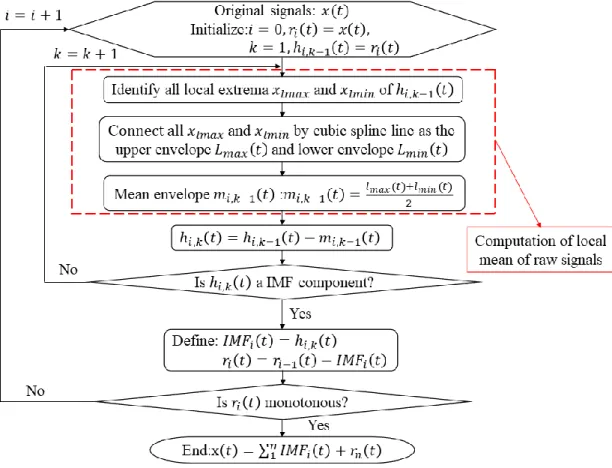
The principle flow chart of EMD is shown in figure 2.4. The key of EMD
algorithm is the computation of local mean of the original signal, which is computed
by taking the average of upper envelopes and lower envelopes. The envelope is
obtained by connecting all local extrema through using cubic spline line. Specifically,
for a single channel signal 𝑥(𝑡), extract all local maximum 𝑥𝑙𝑚𝑎𝑥 and all local
minimum 𝑥𝑙𝑚𝑖𝑛, and connect all 𝑥𝑙𝑚𝑎𝑥 and 𝑥𝑙𝑚𝑖𝑛 by using cubic spline line respectively to get the upper envelope 𝐿𝑚𝑎𝑥(𝑡) and lower envelope 𝐿𝑚𝑖𝑛(𝑡). Then
13
Fig. 2.4 The principle flow chart of EMD.
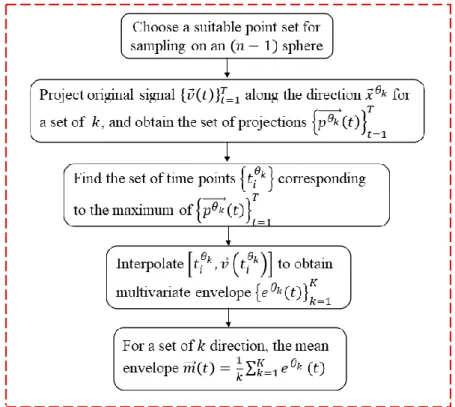
But for multivariate signals, the local extrema may not be defined directly. The
MEMD algorithm solved this problem by taking signal projections along different
directions in n-dimensional spaces, and these signal projections are then averaged to
obtain the local mean. More specifically, for a multivariate signal with n components
{𝑣⃗(𝑡)}𝑡=1𝑇 = {𝑣
1(𝑡), 𝑣2(𝑡), ⋯ 𝑣𝑛(𝑡)}𝑡=1𝑇 which is a sequence of n-dimensional
vectors, and a set of direction vectors {𝑥⃗𝜃𝑘}
𝑘=1 𝐾
= {𝑥𝜃1, 𝑥𝜃2, ⋯ , 𝑥𝜃𝐾} that are along
the directions given by angels {𝜃⃗𝑘}
𝑘=1 𝐾
= {𝜃1, 𝜃2, ⋯ 𝜃𝐾} on a (𝑛 − 1) sphere, the computation of local mean of MEMD algorithm is shown in figure 2.5 [29].
Although the MEMD algorithm can be used to decompose multivariate signals,
with using real-valued projections along multiple directions on hyperspheres in order
to calculate the local mean of the multivariate signals, which may result in a large
14
Fig. 2.5 Flow chart of the computation of local mean for MEMD.
The 2T-EMD offers the possibility to decompose multi-channel signals without
projections by redefining and computing the signal mean envelope, and the
re-definition of the signal mean trend, which is obtained by interpolating between
barycenter of particular oscillation, or called elementary oscillation. Specifically, the
key of 2T-EMD is the computation of signal mean trend, which is obtained by
averaging two envelopes: a first envelope interpolates the even indexed barycenters
which include signal borders, and a second envelope interpolates the odd indexed
barycenters which also include signal borders [30]. Moreover, the 2T-EMD can
process single and multi-channel signals. Let s be a class 𝐶1 function in 𝑅𝐷
domain and differentiable with a continuous first derivative. The sifting procedure of
computing the signal mean trend is briefly illustrated as Algorithm (1) [31]. And the
15
Algorithm 1 2T-EMD Algorithm
1. Defined a time series 𝑇⃗⃗(𝑠) as the tangent vector to s and express as: 𝑇⃗⃗(𝑠): 𝑡 → [1,𝑑𝑠
𝑑𝑡(𝑡)]
2. Defined 𝛼𝑠 as the Euclidean inner products of 𝑅𝐷+1 and express as:
𝛼𝑠: 𝑡 → 𝑙𝑖𝑚 ℎ→0〈𝑇
⃗⃗𝑠(𝑡 − ℎ), 𝑇⃗⃗𝑠(𝑡 + ℎ)〉
Due to the continuity of Euclidean inner product, so αs can be expressed as:
∀𝑡 ∈ 𝑅, 𝛼𝑠(𝑡) = 𝑙𝑖𝑚
ℎ→0〈𝑇⃗⃗𝑠(𝑡 − ℎ), 𝑇⃗⃗𝑠(𝑡 + ℎ)〉
3. Since s is a class 𝐶1 function, we can get the formula below:
∀𝑡 ∈ 𝑅, 𝛼𝑠(𝑡) = ‖𝑇⃗⃗𝑠(𝑡)‖2 = 1 + ‖𝑑𝑠 𝑑𝑡(𝑡)‖
2
Where ‖∙‖ refers to the Euclidean norm of both 𝑅𝐷 and 𝑅𝐷+1. 4. Oscillation extremum of function 𝑠(𝑡) is defined as below:
𝛽𝑠(𝑡): 𝑡 → 𝛽𝑠(𝑡) = ‖𝑑𝑠 𝑑𝑡(𝑡)‖
2
5. Take two consecutive oscillation extrema, respectively 𝑃1 = [𝑡1, 𝑠(𝑡1)] 𝑇 and
𝑃2 = [𝑡2, 𝑠(𝑡2)] 𝑇, thereby 𝑀
𝑃1−𝑃2, the barycenter of the associated elementary
oscillation is defined as below:
𝑀𝑃1−𝑃2 = [ 𝑡1 + 𝑡2 2 , 1 𝑡1− 𝑡2 ∫ 𝑠(𝑡)𝑑𝑡 𝑡1 𝑡2 ] 𝑇
6. The mean vector 𝑒⃗(𝑡) of signal can be obtained according to the definition. In conclusion, there are two aspects of principle differences among EMD, MEMD,
and 2T-EMD, respectively the number of channels analyzed and the computation
method of local mean of original signals. The comparison of EMD, MEMD, and
16
Fig. 2.6 Flow chart of the computation of local mean for 2T-EMD.
Table 2-1 Algorithm Principle Comparison among EMD, MEMD, and 2T-EMD
Method Similarity
Differences
Type of signal Computation method of local mean EMD Original signal 𝒔(𝒕) ∑ 𝑰𝑴𝑭𝒊 𝒏 𝒊=𝟏 + 𝒓(𝐭) (𝒓(𝒕) is residual) Single channel
The local mean is calculated as the half sum of the upper and the lower envelopes, obtained by interpolating between local minima and maxima using cubic splines.
MEMD Multi-channel
Take signal projections along different directions in n-dimensional spaces, and averaged corresponding projections to obtain the local mean.
2T-EMD Single channel
and multi-channel
17
2.2.2 Dynamic 2T-EMD
In order to observe dynamic changes of EEG energy and reduce the influence by
noise, Dynamic 2T-EMD is developed by extending 2T-EMD with excellent static
EEG energy computational performance. As is shown in figure 2.7, a time window
that the width is ∆𝑡 and a time step with the width ∆𝜆 are introduced in the Dynamic 2T-EMD algorithm, where ∆𝑡 and ∆𝜆 are controllable parameters. With the time window sliding along the time axis in a time step, a time step of EEG is
processed and value is stored. Then steps above are repeated to get the dynamic EEG
energy features [32].
Fig. 2.7 Schematic diagram of Dynamic 2T-EMD
18
Algorithm 2 Dynamic 2T-EMD Algorithm
1. Initialize the number of iteration 𝑗 = 1, the number of IMF 𝑖 = 1,, and the number of time step 𝑘 = 0; and set 𝑟⃗𝑖(𝑘 ∙ ∆𝑡) = {𝑠⃗(𝑘 ∙ ∆𝑡)}𝑘=0𝐾 , ℎ⃗⃗
𝑖,𝑗−1(𝑘 ∙ ∆𝑡) =
𝑟⃗𝑖(𝑘 ∙ ∆𝑡).
2. Compute the barycenter 𝑀(𝑖,𝑗−1)
𝑃𝑘𝑥−𝑃𝑘𝑥+1(𝑘 ∙ ∆𝑡) of random consecutive
oscillation extrema 𝑃𝑘𝑥 and 𝑃𝑘𝑥+1 in the period of 𝑘 ∙ ∆𝑡 , that is 𝑀(𝑖,𝑗−1) 𝑃𝑘𝑥−𝑃𝑘𝑥+1(𝑘 ∙ ∆𝑡) = [ 𝑘𝑥∙∆𝑡+𝑘𝑥+1∙∆𝑡 2 , 1 𝑘𝑥∙∆𝑡−𝑘𝑥+1∙∆𝑡∫ ℎ ⃗⃗𝑖,𝑗−1(𝑡)𝑑𝑡 𝑘𝑥∙∆𝑡 𝑘𝑥+1∙∆𝑡 ] 𝑇 .
3. Obtain the signal mean trend 𝑒⃗𝑖,𝑗−1(𝑘 ∙ ∆𝑡) by interpolating between oscillation
barycenters of ℎ⃗⃗𝑖,𝑗−1(𝑘 ∙ ∆𝑡).
4. Subtract e⃗⃗i,j−1(k ∙ ∆t) from the given signals ℎ⃗⃗𝑖,𝑗−1(𝑘 ∙ ∆𝑡) , we define
ℎ⃗⃗𝑖,𝑗(𝑘 ∙ ∆𝑡) = ℎ⃗⃗𝑖,𝑗−1(𝑘 ∙ ∆𝑡) − 𝑒⃗𝑖,𝑗−1(𝑘 ∙ ∆𝑡). If ℎ⃗⃗𝑖,𝑗(𝑘 ∙ ∆𝑡) obey the sifting stop
criteria, define 𝐼𝑀𝐹⃗⃗⃗⃗⃗⃗⃗⃗⃗𝑖(𝑘 ∙ ∆𝑡) = ℎ⃗⃗𝑖,𝑗(𝑘 ∙ ∆𝑡), otherwise repeat the iteration steps from (2) to (4). It is worth noting that the stop criteria is using the Cauchy-like
criteria, more precisely, let 𝑑𝑖,𝑗 be the 𝑖 − 𝑡ℎ IMF computed at the 𝑗 − 𝑡ℎ iteration of the sifting process, then the sifting criteria is for instance 90% of
values ‖𝑑𝑖,𝑗+1(𝑡)−𝑑𝑖,𝑗(𝑡)
𝑑𝑖,𝑗(𝑡) ‖ are lower than 10-2.
5. Define 𝑟⃗𝑖(𝑘 ∙ ∆𝑡) = 𝑟⃗𝑖(𝑘 ∙ ∆𝑡) − 𝐼𝑀𝐹⃗⃗⃗⃗⃗⃗⃗⃗⃗𝑖(𝑘 ∙ ∆𝑡), if the result signal is monotonous, we can get the decomposition results of signals during 𝑘 ∙ ∆𝑡, that is 𝑠⃗(𝑘 ∙ ∆𝑡) = ∑𝑁 𝐼𝑀𝐹⃗⃗⃗⃗⃗⃗⃗⃗⃗𝑖(𝑘 ∙ ∆𝑡) + 𝑟⃗𝑁(𝑘 ∙ ∆𝑡)
𝑖=1 , otherwise repeat steps from (2) to (5).
6. Determine whether the elapsed time 𝑘 ∙ ∆𝑡 exceeds the end time 𝑇2, if it does,
the process goes to end and the final decomposition result {𝑠⃗(𝑘 ∙ ∆𝑡)}𝑘=0𝐾 = {∑𝑁 𝐼𝑀𝐹⃗⃗⃗⃗⃗⃗⃗⃗⃗𝑖(𝑘 ∙ ∆𝑡) + 𝑟⃗𝑁(𝑘 ∙ ∆𝑡)
𝑖=1 }𝑘=0
𝐾
; If it doesn't, moving the time window and
19
2.3 Results
2.3.1 Results of Comparison among 3 Static EMD-Based Algorithms
In this section, EMD, MEMD and 2T-EMD were compared from experimental
aspect based on standard artificial signals and coma and brain-death patients’ EEG
respectively, in which signal representation accuracy and computational time were
compared for standard artificial signals as well as computational time was compared
based on coma and brain-death patients’ EEG. Here signal representation accuracy
was denoted by root-mean-square error (RMSE), shown as formula (2-2). RMSE was
used to measure the deviation of processed value and original value, where N is
sampling frequency, 𝑥𝑖 is the amplitude of artificial signals after processing by
algorithms, 𝑜𝑖 is the amplitude of original standard artificial signals. RMSE = √1
𝑁∑ (𝑥𝑖− 𝑜𝑖) 2 𝑁
𝑖=1 (2-2)
A. Results Based on Standard Artificial Signals
The first part is that EMD, MEMD and 2T-EMD were compared based on standard
artificial signals. From the content explained in section 2.2.1, we know that EMD
algorithm and MEMD algorithm can only be used to process single channel signals
and multi-channel signals respectively, while 2T-EMD can process both single and
multi-channel signals. So comparison between EMD and 2T-EMD based on single
channel standard artificial signals, and comparison between MEMD and 2T-EMD
20
Fig. 2.8 Analysis process of EMD and 2T-EMD based on single channel standard artificial
signals. The upper panel ① was the synthesis process of two sinusoid signals 𝑦1 = 𝑠𝑖𝑛 (2 ∗ 𝜋 ∗ 20 ∗ 𝑡) and 𝑦2 = 𝑠𝑖𝑛 (2 ∗ 𝜋 ∗ 100 ∗ 𝑡); the middle panel ② was the decomposition process of EMD, 2T-EMD and their corresponding Fourier Transform process; the lower panel ③ was the comparison of raw signals and decomposed signals.
21
signals explained in section 2.1.1. As shown in figure 2.8 was a simple example to
explain intuitively the analysis process of EMD and 2T-EMD based on standard
artificial signals.
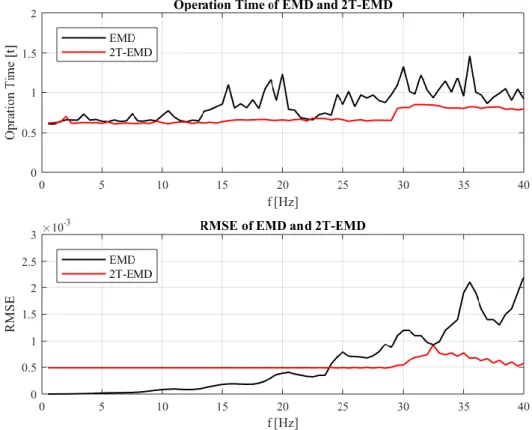
Fig. 2.9 Comparison of operation time and RMSE for EMD and 2T-EMD based on single
channel standard artificial signals.
As is shown in the upper panel of figure 2.9, the computational time of 2T-EMD is
less than 1s and remains the stable duration range of 0.6s ~ 0.85s, while the computational time of EMD fluctuates greatly in the range of 0.6s ~ 1.6s, and is longer than that of 2T-EMD, even reach twice of 2T-EMD. It takes different
computation time to decompose signals of different frequencies for EMD algorithm,
while it almost takes the same computation time for 2T-EMD. And as is shown in the
22
has better integrated performance in both computational time and the signal
representation accuracy based on single channel standard artificial signals.
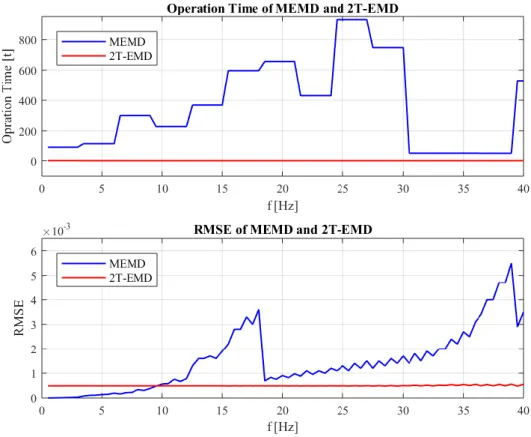
Fig. 2.10 Comparison of operation time and RMSE for MEMD and 2T-EMD based on
multi-channels standard artificial signals.
Secondly, computational time and RMSE of MEMD and 2T-EMD based on
multi-channel standard artificial signals were compared. In this comparison, the
number of multi-channel was set to 6, and the 80 synthetic artificial standard signals
mentioned in section 2.1.1 were divided into 13 groups, with 6 channels per group
from low to high frequency.
B. Results Based on Coma and Brain-Death Patients’ EEG
In the second part, the computational time of EMD, MEMD and 2T-EMD based on
patients' EEG explained in section 2.1.2 were compared. And it was also divided into
two aspects, where one is comparison between EMD and 2T-EMD based on patients'
23
on patients' EEG of multi-channel.
Firstly, EMD and 2T-EMD are used to analyze 36 cases of patients’ EEG data for
random single channel. As is shown in figure 2.11, the computational time of
2T-EMD algorithm is 1.5s ~2.0s, slightly shorter than that of EMD algorithm, which is in the range of 1.9s ~6.8s. So it takes shorter time to process single channel EEG for 2T-EMD compared with EMD.
Fig. 2.11 Comparison of operation time for EMD and 2T-EMD based on 36 cases of coma
and brain-death patients’ EEG.
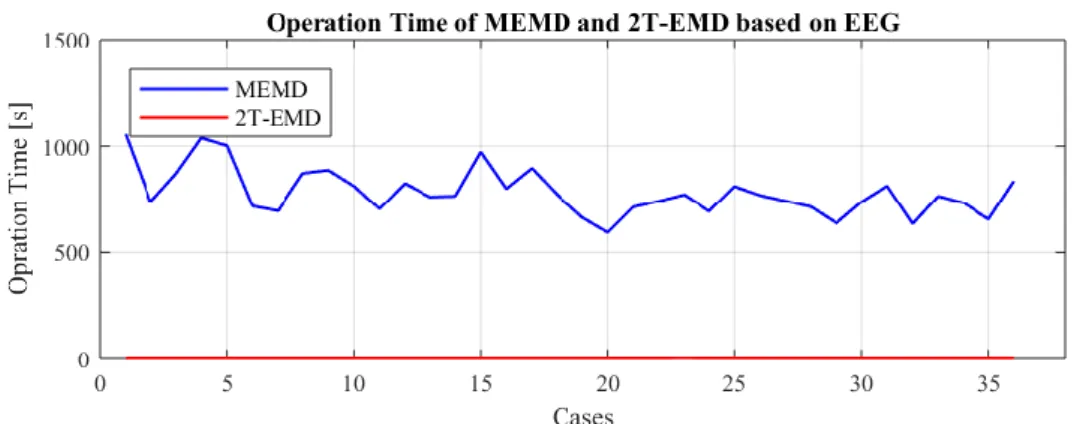
Fig. 2.12 Comparison of operation time for MEMD and 2T-EMD based on 36 cases of coma
and brain-death patients’ EEG.
Secondly, MEMD and 2T-EMD were used to decompose the 36 cases of coma and
brain-death patients' EEG data for 6 channels. As is shown in figure 2.12, the
24
2T-EMD algorithm works much faster than MEMD algorithm for multi-channel EEG.
In summary, it is obvious that the optimal computational performance of 2T-EMD
is the best among EMD, MEMD, 2T-EMD for both single and multi-channel signals
[33].
2.3.2 Results of Dynamic 2T-EMD Based on Patients’ EEG
In this section, the EEG of 35 coma and brain-death patients (male: 21; female: 14)
with a total of 36 cases of EEG (coma: 19; quasi-brain-death: 17) were processed by
Dynamic 2T-EMD and descriptive statistics measure, in order to obtain the
differences of EEG energy between coma patients and brain-death patients.
Specifically, it was explained from overall and individual aspects. Firstly, in order to
give an overall dynamic EEG energy distribution results for coma group and
brain-death group, 60s EEG data were randomly selected from every of 36 cases of
coma and brain-death EEG, and analyzed by Dynamic 2T-EMD and descriptive
statistics measure. Secondly, from individual point of view, two typical cases of EEG
from two different patients who were in coma and brain-death state respectively, and
one special patient whose EEG was from coma state to brain-death state were
processed by Dynamic 2T-EMD.
A. Results for 36 Cases of Coma and Brain-Death Patients’ EEG
Since coma and brain-death patients’ EEG data were recorded in the ICU, which
were mixed with complex noise, statistical analysis visual analysis were used to
analyze the energy data processed by Dynamic 2T-EMD to improve the accuracy and
reliability of results. In this paper, we focused on visual descriptive statistical analysis
method. Descriptive statistics are summary statistics that quantitatively describe or
summarize features of a collection of information [34]. Here basic measures of
25
were applied to evaluate dynamic energy data obtained, in which mean and median
were used to describe the central tendency of data set, and standard deviation and
percentile were introduced to evaluate the dispersion of data set.
Descriptive statistical analysis was conducted to EEG energy features processed by
Dynamic 2T-EMD. Specifically, since duration of every case of EEG was different,
60s EEG data were selected from 19 cases of EEG in coma state and 17 cases of EEG
in brain-death state to process by using Dynamic 2T-EMD algorithm to extract EEG
energy features firstly. And EEG energy features obtained were grouped from three
aspects, which were different cases, different channels, and different states
respectively. And then the EEG energy features grouped were evaluated by applying
descriptive statistical analysis.
There were 4 steps to conduct the experiment measure:
(1) Select randomly 60s EEG data from 36 cases of coma and quasi-brain-death
patients’ EEG (coma: 19; quasi-brain-death: 17). Here there were 5 channels of EEG data with values equal 0 from 3 cases of EEG invalid.
(2) Process these EEG data by applying Dynamic 2T-EMD algorithm and 211
time-energy series (36 cases × 6 channels - 5 invalid series) were obtained.
(3) Group the 211 time-series according to 3 ways:
① Divide the 211 time-series into 36 groups according to 36 cases.
② Divide the 211 time-series into 12 groups according to 2 states and 6 channels. ③ Divide them into 2 groups according to 2 states.
(4) Analyze time-energy series after grouping by using descriptive statistical analysis,
in which the mean and median were computed to evaluate the central tendency and
26
Fig. 2.13 The statistical analysis results of EEG energy for 36 coma and quasi-brain-death
EEG for average channel.
a. Static Statistical Results for 36 Cases of Patients’ EEG
In this part, 211 time-energy series were grouped into 36 set of data based on cases.
The mean, median, standard deviation and quantile were computed for every case for
27
and median of EEG energy for coma case is higher than that for brain-death case for
average channel. Here the mean and median energy fluctuation range of coma cases
are 1.10 × 10⁴ ~ 6.66 × 10⁴ and 1.01 × 10⁴ ~ 6.22 × 10⁴, which are higher than 1.00 × 10⁴, while the mean and median energy fluctuation range of brain-death cases
are 2.48 × 10³ ~ 9.13 × 10³ and 2.40 × 10³ ~ 8.86 × 10³, which are no lower than 1.00 × 10⁴. Moreover, it is also shown that the variance range of standard
deviation of coma cases is wider than that for brain-death cases from figure 2.13(b)
and figure 2.13(c).
b. Static Statistical Results Based on 2 States – 6 Channels
Fig. 2.14 The statistical analysis results of EEG energy for coma group and quasi-brain-death
group at each channel.
In order to get characteristics of EEG energy for coma group and brain-death group
in different channels of this batch of EEG energy data, 211 time-energy series were
grouped into 12 set of data based on 2 states and 6 channels. Mean, median, standard
deviation and quantile were also calculated for the 12 set of data. As shown in figure
2.14(a), (b) and (c), it is obviously observed that the mean and median of coma group
is higher than that of brain-death group for every channel, and the range of energy
change of every channel for coma group is wider than that for brain-death group.
28
value of every channel for 2 groups were shown in Table 2-2 and table 2-3, in which
percent is defined as 𝑝𝑒𝑟𝑐𝑒𝑛𝑡 =(𝑀𝑒𝑎𝑛−𝑀𝑒𝑑𝑖𝑎𝑛)
𝑀𝑒𝑎𝑛 , it is used to measure the difference
between mean and median value. In general, it is shown that the percent for
brain-death group is lower compared with the percent for coma group.
Table 2-2 Mean, median and percent of EEG energy for coma group at every channel.
Coma Channel Fp1 Fp2 F3 F4 F7 F8 Mean 31946 32951 31666 28708 23772 23804 Median 23735 24299 26274 24351 17303 18872 Percent 25.7% 26.3% 17.0% 15.18% 27.2% 20.7%
Table 2-3 Mean, median and percent of EEG energy for brain-death group at every channel Brain- death Channel Fp1 Fp2 F3 F4 F7 F8 Mean 3899 4147 4410 4756 4201 4962 Median 3461 3734 3581 3787 3521 4564 Percent 11.23% 9.96% 18.80% 20.37% 16.19% 8.02%
Here the characteristics of energy for coma group and brain-death group for
average channel were shown in figure 2.15, in which there were 114 time–energy
series (19 cases × 6 channels - 5 invalid series) for coma group and 102 time-energy
series (17 cases × 6 channels) for brain-death group. As can be seen from figure 2.15
(a) and figure 2.15 (b), the distribution of energy data for coma group is intuitively
higher than that for brain-death group, in which the mean of both group are
2.88 × 10⁴ and 4.40 × 10³, and the median of both group are 2.24 × 10⁴ and
29
c. Static Statistical Results Based on 2 States – Average Channel
Fig. 2.15 The error bar and box plot of coma group and brain-death group for average
channel.
d. Dynamic Statistical Results Based on 2 States – Average Channel
In this part, 19 cases of EEG data for coma group and 17 cases of EEG data for
brain-death group were analyzed by Dynamic 2T-EMD. Here the time window of
Dynamic 2T-EMD was set to 1s and no overlap among time windows. Then we took
mean value, 5 quantile values (5%, 25%, 50%, 75%, and 95%) of every second for
channels averaged for coma group and brain-death group respectively due to the two
groups were not balanced. As shown in figure 2.16, it is obviously observed that the
dynamic EEG energy distribution of channels averaged for coma group is higher than
that for brain-death group.
30
averaged channels. Coma group is marked in black and brain-death group is marked in red. Thick lines show median line of data. Thick dashed lines show mean line of data. Dark filled bands highlight 25%-75% of data. Light filled bands highlight 5%-95% of data.
And as shown in figure 2.17, we also analyzed the dynamic EEG energy
distribution for every channel (Fp1, Fp2, F3, F4, F7 and F8) for both coma group and
brain-death group. It is shown there exists significant differences of EEG energy
distribution among different channels for coma group and brain-death group.
Fig. 2.17 Dynamic EEG energy distribution of coma group and brain-death group for 6
channels.
A. Results for 2 Typical Cases and 1 Special Case of Patients’ EEG a. Results for 2 Typical Cases of Coma and Brain-Death Patients’ EEG
31
In this part, we selected 60s EEG data from the coma patient's EEG with recording
time of 937s as well as 60s EEG data from the brain-death patient's EEG with
recording duration of 905s. As is shown in figure 2.18, it is intuitively observed the
dynamic change of EEG energy for the two typical cases. The range of dynamic EEG
energy of the coma patient's EEG is 3.5 × 10⁴ ~ 1.1 × 10⁵, while it's 1.8 × 10³ ~ 4.1 × 10³ for the brain-death patient's EEG.
a. Results for 1 Special Cases of Patient’s EEG from Coma State to Brain-Death State
Moreover, the special patient's EEG whose state was from coma to brain-death state
was processed, in which 60s EEG data from coma EEG segment and 60s EEG data
from brain-death segment were selected to analyzed by Dynamic 2T-EMD. As is
shown in figure 2.18, for the same patient, the EEG energy distribution for coma state
is higher than that for brain-death state, which is consistent with that for coma group
and brain-death group. And the distribution range of EEG energy for the special
patient' EEG decreases from 1.7 × 10⁴ ~ 4.1 × 10⁴ to 2.4 × 10³ ~ 5.8 × 10³ [35].
Fig. 2.18 Dynamic EEG energy distribution of average channel for the patient who was from
coma state to brain-death state.
2.4 Chapter Summary
In this chapter, three static EMD-based EEG energy extracted algorithms (EMD,
32
from algorithm principle and experiments, where experiments based on both standard
artificial signals and quasi-brain-death patients’ EEG respectively. Hereafter, the
Dynamic 2T-EMD algorithm is firstly proposed by dynamically extending 2T-EMD.
Then 36 cases of coma and brain-death patients’ EEG were analyzed by the proposed
algorithm. Moreover, two typical patients’ EEG who were in coma state and in
brain-death state respectively, as well as one special patient’s EEG who was from
coma state to brain-death state were also analyzed by Dynamic 2T-EMD from
individual perspective. EEG energy features obtained then analyzed by descriptive
statistical measure. Final results illustrated that there was a significant differences of
33
Chapter 3 Epilepsy EEG Analysis
3.1 Materials
Fig. 3.1 EEG time series of Bonn dataset
The epilepsy EEG dataset used in this paper is from the Department of
Epileptology at the University of Bonn [36]. The dataset is public available and used
widely in the research of epilepsy EEG data analysis and classification. There were 5
sets in the dataset, denoted as set A, set B, set C, set D and set E. Each of set
contained 100 single-channel EEG segments with recording duration of 23.6s per
segment. The sampling rate and band-pass filter were set 173.61Hz and 0.53∼40Hz. In
details, set A and set B were surface EEG recordings taken from five healthy
volunteers who were relaxed in an awake state with eyes open (A set) and eyes closed
(B set). Set C, set D and set E were intracranial EEG recordings originated from five
patients, in which set C and set D were taken from during seizure free intervals from
34
D), set E were taken from epileptic seizure activity. In this part, C set, D set and E set
were studied. As shown in figure 3.1 is the EEG time series of C set, D set and E set
for Bonn dataset.
3.2 Methodology
3.2.1 Phase-Amplitude Coupling
Fig. 3.2 The process of filtering and Hilbert Transform. (a) was the single-channel time series
𝑥⃗(𝑛) (𝑛 = 1, … , 𝑁) . (b) and (c) were the low-frequency oscillation 𝑥⃗⃗⃗ (𝑛) and 𝑙
high-frequency oscillation 𝑥⃗⃗⃗⃗ (𝑛) filtered by band-pass filter, where the range of ℎ
low-frequency and high-frequency were set to 4Hz – 8Hz and 30Hz – 40Hz. (d) and (e) were low-frequency phase time series ∅⃗⃗⃗ (𝑛) and high-frequency amplitude time series 𝑎𝑙 ⃗⃗⃗⃗ (𝑛) ℎ
computed by Hilbert Transform.
Phase-amplitude coupling is explained as that the high-frequency amplitude is
35
high-frequency amplitude time series were computed firstly before evaluating the
phase-amplitude coupling strength. In this paper, band-pass filtering and Hilbert
Transform were used, in which FIR (finite impulse response) filters was applied to
filter. Take an example, for a single-channel time series 𝑥⃗(𝑛) (𝑛 = 1, … , 𝑁) , band-pass filtered was applied to extracted high-frequency oscillation interested
𝑥ℎ
⃗⃗⃗⃗ (𝑛) and low-frequency oscillation interested 𝑥⃗⃗⃗ (𝑛). Then Hilbert Transform was 𝑙 used to extract corresponding instantaneous phase and instantaneous amplitude of
both oscillations. As shown in formula (3-1), we got two analytic signals.
𝑧𝑙 ⃗⃗⃗ (𝑛) = 𝑎⃗⃗⃗ (𝑛)𝑒𝑙 𝑖∅⃗⃗⃗⃗ (𝑛)𝑙 , 𝑎 𝑙 ⃗⃗⃗ (𝑛) = |𝑧⃗⃗⃗ (𝑛)| 𝑙 𝑧ℎ ⃗⃗⃗⃗ (𝑛) = 𝑎⃗⃗⃗⃗ (𝑛)𝑒ℎ 𝑖∅⃗⃗⃗⃗⃗ (𝑛)ℎ , 𝑎 ℎ ⃗⃗⃗⃗ (𝑛) = |𝑧⃗⃗⃗⃗ (𝑛)| (3-1) ℎ Where ∅⃗⃗⃗ (𝑛) and ∅𝑙 ⃗⃗⃗⃗ (𝑛) were the instantaneous phase time series, as well as ℎ
𝑎𝑙
⃗⃗⃗ (𝑛) and 𝑎⃗⃗⃗⃗ (𝑛) were the instantaneous amplitude time series of both ℎ high-frequency oscillation and low-frequency oscillation. It is shown in figure 3.2 that
the process of band-pass filtering and Hilbert Transform before computing coupling
strength.
A. Modulation Index (MI) of Phase-Amplitude Coupling
There are five methods to quantify the phase-amplitude coupling strength also
called MI. The first method was proposed by Canolty et.al, which evaluated
phase-amplitude coupling strength by computing the normalized MI [37]. The
algorithm is illustrated as Algorithm (3).
Algorithm 3 Phase-amplitude coupling algorithm proposed by Canolty
1. Defined a complex variable, where ah is the amplitude time series of high
frequency oscillation, ∅⃗⃗⃗ is the phase time series of low frequency oscillation: 𝑙
36
2. Compute the absolute value of the mean vector based on 𝑧 (𝑛) and defined the result as ‘MI’: 𝑀𝑟𝑎𝑤 = |1 𝑁∑ 𝑍 (𝑛) 𝑁 𝑛=1 |
3. Using surrogate data approach to compute the surrogate 𝑧⃗⃗⃗ (𝑛) (𝑛 = 1, … , 𝑁; 𝑠 =𝑠 1, … , 𝑆) by introducing an arbitrary time lag between ∅⃗⃗⃗ and 𝑎𝑙 ⃗⃗⃗⃗ . And compute the ℎ mean vector 𝑀𝑠 = |
1
𝑁∑ 𝑧⃗⃗⃗ (𝑛)𝑠 𝑁
𝑛=1 | of 𝑧⃗⃗⃗ (𝑛) as step 2. 𝑠
4. Repeat the step 3 for 𝑠 = 1, … , 𝑆 times to obtain the surrogate values 𝑀1, … , 𝑀𝑆, and compute the mean 𝜇 and standard variance 𝜎 of these surrogate values.
5. Compute the normalized modulation index which is denoted as 𝑀:
𝑀 =𝑀𝑟𝑎𝑤− 𝜇 𝜎
The second method to quantify the phase-amplitude coupling is the PLV
(phase-locking value) method [38-40]. The algorithm is illustrated as Algorithm (4).
Algorithm 4 The Phase-amplitude coupling algorithm based on PLV
1. Apply secondly Hilbert Transform to 𝑎⃗⃗⃗⃗ , and get the analytic signal of 𝑎ℎ ⃗⃗⃗⃗ as ℎ
below:
𝑍𝑎ℎ
⃗⃗⃗⃗⃗⃗ = 𝑎⃗⃗⃗⃗⃗⃗ (𝑛)𝑒𝑎ℎ 𝑖∅⃗⃗⃗⃗⃗⃗⃗⃗ (𝑛)𝑎ℎ (𝑛 = 1, … , 𝑁)
Where 𝑎⃗⃗⃗⃗⃗⃗ (𝑛) and ∅𝑎ℎ ⃗⃗⃗⃗⃗⃗ (𝑛) are the amplitude time series and phase time series of 𝑎ℎ
𝑎ℎ
⃗⃗⃗⃗ (𝑛).
37 𝑃𝐿𝑉 = |1 𝑁∑ 𝑒 𝑖(∅⃗⃗⃗⃗ (𝑛)−∅𝑙 ⃗⃗⃗⃗⃗⃗⃗⃗ (𝑛))𝑎ℎ 𝑁 𝑛=1 |
Where the PLV value is used to measure the coupling strength.
The third method to measure the phase-amplitude coupling was based on GLM
(general linear model) [41]. The algorithm is explained in Algorithm (5).
Algorithm 5 The Phase-amplitude coupling algorithm based on GLM
1. Create a new high-frequency amplitude model by introducing a multiple regression
as below and compute the residual vector 𝑒 . 𝑎ℎ ⃗⃗⃗⃗ = 𝑋 𝛽 + 𝑒 Where 𝑋 = [𝑐𝑜𝑠 (∅⃗⃗⃗ (𝑛)) 𝑠𝑖𝑛 (∅𝑙 ⃗⃗⃗ (𝑛))𝑙 1 ⋮ 1 ] 𝑁×3 (𝑛 = 1, … 𝑁) , 𝛽⃗⃗⃗ are regression
coefficients by using Least-Squares solution, 𝑐𝑜𝑠 (∅⃗⃗⃗ (𝑛)) and 𝑠𝑖𝑛 (∅𝑙 ⃗⃗⃗ (𝑛)) are the 𝑙
cosine and sine transform of low-frequency phase time series respectively.
2. Compute the value described as the model:
𝑟𝐺𝐿𝑀2 = 𝑆𝑆(𝑎⃗⃗⃗⃗ ) − 𝑆𝑆(𝑒 )ℎ 𝑆𝑆(𝑎⃗⃗⃗⃗ )ℎ
Where 𝑆𝑆(𝐴ℎ) and 𝑆𝑆(𝑒) are the sum of squares of high-frequency amplitude time series 𝑎⃗⃗⃗⃗ and the sum of squares of error 𝑒 . The 𝑟ℎ 𝐺𝐿𝑀2 is used to quantify the coupling strength.
The fourth method to measure the phase-amplitude coupling was based on an
adaptive of the KL distance (Kullback-Leibler distance) [42]. The algorithm is
explained in Algorithm (6).
38
1. Construct the composite time series [∅⃗⃗⃗ (𝑡) 𝑎𝑙 ⃗⃗⃗⃗ (𝑡)], which present the amplitude ℎ of low-frequency oscillation at each corresponding phase of the low-frequency
rhythm.
2. Divide the phases ∅⃗⃗⃗ (𝑡) into bins in order, and compute the mean value of 𝑎𝑙 ⃗⃗⃗⃗ (𝑡) ℎ in each phase bin 𝑗, where the mean value is expressed by ⟨𝑎ℎ⟩∅𝑙(𝑗).
3. Normalize the mean value ⟨𝑎ℎ⟩∅𝑙(𝑗): 𝑃(𝑗) = ⟨𝑎𝑓𝐴⟩∅ 𝑓𝑃(𝑗) ∑ ⟨𝑎𝑓𝐴⟩∅ 𝑓𝑃(𝑗) 𝑁_𝑏𝑖𝑛𝑠 𝑗=1
Where N_bins is the number of phase bins.
4. There is no coupling between high-frequency amplitude and low-frequency phase
if the mean value ⟨𝑎ℎ⟩∅𝑙(𝑗) at each phase bin is the same, namely the phase-amplitude distribution 𝑃 is consistent with uniform distribution 𝑈 ; if different, there is coupling. So a new MI is defined to measure the difference of
phase-amplitude distribution and uniform distribution by adapting KL distance. The
new MI is described as:
𝑀𝐼 = 𝐷𝐾𝐿(𝑃, 𝑈) 𝑙𝑜𝑔 (𝑁_𝑏𝑖𝑛𝑠)
Where 𝐷𝐾𝐿(𝑃, 𝑈) = 𝑙𝑜𝑔(𝑁_𝑏𝑖𝑛𝑠) − 𝐻(𝑃), 𝐻(𝑃) = − ∑𝑁_𝑏𝑖𝑛𝑠𝑗=1 𝑃(𝑗)𝑙𝑜𝑔 [𝑃(𝑗)].
The fifth method to quantify the phase-amplitude coupling strength was proposed
by Ozkurt. et.al. [43]. The value to quantify the phase-amplitude coupling strength 𝜌 is defined as below: 𝜌 = 1 √𝑁 |∑𝑁𝑛=1𝑎ℎ(𝑛)𝑒𝑖∅𝑙(𝑛)| √∑𝑁𝑛=1𝑎ℎ(𝑛)2 (𝑛 = 1, … , 𝑁) (3-2) B. Phase-Amplitude Comodulogram
Phase amplitude comodulogram is the graphical representation that exhibits
39
over a grid of frequencies. When there is no priori assumption of frequency bands
phase-modulating and the amplitude-modulated, the comodulogram can be used to
locate initially the frequency bands which coupling occurs. As shown in figure 3.3,
the frequency of phase 𝑓𝑃 is represented in the horizontal axis and the frequency of amplitude 𝑓𝐴 is displayed in the ordinate axis. The phase-coupling strength at the
band [𝑓𝐴(𝑖) 𝑓𝑃(𝑗)] is denoted using a pseudocolor plot with hot color indicating
high coupling strength.
Fig. 3.3 The example of comodulogram.
3.2.2 Support Vector Machine (SVM)
SVM is a supervised learning method based on statistical learning theory (SLT) in
machine learning. The basic model is the linear classifier that defines the largest
interval in the feature space. It maps the vector to the high-dimensional feature space
through nonlinear mapping, and then selects the most classified surface to obtain a
hyperplane segmentation, which can separate the two types of modes and ensure the
interval is maximized. It is suitable for solving classification problems with low
sample size in high-dimensional complex nonlinear systems. For example, as shown
in figure 3.4, for a linear classification in two dimensional plane, there is a binary