2015 年度博士学位論文
A Brain Informatics-Based Study on Human Cognition, Emotion, and Their Relationship
脳情報学に基づく人間の認知・感情とその相互関係における研究
指導教員 鍾 寧教授
前橋工科大学大学院
環境・情報工学専攻 博士後期課程
1236502
Yang Yang 楊 陽
審査員 主査 井田 憲一 教授 副査 今村 一之 教授 鍾 寧 教授 白尾 智明 教授 関 崇夫 教授
Acknowledgements
The author would like to express the sincere appreciations to the thesis committee consisting of Professors Kennichi Ida, Kazuyuki Imamura, Ning Zhong, Tomoaki Shirao, and Takao Seki. I am privileged to have such a strong and interdisciplinary committee.
The dissertation has been finished during the last five years. This work could never been done without the kind guidance of my supervisors Professors Zhong and Imamura.
Thus, I would like to express my greatest gratitude for their wise advice and encouragements. As a student with the background of psychology, Prof. Zhong led me into the field of engineering and taught me how to think creatively and work effectively.
He also demonstrated that the key to success should be greatly attributed to the working attitude, such as the enthusiasm and earnest. His expertise, understanding, guidance and support made it possible for me to work on the cutting-edge researches that were of great interest to me. It was a pleasure working with him. I am highly indebted and thoroughly grateful to Prof. Imamura for his immense interest in my topic of research as well as specialized comments and suggestions. His generous supports enabled me to establish links with other Japanese scholars and academic organizations.
Maebashi Institute of Technology was my academic home for the last years. I am thankful to all members in Zhong’s Laboratory, especially Mr. Taihei Kotake, Dr.
Shinichi Motomura, and Dr. Muneaki Ohshima who helped me improve my language ability, adapt to the life in Japan, and maintain the laboratorial environment. I would also like to express my special thanks to Dr. Juzhen Dong for her warm supports to many aspects in my life and study.
ii
Maebashi Institute of Technology, Doctor Dissertation of Engineering
Yang Yang: A Brain Informatics-Based Study on Human Cognition, Emotion, and Their Relationship
I would like to thank the teachers and students in the International WIC Institute, Beijing University of Technology, especially to Prof. Shengfu Lu, Dr. Haiyan Zhou, and Dr. Mi Li, who shared their valuable research experiences and discussed with me for several times to handle the technical issues occurred during my study.
My deepest gratitude is owned to my parents and grandparents who raised me and have been giving me continuous encouragements to motivate me to pursue further knowledge. Moreover, owe to my parents’ and parents-in-law’s understanding, I could focus on my research without being distracted by family trifles.
Finally, and most importantly, I would like to thank my wife Yunfan Li. Her support, encouragement, quiet patience and unwavering love were undeniably the bedrock upon which the past ten years of my life have been built. Her tolerance of my frequent and perennial leaving is a testament of her unyielding devotion and love. Without her support in life and spirit, this thesis could not be finished, either.
Abstract
This dissertation concentrates on the neural substrates underlying the human cognition, emotion, and their interactions. Directed by the systematic methodology of brain informatics (BI), functional magnetic resonance imaging (fMRI) experiments were performed to investigate the information processing of mental arithmetic, self-regulation of aversive emotion, and attention deployment of patients with major depressive disorder (MDD), which were utilized as typical paradigms to study the relationship between cognition and emotion. Four major findings could be concluded:
1) mental addition calculation is naturally automatic while subtraction calculation is complex; 2) both bottom-up suppression and top-down regulation are engaged in the self-recovery from aversive emotion; 3) cognition and emotion influence each other, since some cognitive resources and brain regions are shared by the both brain functions;
4) Abnormal functioning in the joint brain areas is more likely to lead to impairments in both cognitive and emotional functions simultaneously. Our findings demonstrate that human cognition and emotion are not isolated, but compete for cognitive resources for attention and executive control. The present thesis can also be considered as a case study for demonstrating the advances of BI methodology in accelerating progress towards a multi-level understanding of brain structure and function.
Keywords: Brain informatics, systematic investigation, fMRI, mental arithmetic, DCM, emotion regulation, depression.
iv
Maebashi Institute of Technology, Doctor Dissertation of Engineering
Yang Yang: A Brain Informatics-Based Study on Human Cognition, Emotion, and Their Relationship
研究内容要約:
「脳情報学に基づく人間の認知・感情とその相互関係における研究」
脳情報学は脳を複雑システムとして捉えた上で、人間の脳内情報処理メカニズムと関わる脳ビ ッグデータの収集・分析・管理・利用を横断的に行う新たな研究領域と考えられる。脳情報学の 一つの目標は、まだ明らかになっていない人間の「思考」の基礎にある神経メカニズムの解明で ある。この目標を達成するために、本研究では「多視点の立場・全過程の研究」という脳情報学 の方法論に基づき、機能的磁気共鳴画像法(fMRI)を利用し健常者の基本認知(加減暗算)・感 情(調整)機能・それらの機能の相互関係、及びうつ病患者特有の低下した認知と感情機能を研 究した。
1.暗算時における加減算の認知処理に関する研究
人間は四則演算を行う時に、それぞれに対して用いるストラテジーが異なる。数字の量を比較 して操作をする減算と、記憶に保存された答えを直接取り出す乗算の違いは既に解明されている。
しかし、加算と減算の間に本質的な違いが存在するか否かについては、未だ明らかにされていな い。そこで、この問題に対して fMRI 実験を実施し解明を試みた。一般線形モデルと機能的連結 分析でデータを処理した後の結果、被験者群が減算を行う際に、左脳半球の下前頭回の賦活が加 算した時よりも強く見られた。また、この部位は減算時に音韻処理を担当する脳ネットワークと の関連強度を高めることを発見した。更に、動態的因果モデリング(DCM)分析で減算が音韻や運 動など複数の認知モジュールの統合を要することを示した。一方で、加算は減算と比べ複雑では ないことが確認できた。減算時は加算時に比べ追加の処理が必要であるため、計算時に更に時間 を要し、正答率が低下する。
2.嫌悪状態からの感情回復に関する研究
被験者が嫌悪を感じた後の状態から冷静になるまでの脳の回復過程に注目した。fMRI 実験を 利用して、被験者群が嫌悪を感じる画像を見た後と、特に感情に変化を与えない画像を見た後の 各反応を比較した結果、脳は異なるストラテジーで自動的に感情の反応を調整することを発見し た。感情回復の初期に、脳は左側の尾状核を中心とするネットワークを配置して、受動的な感情 抑制を行う。感情回復の後期になると、抑制ネットワークの賦活が次第に弱くなり、反対に背部 の注意ネットワークの賦活が次第に強くなる。この遷移の間に被験者が能動的に注意のリソース を配分し、自身の注意を恐怖の体験から遠ざけることが明らかとなった。これらの結果から、無 意識下において人間の脳は異なるストラテジーを利用して感情状態を調整でき、感情回復の時に ボトムアップの抑制とトップダウンの認知調整の両方が利用されていることが示唆された。また、
v この結果を DCM 分析により検証した。
3.認知と感情の間の相互作用に関する研究
認知と感情が相互に与える影響を研究するために、注意を逸らすタスクを用意し、被験者の感 情に変化が生じた直後に加減暗算を課したときの脳の認知処理過程を調査した。これにより、ネ ガティブな感情刺激が計算処理に強い妨害を与えることを解明した。ネガティブな画像を見た後 の暗算は計算時間が明らかに長く正答率も低下したが、この現象はポジティブな感情刺激では見 られなかった。この現象に対し、fMRI の画像分析を用いて検証を行った。ネガティブな状態で 計算した場合、認知活動と関連のある前頭-頭頂ネットワークの賦活がさらに強まり、認知と感 情の間に交互作用効果が存在することが示唆された。これは、人間の脳にとってネガティブな感 情刺激を受けた後に注意の焦点を計算へ移すことがより難しく、計算タスクを完成するために前 頭-頭頂ネットワークが大きな労力を要し、賦活が強まった事が原因と考えられる。長い計算時 間と低い正答率が焦点遷移の難しさを示している。
認知と感情の相互作用を多面的に解明するため、低下した認知機能と感情に関する研究も必要 である。そこで、うつ病患者に感情に変化を与える画像タスクと暗算の注意を逸らすタスクを用 意し、実験の結果を健常者と比較した。「思考が緩慢である」といううつ病患者の症例通り、患 者群は健常者より正答率が低い結果となった。この症例の神経メカニズムを解明するために、多 様なデータを利用し体系的な調査を行った。初めに、脳の形態データと静止状態の機能データを 統合的に分析し、辺縁領域‐皮質回路と前頭‐頭頂ネットワークの構造と機能における両方の変 化がうつ病の感情調整の機能障害を引き起こすという結果を導いた。次に、タスク状態と静止状 態の機能データを統合的に分析し、機能障害の原因となる島皮質が刺激顕著性の検出に影響を与 え、正の感情を低下させ、患者の快感の消失を招くという結果を導いた。最後に、拡散テンソル 画像法で患者の白質の構造を観察し、前頭葉と辺縁系を繋ぐ鉤状束の異方性から異常を検出した。
つまり、前帯状皮質と島皮質の異常な構造と機能が正の感情と負の感情の不適切なコントロール に繋がり、うつ病の「思考が緩慢である」という症例を招くことを発見した。
複雑な脳科学の問題に対して、単一の実験と分析方法から研究することは困難である。そこで、
脳情報学の体系的な方法論に基づき、多面的にこの問題に着手し、人間の認知・感情とその間の 関係を調査した。この研究で、認知と感情の機能は独立した存在ではなく、提携する関係である ことが判明した。認知と感情を繋ぐ脳の部位が損傷した場合、いずれかの機能を損ねる可能性が ある。本研究はうつ病の病理解明のための新しい根拠を示し、診断と治療評価への貢献が期待で きる。更に、将来の研究に向けた脳情報学の活用と体系的調査の基盤を構築した。
Contents
Acknowledgements i
Abstract iii
Contents vi
List of Figures ix
List of Tables xi
1 Prologue 1
1.1 Introduction 1
1.2 Organization of the Thesis 5
2 The Brain Informatics Methodology 7
2.1 Background and Goal 7
2.2 Top-Down Principle Applied in Cognitive Neuroscience 18
2.3 Systematic BI Methodology 21
2.4 WaaS and Global Brain 27
3 Related Work 31
3.1 Brain, Cognition, and Emotion 31
3.2 Magnetic Resonance Imaging 33
3.3 Human Connectome Project (HCP) 35
3.4 Human Brain Project (HBP) 37
3.5 Conclusion 41
4 Studies on Human Cognition Using fMRI 43
4.1 Introduction 44
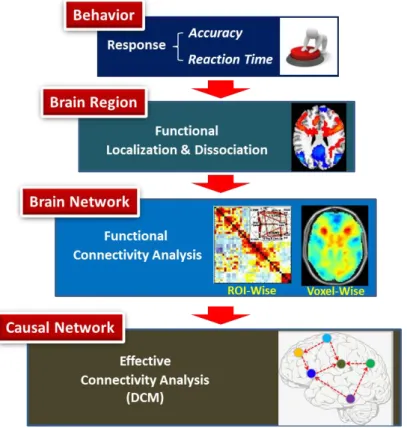
4.2 Multi-Aspect Analysis Based on BI Methodology 49
Contents vii
4.3 Common and Different Brain Regions for Mental Addition and Subtraction 50
4.3.1 Materials and Methods 51
4.3.2 Results 55
4.3.3 Discussion 59
4.4 Common and Different Brain Networks for Addition and Subtraction 64
4.4.1 Materials and Methods 64
4.4.2 Results 66
4.4.3 Discussion 67
4.5 Dynamic Causal Differences between Mental Addition and Subtraction 73
4.5.1 Materials and Methods 76
4.5.2 Results 79
4.5.3 Discussion 83
4.6 Conclusion 92
5 Studies on Emotion Regulation Using fMRI 94
5.1 Introduction 95
5.2 Top-Down Construction of Sets of Experiments 97
5.3 Self-Recovery from Aversive Emotion in Healthy Subjects 98
5.3.1 Materials and Methods 98
5.3.2 Results 102
5.3.3 Discussion 108
5.4 A Dynamic Causal Model of Emotion Self-Regulation in Healthy Subjects 111
5.4.1 Materials and Methods 111
5.4.2 Results 113
5.4.3 Discussion 116
5.5 Conclusion 118
6 Interactions among Cognition, Emotion, and Depression 119
6.1 Introduction 120
6.2 Systematic Investigation Based on Multi-Modal Data 125
6.3 Interactions between Mental Arithmetic and Emotional Response 126
6.3.1 Materials and Methods 127
Contents viii
Maebashi Institute of Technology, Doctor Dissertation of Engineering
Yang Yang: A Brain Informatics-Based Study on Human Cognition, Emotion, and Their Relationship
6.3.2 Results 130
6.3.3 Discussion 133
6.4 Morphologic and Functional Connectivity Alterationsin Patients with MDD 134
6.4.1 Materials and Methods 135
6.4.2 Results 139
6.4.3 Discussion 143
6.5 Neural Correlates Underlying Ahedonia in MDD 146
6.5.1 Materials and Methods 147
6.5.2 Results 150
6.5.3 Discussion 159
6.6 Conclusion 165
7 Epilogue 167
7.1 Contributions and Discussion 167
7.2 Limitations 170
7.3 Future Work 174
7.3.1 Extensions of Systematic Cognitive Experiments 174 7.3.2 Convergence of Data from Different Cognitive Tasks 178 7.3.3 Exploring the Boundary of Brain Big Data 180
Bibliography 183
Publications 209
List of Figures
1.1 Main contents of this thesis 4
1.2 Organization of this thesis 5
2.1 Illustration of brain big data center with full scale data 12
2.2 A framework of the BI global data center 13
2.3 Illustration of BI top-down research principle 19
2.4 Illustration of thinking-centric experimental design 20
2.5 Systematic investigations with different types of subjects 22
2.6 Systematic consideration on the design of single fMRI experiment 24
2.7 Illustration of the Data-Brain 25
2.8 Illustration of systematic human brain data analysis and simulation 28
4.1 Multi-aspect analysis based on BI methodology 50
4.2 Paradigm of stimuli presentation 53
4.3 Results of conjunction analysis 56
4.4 Operation-specific brain regions 59
4.5 Left IFGtri-centered and operation-specific networks 70
4.6 Intensity differences between addition-related and subtraction-related networks 72
4.7 Volumes-of-interest (VOIs) selected for the DCM analysis 78
4.8 Networks discovered for arithmetic operations based on six (ventral pathway) regions showing addition and subtraction effects 81
4.9 Optimum model for the extended subtraction (dorsal pathway) network 84
5.1 Systematic investigations on various types of emotions 97
5.2 Experimental paradigm 100
5.3 Contrasts of different conditions 103
5.4 Regions of activation were revealed by contrasts of ERS vs. PVS and LRS vs. PVS 106
5.5 Results of functional connectivity analyses 107
List of Figures x
Maebashi Institute of Technology, Doctor Dissertation of Engineering
Yang Yang: A Brain Informatics-Based Study on Human Cognition, Emotion, and Their Relationship 5.6 Proposed 50 models of emotion regulation for DCM analysis 114 5.7 fMRI images of subjects viewing aversive pictures compared with neutral pictures 114 5.8 The result of BMS analysis on the proposed 50 models 115 5.9 Dynamic models for self-regulating aversive emotions 117
6.1 Systematic investigation based on multi-modal data 126 6.2 Main effects of calculation and emotion revealed by factorial analysis 131
6.3 Results showing how emotion affects cognition 132
6.4 Results showing how cognition affects emotion 133
6.5 Gray matter differences between MDD patients and healthy controls (HC) 140 6.6 Functional connectivity differences between MDD patients and HC 141
6.7 Results of brain-symptom correlation analysis 142
6.8 Regions showing group differences in brain activation and zALFF 152 6.9 Common regions showing group differences in
both task-state and resting-state between MDD and HC groups 155 6.10 Results of voxel-wise functional connectivity analysis based on resting-state data 156 6.11 Correlation between percent BOLD change and clinical data 158 6.12 Results of VBA analysis based on diffusion data 159
7.1 Extensions of systematic cognitive experiments 176
7.2 Integrating brain big data with full correlation analysis 179 7.3 A preliminary discussion about the boundary of brain big data 181
List of Tables
4.1 In-scanner behavioral results 57
4.2 Common regions activated in both addition and subtraction processes 57
4.3 Regions with significant activation and deactivation elicited by contrasts 60
4.4 Regions with significant activation elicited by ST > AT 61
4.5 Regions showing significant correlations to the seed 68
4.6 VOIs selected for DCM analysis 80
4.7 Directed connections and corresponding modulatory changes in the first (ventral pathway) DCM 83
5.1 Activated regions revealed by the paired t-tests 104
5.2 Regions significantly activated following ERS vs. PVS and LRS vs. PVS 105
5.3 Regions with significantly increased activation elicited by aversive condition 115
6.1 Demographic and clinical characteristics of participants 137
6.2 Regions with gray matter reduction in MDD patients 139
6.3 Brain regions with significantly altered functional connectivity in MDD patients 141
6.4 Demographic and clinical characteristics of MDD patients and healthy controls 148
6.5 Regions with decreased activation elicited by contrasts of MDD versus HC 153
6.6 Regions with group differences in zALFF values 154
6.7 Common regions showing group differences in both task state and resting state 154
6.8 Regions showing significant differences elicited by group comparison of voxel-wise functional connectivity based on resting-state data 157
Chapter 1
Prologue
1.1 Introduction
One of the greatest scientific challenges is to understand the human brain. Although the flexible use of cognitive and neuroimaging approaches has allowed the measurement of macroscopic features (such as mental states revealed by behavioral experiments), mesoscopic features (such as blood-oxygen-level dependent changes within gray matter and diffusion anisotropy within white matter tracts), and microscopic features (such as the signal transmission among neurons) of the human brain, a comprehensive understanding has not been achieved across the multiple features to unravel the mystery of higher-order brain functions, such as consciousness and intelligence. For decades, some of engineering‘s best minds have concentrated their thinking skills on how to create thinking machines — computers capable of emulating human intelligence. However, our techniques at this moment are still far away from the target, due to our lack of knowledge about the underpinnings of the intelligence. The major obstacle that hinders our understanding on the brain is the fragmentation of brain researches and the data they bring about. To date, a great body of studies concerning on only single aspects of the brain have been performed separately, while less is known about how different domains of brain higher functions interact, how neural responses vary by cognitive state, and how the data and information across all the brain-related
1.1 Introduction 2
disciplines can be integrated, such as those from molecular, cellular, synaptic, circuit, systems, computational, and psychological fields. To overcome these challenges, the brain informatics (BI) has been proposed, which regards the brain as a human information processing system and focuses on thinking-centric higher-order functions of the brain with a full perspective ranging from macrostructure to microstructure (Zhong et al., 2011). In the context of brain big data era, BI puts forward a systematic methodology to lead the way how experiments can be designed to investigate the complex brain, how brain big data can be collected by implementation of experiments and integration of shared public data resources, how the collected data can be effectively managed with help of advanced informatics approaches, and how the brain big data can be systematically analyzed, simulated, modeled, and conceptualized. BI aims at disclosing the mechanism of information processing within the human brain, and providing the key technique for implementing such an attempt by offering informatics-enabled brain studies and applications in a social-cyber-physical space, thereby supporting the Web intelligence (WI) (Zhong et al., 2015).
For many years, the relationship between cognition and emotion which are both considered as critical components of human thinking has fascinated plenty of neuroscientists. A traditional notion conceives that there is a considerable degree of functional specialization and that many regions can be conceptualized as either
‗affective‘ or ‗cognitive‘ (Pessoa, 2008). Anatomically, James Papez proposed the well-known Papez circuit connecting the hypothalamus to the limbic lobe as the basis for emotional experiences, which is situated primarily in the subcortical areas involving the hippocampal formation (subiculum), fornix, mammillary bodies, mammillothalamic tract, anterior thalamic nucleus, cingulum, and entorhinal cortex (Shah et al., 2012). By
1.1 Introduction 3
Maebashi Institute of Technology, Doctor Dissertation of Engineering
Yang Yang: A Brain Informatics-Based Study on Human Cognition, Emotion, and Their Relationship
the neural foundation underlying the brain cognition, such as memory, attention, perception, awareness, language, and consciousness. Nonetheless, the progress of electrophysiological and neuroimaging studies seems to have brought new enlightenments in the interplays between emotion and cognition. It has been evidenced that emotion and cognition influence each other. As one of examples describing how emotion affects cognition, Shackman et al. (2006) imposed electric shocks randomly on the subjects when they were engaged in N-back tasks for testing their visuospatial and verbal working memory (WM). As a result, the threat-induced anxiety selectively disrupted accuracy of spatial but not verbal WM performance. On the contrary, cognitive strategies mediate the emotion regulation. Kanske et al. (2011) indicated that both distraction (focusing away from an emotional stimulus) and reappraisal (reinterpreting the emotional situation of an emotional stimulus) can be applied to down-regulate emotional intensity, while a stronger decrease in amygdala activity for distraction was observed when compared with reappraisal. Taken together, although the brain regions corresponding to emotion and cognition are spatially distributed, interactions can be found between these two important systems. However, only few neuroscience-based studies have addressed the mechanisms of such intercommunication.
Identification of the emotion context is key to furthering our understanding on the core meaning of verbal conversation. Probably, this is one of reasons why human can always grasp the ―heart‖of ambiguous or incomplete information but machines can‘t make it.
Therefore, systematic investigations were carried out on human cognition, emotion, and their relationship in this thesis directed by the guidance of BI methodology (see Figure 1.1). Mental arithmetic was selected as the targeted aspect of the wide-ranging human information processing, given that the mental arithmetic is essential to our intact social lives and that it involves phonological, semantic, and syntactic processes that are
1.1 Introduction 4
similar to the high-level language peculiar to human alone. Chapters about emotion concentrate on the self-regulation of aversive emotion on which few studies have been implemented before. Finally, this thesis concerns on the interplays among mental arithmetic, emotional responses, and the major depressive disorder (MDD) that serves as counterevidence for revealing impaired cognition and emotion functions. Although works depicted in this thesis represent only a small part of BI researches, it can be considered as a case study for demonstrating the advances of BI methodology in accelerating progress towards a multi-level understanding of brain structure and function.
Fig. 1.1: Main contents of this thesis. Systematic investigations were carried out on human cognition, emotion, and their relationship in this thesis directed by the guidance of BI methodology.
1.2 Organization of the Thesis 5
Maebashi Institute of Technology, Doctor Dissertation of Engineering
Yang Yang: A Brain Informatics-Based Study on Human Cognition, Emotion, and Their Relationship
1.2 Organization of the Thesis
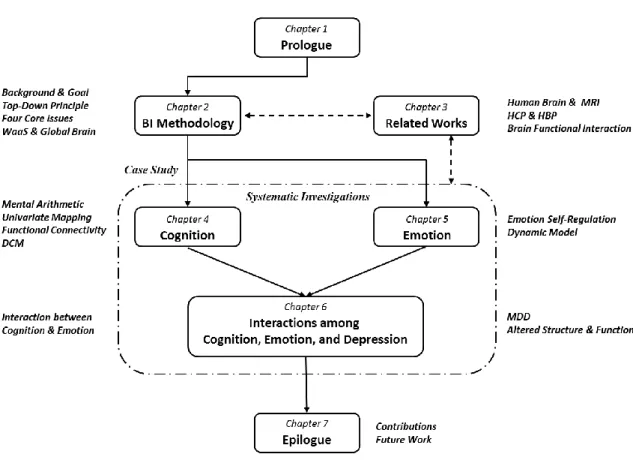
The main contents of this thesis consist of 7 chapters that are organized as shown in Figure 1.2.
Fig. 1.2: Organization of this thesis. This thesis consists of 7 major chapters.
Chapter 2 describes the BI methodology: its background and goal, top-down principle for cognitive neuroscience research, four core issues, and an overview about the WaaS and Global Brain which serve as a global platform supporting the whole systematic BI research process and its real-world applications.
Chapter 3 introduces related works, including some basic information about the human brain researches and magnetic resonance imaging (MRI) that was employed as
1.2 Organization of the Thesis 6
the main approach in this thesis; some information and new progress of the Human Connectome Project (HCP) and the Human Brain Project (HBP); and an overview about cutting-edge studies on the brain functional interaction based on big data.
Chapter 4 elaborates the neural substrates underlying overlaps and differences between mental addition and subtraction processes by using univariate mapping, functional connectivity analysis, and dynamic causal modeling analysis (DCM), respectively.
Chapter 5 focuses on the self-regulation of aversive emotion to investigate the emotion regulation processes underlying the natural recovery period, and proposes a model to explain the dynamic neural activity involved in the regulatory processing.
Chapter 6 delineates interplays between cognition and emotion by using distraction paradigm that contains mental arithmetic tasks and viewing affective pictures. This chapter also describes the systematic investigations on the MDD by combining structural MRI, resting-state MRI, on-task MRI, and diffusion MRI.
Finally, Chapter 7 concludes this thesis. It discusses contributions and some topics for future researches.
Chapter 2
The Brain Informatics Methodology
This chapter presents the brain informatics (BI) methodology. The first section gives its background and goal. The second section describes its top-down principle applied in the field of cognitive neuroscience. The third section concerns on its four core issues.
Finally, the fourth section outlines an overview about the WaaS and Global Brain which serve as a global platform supporting the whole systematic brain informatics research process and its real-world applications.
2.1 Background and Goal
Brain is the command center and the most complex part of the human body. For centuries, scientists and philosophers have been fascinated by the brain, but for long they viewed this complex system as nearly incomprehensible. However, scientists have learned more about the brain in the last few decades because of the accelerating pace of research in neurological science and the development of new techniques. Histological, neuroimaging, electrophysiological, and behavioral experiments have yielded a great body of results that facilitate our holistic understanding on the brain from microscopic to macroscopic levels. The brain-inspired investigations brought together researchers and practitioners from diverse fields, not only confined in neuroscience and medical fields, but extended to computer science, information technology, AI, Web intelligence,
2.1 Background and Goal 8
cognitive science, life science, economics, data mining, data and knowledge science, intelligent agent technology, human computer interaction, complex systems, and system science. Converged interests in the human brain have hastened new kinds of BI methods and global research communities to develop a platform on the intelligent Web and knowledge grids that enable high-speed, distributed, large-scale analysis and computations and radically new ways of data and knowledge sharing (Zhong et al., 2011).
BI is an emerging interdisciplinary and multidisciplinary research field that focuses on studying the mechanisms underlying the human information processing system (HIPS) (Zhong et al., 2011). BI studies the thinking-centric higher-order cognitive functions of the brain, which covers areas such as attention, emotion, memory, language, calculation, heuristic search, reasoning, planning, decision making, problem solving, learning, discovery, creativity, and so forth. BI also focuses on the overall production of the brain big data that are generated when the brain is explored, ranging from experimental design, data collection, to data analysis, management, and utilization. One goal of BI researches is to develop and demonstrate a systematic approach to an integrated understanding of multiple scales of working principles about the brain by means of experimental, computational, and cognitive neuroscience studies, as well as advanced Web-intelligence-centric information technologies. Another goal of BI is to promote new forms of collaborative and interdisciplinary work to contribute to a clearer understanding of the brain. ―Brain big data computing‖ can be summarized as the core conception of BI with double meanings. On one hand, the BI-based empirical studies, such as those based on functional magnetic resonance imaging (fMRI), electroencephalography (EEG), and magnetoencephalography (MEG), shed light on
2.1 Background and Goal 9
Maebashi Institute of Technology, Doctor Dissertation of Engineering
Yang Yang: A Brain Informatics-Based Study on Human Cognition, Emotion, and Their Relationship
which is driven by various external inputs (stimuli), and offer new insights into the development of human-level intelligence on the wisdom Web and knowledge grids. On the other hand, human brain functions are modeled and conceptualized (computing) based on the notions of information processing systems. Informatics-enabled methods contribute to the computation of brain big data, covering data analysis, curation, mining, and use. Web intelligence-centric information technologies are applied to support brain science studies. For instance, the wisdom Web and knowledge grids enable high-speed, large-scale analysis, simulation, and computation as well as new ways of sharing research data and scientific discoveries.
BI highlights three major aspects that lead different ways to study traditional cognitive science, neuroscience, and AI.
Systematic investigations for complex brain science problems
Understanding the human brain is one of the greatest challenges, since the human brain represents the most complex structure which is capable of generating the kind of higher consciousness and cognition associated with human ingenuity. Moreover, the adult human brain has 86 billion neurons engaging in processing and transmitting information through electrical and chemical signals within brain, and each neuron has between 1000 to 10000 synapses that result in 125 trillion synapses in the cerebral cortex alone (Herculano-Houzel, 2012). The complexity of brain has triggered comprehensive studies with separate concerns on distinct aspects of the brain, such as the morphology, function, connectivity, neuron, and gene. Most of those studies are implemented alone, less attention has been paid on the integration of multiple aspects and relationship between different research objects. In this context, BI proposes a systematic frame for investigating complex brain science problems that is characterized by four features: (1) full scale perspective; (2) multi-modal measurements; (3) whole
2.1 Background and Goal 10
process of BI data circle; (4) global brain data resources.
A full scale perspective indicates a holistic consideration about the brain-related researches that advocates an integration of wide-ranging investigations from macro-, meso-, and micro-scales (see Figure 2.1). Firstly, the macro-scale researches examine the behavioral responses to stimuli (i.e., accuracy and reaction time) of human subjects by using cognitive experimental paradigms. Furthermore, other non-physiological information about the subjects is regarded as macro-scale data as well, such as the demographic information of subjects, scores of psychological and mental questionnaires, etc. Macro-scale researches explore the hidden states of human mind indirectly via external phenomena. Secondly, the meso-scale studies emphasize the physiological, electrophysiological, hemodynamic, and endocrine monitoring indicators of the whole brain or some brain regions of interest. Although the importance of structural data of the brain (e.g., voxel-based morphology, white matter tracts) is also stressed, BI puts more emphasis on the brain functions, especially higher cognitive functions presented during both resting-state (task-free) and task-states. The meso-scale studies are dedicated to revealing neural mechanisms of the brain to interpret the external behaviors. Thirdly, the micro-scale studies concentrate on the infrastructural units underlying the brain structure and functions, namely, neuron, synapse, and genome. Studies at this level adopt cellular and molecular approaches to disclose the basic principles of how the brain basic functions proceed. BI does not compete with on-going neuroscience researches, but adds a complementary new strategy to achieve a unified, multi-level understanding of the human brain by integrating multidimensional data. The ultimate objective of brain-centered investigations is to establish integrative, quantitative, and predictive theories of brain structure and function. However, it is difficult to obtain the
2.1 Background and Goal 11
Maebashi Institute of Technology, Doctor Dissertation of Engineering
Yang Yang: A Brain Informatics-Based Study on Human Cognition, Emotion, and Their Relationship
the parts of the brain work together. Thus, in the frame of BI, a unified brain atlas, such as the atlas with Montreal Neurological Institute (MNI) coordinates, can provide a reference for building connections between anatomical brain regions and biophysical features of each region observed from different scales.
The explosive growth in the development and use of noninvasive neuroimaging and electrophysiological technologies accelerates the research on human brain under normal and pathological conditions. Multi-modal measurements, using MRI, positron emission tomography (PET), EEG/MEG, eye-tracking, and so forth, have showed the great advantage in visualization and analysis of the brain function and structure in unprecedented detail and transformed the way how studies are conducted on the nervous system under normal and pathological conditions (Kikinis et al., 2014). Multi-modal approaches advances the neuroscience research by overcoming the limits of individual measuring modalities and by identifying the associations of findings from different measuring sources (Liu et al., 2015a). For instance, fMRI combined with EEG enhances the spatiotemporal resolution that cannot be achieved by the single modality alone; joint analyses using the data provided by PET/CT and PET/MRI contributes to the combination of brain structural and functional images. Furthermore, multi-modal approaches can also cross-validate findings from different sources and identify associations and patterns, e.g., causality of brain activity can be deduced by linking dynamics in different imaging readings. Nevertheless, multi-modal neuroimaging computing is a very challenging task due to large inter-modality variations in spatiotemporal resolution, and biophysical/biochemical mechanism. Compared to single modality computing, it requires more sophisticated bias correction, co-registration, segmentation, feature extraction, pattern analysis, and visualization (Liu et al., 2015b).
BI proposes a solution which solves these problems by integrating the heterogeneous
2.1 Background and Goal 12
data at the metadata level rather than the raw data level (see Figure 2.2). Provenance, which refers to the sources of information, is crucial to making determinations about how to integrate diverse information sources in Semantic Web techniques (Simmhan et al., 2005). By using the BI Provenances, the brain big data center is able to achieve the hybrid upon the heterogeneous data after the somatization.
Fig. 2.1: Illustration of brain big data center with full scale data. In the brain big data center, a unified brain atlas (such as the MNI atlas) can provide a reference for building connections between anatomical brain regions and biophysical features of each region observed from different scales. The macro-scale researches explore the hidden states of human mind indirectly via external phenomena. The meso-scale studies emphasize the physiological, electrophysiological, hemodynamic, and endocrine monitoring indicators of the whole brain or some brain regions of interest. The micro-scale studies concentrate on the infrastructural units underlying the brain structure and functions, namely, neuron, synapse, and genome.
2.1 Background and Goal 13
Maebashi Institute of Technology, Doctor Dissertation of Engineering
Yang Yang: A Brain Informatics-Based Study on Human Cognition, Emotion, and Their Relationship
Fig. 2.2: A framework of the BI global data center. BI brain big data center merges global brain data resources, including open data shared by public database, data from cooperative partners, and data collected locally. By using the BI Provenances, the brain big data center is able to achieve the hybrid upon the heterogeneous data after the somatization.
BI researchers use informatics to support brain science studies and attempt to capture new forms of collaborative and interdisciplinary work. The whole BI data process includes measuring, collecting, modeling, transforming, managing, mining, interpreting, and explaining multiple forms of brain data obtained from various sources. During these stages, brain data are processed through a data-cycle system that extracts core values of the data in a hierarchy form to meet needs for different purposes—going through the BI data, information, knowledge, wisdom cycle (or BI data cycle for short)—from the expert-driven and state-of-the-art process to the normative and propagable one (Zhong et al., 2011; Zhong and Motomura, 2009). Systematic BI study produces and absorbs various original data, deriving data and data features, which include a large number of unstructured data, especially multi-modular data. For effectively managing, sharing and
2.1 Background and Goal 14
utilizing these data, a transformation from raw data to various metadata is needed.
Aiming at different purposes of data sharing and data utilization, the metadata includes different contents. The metadata describing the origin and subsequent processing of biophysical data is often referred to as ―provenance‖ (Simmhan et al., 2005), which can be regarded as a kind of information. Prior knowledge-based four ontological dimensions and their own domain ontologies form a knowledge-base for constructing BI provenances (see Figure 2.2). Thus, these four dimensions can be connected by the relations among dimensions to provide holistic conceptual schemata for various BI provenances. In turn, the newly transformed BI provenances generate new knowledge derived from semantic reasoning and computation to supplement and update the knowledge-base. The evolving knowledge-base provides users the wisdom service, which means the right service, for the right object, at the right time, and in the right context (Zhong et al., 2011). Finally, new data will be produced when users utilize the wisdom service from the BI brain big data center, and become one part of the new round of data cycle.
As shown in Figure 2.2, the BI brain big data center merges global brain data resources. Using biophysical open data shared by public database is an effective way to improve the limited reliability in individual studies on the human brain with small samples caused by the costly acquisition of experimental data. In the last decade, major advances have been made in the availability of shared neuroimaging data, such that there are more than 8,000 shared MRI data sets available online (Poldrack and Gorgolewski, 2014). These data are potential to maximize the contribution of research subjects and enable the availability of large-scale organization on brain big data to get new discoveries hidden in separate data sets. However, existing biophysical databases
2.1 Background and Goal 15
Maebashi Institute of Technology, Doctor Dissertation of Engineering
Yang Yang: A Brain Informatics-Based Study on Human Cognition, Emotion, and Their Relationship
instance, the Alzheimer‘s Disease Neuroimaging Initiative (ADNI, http://adni.loni.usc.edu/) is dedicated to sharing data of patients with Alzheimer‘s Disease (AD) to facilitate researches on the degenerative disease; The Human Connectome Project (http://www.humanconnectomeproject.org/) is working on typical patterns of structural and functional connectivity in the healthy human brain; the 1000 Functional Connectomes Project (http://fcon_1000.projects.nitrc.org/) focuses only on the resting-state fMRI data. Hence, an informatics-enabled platform, i.e, the BI brain big data center is needed to integrate the data across databases. Nonetheless, the BI brain big data center does not redistribute the collected open data, but provides new information and knowledge obtained via automated analysis on the big data from available databases. On the other hand, although a mass of open data can be acquired, the implementation of BI-based experiments is still necessary. The data collected locally help make up the absent areas that the shared open data failed to cover. More importantly, the local experiments are able to meet the full scale and multi-modular requirements of BI. For example, structural MRI, resting-state functional MRI, task-state functional MRI, and diffusion MRI data can be obtained for each patient of the cohorts with depressive disorder, to corroborate results from different viewpoints (see Chapter 6). Finally, extracting results in published papers is another way to enhance the BI Provenances. The extracted contents of papers are able to support the meta-analysis which has been considered as a powerful method for displaying the common truth behind all conceptually similar studies. By combining the natural language processing (NLP) and semantic web techniques, the BI brain big data center seeks to get the results of papers that most interest users and provide personalized recommendation systems focusing on user preferences to relieve the information overload occurred when researchers retrieve academic information from the Internet.
2.1 Background and Goal 16
New information technologies for systematic brain science studies
A systematic BI study cannot be realized using only a traditional expert-driven approach. A powerful brain data center needs to be developed on the Wisdom Web and knowledge grids as the global research platform to support the whole systematic BI research process (Zhong et al., 2011; Zhong and Chen, 2012). Various IT technologies have been applied to brain science studies. Presently, many brain databases have been constructed to effectively store and share multiple levels of brain data. Some distributed analytical platforms of brain data also support the integration of analytical methods.
However, these existing information systems cannot effectively support the systematic human brain data analysis needed for BI. These brain databases still require extensive knowledge from investigators because they mainly focus on the description of experiments and data processing, neglecting the relationships among different experiments and data processing. Their data mainly comes from isolated experiments and thus is difficult to describe synthetically. Using those distributed analytical platforms, an expert-driven approach is still required because those analytical platforms mainly focus on the description and performance of analytical work flows. Hence, BI needs to develop a new approach for systematic brain data analysis by using advanced IT technologies (Zhong et al., 2011; Zhong and Chen, 2012).
Researchers have developed expert tools such as the Brain Vision Analyzer, MEDx/SPM, NIS, and AFNI with statistical parametric mapping for cleaning, normalizing, and visualizing event-related potential (ERP)/ EEG and fMRI/DTI data, respectively. They have also studied how to analyze and understand ERP and fMRI data using data mining and statistical learning techniques. To understand human information processing principles and mechanisms relating to higher cognitive functions such as
2.1 Background and Goal 17
Maebashi Institute of Technology, Doctor Dissertation of Engineering
Yang Yang: A Brain Informatics-Based Study on Human Cognition, Emotion, and Their Relationship
complex human brain and mind related diseases, we must develop new brain data mining techniques based on the BI methodology. The human brain is too complex for a single data mining algorithm. Agent-enriched brain data mining is thus a key BI methodology for multi-aspect data analysis in multiple data obtained by cognitive experiments, clinical diagnosis, and e-health (Zhong and Motomura, 2009).
BI studies based on Web intelligence research needs
To develop Web-based problem solving and decision making as well as knowledge discovery systems with human-level capabilities, we need to better understand how human beings do complex adaptive, distributed problem solving and reasoning. We also need to understand how intelligence evolves for individuals and societies, over time and place. Ignoring what goes on in the human brain and instead focusing on behavior has been a large impediment to understand complex human adaptive, distributed problem solving, and reasoning. As a result, the relationships between classical problem solving and reasoning and biologically plausible problem solving and reasoning need to be defined and/or elaborated (Zhong et al., 2007c). Current Web intelligence research can be extended from Wisdom Web to Wisdom Web of Things (W2T) (Zhong et al., 2002;
Zhong et al., 2007b), which is a novel vision for computing and intelligence in the post-WWW era recently put forward by a group of leading researchers in the Web intelligence, ubiquitous intelligence, BI, and cyber individual fields (Zhong et al., 2013).
The W2T is an extension of the wisdom Web in the IoT/WoT (Internet/Web of Things) age. ―Wisdom‖ means that each thing in the IoT/WoT can be aware of both itself and others to provide the right service, for the right object, at the right time, and in the right context. The basic observation is that a new world, called the hyper world, is emerging by coupling and empowering humans in the social world, information and computers in the cyber world, and things in the physical world. There are four fundamental issues for
2.2 Top-Down Principle Applied in Cognitive Neuroscience 18
W2T to address: ―How do we realize the harmonious symbiosis of humans, Web (information), and things in an emerging hyper world? How do we implement the data cycle system as a practical way to realize the harmonious symbiosis of humans, Web (information), and things in the hyper world? How do we holistically investigate intelligence in the hyper world? How do we unify studies of humans, networks, and information granularity in the hyper world?‖ A new holistic intelligence methodology can be developed by integrating Web intelligence, ubiquitous intelligence, BI, and cyber-individuals in order to realize the harmonious symbiosis of humans, computers, and things in the hyper world (Zhong et al., 2013).
2.2 Top-Down Principle Applied in Cognitive Neuroscience
To understand the brain, we have to know what the brain does: its high level emergent activities. BI is interested in the full scale data of human brain, covering the field of brain function, anatomy, neuron, even the proteins (see Figure 2.3).
Investigation on the detailed mechanics is helpful to enlarge our understanding on the human higher cognitions and intelligence. For instance, we want to understand how a genetic mutation or the wrong positioning of a protein in a cell affects behavior; how a drug acting on a specific molecule can produce changes in cognition. For this, we need multi-scale models detailed enough to represent mutations and the positioning of molecules. Although remarkable progresses have been made in recent years in the field of neuroscience, e.g., the mouse brain connectome has been mapped (Oh et al., 2014) and the genome-wide maps of adult human brain has been generated (Hawrylycz et al., 2012), a huge gap still exist between our existing knowledge about the animal‘s brain or the infrastructure of human brain and our ultimate goal about the brain that seeks the
2.2 Top-Down Principle Applied in Cognitive Neuroscience 19
Maebashi Institute of Technology, Doctor Dissertation of Engineering
Yang Yang: A Brain Informatics-Based Study on Human Cognition, Emotion, and Their Relationship
complete comprehension of the human consciousness and intelligence. Therefore, BI proposes a top-down principle which insists the priority of direct investigations on the highest order — human information processing system (i.e., the meso-scale of the brain) when conducting the full scale neurological studies, to promptly apply the findings of thinking-centric investigations in enlightening the development of human-level intelligence on the wisdom Web and knowledge grids. Meanwhile, the macro- and micro-scale studies proceed as well. BI aims to bring both high-level and low-level functions of the brain together, by making it finally possible to understand basic principles of cognition, together with the underlying mechanics. At the same time, the multi-scale modeling approach will help settle historical arguments about the level of biological detail necessary to explain specific cognitive capabilities.
Fig. 2.3: Illustration of BI top-down research principle. BI is interested in the full scale data of human brain, covering the field of brain function, anatomy, neuron, even the proteins. Meanwhile, BI advocates the priority of study on the human information processing system.
2.2 Top-Down Principle Applied in Cognitive Neuroscience 20
Fig. 2.4: Illustration of thinking-centric experimental design. BI instructs a coarse-to-fine investigation on the thinking-centric brain functions based on top-down principle.
In order to make clear the human information processing system, the top-down principle also instructs the implementation of thinking-centric experiments (see Figure 2.4). The thinking-centric experiments can be carried out based on distinct domains of cognitive functions, such as problem solving, decision making, executive control, language processing, emotion processing, learning, attention, etc., and then finally realize a complete coverage of all higher-order brain functions. Under domains, some classic experimental paradigms are utilized as main experiments which play critical roles in the preliminary exploration of the validity and limitations of each paradigm, as well as getting inspirations for indicating the directions how the subsequent experiments can be designed to be specific enough to induce the brain activity of interest and acquire
2.3 Four Core Issues of BI 21
Maebashi Institute of Technology, Doctor Dissertation of Engineering
Yang Yang: A Brain Informatics-Based Study on Human Cognition, Emotion, and Their Relationship
more possible scientific values. After the main experiments, inspiring results prompt following experiments which are called supplementary experiments with modified designs based on the classic ones can be performed to fulfill the more precise research objectives. Taken together, the top-down principle of BI instructs a coarse-to-fine strategy to conduct the thinking-centric investigations. The merit of doing this is that the schematized experimental designs make it easier to organize and integrate data and results from different experiments. Because of the top-down consideration, the subsequent experiments serve as supports and extensions to the preceding experiments.
Bottom-up strategy is prone to give rise to unstructured datasets which are weak in corroborating each other. Therefore, when the ultimate goal is to achieve a complete view of all higher cognitive functions as BI aims, a top-down modeling approach will be more effective and high-efficiency.
2.3 Four Core Issues of BI
The complexity of brain science determines that BI is systematic. That is, BI adopts a systematic methodology to investigate human information processing mechanisms, which includes four core issues as follows.
(1) Systematic investigations of complex brain science problems.
Besides the full scale and multi-modular investigations of thinking-centric complex brain science problems, BI also concerns on different cohorts of human subjects, including healthy ones as well as the diseased ones (see Figure 2.5). Brain big data indicates the large scale and complexity of the brain-related data sets. However, this term means more than a large quantity. Only accumulation of monotonous data does not contribute to expanding our understanding on the data. The feature of variety of big data,
2.3 Four Core Issues of BI 22
compared with the volume, is more likely to enable a different view on the data and allow us to learn something new. In a similar way, studies on subjects with brain injuries and mental disorders are effective to show the consequences if certain brain functions are lost or impaired, to explore and validate effects that the monotonous data are inadequate. To increase the variety of brain big data, the systematic studies should give thought to subjects with different genders, ages, health states, education backgrounds, and so forth.
Fig. 2.5: Systematic investigations with different types of subjects. The feature of variety of big data is more likely to further our understanding on the data. Thus, systematic studies should give thought to subjects with different genders, ages, health states, education backgrounds, and so forth.
(2) Systematic design of cognitive experiments.
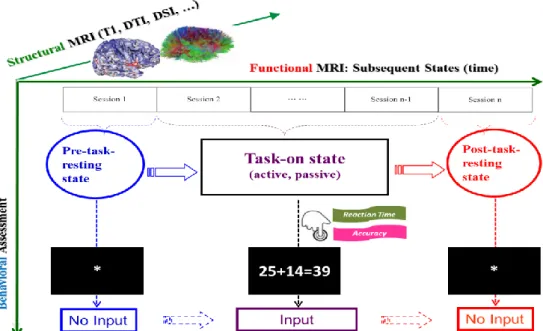
Besides the top-down principle for constructing the intact brain big data sets, BI asks for a systematic consideration on the design of single experiment as well. To reduce the cost for conducting the experiments and maximize each subject‘s contribution, BI investigations collect as many as possible data for each time. For instance, it is
2.3 Four Core Issues of BI 23
Maebashi Institute of Technology, Doctor Dissertation of Engineering
Yang Yang: A Brain Informatics-Based Study on Human Cognition, Emotion, and Their Relationship
during the implementation of fMRI experiment for each time (see Figure 2.6).
Functional image is the primary target of the data collection. The underlying neural correlates of the ―thinking‖ in which the subject is engaged can be exhibited by the well-designed cognitive tasks. Meanwhile, the resting-state fMRI (rs-fMRI) has been pervasively employed to investigate the spontaneous neural fluctuations of human brain in the past few years. It has been suggested that spatial patterns and nodal graph properties in the major brain functional networks, e.g., the default mode network (DMN), might vary across the rest period before an on-task state, the on-task state, and the rest period after the on-task state (Wang et al., 2012). Thus, fMRI data over three sequential periods are measured as the routine, including pre-task resting, task-on with active and passive tasks, and post-task resting. Behavioral assessment displays the behavioral responses of subjects which provide the explicit reference for interpreting causality between internal underpinnings and external expressions. Structural images for each subject taken in fMRI experiments consist of a T1 weighted 3D image taken by the magnetization prepared rapid gradient echo (MPRAGE) sequence and a diffusion image based on diffusion tensor imaging (DTI) technique. The T1 image is supplied as a reference for the co-registration of the local structural space and the functional images.
Another use of T1 image is to enable the voxel-based morphological (VBM) analysis which is reliable to uncover the structural alterations in the brains of patients with psychiatric disorders (Ashburner and Friston, 2000). In brief, the collection of all types of available data in the fMRI experiments (especially the experiments with patients) allows the multi-angle mining of valuable information to explain the complex brain activities.
(3) Systematic human brain data management.
The development of brain science has led to a vast increase of brain data. To meet
2.3 Four Core Issues of BI 24
requirements of a systematic methodology of BI, a new conceptual model of brain data was proposed, namely Data-Brain, which explicitly represents various relationships among multiple human brain data sources, with respect to all major aspects and capabilities of human information processing systems (HIPS) (Zhong and Chen, 2012).
A multi-dimension framework and a BI methodology based ontological modeling approach have been developed to implement a Data-Brain (see Figure 2.7). The Data-Brain, Data-Brain based BI provenances, and heterogeneous brain data can be used to construct a Data-Brain based brain data center which provides a global framework to integrate data, information and knowledge coming from the whole research process for systematic BI study. Such a Data-Brain modeling approach represents a radically new way for domain-driven conceptual modeling of brain data, which models a whole process of systematically investigating human information processing mechanisms.
Fig. 2.6: Systematic consideration on the design of single fMRI experiment. It is necessary to involve behavior assessment, structural images, and functional images during the implementation of fMRI experiment for each time.
2.3 Four Core Issues of BI 25
Maebashi Institute of Technology, Doctor Dissertation of Engineering
Yang Yang: A Brain Informatics-Based Study on Human Cognition, Emotion, and Their Relationship
Fig. 2.7: Illustration of the Data-Brain. The Data-Brain that is a conceptual model of brain data provides a global framework to integrate data, information and knowledge coming from the whole research process for systematic BI study.
(4) Systematic human brain data analysis and simulation.
With respect to the human brain, recent neuroimaging techniques, including fMRI, EEG, and MEG, now allow us to probe the brain at unprecedentedly high temporal or spatial resolution without the use of invasive techniques. Multiple advanced computational methods are used to investigate and solve algorithmic image computing problems in basic and applied neuroscience. Some common grounds can be found across the data analyzing techniques: statistical analysis of neuroimages is commonly approached with intragroup or intergroup comparisons made by repeated application of univariate or multivariate tests performed on the global brain or set of the regions of interest sampled in the acquired images (Turkheimer et al., 2000); standard group analyses of fMRI data rely on spatial and temporal averaging of individuals. However, particular approaches are also necessary to refine characteristic information from each