A uthor(s )
K im, S hin-Il; Matsumoto, T omoko; K agawa, Harunobu;
Nakamura, Michiko; Hirohata, R yoko; Ueno, A yano; Ohishi,
Maki; S akuma, T etsushi; S oga, T omoyoshi; Y amamoto,
T akashi; W oltjen, K nut
C itation
Nature C ommunications (2018), 9
Is s ue D ate
2018-03-05
UR L
http://hdl.handle.net/2433/229515
R ig ht
©
T he A uthor(s) 2018. T his article is licensed under a C reative
C ommons A ttribution 4.0 International L icense, which permits
use, sharing, adaptation, distribution and reproduction in any
medium or format, as long as you give appropriate credit to the
original author(s) and the source, provide a link to the C reative
C ommons license, and indicate if changes were made. T he
images or other third party material in this article are included
in the article’
s C reative C ommons license, unless indicated
otherwise in a credit line to the material. If material is not
included in the article’
s C reative C ommons license and your
intended use is not permitted by statutory regulation or exceeds
the permitted use, you will need to obtain permission directly
from the copyright holder. T o view a copy of this license, visit
http://creativecommons.org/licenses/by/4.0/.
T ype
J ournal A rticle
T extvers ion
publisher
Microhomology-assisted scarless genome editing
in human iPSCs
Shin-Il Kim
1
, Tomoko Matsumoto
1
, Harunobu Kagawa
1
, Michiko Nakamura
1
, Ryoko Hirohata
1
, Ayano Ueno
2
,
Maki Ohishi
2
, Tetsushi Sakuma
3
, Tomoyoshi Soga
2
, Takashi Yamamoto
3
& Knut Woltjen
1,4
Gene-edited induced pluripotent stem cells (iPSCs) provide relevant isogenic human disease
models in patient-speci
fi
c or healthy genetic backgrounds. Towards this end, gene targeting
using antibiotic selection along with engineered point mutations remains a reliable method to
enrich edited cells. Nevertheless, integrated selection markers obstruct scarless
transgene-free gene editing. Here, we present a method for scarless selection marker excision using
engineered microhomology-mediated end joining (MMEJ). By overlapping the homology
arms of standard donor vectors, short tandem microhomologies are generated
fl
anking the
selection marker. Unique CRISPR-Cas9 protospacer sequences nested between the selection
marker and engineered microhomologies are cleaved after gene targeting, engaging MMEJ
and scarless excision. Moreover, when point mutations are positioned unilaterally within
engineered microhomologies, both mutant and normal isogenic clones are derived
simulta-neously. The utility and
fi
delity of our method is demonstrated in human iPSCs by editing the
X-linked
HPRT1
locus and biallelic modi
fi
cation of the autosomal
APRT
locus, eliciting
disease-relevant metabolic phenotypes.
DOI: 10.1038/s41467-018-03044-y
OPEN
1Center for iPS Cell Research and Application (CiRA), Kyoto University, Kyoto 606-8507, Japan.2Institute for Advanced Biosciences, Keio University,
Tsuruoka, Yamagata 997-0052, Japan.3Department of Mathematical and Life Sciences, Graduate School of Science, Hiroshima University, Hiroshima
739-8526 Japan.4Hakubi Center for Advanced Research, Kyoto University, Kyoto 606-8501, Japan. Shin-Il Kim and Tomoko Matsumoto contributed equally
to this work. Correspondence and requests for materials should be addressed to K.W. (email:[email protected])
123456789
F
unctional genomics relies on gene targeting to create or
revert mutations implicated in regulating protein activity or
gene expression. This methodology has advanced greatly
across species through the development of designer nucleases
such as ZFNs, TALENs, and CRISPR-Cas9
1,2, with CRISPR-Cas9
taking the lead due to the simplicity of programmable sgRNA
cloning, coupled with ef
fi
cient and reproducible genomic
vage. Despite differences in experimental design and DNA
clea-vage mechanism, all engineered nucleases function by generating
targeted double strand breaks (DSBs) to induce cellular DSB
repair (DSBR) pathways. Error-prone repair via non-homologous
end joining (NHEJ) is typically suf
fi
cient for gene disruption,
while homology directed repair (HDR) can be usurped with
custom template DNA that acts as a donor in the repair of
tar-geted double-strand breaks, allowing for more speci
fi
c gene
edit-ing. These advances are of particular interest in the
fi
eld of human
genetics for disease modeling, where gene targeting in human
induced pluripotent stem cells (iPSCs) with nucleases enables the
original patient iPSC line to act as an isogenic control
3.
Although recent advances in nuclease technology have
respectably improved gene targeting ef
fi
ciencies for human
embryonic stem cells (ESCs) or iPSCs, the deposition of single
nucleotide variations which mimic or correct patient mutations
remains dif
fi
cult without a robust means for enrichment and
selection, such that positive selection for antibiotic resistance
markers remains a staple in gene targeting
4. Moreover, positive
selection provides a method for generating clonal populations
with minimal effort. For genome editing by conventional gene
targeting with positive selection, scarless excision of the antibiotic
selection marker is a critical step, yet remains non-trivial using
current approaches. Methods such as Cre-loxP recombination
5,
and more recently excision-prone transposition
6have been
shown to remove selection markers after their utility is expended.
However, these methods are fraught with complications such as
residual recombinase sites
7, low excision frequencies, and
potential for re-integration
8. Alternative methods to achieve
scarless excision must therefore be sought.
Within the repertoire of endogenous cellular repair pathways,
microhomology-mediated end joining (MMEJ), is an
under-appreciated mechanism for repairing DSBs. MMEJ is a
Ku-independent pathway that employs naturally occurring
micro-homology (
µ
H) of 5
–
25 bp present on either side of the DSB to
mediate end joining
9. The outcome of MMEJ is a reproducible
deletion of intervening sequences while retaining one copy of the
µ
H. For this reason, MMEJ is normally considered to be
muta-genic, because of an overall loss of genetic information by precise
deletion.
In our current research, we address the need for high-
fi
delity
excision by recruiting MMEJ. Using standard donor vector design
where a point mutation is juxtaposed with a positive selection
marker, we go on to engineer
µ
H that
fl
ank the marker through a
PCR-generated overlap in the left and right homology arms. After
positive selection for gene targeting, we introduce DSBs using
validated and standardized CRISPR-Cas9 protospacers nested
between the selection marker and
µ
H, stimulating the cell to
employ MMEJ for scarless excision, leaving behind only the
designer point mutation at the locus. Moreover, employing
imperfect microhomology, we demonstrate that it is possible to
produce isogenic mutant and control iPSC lines from the same
experiment, addressing a current concern in the
fi
eld over the
effects of nuclease and cell culture manipulations
10. We employ
this technique in human iPSCs to edit hypoxanthine
phosphor-ybosyltransferase 1 (
HPRT1
) and biallelically edit adenosine
phosphoribosyl transferase (
APRT
), deriving iPSC models and
isogenic controls for HPRT
Munichpartial enzyme de
fi
ciency
11and
the common Japanese APRT*J allele
12, respectively. Measures of
cellular metabolism establish consistent disease phenotypes
between engineered iPSC clones, as compared to concordant
controls. We expect this technique to have broad applications,
even beyond scarless iPSC genome editing.
Results
MMEJ bias towards precise repair outcomes
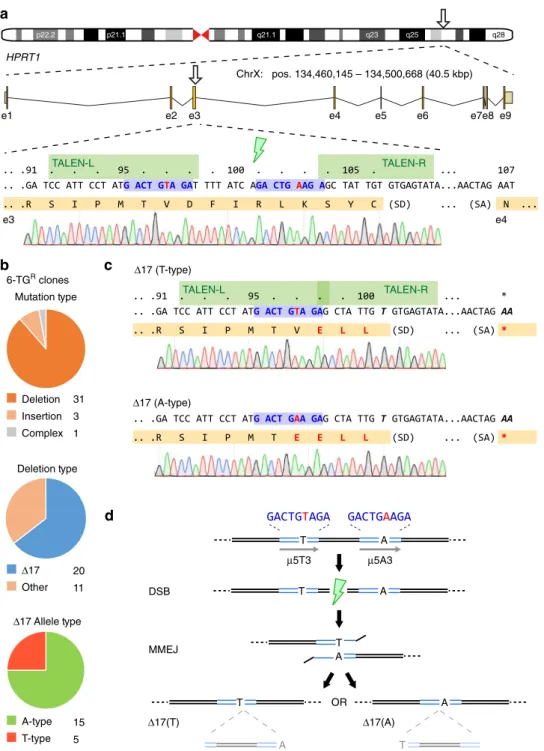
. Gene disruption
using programmed endonucleases relies on cellular error-prone
repair pathways such as NHEJ to produce out-of-frame insertion
and deletion (indel) mutations. We previously exploited this
phenomenon to disrupt HPRT enzyme function in 201B7 human
female iPSCs in order to assess the activities of modi
fi
ed TALEN
architectures
13. In that assay, transient transfection of TALENs
modeled after
HPRT1
_B
14which target exon 3 of the human
HPRT1
gene (Fig.
1
a), followed by metabolic enrichment for
HPRT loss-of-function by 6-thioguanine resistance (6-TG
R;
Supplementary Fig.
1
) revealed a recurring mutation comprised
of 17 deleted bases (
Δ
17). TALEN-mediated disruption of
HPRT1 in another female iPSC line (409B2) reproduced the
Δ
17
allele at a frequency of ~12% (Supplementary Fig.
2
). DSBR
outcomes may be biased by short direct sequence repeats towards
alternative MMEJ repair
9. We therefore used a modi
fi
ed script
15to detect
µ
H at the expected DSB site and identi
fi
ed a 5 bp
µ
H
(
µ
5:
‘
GACTG
’
) lying within the left TALEN (TALEN-L) binding
site and the intervening spacer region, separated by heterologous
sequence (Fig.
1
a). Further examination revealed a shorter
µ
H of
3 bp (
µ
3:
‘
AGA
’
) adjacent to
µ
5, separated by only one variant
base (T or A), resulting in an imperfect compound
µ
H of the
structure
‘
GACTGWAGA
’
, where W
=
T/A (hereafter referred to
as
µ
5W3). These observations suggested a biased repair pathway
through MMEJ which warranted further investigation.
Considering the
HPRT1
locus is X-linked, we set out to explore
the spectrum of DSBR outcomes induced by TALEN in male
1383D6 iPSCs
16and H1 ESCs
17. Whilst maintaining the same
target sequences
14,
HPRT1
_B TALENs were updated from a
truncated
Xanthomonas oryzae
pv. (PthXo1)-based TALE
scaf-fold
13to
X. campestris
pv.
vesicatoria
(AvrBs3)-based +136/+63
TALE architecture
18and expressed from a CAG promoter-driven
expression vector. These TALEN vector modi
fi
cations resulted in
a 3-fold increase in cleavage activity for Avr
HPRT1_B
TALENs as
measured by single-strand-annealing (SSA) assay
19(Supplemen-tary Fig.
3
a). Enhanced genome cleavage activity was also
demonstrated in 1383D6 male iPSCs by improved
HPRT1
knockout as measured by 6-TG
Rcolony formation
(Supplemen-tary Fig.
3
b). We estimated allele frequencies in a bulk population
of 6-TG
RiPSCs by employing computational sequence trace
decomposition (TIDE) from mixed PCR amplicons
20. In the
sequence trace
fi
le, overlapping peaks were observed immediately
following
µ
5W3, with a preceding T/A overlay at position
‘
W
’
(Supplementary Fig.
4a-c
). Amongst a variety of minor deletion
alleles,
Δ
17 was found to be signi
fi
cantly overrepresented (63.5%,
Supplementary Fig.
4
d), strongly supporting MMEJ through
µ
5W3. TIDE veri
fi
ed a similar frequency in male H1 human ESCs
(43.9%, Supplementary Fig.
4
e-g). In order to exclude the
possibility that this apparently high rate of MMEJ repair in the
population was an artifact of PCR bias, we isolated 6-TG
RiPSC
clones and performed Sanger sequencing of exon 3
(Supplemen-tary Fig.
5
). Clonal analysis revealed deletions as the most
common DSBR outcome (~88%), amongst which the
Δ
17 allele
comprised the majority (~64%), consistent with the
population-based TIDE analysis. The
Δ
17 alleles could be further subdivided
according to the imperfection in
µ
5W3 at a ratio of 5(T):15(A)
(Fig.
1
b,c), presumably dictated by more frequent use of the
longer
µ
5 for repair, and a concordant loss of the intervening
shift which results in three (D98E, F99L, I100L, for
HPRT
∆17T) or
four (V97E, D98E, F99L, I100L, for
HPRT
∆17A) missense
mutations terminating in a nonsense mutation (
fsTer101
),
resulting in loss of HPRT function as measured by resistance to
6-TG and sensitivity to HAT (Supplementary Fig.
6
), with no
additional effects on clone morphology or growth rate under
normal culture conditions.
Analysis of the TALEN-mediated
HPRT1
knockout data led us
to two key conclusions (Fig.
1
d):
fi
rst, that common MMEJ events
result in high-
fi
delity deletion of intervening sequence, and
second, that MMEJ between imperfect
µ
H (
µ
5W3) leads to
alternate yet predictable allelic outcomes.
Coincident editing of mutants and isogenic controls
. Genome
targeting in human iPSCs bene
fi
ts from antibiotic enrichment, yet
to achieve scarless editing of patient mutations selection markers
must be removed entirely
21. Inspired by TALEN-mediated
µ5T3 µ5A3
T A
T
T
A
A
T OR A
T A
∆17(T) ∆17(A)
DSB
MMEJ
d
b
c
TALEN-L TALEN-R
∆17 (A-type)
∆17 (T-type)
a
HPRT1
ChrX: pos. 134,460,145 – 134,500,668 (40.5 kbp)
p22.2 p21.1 q21.1 q23 q25 q28
e1 e2 e3 e4 e5 e6 e7e8 e9
TALEN-L TALEN-R
e3 e4
Mutation type
Deletion Insertion Complex
31 3 1 6-TGR clones
Deletion type
∆17
Other 11 20
∆17 Allele type
A-type T-type 5
15
Fig. 1TALEN disruption of theHPRT1locus is biased by endogenous microhomology.aSchematic of the humanHPRT1locus with detail for segments of exon 3 and 4 (orange) including splice junctions, theHPRT1_B NC- or Avr-TALEN target sites (green), and predictedμ5W3 microhomology (blue) with the
mismatched base (A/T) shown in red. Chromosome positions refer toH. sapiensGRCh38.HPRT1codons are numbered above. 1383D6 iPSC sequence
trace genome is shown below. SD, splice donor; SA, splice acceptor.bSummary of repair outcomes in 6-TGRclones following transfection of 1383D6 iPSCs
HPRT1
disruption by MMEJ (Fig.
1
d), we reasoned that by
engineering duplicated
µ
H from unique endogenous sequences,
such that they
fl
ank the antibiotic selection marker, we could
induce the cell to employ MMEJ to repair nested DSBs resulting
in scarless excision and locus restoration with only engineered
point mutations remaining (Fig.
2
a). To demonstrate this
microhomology-assisted excision (MhAX) technique, we chose to
edit bases within exon 3 of
HPRT1
. As
HPRT1
is expressed in
human iPSCs, we employed a puro
∆
TK (a fusion of puromycin to
truncated thymidine kinase) antibiotic counter-selection marker
as a 2A-peptide linked promoterless gene-trap; an approach
similar to that used for background-free AAVS1 targeting
16, but
lacking a splice-acceptor sequence in favor of in-frame insertion
into the
HPRT1
open reading frame (Fig.
2
b). As well, we
included a constitutively expressed CAG::mCherry reporter gene
with the intent to track both gene targeting and excision steps. In
order to introduce DSBs
fl
anking the selection/reporter cassette,
we chose to employ CRISPR-Cas9 rather than TALEN, exploiting
multiple advantages including: a uni
fi
ed Cas9 protein and sgRNA
plasmid expression system
22and de
fi
ned endonuclease
break-points
23. In selecting protospacer/sgRNA combinations, we
focused on three sgRNAs targeting the GFP gene of
A.victoria
,
already shown to have high activity and low toxicity in human
U2OS osteosarcoma cells
24. Activity of each GFP sgRNA was
determined using an SSA assay in HEK293T cells (Supplementary
Fig.
7
a and b), and an AAVS1-CAG::eGFP disruption assay in
human iPSC (Supplementary Fig.
7
c). No overt cytotoxicity was
observed for any of the sgRNAs in either assay. Based on these
data, we selected the eGFP1 protospacer (hereafter referred to as
ps1). Duplicated ps1 protospacers were positioned
fl
anking the
cassette in a divergent orientation such that the PAMs and
upstream cleavage sites were proximal to the engineered
µ
H
(Fig.
2
a). High-throughput screening and computational analysis
of sgRNA libraries
25has revealed that a
‘
G
’
nucleotide positioned
downstream of the PAM is unfavorable for Cas9 activity. We
therefore de
fi
ned potential
µ
H in the genome such that each
nested ps1 PAM would be
fl
anked by a
‘
T
’
or an
‘
A
’
nucleotide
(Supplementary Table
1
).
+ / –
Munich & Silent mutation Silent mutation ONLY
T A T C
G C
T A T C
T A T C T C T A
a
MMEJ Targeting Excision2A-puro∆TK; CAG::mCh
mChpos
mChneg
mChneg
c
T = AflII
A = S104R
Normal
e3
Afl II
Silent mutation (035-C1)
e3
Afl II
Munich S104R & Silent (035-D12)
e3
T A
T A
Bilateral:
Unilateral: 1 kb
Hind III 9.8 kbp Hind III Hind III Hind III Hind III 6.9 kbp Hind III
6.9 kbp 6.9 kbp
puro pA pA
T2A
mCherry probe
e2 HPRT-B
e3
e2 e3 e2 e3
dTK mCh e3’ dna319 dna319 dna123 e2 HPRT-B dna383 e3 HA-L HA-R HPRT-B CAG
Munich & Silent
Hind III Hind III dna319
Afl II
Normal allele Targeted allele T T T T G C A
Afl II
A C C µH µH µH Scarless excision
b
ps1 ps1e
Hind III HPRT-B probe
6.9 kbp 9.8 kbp
9.8 kbp
1383D6 033-U-45 035-C1 035-D1 035-B2 035-H2 035-A1
1
035-C3 035-D3 035-A4 035-F5 035-G5 035-G7 035-G8 035-D12 1383D6 033-B-43 035-E5 035-H6a 035-C7 035-D9 035-D1 035-H6
1
unilateral bilateral
×
Hind III mCherry probe
Donor vector
OR
ChrX: HPRT1
p22.2 p21.1 q21.1 q23 q25 q28
pos. 134,470,590 – 134,477,443
Targeted allele ps1 sgRNA 033-B-43 (bilateral) mCh FSC 1.4% 96.5% 99.0% 0.5% HAT– HAT+ 033-U-45 (unilateral)
0102 103 104 105
0102 103 104 105
0 50K 100K 200K 150K 250K
0102 103 104 105
0 50K 100K 200K 150K 250K 0 50K 100K 200K 150K 250K
0102 103 104 105
0 50K 100K 200K 150K 250K HAT– HAT+ 1.9% 94.9% 98.7% 0.7% mCh FSC
d
HPRT1 Normal alleleExcision Excised clones:
OR
ps1 ps1
µ13 µ13
Munich / Silent:M M M M M SS S S SM M M M M M M M M + / –
µH µH
dna383
Afl II
Hind III dna319 HPRT-B dna383 Silent ONLY dna383 dna804 mChneg
Fig. 2Imperfect microhomology simultaneously creates iPSCs with patient mutations and their isogenic controls.aSchematic overview of the MMEJ method for editing HPRTMunichand control alleles. Left and right homology arms overlap, generating a 13 bp tandemµH (blue)flanking the selection cassette (red). The patient mutation (c.312C>A, red) is present in oneµH (unilateral) or both (bilateral). A silent bilateral point mutation (c.306G>T, blue) generates anAflII site. Complementary ps1 protospacers (black) are nested divergently between theµH and cassette, with sequences and cut site
positions indicated in green above. Gene targeting used AvrHPRT1_BTALENs (yellow bolt). Upon transfection of targeted clones with CRISPR-Cas9
(pX-ps1), DSBs are generatedflanking the cassette, proximal to the engineeredµH (green bolts). Repair by MMEJ scarlessly excises the cassette, resulting in
two possible editing outcomes.bDetailed schematic ofHPRT1gene targeting and MMEJ resolution. Exons (gray), overlapping homology arms (HA-L/R,
white),µH (blue), ps1 CRISPR-Cas9 target sites (green), and engineered bases are indicated. 2A-puroΔTK is inserted in-frame withHPRT1exon3. Black bars indicate Southern blot probes for the indicated restriction fragments. Genotyping primers are shown in red.cFACS scheme used to enrich mChneg
Considering our observations for repair of the imperfect
µ
5W3
at the
HPRT1
locus (Fig.
1
), we surmised that the duality of
outcomes could be intentionally exploited to produce both
mutant and control iPSC clones from a single experiment. We
chose to focus on re-creating the HPRT
Munichpartial enzyme
de
fi
ciency
11, originally discovered in a patient presenting with
gout caused by hyperuricemia. The HPRT
Munichallele results
from a C-to-A transversion mutation (rs137852485; c.312C
>
A;
S104R)
26located within exon 3 of
HPRT1
neighboring the
Avr
HPRT1_
B TALEN target site. Through an overlap in
HPRT1
homology arms, we created a
fl
anking
µ
H
‘
TAAGAG
A
TATTGT
’
which contained the Munich c.312C
>
A mutation centrally (bold
underlined) and an additional Silent c.306G
>
T mutation at the 5
’
end of the
µ
H (underlined) that generated an
A
flII restriction site
exclusively for diagnostic purposes (Fig.
2
a and Supplementary
Table
1
). In order to recapitulate the imperfect
µ
H phenomenon,
we generated two targeting vectors in which the Munich c.312A
patient mutation was either symmetrical (bilateral), or
asymme-trical (unilateral, such that the downstream homology is
‘
TAAGAGCTATTGT
’
) (Fig.
2
a). Bilaterally encoded mutations
were hypothesized to be deposited in 100% of clones, while
unilaterally encoded mutations would be deposited in only a
fraction of clones. Both
µ
H contained the diagnostic
A
flII
c.306G
>
T mutation.
Avr
HPRT1
_B TALENs were employed to stimulate gene
targeting in 1383D6 iPSCs. Puro
Rclones were screened by
Southern blot genotyping, mCherry expression by FACS,
sensitivity to HAT, and resistance to 6-TG (Supplementary
Fig.
8
a and
9
a,b). Excision was induced by transfection with
pX-ps1, producing mCh
negpopulations at a rate of 1.4 and 1.9% for
033-B-43 (bilateral) and 033-U-45 (unilateral), respectively
(Fig.
2
c). mCh
negcells were therefore FACS sorted to
>
98%
purity and replated at clonal density with or without HAT
selective pressure. Under HAT selection 033-B-43 yielded no
clones, suggesting either a failure to repair or a phenotypic effect
of the Munich c.312A mutation (Table
1
). On the other hand,
under HAT selective pressure 033-U-45 generated iPSC colonies
which all achieved scarless excision but represented deposition of
the Silent c.306T mutation exclusively (49/49), indicating either a
repair bias or supporting the possibility that HPRT
Munichclones
retain sensitivity to HAT.
Scarlessly engineered HPRT
Munichalleles were produced in the
absence of HAT selective pressure (Table
1
). Southern blotting of
clones (Fig.
2
d) provided evidence that the HPRT locus was
reconstituted and that transgenes had not re-inserted into the
genome at any detectable rate. Releasing HAT selective pressure
also revealed clones that repaired via NHEJ (Table
1
), many of
which (
>
40%) represented perfect end-joining comprised of ps1
breakpoints, PAMs, and retention of
fl
anking
µ
H (Supplementary
Fig.
8
b). From parental clones with bilateral
µ
H, 4.5% (8/179)
excised scarlessly, and all clones bore both the Silent c.306T and
Munich c.312A mutations. Clones from unilateral
µ
H excised
scarlessly at a rate of 6.8% (14/206). Importantly, 9/14 clones bore
both the Silent and Munich mutations, while the remainder (5/
14) carried only the Silent mutation (Table
1
) as veri
fi
ed by
sequencing (Fig.
2
e) and restriction fragment length
polymorph-ism (RFLP) analysis (Supplementary Fig.
8
c), indicating that we
could reproduce the stochasticity of MMEJ outcomes by
intentionally engineering imperfect homology.
Finally, we set out to examine the phenotypic consequences of
HPRT editing and assess clonal variation. Under normal iPSC
maintenance conditions, no difference in morphology or growth
rate was noted between normal, mutant, or isogenic control
clones (Supplementary Fig.
9
a and b). Within 24 h of HAT
treatment knockout iPSCs were completely eliminated, while
HPRT
MunichiPSCs showed delayed growth by cell number and a
profound change in cell morphology (Supplementary Fig.
9
b,
bottom), leading to complete cell death by prolonged treatment.
Interestingly, unlike knockout iPSCs, HPRT
MunichiPSCs also
retained a delayed sensitivity to 6-TG (20
µ
M, Supplementary
Fig.
9
a). Previously, in vitro assays using HPRT
Munichpatient cell
lysates indicated abnormal hypoxanthine catalytic activity
27although protein levels were normal
11,28. Accordingly, while
HPRT protein was undetectable in Western blot analysis of
knockout iPSC line lysates, HPRT
Silentor HPRT
Munichclones
revealed normal protein expression levels (Supplementary Fig.
9
c).
Pathologically, excess hypoxanthine is converted into uric acid
(Supplementary Fig.
1
) which can accumulate in the joints and
tendons causing in
fl
ammatory arthritis, kidney stones, or urate
nephropathy. Capillary-electrophoresis mass spectrometry
(CE-MS) was used to detect ionic metabolites in spent cell culture
media
29,30. While HPRT
Silentclones had metabolic pro
fi
les
resembling 1383D6, HPRT
MunichiPSCs accumulated both
hypoxanthine and guanine, but to a lesser extent than
Δ
17 or
033-U-45 knockouts (Supplementary Fig.
9
d). These cell growth
and metabolome data are consistent with a low-level salvage of
guanine and hypoxanthine in HPRT
Munichcells which is
insuf
fi
cient for DNA replication and growth in the absence of
de novo synthesis. As such, we generated a unique iPSC model of
an
HPRT1
coding-region variant, using the MhAX technique to
scarlessly and stochastically deposit disease-relevant or control
point mutations.
Parameters affecting MMEJ cassette excision
. In order to
explore the effects of increasing
µ
H length on MMEJ ef
fi
-ciencies
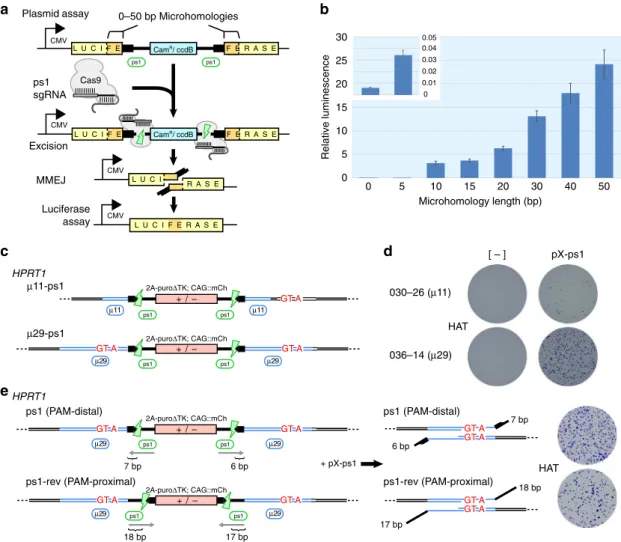
31, we developed a plasmid-based MMEJ assay analogous
to our cassette design used to generate the HPRT
Munichallele. We
fl
anked a Cam
R/
ccdB
positive/negative bacterial selection marker
with ps1 protospacers and inserted it into a luciferase expression
vector with
fl
anking
µ
H of increasing length from 0
—
50 bp
(Fig.
3
a,b). Following transfection into HEK293T cells, a positive
correlation between
µ
H length and luciferase activity was
observed, suggesting an improved rate of MMEJ (Fig.
3
b).
Excision from an extrachromosomal plasmid in HEK293T cells
may not accurately re
fl
ect precise excision from the iPSC genome.
We therefore established a contextually relevant chromosomal
assay at the HPRT locus where cassette excision by MMEJ results
Table 1 Rates of scarless editing at the HPRT locus using engineered microhomology
Parent clone
Munich mutation
Enrichment Samples analyzed
Normal allele
NHEJ (perfect)
Scarless excisiona
Fidelity (%)b
Silent ONLY
Munich & Silent
033-B-43 bilateral HAT 0 n/a n/a n/a n/a n/a n/a
no HAT 179 0 171 (75) 8 4.5 0 8
033-U-45 unilateral HAT 49 0 0 49 100 49 0
no HAT 206 0 192 (84) 14 6.8 5 9
in recovery of HAT resistance, along with the deposition of three
synonymous mutations disrupting
µ
5A3 (c.303A
>
G, c.304C
>
T,
and c.306G
>
A) (Supplementary Fig.
10
and
11
). Using TALEN,
MhAX cassettes
fl
anked by
µ
H of 11 bp
‘
TGACTGTAGAT
’
, or
29 bp
‘
TGACTGTAGATTTTATCAGGTTAAAGAGC
’
, the latter
of which contained the synonymous mutations (underlined,
Supplementary Table
1
), and with nested ps1 protospacers were
targeted to
HPRT1
exon 3 (Fig.
3
c). Excision using
µ
29 gave rise
to higher numbers of HAT
Rcolonies (Fig.
3
d) even though
mCh
negfractions were similar between the two constructs
(Table
2
and Supplementary Fig.
12
a), indicating that Cas9
cleavage and cassette excision rates were not affected by
µ
H
length but rather led to enhanced scarless repair by MMEJ.
Genotyping of
HPRT1
alleles from
µ
11 and
µ
29 mCh
negpopulations (without HAT enrichment) revealed a
>
4-fold
increase in scarless repair and mutation deposition (7.8% vs
~35% avg.), similar to the fold-change observed in the plasmid
assay (Fig.
3
b). Thus, increasing the length of
µ
H improves
scarless excision from human iPSC chromosomes.
Evidence from DSBR in yeast
32and mouse ESCs
33suggests
that the presence of long heterology (non-homologous sequence
from the end of DSBs until the start of homology) can negatively
impact MMEJ or HDR repair rates. We tested this parameter by
inverting the ps1 protospacers (ps1-rev), such that their PAMs
were placed proximal to the cassette, leading to a 17 or 18 bp
heterology on either end compared to 6 or 7 bp generated in the
PAM-distal orientation used thus far (Fig.
3
e and Supplementary
Table
1
). Cassette excision rates (% mCh
neg) using PAM-distal or
-proximal protospacers were similar (Supplementary Fig.
12
b),
indicating that orientation itself does not affect CRISPR-Cas9
cleavage. However, MMEJ repair rates were impeded by
elongated heterology as indicated by a reduction in overall HAT
Rcolony formation following excision of ps1-rev alleles (Fig.
3
e,
ps1 (PAM-distal)
d
ps1-rev (PAM-proximal)
GT A 7 bp
18 bp 6 bp
17 bp
a
c
R A S E CMV
L U C I CMV
Cas9
ps1 sgRNA
0–50 bp Microhomologies
CMV
CamR/ ccdB
Luciferase
assay L U C I F E R A S E
L U C I F E F E R A S E
F E R A S E CMV
L U C I F E
Excision
MMEJ
Relative luminescence
Microhomology length (bp)
0 5 10 15 20 30 40 50
0.05 0.04 0.01 0.02 0.03 0
b
e
HAT 030–26 (µ11)
[ – ]
036–14 (µ29)
pX-ps1
GT A
GT A GT A
HPRT1
HPRT1
HAT
GT A + / –
µ11-ps1 2A-puro∆TK; CAG::mCh
+ / – µ29-ps1
GT A GT A
2A-puro∆TK; CAG::mCh
ps1 ps1
ps1 ps1
ps1 ps1
ps1 ps1
µ11 µ11
µ29
µ29 µ29
µ29
µ29
µ29
ps1-rev (PAM-proximal) ps1 (PAM-distal)
7 bp 6 bp
+ / – GT A
GT A
18 bp 17 bp
+ / – GT A
GT A
ps1 ps1
2A-puro∆TK; CAG::mCh
2A-puro∆TK; CAG::mCh
Plasmid assay
+ pX-ps1
CamR/ ccdB
0 30
25
20
15
10
5
Fig. 3Parameters affecting cassette excision by MMEJ.aSchematic of the plasmid-based MMEJ assay measuring luciferase repair.bLuciferase activity as a function of increasingflankingμH length. Inset shows luciferase activity with 5 bpμH compared to background (0 bp). Error bars show s.e.m. (n=3).
cSchematic of theHPRT1chromosomal assay depicting MhAX cassettes and nested ps1 protospacers withflanking 11 or 29 bp ofμH. Synonymous
mutations are shown in red.dHATRcolonies arising from targeted clones without or with nuclease (pX-ps1) transfection. One representative clone is
shown for each homology length.eSchematic ofHPRT1-targetedμ29 MhAX cassettes with inverted ps1 protospacers. Predicted heterology lengths are
indicated for each DSB. HAT-resistant colonies following excision are representative of three independent experiments. HAT-selected populations from either protospacer orientation are enriched for MMEJ repair (Supplementary
Fig.12c)
Table 2 Microhomology length affects MMEJ repair of
human chromosomes
Parent clone
µH (bp) Excision (%
mChneg)
Scarless excision
Fidelity (%)
030-26 11 3.5 6/77 7.8
036-08 29 2.8 17/45 35.6
036-12 29 3.4 29/82 35.4
right). Based on these results, subsequent MhAX experiments
employed elongated
µ
H and maintained ps1 in a PAM-distal
orientation for reduced heterology.
Biallelic modi
fi
cation of the
APRT
locus
. Many disease-causing
mutations show autosomal recessive inheritance. To demonstrate
scarless biallelic modi
fi
cation using the MhAX method, we chose
to edit the adenosine phosphorybosyl transferase (
APRT
) gene,
which produces the enzyme required for the synthesis of
ade-nosine monophosphate (AMP) from adenine (Supplementary
Fig.
1
). The APRT*J allele (rs104894507; c.407T
>
C; M136T)
results in partial enzyme de
fi
ciency causing a buildup of
2,8-dihydroxyadenine (2,8-DHA) crystals, often leading to kidney
stone formation or more severely, kidney failure
12. Although
APRT*J is prevalent in Japanese patients with urolithiasis (79%),
an in vitro iPSC model remains to be generated. Employing a
gene-trap selection marker and constitutive reporter cassette
fl
anked by PAM-distal ps1 protospacers, we engineered a
fl
anking
32 bp
µ
H (GTACCA
C
GAACGCTGCCTGTGAGCTGCTGGGC)
in which a synonymous c.402A
>
T Silent mutation (underlined)
generating a diagnostic
Acc
65I restriction site was present
bilat-erally, while the c.407T
>
C APRT*J mutation (bold underlined)
was present unilaterally (Fig.
4
a and Supplementary Table
1
).
CRISPR-Cas9 sgRNAs overlapping the mutation sites in
APRT
exon 5 were screened using T7EI digestion and directly in iPSCs
by
APRT
gene targeting (Supplementary Fig.
13
). APRT sgRNA-2
was selected for superior performance in both assays. In order to
reduce random integration of the donor vector backbone, we
employed negative selection for GFP
fl
uorescence
34(Fig.
4
a).
Puro
R, mCh
pos/GFP
negiPSC clones were identi
fi
ed by
micro-scopy, picked, and genotyped (Fig.
4
b,c). Mean mCherry
fl
uor-escence intensity displayed a bimodal distribution (Fig.
4
d),
which was linked to copy number by genotyping heterogously
and homozygously targeted clones.
Three each of hetero- and homozygously targeted clones were
subjected to cassette excision via transfection of pX-ps1. Excision
rates were consistently higher for heterozygous (6.7% avg.) versus
homozygous (3.3% avg) targeted clones (Table
3
and
Supple-mentary Fig.
14
), re
fl
ecting the requirement for one or two copies
of the cassette to be removed from the genome. Excised mCh
negpopulations were isolated by FACS, from which the spectrum of
alleles was analyzed by Sanger sequencing of genomic PCR
products (Table
3
). Expectedly, approximately half of the
sequences detected in excised populations from heterozygous
targeted clones were unmodi
fi
ed normal alleles. Scarless excision
of the cassette occurred at an average rate of 30% amongst
heterozygous clones. Homozygous targeted clones showed an
a
Chr16:APRT pos. 88,807,267–88,811,860 (reverse)p13.3 p12.3 p12.1 p11.2 q11.2 q12.1 q21 q22.1 q23.1
+ / –
+ / –
APRT*J & Silent mutation Silent mutation ONLY
T T
A T
T C T T
T T T C
b
MMEJ Targeting Excision2A-puro∆TK; CAG::mCh
mChpos T = Acc65I
C = M136T
T C Scarless excision ps1 ps1 Donor Vector – CAG::eGFP GFPneg mChneg T C T T
e1 e2 e3 e4
Bam HI
e5
Bam HI T
C
Acc 65I Acc 65I
e1 e2 e3 e4
Bam HI
e5
Bam HI Acc 65I Acc 65I
Acc 65I Acc 65I
T T
1 kb
2.8 kbp
puro pA pA
T2A
mCherry probe
e1 e2 e3 e4
dTK mCh
dna116
dna1865 dna804
CAG Acc 65I Acc 65I
e5 Bam HI
4.0 kbp T T T C 2.2 kbp
e1 e2 e3 e4 APRT-5’ dna1796
Bam HI
e5
dna1796
dna1865
dna1796
dna1865 Acc 65I µH Bam HI
A T G/C
µH
G/C G/C µH
µH µH
G/C
2.2 kbp APRT-5’
2.2 kbp APRT-5’
APRT*J & Silent Silent ONLY Normal allele
Targeted allele
c
f
APRT-5’ probe Bam HI
Targeting
1383D6 052–2–1 052–2–2 052–2–3 052–2–13 052–2–15 052–2–16 052–2–21 052–2–22 1383D6 052–2–5 052–2–1 052–2–44 052–2–51 052–2–52 052–2–61
1 Heterozygous Homozygous × 2.2 kbp 2.8 kbp Acc 65I mCherry probe 4.0 kbp Excised clones: 2.2 kbp 2.8 kbp 4.0 kbp
1383D6 052–2–2 056K-15 056K-17 056K-20 056K-41 056K-103 056K-123 1383D6 052–2–1
1
056–1–31 056–1–69 056–1–103 056–1–129
056–1–16
Heterozygous Homozygous
056–1–154 056–1–162 056–1–166 056–1–178
APRT-5’ probe Bam HI
Acc 65I mCherry probe
d
e
HET NORM NHEJ SILENT APRT*J NORM 2
NHEJ 103 0
SILENT 11 0 0
APRT*J 38 0 0 0
Allele A
Allele B
Total: 154 052–2–2
HOMONORM NHEJ SILENT APRT*J NORM 0
NHEJ 0 133
SILENT 0 3 2
APRT*J 0 15 1 6 Allele B Allele A Total: 160 052–2–11 Excision APRT Normal allele OR OR
µ32 µ32
ps1 ps1 1383D6 2 13 21 Het
Count 0102 103 104 105
mCh Targeted clones:
S A
APRT*J / Silent: A A S S A AAS S A A A A/S
Acc 65I
dna1865 HA-L
HA-R
Bam HI Acc 65I
e5’
Acc 65I APRT-5’
dna1728 Bam HI
Acc 65I
11 52 61 Homo 0 100 200 300
Fig. 4Biallelic modification of theAPRTlocus.aSchematic overview of the method for scarless engineering of APRT*J and control alleles. Homology arm overlap generates a 32 bp tandemµH (blue), with the patient mutation (c.407T>C, red) present unilaterally, and the Silent mutation (c.402A>T, blue) present bilaterally. A GFP reporter is included in the backbone to exclude cells with random donor integration by FACS. Gene targeting used CRISPR-Cas9 (yellow bolt, Supplementary Fig.13). The remaining elements are as described in Fig.2a.bDetailed schematic ofAPRTgene targeting and MMEJ resolution. The heterozygous SNP (rs8191489) is shown in orange. Additional labeling is consistent with Fig.2b.cSouthern blot analysis of selectAPRT
hetero- and homozygously targeted clones using genomic (APRT-5’, top) and transgenic (mCherry, bottom) probes. Parental 1383D6 iPSCs are included as a control.“x”indicates one clone with aberrant banding.dHistograms of mCherryfluorescence intensities in selectAPRTtargeted clones. Note that the
bimodal distribution is correlated with genotype, and therefore CAG::mCh transgene copy-number.eAPRTdiploid genotypes of clones. Heterozygous
genotypes were resolved using TIDE. Alleles marked as‘APRT*J’were also edited with the Silent mutation.fSouthern blot analysis of select excised clones
revealing restoration of theAPRTlocus (APRT-5’probe, top) and removal of the cassette (mCherry probe, bottom). Parental 1383D6 and intermediate
overall reduced rate of scarless excision (13% avg.), lending to a
relative increase in NHEJ alleles. Co-deposition of the Silent and
APRT*J mutations was more common than Silent alone, possibly
due to the unbalanced nature of the imperfect
µ
H (
µ
6Y25;
Supplementary Table
1
). Thus, unilateral
µ
H was again observed
to stochastically generate both silent and pathogenic allele types.
From populations of mCh
negcells, clones were isolated and
genotyped. To ensure the identi
fi
cation of both alleles, we
included a neighboring heterozygous SNP (rs8191489, G/C) from
intron 3 within the PCR amplicon (Fig.
4
b and Supplementary
Fig.
15
a), and employed TIDE analysis to decompose
hetero-zygous repair events. The diploid genotypes of all clonally isolated
iPSCs are summarized in Fig.
4
e. Scarless excision rates in the
heterozygously targeted clone 052
–
2
–
2 were 31.8% (49/154
clones), similar to that predicted from population analyses
(Table
3
). Homozygous clone 052
–
2
–
11 gave rise to 5.6% (9/
160 clones) with scarless biallelic modi
fi
cation, representing
homozygous and compound heterozygous edited genotypes
(Fig.
4
e and Supplementary Fig.
15
a). Sequence decomposition
revealed that an additional 18 clones with one NHEJ allele
underwent scarless excision of the other allele (Supplementary
Fig.
16
), such that the frequency of clones having at least one
scarlessly edited allele (27/160 clones, or 16.9%) was in agreement
with our initial population analysis.
Monoallelically and biallelically edited iPSC clones were
selected and correct gene editing was further con
fi
rmed using
Southern blot (Fig.
4
f) and an
Acc
65I RFLP assay (Supplementary
Fig.
17
). We phenotyped edited clones by testing their resistance
to 2,6-diaminopurine (DAP, Supplementary Fig.
1
and
15
b), a
toxic purine analog
35. Parental 1383D6 and homozygous
APRT
Silent/Silentmutants displayed severe drug sensitivity to 10
µ
g/mL DAP treatment, with nearly complete cell killing within
just 48 h (Supplementary Fig.
15
b). Heterozygous targeted or
APRT
*J/Silentcells had reduced sensitivity to DAP but were
essentially eliminated within 48 h, while homozygous targeted
and
APRT
*J/*Jcells were completely resistant to DAP treatment.
This data veri
fi
es a reproducible change in cellular metabolism
amongst
APRT
gene-edited iPSCs.
Expedited generation of an isogenic allelic series
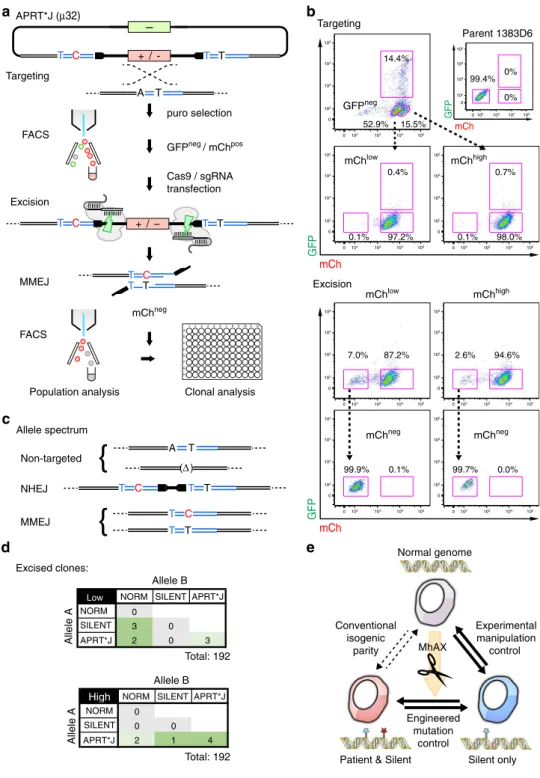
. With the goal
of expediting the scarless gene editing process in iPSCs, we chose
to exploit the high
fi
delity of gene-trap targeting with
copy-number dependent transgene expression and
fl
uorescent
counter-selection of random targeting events by FACS (Fig.
5
a).
APRT
gene targeting was carried out as described above (Fig.
4
),
how-ever instead of clonal isolation and screening of targeted
inter-mediates, entire puro
Rpopulations were harvested in bulk and
subjected to FACS to isolate mCh
pos/GFP
negiPSCs (Fig.
5
a,b).
We further separated the mCh
pospopulation into mCh
low(52.9%
of total) and mCh
high(15.5% of total) (Fig.
5
b) in order to enrich
for heterozygous or homozygously targeted cells (Fig.
4
d),
respectively. Cassette excision was more ef
fi
cient from the
mCh
lowthan mCh
high(7.0 vs 2.6%) bulk population (Fig.
5
b),
consistent with excision one or two transgene copies from
het-erozygous or homozygously targeted clones (Table
3
), suggesting
that the MhAX method may be expedited by FACS when the
fi
delity of targeting is high.
Genotyping of the two excised populations classi
fi
ed alleles
into 3 categories: non-targeted, which includes normal alleles or
indel alleles generated by APRT sgRNA-2 during gene targeting;
NHEJ, which arise during repair of cassette excision
(distin-guished from APRT sgRNA-2 indels as they retain engineered
µ
H
and cassette sequences, similar to that shown in Supplementary
Fig.
8
b); and MMEJ, which resolve scarlessly and retain the
pathogenic APRT*J and/or Silent mutations (Fig.
5
c and Table
4
).
Notably, while the mCh
highpopulation was biased toward NHEJ
and MMEJ, the mCh
lowpopulation contained more frequent
indels (37.5 vs 6.1% for mCh
high), validating FACS enrichment of
monoallelically or biallelically targeted cells, but also re
fl
ecting the
potential of CRISPR-Cas9 to elicit error-prone repair of DSBs in
opposition to HDR. A similar process of FACS-based targeting
and excision for the X-linked HPRT
Munichallele (Supplementary
Fig.
18
and Supplementary Table
2
) gave rise to scarless gene
edited clones at a rate comparable to that observed previously for
cloned intermediates (5.6 vs 8%; Table
1
) without a signi
fi
cant
proportion of normal or indel alleles. Excluding non-targeted
normal and indel alleles from the
APRT
analysis, the
fi
delity of
scarless repair of target alleles was estimated to be slightly higher
for the mCh
lowpopulation compared to mCh
high(26.5 vs 22.7%).
Finally, we performed clonal isolation from bulk excised
populations for the analysis of
APRT
diploid genotypes (Fig.
5
d).
Although TIDE analysis revealed compound heterozygous
genotypes including indel and NHEJ alleles (as seen in Fig.
4
e),
we focused only on biallelic editing, or monoallelic editing where
the alternate allele was normal. Monoallelic editing was biased in
clones from mCh
lowsorting (Fig.
5
d, top), while biallelically
edited clones were more prevalent from mCh
high(Fig.
5
d,
bottom). Thus, the simultaneous isolation of an allelic series in
iPSC which have been handled under equivalent experimental
conditions provides a new source of monoallelic (APRT*J/Norm
and Silent/Norm) and biallelic (APRT*J/Silent and APRT*J/
APRT*J) isogenic parity (Fig.
5
e).
Discussion
Microhomology-mediated end joining reproducibly deletes one
copy of tandem homology along with intervening genomic DNA
sequences to generate deletions of predictable size
9,15,31. In the
current study, we report the development of a scarless genome
editing approach termed MhAX (microhomology assisted
exci-sion), where arti
fi
cially engineered
µ
H accompanied by nested
CRISPR-Cas9 target sites predisposes DSBR toward scarless
excision of a selectable marker. Demonstrations of monoallelic
and biallelic editing to deposit disease-relevant HPRT
Munichor
APRT*J mutations highlight the precision of this endogenous
Table 3 Rates of scarless editing at the
APRT
locus using engineered microhomology
Parent clone
Genotype Excision (%mChneg)
Samples analyzed
Normal allele
NHEJ (perfect)
Scarless excisiona
Fidelity (%)b
Silent ONLY
APRT*J & Silent
052-2-2 Het 8.4 37 23 9 (5) 5 35.7 1 4
052-2-13 Het 5.0 50 30 17 (8) 3 15.0 1 2
052-2-21 Het 6.8 46 24 14 (11) 8 36.4 4 4
052-2-11 Homo 3.4 45 0 40 (26) 5 11.1 0 5
052-2-52 Homo 3.6 53 0 47 (30) 6 11.3 1 5
052-2-61 Homo 2.9 46 0 38 (30) 8 17.4 0 8
pathway. Based on conventional donor construction and standard
gene targeting principles which have been employed in the
fi
eld
for decades
36,37, MhAX provides a tractable methodology which
enhances established gene targeting pipelines. When recruiting
HDR to deposit point mutations, dsDNA donors present an
advantage over ssDNA through extension of the conversion tract
from tens to hundreds of bases from the DSB
38. Our approach is
complementary to NHEJ or MMEJ mediated insertion of
transgenic cassettes
fl
anked with minimal homology arms
fol-lowing nuclease cleavage of both the donor and target genome
39–41
. Analogous to recombinase-based cassette removal techniques,
yet completely independent of residual exogenous recombinase
sites
42, MMEJ-based transgene excision could have similar broad
applications in the precise elimination of foreign genetic elements
for gene or cell therapy applications, and possibly even
condi-tional gene manipulation.
Low NORM SILENT APRT*J NORM 0
SILENT 3 0
APRT*J 2 0 3
Allele A
Allele B
High NORM SILENT APRT*J
NORM 0 SILENT 0 0
APRT*J 2 1 4
Allele A Allele B
a
c
Experimental manipulation control Engineered mutation control Conventional isogenic parityPatient & Silent Silent only Normal genome MhAX Excised clones: Parent 1383D6 99.4% 0% 0% 0 0 0 105 105 105 105 104 104 104 104 103 103 103 103 102 102 102 102 0 0 105 105 104 104 103 103 102 102 0 0 105 105 104 104 103 103 102 102 0 0 105 105 104 104 103 103 102 102 0 0 105 105 104 104 103 103 102 102 0 0 105 105 104 104 103 103 102 102 0 0 105 105 104 104 103 103 102 102 0 mCh mCh GFP GFP 0.1% 97.2% 7.0% 87.2% 99.9% 0.1% 0.1% 98.0% 2.6% 99.7% 0.0% mChlow 52.9% 15.5% 14.4% 0.4% 0.7% 94.6% mChhigh Targeting Excision
mChneg mChneg mChlow mChhigh
b
Allele spectrum (∆) MMEJ Non-targeted NHEJ{
{
A T T T T T T C T C + / -+ / – T C T C Targeting Excision MMEJ mChnegCas9 / sgRNA transfection GFPneg / mChpos
Population analysis puro selection Clonal analysis A B C D E F G H
123456789101112
– T C T T T T T T A T FACS FACS
e
Total: 192 Total: 192d
mCh GFPAPRT*J (µ32)
GFPneg
Fig. 5Expedited biallelic gene editing by FACS sorting.aSchematic of the FACS sorting protocol. GFPneg/ mChposcells (targeted) are isolated in bulk and
subjected to nuclease transfection, followed by sorting populations for mChneg(excised). Resolved alleles were screened in the population, or in single-cell derived iPSC clones. The donor vector, allele and additional features are as described in Fig.4a,b.bRepresentative FACS plot for the targeting and excision steps. GFPposcells were excluded, and mChposcells were divided into high and low fractions to bias monoallelically and biallelically targeted cells,
In this initial demonstration of MhAX, we achieved excision
rates from ~5
–
35%, which is practical for clonal isolation of iPSCs
with biallelic modi
fi
cation. In human iPSCs, we empirically
ver-i
fi
ed published observations that longer
µ
H improves MMEJ
repair rates
43. NHEJ deletions ranging from 0.5
–
8 kb of the
MALAT1 gene using CRISPR-Cas9 and paired sgRNAs in human
H9 ESCs showed an inverse correlation between deletion size and
ef
fi
ciency
44, suggesting that consolidation of selection markers to
reduce cassette size (here ~5 kb) may further improve excision
rates. Additionally,
µ
H characteristics such as GC-content or
reduced distance from the break site (heterology)
45,46may affect
MMEJ. Heterologous tails of 8
–
9 bp were shown to be less
inhi-bitory to MMEJ in mammalian cells than yeast
47, and our data
indicates that heterology
>
7 bp impedes, but does not completely
prevent MMEJ in human iPSCs. Heterology could be theoretically
reduced to zero by overlapping, rather than abutting, endogenous
and operational sequences. It should be noted that the extent to
which these parameters warrant manipulation may depend upon
the sequence context of the target locus, and that for additional
interrogation of DSBR processes in human iPSCs, our HPRT
reconstitution assay could prove effective.
MhAX uses unique CRISPR-Cas9 protospacers and cognate
sgRNAs for excision (here ps1, targeting eGFP-derived
sequen-ces), which may be further optimized for high activity, low
cytotoxicity, and reduced homology to the host genetic
back-ground, using parameters de
fi
ned from large scale screens
25. A
comparable ssODN-based scarless editing method, which
requires two rounds of targeting to generate point mutations,
demands the design and assay of specialized CRISPR-Cas9
sgRNAs which are limited by the target locus
48. Moreover, those
sgRNAs retain high similarity to edited alleles and were shown to
re-cleave them at low frequency. Custom MhAX sgRNAs, on the
other hand, can be freely designed to have consistent cleavage
activity and restricted off-target pro
fi
les. Moreover, since
proto-spacers employed in MhAX are completely removed from the
genome after excision, both the corrected and mutant alleles are
protected from subsequent cleavage events, allowing the sgRNAs
to be recycled after their initial use. Further improvements in
protospacer prediction
49and CRISPR-Cas9 engineering
50will
continue to aid reagent design.
Gene targeting may be streamlined using
fl
uorescent
enrich-ment for HDR and against random donor plasmid integration
34.
In the current work, we combined gene-trap selection with
constitutive expression of CAG::GFP to exclude random
inte-gration, and CAG::mCherry in order to track targeting and
excision in populations, without the need for intermediate
clon-ing. Furthermore, separation of the bimodal mCh
pospopulation
ultimately enriched for monoallelically and biallelically edited
iPSCs. In cases where consistent scaling of reporter gene
expression between heterozygous and homozygous targeting may
not be observed, isolation of biallelically modi
fi
ed iPSC clones
could be achieved using dual-
fl
uorescent, or dual-drug positive
selection
16. FACS for mCh
negiPSCs, along with PCR and more
conclusive Southern blot genotyping provided evidence that
excised transgenes do not readily re-insert into the genome,
presenting a potential advantage over transposition
51,52, which
also requires retention of a proximal transposon footprint.
Genetic background has been implicated in contributing the
greatest source of variation between iPSC lines
53,54, such that
debate over what constitutes appropriate controls remains. The
creation of isogenic controls directly from patient or normal
iPSCs constrains genetic backgrounds facilitated by genome
engineering
3.However experimental manipulations such as
nuclease exposure, extensive subcloning, and prolonged passage
may additionally contribute to subtle deviations from the original
parental cell line
10. Using a plasmid recircularization assay,
mismatched base conversion within MMEJ junctions has been
shown to occur in yeast
32, reminiscent of our observations at the
human
HPRT1
locus. Our intentional use of imperfect
µ
H to
direct MhAX allowed the isolation of both mutant and normal
isogenic clones from a single experiment. Thus, gene editing
using the MhAX technique combined with
unilaterally-engineered point mutations retains the closest possible relation
between two clonal cell lines, opening a new dimension to the
interdependence of isogenic controls.
Methods
Plasmid construction. Supplementary Table3provides a list of sequence-verified plasmids used in this study. Primers used for cloning and validation are listed in Supplementary Tables4-6. Complete sequences are available through Addgene or upon request. Detailed cloning histories are available upon request as Snapgene
files.
HPRT1_B NC-TALENs were described previously13. Avr-TALEN expression
vectors with non-repeat-variable di-residue (non-RVD) variations were assembled using the Platinum TALEN method18, into a modified ptCMV-136/63-VR expression vector containing a CAG promoter instead of CMV. The DNA-binding modules were then assembled using the two-step Golden Gate method. Assembled modules were as follows: Left, HD HD NI NG NG HD HD NG NI NG NN NI HD NG NN NG NI NN NI NG; Right, NI NG NI HD NG HD NI HD NI HD NI NI NG NI NN HD NG.
For CRISPR-Cas9 expression, sgRNA oligos were annealed and cloned into pX330 (Addgene plasmid #42230, a gift from Feng Zhang) linearized withBbsI as previously described22. The resulting plasmids were sequence verified using primer
dna790.
TheHPRT1SSA reporter vector was used as previously described13. Additional SSA reporter vectors for AAVS1 TALENs and eGFP sgRNAs were generated by annealing oligos consisting of the target genomic sequence followed by ligation into pGL4-SSA linearized withBsaI.
To derive homology forHPRT1gene editing, a larger region of 1253 bp surrounding theHPRT1_B TALEN target site was PCR amplified from 201B7 iPSC genomic DNA55, cloned into a minimal pBluescript backbone, and sequence
verified. To derive homology forAPRTgene editing, a larger region of 1256 bp was PCR amplified from 1383D6 iPSC genomic DNA, cloned using the Zero Blunt TOPO PCR Cloning Kit for Sequencing (Invitrogen), and sequence verified. The resulting plasmid (pCR4-hAPRT-G) represents the rs8191489 G allele.
The puroΔTK selection marker was designed as previously described56, and constructed in an AAVS1 donor vector (Addgene plasmid #22075, a gift from Rudolf Jaenisch). A modified version (KW999) containing the CAG::mCherry reporter and uniqueflanking restriction sites was constructed using pAAVS1-P-CAG-mCh (Addgene plasmid #80492) as a base. The pCAG-eGFP-pA plasmid (KW991) used as a negative-selection backbone was constructed by Gateway cloning (Invitrogen) of a pENTR-eGFP Entry vector.
Two different strategies employing one-pot InFusion cloning (Clontech) were used to generateHPRT1andAPRTdonor vectors. For plasmids KW836, KW838, and KW883 the p3-HPRT1 vector was inverse-PCR amplified with primers that included all operational sequences for excision and MMEJ repair, including: the ps1 protospacer and PAM sequences, appropriately engineeredµH, as well as Silent and Munich mutations, and terminating with 12–15 nt InFusion overhangs. For KW794, a version of the p3-HPRT1 homology plasmid containing an MC1::DTA negative selection marker was used as a template. The 2A-puroΔTK selection marker was amplified such that the T2A and selection marker coding region were in-frame withHPRT1exon 3. All PCR-amplified regions were verified by
Table 4 APRT allele spectrum of excised populations following FACS enrichment
Non-targeted NHEJ MMEJ
mCh Pop. Samples analyzed Normal allele Indel NHEJ (perfect) Silent ONLY APRT*J & Silent Fidelity (%)
low 56 1 21 25 (10) 2 7 16.1