Navier-Stokes
方程式に対する時間
2
次精度特性曲線
有限要素スキームの安定性
Stability of
a characteristic
finite element
scheme
of
second order in
time increment
for the
Navier-Stokes
equations
九州大学大学院数理学研究院
野津裕史
(Hirofumi NOTSU)*
田端正久(Masahisa
TABATA)\dagger
Faculty
of Mathematics,
KyushuUniversity
1
Introduction
Let $\Omega$be abounded domain in
$\mathbb{R}^{d}(d=2,3)$ and $T$beapositiveconstant. WeconsIderthe problem governed by the nonstationary Navier-Stokes equations subject to the Dirichlet boundary conditions; find $(u,p)$ : $\Omega x(0,T)arrow \mathbb{R}^{d}x\mathbb{R}$such that
$\{\begin{array}{ll}\frac{\partial u}{\theta t}+(u\cdot\nabla)u-\nabla(2\nu D(u))+\nabla p=f in \Omega x(0,T),\nabla\cdot u=0 in \Omega x(0,T),u=g on \Gamma x(0,T),u=u^{0} in \Omega, at t=0,\end{array}$ (1)
where
$u$ is the velocity, $p$ is thepressure,
$f$ isan
exterior force, $g$ isa
boundary velocity,$u^{0}$ is
an
initial velocity,$\nu(>0)$ is
a
viscosity, $\Gamma\equiv\partial\Omega$, and $D(u)$ is the strain-rate tensordefined by
$D_{ij}(u) \equiv\frac{1}{2}(\frac{\partial u_{t}}{\partial x_{j}}+\frac{\partial u_{j}}{\partial x_{1}})$
.
A $second- order-\ddagger n$-time characteristic finite element scheme for convection-diffusion
problems had been developed in [2], where they had proved stability and
convergence
theorems. Using theiridea,
we
have developeda
second ordercharacteristic finiteelementscheme [1] for (1). Ourscheme is thecombination of
a
second-order-in-time characteristicfinite element scheme and the
ffist-order-in-time
characteristic finite element scheme (seeFigure 1). The scheme has such advantages that it isof second order in $\Delta t$ and
that
thematrices
are
symmetric. The combined scheme is stableeven
for high Reynolds numberproblems. Inthispaper
we
considerthe stability. Thecontentsofthe paperare
as
follows.’E-mail: notsuOmath.kyushu-u.ac.jp
$\dagger_{E}$
$...arrow(_{p_{h}^{n-1}}^{u_{h}^{n-1}})arrow^{\Delta t_{0}=O(\Delta t)Secondorder}(\begin{array}{l}u_{h}^{n-\alpha}p_{h}^{n-\alpha}\end{array})arrow^{\Delta t_{1}=O(\Delta t^{2})Firstorder}(\begin{array}{l}u_{h}^{n}p_{h}^{n}\end{array})arrow\cdots$
Figure 1: Time evolution ofthe scheme
We introduce the scheme in Section 2 and present a sufficient condition for the scheme
to be stable in Section 3. In the last section
we
check the condition numerically inan
example and solve
a
cavity flow problem with high Reynolds numbers.We
use
the function spaces $L^{2}(\Omega)$ and $W^{1,\infty}(\Omega)$.
Forany
normedspace
$X$we
use
thenotation $\Vert\cdot\Vert_{X}$
to
represent theX-norm.
We omit $\Omega$ in the notationsof
norms, anduse
$\Vert\cdot||$ to show the $L^{2}$
-norms
$\Vert\cdot\Vert_{L^{2}},$ $\Vert\cdot\Vert_{(L^{2})^{i}},$ $\Vert\cdot\Vert_{(L^{2})^{dxi}}$.
2
A
second order
characteristic finite element scheme
For time increments $\Delta t$
,
\Deltaが and velocities$u,$ $v$ : $\Omegaarrow \mathbb{R}^{d}$,
we
define $X_{1}(u, \Delta t)$ and$X_{2}(u,v, \Delta t’, \Delta t)$ by
$X_{1}(u, \Delta t)(x)\equiv x-u(x)\Delta t$
,
$X_{2}(u, v, \Delta t’, \Delta t)(x)\cong x-\{(1+\frac{\Delta t}{2\Delta t})u(x-u(x)\Delta t’)-\frac{\Delta t}{2\Delta t}v(x-u(x)(\Delta t’+\Delta t..\}\Delta t’$
,
respectively. The $X_{1}(i=1,2)$
are
used for the i-th order approximate values ofupwindpoints. For
a
function $\psi$over
$\Omega x(0,T)$,we
set $\psi^{n}\equiv\psi(\cdot, t^{n})$, where $t^{n}$ is defined by$t^{n}\equiv n\Delta t$
.
The symbol $\circ$means
the composition of functions,$(\psi^{n}\circ X)(x)\equiv\psi^{\mathfrak{n}}(X(x))$
.
Let $\mathcal{T}_{h}=\{K\}$ be
a
triangulation of$\Omega$.
We define $\Omega_{h}$ by$\Omega_{h}\equiv int\cup\{K;K\in \mathcal{T}_{h}\}$
and$\Gamma_{h}\equiv\partial\Omega_{h}$
.
Let$\Delta t$bea
timeincrement, and$N_{0}$ bea
positiveinteger.We
set$\alpha\equiv 1/N_{0}$
,
$\Delta t_{0}\equiv(1-\alpha)\Delta t$and
$\Delta t_{1}\equiv\alpha\Delta t$.
We
define A
by$A\equiv\{n\in \mathbb{R};n=m\alpha, m\in N, 1\leq m\leq N_{0}\}\cup\{n\in \mathbb{R};n\in N\cup(N-\alpha), 1\leq n\leq N_{T}\}$
and set $\Lambda_{0}\equiv\Lambda\cup\{0\}$, where $N_{T}\equiv[T/\Delta t]$
.
In the following definitionswe
use
thesame
notation $(\cdot, \cdot)$ to represent the $L^{2}(\Omega_{h})$-inner products in the scalar- and vector-valuedfunction spaces. Suppose $\{u_{h}^{n}\}_{n\in\Lambda_{0}}\subset H^{1}(\Omega_{h})^{d},$ $\{p_{h}^{\mathfrak{n}}\}_{\mathfrak{n}\in\Lambda}\subset H^{1}(\Omega_{h})$ and $f\in C^{0}(L^{2}(\Omega_{h})^{d})$
be given. We definelinearforms$\mathcal{A}_{0h}^{\mathfrak{n}-\alpha}(u_{h},p_{h}),$$\mathcal{A}_{1h}^{n}(u_{h},p_{h}),$$P_{0h}^{1-\alpha}(f, u_{h}),$$P_{1h}^{\iota}f$
on
$H_{0}^{1}(\Omega_{h})^{d}$and $\mathcal{B}_{h}^{\mathfrak{n}}u_{h}$
on
$L_{0}^{2}(\Omega_{h})$as
follows:$\langle A_{h}^{n-\alpha}(u_{h},p_{h}), v_{h}\rangle\equiv(\frac{u_{h}^{n-\alpha}-u_{h}^{n-1}oX_{2}(u_{h}^{n-1},u_{h}^{n-2},\Delta t_{0},\Delta t)}{\Delta t_{0}},$$v_{h})$
$+\nu(D(u_{h}^{n-a})+D(u_{h}^{n-1})\circ X_{1}(u_{h}^{n-1}, \Delta t_{0}),$$D(v_{h}))+ \nu\Delta t_{0}\sum_{t_{\dot{\theta}},k=1}^{d}(D_{ij}(u_{h}^{n-1})u_{hk,j}^{n-1},v_{hi,k})$
$\langle \mathcal{A}_{1h}^{n}(u_{h},p_{h}), v_{h}\rangle\equiv(\frac{u_{h}^{n}-u_{h}^{n-\alpha}\circ X_{1}(u_{h}^{n-\alpha},\Delta t_{1})}{\Delta t_{1}},$ $v_{h})+2\nu(D(u_{h}^{n}),$ $D(v_{h}))-(\nabla\cdot v_{h},p_{h}^{n})$,
$\langle \mathcal{F}_{0h}^{n-\alpha}(f, u_{h}), v_{h}\rangle\equiv\frac{1}{2}(f^{n-\alpha}+f^{n-1}\circ X_{1}(u_{h}^{n-1}, \Delta t_{0}),$$v_{h})$, $\langle F_{1h}^{t}f, v_{h}\rangle\equiv(f^{n}, v_{h})$,
$\langle \mathcal{B}_{h}^{n}u_{h}, q_{h}\rangle\equiv(\nabla\cdot u_{h}^{n}, q_{h})$
.
We set finite element spaces
$X_{h}\equiv\{v_{h}\in C^{0}(\overline{\Omega}_{h})^{d};v_{h}|_{K}\in P_{2}(K)^{d},$ $\forall_{K\}}$
$V_{h}(g)\equiv\{v_{h}\in X_{h};v_{h}(P)=g(P)(node P.\in\Gamma_{h})\}$, $V_{h}\equiv V_{h}(0)$, $Q_{h}\equiv\{q_{h}\in C^{0}(\overline{\Omega}_{h});q_{h}|_{K}\in P_{1}(K),$ $\forall_{K}\int_{\Omega_{h}}q_{h}dx=0\}$
.
Forthe given function $f$ the notation $f_{h}(\cdot, t)$
means
$\Pi_{h}f(\cdot, t)$, where $\Pi_{h}$ : $C^{0}(\overline{\Omega}_{h})^{d}arrow X_{h}$is the interpolation operator.
A second order
characteristic finite element
approximation to problem (1) is thefol-lowing; find $\{(u_{h}^{n}, p_{h}^{\mathfrak{n}})\in V_{h}(g^{n})xQ_{h};n\in\Lambda\}$such that
general stage:
$\{\begin{array}{ll}A_{0h}^{n-\alpha}(u_{h},p_{h})=\mathcal{F}_{0h}^{n-\alpha}(f_{h}, u_{h}) in V_{\hslash},\mathcal{B}_{h}^{n-\alpha}u_{h}=0 in Q_{h}’,\end{array}$ (2a)
$\{\begin{array}{ll}A_{1h}^{n}(u_{h},p_{h})=\mathcal{F}_{1h}^{m}f_{h} In V_{h}’,\mathcal{B}_{h}^{n}u_{h}=0 in Q_{h}’,\end{array}$ (2b)
$(n=2, \cdots N_{T})$,
initial stage:
$\{\begin{array}{ll}\mathcal{A}_{1h}^{m\alpha}(u_{h},p_{h})=F_{1h}^{m\alpha}f_{h} in V_{h)}’\mathcal{B}_{h}^{m\alpha}u_{h}=0 in Q_{h}’,u_{h}^{0}=\Pi_{h}u^{0}, \end{array}$ (2c)
$(m=1, \cdots N_{0})$
.
We find $(u_{h}^{n-\alpha},p_{h}^{n-\alpha})hom(2a)$ and find $(u_{h}^{n},p_{h}^{n})$ ffom (2b). The absence of $(u_{h}^{1}, p_{h}^{1})$ is
covered by (2c). (2a) is
a
second order scheme in $\Delta t_{0}$, and (2b) and (2c)are
first orderschemes in $\Delta t_{1}$
.
Ifwe
set $\Delta t_{0}=O(\Delta t)$ and $\Delta t_{1}=O(\Delta t^{2})$, the scheme (2) is of secondorder in $\Delta t$
.
3
Stability of the scheme
In this section
we
presenta
propositionon
the stability of the scheme. Thosehypothesesare
checked numericaUyinSection
4.For
a
givenseries$\{w^{n}\}_{n\in\Lambda_{0}}$ina
normedspace$X$,we
introducenorms-
$\Vert\cdot||\iota\infty(x),$ $||\cdot\Vert_{l^{2}(X)}$,$\Vert\cdot\Vert_{l_{\Lambda}^{2}(X)}$ defined by
$||w||_{l(X)} \infty\equiv\max_{\mathfrak{n}\in\Lambda_{0}}||w^{n}||_{X}$,
$||w \Vert_{l_{A}^{2}(X)}\equiv\{\Delta t_{1}\sum_{m=1}^{N_{0}}\Vert w^{m\alpha}||_{X}^{2}+\sum_{n=2}^{N_{T}}(\Delta t_{0}\Vert w^{n-\alpha}||_{X}^{2}+\Delta t_{1}||w^{n}\Vert_{X}^{2})\}^{1/2}$
.
Hypothesis 1. There exists
constants
$M_{1},$ $M_{2},$ $c_{1}$ and $c_{2}$ independentof
$\Delta t,$ $\alpha$ and $h$such that
$\{\begin{array}{l}||u_{h}\Vert_{l\infty((W^{1,\infty})^{d})}\leq M_{1}X_{1}(u_{h}^{(m-1)\alpha}, \Delta t_{1})(\Omega)\subset\Omega(m=1, \cdots N_{0}),X_{1}(u_{h}^{n-\alpha}, \Delta t_{1})(\Omega)\subset\Omega X_{1}(u_{h}^{n-1}, \Delta t_{0})(\Omega)\subset\Omega,X_{2}(u_{h}^{\mathfrak{n}-1},u_{h}^{n-2}, \Delta t_{0})(\Omega)\subset\Omega(n=2, \cdots N_{T})\forall_{n}(n=2, \cdots N_{T}),\nu\Vert D(u_{h}^{n})\Vert^{2}\leq\nu(1+c_{1}\Delta t_{0})||D(u_{h}^{n-\alpha})\Vert^{2}+c_{2}||f_{h}^{\mathfrak{n}}\Vert^{2}\Vert\nabla p_{h}\Vert_{l^{2}((L^{l})^{d})}\leq M_{2}\end{array}$
Proposition 1. Let $(u_{h},p_{h})$ be the solution
of
(2) with $g=0$.
Suppose that Hypothesis 1holds. Then there exists a positive constant $C$ independent
of
$\Delta t,$ $\alpha$ and $h$ such that1I
$u_{h}\Vert_{\iota\infty_{t(L^{2})^{\ell})}}+\sqrt{\nu\Delta t_{0}}\Vert D(u_{h})\Vert_{l((L^{2})^{dxd})}\infty$$\leq C\{\Vert u_{h}^{0}||+\sqrt{\nu\Delta t}\Vert D(u_{h}^{0})\Vert+\Vert\nabla p_{h}\Vert_{l^{2}((L^{2})^{d})}+\Vert f_{\hslash}\Vert_{l_{\Lambda}^{2}((L^{2})^{d})}\}$
.
4
Numerical
results
In this section
we
show numerical results in $d=2$ with $P2/P1$ element. In [4] it isremarked that much attention should be paidto numerical integration ofcomposite
func-tions. We used
a
numerical integration formula of degree fiveon
each triangle [3].For
a
number $N\in N$we
set $\Delta t\equiv 1/N$ and $N_{0}\equiv N+1$, i.e.,$\Delta t=\frac{1}{N}$, $\Delta t_{0}=\frac{1}{N+1}$
,
$\Delta t_{1}=\frac{1}{N(N+1)}$.
(3)Since
it holds that$\Delta t_{0}=O(\Delta t),$ $\Delta t_{1}=O(\Delta t^{2})$
as
$Narrow+\infty$,
the
scheme
(2) is of second order in $\Delta t$.
To check the assumptions of Proposition 1,
we
solve the following example.Example 1. We take $\Omega=(-0.5,0.5)^{2},$ $T=1$ and
five
valuesof
$\nu$,$\nu=1,10^{-1},10^{-2},10^{-3},10^{-4}$
.
The
functions
$f,$ $u^{0}$ and$g$
are
givenso
that the exact solution is$\{\begin{array}{l}u_{1}(x_{1}, x_{2},t)=-4\sin^{2}(2\pi t)\cos^{4}(\pi x_{1})\cos^{3}(\pi x_{2})\sin(\pi x_{2})u_{2}(x_{1},x_{2}, t)=4(2\pi t)\cos^{3}(\pi x_{1})\cos^{4}(\pi x_{2})\sin(\pi x_{1})p(x_{1}, x_{2},t)=\sin(2\pi(t+x_{1}+x_{2}))\end{array}$
Let $N_{\Omega}$ be the divisim number of each side of $\Omega$
,
andwe
set $N=N_{\Omega}$ in (3). Weused almost uniform meshes with $N_{\Omega}=32,40,48,56$ by FreeFEM [5] (see Figure 2).
Figure 2: A sample mesh $(N_{\Omega}=5)$
values of $\nu,$ $M_{1}$ remained almost constant, $M_{1}\approx 13$
.
Weset
$c_{*} \equiv\max\{c_{1}, c_{2}\}$.
For each$\nu=1,10^{-1},10^{-2},10^{-3}$ and $10^{-4},$ $c_{l}$
was
almost
constant,ら $\approx 2\cross 10^{-4}$,
3
$x10^{-4}$, 3 $x10^{-5}$, $3\cross 10^{-6}$, 3
$\cross 10^{-7}$,respectively. $M_{2}$ remained almost constants,
$M_{2}\approx 6.3$,
for every $\nu$
.
Example 2 (a regularized cavity-flow). We take $\Omega=(0,1)^{2},$ $T=500,$ $f=0,$ $u^{0}=0$,
$g_{1}(x_{1}, x_{2}, t)=\{\begin{array}{ll}16x_{1}^{2}(1-x_{1})^{2} (x_{2}=1)0 (x_{2}\neq 1)\end{array}$
$g_{2}=0$ and three values
of
$\nu$,$\nu=10^{-2},10^{-3},2x10^{-4}$
.
Reynolds number $Re(\equiv 1/\nu)$ equals to 100, 1,
000
and 5,000, respectively.Consider-ingthe boundary layers,
we
usednonuniform meshes refinednear
the boundary. Figure 3shows the meshes ($N_{\Omega}=50$ for $Re=100,1,000,$ $N_{\Omega}=100$ for $Re=5,000$).
Figure 3: Meshes of $Re=100,1$
,
000 (left) and $Re=5$,000
(right)We set $N=10(Re=100,1,000),$ $20(Re=5,000)$ in (3), and total step numbers
are
5,
000
and 10,000, respectively. We computed (minimum) values, which satisfied $(i)-(Iv)$of HypothesIs 1. For $Re=100$
,
theywere
For $Re=1OOO$
,
theywere
$M_{1}\approx 173$
,
$c_{*}\approx 0.22$, $M_{2}\approx 4.1$.
For $Re=5000$, they
were
$M_{1}\approx 398$, $c_{*}\approx 0.24$, $M_{2}\approx 3.6$
.
At $t=500$ every solution
was
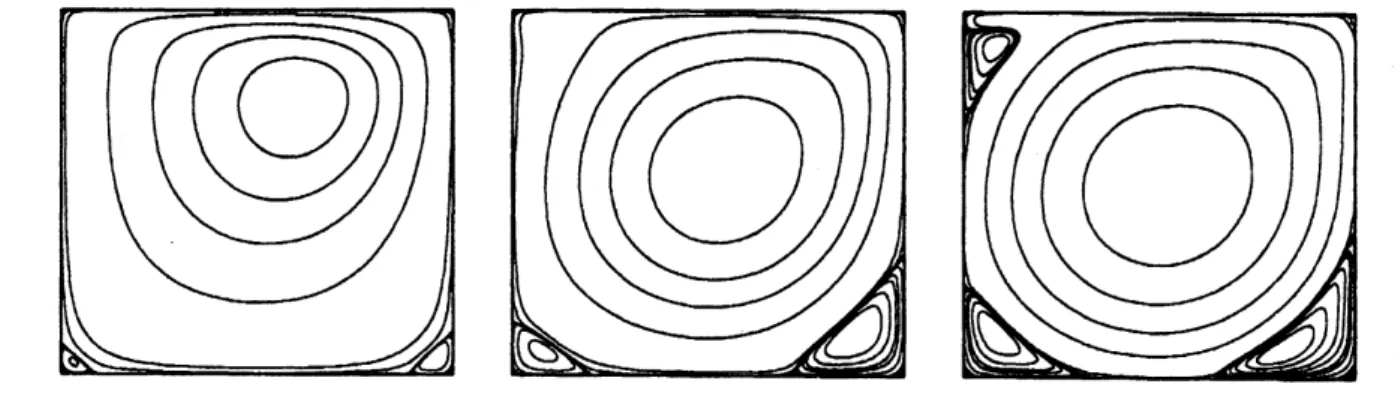
almost stationary. Figure 4 exhibits the streamlines,which show the flow patterns well ofthis problem.
Figure 4: Thestreamlinesof$Re=100$ (left), $Re=1$,
000
(center) and$Re=5$,000
(right)5
Conclusions
We have presented
a
$8ufficient$ condition for the scheme (2) to be stable. Ina
numericalexample
we
haveseen
the condition is reasonable. In another numericalexamplewe
havesolved successfully a cavity flow problem with Reynolds numbers up to 5,000.
References
[1] H. Notsu and M. Tabata, A second order characteristic finite element scheme for
the Navier-Stokes equations and
some
numerical simulations, Proceedings of the 20thSymposium
on
Computational Fluid Dynamics(2006), E5-3 (in Japanese).[2] H. Rui and M. Tabata, A second order characteristic finite element scheme for
convection-diffusion problems, Numer. Math., $92(2002):161- 177$
.
[3] A. H. Stroud, Approximate calculation of multiple integrals, Prentice-Hall,
1971.
[4] M. Tabata and S. Fujima, Robustness of
a
characteristic flnite element scheme ofsecond orderin timeincrement, In C. Groth andD. W. Zingg, editors, Computational
Fluid Dynamics 2004, Springer, 177-182,